


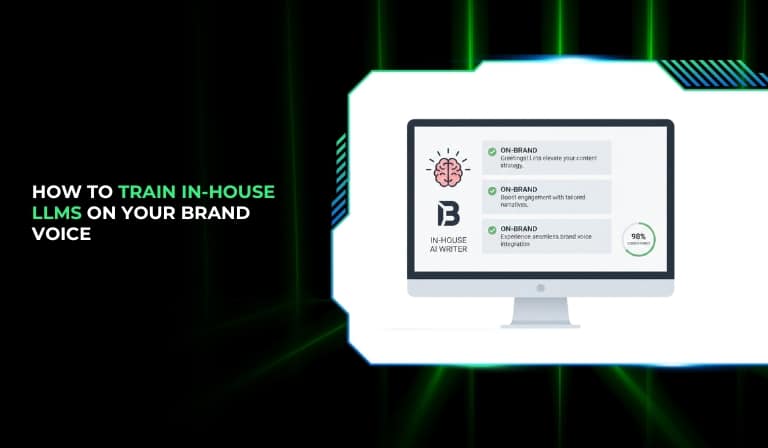
Training in-house large language models (LLMs) on your brand voice is no longer optional for teams that rely on AI to produce customer-facing content. Generic AI outputs may be grammatically correct, but they often miss tone, intent, and nuance that define how a brand communicates. This blog explains how organizations can systematically teach their in-house LLMs to write in a consistent, recognizable brand voice, using structured documentation, controlled datasets, governance workflows, and measurable evaluation methods. The goal is not creativity without limits, but reliability, consistency, and brand safety at scale.
Why Teaching Your Large Language Model (LLM) Your Brand Voice Matters
Brand voice is the personality behind every message a company publishes. When an LLM does not understand this voice, it produces content that feels inconsistent, off-tone, or misaligned with brand values. Teaching an LLM your brand voice ensures that AI-generated content supports long-term brand equity rather than weakening it.
- Brand voice consistency builds trust and recognition across channels
- Untrained LLMs tend to default to generic, neutral language
- Off-brand AI outputs can dilute positioning and confuse audiences
- Clear brand voice constraints reduce the risk of misleading or inappropriate messaging
Which Marketing Channels Gain the Most from Brand-Trained AI?
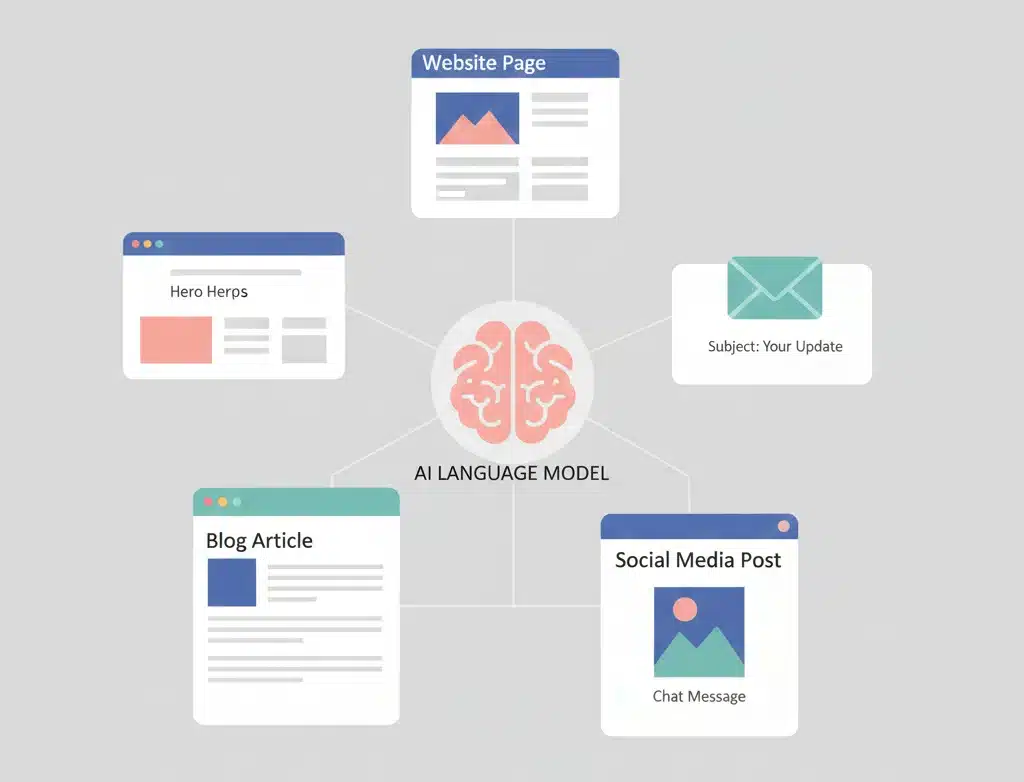
Some marketing channels benefit more than others when an LLM consistently applies brand voice rules. These channels rely heavily on repetition, scale, and consistency, making them ideal candidates for brand-trained AI.
- Website and landing page copy that must reflect brand positioning
- Blog content and long-form educational resources
- Email marketing campaigns and newsletters
- Social media posts that require a recognizable tone
- Customer support and helpdesk responses
- Internal communications and enablement materials
Implementation Workflow and Governance for In-house LLMs
Training an LLM on brand voice requires more than technical setup. A clear workflow and governance structure ensures that AI-generated content remains accurate, consistent, and accountable over time.
1. Define Your Workflow
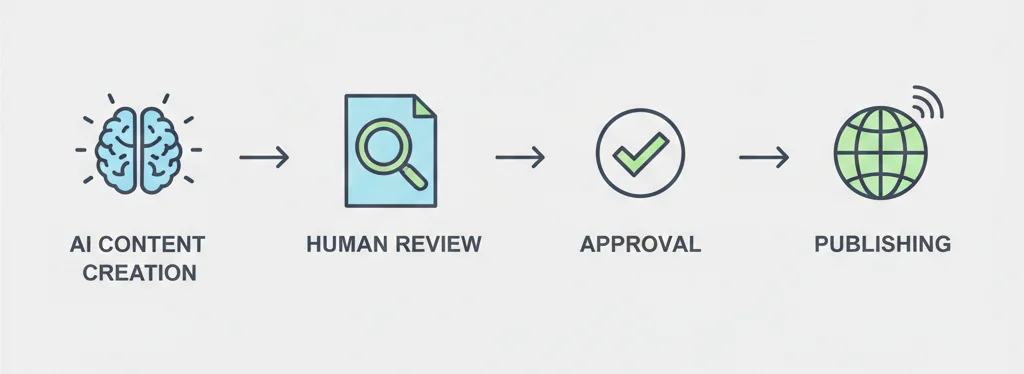
A defined workflow clarifies how AI-generated content moves from creation to publication. This includes identifying where AI is used, when human review is required, and how feedback is incorporated.
- Decide which content types AI can generate independently
- Establish human review checkpoints for sensitive content
- Define approval stages before content is published
2. Test Your Brand Voice Output
Testing helps identify whether the LLM produces content that truly matches your brand voice. This step compares AI outputs with established human-written benchmarks.
- Generate baseline outputs using brand prompts
- Compare tone, vocabulary, and structure against existing content
- Identify inconsistencies and tone drift early
3. Maintain Version Control and Documentation
Brand voice evolves over time. Without version control, updates to prompts, datasets, or models can introduce inconsistencies.
- Track changes to brand prompts and guidelines
- Document updates to datasets and training methods
- Maintain records of major brand voice revisions
4. Assign Team Roles and Responsibilities
Clear ownership prevents confusion and ensures accountability throughout the training and maintenance process.
- Marketing teams define brand voice rules and examples
- Engineering teams manage model behavior and deployment
- Legal or compliance teams review risk-sensitive outputs
Create a Brand Voice Document for Your LLM
A brand voice document translates subjective brand traits into clear, actionable rules an LLM can follow. This document becomes the foundation for prompts, training data, and evaluation.
1. Style Guidelines
Style guidelines describe how the brand communicates at a high level, including formality and structure.
- Level of formality or informality
- Conversational versus authoritative tone
2. Tone Adjectives
Tone adjectives define the emotional character of the brand across different situations.
- Primary tone attributes used most often
- Secondary tones for specific contexts
3. Keywords and Phrases
Approved keywords and phrases help reinforce brand identity and positioning.
- Preferred phrases and terminology
- Words or expressions to avoid
4. Grammar and Punctuation Rules
Grammar rules reduce stylistic inconsistency and improve readability.
- Sentence length preferences
- Use of punctuation, capitalization, and formatting
5. Vocabulary Rules and Sentence Structure
Vocabulary rules define how complex or simple the language should be.
- Technical versus plain-language usage
- Preference for active or passive voice
6. On-Tone Content Examples
Examples provide concrete guidance that abstract rules cannot fully capture.
- Examples of content that clearly matches brand voice
- Examples that demonstrate what to avoid
7. Contextual and Persona Prompts
Contextual prompts help the LLM adjust tone for different audiences without breaking brand rules.
- Audience-specific tone variations
- Persona-based writing guidance
8. Additional Context Fields
Additional context reinforces brand intent beyond tone and style.
- Brand values and mission
- Positioning and competitive stance
- Industry or regulatory constraints
Example: What a Brand Voice Document Looks Like
A typical brand voice document combines written rules, examples, and structured fields that can be easily reused in prompts or retrieval systems. It is concise enough for practical use but detailed enough to remove ambiguity.
Use AI to Create Brand Voice Guidelines
AI can accelerate the process of documenting brand voice by analyzing existing content and identifying patterns. However, AI should assist, not replace, human judgment in defining brand intent.
- AI can surface recurring tone and language patterns
- It helps summarize stylistic tendencies at scale
- Human review is required to validate and refine outputs
How to Use AI to Document Your Brand Voice
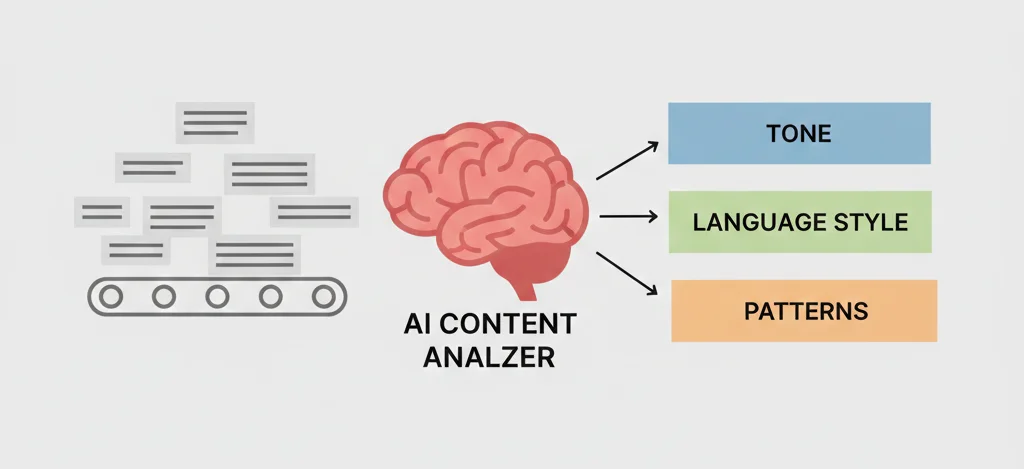
Using AI to document brand voice involves structured analysis rather than open-ended generation.
Step 1: Gather Your Best Content
Select content that best represents your brand at its strongest.
- High-performing blogs and articles
- Effective email campaigns
- Well-received landing pages
Step 2: Feed It to an LLM
Content should be clean, relevant, and properly formatted before analysis.
- Remove outdated or inconsistent messaging
- Organize content into manageable sections
Step 3: Ask the AI to Analyze Specific Elements
Targeted questions help AI extract useful insights.
- Tone and emotional cues
- Language complexity
- Repeated phrasing patterns
Step 4: Create Your Brand Voice Guide
Transform AI insights into explicit rules and examples that humans and models can follow.
What AI Can Detect vs What It Cannot
AI excels at identifying patterns but struggles with intent and strategy.
- AI detects repetition, tone trends, and structure
- AI cannot fully understand brand values or positioning nuance
What You’ll Need to Add Manually
Human input ensures the brand voice aligns with business goals.
- Strategic messaging priorities
- Ethical and cultural considerations
Refine Over Time
Brand voice documentation should be updated as campaigns, products, and audiences evolve.
Gather Data, Content, and Resources to Feed Your LLM
High-quality data determines how well an LLM learns brand voice.
Start with Your Brand Voice Document
The document acts as the central reference point for all training methods.
- Use it consistently in prompts and retrieval systems
- Update it alongside brand changes
Collect Your “Greatest Hits”
Only include content that reflects your best brand communication.
- High-performing marketing assets
- Content approved by senior stakeholders
Include Customer Interaction Examples
Real interactions help the model learn how brand voice applies in conversations.
- Support tickets and chat logs
- Sales or onboarding communications
Organize Your Dataset
Structured data improves reliability and evaluation.
- Label by channel, audience, and tone
- Separate examples by use case
Keep Your Dataset Updated
Outdated content can reintroduce old messaging patterns.
- Remove deprecated messaging
- Add new campaigns regularly
Choose How to Train Your LLM: Methods to Teach the Model
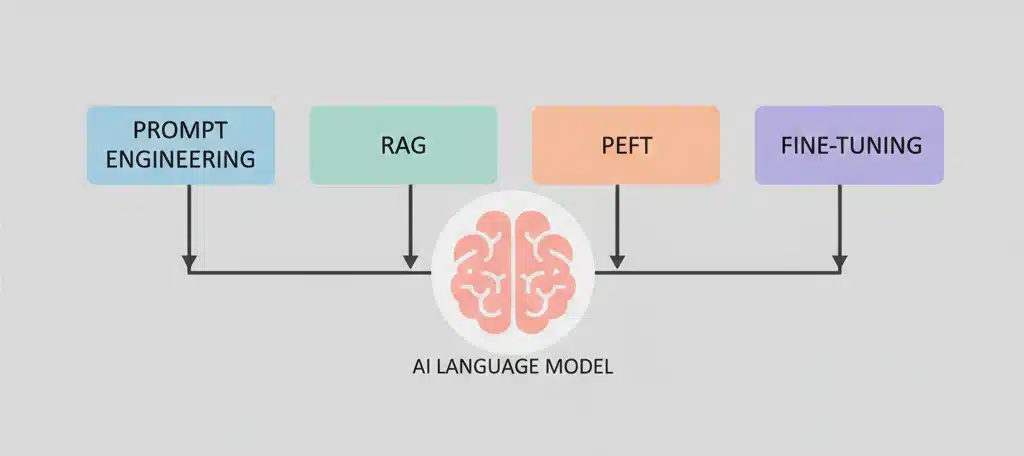
The Four Main In-house LLM Training Methods
Different training methods offer varying levels of control, cost, and complexity.
1. Prompt Engineering
Prompt engineering uses structured instructions to guide model output without changing model weights.
- Fast to implement
- Easy to update
- Limited long-term consistency
2. Retrieval-Augmented Generation (RAG)
RAG allows the model to reference brand documents at generation time.
- Keeps outputs aligned with approved guidelines
- Easier to maintain than fine-tuning
- Depends on high-quality retrieval
3. PEFT (Parameter-Efficient Fine-Tuning)
PEFT adjusts a small subset of model parameters to improve brand alignment.
- More consistent than prompts alone
- Lower cost than full fine-tuning
- Requires technical expertise
4. Full Fine-Tuning
Full fine-tuning retrains the model more extensively on brand data.
- Strong consistency for narrow use cases
- Higher cost and maintenance burden
- Risk of overfitting brand voice
Do Marketing Teams Need to Fine-Tune?
Most marketing teams achieve sufficient consistency using prompt engineering and RAG, reserving fine-tuning for specialized or high-volume use cases.
Measure and Refine Your Brand Voice Results
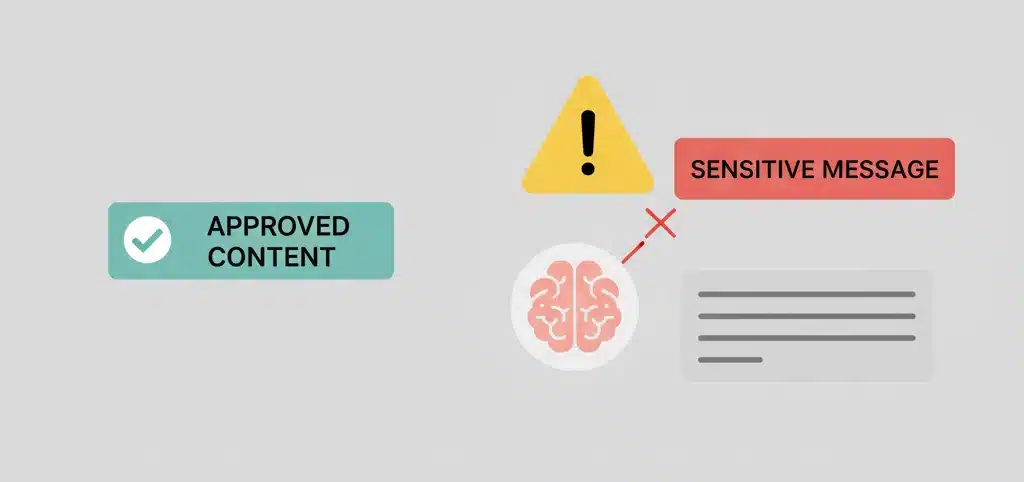
Evaluation ensures the LLM continues to meet brand standards.
Set Up a Review Process
Regular review cycles catch issues before they scale.
- Human-in-the-loop reviews
- Defined approval criteria
Measure Brand Voice Consistency
Consistency can be evaluated through structured review and comparison.
- Tone alignment checks
- Cross-channel consistency reviews
Test with Your Audience
Audience feedback validates whether AI outputs feel authentic.
- A/B testing AI versus human content
- Qualitative feedback analysis
Refine Your Prompts and Examples
Small improvements in prompts can significantly improve output quality.
- Clarify constraints
- Add better examples
Iterate Relentlessly
Brand voice training is an ongoing process, not a one-time task.
Trade-offs, Risks, and When Not to Use AI for Brand Voice
AI is not suitable for every communication scenario.
Real Risks to Consider
Uncontrolled AI outputs can introduce brand and compliance risks.
- Off-brand messaging
- Inaccurate or misleading statements
- Legal or regulatory exposure
Strategic Limitations: When AI Training Doesn’t Make Sense
Some messages require human judgment and emotional intelligence.
- Crisis communications
- Highly sensitive announcements
The Ongoing Maintenance Burden
Training and governance require continuous investment.
- Time spent updating datasets
- Ongoing review and evaluation
Conclusion
Training in-house LLMs on your brand voice is a strategic investment in consistency, trust, and scalability. By documenting brand voice clearly, selecting the right training methods, establishing governance workflows, and continuously evaluating outputs, organizations can ensure their AI systems act as reliable brand representatives. When implemented thoughtfully, brand-trained LLMs become an extension of the brand itself rather than a risk to manage.
FAQs
1. What does it mean to train an in-house LLM on brand voice?
Training an in-house LLM on brand voice means teaching the model to consistently follow your company’s tone, language style, vocabulary, and communication rules when generating content. This is done using structured brand voice documents, prompts, datasets, and governance workflows rather than relying on generic AI behavior.
2. Do I need to build my own LLM to train it on brand voice?
No. Most organizations do not need to build an LLM from scratch. Brand voice alignment can be achieved using prompt engineering, retrieval-augmented generation (RAG), or parameter-efficient fine-tuning on existing models, depending on the level of control required.
3. Is prompt engineering enough to maintain brand voice consistency?
Prompt engineering can work well for many marketing use cases, especially when combined with a strong brand voice document. However, prompts alone may struggle to maintain consistency at scale or across multiple teams, which is why some organizations add RAG or fine-tuning.
4. What is the difference between RAG and fine-tuning for brand voice?
RAG supplies brand-approved documents to the model at generation time, ensuring outputs follow current guidelines. Fine-tuning changes the model’s behavior by training it on brand-specific data. RAG is easier to update, while fine-tuning offers deeper consistency but higher cost and maintenance.
5. How much data is required to train an LLM on brand voice?
Brand voice training does not require massive datasets. A smaller, high-quality collection of approved content, including blogs, emails, website copy, and customer interactions, is often more effective than large volumes of inconsistent data.
6. Can AI accurately identify a brand’s voice on its own?
AI can detect patterns such as tone, sentence structure, and vocabulary usage, but it cannot fully understand brand intent, values, or strategic positioning. Human review is essential to validate and refine AI-generated brand voice guidelines.
7. How do you measure whether an LLM is following brand voice correctly?
Brand voice alignment is measured through structured reviews, comparison with approved examples, tone consistency checks, and audience feedback. Many teams use human-in-the-loop evaluations rather than relying solely on automated scoring.
8. How often should brand voice guidelines and prompts be updated?
Brand voice documentation and prompts should be reviewed regularly, especially after major campaigns, product launches, or messaging changes. Treat brand voice training as an ongoing process rather than a one-time setup.