


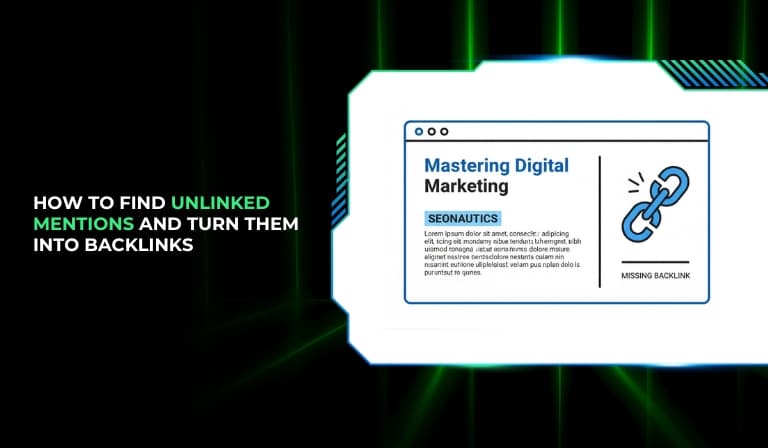
Unlinked mentions are one of the most overlooked opportunities in search engine optimization. Many websites, blogs, news portals, and industry publications mention brands, products, founders, or campaigns without adding a clickable link to the official website. These mentions show that your brand is already recognized, but without a backlink, you do not receive the full SEO value.
Unlike traditional link building, where you reach out to someone who has never mentioned your brand, reclaiming unlinked mentions focuses on websites that already know you. This makes the process warmer, more natural, and often more successful. In this guide, you will learn how to find unlinked mentions, qualify them, reach out professionally, and turn them into valuable backlinks that support your SEO growth.
What Are Unlinked Mentions?
Unlinked mentions are references to your brand, business, product, or team on another website where your name appears but no hyperlink is added to your official domain.
They can appear in different formats:
- Brand name mentions (for example, your company name written in a blog post)
- Product or service mentions
- Founder or team member mentions
- Campaign or event mentions
- Image usage without proper credit link
For example, if a blog says “XYZ Marketing offers digital services in India” but does not link to xyzmarketing.com, that is an unlinked mention. If the same sentence includes a clickable link to your site, that is a linked mention and counts as a backlink.
Why Unlinked Mentions Matter for SEO
Backlinks are one of the strongest ranking signals in search engine algorithms. When a reputable website links to your page, it signals credibility, authority, and relevance.
Unlinked mentions matter because:
- Backlinks help improve search engine rankings by passing authority.
- Links from relevant websites increase trust signals.
- They can drive referral traffic from users who click through.
- Visitors coming from contextual mentions often have higher intent.
- Converting mentions is easier than cold link building because awareness already exists.
When someone has already mentioned your brand, the barrier to adding a link is lower compared to asking for a brand-new placement.
Benefits of Converting Unlinked Mentions Into Backlinks
Turning unlinked mentions into backlinks provides several strategic advantages:
- Higher success rate because the brand is already referenced.
- Faster turnaround since content is already published.
- Opportunity to build relationships with editors and writers.
- Improved brand visibility through proper attribution.
- Increase in domain authority when links come from quality domains.
- Stronger E-E-A-T signals through third-party recognition.
Because the mention already exists, you are not asking for content creation. You are simply requesting proper credit.
Step-by-Step Process to Find Unlinked Mentions
Step 1: Search Using Google Operators
Google search operators help you find brand mentions manually.
You can use:
- “Brand Name” -site:yourwebsite.com
- “Founder Name” -site:yourwebsite.com
- “Product Name” -site:yourwebsite.com
This method removes your own website results and shows pages where your brand is mentioned elsewhere. After identifying pages, check whether they include a link.
Step 2: Use Google Alerts
Google Alerts allows you to monitor new mentions automatically.
You can:
- Set alerts for your brand name.
- Include variations of your brand name.
- Track product names and key team members.
- Choose frequency and sources (news, blogs, web).
When you receive an alert, review the page and check whether the mention includes a link.
Step 3: Use SEO Tools
Professional SEO tools help scale the process.
You can use:
- Ahrefs Content Explorer to search brand mentions.
- SEMrush Brand Monitoring to track mentions.
- Moz tools for monitoring links.
- Screaming Frog to audit internal linking structures.
These tools allow you to filter pages that mention your brand but do not link to your domain.
Step 4: Social Listening Tools
Social listening platforms track brand mentions across web and social channels.
Common platforms include:
- Mention
- Brand24
- BuzzSumo
You can filter for web mentions instead of social media mentions to focus on backlink opportunities.
Step 5: Reverse Image Search
If your brand images, infographics, or product visuals are used without credit, you can find them using:
- Google Image Search
- TinEye
Upload your image or paste the image URL. If a website uses your image without linking to you, you can request attribution.
How to Qualify Unlinked Mentions
Not every mention should become a backlink. You must evaluate quality first.
Check the following:
- Domain authority or domain rating
- Relevance to your industry
- Estimated traffic potential
- Spam score indicators
- Whether the page is indexed in Google
- Whether they link to similar businesses
If a website is low quality or spammy, it may not be beneficial to request a link.
How to Turn Unlinked Mentions Into Backlinks
Step 1: Find the Right Contact Person
Reaching the correct contact increases your success rate.
You can look for:
- The article author
- Content manager
- Editor
- Website owner
You can use LinkedIn to identify team members and tools like Hunter.io to find email addresses associated with the domain.
Step 2: Craft a Winning Outreach Email
Your email should be simple, polite, and direct.
Focus on:
- Personalization using the author’s name.
- Appreciation for mentioning your brand.
- Clear explanation of where the mention appears.
- Request to add a link to a specific URL.
- Keeping the message short and respectful.
Sample Outreach Email Template
Subject: Quick Thank You for Mentioning [Brand Name]
Hi [Name],
I recently came across your article titled “[Article Title]” and noticed you mentioned [Brand Name]. Thank you for including us.
Would it be possible to add a link to our official website (www.yoursite.com) so readers can easily find more details?
I appreciate your time and great work.
Best regards, [Your Name]
Follow-up Email Template
Subject: Gentle Follow-Up on Brand Mention
Hi [Name],
Just following up on my previous message regarding the mention of [Brand Name] in your article.
If possible, we would appreciate adding a link to help readers access accurate information.
Thank you again for your time.
Best, [Your Name]
Outreach Best Practices
Effective outreach requires professionalism and consistency.
Key best practices:
- Send emails during working hours in the recipient’s timezone.
- Avoid sounding demanding or entitled.
- Keep communication clear and polite.
- Track outreach in a spreadsheet or CRM.
- Follow up once if there is no response.
Respectful communication improves long-term relationship building.
Automation vs Manual Outreach
Automation can help scale outreach, but it must be used carefully.
Consider:
- Automation tools can send bulk emails.
- Personalized manual outreach increases response rates.
- Over-automation can appear spammy.
- A hybrid approach works best for scaling while maintaining personalization.
- Use outreach tools for tracking, not for sending generic messages.
Quality matters more than quantity.
Measuring Success
Tracking performance helps evaluate ROI.
Monitor:
- Number of backlinks acquired.
- Changes in keyword rankings.
- Referral traffic in Google Analytics.
- Conversions from referral traffic.
- Monthly reporting to track growth trends.
Consistent tracking shows whether your strategy is effective.
Advanced Strategies
Once you master the basics, you can scale further.
Advanced approaches include:
- Setting up ongoing brand monitoring systems.
- Finding competitor unlinked mentions and pitching your brand.
- Running PR campaigns to generate mentions.
- Turning podcast interviews into backlinks.
- Reclaiming broken mentions where links were removed.
These methods turn brand awareness into measurable SEO value.
Tools Comparison Table (Quick Overview)
| Tool | Best For | Free/Paid | Ease of Use |
| Google Alerts | Basic monitoring | Free | Easy |
| Ahrefs | Advanced mention discovery | Paid | Moderate |
| SEMrush | Brand monitoring | Paid | Moderate |
| Brand24 | Web and social monitoring | Paid | Easy |
| BuzzSumo | Content monitoring | Paid | Easy |
Realistic Timeline & Expected Results
Converting unlinked mentions does not produce instant results. Response times vary depending on the website and editor availability.
Generally:
- Outreach response rates vary.
- Some links are added within days.
- Others require follow-ups.
- Monthly link gains depend on brand visibility.
- ROI improves as brand mentions increase over time.
Consistency produces steady growth rather than overnight success.
FAQs
How long does it take to convert mentions into backlinks?
It depends on response time from website owners. Some respond quickly, while others may take weeks.
What if the site refuses to add a link?
You should respect their decision and move on. Focus on other opportunities.
Should I offer something in return?
In most cases, simple attribution is enough. Offering payment may violate search engine guidelines.
Is this white-hat SEO?
Yes. You are requesting proper attribution for an existing mention, which aligns with ethical SEO practices.
How often should I check for mentions?
Monitoring monthly is common, but brands with high visibility may track mentions weekly.
Conclusion
Unlinked mentions are one of the most practical and efficient link-building strategies available. Because your brand is already recognized, the conversion barrier is lower than traditional outreach. By monitoring mentions consistently, qualifying opportunities carefully, and sending professional outreach emails, you can transform brand awareness into measurable SEO authority. Over time, this strategy strengthens your backlink profile, increases search visibility, and builds stronger relationships within your industry.