


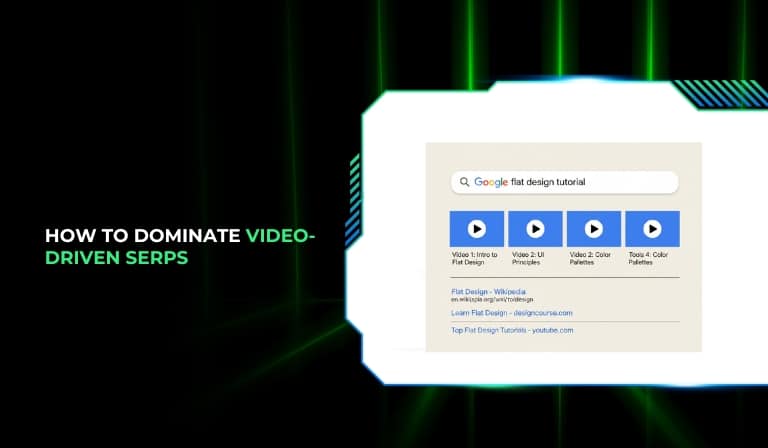
Search is no longer just about blue links. Over the past few years, Google has increasingly displayed video carousels, featured clips, and AI-generated summaries directly on the results page. In many industries, videos appear above traditional organic listings, especially for tutorials, product comparisons, and “how-to” searches.

This shift is driven by clear factors: users prefer visual explanations, mobile usage continues to grow, and Google’s AI systems are now capable of understanding spoken words inside videos. As a result, search results have become more visual, more interactive, and more multimedia-focused.
In this guide, you will learn how video-driven SERPs work, what type of videos Google tends to favor, and how to build a structured strategy that improves your visibility across both YouTube and on-site video content.
The Rise of Video-First SERPs
Video-first SERPs did not appear overnight. They evolved gradually as user behavior and search technology advanced.
Traditional Video SERPs (Then)
Earlier versions of video results were limited and predictable. They typically included:
- A small video thumbnail next to a blue link
- A basic video carousel appearing lower on the page
- Heavy dependence on YouTube-hosted content
- Minimal segmentation inside videos
Video was present, but it was not dominant. Text content usually occupied the most visible positions.
Evolving Video SERPs (Now)
Today, video often appears at the top of search results. The evolution includes:
- AI Overviews referencing video content for answers
- Prominent video carousels near the top of the page
- Key moments that jump directly to specific timestamps
- Featured clips extracted from longer videos
- Increased visibility of short-form content on mobile
Search engines now treat videos as primary answers, not supplementary media.
The Anatomy of a Video-Driven SERP
To dominate video-driven SERPs, you must understand how they are structured and what components influence visibility.
Video Carousels
Video carousels are horizontal lists of videos displayed prominently in search results. They typically appear for tutorial-based or informational queries.
Key characteristics include:
- Thumbnail prominence
- Title relevance to the search query
- Strong engagement signals
- Clear topic alignment
Optimizing titles and thumbnails significantly impacts click-through rates in these carousels.
Featured Clips
Featured clips highlight a specific section of a video that directly answers a user’s question. Instead of showing the entire video, Google may link to a precise timestamp.
To increase eligibility:
- Structure videos around clear question-answer segments
- Verbally state the question and answer clearly
- Use chapters and timestamps
- Provide strong contextual relevance
Featured clips reward structured, direct content.
Key Moments
Key moments are timestamped sections within a video that Google displays directly in search results. They allow users to jump to specific segments.
To optimize for key moments:
- Add detailed chapters with descriptive labels
- Ensure transcripts reflect the structure
- Maintain semantic clarity in spoken content
This helps search engines understand the logical flow of the video.
AI-Generated Video Summaries
AI systems can analyze spoken words and generate contextual summaries. These summaries rely heavily on transcripts and semantic clarity.
To improve AI comprehension:
- Use clear, structured language
- Avoid unnecessary filler content
- Reinforce primary keywords naturally
- Maintain topic consistency
AI interpretation favors clarity and relevance.
Why Video-Driven SERPs Are Becoming So Important
Video visibility is increasing due to measurable shifts in user and platform behavior:
- Users prefer visual explanations for complex topics
- Mobile-first browsing encourages video consumption
- Short-form content has increased engagement rates
- AI systems can now interpret multimodal content
- Video thumbnails often attract higher click-through rates than plain text
For many competitive keywords, video now competes directly with traditional organic listings.
What Type of Videos Does Google Prefer?
Google tends to favor videos that clearly satisfy search intent.
Common high-performing formats include:
- Informational tutorials that explain processes step by step
- Product demonstrations showing real usage
- Comparison videos evaluating alternatives
- FAQ-style videos answering direct questions
- Evergreen content that remains relevant over time
Videos that provide structured answers aligned with user intent generally perform better than purely promotional content.
What’s Best for Video SEO? YouTube, TikTok, or Other Channels?
Different platforms serve different purposes. Understanding their roles helps you allocate resources effectively.
Why YouTube Dominates Video SEO
YouTube benefits from strong integration with Google’s indexing systems.
Key advantages include:
- Advanced search functionality
- Strong metadata infrastructure
- Automatic transcript generation
- High domain authority
- Deep integration into Google’s SERPs
Because YouTube is optimized for search intent, it often dominates video rankings.
TikTok & Short-Form Discoverability
TikTok and similar platforms excel at social discovery rather than traditional search visibility.
They are effective for:
- Trend-based exposure
- Brand awareness
- Short attention-span engagement
However, their integration into Google’s SERPs is less consistent compared to YouTube.
On-Site Video Hosting
Hosting videos on your own website offers control but requires technical optimization.
Benefits include:
- Direct traffic ownership
- Enhanced brand authority
- Better integration with your content ecosystem
Challenges include:
- Need for schema markup
- Video sitemaps
- Hosting performance management
A hybrid strategy—publishing on YouTube while embedding optimized videos on your website—often provides balanced visibility.
8 Powerful Tips to Dominate Video SEO in 2026
1. Structure Your Videos for Discovery
Search engines and users both favor organized content.
Best practices include:
- Strong hook within the first 10–15 seconds
- Clear introduction of the topic
- Logical segmentation
- Direct answers early in the video
Clear structure improves retention and indexing.
2. Metadata Optimization
Metadata helps search engines understand video relevance.
Key elements include:
- Keyword-aligned titles
- Descriptive summaries
- Strategic use of tags
- Clear, structured chapters
Metadata must reflect actual content accurately.
3. Writing Keyword-Rich Transcripts & Captions
Transcripts provide text-based signals for search engines.
Benefits include:
- Improved semantic understanding
- Better accessibility
- Enhanced AI interpretation
- Greater eligibility for featured segments
Natural keyword inclusion is more effective than forced repetition.
4. Mastering Video Schema Markup
Schema markup provides structured data about video content.
Important elements include:
- VideoObject schema
- Upload date
- Duration
- Thumbnail URL
- Description
- Clip markup for key moments
Structured data increases the likelihood of rich results.
5. Optimize for AI Overviews & Multimodal Search
AI systems extract information from spoken content.
To optimize:
- Use question-based headings in scripts
- Provide concise, direct answers
- Maintain semantic clarity
- Avoid vague explanations
Clear structure improves AI-driven extraction.
6. Enhance Engagement Signals
Engagement metrics influence platform visibility.
Important signals include:
- Watch time
- Audience retention
- Click-through rate
- Comments and interactions
Higher engagement typically correlates with stronger rankings.
7. YouTube SEO vs On-Site Video SEO
YouTube optimization focuses on platform engagement, while on-site SEO focuses on technical signals.
Comparison factors include:
- Hosting control
- Traffic ownership
- Search visibility
- Monetization strategy
Balancing both approaches often produces the strongest results.
8. Measuring & Scaling Video Visibility
Tracking performance ensures continuous improvement.
Key measurement strategies include:
- Monitoring impressions in Google Search Console
- Reviewing YouTube Analytics metrics
- Testing thumbnails and titles
- Expanding successful topic clusters
Data-driven scaling increases long-term visibility.
How to Increase Your Chances of Appearing as Rich Snippets
Rich snippets enhance visibility beyond standard listings.
To increase eligibility:
- Implement accurate schema markup
- Add FAQ sections aligned with video content
- Include timestamp chapters
- Maintain high topical authority
- Ensure fast-loading pages
Structured and technically sound implementation improves eligibility.
Building a Complete Content Strategy for Video-Driven SERPs
A structured content strategy ensures consistency.
Essential components include:
- Identifying video-intent keywords
- Auditing SERPs for video presence
- Creating topic clusters
- Repurposing long-form content into short clips
- Maintaining consistent publishing schedules
Strategic planning is more effective than random uploads.
Advanced Domination Tactics for 2026
Advanced strategies focus on authority building.
Key tactics include:
- Developing video-rich pillar pages
- Using short-form clips to drive long-form traffic
- Strengthening internal linking
- Building backlinks to video pages
- Updating older videos with improved metadata
Optimization is an ongoing process.
FAQs
How long should a video be to rank on Google?
There is no fixed ideal length. The optimal duration depends on search intent and content depth. Videos should be long enough to answer the query thoroughly while maintaining strong retention.
Does Google rank YouTube videos higher than website videos?
YouTube videos often rank prominently due to strong indexing and authority. However, properly optimized on-site videos with structured data can also rank effectively.
Are Shorts good for SEO?
Short-form videos can increase visibility and brand exposure. Their impact depends on intent alignment and integration within a broader strategy.
How long does it take for a video to rank?
Ranking timelines vary based on competition, authority, and engagement. Consistency and optimization improve long-term visibility.
Can AI-generated transcripts help rankings?*
Accurate transcripts improve semantic understanding. However, they must be reviewed for accuracy to ensure clarity and relevance.
Conclusion
Video-driven SERPs are no longer a future trend. They are already shaping how users discover information. Search engines increasingly prioritize structured, engaging, and semantically clear video content.
Dominating these results requires a combination of strategic planning, technical implementation, engagement optimization, and continuous measurement. By focusing on structure, metadata, schema, and audience retention, you position your content for stronger visibility in evolving search environments.
Video SEO is not about uploading content and hoping it ranks. It is about building a structured system that aligns with user intent, search technology, and measurable performance signals.