


So you’re standing there with two tabs open, one Flipkart, one Amazon, same product, and the prices don’t match, the delivery dates don’t match, and honestly you’re not even sure which one actually has the better deal once you count the coupons and bank offers. That confusion is basically the entire reason this comparison exists. Millions of people in India do this exact thing every single day, and most of them just pick whichever app they opened first out of habit rather than doing any real comparison.

Flipkart vs Amazon isn’t some abstract debate for tech blogs. It’s a real, everyday decision that affects your wallet, your time, and if you’re a seller, your entire business. Between the two of them, these platforms handle a massive chunk of India’s online retail, and they’ve basically trained an entire generation of shoppers to expect fast delivery, easy returns, and constant sales. But they are not the same company wearing different colors. Flipkart grew up Indian, understands Bharat in a way that took Amazon years to catch up on, and Amazon brought global scale, Prime, and a logistics machine that’s hard to compete with. Neither one is universally “better” — that’s the honest answer before we even get into details.
This guide is for three kinds of people. First, regular shoppers who want to know where to get the better deal on their next phone or festive season haul. Second, people thinking about starting a business and trying to figure out whether to sell on Amazon, Flipkart, or both. Third, small business owners and D2C brands who already sell somewhere and are wondering if they’re leaving money on the table by ignoring the other platform. Whichever camp you’re in, stick around, because we’re going deep into pricing, delivery, seller fees, customer support, and pretty much everything else that actually matters.
What You Will Learn in This Guide
- How Flipkart and Amazon actually compare on pricing, not just on paper but in real shopping situations
- Which platform delivers faster in your city, whether that’s a metro or a small town
- Whether Flipkart Plus or Amazon Prime gives you more value for the money
- What it really costs to sell on each platform, including hidden fees sellers don’t talk about enough
- Which one wins for electronics, fashion, and grocery shopping specifically
- How customer service and return policies stack up when something actually goes wrong
- Where each platform is heading in the next few years and what that means for you
Quick verdict before we dive in: if you’re chasing the lowest price and love festival sales, Flipkart usually edges ahead, especially on electronics and fashion through Myntra. If you want a wider product range, a stronger membership program, and more consistent delivery speed across the country, Amazon tends to win. For sellers, it genuinely depends on your product category and how much competition you’re willing to deal with. Now let’s actually break this down properly.
Flipkart vs Amazon at a Glance (Comparison Table)
Before we go section by section, here’s a snapshot table that gives you the full picture in one look. This is the kind of table you’d want to screenshot and refer back to later.
| Feature | Flipkart | Amazon |
|---|---|---|
| Founded | 2007, Bengaluru | 1994 (Amazon.com), 2013 (Amazon India) |
| Parent Company | Walmart (majority stake) | Amazon.com Inc. |
| Headquarters | Bengaluru, India | Seattle, USA (India HQ in Bengaluru) |
| Countries Available | Primarily India | 20+ countries globally |
| Product Categories | Electronics, fashion, home, groceries, travel | Electronics, fashion, home, groceries, digital media, cloud services |
| Sellers | Lakhs of registered sellers across India | Lakhs of sellers, strong FBA network |
| Delivery Network | Ekart logistics, expanding quick commerce | Amazon logistics, extensive fulfillment centers |
| Membership Program | Flipkart Plus (free, points-based) | Amazon Prime (paid subscription) |
| Payment Options | UPI, cards, net banking, EMI, COD, wallets | UPI, cards, net banking, EMI, COD, Amazon Pay |
| Customer Support | Chat, call, email support | Chat, call, email, strong self-service tools |
| Return Policy | Category-based, generally 7-10 days | Category-based, generally 7-10 days, sometimes longer for Prime |
| Grocery | Flipkart Minutes | Amazon Fresh |
| Digital Services | Limited (Cleartrip travel) | Prime Video, Prime Music, Kindle, Audible |
| Marketplace Model | Third-party marketplace | Third-party marketplace + some direct retail |
| Best For | Value shopping, fashion, festive deals | Wide catalog, faster nationwide delivery, digital bundle |
This table alone probably answers half the questions people search Flipkart vs Amazon for. But there’s a lot of nuance buried in each row, so let’s unpack it properly.
What Is Flipkart?

Flipkart started life as an Indian online bookstore and turned into the country’s biggest homegrown eCommerce name. It’s headquartered in Bengaluru and has grown into a full-blown retail ecosystem covering everything from smartphones to sarees to instant grocery delivery. What makes Flipkart interesting is that it was built by Indians, for Indian buying habits, long before global players fully understood what that meant.
History
Flipkart launched in 2007, right when online shopping in India was basically nonexistent. Most people didn’t trust putting their card details online, and cash on delivery wasn’t even standard yet. Flipkart pushed COD as a trust-building move, and honestly, that single decision changed how India shops online. It made the platform accessible to people who’d never buy anything sight unseen from a stranger on the internet.
Founders
Sachin Bansal and Binny Bansal, two IIT Delhi graduates who used to work at Amazon, started Flipkart out of a small apartment in Bengaluru. There’s something almost poetic about two ex-Amazon employees building the company that would become Amazon’s biggest rival in India. They didn’t have massive funding on day one, just a bet that Indians would eventually shop online if someone made it easy and trustworthy enough.
Growth Journey
From selling books to becoming a multi-category giant, Flipkart’s growth wasn’t a straight line. It went through funding rounds, aggressive expansion, price wars, and had to fight off international competition arriving with deep pockets. Along the way, it acquired Myntra, launched its own payment systems, and built one of India’s largest private logistics networks called Ekart.
Ownership (Walmart)
In 2018, Walmart bought a majority stake in Flipkart for around 16 billion dollars, one of the largest eCommerce acquisitions in the world at that point. This gave Flipkart access to Walmart’s global supply chain expertise and deep pockets, while letting it keep its Indian identity and leadership largely intact. It wasn’t a full American takeover in spirit, more like a partnership with serious financial backing.
Current Market Position
Flipkart remains one of the top two players in Indian eCommerce, competing neck and neck with Amazon for market share depending on the category and season. During festive sales like Big Billion Days, Flipkart routinely pulls in massive traffic and sales numbers that rival or beat Amazon’s own festival events.
Major Business Verticals
Flipkart Marketplace
This is the core shopping platform where most people buy electronics, home goods, fashion, and daily essentials. It’s a third-party marketplace, meaning most products are sold by independent sellers rather than Flipkart itself, though Flipkart manages logistics, quality checks, and customer service standards across the board.
Myntra
Myntra is Flipkart’s fashion arm, and honestly, it’s the reason Flipkart dominates fashion eCommerce in India. Acquired years ago, Myntra runs semi-independently with its own app and brand identity, but it benefits from Flipkart’s backend infrastructure and combined seller network.
Shopsy
Shopsy is Flipkart’s answer to ultra-budget shopping, targeting price-sensitive buyers in smaller towns who want the cheapest possible version of a product without worrying too much about premium branding. It’s a social-commerce-style app that lets everyday people resell products and earn a margin, which is a clever way to reach Tier-3 and Tier-4 markets.
Flipkart Minutes
This is Flipkart’s quick commerce play, delivering groceries and daily essentials in under 15-20 minutes in select cities. It’s Flipkart’s direct answer to the instant delivery boom that changed how urban India buys everyday items.
Cleartrip
Flipkart also owns Cleartrip, a travel booking platform for flights and hotels. It’s a smaller part of the business but shows Flipkart’s ambition to become a one-stop platform beyond just physical products.
Major Milestones
Flipkart’s story includes crossing a billion dollars in gross merchandise value early on, becoming the first Indian unicorn in eCommerce, acquiring Myntra and Jabong, surviving Amazon’s aggressive India entry, and eventually becoming part of the Walmart family while still operating like a homegrown company on the surface.
What Is Amazon?
Amazon needs almost no introduction globally, but Amazon India is its own beast, built specifically to compete in one of the world’s most price-sensitive and logistically complex markets. It’s not just a shopping site here, it’s an entire ecosystem covering entertainment, cloud computing, and daily deliveries.
History
Amazon started in 1994 as an online bookstore run out of a garage in Seattle by Jeff Bezos. It grew into “the everything store” over the next couple of decades, expanding into nearly every product category imaginable and eventually into cloud computing, which became one of its biggest profit engines.
Founder
Jeff Bezos built Amazon from a simple idea: sell books online because they’re easy to catalog and ship. That idea snowballed into the largest online retailer on the planet, and Bezos stepped back from day-to-day CEO duties in 2021, handing the reins to Andy Jassy.
Global Expansion
Amazon expanded aggressively across North America, Europe, and Asia, adapting its model city by city and country by country. Entering markets like India meant rethinking assumptions Amazon had baked in from its US operations, because Indian shoppers behave very differently from American ones.
Amazon India
Amazon India launched in 2013, years after Flipkart already had a head start and loyal customer base. It came in with deep pockets and aggressive discounting, forcing Flipkart and other local players to fight hard just to hold their ground. Amazon India has since built massive fulfillment infrastructure and localized its offerings heavily, including cash on delivery, regional language support, and India-specific payment options.
Business Segments
Marketplace
The core Amazon India shopping experience where you buy everything from phone cases to refrigerators, sold by a mix of Amazon itself and third-party sellers using the marketplace model.
Prime
Amazon Prime bundles free fast delivery, video streaming, music, and other perks into a single paid subscription. It’s arguably Amazon’s smartest business move because it locks customers into the ecosystem across multiple services at once.
Fresh
Amazon Fresh handles grocery and daily essential deliveries, competing directly with Flipkart Minutes and other quick commerce apps like Blinkit and Zepto.
MiniTV (historical context if relevant)
Amazon MiniTV was Amazon’s ad-supported video app aimed at giving Indian users free short-form and long-form content inside the shopping app itself, though its role has shifted over time as Amazon’s content strategy evolved.
Pharmacy
Amazon Pharmacy lets users order medicines and health products online, a category that grew significantly after people got comfortable ordering medical supplies digitally.
Pay
Amazon Pay functions as a digital wallet and payment gateway, letting users pay bills, recharge phones, and make purchases across Amazon and partner platforms.
Audible
Audible is Amazon’s audiobook subscription service, giving Prime and Audible subscribers access to a huge audiobook library, which ties nicely into Amazon’s broader content ecosystem.
Kindle
Kindle is Amazon’s e-reader and digital book platform, letting users buy and read ebooks, another piece of Amazon’s content-and-commerce combo that Flipkart simply doesn’t have an equivalent for.
AWS (briefly)
Amazon Web Services is Amazon’s cloud computing division, and while it’s not something shoppers interact with directly, it’s worth knowing that AWS generates a massive share of Amazon’s global profit and funds a lot of the retail side’s aggressive pricing and expansion.
Current Market Position
Amazon India remains one of the top two eCommerce players, competing head to head with Flipkart across nearly every category. It tends to have an edge in electronics and international brand availability, while Flipkart often edges ahead in fashion and hyper-local pricing strategies.
Flipkart vs Amazon: Feature-by-Feature Comparison
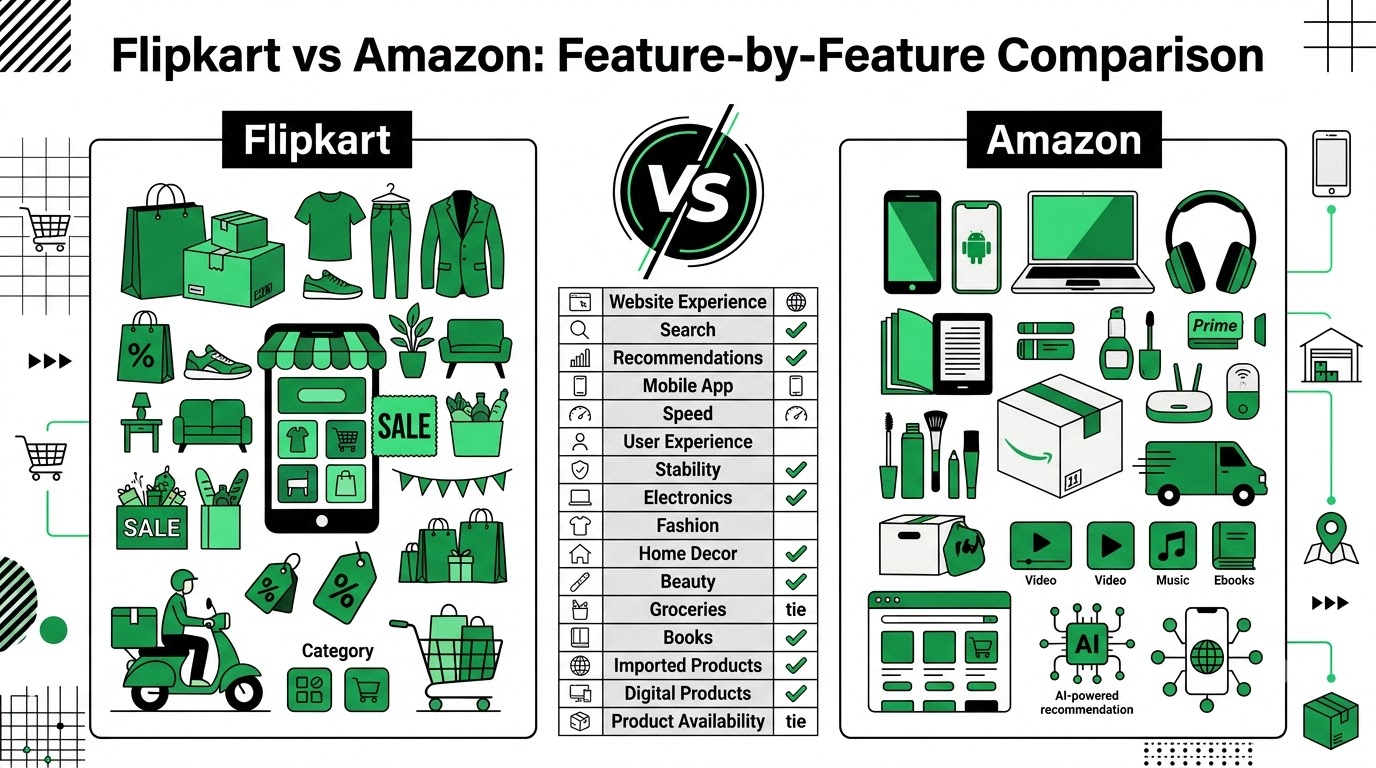
Now that you know who these two players are, let’s get into the actual comparison, feature by feature, because this is where the real decision-making happens.
Website Experience
Homepage
Flipkart’s homepage leans heavily into deals, banners, and category shortcuts, and it feels distinctly Indian in its visual style, bright colors and bold typography everywhere. Amazon’s homepage is cleaner and more minimal, prioritizing personalized recommendations based on your browsing history over blanket promotional banners.
Navigation
Flipkart organizes categories in a way that feels intuitive for Indian shoppers, grouping things like festive collections and regional preferences prominently. Amazon’s navigation is more standardized globally, which means it’s consistent but sometimes feels less tailored to local shopping moments like specific festivals.
Product Discovery
Amazon generally edges ahead here because of its recommendation engine, built on years of global data and refined algorithms. Flipkart has improved a lot but still occasionally shows less relevant suggestions compared to Amazon’s uncanny ability to know what you’ll want next.
Search Function
Both platforms have decent search, but Amazon’s search filters and autocomplete tend to feel slightly faster and more accurate, especially for specific product model numbers. Flipkart’s search sometimes struggles with very specific queries, showing broader results than what you actually typed.
Filters
Flipkart offers solid filtering options for price, brand, ratings, and specifications, and honestly it’s improved a ton over the years. Amazon’s filters are just as robust, with the added benefit of “Amazon’s Choice” and similar badges that help you cut through decision paralysis faster.
Recommendations
Amazon wins this one clearly. Its recommendation system pulls from years of shopping data across every category, and it genuinely feels like it knows your taste better than Flipkart does most of the time.
Mobile Experience
Both apps are built mobile-first because, let’s be honest, most Indian shoppers browse and buy on their phones, not desktops. Flipkart’s app feels snappy and colorful, Amazon’s feels efficient and no-nonsense.
Winner: Amazon, mainly because of stronger search and recommendation tech, though Flipkart isn’t far behind and wins some people over with its more vibrant, India-tailored design.
Mobile App
Speed
Both apps load fast on decent networks, but Amazon’s app tends to handle low-bandwidth situations a bit better, which matters a lot in Tier-2 and Tier-3 cities where connectivity isn’t always great.
Interface
Flipkart’s interface feels more colorful and promotional, packed with deal banners. Amazon’s interface is cleaner, more functional, less flashy, which some users prefer and others find a bit boring.
User Experience
Flipkart makes browsing feel like an event, especially during sales, while Amazon makes browsing feel efficient and transactional. Depends entirely on what kind of shopper you are.
Stability
Both apps are generally stable, though Flipkart has had occasional hiccups during massive sale events like Big Billion Days when traffic spikes hard. Amazon’s infrastructure, built on AWS itself, tends to handle traffic surges a bit more gracefully.
Features
Amazon’s app bundles in Prime Video, Amazon Pay, and other services directly, giving it a more all-in-one feel. Flipkart’s app focuses more purely on shopping, with Myntra and Shopsy kept as separate apps.
Winner: Slight edge to Amazon for stability during high traffic, but Flipkart’s shopping-focused approach appeals to people who don’t want a cluttered super-app experience.
Product Range
Electronics
Both platforms carry all the major smartphone, laptop, and appliance brands, but Amazon often gets slightly earlier access to certain global brand launches and imported electronics that Flipkart doesn’t stock as quickly.
Fashion
Flipkart dominates here through Myntra, which has partnerships with hundreds of fashion brands, both Indian and international, that Amazon simply doesn’t match in depth or curation.
Furniture
Both platforms sell furniture through third-party sellers, and honestly the experience is fairly similar, though Amazon’s furniture category feels slightly more curated with better product photography standards.
Home Decor
Flipkart has invested heavily in home decor categories, especially around festive seasons like Diwali, offering localized decor items that Amazon’s catalog doesn’t always prioritize as heavily.
Beauty
Amazon has built a strong beauty vertical with authorized brand stores for international cosmetics brands, giving buyers more confidence about authenticity compared to some third-party beauty listings on Flipkart.
Groceries
This is closer to a tie, with Amazon Fresh and Flipkart Minutes both competing for the same daily essentials market, though coverage varies heavily by city for both.
Books
Amazon still feels more natural for books, partly because that’s literally where the company started, and Kindle integration makes ebook buying seamless in a way Flipkart doesn’t offer.
Toys
Both platforms carry a wide range of toys from global and local brands, and pricing tends to be competitive on both sides depending on ongoing sales.
Sports
Amazon and Flipkart both carry sports equipment and apparel, with Decathlon and other specialized sellers available on both, so this category doesn’t show a huge gap either way.
Luxury
Amazon has pushed harder into premium and luxury categories with dedicated brand stores, while Flipkart’s luxury presence is comparatively smaller and less structured.
Imported Products
Amazon’s global backend makes importing international products, especially electronics and niche gadgets, noticeably smoother than what Flipkart currently offers.
Digital Products
Amazon wins hands down here because of Kindle, Audible, and Prime Video bundled together, something Flipkart hasn’t built an equivalent ecosystem for.
Winner: Amazon for electronics, imports, and digital products, Flipkart for fashion and home decor specifically.
Product Availability
Exclusive Products
Both platforms negotiate exclusive launches with smartphone brands especially, so certain models might only be available on Flipkart while others launch exclusively on Amazon, and this rotates depending on brand deals each quarter.
Brand Partnerships
Flipkart has strong brand partnerships in fashion through Myntra, while Amazon has stronger tech and international brand tie-ups, so exclusivity really depends on which category you’re shopping in.
Limited-Time Launches
Both platforms host limited-time product drops during major sale events, and honestly this has become a marketing tactic both sides use heavily to create urgency and hype around specific launches.
Winner: Tie, since exclusivity swings between platforms depending on the brand and category involved.
Pricing Comparison
Regular Prices
On any regular, non-sale day, prices between Flipkart and Amazon are usually within a few hundred rupees of each other for the same product, assuming it’s sold by comparable sellers. Neither platform is consistently cheaper across the board, so the smart move is always to check both before buying anything above a few thousand rupees.
Festival Discounts
Flipkart Big Billion Days
Flipkart’s Big Billion Days is one of the biggest shopping events in India, often running in October and pulling insane discounts on electronics and fashion. It’s become almost a cultural moment at this point, with people literally waiting all year to buy that one expensive gadget.
Amazon Great Indian Festival
Amazon’s Great Indian Festival runs around the same time and competes directly with Big Billion Days for the same shoppers’ attention and wallets. Both events see massive traffic, aggressive discounting, and honestly a lot of price-matching happening in real time as each platform tries to undercut the other.
Bank Offers
Both platforms partner with major banks like HDFC, ICICI, and SBI to offer instant discounts on card payments, and these bank offers often make a bigger price difference than the base discount itself. It’s genuinely worth checking which bank offer applies before finalizing a purchase.
Coupons
Flipkart and Amazon both run coupon codes for specific categories or first-time buyers, and these stack differently depending on the seller, so the final price can vary more than people expect just from coupon application alone.
Cashback
Amazon Pay and Flipkart’s wallet integrations both offer cashback on certain payment methods, particularly UPI transactions, which has become a bigger deal since UPI usage exploded across India.
Exchange Offers
Both platforms let you trade in an old device for instant discount on a new purchase, especially for smartphones and laptops, and the exchange value offered can swing your final price significantly depending on which platform values your old device higher.
EMI Options
No-cost EMI is available on both platforms across most major banks and credit cards, making expensive electronics feel more affordable when split over several months without extra interest.
Price Lock
Some Amazon deals let you lock in a price ahead of a sale event, guaranteeing you won’t miss out even if stock runs low, a feature Flipkart doesn’t consistently offer in the same structured way.
Winner: Flipkart edges ahead during festive sales, especially Big Billion Days, but Amazon’s price lock and consistent bank offers make it competitive year-round.
Delivery & Logistics Comparison
Shipping Speed
Same-Day Delivery
Both platforms offer same-day delivery in select metro cities for eligible products, though availability depends heavily on your pin code and the seller’s location relative to you.
One-Day Delivery
Amazon Prime members often get one-day delivery as a standard perk in major cities, while Flipkart Plus members get similar speed but with slightly less consistent coverage outside big metros.
Two-Day Delivery
For non-Prime and non-Plus users, two-day delivery is fairly standard on both platforms for popular products stocked in nearby fulfillment centers.
Hyperlocal Delivery
Flipkart Minutes
Flipkart Minutes delivers groceries and daily essentials in under 20 minutes in cities where it operates, competing directly against dedicated quick commerce apps rather than just Amazon.
Amazon Fresh
Amazon Fresh offers scheduled and sometimes same-day grocery delivery, though it hasn’t pushed as aggressively into the ultra-fast under-30-minute delivery space that Flipkart Minutes and other quick commerce apps have claimed.
Amazon Now (if applicable)
Amazon has also experimented with faster local delivery formats in certain cities, trying to close the gap with quick commerce competitors, though this remains more limited in scale compared to Flipkart’s push.
Delivery Coverage
Urban
Both platforms deliver reliably and quickly across major metros like Delhi, Mumbai, Bengaluru, and Chennai, with minimal difference in actual speed for most products.
Tier-2 Cities
Amazon has historically had a slight edge in Tier-2 city coverage due to its earlier investment in fulfillment centers spread across the country, though Flipkart has closed this gap significantly in recent years.
Tier-3 Cities
Flipkart, with its deep understanding of Bharat markets and COD-first approach, tends to have stronger penetration in Tier-3 towns where trust in online payment is still building.
Villages
Delivery to rural villages remains a challenge for both platforms, though Flipkart’s logistics arm Ekart has pushed harder into last-mile rural delivery partnerships compared to Amazon’s more metro-focused expansion strategy.
Winner: Amazon slightly ahead in overall delivery speed and Tier-2 coverage, Flipkart stronger in Tier-3 and rural reach, and Flipkart Minutes currently leads in hyperlocal quick commerce.
Membership Programs
Flipkart Plus
Benefits
Flipkart Plus is free to join and rewards you with points on every purchase, which you can redeem for perks like early access to sales, faster delivery, and exclusive customer support.
Eligibility
You earn Plus membership by accumulating a certain number of Super Coins through shopping, rather than paying upfront, which makes it more accessible for occasional shoppers who don’t want a recurring subscription cost.
Rewards
Super Coins can be redeemed for discounts, exclusive deals, and sometimes even partner brand vouchers, creating a small gamified loop that encourages repeat purchases.
Shipping
Plus members typically get free and faster shipping on eligible orders, similar to what Prime offers but without the upfront membership fee attached.
Partner Benefits
Flipkart has tied Plus membership benefits to partner services occasionally, though this ecosystem is noticeably smaller compared to what Amazon Prime bundles in.
Amazon Prime
Shopping Benefits
Prime members get free one-day or two-day delivery on eligible products, early access to lightning deals, and exclusive discounts during Prime Day and festival sales.
Prime Video
Prime Video gives subscribers access to a massive library of movies and shows, including popular original series, making Prime feel like it’s worth the money even for people who don’t shop that often.
Prime Music
Prime Music offers ad-free music streaming with a decent catalog, though it’s not as extensive as dedicated music platforms like Spotify, but it’s a nice bonus bundled into the same subscription.
Reading
Prime Reading gives subscribers free access to a rotating selection of ebooks and magazines, a nice perk for people who read regularly and don’t want to pay separately for Kindle Unlimited.
Gaming
Prime Gaming includes free games and in-game content for popular titles, an unexpected bonus that gamers subscribing to Prime for shopping benefits often don’t realize they’re getting.
Free Delivery
Free delivery on millions of eligible items is probably the single biggest reason people subscribe to Prime in the first place, especially frequent shoppers who order multiple times a month.
Prime Deals
Prime members get early or exclusive access to major deals during Amazon’s sale events, sometimes hours or even a full day before non-members can see the same discounts.
Flipkart Plus vs Amazon Prime
Comparison Table
| Aspect | Flipkart Plus | Amazon Prime |
|---|---|---|
| Cost | Free (earned via Super Coins) | Paid annual or monthly subscription |
| Delivery | Faster shipping on eligible orders | One-day/two-day delivery, wide coverage |
| Entertainment | None built-in | Prime Video, Prime Music, Gaming |
| Reading | None | Prime Reading included |
| Early Sale Access | Limited | Strong early access to deals |
| Best For | Occasional shoppers who don’t want subscription costs | Frequent shoppers who also want entertainment |
Pricing
Flipkart Plus costs nothing directly since it’s earned through shopping activity, while Amazon Prime requires an annual or monthly fee, though that fee often pays for itself quickly if you shop frequently and use the entertainment perks too.
Benefits
Prime clearly offers more bundled value if you actually use the video and music perks, while Plus is a no-strings-attached loyalty reward that costs nothing but also gives less overall.
Who Should Buy Which?
If you shop occasionally and don’t care about streaming, Flipkart Plus makes sense because it’s free. If you shop often and would also enjoy Prime Video or Prime Music, the Prime subscription usually delivers more total value for the money spent.
Winner: Amazon Prime for total bundled value, Flipkart Plus for zero-cost simplicity.
Customer Service Comparison
Support Channels
Both platforms offer live chat, email support, and phone support, though Amazon’s support system tends to feel slightly more structured with clearer escalation paths when a chat bot can’t resolve your issue.
Live Chat
Live chat on both platforms usually starts with an automated bot before connecting you to a human agent, and response times are generally fast for straightforward issues like tracking or refund status.
Email support exists on both platforms but tends to be slower than chat, mostly useful for non-urgent issues or when you need to attach documentation like photos of a damaged product.
Phone
Phone support is available on both, though getting through to a human quickly can vary depending on time of day and how busy their support lines are during sale events.
Help Center
Amazon’s help center is generally well-organized with detailed self-service articles covering almost every possible issue, letting many users solve problems without ever contacting an agent.
AI Support
Both platforms use AI chatbots for initial troubleshooting, and honestly these have gotten noticeably better at handling simple queries like order status or return initiation without needing a human at all.
Resolution Speed
Amazon generally resolves straightforward issues like refunds and replacements a bit faster, partly due to its more automated backend processes for handling common complaint types.
Complaint Handling
Flipkart has improved its complaint handling significantly over the years, though some users still report longer resolution times for complex issues involving third-party sellers rather than Flipkart-fulfilled orders.
Escalation Process
Both platforms let you escalate unresolved issues to senior support, though Amazon’s escalation process feels slightly more transparent, with clearer timelines communicated to the customer.
Customer Satisfaction
Customer satisfaction really varies by individual experience and seller involved, but Amazon tends to score marginally higher in surveys specifically around resolution speed and support consistency.
Winner: Amazon, mainly due to faster resolution and a more mature self-service help system, though Flipkart isn’t far behind and has closed the gap considerably.
Return, Refund & Replacement Policy
Flipkart Policy
Flipkart’s return window typically ranges from 7 to 10 days depending on the product category, with some categories like fashion getting slightly longer windows and electronics getting stricter, shorter ones.
Amazon Policy
Amazon follows a similar category-based return policy, generally 7 to 10 days, though Prime members sometimes get extended return windows during festive sales as a goodwill gesture.
Refund Timeline
Refunds on both platforms typically process within 3 to 7 business days after the returned item is received and inspected, though bank processing times can add a few extra days beyond that.
Replacement
Both platforms offer direct replacement for defective products in many categories, which is usually faster than a refund-and-rebuy cycle since it skips the repayment step entirely.
No-Return Categories
Certain categories like innerwear, perishable groceries, and some personal care items are non-returnable on both platforms for hygiene reasons, which is standard practice across most eCommerce sites globally.
Easy Returns
Flipkart and Amazon both offer doorstep pickup for returns in most serviceable areas, meaning you don’t have to pack up and ship the item back yourself at a courier office.
Pickup Process
The pickup process on both platforms is generally smooth, with a delivery partner arriving within a scheduled window to collect the returned item, though rural areas sometimes see delays compared to metro cities.
Winner: Roughly tied, though Amazon’s return process feels marginally smoother for Prime members specifically due to slightly longer return windows during sales.
Payment Options Comparison
UPI
Both platforms fully support UPI payments, which has become the dominant payment method in India for online shopping, and both offer occasional cashback incentives for choosing UPI over cards.
Debit Cards
Debit card payments work seamlessly on both platforms, with standard bank processing and occasional discount offers tied to specific bank debit cards during sale events.
Credit Cards
Credit card payments are supported broadly, and this is where a lot of the juicy discount action happens, since both platforms partner with major card issuers for instant discounts.
Net Banking
Net banking remains available as a payment option on both platforms, though its usage has dropped significantly as UPI has taken over as the preferred digital payment method.
EMI
No-cost EMI options are available on both platforms for eligible products and card types, making higher-ticket purchases like laptops and TVs more manageable when split into monthly installments.
Pay Later
Both platforms offer buy-now-pay-later style options through partner services, letting eligible users delay payment or split it into smaller installments without needing a traditional credit card.
Gift Cards
Amazon has a more mature gift card ecosystem, letting you buy and redeem gift cards easily, while Flipkart’s gift card system exists but feels less integrated into the overall shopping experience.
Wallets
Amazon Pay functions as Amazon’s own wallet, while Flipkart integrates with various third-party wallets and its own Super Coin system rather than running one unified proprietary wallet.
COD
Cash on delivery remains available on both platforms, which is still hugely important in India, especially in smaller towns where trust in digital payments is still growing.
International Cards
Amazon generally handles international card payments a bit more smoothly given its global infrastructure, while Flipkart’s international card support exists but feels slightly less polished.
Winner: Amazon, mainly due to its more mature wallet and gift card ecosystem, though both platforms cover the core payment methods Indian shoppers actually use daily.
Flipkart vs Amazon for Electronics
Smartphones
Both platforms host exclusive smartphone launches depending on brand deals, so checking both before buying a new phone is genuinely worth the extra five minutes, since one might have a better bank offer or exchange value than the other.
Laptops
Laptop pricing tends to be competitive on both platforms, though Amazon often has a slightly broader selection of international brands and configurations compared to Flipkart’s catalog.
TVs
Both platforms run aggressive TV discounts during festive sales, and honestly the price difference between them on any given TV model can shift by the hour during Big Billion Days or Great Indian Festival.
Gaming
Amazon has a stronger gaming accessories and console catalog, partly due to better relationships with global gaming brands, while Flipkart’s gaming section has grown but still lags slightly behind.
Accessories
Both platforms are flooded with third-party accessory sellers, so checking seller ratings before buying cheap accessories like cables or cases matters a lot regardless of which platform you’re on.
Official Brand Stores
Both Flipkart and Amazon run official brand stores for major electronics companies, which helps buyers trust they’re getting genuine products directly tied to brand warranties.
Warranty
Warranty terms are set by manufacturers rather than the platform itself, so this doesn’t really differ between Flipkart and Amazon, though the ease of claiming warranty support can vary by seller.
Exchange
Exchange offers fluctuate constantly between both platforms, and honestly the best move is comparing exchange values on your specific old device before committing to either platform for a new purchase.
Who Wins?
Amazon edges ahead for electronics overall due to broader international brand availability and a slightly more mature gaming and accessories catalog, though Flipkart remains highly competitive on pricing during sale events.
Flipkart vs Amazon for Fashion
Brands
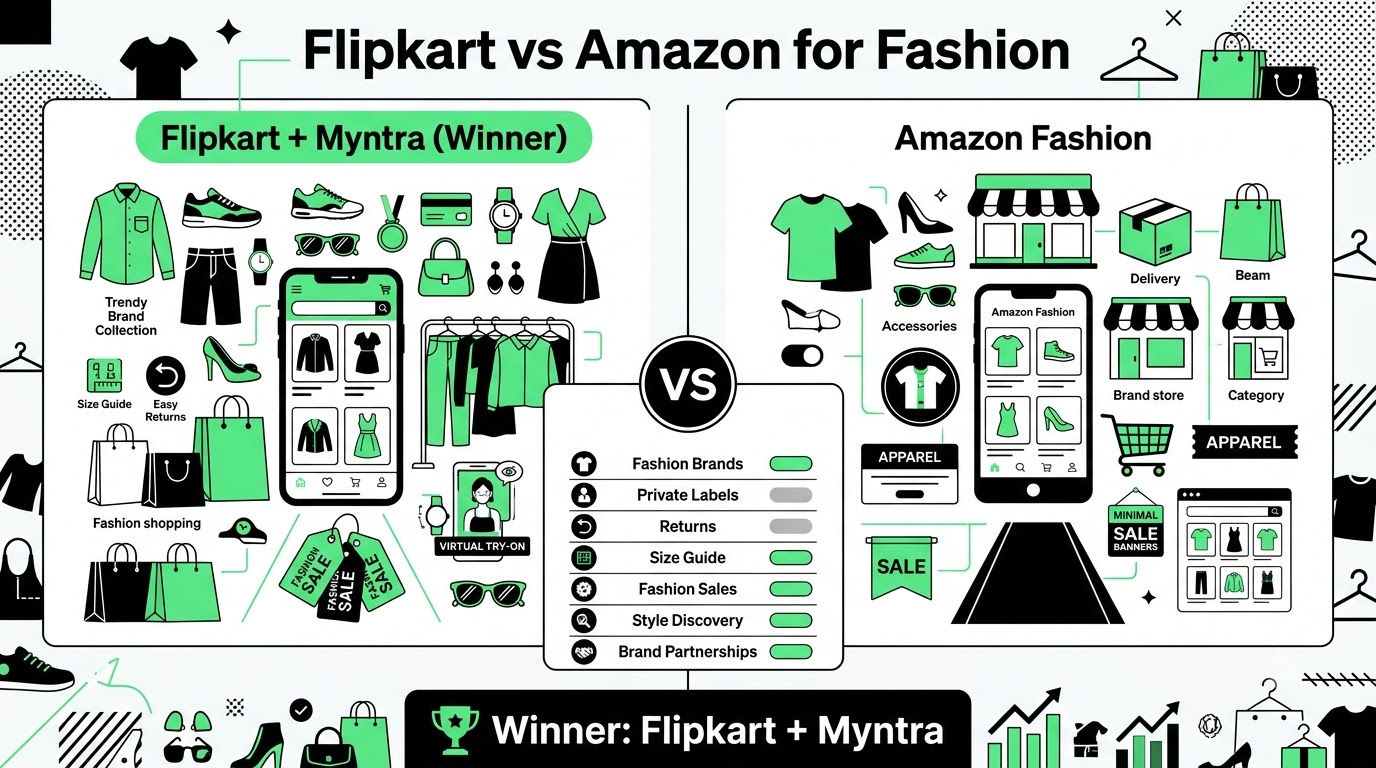
Flipkart, through Myntra, carries a significantly wider and deeper range of fashion brands compared to Amazon, spanning everything from budget labels to premium Indian and international designers.
Private Labels
Both platforms run private label fashion brands offering budget-friendly alternatives to name brands, though Myntra’s private labels feel more fashion-forward compared to Amazon’s more basic in-house options.
Returns
Fashion returns on both platforms are generally smooth given how common size and fit issues are, though Myntra’s return process specifically feels optimized for fashion given that’s its entire focus.
Sizing
Myntra offers detailed sizing guides and sometimes even virtual try-on features for certain categories, giving it an edge over Amazon’s more generic sizing charts.
Fashion Sales
Myntra’s End of Reason Sale is a massive fashion-specific event that Amazon simply doesn’t have a direct equivalent for, since Amazon’s fashion sales tend to get bundled into broader festival events rather than standing alone.
Myntra Advantage
Myntra gives Flipkart’s ecosystem a genuine fashion specialty that Amazon can’t easily replicate, since Amazon’s fashion catalog, while decent, doesn’t have a dedicated app experience built purely around style and trend discovery.
Who Wins?
Flipkart wins fashion clearly, largely thanks to Myntra’s depth, brand partnerships, and fashion-specific sales events that Amazon’s more generalized approach can’t fully match.
Grocery Comparison
Amazon Fresh
Amazon Fresh offers scheduled grocery delivery with a decent product range, though its speed hasn’t matched the ultra-fast quick commerce trend that’s taken over urban grocery shopping in India.
Flipkart Grocery
Flipkart Minutes has taken over the grocery-adjacent role within Flipkart’s ecosystem, focusing on fast delivery of daily essentials rather than large weekly grocery hauls.
Fresh Produce
Neither platform is primarily known for fresh produce like vegetables and fruits, since dedicated grocery apps like BigBasket and Blinkit tend to dominate that specific niche more heavily.
Daily Essentials
Both platforms handle daily essentials like packaged food, toiletries, and household items reasonably well, though delivery speed and city coverage vary significantly depending on where you live.
Coverage
Flipkart Minutes currently covers fewer cities than Amazon Fresh’s broader delivery network, though it’s expanding aggressively given how competitive the quick commerce space has become.
Pricing
Grocery pricing between the two doesn’t show a massive consistent gap, though occasional platform-specific discounts can tip the scale for specific items during any given week.
Delivery
Flipkart Minutes wins on raw speed for its supported cities, delivering essentials in minutes rather than the scheduled next-day windows more typical of Amazon Fresh.
Winner: Flipkart Minutes for speed where it’s available, Amazon Fresh for broader overall coverage across more cities.
Seller Comparison: Flipkart Seller vs Amazon Seller
This section matters a ton if you’re thinking about starting a business rather than just shopping, so let’s slow down here.
Seller Registration
Requirements
Both platforms require a valid business registration, bank account, and GST number to start selling, and the onboarding process typically takes a few days once documentation is submitted correctly.
Documents
You’ll need PAN card details, GST registration, bank account proof, and sometimes a cancelled cheque, and both platforms have fairly similar documentation checklists for new sellers.
GST
GST registration is mandatory on both platforms for most product categories, though certain exempt categories like books can sometimes be listed without it depending on current tax rules.
Fees
Commission
Commission rates vary heavily by category on both platforms, generally ranging from 5 to 20 percent depending on what you’re selling, and it’s genuinely worth comparing category-specific rates before deciding where to list a product.
Shipping
Both platforms charge shipping fees based on weight and dimensions, and using their fulfillment services, Amazon FBA or Flipkart’s equivalent, often reduces per-order shipping costs compared to self-ship options.
Advertising
Sponsored product ads are available on both platforms, letting sellers pay to boost visibility, and costs scale with competition in your specific category, similar to how Google Ads pricing works.
Seller Dashboard
Analytics
Both platforms provide seller dashboards with sales data, traffic insights, and performance metrics, helping sellers understand what’s working and where they’re losing potential customers.
Payment Cycle
Payment cycles typically run every 7 to 15 days on both platforms, though this can vary based on your seller tier and how long you’ve been active on the platform.
Seller Protection
Both platforms offer some seller protection against fraudulent returns or chargebacks, though the actual claims process can feel slow and bureaucratic on either side according to many seller complaints online.
Inventory Management
Fulfillment
Amazon FBA
Fulfillment by Amazon lets sellers ship inventory to Amazon warehouses, and Amazon handles storage, packing, and shipping from there, which massively reduces the operational burden on small sellers.
Flipkart Fulfillment
Flipkart offers a similar fulfillment service, storing seller inventory in its warehouses and handling the shipping process, giving sellers access to faster delivery promises without managing logistics themselves.
Marketing Tools
Both platforms offer promotional tools like deal listings, coupon creation, and sponsored placements, and using these effectively often makes the difference between a product that sells and one that sits unnoticed.
Who Should Sell Where?
If your product fits fashion, home decor, or budget categories, Flipkart’s audience through Shopsy and Myntra gives you strong reach. If you’re selling electronics, imported goods, or premium products, Amazon’s audience and fulfillment infrastructure tend to work better.
Comparison Table
| Factor | Flipkart Seller | Amazon Seller |
|---|---|---|
| Commission | Category-based, 5-20% | Category-based, 5-20% |
| Fulfillment | Flipkart Fulfillment | Amazon FBA |
| Best Categories | Fashion, home, budget goods | Electronics, imports, premium goods |
| Reach | Strong in Tier-2/3 towns via Shopsy | Strong in metros and internationally |
| Advertising | Sponsored listings available | Sponsored Products, Brand campaigns |
Advertising Platform Comparison
Amazon Ads
Amazon Ads gives sellers access to sponsored product placements, display ads, and brand campaigns, backed by Amazon’s massive shopping data that helps target the right buyers more precisely.
Flipkart Ads
Flipkart Ads offers similar sponsored listing options, letting sellers boost product visibility within search results and category pages, though the overall ad ecosystem feels slightly less mature than Amazon’s.
Sponsored Products
Both platforms let sellers pay to appear higher in search results for relevant keywords, essentially working like a mini search engine ad auction within each marketplace.
Brand Campaigns
Amazon offers more sophisticated brand campaign tools, including video ads and dedicated brand storefronts, giving established sellers more ways to build brand recognition beyond just individual product listings.
Display Ads
Display advertising exists on both platforms, showing banner-style ads across the shopping experience, though Amazon’s display network tends to have broader reach given its global ad infrastructure.
Reporting
Amazon’s ad reporting dashboard tends to be more detailed, giving sellers clearer insight into click-through rates, conversion data, and return on ad spend compared to Flipkart’s more basic reporting tools.
ROI
Return on ad spend varies heavily by category and competition level on both platforms, so there’s no universal winner here, it really depends on testing your specific product against both platforms directly.
Winner: Amazon, mainly due to more detailed reporting and mature brand campaign tools, though Flipkart’s ad costs can sometimes be lower for less competitive categories.
Flipkart vs Amazon for Small Businesses
Ease of Selling
Flipkart’s onboarding process is often seen as slightly friendlier for first-time sellers, particularly those targeting budget-conscious buyers through Shopsy’s simplified reselling model.
Reach
Amazon’s global brand recognition helps small sellers reach a broader, sometimes more affluent audience, while Flipkart’s reach into Tier-2 and Tier-3 India gives sellers access to price-sensitive buyers in huge volumes.
Marketing
Both platforms offer marketing support tools, but Amazon’s more established seller university and resources tend to give new sellers a clearer roadmap for growing their listings.
Growth Opportunities
Flipkart’s growth story in smaller towns creates opportunities for sellers targeting mass-market products, while Amazon’s premium positioning suits sellers targeting higher-value, brand-conscious customers.
Support Programs
Local Sellers
Both platforms run programs supporting local manufacturers and artisans, helping them list products online without needing deep technical or logistics expertise upfront.
MSMEs
Small and medium enterprises get dedicated onboarding support on both platforms, including reduced fees or waived charges during initial launch periods in some cases.
Women Entrepreneurs
Both Flipkart and Amazon run women entrepreneur support initiatives, offering mentorship, reduced fees, or dedicated seller communities to help women-led businesses get started online.
Rural Sellers
Flipkart has pushed harder into enabling rural sellers and artisans to reach urban buyers directly, partly through its Shopsy platform’s focus on smaller towns and villages.
Winner: Flipkart for reach into smaller towns and simpler onboarding, Amazon for brand credibility and more structured growth resources for scaling sellers.
Sustainability & CSR Comparison
Packaging
Both platforms have pushed toward reducing plastic packaging, introducing recyclable and reusable packaging options for various product categories over the past few years.
Renewable Energy
Amazon has made bigger global commitments toward renewable energy usage across its warehouses and data centers, while Flipkart’s sustainability efforts are more India-specific and still scaling up.
EV Deliveries
Flipkart has invested in electric vehicle delivery fleets, particularly for last-mile delivery in metro cities, aiming to cut emissions from its massive daily delivery volume.
Waste Reduction
Both platforms run initiatives to reduce packaging waste and encourage sellers to use eco-friendly materials, though enforcement and adoption rates vary across their vast seller networks.
Seller Empowerment
Both platforms run programs helping small sellers and artisans access online markets, which indirectly supports sustainable local economies rather than just large-scale manufacturing.
Social Initiatives
Amazon and Flipkart both fund social initiatives around education, skill development, and community support, though these programs tend to operate somewhat quietly compared to their main business operations.
Winner: Roughly tied, with Amazon ahead on global renewable energy commitments and Flipkart ahead on India-specific EV delivery investment.
Security & Buyer Protection
Secure Payments
Both platforms use encrypted payment gateways and comply with standard security protocols, making the actual transaction process reasonably safe on either side.
Fraud Protection
Both offer buyer protection policies covering fraudulent transactions or non-delivery, though the actual claims resolution process can take time and occasionally frustrate affected buyers.
Data Privacy
Both platforms collect user data for personalization and advertising purposes, and while both claim to follow data protection standards, neither is fully transparent about exactly how deep that data usage goes.
Verified Sellers
Both platforms run seller verification processes before onboarding, though counterfeit or misrepresented products still occasionally slip through on either marketplace despite these checks.
Product Authenticity
Official brand stores on both platforms offer stronger authenticity guarantees compared to random third-party sellers, so sticking to verified brand stores reduces your risk of counterfeit products significantly.
Warranty Protection
Warranty coverage depends on the manufacturer rather than the platform, though buying through official brand stores on either platform makes warranty claims noticeably smoother.
Safe Shopping Tips
Always check seller ratings, read recent reviews, and prefer official brand stores for expensive electronics, regardless of whether you’re shopping on Flipkart or Amazon.
Winner: Tie, since both platforms have comparable security infrastructure and similar risks tied mostly to third-party seller behavior rather than platform-level flaws.
Pros and Cons
Flipkart Pros
Strong fashion catalog through Myntra, better festive sale discounts historically, deeper penetration into Tier-2 and Tier-3 India, and a free membership program through Super Coins that doesn’t require a subscription fee.
Flipkart Cons
Weaker digital content ecosystem, occasional app instability during massive sale traffic spikes, and a smaller international product catalog compared to Amazon’s global sourcing capability.
Amazon Pros
Stronger recommendation engine, broader electronics and imported product catalog, more mature Prime bundle with entertainment perks, and generally faster complaint resolution through customer support.
Amazon Cons
Prime requires a paid subscription unlike Flipkart’s free Plus program, weaker fashion depth compared to Myntra, and a homepage experience that some Indian shoppers find less festive or engaging during sale seasons.
Comparison Table
| Aspect | Flipkart | Amazon |
|---|---|---|
| Strength | Fashion, festive sales, Tier-2/3 reach | Electronics, digital content, recommendations |
| Weakness | Digital ecosystem, app stability under load | Fashion depth, subscription cost for full perks |
| Membership | Free (Super Coins) | Paid (Prime) |
| Best Use Case | Deal hunting, fashion shopping | Wide catalog shopping, entertainment bundle |
Flipkart vs Amazon: Head-to-Head Scorecard
| Category | Flipkart | Amazon | Winner |
|---|---|---|---|
| Pricing | 8/10 | 7.5/10 | Flipkart |
| Product Variety | 7.5/10 | 8.5/10 | Amazon |
| Electronics | 7/10 | 8.5/10 | Amazon |
| Fashion | 9/10 | 6.5/10 | Flipkart |
| Grocery | 7/10 | 6.5/10 | Flipkart |
| Delivery | 7.5/10 | 8/10 | Amazon |
| Customer Support | 7.5/10 | 8/10 | Amazon |
| Membership | 7/10 | 8/10 | Amazon |
| Returns | 7.5/10 | 7.5/10 | Tie |
| Seller Experience | 7.5/10 | 8/10 | Amazon |
| Advertising | 7/10 | 8/10 | Amazon |
| Mobile App | 7.5/10 | 8/10 | Amazon |
| Security | 8/10 | 8/10 | Tie |
| Availability | 7.5/10 | 8/10 | Amazon |
| Overall Score | 7.5/10 | 7.9/10 | Amazon (slight edge) |
This scorecard isn’t gospel, it’s a rough snapshot based on category strengths discussed throughout this guide. Your personal winner might flip completely depending on what you shop for most and where you live.
Which Platform Is Better for Different Users?
Students
Students on tight budgets tend to lean toward Flipkart for its stronger discount culture and free Plus membership that doesn’t require an upfront subscription payment.
Families
Families juggling groceries, electronics, and household goods often find Amazon’s broader catalog and Prime bundle more convenient for one-stop shopping across multiple categories at once.
Professionals
Working professionals who value time savings tend to prefer Amazon Prime’s faster delivery and entertainment bundle, since the subscription cost feels justified by convenience alone.
Tech Enthusiasts
Tech enthusiasts chasing the latest gadgets and international electronics often gravitate toward Amazon due to its broader import catalog and earlier access to certain global product launches.
Fashion Buyers
Fashion-focused shoppers almost always end up preferring Flipkart because of Myntra’s depth, brand variety, and fashion-specific sale events that Amazon can’t fully replicate.
Grocery Shoppers
Grocery shoppers in cities with Flipkart Minutes coverage often prefer its speed, while those outside its coverage area lean toward Amazon Fresh or dedicated grocery apps instead.
Premium Customers
Premium buyers looking for luxury brands and international products tend to favor Amazon’s more developed premium and luxury store partnerships.
Budget Shoppers
Budget-conscious shoppers hunting for the lowest possible price generally favor Flipkart, especially during Big Billion Days when discounts can get genuinely aggressive.
Small Businesses
Small businesses targeting Tier-2 and Tier-3 India often find Flipkart’s Shopsy platform easier to break into, while those targeting metro and premium buyers lean toward Amazon.
Large Brands
Large established brands often sell on both platforms simultaneously to maximize reach, treating Flipkart vs Amazon less as a choice and more as a dual-channel strategy.
Manufacturers
Manufacturers looking for bulk order visibility and B2B-style relationships sometimes find Amazon’s business-focused tools slightly more developed than Flipkart’s equivalent offerings.
D2C Brands
D2C brands building their own identity often use both platforms as distribution channels while running their own website separately for full brand control and better margins.
Expert Buying Tips
Compare Prices Before Purchasing
Always check both platforms before buying anything above a thousand rupees, since price differences between Flipkart and Amazon can be surprisingly significant even for the exact same product model.
Check Seller Ratings
Seller ratings matter more than platform reputation alone, since a poorly rated third-party seller can ruin your experience regardless of whether you’re shopping on Flipkart or Amazon.
Read Verified Reviews
Verified purchase reviews tend to be more trustworthy than generic star ratings, so actually reading a handful of detailed reviews before buying saves you from nasty surprises later.
Verify Warranty
Always confirm warranty terms directly with the manufacturer’s official channels rather than assuming the platform automatically guarantees full warranty coverage on every purchase.
Track Festival Sales
Big Billion Days and Great Indian Festival both offer genuinely good deals, so timing bigger purchases around these events rather than buying on impulse saves real money.
Use Membership Benefits
If you’re already a Prime or Plus member, actually use the perks you’re paying for or earned, since unused benefits are essentially money left on the table.
Use Credit Card Offers
Bank-specific credit card offers can shave off significant amounts from your final bill, so it’s worth checking which card gives the best discount before checkout on either platform.
Compare Exchange Values
Exchange offers vary wildly between platforms for the same old device, so getting a quote from both before trading in your phone or laptop is genuinely worth the extra effort.
Watch Lightning Deals
Lightning deals and flash sales often disappear within minutes, so setting alerts or checking frequently during major sale events helps you catch genuinely good limited-time discounts.
Common Mistakes to Avoid
Buying from Unknown Sellers
Buying expensive items from unrated or newly registered third-party sellers without checking reviews first is one of the most common ways shoppers end up with counterfeit or damaged products.
Ignoring Return Policies
Skipping the fine print on return policies before buying, especially for electronics with shorter return windows, often leaves buyers stuck when a product develops an issue after the window closes.
Missing Bank Offers
Forgetting to apply an available bank discount before checkout means paying more than necessary, something that happens more often than people realize simply due to checkout fatigue.
Skipping Product Reviews
Skipping reviews entirely and buying based purely on product photos and descriptions often leads to disappointment once the actual product arrives and doesn’t match expectations.
Not Comparing Prices
Buying immediately on one platform without checking the other first means potentially overpaying by a noticeable margin, especially on higher-ticket electronics purchases.
Ignoring Delivery Dates
Not checking estimated delivery dates before ordering time-sensitive gifts or event-related purchases leads to plenty of last-minute panic that’s entirely avoidable with a quick date check.
Buying Without Warranty
Purchasing electronics from unofficial third-party listings without clear warranty terms often leaves buyers with no recourse if the product fails shortly after purchase.
Future of Flipkart vs Amazon in India
AI-powered Shopping
Both platforms are integrating AI-driven product recommendations and conversational shopping assistants, aiming to make product discovery feel more like a conversation than a search bar exercise.
Quick Commerce Expansion
Flipkart Minutes and Amazon’s own quick delivery experiments signal that both platforms see instant delivery as a battleground worth fighting over as competitors like Blinkit and Zepto gain massive traction.
Voice Commerce
Voice-assisted shopping through smart speakers and voice search is slowly growing, and Amazon’s existing Alexa ecosystem gives it a natural head start over Flipkart in this specific area.
Drone Deliveries
Drone delivery pilots have been tested by both companies in limited settings, though widespread rollout across India still faces regulatory and infrastructure hurdles before becoming mainstream.
ONDC Competition
The Open Network for Digital Commerce, backed by the Indian government, poses a genuine long-term challenge to both platforms by potentially decentralizing eCommerce away from single-app dominance.
Personalized Shopping
Both platforms continue investing in hyper-personalized shopping experiences, using purchase history and browsing behavior to tailor everything from homepage layout to individual product recommendations.
AR/VR Shopping
Augmented reality try-before-you-buy features, especially for fashion and furniture, are slowly being tested by both platforms as a way to reduce return rates caused by fit or fit-related dissatisfaction.
Sustainability
Expect continued investment from both companies into EV delivery fleets and reduced packaging waste, partly driven by regulatory pressure and partly by genuine consumer demand for greener practices.
Cross-border Commerce
Amazon’s global infrastructure gives it a natural advantage in cross-border shopping, letting Indian buyers access international products more easily than Flipkart currently supports.
Predictions for the Next Five Years
Expect quick commerce to keep eating into traditional next-day delivery expectations, AI shopping assistants to become standard rather than novel, and both platforms to keep fighting hard over the same Tier-2 and Tier-3 markets that represent India’s biggest growth opportunity left.
Frequently Asked Questions (FAQs)
Which is better, Flipkart or Amazon? Neither is universally better. Flipkart tends to win on fashion, festive discounts, and reach into smaller towns, while Amazon tends to win on electronics variety, delivery consistency, and its bundled entertainment ecosystem through Prime.
Is Flipkart cheaper than Amazon? Flipkart is often cheaper during festive sale events like Big Billion Days, but on regular days, prices between the two platforms are usually close enough that checking both before buying is the smarter move.
Which platform offers faster delivery? Amazon generally offers slightly more consistent fast delivery across a wider range of cities, though Flipkart Minutes actually beats Amazon on speed for grocery and daily essentials in the cities where it operates.
Is Amazon Prime worth it in India? Amazon Prime is worth it if you shop frequently and would also use Prime Video or Prime Music regularly, since the bundled value quickly outweighs the subscription cost for active users.
What are the benefits of Flipkart Plus? Flipkart Plus gives you faster delivery, early sale access, and exclusive support, all without paying a subscription fee, since membership is earned through Super Coins collected from regular shopping.
Which has a better return policy? Return policies are fairly similar between the two, both offering roughly 7 to 10 day windows depending on category, though Amazon occasionally extends windows for Prime members during sales.
Which platform is better for electronics? Amazon generally has the edge for electronics, offering a broader catalog of international brands and earlier access to certain global product launches compared to Flipkart.
Which platform has better fashion products? Flipkart wins clearly for fashion, largely because of Myntra’s deep brand partnerships and fashion-specific sale events that Amazon simply doesn’t match in scale or curation.
Can I sell on both Amazon and Flipkart? Yes, plenty of sellers list products on both platforms simultaneously to maximize reach, treating them as complementary sales channels rather than picking just one exclusively.
Which marketplace charges lower seller fees? Fees vary heavily by category on both platforms, so there’s no universal answer here, it genuinely depends on what you’re selling and which platform’s audience fits your product better.
Is Amazon more reliable than Flipkart? Both platforms are reliable for the vast majority of transactions, though Amazon’s infrastructure tends to handle massive traffic spikes during sale events slightly more smoothly than Flipkart’s.
Which platform offers better customer support? Amazon tends to resolve issues slightly faster with a more structured escalation process, though Flipkart has significantly improved its support quality over recent years.
Which has more products? Amazon generally has a broader overall product catalog, especially in electronics and imported goods, while Flipkart’s catalog is deeper specifically within fashion through Myntra.
Is Flipkart owned by Walmart? Yes, Walmart acquired a majority stake in Flipkart in 2018, though Flipkart continues operating with its own leadership and India-specific brand identity rather than being rebranded.
Which platform has better exchange offers? Exchange values fluctuate constantly between both platforms depending on the specific device and ongoing promotions, so comparing quotes from both before trading in is always the smarter approach.
Which is better for small businesses? Flipkart tends to be friendlier for small businesses targeting Tier-2 and Tier-3 markets through Shopsy, while Amazon suits sellers targeting premium or international-facing customer bases better.
Are products authentic on both platforms? Both platforms have official brand stores offering strong authenticity guarantees, though counterfeit risk exists on either marketplace when buying from unverified third-party sellers instead.
Which platform has better festive sales? Flipkart’s Big Billion Days and Amazon’s Great Indian Festival are both massive events, with Flipkart historically edging ahead slightly on aggressive electronics and fashion discounting.
Which app is better for shopping? It depends on preference, Flipkart’s app feels more colorful and promotional while Amazon’s feels cleaner and more efficient, with Amazon having a slight edge in stability during high traffic.
Which platform is growing faster in India? Both platforms continue growing steadily, with quick commerce and Tier-2/3 market expansion being the biggest growth battlegrounds for both companies right now.
How do Flipkart Minutes and Amazon’s quick delivery compare? Flipkart Minutes currently leads in raw speed for grocery and essentials delivery in supported cities, while Amazon’s quick delivery push remains more limited in scale by comparison.
Which platform provides better value for Prime or Plus members? Amazon Prime offers more total bundled value through entertainment perks, while Flipkart Plus offers solid value at zero direct cost, making the better choice dependent on your shopping frequency and entertainment habits.
Is Cash on Delivery available on both platforms? Yes, both platforms support cash on delivery across most serviceable areas, though availability can vary slightly depending on the specific seller and product category involved.
Which marketplace is better for first-time sellers? Flipkart’s onboarding through Shopsy tends to feel friendlier for absolute beginners, while Amazon’s more structured seller university resources help sellers who want a clearer long-term growth roadmap.
What factors should I consider before choosing between Flipkart and Amazon? Consider what you’re buying most often, your city’s delivery coverage, whether you value entertainment perks enough to pay for Prime, and for sellers, which platform’s audience actually matches your product category best.
Final Verdict
After going through pricing, delivery, membership programs, customer support, and the entire seller experience, there’s no single clean winner here, and honestly that’s the most honest answer anyone can give you. Flipkart vs Amazon isn’t a fight with one obvious champion, it’s two genuinely strong platforms that happen to be really good at different things.
Choose Flipkart if: you prioritize competitive pricing, love hunting for deals during electronics sales, shop for fashion regularly through Myntra, and get excited about the energy around Big Billion Days every year.
Choose Amazon if: you value having a wider product catalog to browse, want premium membership benefits bundled with entertainment, need faster delivery consistently across more locations, and appreciate a more mature, established seller ecosystem if you’re running a business.
Use both if: you want to squeeze out the absolute best prices by comparing before every purchase, or you’re a seller trying to reach the maximum possible audience across India’s two biggest marketplaces without limiting yourself to just one channel.
At the end of the day, the smartest shoppers don’t pick a side and stay loyal out of habit. They check both, they read the reviews, they compare the seller ratings, they look at delivery timelines before ordering something time-sensitive, and they actually use whatever membership perks they’re already paying for or have earned. That habit alone will save you more money over a year than picking the “better” platform ever will.