


Enhanced Cost Per Click (ECPC) is a bidding option designed for advertisers who want more performance than manual bidding but are not ready to fully rely on automated strategies. It acts as a middle ground between complete control and complete automation.

In modern Google Ads, bidding decisions are increasingly influenced by machine learning and real-time signals. ECPC was introduced to help advertisers improve conversions while still keeping manual bids as the foundation. Instead of replacing your bids entirely, ECPC adjusts them when Google believes a click is more or less likely to lead to a conversion.
This makes ECPC especially useful for advertisers who want better results without losing visibility into how bids are being managed.
What Is Enhanced Cost Per Click (ECPC)?
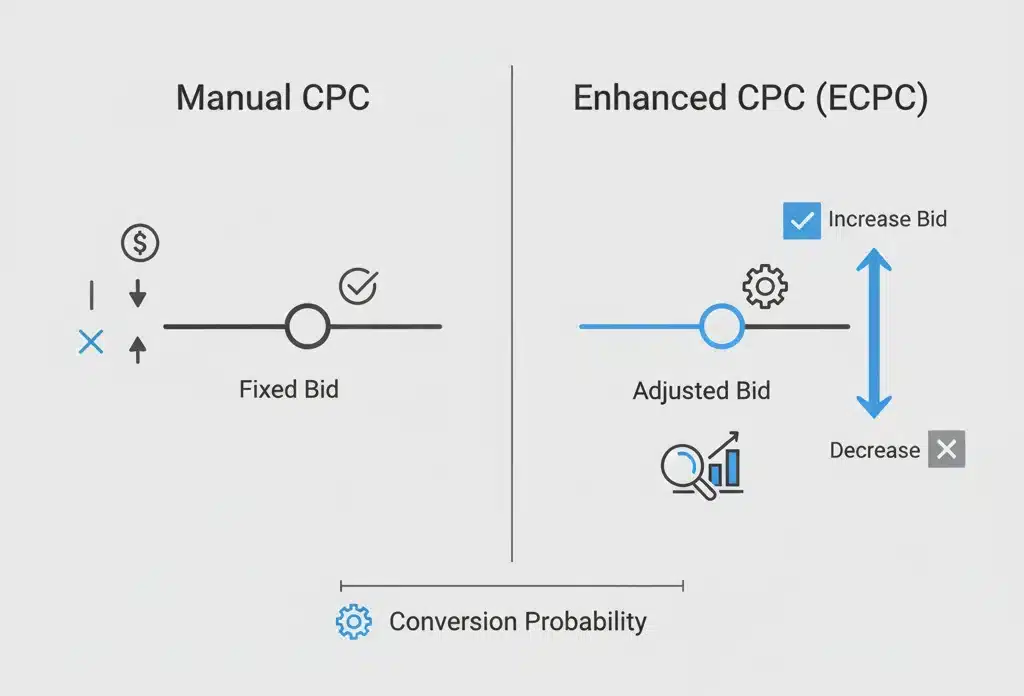
Enhanced Cost Per Click is a bidding feature that works on top of manual CPC bidding. You still set your keyword bids, but Google is allowed to increase or decrease those bids during the auction to improve conversion chances.
The goal of ECPC is not to maximize clicks but to maximize conversions within your existing bidding structure. It uses historical data and contextual signals to decide when a click is more valuable.
ECPC does not guarantee conversions, but it improves the probability of getting them compared to purely manual bidding.
How Does Pay-Per-Click (PPC) Bidding Work?
Pay-Per-Click bidding is based on an auction system that runs every time someone searches or visits a website where ads can appear. Advertisers compete by setting bids for keywords or placements, and the platform decides which ad to show.
The final ad position is not decided only by bid amount. It is influenced by both bid value and ad quality.
- Advertisers set bids for keywords or audiences
- Google evaluates relevance and expected performance
- Ads with better overall value appear higher
- You pay only when someone clicks the ad
ECPC operates within this same auction system but adjusts bids dynamically during the auction.
How Enhanced Cost Per Click (ECPC) Works
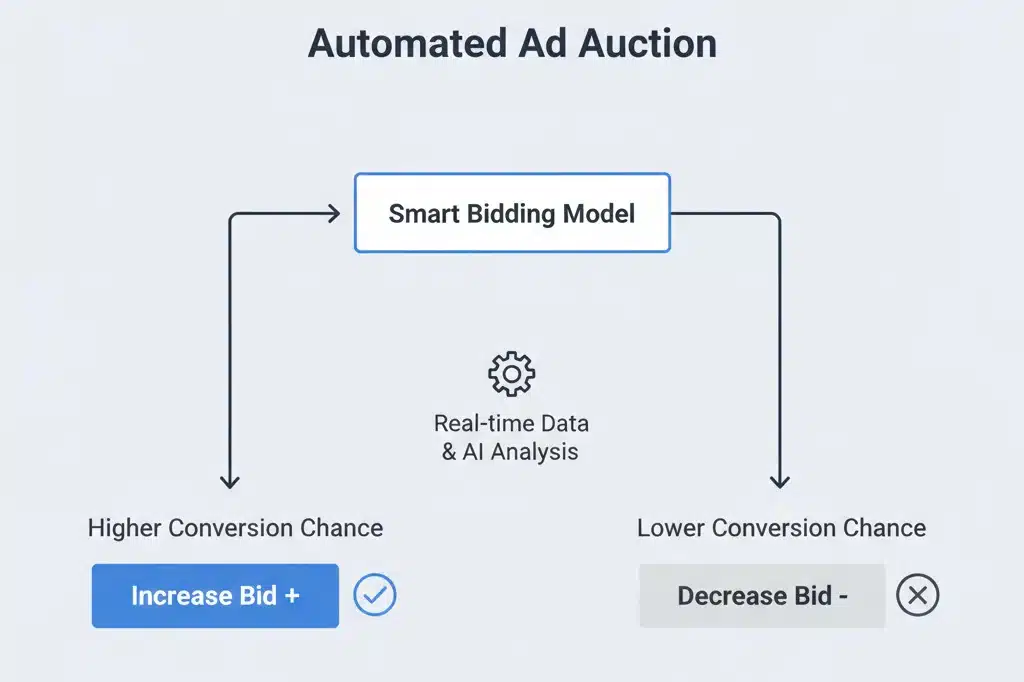
ECPC analyzes each auction in real time and compares it with historical conversion data. If Google predicts that a click is more likely to convert, it may increase your bid. If a click looks less likely to convert, it may lower the bid.
The adjustment happens automatically and only applies at auction time. Your original bid remains the base bid.
1. Signals Used by ECPC for Bid Adjustments
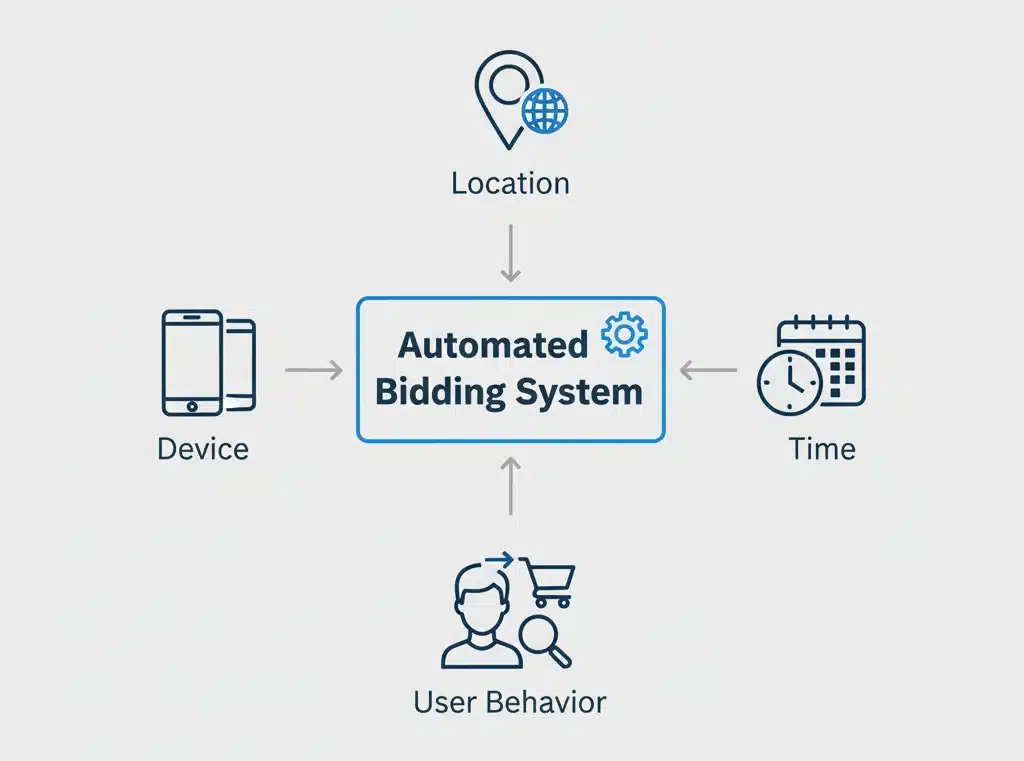
ECPC relies on multiple contextual signals to predict conversion likelihood.
- Device type (mobile, desktop, tablet)
- User location
- Time of day and day of the week
- Browser and operating system
- Historical performance of similar searches
These signals help Google estimate whether a click is more valuable than average.
2. Google’s Machine Learning Role in ECPC
Machine learning helps ECPC recognize patterns from past data. It learns which types of clicks have historically resulted in conversions and applies that knowledge to future auctions.
- Uses historical conversion data
- Improves predictions over time
- Requires a learning period
- Performance improves with consistent data
ECPC does not work effectively without enough conversion history.
ECPC vs Manual CPC: Key Differences
Manual CPC gives advertisers full control over bids but does not adjust bids automatically based on conversion likelihood. ECPC enhances manual CPC by adding automated intelligence.
- Manual CPC keeps bids fixed
- ECPC adjusts bids in real time
- Manual CPC focuses on clicks
- ECPC focuses on conversions
- Manual CPC requires constant monitoring
ECPC reduces the need for constant bid adjustments while keeping manual control intact.
ECPC vs Smart Bidding Strategies
Smart Bidding strategies like Target CPA and Target ROAS use full automation. ECPC is not fully automated and works as an assisted bidding method.
- ECPC uses manual bids as a base
- Smart Bidding ignores manual bids
- ECPC needs fewer conversions than Smart Bidding
- Smart Bidding offers stronger optimization at scale
ECPC is better suited for advertisers who want gradual automation.
Conversion Tracking and ECPC: Why It’s Mandatory
ECPC depends entirely on conversion data. Without accurate tracking, it cannot determine which clicks are valuable.
If conversion tracking is missing or incorrect, ECPC may make poor bid adjustments.
- Conversion actions must be properly set up
- Data accuracy directly impacts performance
- Incorrect tracking can waste budget
- More data improves bid predictions
Conversion tracking is not optional when using ECPC.
Advantages of Using Enhanced Cost Per Click
ECPC offers a balance between control and automation, making it suitable for many advertisers.
- Improves conversion focus
- Retains manual bidding control
- Easier to manage than pure manual CPC
- Lower risk than full automation
- Suitable for smaller budgets
It is often used as a transition strategy.
Limitations and Challenges of ECPC
Despite its benefits, ECPC has limitations that advertisers should understand.
- Less powerful than Smart Bidding
- Can increase CPC in some cases
- Requires conversion history
- Limited scalability for large accounts
ECPC should not be treated as a long-term solution for high-growth campaigns.
When Should You Use Enhanced Cost Per Click?
ECPC works best in specific scenarios where some data already exists.
- Campaigns with past conversions
- Lead generation campaigns
- Small to medium ad budgets
- Advertisers testing automation
It is ideal when you want improvement without losing control.
When You Should Avoid ECPC
There are situations where ECPC may not deliver good results.
- New campaigns with no data
- High-volume ecommerce campaigns
- Strict ROAS-driven strategies
- Highly seasonal campaigns
In these cases, other bidding strategies perform better.
How to Set Up Enhanced Cost Per Click (Step-by-Step)
ECPC is enabled at the campaign or portfolio bidding level in Google Ads.
- Choose Manual CPC bidding
- Enable Enhanced CPC option
- Select conversions or conversion value
- Ensure tracking is active
- Monitor performance after activation
Proper setup is critical for success.
Best Practices for Using ECPC Effectively
To get consistent results, ECPC should be managed carefully.
- Improve Quality Score to control CPC
- Use tightly themed keywords
- Analyze device and time performance
- Allow a learning period
- Avoid frequent bid changes
Good structure improves ECPC performance.
Common Mistakes to Avoid with ECPC
Many advertisers fail with ECPC due to setup and expectation errors.
- Enabling ECPC without tracking
- Using it on low-volume campaigns
- Expecting instant results
- Making frequent changes during learning
Avoiding these mistakes improves stability.
Key Metrics to Track for ECPC Performance
Performance measurement is essential to understand ECPC impact.
- Cost per conversion
- Conversion rate
- Average CPC
- Click-through rate (CTR)
- Impression share
Tracking trends is more important than daily fluctuations.
Is Enhanced Cost Per Click Still Relevant in 2026?
Despite increased automation, ECPC remains relevant as a transitional strategy. It allows advertisers to benefit from machine learning without giving up manual control entirely.
ECPC is especially useful for advertisers who want to prepare their accounts for Smart Bidding while maintaining stability.
Conclusion
Enhanced Cost Per Click is best viewed as a supporting bidding strategy rather than a final solution. It improves conversion performance over manual CPC while maintaining advertiser control.
If your campaign has reliable conversion data and you want better efficiency without full automation, ECPC is a practical choice. However, for large-scale or revenue-driven campaigns, Smart Bidding strategies often deliver stronger long-term results.
Choosing ECPC should always align with your campaign goals, data availability, and risk tolerance.
Frequently Asked Questions (FAQs)
1. What is Enhanced Cost Per Click (ECPC)?
Enhanced Cost Per Click (ECPC) is a bidding feature in Google Ads that works alongside manual CPC bidding. It automatically increases or decreases your bids during auctions when a click is more or less likely to lead to a conversion, while keeping your manual bids as the base.
2. How does ECPC differ from manual CPC bidding?
Manual CPC uses fixed bids that do not change based on user intent or conversion likelihood. ECPC adds automation by adjusting bids in real time using historical conversion data, helping improve conversion chances without fully automating bidding.
3. Does ECPC increase advertising costs?
ECPC can increase cost per click in some auctions where conversion likelihood is high. However, the goal is to improve conversions, not just reduce CPC. Overall costs depend on campaign structure, tracking accuracy, and performance optimization.
4. Is conversion tracking required for ECPC?
Yes. ECPC relies on conversion data to adjust bids. Without accurate conversion tracking, ECPC cannot function properly and may lead to inefficient spending.
5. Can ECPC be used with all campaign types?
ECPC is commonly used with Search and Display campaigns. Availability may vary depending on campaign settings and bidding options, but it is not suitable for every campaign type, especially those focused strictly on return on ad spend.
6. How long does ECPC take to optimize performance?
ECPC requires a learning period during which it collects and analyzes conversion data. Performance improvements typically stabilize after sufficient data is gathered, rather than immediately after activation.
7. Is ECPC better than Smart Bidding strategies?
ECPC is not better than Smart Bidding, but it serves a different purpose. ECPC offers partial automation with control, while Smart Bidding uses full automation and is more effective for large-scale, data-rich campaigns.
8. Can ECPC work with a small advertising budget?
Yes, ECPC can work with small to medium budgets as long as the campaign has consistent conversion data. It is often used by advertisers who want improved performance without committing to full automation.