


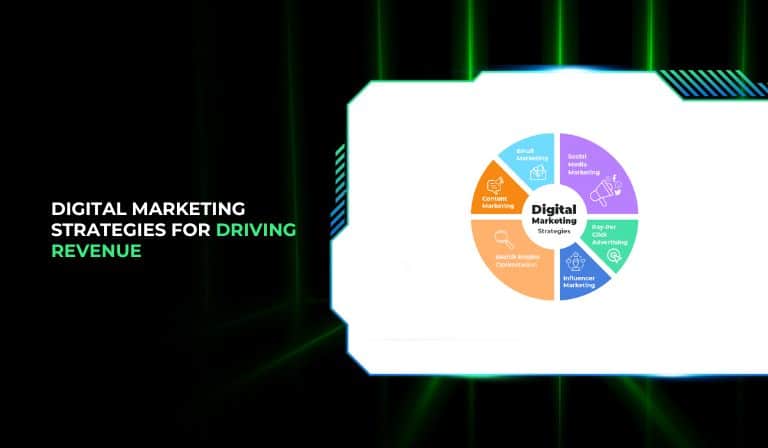
Most businesses aren’t failing at marketing because they’re doing nothing. They’re failing because they’re doing too many things, none of them well, with no clear line between activity and actual money coming in. There’s a difference between being busy with marketing and actually running digital marketing strategies for driving revenue. That difference shows up in your bank account, not your traffic reports.

Here’s what nobody talks about: most businesses that struggle with digital marketing aren’t short on tactics. They’ve got an Instagram page, maybe a blog, probably some Google Ads running at a cost-per-click that hasn’t been reviewed since someone set it up in 2022. The problem isn’t access to channels. It’s the absence of a strategy that connects those channels to a business outcome. Clicks that don’t convert aren’t marketing. They’re just spending.
This post covers 9 digital marketing strategies that actually move revenue, not just vanity metrics. Not a generic listicle. These are strategies with real mechanics behind them, explained the way you’d explain them to someone who has to actually run them, not just approve a budget for them. SEO, PPC, content, email, social, voice search, video, ABM, web design. We’ll get into how each one works, why it matters right now, and what separates the businesses doing it well from the ones just going through the motions.
9 Digital Marketing Strategies for Driving Revenue That Actually Work
1. Search Engine Optimization (SEO)
SEO is the only digital marketing channel where the effort you put in today keeps paying back for years without you writing another check. That’s the whole argument for it. A page that ranks number one for a high-intent keyword can generate leads every single day without an ad budget behind it. That’s not theoretical. That’s what happens when you build SEO the right way.
The problem is most businesses don’t. They write blog posts about things nobody searches for, ignore technical issues that stop Google from crawling their site properly, and then wonder why organic traffic isn’t growing. SEO done badly is just content production with no return.
Keyword Research With Commercial Intent
The biggest SEO mistake is optimizing for traffic instead of revenue. High traffic, low intent keywords look great in a dashboard. They do nothing for sales. If you’re a B2B SaaS company, ranking for “what is project management” gets you readers. Ranking for “best project management software for construction teams” gets you buyers.
Start keyword research in Ahrefs or Semrush. Filter for keywords where the searcher has a problem they want to solve right now. Look at the SERP. If the first page is full of product pages and comparison guides, that’s a commercial intent keyword. If it’s full of Wikipedia and definition pages, the traffic won’t convert.
Technical SEO: The Foundation That Breaks Everything Else
No amount of content and link building rescues a site with serious technical problems. Core Web Vitals, crawl budget, duplicate content, hreflang tags for international sites. These aren’t optional. Google has been explicit that page experience signals are ranking factors.
Run a crawl in Screaming Frog or Sitebulb every quarter. Look specifically for crawl errors, pages blocked by robots.txt that shouldn’t be, thin pages with under 300 words getting indexed, and internal linking structures that leave important pages with zero links pointing to them. Fix those first. Then focus on content.
Link Building That Actually Works in 2026
Links are still the strongest off-page ranking signal. What’s changed is that low-quality links now hurt more than they help. Google’s SpamBrain algorithm has gotten genuinely good at detecting link schemes, PBNs, and paid link farms.
What works: digital PR that earns coverage on real publications, building tools or data studies that journalists link to naturally, and strategic guest posting on topically relevant sites with real editorial standards. The goal is links that a real human would actually click because they’re useful, not links that exist purely to pass authority.
2. Pay-Per-Click (PPC) Advertising
PPC is the only digital marketing strategy that can put you in front of buyers today, not six months from now. That’s its value. You turn it on, you get traffic. You turn it off, it stops. For businesses that need revenue now and can’t wait for SEO to compound, PPC is where you start.
But PPC is also where money disappears fastest when managed poorly. Google Ads campaigns without proper negative keyword lists will spend your budget on irrelevant searches. Campaigns without conversion tracking beyond last-click attribution will show you a cost-per-conversion that’s completely wrong. And landing pages that aren’t matched to the search intent of the ad will tank your Quality Score, which drives up your cost-per-click.
Google Ads: Structure That Preserves Budget
The structure that works in 2026 is tighter ad groups, Performance Max campaigns supplemented by Search campaigns for high-value terms you want to control, and aggressive use of negative keywords from day one. Pull your Search Terms report weekly for the first 90 days. You’ll find a long list of searches you’re paying for that have nothing to do with your product. Add them as negatives.
Smart Bidding (Target ROAS, Target CPA) works when you have enough conversion data. Google’s documentation recommends at least 30 to 50 conversions per month before switching to automated bidding. Without that data, you’re handing budget control to an algorithm that’s making guesses.
Landing Pages and Conversion Rate Optimization
The ad gets the click. The landing page earns the conversion. These two things need to match, and most companies don’t get this right. If someone clicks an ad for “CRM software for real estate agents,” they should land on a page specifically about CRM software for real estate agents, not your generic SaaS homepage.
Test headline variations in Google Optimize (or VWO or Unbounce). Test form length. Test CTA copy. A 1% improvement in conversion rate on a page getting 5,000 visits a month is significant. It doesn’t take a massive change. It takes systematic testing, not gut instinct.
3. Content Marketing
Content marketing is the strategy that looks slowest but compounds the hardest. A single piece of content that ranks can generate leads for five years. That math doesn’t work in any other channel. But it only works if the content is built with a real topical authority strategy behind it, not just churned out to hit a publishing calendar.
The companies winning at content marketing in 2026 are the ones that own a topic, not just a keyword. They have a cluster of 20 to 30 pieces of content that all connect, all internally link, and all signal to Google that this site is the authoritative source on this subject. That’s topical authority, and it’s how you move from ranking a few pages to ranking an entire category.
Building a Content Cluster Around Revenue Keywords
Start with your money pages. These are the pages that directly support sales: service pages, product pages, comparison pages, case study pages. Then build supporting content that answers every question a potential buyer might have before converting. Each supporting piece links back to the money page.
For example: if you sell HR software, your money page might target “HR software for small businesses.” Your cluster content covers topics like “how to run payroll for a small business,” “employee onboarding checklist,” “HR compliance requirements by state,” and so on. Each piece earns its own organic traffic and funnels it toward the money page.
Content That Earns Links, Not Just Rankings
The best content is designed to be cited and shared, not just found through search. Original research, industry surveys, data compilations, free tools and calculators. These earn backlinks naturally because other writers and journalists need sources. Ahrefs publishes annual SEO studies. Semrush runs keyword data reports. Both earn hundreds of backlinks per piece because the data doesn’t exist anywhere else.
If you don’t have the budget to run a survey or build a tool, a genuinely comprehensive guide that outdoes everything currently ranking is still linkworthy. Depth and accuracy beat length and frequency every time.
4. Email Marketing
Email is not a dying channel. Anyone telling you that hasn’t looked at the numbers. The average email marketing ROI sits around $36 for every $1 spent, which beats every other digital channel when you look at return on spend. The reason is simple: you own the list. No algorithm changes take it away from you. No ad auction increases your cost. You decide when to reach people and what to say.
The businesses not getting that ROI are the ones treating email like a blast channel. Same newsletter to everyone, sent when someone remembers to schedule it. That’s not email marketing. That’s noise.
Segmentation and Behavioral Triggers
The mechanics that actually drive revenue in email are segmentation and behavioral triggers. Segmentation means sending different messages to different parts of your list based on what they’ve done, what they care about, or where they are in the buying process. A lead who downloaded a top-of-funnel guide needs different content than a lead who visited your pricing page three times.
Behavioral triggers are automated emails that fire based on specific actions. Someone abandons a cart, they get an email. Someone hasn’t opened anything in 90 days, they get a re-engagement sequence. Someone upgrades their plan, they get an onboarding series. Klaviyo, HubSpot, and ActiveCampaign all build these workflows. They run in the background and generate revenue without anyone manually sending anything.
Deliverability: The Thing That Kills Performance
You can write the best email in the world. If it lands in spam, nobody sees it. Deliverability is a real technical problem that most businesses ignore until open rates crash. Keep your list clean. Remove hard bounces immediately. Run a sunset flow to remove contacts who haven’t engaged in six months. Authenticate your domain with SPF, DKIM, and DMARC records. Check your sender reputation in Google Postmaster Tools monthly. These are hygiene tasks, not optional extras.
5. Social Media Marketing
Social media marketing gets a bad reputation because most businesses run it wrong. They post product promotions on LinkedIn, stock photos with generic captions on Instagram, and share blog links on Facebook that nobody clicks. That’s not a strategy. That’s just being present for the sake of it.
The platforms that drive revenue are channel-specific. LinkedIn for B2B outreach and thought leadership. Instagram and TikTok for B2C brand building and product discovery. YouTube for search-driven video. Pinterest for e-commerce with specific visual product categories. You don’t need to be on all of them. You need to be good on the ones where your buyers actually spend time.
Organic vs. Paid Social: Where Each Fits
Organic social builds brand awareness and trust over time. It’s slow. Paid social drives traffic and conversions faster but requires constant creative refresh because ad fatigue hits hard on social platforms, faster than on search. The combination that works is using organic content to test what resonates, then putting budget behind the posts that perform.
Meta Ads Manager’s advantage targeting (formerly Lookalike Audiences) still works well for e-commerce when you feed it a clean customer list. Upload your top 20% of customers by lifetime value as a seed audience, build a 2% lookalike, and test creatives against it. Your CPAs on cold audiences drop when the algorithm finds people who actually look like your buyers.
Creator Partnerships Over Brand Accounts
Honestly, in 2026, the brand account matters less than it did five years ago. What drives attention on social is people, not logos. Micro-influencers with 10,000 to 100,000 followers in a specific niche often outperform macro-influencers for conversion because their audiences trust them. A skincare brand partnering with a dermatologist with 50,000 followers converts better than a celebrity sponsorship, usually at a fraction of the cost.
6. Voice Search Optimization
Voice search gets overlooked and that’s a mistake because it’s already changing how buyers find businesses. About 27% of the global online population is using voice search on mobile, and that number goes up every year as smart speakers become household staples. The way people type searches is different from how they speak them, and if your content is only optimized for typed queries, you’re invisible to a growing chunk of searches.
Voice queries are conversational. People ask Google, “what’s the best accounting software for freelancers” or “how do I file taxes as an independent contractor.” They’re not typing “freelancer accounting software.” The structure of your content needs to match how people actually talk.
Optimizing for Featured Snippets and Position Zero
Most voice search results come from featured snippets, the answer boxes Google shows above organic results. Structuring content to earn those snippets is the same thing as optimizing for voice. Write short, direct answers to specific questions. Use the question as an H3 heading, then answer it in one to three sentences in plain language, then expand with more detail below. That structure works for featured snippets, voice search, and AI Overviews simultaneously.
Use AlsoAsked or AnswerThePublic to find the exact question phrasing your audience uses. Build FAQ sections that answer those questions word for word. Keep answers under 40 words for the direct answer. Google reads 29 words on average from a featured snippet as a voice search result.
Local Voice Search for Brick-and-Mortar and Service Businesses
“Near me” voice searches have grown massively. “Plumber near me,” “best pizza place near me,” “dentist open now.” These are buying-intent searches with immediate conversion potential. For any business with a physical location or a service area, this matters a lot.
Google Business Profile is the foundation. Keep it complete: accurate hours, categories, photos, services listed. Respond to reviews. Use the Q&A section to pre-answer common questions. Consistent NAP (Name, Address, Phone) across all directories is still a local ranking signal. Get your business into Yelp, Bing Places, Apple Maps, and industry-specific directories.
7. Video Marketing
Video is now how people prefer to learn before they buy. Wyzowl’s State of Video Marketing report found that 89% of consumers say watching a video convinced them to buy a product or service. That number has been climbing steadily for years. It’s not a trend. It’s a shift in how decisions get made.
The businesses winning at video aren’t the ones with the biggest production budgets. They’re the ones posting consistently, matching video content to what buyers actually need at each stage of the funnel, and distributing it in more than one place.
YouTube as a Search Engine
YouTube is the second largest search engine in the world. A video that ranks on YouTube also often appears in Google SERPs. That’s double real estate on the same search. For high-intent queries like “how to use [software name]” or “best [product category] review,” a YouTube video can outrank text content because Google knows users prefer video for those queries.
Optimize YouTube videos the same way you optimize blog posts. Research keywords in TubeBuddy or vidIQ. Put the primary keyword in the video title, description (first two sentences), and tags. Add chapters with keyword-rich chapter titles. Create a custom thumbnail that stops the scroll. The click-through rate on your thumbnail directly impacts how YouTube surfaces your video.
Short-Form Video for Top-of-Funnel Awareness
TikTok, Instagram Reels, and YouTube Shorts are pure top-of-funnel in most categories. They build brand recognition fast and at low cost, but they rarely convert on first exposure. The strategy is to use short-form to introduce your brand, build trust over multiple touches, and then let email, retargeting, and SEO close the deal.
The mistake most brands make with short-form is trying to sell in every video. People scroll away from ads. They stop for content that teaches, entertains, or makes them feel seen. A software company showing a 30-second tip about how to solve a real problem their users face will outperform a 30-second product demo every single time.
8. Account-Based Marketing (ABM)
ABM is the B2B strategy that most companies say they want to do and almost none of them do properly. The concept is simple: instead of casting a wide net and hoping buyers find you, you identify exactly which companies you want as clients and build campaigns specifically for them. Not campaigns for a persona. Campaigns for a specific company, sometimes specific people within that company.
Done well, ABM has dramatically higher close rates than inbound marketing alone because you’re not waiting for prospects to discover you. You’re putting the right message in front of the right decision-makers at the right companies, repeatedly, until they’re ready to talk.
Building the Target Account List
This starts with your ICP (Ideal Customer Profile), which should be based on data from your best existing customers, not intuition. Look at the clients who have the highest lifetime value, shortest sales cycles, and lowest churn. What do they have in common? Company size, industry, tech stack, number of employees, annual revenue, growth stage. That’s your ICP. Build a target account list of companies that match those criteria.
Tools like Apollo.io, ZoomInfo, and Cognism help you find companies matching your ICP and pull contact data for the decision-makers inside them. LinkedIn Sales Navigator lets you filter by almost any company or job attribute. The list doesn’t need to be long. A well-run ABM program targeting 50 accounts outperforms a generic outbound program targeting 500.
Multi-Channel ABM Execution
The reason ABM works is that you’re showing up consistently across every channel a target account uses. LinkedIn ads targeted by company and job title. Direct mail to specific decision-makers. Personalized email sequences referencing their specific business. Content created specifically for their industry. Executive-to-executive outreach from your leadership team.
The coordination between sales and marketing is what makes this work or fail. Marketing builds awareness and heats up the account. Sales reaches out when there’s enough engagement signal to suggest timing is right. If those two teams aren’t aligned on the account list, the messaging, and the handoff process, ABM just becomes expensive spray-and-pray.
9. Web Design as a Revenue Channel
Most companies treat their website like a brochure. They build it, launch it, and forget about it until someone decides it looks outdated. That’s the wrong mental model. Your website is a 24/7 salesperson. It talks to every lead and prospect you have. If it’s slow, confusing, or doesn’t clearly tell visitors what to do next, it’s costing you money every single day.
Conversion rate optimization (CRO) on your website is one of the highest-leverage things you can do because it multiplies the value of every other channel. If your site converts at 1% and you improve it to 2%, you’ve doubled the leads you get from the same traffic without changing your ad budget or your SEO strategy.
Page Speed and Core Web Vitals
Google’s Core Web Vitals (Largest Contentful Paint, Cumulative Layout Shift, Interaction to Next Paint) are ranking factors, but they’re also conversion factors. A one-second delay in page load time can reduce conversions by up to 7%, according to data from Akamai. On mobile, where most web traffic now comes from, the impact is even bigger.
Test your site in Google PageSpeed Insights and GTmetrix. Look for render-blocking JavaScript, unoptimized images, and hosting infrastructure that can’t handle traffic spikes. If your LCP score is above 4 seconds, that’s a problem for both rankings and conversions.
UX, Navigation, and Conversion Path Clarity
The question every page on your site needs to answer in the first three seconds is: what am I supposed to do here? If the answer isn’t obvious, people leave. Navigation should be simple. CTAs should be clear and specific (“Book a Free Audit” beats “Contact Us”). The visual hierarchy should guide the eye toward the conversion action.
Use Hotjar or Microsoft Clarity to watch session recordings and heatmaps. You’ll see exactly where people are clicking, where they stop scrolling, and where they drop off. Most conversion problems are visible in the first 10 recordings. Find the friction, remove it, test the change, measure the impact.
What Makes These Digital Marketing Strategies for Driving Revenue Actually Work Together
Running nine separate strategies in silos doesn’t work. The businesses generating real revenue from digital marketing are running these channels so they reinforce each other. SEO-optimized content earns organic traffic. Email captures that traffic and nurtures it. PPC retargets visitors who didn’t convert. Social builds brand recognition so email open rates stay high. Video explains the product so the website converts better. ABM uses all of the above aimed at the specific companies sales wants to close.
The single most common reason digital marketing doesn’t drive revenue isn’t a strategy problem. It’s an attribution and feedback problem. Marketing doesn’t know which activities are actually converting to closed deals because nobody set up proper tracking from ad click to CRM stage. Fix that first. Without it, you’re optimizing for metrics that may have nothing to do with what your business actually needs.
Set up UTM parameters on every campaign. Connect Google Ads to your CRM. Track leads from source through to closed-won. Review it monthly. The patterns will tell you where to put more budget and where to stop wasting money. That clarity is worth more than any individual tactic on this list.
Conclusion
Digital marketing strategies for driving revenue aren’t complicated in concept. They’re hard in execution because they require consistency, proper tracking, and the discipline to fix what isn’t working rather than just adding more channels. Pick two or three of the strategies on this list based on where your buyers are and where your business is in its growth stage. Do those well before expanding.
The one thing that makes everything else easier: set up your analytics properly before you do anything else. Google Analytics 4, UTM parameters, CRM integration with your ad platforms. Know exactly what’s driving revenue and what’s burning budget. Then make decisions based on that data, not on what’s working for someone else’s business in a different category at a different stage.
Start with the channel closest to money. Build from there.
Frequently Asked Questions
What is a digital marketing strategy?
A digital marketing strategy is a plan that defines which online channels you’ll use, how you’ll use them, and what business outcomes you’re trying to achieve. It’s different from a tactic (a specific action like running a Google Ads campaign) and from a campaign (a time-bound marketing effort). A strategy connects every activity to a measurable business goal, usually revenue, leads, or customer acquisition.
Which digital marketing strategy has the highest ROI?
Email marketing consistently shows the highest ROI, with averages around $36 returned for every $1 spent. SEO shows comparable long-term ROI because the traffic compounds over time without ongoing cost. The honest answer is: the highest ROI strategy depends on your business model, sales cycle, and how mature your existing channels are. A new business with no email list gets better short-term ROI from PPC. A business with 5,000 existing customers gets more from email and retention.
How long does SEO take to drive revenue?
Most SEO programs show meaningful organic traffic growth in four to six months and real revenue impact in six to twelve months. That timeline assumes a site without serious technical problems, consistent content production targeting commercial intent keywords, and an active link building program. Sites in highly competitive industries (finance, insurance, legal) can take 12 to 24 months to see significant results because the competition is so entrenched.
Is PPC worth it for small businesses?
Yes, if managed well. The risk for small businesses is that PPC budgets get eaten up by broad match keywords, poor targeting, and landing pages that don’t convert. Start with a small, tightly controlled campaign: two to three exact match or phrase match keyword groups, a dedicated landing page for each ad group, and conversion tracking connected to your CRM. Prove the economics at small scale before scaling up budget.
What’s the difference between a digital marketing strategy and a digital marketing campaign?
A strategy is ongoing. It defines the approach, the channels, the goals, and the measurement framework. A campaign is a defined, time-limited effort with a specific objective, like promoting a product launch or a seasonal sale. You run campaigns within a strategy. A campaign that doesn’t connect to a broader strategy is usually wasted effort because there’s no system to retain and nurture the attention you create.
How do I know which digital marketing channels are right for my business?
Start with where your buyers actually are and how they make decisions. B2B companies with long sales cycles need LinkedIn, ABM, and email. E-commerce businesses need SEO, paid social, and email. Local service businesses need Google Business Profile, local SEO, and Google Ads for high-intent local searches. The mistake is copying what a competitor does instead of starting from how your specific buyers research, evaluate, and decide.
What is account-based marketing and when should I use it?
ABM is a B2B strategy where marketing and sales align to target specific high-value companies with personalized campaigns instead of targeting a broad audience. Use it when you have a clearly defined ICP, an average deal size that justifies the resource investment, and enough alignment between your marketing and sales teams to coordinate outreach. ABM works best for companies with deal sizes above $20,000 annually where the cost of personalized outreach is justified by the return.
How much should I spend on digital marketing?
There’s no universal number, but a common benchmark for businesses in growth mode is 10 to 20% of revenue. B2B companies typically spend toward the lower end of that range; direct-to-consumer brands often spend more because customer acquisition requires more top-of-funnel volume. More important than the total budget is how it’s allocated and whether spend is being tracked to actual revenue, not just vanity metrics.
Can video marketing work for B2B companies?
Yes, and it’s underused in B2B. Explainer videos, case study videos, thought leadership content from executives, and product walkthrough videos all perform well in B2B contexts. LinkedIn video gets higher organic reach than static posts. YouTube ranks well for solution-aware B2B searches. The format that works in B2B is practical and educational, not entertainment-focused. Show buyers how to solve a problem they already know they have.
What’s the fastest way to start seeing results from digital marketing?
PPC is the fastest path to traffic and initial conversion data. Run a tightly controlled Google Ads search campaign targeting your highest-intent keywords, send traffic to a focused landing page, and track conversions. This gets you data quickly. While PPC runs, build out your SEO and content strategy in parallel so you’re building long-term organic assets at the same time you’re buying short-term traffic. Email starts generating value the moment you have a list to send to, even if it’s small.