


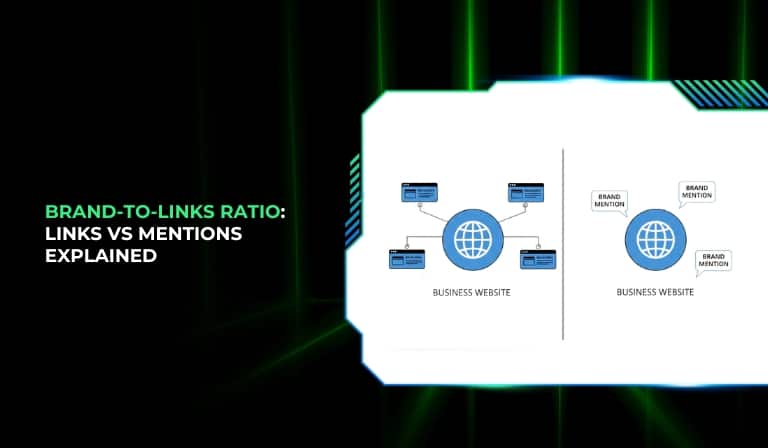
Search engines have changed. A few years ago, backlinks were the strongest signal of authority. Today, search engines also evaluate how often your brand is mentioned across the web, even if those mentions do not contain clickable links.

The Brand-to-Links Ratio (BLR) is a way to understand the balance between how many backlinks your website earns and how often your brand is mentioned online. This balance matters because search engines now analyze authority at both the page level and the entity (brand) level.
In this guide, we will clearly explain backlinks, brand mentions, entity signals, BLR benchmarks, and how to improve your ratio in a natural and sustainable way.
The Evolution of Authority Signals in SEO
Search engine authority signals have evolved over time. Understanding this evolution helps explain why BLR matters today.
The Era of Backlink-Dominated SEO
In the early days of search engines, ranking systems relied heavily on link analysis. Pages that received more links were often considered more authoritative.
- The link graph model mapped connections between websites.
- PageRank used links as votes of confidence.
- The more high-quality links a page had, the higher it could rank.
Backlinks became the foundation of SEO strategy.
Why “Link or Nothing” SEO Is Over
Over time, heavy dependence on links created problems.
- Link manipulation and spam became common.
- Paid link networks distorted authority signals.
- Over-optimized anchor text patterns became detectable.
As a result, search engines improved their systems to detect unnatural link profiles and to evaluate additional trust signals beyond links.
The Rise of Entity-Based Search
Modern search engines understand topics, people, brands, and organizations as entities.
- Search systems now evaluate entity relationships, not just page connections.
- Knowledge panels and entity recognition show structured brand understanding.
- Semantic search allows engines to interpret context, not only keywords.
This shift means brand recognition and mentions contribute to perceived authority.
Backlinks Explained (The Traditional Authority Signal)
Before understanding BLR, we must clearly define backlinks.
What Is a Backlink?
A backlink is a hyperlink from one website to another.
- DoFollow links can pass ranking signals.
- NoFollow links typically do not pass traditional link equity but still provide visibility.
- Editorial links are naturally placed references.
- Manufactured links are artificially created for SEO purposes.
Search engines evaluate the quality and context of each backlink.
How Backlinks Pass Authority
Backlinks contribute to authority in several ways.
- Link equity flows from one page to another.
- Anchor text provides contextual clues.
- Topical relevance strengthens ranking signals.
A backlink from a highly relevant and trusted website carries more value than a random link.
Limitations of Backlink-Only Strategies
Relying only on backlinks can create risks.
- Excessive link building can trigger spam detection.
- Over-optimized anchors may look manipulative.
- Link quantity without brand recognition can appear unnatural.
Modern SEO requires broader signals.
Brand Mentions Explained (The Modern Authority Signal)
Brand mentions are references to your business name across the web.
What Is a Brand Mention?
A brand mention occurs when your brand name appears in content.
- Linked mentions include a clickable hyperlink.
- Unlinked mentions reference your brand without a link.
- Citations may include business details such as name and location.
- Implied links refer to contextual brand references without a hyperlink.
Search engines can detect brand names in text, even without links.
Co-Citation, Co-Occurrence, and Co-Reference
These concepts describe how entities are connected.
- Co-citation occurs when two brands are mentioned together.
- Co-occurrence refers to brands appearing in similar topical contexts.
- Co-reference connects related mentions across content.
When your brand appears alongside established entities, it may strengthen topical association.
Mentions in AI Search and LLMs
AI-driven search experiences rely on entity understanding.
- AI summaries often cite well-known brands mentioned frequently online.
- Repeated brand references reinforce recognition.
- Entity consistency across sources supports credibility.
This increases the importance of brand visibility beyond hyperlinks.
Links vs Mentions — What’s the Real Difference?
Understanding the difference clarifies why balance matters.
Direct Authority vs Implied Authority
Backlinks provide direct link-based signals. Mentions contribute implied authority through brand recognition.
Ranking Impact Comparison
Backlinks have a measurable historical impact on rankings. Mentions contribute indirectly by strengthening entity trust and contextual relevance.
Traffic Impact Comparison
Backlinks can drive referral traffic. Mentions may increase brand searches and direct visits.
Trust & E-E-A-T Signals
Frequent brand mentions can reinforce:
- Expertise
- Authoritativeness
- Trustworthiness
These align with quality evaluation principles used in search systems.
Short-Term vs Long-Term Value
Links may produce faster ranking changes. Mentions build long-term brand equity and recognition.
What Is Brand-to-Links Ratio (BLR)?
Now we define the core concept.
Simple Definition
Brand-to-Links Ratio measures the balance between total brand mentions and total backlinks.
BLR Formula
BLR = Total Brand Mentions ÷ Total Backlinks
This formula helps assess whether your brand presence aligns with your link growth.
Example Calculation (With Sample Data)
If a website has:
- 500 brand mentions
- 250 backlinks
BLR = 500 ÷ 250 = 2.0
This means the brand is mentioned twice as often as it receives backlinks.
Why BLR Signals Natural Growth
A natural brand typically receives both:
- Mentions in discussions
- Links in references
If a website has thousands of backlinks but very few brand mentions, it may indicate unnatural link-building behavior.
2026 Industry Benchmarks: Who Has Stronger Ratios?
BLR varies by industry.
High-Mention Brands (Media, Ecommerce, SaaS)
Established brands often receive:
- Frequent mentions in articles
- Social references
- News coverage
These brands usually have strong brand recognition relative to links.
Link-Heavy but Low-Brand Sites
Some niche affiliate sites may show:
- High backlink acquisition
- Minimal brand recognition
- Limited branded search demand
Such profiles can look unbalanced.
Startups vs Established Brands
Startups typically have:
- Fewer mentions
- Growing link acquisition
Established brands tend to have:
- Higher mention volume
- Stable link growth
High Traffic ≠ High BLR
Traffic alone does not guarantee strong brand presence. A site can receive traffic through search queries without broad brand recognition.
What Is a Healthy Brand-to-Links Ratio?
There is no fixed universal number.
There Is No Perfect Number (And Why)
Industries differ in:
- Media exposure
- PR activity
- Brand awareness levels
Therefore, ratios vary.
Signs Your Ratio Is Too Link-Heavy
- Backlinks grow rapidly but mentions remain low.
- Anchor text patterns are heavily optimized.
- Brand search volume is minimal.
Signs Your Brand Mentions Are Too Weak
- Few references outside your own content.
- Limited media exposure.
- Minimal presence in industry discussions.
Risk Signals of an Unnatural Profile
- Sudden spikes in backlinks without brand growth.
- Excessive identical anchor text.
- Low contextual mentions in authoritative content.
How to Measure Your Brand-to-Links Ratio
Measurement requires tracking both components.
Tracking Backlinks
Use backlink analysis tools to:
- Count referring domains
- Monitor link growth
- Review anchor distribution
Tracking Linked & Unlinked Mentions
Brand monitoring tools can:
- Detect brand name appearances
- Identify media mentions
- Track citation frequency
Brand Visibility Workflow
A practical workflow includes:
- Monthly backlink reporting
- Monthly brand mention tracking
- Ratio calculation
- Competitor comparison
Competitor BLR Analysis
Compare:
- Competitor backlink counts
- Competitor mention frequency
- Relative brand search demand
This provides context for your ratio.
How to Increase Brand Mentions (Without Buying Links)
Brand visibility should grow naturally.
Digital PR
- Publish newsworthy content.
- Share data-driven insights.
- Pitch stories to relevant publications.
Thought Leadership Content
- Publish expert articles.
- Contribute to industry platforms.
- Participate in expert roundups.
Data Studies & Original Research
- Release surveys.
- Publish industry reports.
- Share unique findings.
Original data increases citation probability.
Podcast & Media Appearances
- Appear on industry podcasts.
- Join webinars.
- Participate in interviews.
These activities often generate mentions.
Social Amplification Strategy
- Share content across social channels.
- Encourage discussion.
- Build community engagement.
Higher visibility increases organic mentions.
How to Build High-Quality Links Naturally
Links should support brand growth.
Linkable Assets
- Comprehensive guides
- Tools and calculators
- Visual resources
High-value content attracts references.
Skyscraper Technique
- Identify popular content.
- Create improved versions.
- Promote to relevant audiences.
HARO-Style Outreach
- Respond to journalist queries.
- Provide expert insights.
- Offer clear, concise commentary.
Broken Link Building
- Identify broken references.
- Suggest relevant replacement content.
- Provide value to site owners.
Resource Page Link Building
- Find curated resource lists.
- Request inclusion when relevant.
- Ensure content matches the topic.
The Strategic Implications for SEOs and CMOs
BLR affects broader marketing strategy.
Moving from Link Building to Brand Building
- Invest in authority, not just links.
- Focus on reputation and visibility.
- Strengthen brand recall.
Cross-Channel Visibility
- Align SEO with PR.
- Integrate content marketing.
- Support brand consistency across platforms.
PR + SEO Integration
- Use PR campaigns to earn mentions.
- Convert media exposure into long-term brand recognition.
Content Strategy Alignment
- Produce authoritative content.
- Reinforce brand identity.
- Maintain topical relevance.
Brand-to-Links Ratio in the AI Visibility Era
Search experiences are evolving.
Entity Graph vs Link Graph
Search engines evaluate:
- Entity relationships
- Contextual connections
- Brand consistency
Links remain important, but entity recognition strengthens visibility.
AI Overviews and Brand Citations
AI-driven results often reference recognized brands that are frequently mentioned across reliable sources.
The Role of Consistent Brand Signals
Consistency in:
- Brand name usage
- Messaging
- Industry positioning
Supports entity clarity.
Preparing for the Future of Search
To stay competitive:
- Build real brand recognition.
- Earn editorial mentions.
- Maintain a natural backlink profile.
Conclusion
The strongest SEO strategy does not choose between links and mentions. It balances both. Backlinks provide measurable authority signals that support ranking performance. Brand mentions reinforce entity trust, visibility, and recognition across the web.
A sustainable SEO strategy focuses on building a recognizable brand while earning high-quality, relevant links. When backlinks grow naturally alongside brand visibility, your Brand-to-Links Ratio remains healthy. This balanced approach reduces risk, strengthens authority, and prepares your website for the future of search.