


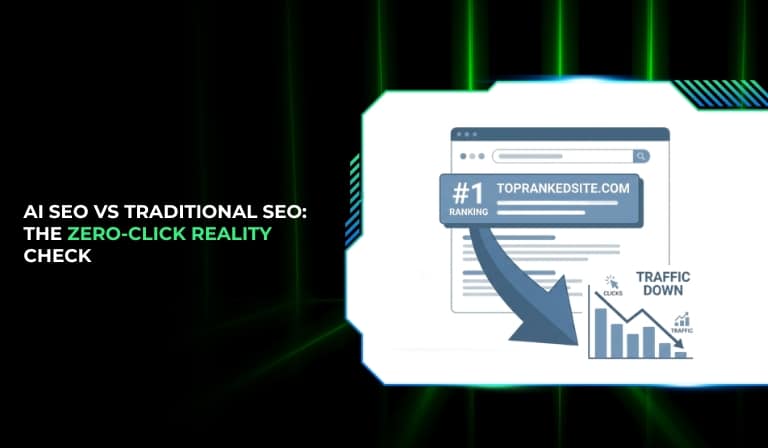
Imagine this: your most important page sits at position one on Google. It has been there for two years. This month, it received fewer clicks than the same time last year — by a significant margin. There is no penalty. There is no manual action flagged in Google Search Console. Your impressions have actually gone up. And yet, traffic is down.
This is not a hypothetical for most SEO practitioners in 2025. It is the operating reality. And it is the direct result of a fundamental shift in what search engines are built to do, and who they primarily serve.
For nearly two decades, SEO operated on a simple, reliable chain of logic: rank higher, earn more clicks, drive more traffic, generate more revenue. That causal chain is fracturing — and it is doing so in a very specific, measurable, and accelerating way.
The thesis of this piece is direct: traditional SEO optimizes for rankings. AI SEO optimizes for answers. And the era of zero-click search — where users receive satisfying answers directly inside the search results page without ever visiting a website — is not an edge case, a temporary quirk, or a problem confined to low-quality content farms. According to SparkToro’s 2024 Zero-Click Search Study, conducted using clickstream data from tens of millions of users via Datos (a Semrush company), out of every 1,000 Google searches performed in the United States, only 360 result in a click to the open web. In the EU, the number is only marginally better at 374. Zero-click is not the future. It is the default behavior of the modern search user, right now.
This blog is for SEO leads, content strategists, and growth marketers who are beginning to question the ROI of workflows that worked extremely well in 2019 but feel increasingly uncertain today. The goal is not to generate alarm, declare the death of traditional SEO, or champion a shiny new framework without evidence. The goal is to show you exactly what the data says, lay out a rigorous, side-by-side comparison of how traditional and AI SEO operate, and give you a concrete hybrid strategy for the world as it actually exists in 2026.
There will be no hype in these pages. Every major claim is backed by research from SparkToro, Seer Interactive, BrightEdge, Semrush, Ahrefs, Pew Research, and others. If a number appears, it came from a specific, verifiable source. If a strategy is recommended, there is a measurable reason behind it.
Let’s begin with how we arrived here.
How We Got Here: The Search Landscape Has Fractured
The modern search results page looks almost nothing like the one that trained the first generation of SEO practitioners. To understand where things stand today, it helps to trace the structural progression of search clearly — not as a story of gradual evolution, but as a series of deliberate architectural decisions by Google that steadily redirected value away from the open web and toward Google’s own ecosystem.
The Timeline of Structural Change
- 2010: Google’s SERP consisted of ten organic blue links and a few text ads. Every position had a roughly predictable click-through rate. Ranking was the only game in town, and it worked.
- 2013: Google’s Knowledge Graph launched, introducing direct answers for factual queries — population figures, celebrity birthdays, unit conversions. For the first time at scale, some searches ended on the SERP itself. Users did not need to click.
- 2015–2018: Featured snippets became commonplace. The concept of “position zero” emerged — content that answered a query so cleanly it was displayed above the first organic result, stealing clicks from the page that earned it. Local packs, shopping carousels, and “People Also Ask” boxes began fragmenting the traditional click flow across a growing variety of query types.
- 2019: BERT (Bidirectional Encoder Representations from Transformers) launched, dramatically improving Google’s ability to understand natural language queries and return more precisely relevant answers, including directly on the SERP in snippet form.
- 2023: Google’s Search Generative Experience (SGE) launched in beta. ChatGPT Search and Perplexity emerged as serious answer-based alternatives to traditional search, capturing significant mindshare among younger users and researchers.
- 2024: AI Overviews launched broadly in the US in May 2024. According to BrightEdge, organic click-through rates dropped 30% year-over-year in the first year of AI Overviews’ widespread rollout. The era of answer-engine competition became undeniable.
- 2025–2026: AI Overviews expanded from appearing in 6.49% of US queries in January 2025 to over 25% of all US queries by early 2026, according to Conductor’s analysis of 21.9 million queries. Google AI Overviews now reach 1.5 billion monthly users across 200+ countries. Gartner projected in 2024 that traditional search engine volume would drop 25% by 2026 due to AI chatbots and virtual agents — and as of early 2026, that trajectory is on course.
The Two Diverging Camps
These changes have created a visible and growing split in the practitioner community. One camp — typically those with strong technical SEO backgrounds, e-commerce clients, or local service businesses — continues to double down on traditional ranking signals: crawlability, Core Web Vitals, backlink authority, schema markup, and keyword targeting. The other camp, increasingly, is pivoting toward what is variously called Answer Engine Optimization (AEO), Generative Engine Optimization (GEO), or AI SEO: structuring content and building brand authority so that AI-powered answer systems choose to extract, cite, and synthesize it.
The tension between these camps is real. Declaring one side the winner would be premature — and this piece will explain precisely why both camps are partially right and partially exposed to significant risk.
Why This Debate Matters Now — Especially for Content
There is a dimension of this story that receives insufficient attention: AI models are not just retrieving information from the web in real time. The large language models that power tools like ChatGPT, Gemini, and Perplexity were trained on vast quantities of indexed content. This means that your content’s role in the information ecosystem has quietly shifted. It is no longer just bait for a click. It is now simultaneously a training signal, a citation source, and a measure of brand authority in the AI layer of the web. The implications for long-term brand equity are significant — and they are still largely unmeasured by most organizations.
Traditional SEO: What It Is, What It Does, Where It Still Wins
Traditional SEO is the practice of improving a website’s visibility in organic search engine results through a structured combination of technical optimization, on-page content signals, and external authority building. It is a mature discipline backed by decades of practitioner knowledge, established tooling, and documented best practices. Before evaluating where it is losing ground, understanding its core architecture is essential.
The Three Core Pillars of Traditional SEO
Traditional SEO rests on three foundational pillars that have remained largely consistent since the discipline emerged, even as the signals within each have grown more sophisticated:
- Technical health: This encompasses crawlability, indexability, site speed, Core Web Vitals, mobile responsiveness, structured data implementation, canonical tags, XML sitemaps, and HTTPS security. Google has confirmed Core Web Vitals as a Page Experience ranking factor — specifically acting as a “tie-breaker” between pages of similar content quality, with sites that pass all three Core Web Vitals thresholds receiving preferential treatment in competitive results. Technical SEO ensures that search engine bots can efficiently discover, render, and understand a site’s content. Without this foundation, no amount of content quality or link authority performs at its potential.
- On-page optimization: This includes keyword targeting and placement, title tags and meta descriptions, heading hierarchy (H1–H6), internal linking architecture, schema markup, content depth and topical coverage, and E-E-A-T signals (Experience, Expertise, Authoritativeness, Trustworthiness). On-page SEO ensures that a given page clearly communicates its subject matter and its relevance to specific queries. Google’s own documentation confirms that content relevance remains the most important ranking factor — Google’s John Mueller has stated publicly that “relevance is still by far much more important” than performance metrics alone.
- Off-page authority (backlinks): Links from external domains signal to Google that a page is credible, trusted, and worth surfacing. The number of referring root domains linking to a page remains one of the highest correlations to organic rankings. According to data from Wellows’ analysis of search engine ranking factors (citing Google Search Central, 2025), backlinks are still among the top three ranking factors — though quality, diversity, and contextual relevance of the link matter significantly more than raw volume.
The Metrics Traditional SEO Owns
The metrics that traditional SEO generates are well-established, directly measurable, and feed into the revenue attribution models that most marketing departments, agencies, and C-suite reporting frameworks are built around:
- Organic ranking position by keyword and page
- Click-through rate (CTR) from the SERP
- Domain authority and page authority scores (Moz, Ahrefs, Semrush equivalents)
- Crawl coverage and indexation rate
- Organic session volume and pages per session
- Conversion rate from organic traffic
These metrics are important because they connect directly to revenue. This directness is one of traditional SEO’s enduring advantages over AI SEO, where the attribution chain is longer and less standardized.
Where Traditional SEO Remains Genuinely Irreplaceable
Despite the growing pressure from AI Overviews and zero-click behavior, traditional SEO retains strong, data-backed effectiveness in specific and commercially significant query categories:
- Local SEO: Ahrefs data from November 2025 confirms that only 7.9% of local searches trigger a Google AI Overview. For businesses with physical locations — restaurants, law firms, dental offices, plumbers, contractors — the Google Local Pack, Google Business Profile optimization, and geotargeted organic rankings continue to drive high-intent, click-through traffic with minimal AI interference. BrightEdge data further confirms that the overlap between AI Overviews and local queries remains the lowest of any major category.
- E-commerce and product discovery: Shopping queries are among the least affected by AI Overviews. Ahrefs’ data categorizes the shopping sector as having an AI Overview share of just 3.2% — the lowest of all sectors measured. Category pages, product detail pages, comparison queries (“best running shoes under $150”), and transactional searches still resolve through traditional clicks in the overwhelming majority of cases.
- Transactional and purchase-intent queries: Semrush research analyzing over 10 million keywords found that 88.1% of queries triggering AI Overviews are informational in nature, not transactional. A user searching “buy CRM software for small business” or “subscribe to meal prep service” is not looking for an AI-synthesized answer. They are looking to convert. Traditional SEO still owns this intent layer.
- Branded and navigational search: Users searching for a specific company, product, or platform by name will click. Brand authority and technical SEO — ensuring that brand entity signals are accurate, that the site is healthy, and that Knowledge Panel information is correct — continue to matter here with minimal AI disruption.
| Query Type | AI Overview Prevalence | Traditional SEO Effectiveness |
| Informational (“how to,” “what is”) | Very high — 88%+ of AI Overviews are informational (Semrush) | Declining — high AI interference |
| Local service queries | Low — 7.9% AIO trigger rate (Ahrefs) | High — still primarily click-driven |
| Transactional / purchase-intent | Low — ~8.9% for transactional keywords (seoClarity, March 2025) | High — conversion still requires a click |
| Branded / navigational | Very low | High — brand searches click through |
| News and current events | Moderate and rising (zero-click hit 69% for news by May 2025) | Declining — news publishers hardest hit |
| Health / medical information | High — 43% of health queries trigger AIO (Ahrefs) | Moderate — E-E-A-T signals provide partial protection |
| Shopping / e-commerce | Very low — 3.2% AIO rate (Ahrefs) | High — purchase flow still requires site visit |
Where Traditional SEO Is Losing Ground
Traditional SEO’s weaknesses in the current environment deserve naming clearly, because practitioners who ignore them are making planning decisions based on a model of the world that no longer reflects reality:
- Slow iteration cycles: A content refresh or link building campaign takes months to show measurable results, at a point in history when search behavior is shifting in weeks. AI Overviews grew from 6.49% of queries in January 2025 to 25.11% by early 2026 (Conductor, 21.9 million queries). The pace of change outstrips traditional SEO’s feedback loops.
- Link-building has become commoditized: Guest post farms, link exchanges, and mass outreach networks have made it increasingly difficult to distinguish organic authority-building from manufactured signals. Google’s own documentation continues to warn against paid link schemes, and algorithm updates have become more aggressive at discounting low-quality link velocity.
- CTR declines even at top positions: According to Ahrefs, AI Overviews reduce clicks to websites by approximately 34.5% overall. When an AI Overview is present, the first organic result is pushed to an average of 1,686 pixels down the page — beyond the visible fold on most standard screen sizes. Being ranked number one no longer guarantees being seen first.
- HCU volatility: Google’s Helpful Content Update of 2023 devastated many sites that had been successfully optimizing for rankings without genuinely serving user intent at depth. Sites that built content strategies around keyword targeting rather than topical authority experienced dramatic drops in visibility.
AI SEO Decoded: Optimizing for Machines That Summarize, Not Rank
AI SEO refers to the practice of structuring content, building brand authority, and distributing credibility signals across the web so that AI-powered answer engines choose to cite, extract, or synthesize your content when constructing their responses. The discipline goes by several names in the industry: AEO (Answer Engine Optimization), GEO (Generative Engine Optimization), or AI visibility optimization. Whatever the label, the underlying objective is the same — not to earn a high ranking position in a list of ten blue links, but to become the trusted source an AI model references when a user asks about your area of expertise.
This is a meaningfully different objective from traditional SEO. Traditional SEO asks: “How do I rank above my competitors for this keyword?” AI SEO asks: “How do I become the source that AI uses when someone asks a question in my category?”
What AI Systems Reward — The Signals That Actually Matter
Understanding what drives AI citation decisions requires separating the AI retrieval layer from the traditional ranking layer. A 2025 analysis of over 680 million citations, published by The Digital Bloom, found that only 4.5% of AI Overview citations directly matched a Page 1 organic URL for the same query — meaning traditional rank is not the primary driver of AI citation. The signals that matter are different:
- Factual precision and direct, extractable answers: AI Overviews and LLMs do not reward content that builds slowly to a conclusion or that hedges extensively before reaching a point. They reward content that delivers a clean, accurate, direct answer early in the text. Research tracking LLM citation patterns found that 44.2% of all LLM citations come from the first 30% of a page’s content. If your introduction spends three paragraphs establishing context before answering the question, the AI retrieval system moves on to the next candidate.
- Structured data and schema markup: FAQ schema, HowTo schema, Article schema, and Person/Author schema all help AI systems parse and understand content efficiently. BrightEdge’s 16-month study (May 2024 to September 2025) found that pages with sequential heading structures and rich schema correlate with 2.8x higher citation rates in AI-generated answers compared to pages without these signals.
- E-E-A-T signals (Experience, Expertise, Authoritativeness, Trustworthiness): The clearest evidence of E-E-A-T’s importance in AI visibility comes from the health sector. Mayo Clinic, Cleveland Clinic, and WebMD all maintained top-25 citation rankings in Google AI Overviews throughout 2025, despite widespread traffic decline across the health publishing category. Their E-E-A-T signals — author credentials, institutional authority, consistent citation in peer-reviewed and government sources — provided protection that keyword optimization alone cannot replicate.
- Brand entity clarity and off-site mentions: A 2025 analysis found that brand mentions had a stronger correlation (0.664) with AI visibility than backlinks (0.218), according to Digital Information World. Ahrefs confirmed in December 2025 that YouTube mentions and branded web mentions are the top factors correlating with AI brand visibility across ChatGPT, AI Mode, and AI Overviews. Separately, Stacker research published December 2025 found that distributing content to a wide range of publications can increase AI citations by up to 325% compared to publishing solely on your own domain.
- Content freshness: AirOps research on 2025 AI citation patterns found that pages not updated in the previous quarter are three times more likely to lose AI citations than recently refreshed pages. More than 70% of all pages currently cited by AI have been updated within the past 12 months. Stale content — regardless of how well it once ranked — falls out of AI rotation quickly once fresher alternatives are available.
- Domain authority remains a significant predictor: SE Ranking’s study of 2.3 million pages found that high-traffic sites earn 3x more AI citations than low-traffic ones, with domain traffic as the strongest predictive factor (SHAP value of 0.63). This means traditional SEO’s work on domain authority is not irrelevant to AI visibility — it feeds into it, even if the relationship is indirect.
The Metrics AI SEO Uses — and How They Differ from Traditional SEO
AI SEO requires a fundamentally different measurement framework. The metrics that matter are:
- AI citation frequency: How often does your brand or content appear in AI-generated answers across Google AI Overviews, Perplexity, ChatGPT Search, and Gemini? This currently requires manual testing, platform-specific tracking tools, and blending Search Console data with brand monitoring platforms.
- Brand mention velocity: How rapidly are third-party sources across the open web referencing your brand in relevant topical contexts? Research confirms that brands earning both citations and mentions show a 40% higher likelihood of reappearing consistently across AI answers (AirOps, 2026).
- Share of voice in AI summaries: When a user asks a question in your industry category, how often does your brand appear in the synthesized answer compared to competitors?
- AI-referred traffic quality: Seer Interactive’s analysis confirmed that brands cited in AI Overviews earn 35% higher organic CTR and 91% higher paid CTR on those same queries compared to non-cited brands. Semrush data from 2025 separately found that LLM visitors convert at 4.4 times the rate of standard organic visitors.
The Honest Weaknesses of AI SEO
Applying the same critical lens to AI SEO as to traditional SEO is essential for practitioners making real budget and resource decisions:
- Measurement is not standardized: There is no universal “AI rank tracker” that functions with the reliability and breadth of tools like Ahrefs or Semrush for traditional rankings. Monitoring AI visibility requires combining manual query testing, AI-specific platforms (such as Conductor’s AI Visibility tools, BrightEdge AI Insights), Google Search Console data, and brand mention monitoring tools. The tooling ecosystem is immature relative to the scale of the problem.
- AI citation attribution is opaque: When your content is cited in an AI Overview, that event does not always appear as a separately filterable signal in Search Console. Determining which specific content earned a citation, and what structural or authority signals drove it, requires laborious cross-referencing. As of June 2025, AI Mode clicks count toward Search Console totals under the “Web” search type without being separately filterable.
- Volatility is extreme: Ahrefs research from November 2025 found that AI Overview content changes for 70% of queries when the same query is run again. When an AI system regenerates an answer, 45.5% of citations are replaced with new sources. Only 30% of brands stay visible from one AI answer to the next for the same query (AirOps, 2026). This means AI citation is not a “set and forget” achievement — it requires ongoing content maintenance and freshness investment.
- ROI timelines are longer and less direct: Building brand entity authority, earning consistent third-party mentions, publishing content that passes AI extractability standards, and maintaining freshness across a content library are all long-cycle investments. The revenue attribution path — from AI citation to brand awareness to eventual conversion — is less direct and harder to model than the traditional organic traffic → conversion path.
| Dimension | Traditional SEO | AI SEO (GEO/AEO) |
| Primary Goal | Rank on the SERP for target keywords | Be cited or synthesized in AI-generated answers |
| Content Format | Long-form, keyword-optimized, topically comprehensive | Answer-first, structured, passage-extractable, entity-clear |
| Key Signal | Backlinks, domain authority, on-page relevance | Brand mentions, E-E-A-T, schema, content freshness, off-site distribution |
| Primary Tool | Ahrefs, Semrush, Google Search Console (ranking view) | Brand monitoring platforms, AI visibility trackers, manual citation testing |
| Measurement | Rank position, CTR, organic sessions, domain authority | AI citation frequency, share of voice in AI answers, AI-referred traffic conversion |
| Timeline | 3–6 months typical to see ranking movements | 6–12 months to build citation-level authority at scale |
| Risk Profile | Algorithm volatility, link penalties, HCU exposure | Citation volatility (70% content change per Ahrefs), opaque attribution |
| Still Relevant in 2026? | Yes — critical for transactional, local, e-commerce queries | Yes — critical for informational queries, brand discovery, and AI-era brand authority |
The Zero-Click Reality Check: What the Data Actually Says
The term “zero-click search” refers to a search session in which the user does not click any result — because the answer was delivered sufficiently on the search results page itself. The behavior is not new; Knowledge Panels and Featured Snippets drove it for years. What is new is the scale, the pace of acceleration, and the depth of AI’s role in making zero-click the statistical norm rather than the exception.
The Numbers Behind Zero-Click — A Full Data Picture
The following data points are drawn from SparkToro, Datos (a Semrush company), BrightEdge, Seer Interactive, Ahrefs, Search Engine Land, and Similarweb. Sources are specified per data point for accuracy:
- In 2024, 58.5% of US searches and 59.7% of EU searches ended without any click to an external website. Out of every 1,000 US searches, only 360 clicks reach the open web (SparkToro / Datos, 2024).
- When a Google AI Overview is triggered on a query, the zero-click rate rises to 83% — meaning 8 in 10 users who see an AI Overview do not click any external link (BrightEdge / Semrush aggregated data, 2025).
- For Google’s AI Mode specifically, the zero-click rate reaches 93% (PushLeads, citing platform data, 2025).
- On mobile, the zero-click rate reaches approximately 77% compared to 47% on desktop (SparkToro / Up & Social, 2025).
- For news-related queries, zero-click outcomes rose from 56% in May 2024 to 69% by May 2025 — a 13-percentage-point increase in 12 months — directly coinciding with the AI Overviews rollout (Similarweb data, reported by TechCrunch).
Zero-Click by Query Category
The impact of zero-click and AI Overview interference is not distributed evenly. It varies significantly by what kind of query a user is performing:
| Query Category | AI Overview Prevalence | Approximate Zero-Click Rate | Traffic Risk Level |
| Science / factual information | 43.6% (Ahrefs, Nov 2025) | Very high | High |
| Health / medical | 43.0% (Ahrefs, Nov 2025) | High | Moderate (E-E-A-T mitigates) |
| News and current events | 15.1% (Ahrefs, Nov 2025) | 69% and rising (Similarweb, May 2025) | High |
| General informational | ~88% of all AIOs are informational (Semrush) | High | High |
| Local searches | 7.9% (Ahrefs, Nov 2025) | Moderate | Low |
| Shopping / e-commerce | 3.2% (Ahrefs, Nov 2025) | Low | Low |
The Visibility Paradox: Brand Impressions Up, Clicks Down
One of the most important and genuinely complex aspects of the zero-click reality is what BrightEdge’s one-year AI Overviews review captured: while CTR dropped 30% year-over-year following AI Overviews’ widespread rollout, impressions increased by 49% over the same period. More users are seeing brand names inside AI-generated answers even as fewer are clicking through to the websites those answers reference.
Whether this constitutes a win, a loss, or something more nuanced depends entirely on the business model. For a SaaS company with strong brand recognition, appearing in an AI Overview that answers “what is the best project management tool for agencies” is brand reinforcement — even if the user does not click. For an ad-supported news publisher whose revenue model requires clicks to generate pageview-based ad revenue, the same AI Overview is devastating.
Who Loses Most from Zero-Click
The businesses and content types most exposed to zero-click damage share a specific profile: they depend on clicks from informational and research-intent queries to fund their operations or fill the top of their conversion funnel.
- Ad-supported publishers and content sites have been hit hardest. According to The Digital Bloom’s analysis, Forbes and HuffPost both recorded approximately 50% traffic losses between mid-2024 and mid-2025. Organic traffic to the top 50 US news websites fell from a peak of 2.3 billion monthly visits in mid-2024 to under 1.7 billion by May 2025 — a loss exceeding 600 million monthly visits in less than one year.
- Affiliate content sites that built their entire traffic base on top-of-funnel informational queries (“best X for Y,” “how to choose Z”) are experiencing their worst algorithmic conditions in search history — the combination of HCU, AI Overviews, and zero-click behavior has compressed their search-visible surface area significantly.
- Education and EdTech companies have also absorbed heavy losses. Chegg reported a 49% decline in non-subscriber traffic comparing January 2025 to January 2024, as AI systems deliver educational answers directly on the SERP.
Who Loses Least from Zero-Click
- SaaS companies with strong brand moats and product-led traffic funnels are less dependent on informational top-of-funnel clicks. Their key conversion queries tend to be branded, transactional, or comparison-based — categories where AI Overviews appear at low rates.
- E-commerce retailers whose traffic is built on shopping and product queries remain substantially protected. The 3.2% AI Overview rate in the shopping category means the traditional click-to-product-page flow is largely intact.
- Local service businesses (lawyers, dentists, home services, restaurants) operate primarily in the local search layer where AI Overview penetration is 7.9% and Local Pack results are still click-driven.
The Citation Economy: Does AI Visibility Lead to Real Business Outcomes?
Seer Interactive’s data provides the most actionable answer on this question. Across 3,119 informational queries and 42 organizations studied between June 2024 and September 2025 — spanning 25.1 million organic impressions — brands that were cited in AI Overviews saw:
- 35% higher organic CTR on those queries compared to non-cited brands
- 91% higher paid CTR on those same queries
Meanwhile, non-cited brands on the same queries suffered the full 65% organic CTR decline that AI Overview presence imposed. One AI citation, in other words, can generate more qualified traffic than holding position three in traditional organic results for the same query.
Adobe’s research separately documented that web traffic from AI-driven referrals increased more than tenfold in the United States between July 2024 and February 2025. While AI referral traffic still represents a modest absolute share of total sessions, Semrush data found LLM visitors convert at 4.4 times the rate of standard organic visitors — making each AI-referred session significantly more commercially valuable.
The Uncomfortable Truth
Neither camp in the traditional vs. AI SEO debate is cleanly winning right now.
Traditional SEO is losing CTR and click volume on its most content-intensive query types — the informational layer that has historically justified massive content investment. AI SEO is gaining measurable influence and driving demonstrably higher-quality traffic where it works, but remains difficult to measure at scale, operationally volatile (AI Overview content changes 70% of the time per Ahrefs), and unproven as a direct, standalone revenue driver for most organizations.
The real loser is the practitioner who ignores both — doubling down purely on traditional rankings in the face of declining CTR, or abandoning proven revenue-driving tactics in pursuit of an optimization paradigm whose attribution model is still being established by the industry.
The Hybrid Strategy: Scoring on Both Boards
A hybrid strategy is not a compromise. It is a recognition that traditional SEO and AI SEO do not compete for the same queries, serve the same user intents, or produce the same downstream outcomes. They are complementary layers that, when aligned correctly, protect existing revenue streams while building the infrastructure for AI-era visibility.
The appropriate allocation of effort between these two layers should be driven by your specific query mix. If the majority of your organic traffic comes from transactional or local queries, AI SEO is relatively low priority in the short term. If your organic traffic is dominated by informational, how-to, or research-intent queries — the categories where AI Overviews appear at rates of 43–88% — then the urgency to build AI visibility infrastructure is considerably higher.
The hybrid framework is organized around four pillars:
Pillar 1 — Protect Your Transactional Core with Traditional SEO
Bottom-of-funnel pages — pricing pages, product pages, comparison pages, and service location pages — still convert through clicks and still benefit directly from traditional SEO investment. Technical hygiene (Core Web Vitals, crawlability, structured data), link equity, and on-page optimization remain directly tied to revenue for these page types.
The data supports continued investment here: Semrush confirmed that transactional queries had an AI Overview rate of approximately 8.9% as of March 2025. Shopping queries sit at 3.2% (Ahrefs). Local queries at 7.9% (Ahrefs). These are the query categories where traditional SEO’s click-to-revenue chain remains largely intact, and where investment has a predictable return profile.
Additionally, Google confirmed that Core Web Vitals function as a “tie-breaker” in competitive results with similar content quality. In saturated categories where multiple brands are optimizing for the same transactional keywords, technical performance — particularly mobile Core Web Vitals — can be the margin of difference.
Pillar 2 — Win Informational Real Estate with AI-First Content
For “what is,” “how to,” “best X for Y,” and question-format queries — where AI Overview interference is highest — content must be restructured for AI extraction, not just for human reading. This means:
- Leading with the direct answer, not building up to it. AI retrieval systems extract from the first 30% of content (per LLM citation analysis). Long contextual introductions push the extractable answer below the AI system’s effective retrieval threshold.
- Using clear question-and-answer formatting within the body of the content, making it structurally obvious what question each passage answers.
- Implementing FAQ and HowTo schema on applicable pages. BrightEdge confirmed that sequential headings and rich schema correlate with 2.8x higher AI citation rates.
- Targeting question-format queries explicitly — Ahrefs data from November 2025 found that 57.9% of AI Overviews are triggered by question-format queries, and 46% are triggered by long-tail queries of 7 words or more.
- Refreshing content on a quarterly basis to avoid the 3x citation-loss penalty for stale pages documented by AirOps.
Pillar 3 — Build Brand Entity Authority
Brand entity authority is the infrastructure that makes AI citations stable and consistent over time. It is built through a set of signals that are distinct from both traditional backlink building and on-page keyword optimization:
- Knowledge Panel optimization: Ensure your brand’s Knowledge Panel data — company description, founding date, leadership, products, social profiles — is accurate and consistent. Discrepancies between your Google Business Profile, Wikipedia entries, Wikidata, and your own website create entity ambiguity that reduces AI systems’ confidence in citing your brand.
- Consistent E-E-A-T author and organization signals: Create and maintain author biography pages with explicit credential signals (degrees, certifications, years of experience, publications). Implement Person schema and Organization schema to make these signals machine-readable. The health sector’s relative resilience in AI citations — Mayo Clinic and WebMD maintaining top-25 citation rankings despite widespread health traffic decline — is directly traceable to the depth of their E-E-A-T infrastructure.
- Third-party brand mentions across authoritative sources: Approximately 85% of brand mentions that inform AI answers originate from third-party pages, not owned domains (AirOps, 2026). Earning mentions in respected industry publications, business directories, community platforms like Reddit and YouTube, and authoritative news sources builds the distributed mention network that AI systems use to verify brand credibility.
- Distributed content publishing: Stacker’s December 2025 research found that distributing content to a wide range of publications increases AI citations by up to 325% compared to publishing solely on your own domain. This makes earned media strategy a direct input to AI SEO performance, not just a PR function.
Pillar 4 — Measure What Matters Differently
The most dangerous measurement mistake in the current environment is continuing to use only traditional SEO metrics — rank, sessions, organic CTR — as the primary indicators of search strategy health. These metrics will increasingly show a picture of apparent stability (stable rankings, even growing impressions) while the underlying traffic and revenue position quietly erodes.
A hybrid measurement framework adds:
- AI citation tracking: Manual monthly testing of your top 30–50 queries across ChatGPT, Perplexity, Google AI Overviews, and Gemini to record whether and how your brand appears. As of 2026, platforms such as Conductor, BrightEdge, and Semrush are building dedicated AI visibility tracking modules.
- Brand mention monitoring: Tools like Mention or BrandWatch track unlinked brand mentions across the web. These are inputs to both brand entity authority building and early signals of growing or shrinking AI visibility.
- GSC click-through delta vs. impression retention: Tracking the gap between impression growth and click retention in Google Search Console at the query level reveals exactly which content areas are experiencing AI Overview displacement. Queries where impressions are growing but clicks are falling are being answered by an AI Overview before the user clicks.
- AI-referred traffic conversion rate: If you are receiving traffic from ChatGPT, Perplexity, or other AI referrers (visible in GA4 and Google Search Console as direct or referral traffic from those domains), tracking the conversion rate of these sessions against organic baseline is essential. Semrush data found LLM visitors convert at 4.4x the organic rate — making even modest AI referral volumes commercially significant.
Where to Start: A 30/60/90-Day Prioritization
Understanding the strategic framework is one thing. Operationalizing it inside a real organization — with finite resources, existing client commitments, and legacy content libraries — requires a sequenced, prioritized execution path. The following 30/60/90-day plan is designed for practitioners who are starting to build hybrid SEO infrastructure from scratch.
Days 1–30: Audit and Triage
The first month is about developing a clear, data-based picture of your current exposure and opportunity — before changing anything.
- Identify your top informational pages by impressions. Use Google Search Console filtered by query type: look specifically for pages receiving high impressions on informational queries (question-format, “how to,” “what is,” “best X”). These are your highest-risk pages for AI Overview displacement and your highest-opportunity pages for AI citation optimization.
- Check which queries are already triggering AI Overviews. For your top 20–30 informational queries, manually run them in Google (or use a tool like BrightEdge or Semrush’s AI Overviews tracker). Record which queries have an AI Overview present, whether your brand appears in the AI Overview, and what sources are being cited instead.
- Flag zero-click queries in Google Search Console. Specifically look for queries where impressions are growing or stable but clicks are declining. This pattern — growing impressions, shrinking CTR — is the signature of AI Overview displacement. These are the queries where restructuring content for AI citation is most urgent.
- Assess schema coverage across your top 50 pages. Use Google’s Rich Results Test to verify which pages have schema markup and which do not. Note which page types are missing FAQ, HowTo, Article, or Author schema.
Days 31–60: Restructure and Signal
The second month is about making targeted, evidence-based changes to existing content and technical infrastructure — not creating new content from scratch.
- Reformat top informational content for passage-level extraction. For each page identified in the audit as a high AI-Overview-displacement candidate, restructure the content so that the direct answer to the primary query appears in the first 200–300 words. Add a clear “quick answer” or introductory direct response before the full explanation. This change alone addresses the finding that 44.2% of LLM citations come from the first 30% of a page.
- Add FAQ schema to informational pages. For pages covering topics that users frequently ask follow-up questions about, add structured FAQ markup with specific question-and-answer pairs. BrightEdge’s data confirms this directly correlates with a 2.8x improvement in AI citation rate.
- Build or strengthen author bios with credential signals. For every piece of content on high-AIO-risk pages, ensure the author has a dedicated author page that includes: full name, professional credentials, years of experience, areas of expertise, and links to external validation (LinkedIn, published work, certifications). Implement Person schema on author pages.
- Submit updated pages to Google’s URL Inspection tool and request re-indexing to ensure that restructured pages are re-crawled and updated data is available to AI Overviews.
Days 61–90: Measure and Iterate
The third month is about establishing a repeatable measurement cadence and identifying what is working before scaling investment further.
- Set up brand mention monitoring. Configure a tool such as Mention, BrandWatch, or Google Alerts to track your brand name across the open web, including Reddit, industry forums, YouTube (via transcript indexing), and news sources. This monitoring serves two functions: it provides data on your current brand mention volume as an AI citation input, and it flags inaccurate brand information circulating in the wild that could create entity confusion.
- Track your GSC click-through delta vs. impression retention at query level. Pull a month-over-month comparison for your top 50 informational queries: are impressions growing while clicks are falling? If so, what is the magnitude of the gap? This becomes your baseline measurement for evaluating whether content restructuring in Month 2 is having an effect on AI citation and CTR.
- Measure branded search volume shift. Use Google Search Console (branded queries filtered) and Google Trends to track whether branded search queries are increasing. AI citation can drive downstream branded search lift — users who encounter your brand in an AI Overview and search for it directly later. This is one of the clearest measurable expressions of the “impressions up, clicks down” paradox working in your favor.
- Conduct a manual AI visibility audit across platforms. Run your top 30–50 queries across ChatGPT, Perplexity, Google AI Overviews, and Gemini. Record: does your brand appear? Is it cited? What position in the answer does it occupy? Compare results to the baseline from Month 1. This manual audit becomes a monthly recurring process.
Quick Win: Rewrite Meta Descriptions as Direct Answers
One of the most underutilized and highest-leverage tactics for simultaneous traditional SEO and AI SEO improvement is meta description optimization. Meta descriptions do not directly affect organic rankings, but they serve as mini-summaries that Google’s systems read when constructing featured snippets and, increasingly, AI Overview passage candidates. A meta description written as a direct answer — “SEO copywriting is the practice of writing web content optimized for both search engine ranking signals and human readability, with the goal of driving organic traffic that converts” — is both more compelling for human click-through and more extractable for AI systems than generic descriptions like “Learn everything about SEO copywriting in our comprehensive guide.”
This requires no new content creation, no schema implementation, and no technical infrastructure change. It is a single pass through your highest-impression pages that improves performance across both layers of the search ecosystem simultaneously.
Conclusion
The shift that has been documented throughout this piece is not a temporary algorithm cycle that will reverse when Google updates its guidelines. It is a structural change in the architecture of search itself — one driven by user behavior, AI capability growth, and the commercial incentives of the platforms that control search distribution.
The data is unambiguous: out of every 1,000 searches performed in the United States today, only 360 result in a click to the open web. When an AI Overview is present, 83% of sessions end without a click to any external website. Organic CTR for informational queries where AI Overviews appear has fallen 61% since mid-2024, according to Seer Interactive’s study of 3,119 queries across 42 organizations. These are not rounding errors. They represent a fundamental re-routing of value away from content creators and toward AI-mediated answer delivery.
And yet the organizations that respond to this shift by abandoning search strategy altogether, or by retreating purely to transactional SEO, will also suffer — because the AI-era web is simultaneously creating a new kind of visibility that carries genuine commercial value. Brands cited in AI Overviews earn 35% higher organic CTR and 91% higher paid CTR on those queries. LLM-referred visitors convert at 4.4 times the rate of standard organic traffic. The citation economy is real, it is measurable, and it rewards brands that invest in entity authority, structured content, and distributed credibility.
The synthesis this piece has argued for is direct: rankings measure visibility. Citations measure influence. The SEO team that only chases Page 1 in 2026 is making the same strategic error as the marketing team that measured only television ratings in 2010 — optimizing for a metric that was once a reliable proxy for impact, long after the underlying mechanism of impact has changed.
The answer is not to abandon traditional SEO. It is to expand the definition of search success. Protect your transactional core with rigorous technical SEO. Win informational real estate by restructuring content for AI extraction. Build brand entity authority through distributed publishing and E-E-A-T signals. And measure both layers — rank and citation, sessions and AI share of voice — so you can see the full picture of how your brand performs in the search ecosystem as it actually exists.
Zero-click is not the death of SEO. It is the maturation of it. The discipline is evolving from a traffic-acquisition function into a brand-authority infrastructure function. The organizations that recognize that shift now, and build accordingly, will own digital discovery in the AI era. The ones that don’t will find themselves in the same position as the practitioner who ranked number one and wondered where all the traffic went.