


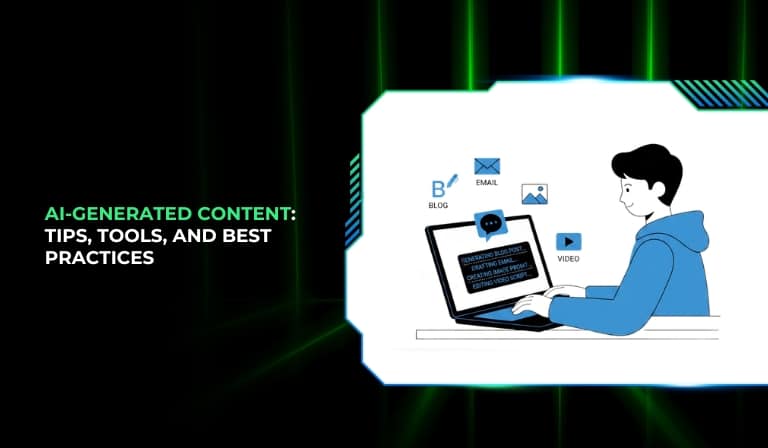
AI-generated content means content created with the help of artificial intelligence tools. Today, many businesses, marketers, and creators use AI tools to write blogs, social media posts, emails, product descriptions, and even create images and videos. The growth of AI tools has made content creation faster and more scalable than before.

As digital competition increases, brands need more content across websites, social platforms, and email campaigns. AI tools help reduce time and effort, but they must be used properly to maintain quality. In this guide, you will learn what AI-generated content is, its benefits and risks, popular tools, SEO impact, best practices, and how to use it responsibly.
What Is AI-Generated Content?
AI-generated content is content produced by software powered by machine learning models. These systems are trained on large datasets and learn patterns in language. When you give a prompt, the AI predicts and generates relevant text, images, or other media.
AI tools do not think like humans. They analyze patterns and generate responses based on probability and training data.
Types of AI-generated content include:
- Blog posts
- Social media captions
- Emails
- Product descriptions
- Ad copy
- Images
- Videos
It is important to understand the difference between AI-assisted and fully AI-generated content:
- AI-assisted content: A human creates the strategy and structure, and AI helps with drafting or improving sections.
- Fully AI-generated content: The entire content is produced by AI with minimal human editing.
Most successful businesses use AI-assisted workflows instead of publishing raw AI output.
Benefits of AI-Generated Content

AI-generated content offers several practical advantages when used properly.
- Saves time and effort: AI can create drafts in minutes, reducing writing time significantly.
- Improves productivity: Teams can produce more content in less time.
- Scales content production: Businesses managing multiple websites or platforms can create content at scale.
- Reduces content costs: AI tools can lower the cost compared to hiring large content teams.
- Helps with idea generation: AI can suggest topics, outlines, and angles.
- Supports SEO and keyword expansion: AI can include related keywords and semantic variations.
- Enables personalization at scale: AI systems can generate multiple versions of content for different audiences.
These benefits are most effective when AI is guided by clear strategy and human oversight.
Limitations and Risks of AI-Generated Content

Although AI offers many benefits, it also has limitations.
- Lack of original thinking: AI does not have real-world experience or personal insights.
- Risk of inaccurate information: AI may generate outdated or incorrect facts if not verified.
- Generic or repetitive content: Without strong prompts, outputs may sound similar to other AI-generated pieces.
- SEO risks: Publishing thin or low-value AI content may reduce content quality and performance.
- Ethical concerns and plagiarism: AI content may unintentionally resemble existing material.
- Over-reliance on automation: Depending only on AI can weaken brand differentiation.
- Brand voice inconsistency: AI may not automatically match a brand’s tone without guidance.
Understanding these risks helps businesses build a balanced AI content strategy.
Popular AI Content Creation Tools

There are many AI tools available for text, images, and multimedia creation.
Text-Based AI Tools
- ChatGPT is widely used for drafting blog posts, brainstorming ideas, and writing marketing content.
- Jasper focuses on marketing copy and brand voice customization.
- Copy.ai helps generate short-form marketing content.
- Writesonic supports blog writing, ads, and landing pages.
- Grammarly assists with grammar, tone, and clarity improvements.
AI Image Generation Tools
- Midjourney creates AI-generated artistic images from text prompts.
- DALL·E generates images based on descriptive prompts.
- Canva includes AI-based design and content features.
AI Video & Multimedia Tools
- Synthesia creates AI-generated videos with digital avatars.
- Pictory converts text into short videos.
- Descript supports audio editing, transcription, and AI voice features.
Choosing the right tool depends on content goals and workflow needs.
How AI-Generated Content Impacts SEO
AI-generated content can impact SEO positively or negatively depending on quality.
Google has stated that content quality matters more than how it is produced. The key factor is whether content is helpful, relevant, and user-focused.
Important SEO considerations include:
- Focus on helpful, people-first content
- Follow E-E-A-T principles (Experience, Expertise, Authoritativeness, Trustworthiness)
- Avoid publishing low-quality or spam-like content
- Ensure factual accuracy
AI content that is edited, improved, and aligned with user intent can perform well in search results. However, unedited bulk content may harm performance.
Best Practices for Creating High-Quality AI Content
Using AI effectively requires a clear process.
1. Always Start With Clear Prompts
Clear prompts produce better results.
- Define topic, audience, tone, and format
- Specify word count and structure
- Include target keywords
A structured prompt helps AI understand expectations.
2. Add Human Editing
Human review is essential.
- Fact-check all claims
- Add real insights and examples
- Improve readability and flow
Editing ensures quality and originality.
3. Maintain Your Brand Voice
Consistency builds trust.
- Create a style guide
- Provide sample content for tone matching
- Adjust outputs to match brand personality
4. Optimize for SEO
SEO should be part of the workflow.
- Conduct keyword research first
- Use headings properly
- Add internal and external links
- Improve meta titles and descriptions
5. Avoid Plagiarism and Duplicate Content
- Use plagiarism detection tools
- Rewrite and enhance generic sections
- Add unique perspectives
6. Combine AI With Human Creativity
- Use AI for drafting and research support
- Use humans for strategy, storytelling, and final approval
This balanced approach improves performance and credibility.
Step-by-Step Process to Create AI-Generated Blog Content
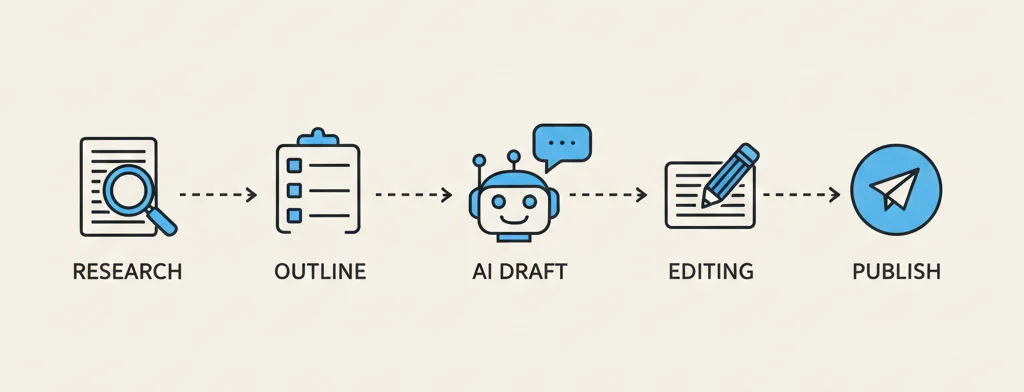
A structured workflow improves results.
- Define topic and search intent
- Conduct keyword research
- Create a detailed outline
- Generate the first draft using AI
- Edit and improve content manually
- Optimize for SEO elements
- Add images and supporting media
- Perform final review and publish
Following these steps ensures content quality and alignment with goals.
AI-Generated Content Use Cases by Industry
Different industries use AI differently.
- E-commerce: Product descriptions and category content
- Digital marketing agencies: Blog writing and ad copy
- Bloggers and publishers: Content scaling
- SaaS companies: Landing pages and help documentation
- Educational platforms: Course descriptions and summaries
- Startups and small businesses: Cost-effective content creation
Each industry must still maintain quality control and accuracy.
Ethical Considerations in AI Content Creation
Ethical use of AI is important for trust and credibility.
- Transparency: Businesses may choose to disclose AI assistance where appropriate.
- Copyright issues: Ensure content does not copy existing material.
- Bias in AI models: AI systems can reflect biases from training data.
- Responsible AI usage: Avoid misleading or harmful content.
- Data privacy: Do not input sensitive data into AI tools without understanding policies.
Responsible use builds long-term brand trust.
AI-Generated Content vs Human-Written Content
AI and human writing each have strengths.
- Speed: AI produces drafts quickly.
- Creativity: Humans provide deeper originality and storytelling.
- Accuracy: Humans can verify and validate facts.
- Emotional connection: Human writers understand audience emotions better.
- Cost: AI may reduce production costs.
- Scalability: AI enables large-scale content generation.
Best results come from combining AI efficiency with human expertise.
Conclusion
AI-generated content has changed how businesses create digital content. It helps save time, scale production, and support marketing efforts. However, it is not a replacement for human creativity, expertise, or strategy.
The most effective approach is to use AI as a tool. Combine structured prompts, human editing, SEO optimization, and ethical practices to create high-quality content. When used responsibly, AI-generated content can become a powerful part of a sustainable digital strategy.