


Businesses are under constant pressure to do more with less—faster operations, better customer experiences, and smarter decision-making. Over the past few years, automation has evolved from simple rule-based systems to advanced AI-driven workflows. Today, companies are not just asking “what can we automate?” but “what should we automate using AI?”

This shift has introduced new terms like AI agents and agentic AI, which are often misunderstood or used interchangeably. Many teams adopt these technologies without fully understanding their differences, leading to poor results, wasted budgets, or unnecessary risks.
This guide is designed to remove that confusion. It explains how traditional automation, AI agents, and agentic AI work, where each one fits, and how to choose the right approach based on your business needs.
What Is Traditional Automation?
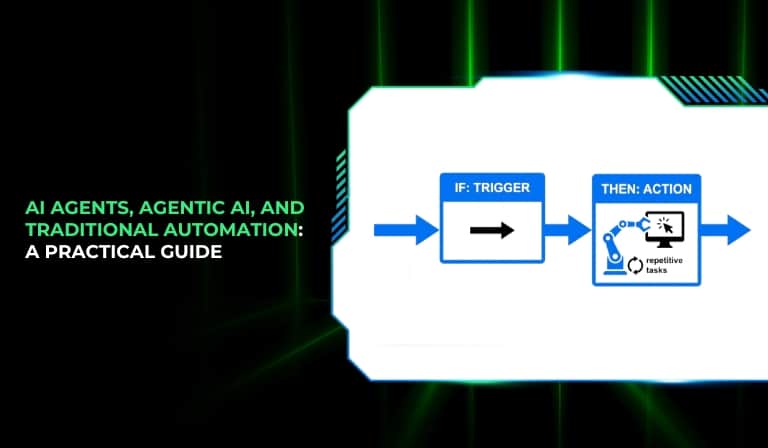
Traditional automation refers to systems that follow predefined rules to perform tasks. These systems operate based on clear instructions and do not make decisions beyond what they are programmed to do.
- Rule-based logic such as “if X happens, then do Y”
- Works best in stable and predictable environments
- Commonly implemented using scripts, workflows, or RPA tools
Examples include:
- Automatically sending emails after a form submission
- Updating CRM records when a lead is created
- Processing invoices with fixed formats
Key benefits:
- High reliability and consistency
- Low risk of unexpected outcomes
- Cost-effective for repetitive tasks
Key limitations:
- Cannot adapt to changes without manual updates
- Fails when inputs vary or are unstructured
- No understanding of context or intent
What Are AI Agents?
AI agents are systems designed to achieve specific goals by processing information, making decisions, and taking actions. Unlike traditional automation, they can interpret context and handle variability.
- Operate using input → reasoning → action flow
- Use machine learning and language models
- Can handle unstructured data like text or conversations
Types of AI agents include:
- Task-based agents for specific workflows
- Conversational agents for interaction
- Semi-autonomous agents with limited decision authority
Examples:
- Customer support bots that understand queries
- Sales assistants that personalize outreach
- Research agents that summarize information
Strengths:
- Ability to understand language and context
- Flexible and adaptable to new scenarios
- Can improve efficiency in complex tasks
Limitations:
- May produce inconsistent or incorrect outputs
- Requires monitoring and validation
- Performance depends on data quality
What Is Agentic AI?
Agentic AI refers to systems that can independently plan, execute, and optimize tasks over multiple steps. These systems go beyond individual actions and focus on achieving broader goals.
- Combines planning, reasoning, and execution
- Can use multiple tools and data sources
- Often includes memory and feedback loops
Key characteristics:
- High level of autonomy
- Ability to break tasks into smaller steps
- Continuous learning and adjustment
Examples:
- AI systems managing full marketing campaigns
- Autonomous tools optimizing ad budgets in real time
- Multi-agent systems coordinating different tasks
Agentic AI is more powerful but also more complex, requiring strong governance and oversight.
AI Agents vs Agentic AI vs Traditional Automation (Simple Comparison)
These three approaches differ mainly in how they handle decisions and complexity.
- Traditional automation follows fixed rules with no flexibility
- AI agents introduce decision-making within defined boundaries
- Agentic AI manages entire workflows with minimal human input
A simple analogy:
- Traditional automation is like a machine following instructions
- AI agents are like assistants making decisions
- Agentic AI is like a manager planning and executing tasks
Key Differences Explained (Deep Dive)
Deterministic vs Probabilistic Systems
Traditional automation is deterministic, meaning the same input always produces the same output. AI systems are probabilistic, meaning outputs can vary based on interpretation.
Rules vs Reasoning
Automation relies on predefined rules. AI agents and agentic systems use reasoning to interpret situations and decide actions.
Static Workflows vs Dynamic Decision-Making
Automation workflows remain fixed. AI systems adapt based on context and inputs.
Human Control vs System Autonomy
Automation requires full human control. AI agents require supervision. Agentic AI can operate independently within defined limits.
Scalability and Adaptability
Automation scales well but struggles with change. AI systems handle change better but require monitoring.
Where Traditional Automation Still Wins
Traditional automation remains highly effective in many scenarios.
- Tasks that are repetitive and structured
- Processes with zero tolerance for errors
- Environments with strict compliance requirements
- Operations where cost efficiency is critical
Examples include payroll processing, data entry, and system integrations.
Where AI Agents Perform Better
AI agents are more suitable when tasks involve variability and context.
- Understanding natural language
- Personalizing communication
- Analyzing data and generating insights
- Handling customer interactions
They are especially useful in marketing, sales, and support functions.
Where Agentic AI Fits Best
Agentic AI is ideal for complex workflows that require coordination and ongoing optimization.
- Multi-step processes across systems
- Real-time decision-making environments
- Continuous improvement tasks
- Cross-channel execution
These systems are often used in advanced marketing operations and large-scale enterprise workflows.
Costs, ROI, and Business Economics
Different approaches come with different cost structures.
- Traditional automation has low setup and maintenance costs
- AI agents require investment in tools, training, and monitoring
- Agentic AI involves higher upfront costs and infrastructure
Hidden costs may include:
- Monitoring and validation
- Error correction
- Integration complexity
ROI considerations:
- Automation delivers quick and predictable returns
- AI agents provide medium-term efficiency gains
- Agentic AI offers long-term strategic value
Risks, Reliability, and Limitations
Risks of Traditional Automation
- Breaks when processes change
- Limited flexibility
Risks of AI Agents
- Inaccurate or inconsistent outputs
- Dependence on data quality
Risks of Agentic AI
- Reduced control over decisions
- Potential for large-scale errors
- Difficulty in debugging and monitoring
Security, Compliance, and Governance
As systems become more autonomous, governance becomes critical.
- Sensitive data handling must be controlled
- Regulatory requirements must be followed
- Systems should include audit trails
Human oversight is essential, especially for high-risk decisions. Organizations must define clear boundaries for AI behavior.
How to Choose the Right Approach (Decision Framework)
1. Is the task repetitive and predictable?
If yes, traditional automation is the best choice.
2. Does it require understanding or judgment?
If yes, AI agents are more suitable.
3. What is the risk if something goes wrong?
High-risk tasks require more control and human oversight.
4. Can all scenarios be predefined?
If not, AI-based systems are needed.
5. How often does the process change?
Frequent changes favor AI solutions.
6. What level of control is required?
Higher control needs lean toward automation.
Simple Decision Tree (Easy Explanation)
- Fixed and predictable tasks → Traditional automation
- Tasks requiring context → AI agents
- Complex, multi-step workflows → Agentic AI
This simple approach helps businesses avoid overcomplicating their systems.
Industry Use Cases
Marketing
- Campaign optimization
- Personalized messaging
- Budget allocation
Sales
- Lead qualification
- Outreach automation
- Follow-up management
Customer Support
- Query handling
- Ticket routing
- Response generation
Finance & Operations
- Invoice processing
- Fraud detection
- Reporting
IT & Internal Operations
- Workflow automation
- Incident management
- System monitoring
How Agentic AI Works Across the Marketing Funnel
Awareness (Content + Ads)
AI systems create and distribute content across channels.
Consideration (Personalization + Retargeting)
They adjust messaging based on user behavior.
Conversion (Offers + Timing Optimization)
They optimize offers and timing to improve conversions.
Retention (Lifecycle Automation)
They manage long-term engagement and customer relationships.
Implementation Roadmap (Step-by-Step)
Step 1: Fix broken processes first
Ensure workflows are clear and efficient.
Step 2: Start with traditional automation
Automate repetitive tasks first.
Step 3: Introduce AI for decision layers
Add AI where interpretation is needed.
Step 4: Add human oversight
Keep humans involved in critical decisions.
Step 5: Gradually move to agentic systems
Scale autonomy carefully.
Step 6: Measure and optimize continuously
Track performance and improve over time.
Conclusion
Choosing between traditional automation, AI agents, and agentic AI is not about picking the most advanced option. It is about selecting the right tool for the right task. Each approach has its strengths, limitations, and ideal use cases.
Businesses that succeed are those that start simple, understand their processes clearly, and adopt AI gradually. Instead of chasing trends, focus on solving real problems with the right level of intelligence and control.
The future is not about replacing systems—it is about combining them intelligently to create efficient, scalable, and reliable workflows.
Frequently Asked Questions (FAQs)
What is the difference between AI agents and automation in one sentence?
Automation follows rules, while AI agents make decisions based on context.
Is agentic AI the same thing as an AI agent?
No, agentic AI involves higher autonomy and multi-step planning.
Does agentic AI replace RPA?
No, it complements RPA by adding intelligence to workflows.
When should a company choose traditional automation over AI agents?
When tasks are repetitive, predictable, and require high accuracy.
When do AI agents make the most sense?
When tasks involve understanding, interpretation, or variability.
What kinds of tasks should never be fully autonomous?
High-risk tasks involving financial, legal, or critical decisions.
Are AI agents more cost-effective than traditional automation?
Not always; they depend on use cases and implementation.
Why do some AI agent pilots fail to produce ROI?
Due to unclear processes, poor data, or lack of monitoring.
Can AI agents work in regulated industries?
Yes, but with strong governance and compliance controls.
What is a hybrid automation model?
A combination of automation, AI, and human oversight.
Do AI agents learn automatically from every action?
Not always; learning depends on system design.
What is the biggest operational risk with agentic AI?
Loss of control and unexpected decision outcomes.
How should companies measure success for AI agents?
Through efficiency, accuracy, and business impact.
Do AI agents need clean data?
Yes, data quality directly affects performance.