


Facebook doesn’t charge you a single rupee to use it, yet Meta pulled in about $135 billion in revenue in 2023, and roughly 97 to 98 percent of that came from ads. Read that again. A product that costs users nothing built one of the biggest advertising machines on earth. That’s the weird part, and it’s exactly why the marketing mix of Facebook is one of the most assigned, most misunderstood case studies in any marketing class.

Most students open a textbook, copy the definition of the 4Ps, write “Facebook is free” under Price, and move on. The result reads like it could describe any company. It misses the real story, which is that Facebook sells to two completely different customers at the same time. Regular people get the product for free. Advertisers pay for access to those people. Every decision about product, price, place and promotion bends around that split.
This guide walks through the marketing mix of Facebook the way a working marketer would see it. You’ll get the classic 4Ps, the extended 7Ps, real numbers, real product flops, and a practical section on how a small business can borrow the same thinking. If you’re writing an assignment, you’ll finish with enough material to stand out. If you run ads, you’ll understand why the platform behaves the way it does.
What You Will Learn in This Guide
- What the marketing mix is, and why applying it to Facebook is trickier than applying it to a normal product company
- How Facebook’s product line works, from the main app to Groups, Marketplace, Reels, Messenger and the ad tools
- How pricing really works when users pay nothing and advertisers pay through an auction
- How Facebook distributes itself through apps, Lite versions, web and global partnerships
- How Facebook promotes itself, and how it makes you promote it for free
- How people, process and physical evidence (the extended 7Ps) apply to a digital platform
- How to use the same marketing mix thinking for your own business or assignment
- Where the model shows its weak spots, plus the mistakes that cost students marks
TL;DR
- Facebook has two customers: users who pay with attention and data, and advertisers who pay cash through an auction.
- The product is not just the blue app. It is a family: Facebook, Messenger, Instagram, WhatsApp, Groups, Marketplace, Reels and the ad stack.
- Price is zero for users and dynamic for advertisers, set by bid, estimated action rate and ad quality.
- Place means reach: billions of phones, Lite versions for weak networks, and a heavy dependence on Apple and Google app stores.
- Promotion is mostly built into the product itself through network effects, with occasional TV campaigns when trust takes a hit.
- The 7Ps add people, process and physical evidence, where the ranking algorithm and the ad review system matter more than any office.
What Is the Marketing Mix of Facebook and Why Does It Matter?
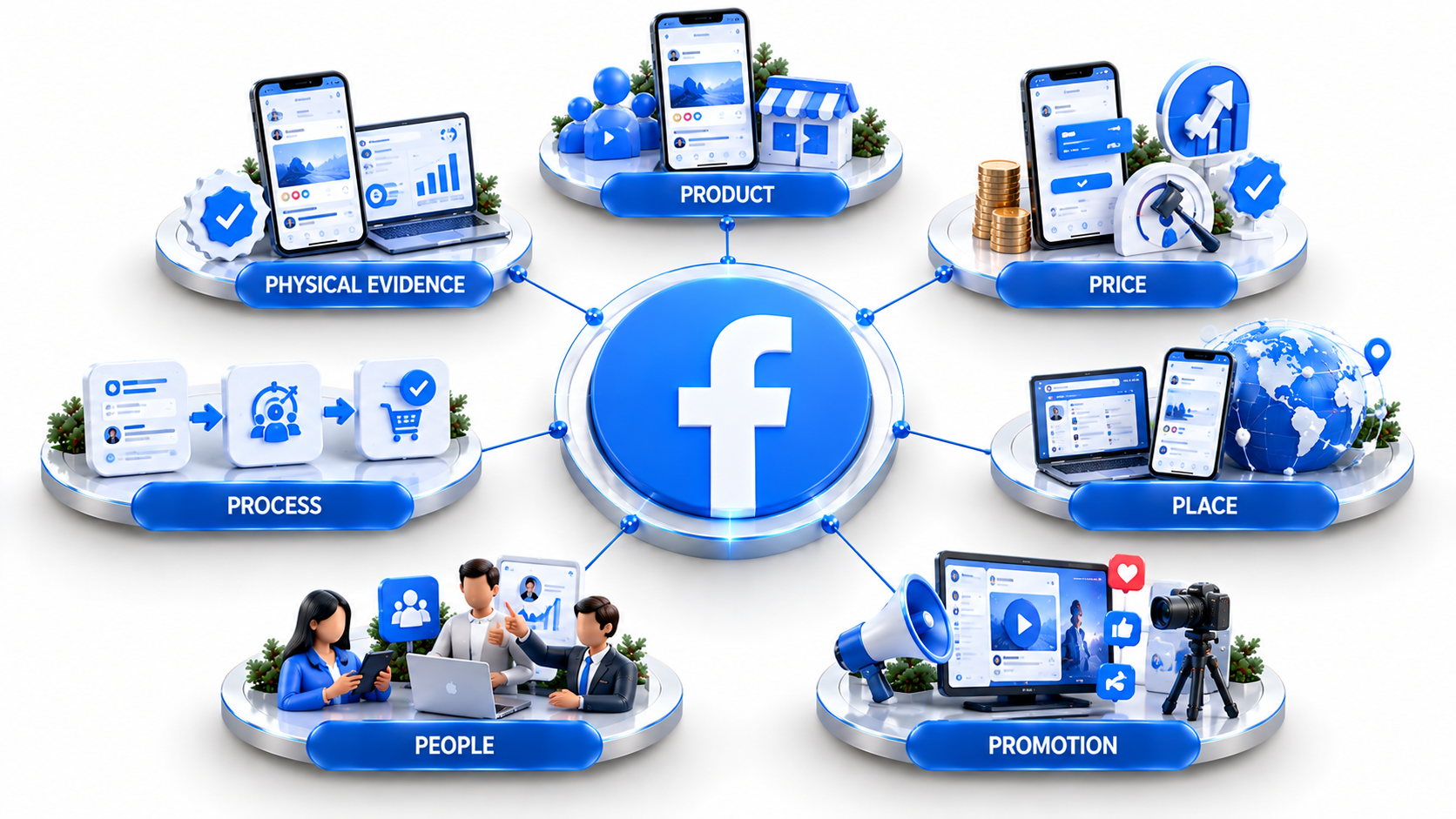
The marketing mix of Facebook is the set of decisions Meta makes about its product, price, place and promotion, plus people, process and physical evidence, to attract users and sell advertising. It is a framework for explaining how one company turns free social networking into a paid business. Think of it as a checklist for reading Facebook’s strategy.
The 4Ps in plain language
The 4Ps came out of Jerome McCarthy’s work in 1960 and got popular through Philip Kotler. Product is what you sell. Price is what it costs. Place is where and how people get it. Promotion is how people find out about it. Simple enough, and every business makes these four calls whether it thinks about them or not.
Here’s the catch for beginners: the 4Ps were built for physical goods like soap, shoes and scooters. A bar of soap has one buyer and one price tag. Facebook doesn’t. When you try to force a social network into that neat box, you have to decide who the customer is first, and that decision changes every answer that follows.
Why Facebook breaks the usual model
Facebook runs what economists call a two-sided market. One side is billions of users. The other side is millions of advertisers. Neither side is worth much without the other. Advertisers pay because users are there. Users show up because friends, family and content are there, and the ads quietly pay for the whole thing.
So when someone asks “what is Facebook’s product?”, the honest answer is two answers. To a user, the product is connection and entertainment. To an advertiser, the product is targeted attention. Good assignments say this early and then split each P into a user version and an advertiser version. That one move puts you ahead of most submissions.
The 7Ps extension and when to use it
Services need more than four Ps, which is why Booms and Bitner added people, process and physical evidence in 1981. Facebook is a service, not a bottle of shampoo. The experience depends on software, moderation staff, support flows and trust signals like verified badges.
Use the 4Ps when your word limit is tight or the teacher asks for the classic model. Use the 7Ps when you want depth, which usually means a university project or a serious case study. This guide covers both, so you can pick what fits and trim the rest.
Product Strategy
The product side of the marketing mix of Facebook covers everything Meta ships to users and advertisers: the core social network, the messaging apps, Groups, Marketplace, video, and the tools businesses use to buy ads. The strategy is to keep adding surfaces where people spend time, because every minute of attention can be sold.
The core social network
The original idea from 2004 was simple. Thefacebook started at Harvard, then spread to other Ivy League schools, then to every university, and finally to anyone with an email address in 2006. The Facebook app today is a News Feed, profiles, friends, events, Pages, Groups and Stories, all stitched together.
The feed is the real product. Everything else feeds it or hangs off it. Since 2018, when Meta announced its “meaningful social interactions” shift, the feed leans harder on posts from friends and Groups. Lately it leans even more on recommended content from accounts you don’t follow, which looks suspiciously like how TikTok works.
The family of apps
Facebook is one app inside a portfolio. Meta bought Instagram in 2012 for about $1 billion and WhatsApp in 2014 for roughly $19 billion. Messenger split from the main app in 2014. In 2023 Threads arrived as a text-based Instagram sibling. Each app targets a different habit, age group or country.
Why does this matter for the marketing mix? Because the portfolio is a defense strategy. A teenager who drifts from Facebook to Instagram is still inside Meta. A shopkeeper in Surat who lives on WhatsApp can still be sold click-to-WhatsApp ads. Product strategy here means owning the habit, not just the logo.
Groups, Marketplace, Pages and Reels
Beyond the feed, a handful of features carry most of the weight. Groups gives communities a home, and Meta has said well over a billion people use them every month. Marketplace launched in 2016 as a local classifieds product. Pages give brands a free storefront. Reels, added in 2021, is Facebook’s answer to short video.
Each one solves a different problem. Groups handle belonging. Marketplace handles buying and selling used stuff, which beat OLX and Craigslist habits in a lot of cities. Pages handle brand presence. Reels handle boredom. When you write about product, name specific features like these. “Various features” earns zero marks.
The advertiser product stack
Here’s where the money lives. Meta Ads Manager lets a business set an objective, pick an audience, upload creatives and watch results. The Meta Pixel and the Conversions API track what people do after clicking. Advantage+ campaigns automate audience and placement choices. Meta Business Suite handles organic posting and inbox management.
For the advertiser, this is the product. The pitch is targeting plus measurement: you can reach women aged 25 to 34 interested in handloom sarees within 20 kilometres, then see how many bought. Pull this out as its own paragraph in any assignment, because textbooks often forget the ad tools exist.
Product flops that show the strategy
Not everything worked. Facebook Home, a launcher for Android phones, arrived with the HTC First in 2013 and vanished within months. Meta’s Portal video-calling hardware was discontinued in 2022. The Libra cryptocurrency project, announced in 2019, was renamed Diem and then shut down in 2022 under regulatory pressure.
These failures are useful in an assignment because they show the product mix is a set of experiments. Meta tries ideas, kills what doesn’t stick and pours resources into what does. The Reels push is the current example, with Meta openly copying a competitor’s format and then using its enormous user base to give it distribution on day one.
Pricing Strategy
Pricing in the marketing mix of Facebook has two layers. Users pay nothing in money. Advertisers pay through a live auction where price moves with competition, audience quality and ad performance. Smaller layers include subscriptions like Meta Verified and fees on certain commerce features.
Free for users, but not really
Download Facebook and no card is asked for. That zero price is the whole growth strategy, because a network is only useful when everyone you know is on it, and nobody joins a paid network if their friends aren’t there yet. Free removes the first barrier.
But there’s a cost. Users pay with time, attention and personal data. Interests, location signals, device details and behavior inside the app feed the ad system. The old line “if you’re not paying, you’re the product” is a bit blunt, though it explains the model. Assignments should state this clearly rather than pretending the price is simply zero.
How the ad auction sets prices
Advertisers don’t see a rate card. Each time a user opens the feed and there’s an ad slot, Meta runs an auction in milliseconds. The winner isn’t just whoever bids the most. Meta describes a total value that combines the advertiser’s bid, the estimated chance the person will take the action, and the quality of the ad experience.
That is why a well-made ad can beat a bigger budget. If your creative gets clicks and few complaints, Meta rewards you with cheaper delivery. If it’s irrelevant or spammy, you pay more for less. Look at what actually happens in accounts: two advertisers with the same budget can pay wildly different costs per result.
Pricing models: CPM, CPC and optimization events
Advertisers set a daily or lifetime budget, and Meta charges mostly on impressions (CPM, cost per thousand views) or clicks (CPC), depending on the campaign setup. You can also optimize for conversions, leads or app installs, where the system aims for the cheapest result of that kind.
Typical costs swing a lot. In India, CPMs often land in the low hundreds of rupees per thousand impressions, and festival seasons like Diwali push them up because everyone wants the same eyeballs. Cheap and expensive depends on audience, timing and creative, so any exact figure in an assignment should say “approximately” and name the market.
Subscriptions, Meta Verified and other revenue
Not all revenue is classic advertising. Meta Verified started in early 2023 as a paid subscription that gives a verified badge, extra impersonation protection and better support access. Pricing started around $11.99 a month on the web and $14.99 on mobile in the US. Prices vary by country and change over time.
There are also smaller streams. Fees apply on some Marketplace shipping sales and creator tools. Meta Quest hardware sells at a price. But advertising still dominates by a wide margin. In marketing mix terms, the subscription is a hedge, a way to earn from users who want more control without depending only on ad auctions.
Why this pricing logic works
The free-for-users, auction-for-advertisers setup creates a flywheel. More users means more ad slots and better targeting data. Better targeting attracts more advertisers. More competition lifts prices. Higher revenue funds more product work and more free features that bring in more users.
The weak point is dependence. When Apple’s App Tracking Transparency arrived with iOS 14.5 in April 2021, Meta said it would cost about $10 billion in ad revenue in 2022. One platform policy change dented a pricing engine. That’s worth including in an assignment as a real risk, not a footnote.
Place and Distribution Strategy
Place in the marketing mix of Facebook is about how and where people reach the platform. Since Facebook is digital, place means app stores, web browsers, lighter app versions, telecom partnerships, and the countries where Meta chooses to push hardest. Distribution is basically software delivery at planetary scale.
Apps, web and Lite versions
Facebook reaches people through the iOS app, the Android app, desktop browsers and mobile web. For phones with little storage or slow networks, Facebook Lite launched in 2015. It is a stripped-down Android app that takes a fraction of the space and works on weak 2G and 3G connections.
That product choice is a distribution choice. In markets like India, Indonesia, Nigeria and Brazil, millions of people use cheaper phones and patchy data. Without a Lite version, those users wouldn’t be reachable. When writing about place, name Lite specifically, because it shows distribution adapting to real conditions on the ground.
Global reach and the India story
Facebook says roughly 3 billion people use it every month, spread across almost every country except those that block it, like China. India is the largest single audience, with more than 300 million Facebook users. Local language support in Hindi, Odia, Tamil, Bengali and many others helps adoption.
Meta also opens regional offices, sells local-currency ads, and runs teams that work with small businesses. A shop owner in Cuttack can buy an ad in rupees through UPI or card without calling anyone. That ease of access to the advertiser side is distribution too, and it often gets ignored in student work.
Partnerships, preloads and Free Basics
Reaching people sometimes means working with telecom operators and phone makers. Facebook has been preinstalled on many Android phones through deals with manufacturers, and zero-rating plans have let users browse Facebook without eating their data pack. The most famous attempt was Free Basics, launched in 2015 with Reliance Communications in India.
It didn’t last. In February 2016, India’s telecom regulator TRAI barred differential pricing for data services, effectively ending Free Basics in the country. That case is a great example of place strategy hitting a regulatory wall, and it makes your assignment look researched rather than recycled.
Dependence on Apple and Google
Here’s an uncomfortable truth. Facebook doesn’t control the doorway. Most people install and update the app through Apple’s App Store or Google Play, and both companies set the rules. Apple’s tracking prompt in 2021 showed how fast a distribution partner can reshape Facebook’s business.
That’s why Meta pushes hard on its own surfaces like WhatsApp, Messenger and web access, and why it keeps investing in hardware like Quest headsets and smart glasses. Controlling more of the path to the user lowers the risk. If you want a sharp point for your conclusion, this dependence is a strong one.
Marketplace and local distribution
Place also applies to physical commerce. Facebook Marketplace connects local buyers and sellers, with listings sorted by distance and category. Facebook Shops, introduced in 2020, lets businesses set up a catalog that can show up across Facebook and Instagram.
These features move Facebook from “where you talk” to “where you transact”, at least in some markets. The goods themselves are delivered by sellers and couriers, not by Meta, so Facebook plays the role of storefront and introducer. That is a classic marketplace model and worth contrasting with Amazon, which handles fulfillment itself.
Promotion Strategy
Promotion in the marketing mix of Facebook is unusual because the product promotes itself. Network effects, notifications, invites and sharing do most of the work. Paid advertising and brand campaigns exist, yet they’ve been used selectively, often to repair trust or to push a new feature.
Word of mouth and network effects
Early growth was almost entirely word of mouth. A student joined, saw friends there, invited more friends, and the circle widened campus by campus. Every new member increased the value for existing members. That’s the network effect, and it is cheaper than any ad campaign you’ll ever run.
Look at the features that keep it spinning today: “People You May Know” suggestions, birthday reminders, tagged photos, event invites. Each nudges someone to log in or bring in another person. For a student project, listing these specific tools as promotion tactics is sharper than writing “Facebook uses social media marketing”.
Paid brand campaigns
Facebook does buy traditional media, though not constantly. After the Cambridge Analytica scandal in 2018, the company ran a TV campaign called “Here Together” that talked about fake accounts, data privacy and bringing communities closer. Meta has also bought big-event airtime to push Groups.
These campaigns are less about acquiring users, because almost everyone who might sign up already has. They are about reputation, feature awareness and reassurance. That’s an important distinction. In saturated markets, promotion shifts from “join us” to “trust us” and “try this new thing”.
Promoting to advertisers
Meta also promotes its ad products to businesses. The channel is partly self-serve and partly relationship driven. Meta Blueprint offers free courses and certifications. Local teams run workshops for small businesses. Case studies on the Meta for Business site show brands that grew with ads, and sales teams manage the bigger accounts.
The message is concrete: reach the right audience, measure results, start small. A shopkeeper can begin with a budget of a few hundred rupees a day. This second promotion track often gets ignored in assignments, even though it generates almost all of Meta’s revenue.
Influencers, creators and public relations
Meta invests in creators through bonuses, monetization programs and partnerships, hoping they’ll keep audiences on Facebook and Instagram rather than moving to YouTube or TikTok. Creator success stories double as promotion, since each one tells other people they can build an audience here.
Public relations runs constantly in the background too. Executives speak at events, product announcements are staged, and policy teams respond to controversies in the press. Mark Zuckerberg’s own public profile has been part of the brand, for better and worse. Good promotion analysis includes these unpaid channels, because they shape perception as much as ads do.
Using social platforms to promote Facebook itself
Facebook advertises on Facebook. That sounds silly until you realize it’s the cheapest, most targeted media Meta owns. New features get announced in feed banners, in-app prompts and notifications. Reels and Marketplace both got in-feed pushes to build early habits.
For anyone learning social media marketing, this is a handy lesson: the best place to promote a social product is inside the social product. If you’re asked to compare promotion strategies, this self-owned media point separates Facebook from, say, a car company that has to rent every billboard.
Marketing Mix of Facebook: The Extended 7Ps (People, Process, Physical Evidence)
The extended marketing mix of Facebook adds three more Ps for service businesses: the people who build and run the platform, the processes that decide what you see, and the physical evidence that signals who Facebook is. For a digital product, these three explain much of the daily experience.
People: employees, users and moderators
Meta employs tens of thousands of people, including engineers, designers, researchers, ad sales teams and policy staff. Contract moderators, often working through outsourcing firms in places like the Philippines, India and Ireland, review reported content. Their work is difficult and has drawn plenty of criticism and lawsuits.
But the users are people too, and in a network they are part of the product. Group admins moderate communities, creators fill the feed, and ordinary users supply the content that keeps everyone else scrolling. A strong People section mentions all three groups, not just staff on a payroll.
Process: ranking, ad review and onboarding
Processes are the invisible machinery. The News Feed ranking system scores thousands of possible posts per person and picks what to show. Ad review checks creatives against policy, using automated systems first and human reviewers for edge cases. Account setup walks a new user through adding friends, a photo and interests.
On the advertiser side, the process runs from creating a Business Manager account, to setting up a payment method, to launching a campaign and reading reports. When these flows are smooth, small businesses try ads. When they break, advertisers vent on X and Reddit. Smooth process equals revenue here.
Physical evidence: logo, interface and data centers
A digital service still leaves traces people can see. The blue “f” logo and thumbs-up button are among the most recognized symbols in the world. The interface layout, blue color palette and notification red dot are consistent across devices. Verified badges are physical evidence of authenticity too.
Behind the scenes, large data centers in places like Oregon, Iowa, Sweden and Singapore power the service, and Meta’s headquarters in Menlo Park gets plenty of coverage. In 2021 the company renamed itself Meta, which shifted the corporate brand while keeping the Facebook app name intact. Mentioning the rebrand adds a nice, current detail.
Why the extra Ps matter for trust
Trust is the quiet driver across all three. People who feel safe keep using the product. Good processes keep spam down. Clear visual signals show what’s official and what isn’t. When any of these slip, headlines follow. The Cambridge Analytica case led to a $5 billion FTC penalty in 2019.
So the 7Ps aren’t decoration. They show where the model can crack. If you’re stuck for a conclusion, argue that the first four Ps got Facebook to scale and the last three decide whether it keeps the public’s patience. That’s an opinion with evidence behind it, which is exactly what markers like.
Applying the Marketing Mix of Facebook to Your Own Business
Studying the marketing mix of Facebook isn’t only for exams. Small businesses can use the same four questions when planning ads on the platform: what exactly are you offering, what will it cost, where will people find it, and how will they hear about it. Here is how that looks in practice.
Start with a clear product and one customer
Say you sell handloom sarees from a small workshop. The vague version of your product is “sarees”. The sharp version is “cotton ikat sarees under ₹3,000 for office-going women aged 28 to 40”. Facebook’s ad tools reward that sharpness, because the system learns faster when the offer and audience are specific.
Write down one customer and one problem before you open Ads Manager. Many beginners skip this and then blame the platform for poor results. Meta’s targeting can find people, but it can’t fix an offer nobody wants. If you’re building these skills from scratch, the broader digital marketing fundamentals cover this planning step in more depth.
Set a price and budget that make sense
Price your product first, then work backward. If a saree sells for ₹2,500 with ₹1,200 in costs, your gross margin is ₹1,300. If ads cost you ₹600 per sale, you keep ₹700. If they cost ₹1,500 per sale, you lose money. Do that math before spending anything.
Then set a test budget, something like ₹500 a day for 5 to 7 days. Don’t touch settings after day one, because Meta’s system needs a learning period, often around 50 conversions, to stabilize delivery. Changing budgets daily resets learning and wastes money. This is the most common beginner error, and it hurts.
Choose placement and funnel stages
Place for you means where the ad shows up: Facebook feed, Instagram feed, Stories, Reels, Marketplace or Messenger. Advantage+ placements let Meta decide, which works fine for most beginners. Click-to-WhatsApp ads suit Indian businesses that close sales through chat.
Think in funnel stages too. Cold audiences see a short video or carousel. People who watched the video or visited your site get a retargeting ad with a stronger offer. Past buyers get a repeat-purchase message. A simple three-stage setup beats one big campaign that tries to do everything.
Plan promotion beyond paid ads
Paid reach is rented. Organic habits build something you own. Post consistently on your Page, create a small Facebook Group or WhatsApp community for customers, reply to comments quickly, and ask happy buyers to share photos. Facebook rewards conversation.
Track what works with the free tools available, such as Meta Business Suite insights and Google Analytics. Look at what content got saved, shared and replied to, not just liked. Likes are cheap. Saves and shares tell you a person actually cared enough to do something.
Measure, learn and repeat
After a week, check cost per result, click-through rate and the quality of leads or sales. If the click rate is under about 1 percent, the creative probably isn’t grabbing people. If clicks are fine but sales are weak, the landing page or price is the problem. Fix one thing at a time.
Keep a simple spreadsheet with date, change made and result. After a month you’ll have your own case study, which is worth more than any template.
Strengths, Weaknesses and Criticism
A fair look at the marketing mix of Facebook has to include what works and what doesn’t. The platform has huge reach, rich data and a proven revenue engine. It also faces privacy fights, ageing user demographics in some markets, heavy competition for attention and regulators who keep sharpening their pencils.
Strengths worth naming
Scale is the first one. Around 3 billion monthly users is a distribution base nobody else can match except YouTube and WhatsApp, which Meta also owns. Data is the second. Years of behavior signals make targeting sharp. Third is the portfolio: if one app cools off, others catch the audience.
Revenue strength matters too. Advertising brought in about $135 billion in 2023, giving Meta cash to spend on AI, Reels and hardware. Add the network effect, which makes it painful for users to leave, and you’ve got a business that’s hard to dislodge. State these with numbers wherever you can.
Weaknesses and ongoing criticism
The biggest weakness is trust. Cambridge Analytica in 2018, repeated privacy fines in Europe, and debates about misinformation, teen mental health and hate speech have followed Meta for years. Each controversy invites new regulation, and regulation can reshape how ads are targeted.
Another weakness is age. In several rich markets, younger users spend more time on Instagram, TikTok and YouTube than on Facebook itself. Facebook’s average user is getting older. Meta handles that by owning Instagram, but the main app still has to fight for relevance with Reels and Groups.
Opportunities: AI, commerce and messaging
On the opportunity side, AI-driven ad tools are lowering the effort for small advertisers. Advantage+ creative options can generate variations of images and text. Business messaging through WhatsApp and Messenger could become a big revenue line, since many customers in India, Brazil and Indonesia prefer chatting to browsing websites.
Commerce is a related opportunity. If Shops and Marketplace grow, Meta can earn from transactions as well as ads. There’s also hardware, with smart glasses and Quest headsets pointing to a post-phone future. Whether any of that pays off is uncertain, so assignments should say “potential” instead of promising outcomes.
Threats: competition, regulation and platform risk
TikTok remains the toughest rival for attention among younger users, and YouTube still dominates long-form video. Regulators in the EU, the US and India keep scrutinizing data use and competition. The EU’s Digital Markets Act and GDPR already limit certain practices.
Platform risk, the Apple point from earlier, is the quieter threat. If an operating system maker controls privacy settings, it controls the quality of Meta’s ad data. A well-balanced assignment lists threats next to strengths and shows how the marketing mix choices either help or worsen them.
Mistakes When Writing About the Marketing Mix of Facebook
Plenty of students lose marks on this topic, not because they lack information but because they treat the model like a form to fill in. Here are the errors that show up again and again, and how to dodge each one before you hit submit.
Treating Facebook as a single-customer business
This is the big one. Writing “the customer is the user” and stopping there makes your whole analysis wobble. Facebook earns almost everything from advertisers, so ignoring them leaves out the money. The fix is easy: label each P with “for users” and “for advertisers” and write both.
Doing this also gives you natural structure and extra word count without waffle. Product for users covers features. Product for advertisers covers Ads Manager and the Pixel. Price for users is data and attention. Price for advertisers is the auction. See how much richer that sounds?
Writing “Facebook is free” and nothing else
Under Price, many assignments say only that Facebook is free. One line. Done. That’s weak, because the interesting part is how the free product funds itself. A strong answer explains the auction, the CPM and CPC models, and the minor subscription revenue from things like Meta Verified.
If you want extra credit, add a short example of a real advertiser’s costs, labelled as an example. Something like a small Indian brand paying around ₹150 per thousand impressions during an ordinary week and more in festival season is believable and shows you understand the dynamics.
Using outdated information
Facebook changes fast. Free Basics died in India in 2016. Libra became Diem and shut down in 2022. The parent company became Meta in 2021. Reels didn’t exist on Facebook before 2021. Textbooks often lag, and writing about “Facebook Inc.” in the present tense is a giveaway.
Check the latest figures from Meta’s investor relations page, annual report or newsroom before quoting any number. Always cite the year next to the figure. A stat from 2019 labelled as 2019 is fine. The same stat presented as current is a mistake that markers spot immediately.
Skipping critique and evidence
Lists of features aren’t analysis. Good answers explain why a choice was made, what it achieved and where it hurt. Why was Instagram bought? To remove a rising competitor and keep younger users inside the family. What did it do? It kept Meta relevant. What was the cost? Regulatory attention.
Use evidence for each claim: a number, a date, a named campaign. And give an opinion. Argue whether the free pricing model is sustainable, or whether promotion should focus more on rebuilding trust. Taking a position, even a modest one, makes your work read like thinking instead of copying.
Conclusion
The marketing mix of Facebook is a story about a free product funded by an auction, spread through apps and partnerships, promoted mostly by its own users, and held together by people, processes and brand signals. Understand the two-customer split and everything else in the model starts to make sense.
For your next step, pick one P and research it properly. Open Meta’s investor reports, read the latest numbers, and write one paragraph that has a real figure, a real example and your own view. Do that for each P, and you’ll have an assignment, or a business plan, that stands apart from the copy-paste crowd.
Frequently Asked Questions
What is the marketing mix of Facebook?
The marketing mix of Facebook is the combination of product, price, place and promotion, along with people, process and physical evidence, that Meta uses to attract users and sell advertising. Because Facebook serves users and advertisers separately, each element has a user version and an advertiser version. That two-sided view is what makes the analysis accurate.
What are the 4Ps of Facebook?
Product is the social network, its apps and its ad tools. Price is free for users and auction-based for advertisers. Place is global access through apps, web, Lite versions and partnerships. Promotion is network effects, in-app prompts, occasional TV campaigns and business outreach. Together they explain how Facebook grows and earns.
How does Facebook make money if it is free?
Facebook earns mainly by selling advertising. Businesses pay Meta to show ads to targeted audiences, and the price is set through a real-time auction. Meta also earns smaller amounts from subscriptions like Meta Verified and fees on some commerce features. Advertising was roughly 97 to 98 percent of Meta’s revenue in 2023.
What is Facebook’s pricing strategy for advertisers?
Advertisers set a budget and a bid or cost goal, then compete in an auction every time an ad slot opens. The winner depends on the bid, the estimated likelihood the viewer will act, and the ad’s quality. Billing is typically per thousand impressions or per click, depending on how the campaign is set up.
Who is Facebook’s target market?
Facebook targets almost everyone with an internet connection, with particularly large audiences among adults aged 25 to 44 in many countries. On the business side, the target market includes small and medium businesses, large brands, creators and app developers who want measurable reach. Different features pull different segments, such as Marketplace for local sellers and Groups for communities.
What is the difference between the 4Ps and 7Ps of Facebook?
The 4Ps cover product, price, place and promotion. The 7Ps add people, process and physical evidence, which suit service businesses. For Facebook, people include employees, moderators and users. Process covers feed ranking and ad review. Physical evidence includes the logo, interface, verified badges and data centers.
How does Facebook promote itself?
Facebook relies heavily on word of mouth and network effects, supported by suggestions, notifications and tagging. It advertises its own features inside its apps and has run TV campaigns, such as “Here Together” in 2018. It also promotes its ad products to businesses through Meta Blueprint courses, events and case studies.
What is Facebook’s place or distribution strategy?
Facebook distributes through the iOS and Android app stores, web browsers and lighter versions like Facebook Lite for slower networks. It also uses phone preloads and telecom partnerships in some regions. Local language support and local-currency ad buying help it reach users and advertisers in each country.
What are the main products in Facebook’s marketing mix?
The core products are the Facebook app with its News Feed, Pages, Groups, Marketplace, Events and Reels. Messenger and the other Meta apps, Instagram and WhatsApp, sit alongside it. For advertisers, the products include Ads Manager, Meta Pixel, Conversions API, Advantage+ campaigns and Meta Business Suite.
Is Facebook still effective for businesses in 2026?
Yes, for many businesses, especially those selling to people aged 25 and above or using Marketplace, Groups and click-to-WhatsApp ads. Results depend on offer, audience and creative quality. Competition from TikTok and YouTube is strong, so many advertisers run campaigns across Facebook, Instagram and other platforms rather than relying on one.
How did the Apple iOS 14.5 update affect Facebook’s marketing?
Apple’s App Tracking Transparency, introduced in April 2021, asked iPhone users to opt in to tracking. Many declined, which weakened Meta’s measurement and targeting on iOS. Meta said the change would reduce its 2022 revenue by about $10 billion, then responded with AI-based modeling and the Conversions API.
What are the weaknesses in Facebook’s marketing mix?
Key weaknesses include privacy and trust issues, an older user base in some markets, heavy reliance on advertising revenue, and dependence on Apple and Google for app distribution. Regulation is a recurring pressure, and competition from TikTok makes it harder to hold the attention of younger audiences.
How can students write a good marketing mix of Facebook assignment?
Start by explaining the two-sided model, then split each P into a user part and an advertiser part. Use current figures with dates, name real features and campaigns, add the 7Ps if space allows, and finish with a clear opinion about strengths and risks. Cite Meta’s reports, not random blogs.