


Facebook has been declared dead so many times that the obituaries have become their own genre. Teenagers drift off, a shiny new app shows up, and somebody writes the eulogy. Then the quarterly numbers land and the thing is still printing money. That gap between the story people tell and the story the balance sheet tells is exactly why a proper SWOT analysis of Facebook is worth your time.

Most versions of this analysis you’ll find online are lazy. They list “huge user base” under strengths, “privacy issues” under weaknesses, and call it a day. A student can’t write a decent assignment from that. A shop owner can’t decide where to put a monthly ad budget from that. And a marketer can’t explain to a boss why Facebook still matters when everyone in the office is posting Reels on Instagram.
So this guide goes slower and gets specific. It walks through what Facebook actually is inside Meta today, how the money really flows, which strengths are holding the whole machine up, which weaknesses are getting worse instead of better, and where the real openings and dangers sit. Along the way you’ll see fresh numbers from Meta’s 2026 results, a few opinions you can argue with, and practical ways to turn the analysis into decisions.
What You Will Learn in This Guide
Before getting into the analysis, here’s a quick map of what the next few thousand words cover, so you can jump to the part you need.
- What Facebook is today, how it fits inside Meta, and how it makes money
- The biggest strengths in the SWOT analysis of Facebook, from sheer scale to the ad system behind it
- The weaknesses that keep showing up in earnings calls and court filings
- The opportunities in AI, messaging, video and emerging markets
- The threats from rivals, regulators, courts and Apple
- How to turn the whole analysis into real decisions as a marketer or student
- Answers to 12 questions people keep searching about Facebook and SWOT
TL;DR
- Facebook’s strengths are scale, ad targeting that actually works, and a parent company with enormous cash flow.
- Its weaknesses are an aging audience, near-total dependence on ads, and a trust problem that never fully goes away.
- The best opportunities sit in AI-driven advertising, business messaging on WhatsApp and Messenger, and Facebook Groups and Marketplace.
- The nastiest threats are youth-safety lawsuits, European regulation, and TikTok and YouTube eating attention.
- Costs are rising much faster than revenue right now, and that’s the number to watch.
- For marketers, Facebook is no longer a place to post and hope. It’s a place to buy reach carefully and build communities.
SWOT Analysis of Facebook
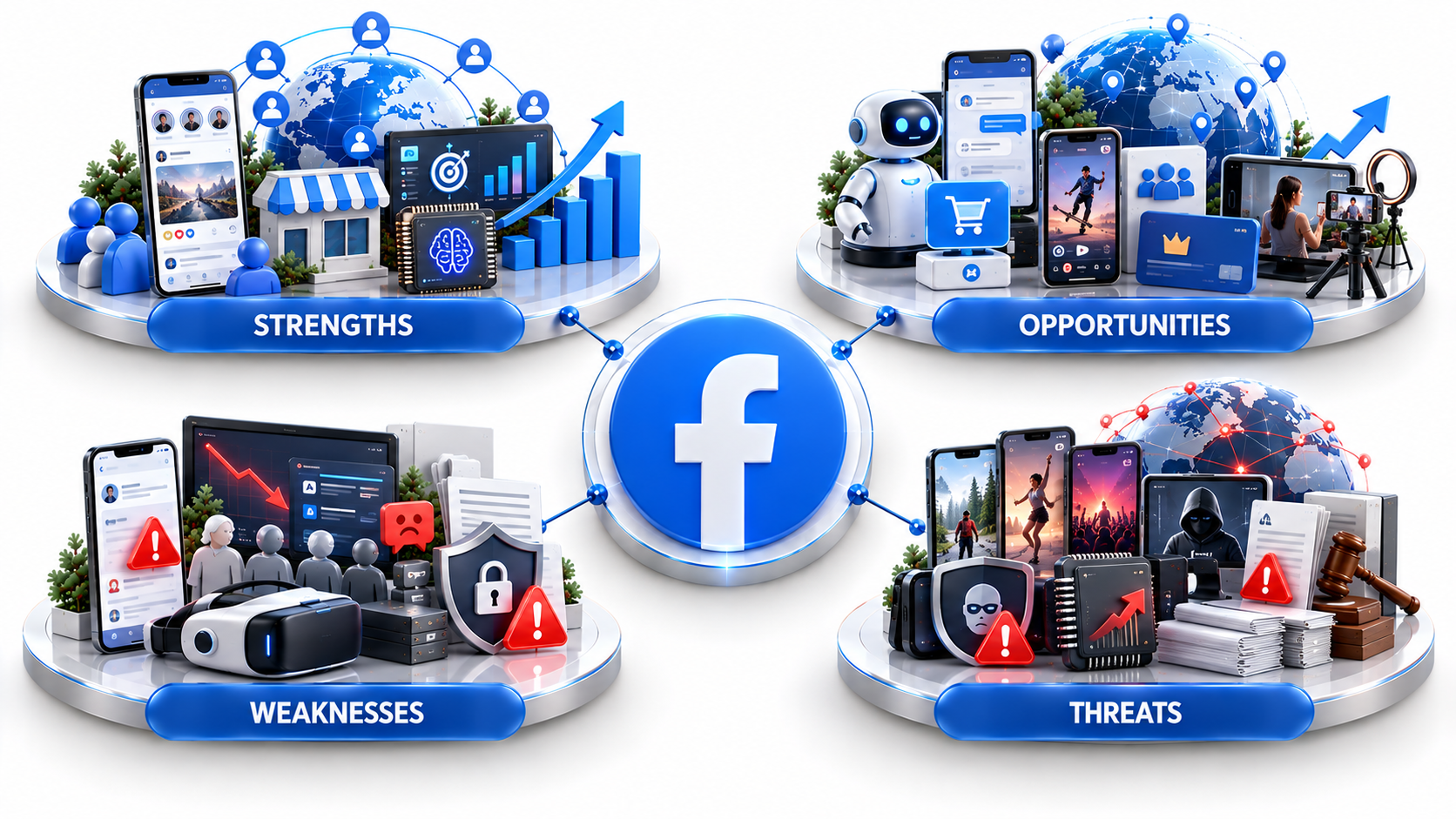
Before sorting anything into four boxes, you need a clear picture of what you’re analyzing. Facebook is a product, Meta is the company, and the money doesn’t come from where most people think. This section sets the base: what Facebook is, how revenue flows, and why a SWOT is still the right tool for the job.
What Facebook Is in 2026 (and What It Isn’t)
Facebook launched in 2004 as a Harvard dorm project and grew into the social network most of the planet has touched at least once. In 2021 the parent company renamed itself Meta, which is why people mix up the two. Facebook is one app. Meta owns Facebook, Instagram, Messenger, WhatsApp, Threads and the Quest headsets.
That distinction matters for a SWOT, because the analysis changes depending on what you’re measuring. If you analyze Facebook the app, you’re looking at a mature, older-skewing social network. If you analyze Meta, you’re looking at one of the most profitable advertising companies ever built. Most strengths and threats below apply to both, and where they don’t, the text says so.
How Facebook Makes Money
Almost everything comes from ads. In the June 2026 quarter, Meta reported advertising revenue of $59.36 billion out of $60.80 billion in total revenue. Do the math and ads are about 97.6% of the business. Facebook’s feed, Stories, Reels, Marketplace and Groups all exist, in the end, to hold attention that gets sold to advertisers.
There are side bets. Meta Verified subscriptions, WhatsApp business messaging and Reality Labs hardware bring in some money, but it’s pocket change next to ads. Think of Facebook as a giant attention auction. Advertisers bid, Meta’s systems decide who sees what, and the user’s behavior trains the system to do it better next time.
Why Run a SWOT on Facebook at All
A SWOT sorts what’s true inside the company (strengths and weaknesses) from what’s happening outside it (opportunities and threats). That split is the whole point. Facebook’s ad system is an internal strength. A new law in Brussels is an external threat. Mixing those up is the most common mistake in student papers.
It’s also still useful because Facebook is hard to read from the outside. Revenue is growing nearly 30% a year while profit is shrinking and regulators keep circling. A SWOT forces you to hold those contradictions at the same time instead of picking a side. It won’t give you a forecast. It gives you a clear, honest frame to think inside, which is better than most hot takes.
Anyone studying this as part of a wider digital marketing education will notice how often Facebook turns up as the example in strategy courses. There’s a reason. Few companies show strengths and weaknesses this loudly at once.
Strengths
Strengths are the things Facebook does better than almost anyone, and they’re the reason the “Facebook is dying” story keeps failing. This section covers the seven that matter most, with real numbers where they exist. Some are obvious. A couple get underrated badly.
Massive Global Reach That Nobody Else Matches
Facebook crossed 3 billion monthly users in 2023, and Meta stopped reporting app-by-app numbers after that, partly because it can’t be compared cleanly anymore. What it does report is the whole family. Average daily active people across Meta’s apps hit 3.60 billion in June 2026, up 3% year over year.
No other company can put an ad in front of that many people. India alone has hundreds of millions of Facebook accounts, and it’s the biggest country on the platform by headcount. Even if Facebook only holds half its audience’s real attention, that’s still a number competitors can’t touch.
An Ad System That Genuinely Works
Here’s the thing most critics skip. People don’t pour billions into Facebook ads out of habit. They keep spending because the system finds buyers. Meta’s targeting, its conversion tracking and its automated campaign tools like Advantage+ have been tuned for over a decade.
A small furniture brand can upload a customer list, build a lookalike audience, and have ads running in under an hour. That kind of speed to first result is hard to replicate. Is it perfect? Nope. But for most small and mid-size businesses, Facebook and Instagram ads remain the first place budgets go and the last place they get cut.
AI Is Making the Core Business Faster
Meta has put a huge bet on AI, and the ad business is where it pays off first. In the second quarter of 2026 ad impressions grew 14% and the average price per ad rose 12%. More ads shown, and each one worth more. That’s rare. Usually showing more ads drags prices down.
The explanation is better recommendations and better ad matching. When the feed keeps people watching longer, there’s more inventory. When the matching improves, advertisers pay more per impression because conversions go up. It’s a loop, and it only works at Meta’s scale because the models need enormous amounts of behavior data.
The Family of Apps Advantage
Facebook doesn’t fight alone. It sits next to Instagram, Messenger and WhatsApp, and they all share infrastructure, ad tooling and data signals. Instagram now has more than 2 billion daily users, and Threads has passed 500 million monthly users.
That matters because an advertiser rarely wants Facebook only. They want one dashboard, one budget and reach across every Meta surface. Facebook gets pulled along by the family. If one app cools off, the others soak up the same ad budget. Competitors with a single app don’t get that cushion.
Financial Firepower
Meta is absurdly profitable. In Q2 2026 the Family of Apps segment alone generated $23.39 billion in operating income in one quarter. That’s the money that funds AI chips, data centers, acquisitions and a long fight in court.
Cash is a weapon in tech. It lets Meta copy features fast (Stories, Reels), buy threats early (Instagram in 2012, WhatsApp in 2014) and absorb fines that would flatten smaller firms. A company can be unpopular and still win if it can outspend everyone for another ten years.
Network Effects and Sticky Social Graphs
Your Facebook account holds years of connections, group memberships, event invites and photos. Leaving means rebuilding all of that somewhere else, and most people don’t bother. That stickiness shows up even when people complain about the app loudly.
Look at how many families still organize reunions, school groups and local alerts through Facebook. It’s not exciting, but it’s habit. Network effects are boring and brutal. Once every relative and neighbor is on one platform, a better app with nobody on it is just an empty room.
Groups, Marketplace and Local Utility
Two Facebook features have real, practical staying power: Groups and Marketplace. Groups let a 40-year-old cyclist find the local riding crew, or a new parent find a nearby moms’ network. Marketplace turns a Facebook account into a secondhand store.
Meta has said more than a billion people use Marketplace each month. Nobody else matches that combination of identity plus neighborhood plus trust. Instagram can’t really do a classifieds board for your town. Facebook can, and it’s become the main reason many adults still open the app daily.
Business Tools That Small Sellers Depend On
Meta Business Suite, Pages, Ads Manager, Shops and messaging tools give small sellers an entire storefront without a website. A home baker can take orders, answer questions and run promotions from one phone.
For anyone running social media marketing for a small client, that low setup friction is a big reason Facebook still shows up in plans. It’s not glamorous, but it’s useful. Useful beats glamorous when the owner needs orders by Friday.
Weaknesses
Weaknesses are the internal problems Facebook has some control over and keeps failing to fix. They’re not secret. Meta lists several in its own filings. Here are the seven that matter most, including a couple that analysts tend to wave off too quickly.
An Aging User Base and Weak Appeal for Teens
The data here is old but stubborn. Pew Research found that 71% of US teens used Facebook in 2014 and 2015. By 2022, that had dropped to about 32%. Teens went to YouTube, TikTok, Snapchat and Instagram, and they didn’t come back.
This matters because platforms need young users to stay culturally relevant. An app that skews 35 and up eventually runs into the calendar. Meta knows it, which is why so much product energy goes to Reels and Instagram. Facebook can stay profitable with older users for a long time, but it can’t easily become cool again.
Near-Total Dependence on Advertising
Ads are roughly 97 to 98 cents of every dollar Meta takes in. That’s a single point of failure. If ad budgets shrink in a recession, if privacy rules limit targeting, or if a competitor steals attention, Meta has almost nothing else to fall back on.
Compare it to Google, which also leans on ads but has cloud and subscriptions, or Amazon, which sells everything. Meta’s other bets are small. WhatsApp business messaging is growing, and other Family of Apps revenue passed $1 billion in a quarter for the first time, up 73%. Good start, but $1 billion barely registers next to $59 billion.
The Trust and Privacy Problem
Cambridge Analytica in 2018 turned a vague unease into a real public scandal. The FTC fined Facebook $5 billion in 2019. In 2023 Irish regulators handed down a €1.2 billion GDPR fine over data transfers to the US. Those aren’t one-off embarrassments. They’ve made a lasting dent.
Ask regular users whether they trust Facebook with their data and the answer is usually a laugh. Yet they keep using it, which says something uncomfortable about convenience versus principle. Still, trust is a weakness because it hands every regulator and competitor a ready-made attack line.
Reality Labs Keeps Burning Cash
Meta’s metaverse push has been expensive. Reality Labs lost $4.62 billion in the second quarter of 2026 alone, on revenue of only $431 million. Since 2020 the division has lost well over $60 billion in total.
Mark Zuckerberg sees headsets and smart glasses as the next computing platform, and he may be right in ten years. But today it’s a giant drag on the whole company’s profit. It’s not Facebook the app, strictly speaking, yet it competes for the same capital and shapes how investors judge the stock.
Rising Costs Are Outrunning Revenue
This one is the weakness to watch hardest right now. Q2 2026 revenue climbed 28%, but total costs and expenses rose 55%, and net income fell 14% to $15.85 billion. Part of that came from a legal charge and severance after a headcount cut, but a lot is AI infrastructure.
Free cash flow tells the same story. Free cash flow dropped to $784 million from $8.55 billion a year earlier as capital spending hit $31.08 billion. Meta is spending like it’s certain the AI payoff arrives. If it doesn’t arrive on schedule, that gap gets ugly fast.
Declining Organic Reach for Pages
Anyone who ran a Facebook Page in 2012 remembers when a post reached most followers for free. That era is gone. Today organic reach for a typical Page sits in the low single digits, and getting seen usually means paying.
That hurts small businesses and creators who built audiences there. It also makes Facebook feel like a pay-to-play toll booth, which breeds resentment. Meta’s logic is simple: free reach doesn’t pay for servers. But the result is a weakness in goodwill with the exact people who populate the platform.
Content Moderation and Scam Fatigue
Facebook is full of spam, fake accounts and scams, and cleaning it costs money and credibility. The company removes more than a billion fake accounts a year, and still, users complain about hijacked profiles, romance scams and fake shops.
Reuters reported in late 2025 that internal documents projected roughly 10% of Meta’s 2024 revenue came from ads for scams and banned goods. Meta disputed how those documents were framed. Either way, the optics are awful, and moderation at this scale is a permanent headache that no amount of AI fully fixes.
Opportunities
Opportunities are outside conditions Facebook can use to grow or fix weaknesses. They aren’t guaranteed. Each one needs execution, money and a bit of luck. Here are six that look real, not just good on a slide.
AI Business Agents and Automated Customer Service
Meta is pushing AI agents that chat with customers for businesses on WhatsApp and Messenger. Zuckerberg said on the Q2 2026 call that more than 1 million businesses use Meta’s business agents every week. That’s early, but the idea is sharp.
Picture a clothing store in Jaipur or Lagos getting 200 “is this in stock?” messages a day. An agent can answer, take payment details and pass a hot lead to a human. If that works, Meta moves from selling ads to selling real business software. That’s a new revenue stream, and it targets the exact small sellers already living on its apps.
WhatsApp and Messenger Commerce
Click-to-message ads, which open a chat instead of a website, are huge in countries where people prefer chatting to browsing. The business customer pays for the ad, then pays again for the conversation. Meta is still early here.
The upside is clear in markets like India, Brazil and Indonesia, where WhatsApp is the default way people talk to shops. If Meta can make buying, booking and paying happen inside a chat thread, it creates a loop competitors can’t easily match. Nobody else has that messaging reach combined with an ad engine.
Reels, Video and the Fight for Attention
Short video isn’t a threat only. It’s also an opportunity, because Facebook can show Reels to its massive audience, not just to Instagram’s. When people spend more time watching, there’s more room for ads.
Meta has already moved time spent upward this way. Facebook video watch time grew as Reels took over more of the feed. The catch is that TikTok and YouTube Shorts fight for the same minutes. Still, a platform with billions of users already in the app has a head start on any newcomer.
Emerging Markets Still Have Room
Revenue per user in the US and Canada was roughly $68 per quarter on Facebook in late 2023, the last time Meta broke it out, compared with about $5.50 in Asia-Pacific. That gap is both a warning and a huge opportunity.
If Meta lifts average revenue per user in India, Indonesia and Africa even halfway toward developed-market levels, the money is enormous. It requires growing local ad markets, payments, and small-business adoption, and that happens slowly. But slow and large beats fast and tiny.
Facebook Groups and Local Community Features
Groups are where Facebook still feels alive. A neighborhood watch group, a used-car club, a parenting forum: those are habits that survive trends. Meta can build more around them, like paid memberships, events, local news and community-run tools.
Think about how Reddit built a business on communities. Facebook already has bigger, older and more local ones. Adding better search, better moderation tools for admins and more ways for creators to earn there could make the app stickier with the older audience that remains its core.
Subscriptions, Meta Verified and New Revenue Lines
Meta Verified, subscription tiers and creator payment tools are small today but they diversify the business. The EU already has an ad-free paid version of Facebook and Instagram, born from regulation but now a live revenue test.
If even a few percent of heavy users pay a monthly fee for extra features or fewer ads, that adds up with billions of accounts. It also reduces reliance on pure advertising, which is the biggest weakness in the whole analysis. It’s a slow-burn opportunity, not a quick win.
Threats
Threats are external forces that could hurt Facebook, and unlike weaknesses, Meta can’t just fix them with a better product. Some are legal, some are competitive, some are technical. These seven are the ones worth losing sleep over if you work at Meta, or if your whole ad strategy sits on it.
TikTok, YouTube and the Attention Squeeze
TikTok took a huge slice of young-user time almost overnight, and YouTube Shorts keeps growing too. Attention is limited. Every minute spent on a rival’s feed is a minute not spent in a Meta ad auction.
Meta’s response has been to copy the format and boost recommendations. That works on revenue, as Q2 showed, but it’s defensive. Facebook keeps reacting. When a platform’s best answer to a threat is “we built the same thing,” it means someone else is setting the pace, and that’s not a comfortable position long term.
Youth-Safety Lawsuits and Court Risk
Courts are now a serious threat. Meta’s own filings warn that youth-related trials scheduled in the US “may ultimately result in a material loss”. In Q2 2026 the company recorded a $2.40 billion charge tied to legal proceedings.
These cases argue that social apps harm teen mental health through design choices. Losing a few could mean big damages and forced product changes, like limits on features for minors. Even winning costs money and headlines. This is the threat that most changed the tone of Meta’s disclosures in the last year.
Regulation in Europe and Beyond
Europe is the toughest regulator. The GDPR already produced the €1.2 billion fine, and the Digital Markets Act and Digital Services Act add more rules on data use, ads and moderation. In 2025 the EU also fined Meta €200 million over its “pay or consent” model.
Other countries are following. Australia moved to restrict social media for under-16s, and several markets are debating similar rules. Each new rule raises compliance costs and chips away at the data Meta uses to target ads. That’s a slow squeeze rather than one big blow.
Antitrust Pressure Over Instagram and WhatsApp
The FTC sued Meta in 2020, arguing that buying Instagram and WhatsApp was meant to snuff out competition. Meta won the first round: in late 2025 a federal judge ruled the agency hadn’t proved Meta holds an illegal monopoly.
Is that threat dead? No. Appeals are possible, and political pressure on big tech hasn’t gone away. A forced breakup would hit the Family of Apps advantage hard. Even a low chance of that outcome is worth listing, because the damage if it happened would be huge.
Apple, Google and Platform Dependence
Meta doesn’t own the phone. Apple’s App Tracking Transparency, launched in 2021, let iPhone users block cross-app tracking. Most said no. Meta later said that change cost it around $10 billion in revenue in 2022.
That’s the structural threat: two companies control the operating systems, the app stores and the privacy toggles. Either can change a rule overnight. Meta has rebuilt its ad system with AI to rely less on tracking, but the dependency doesn’t disappear. Facebook lives on someone else’s land.
The AI Spending Gamble
Meta says it will spend between $130 billion and $145 billion on capital projects in 2026. Full-year expense guidance was set at $165 to $169 billion. That’s a bet that AI will pay off in advertising, in business tools and in new products.
If rivals like OpenAI, Google or Anthropic pull ahead, or if the returns take longer than investors expect, the stock and the budget take a beating. Meta Superintelligence Labs released its first model in early 2026, and the verdict is still open. Overspending is a threat to Meta even when the strategy is smart.
Fake Content, Scams and Brand Safety
Deepfakes, AI-generated spam and scam ads are flooding every platform, and Facebook is a favorite target because of its older, trusting users. Each scandal pushes advertisers to worry about their brand appearing next to junk.
If big brands decide the environment is too messy, they quietly move budgets elsewhere. That’s happened before, in boycott campaigns. Moderation is expensive, and AI makes fake content cheaper to create than to catch. This threat grows every year, and nobody has a clean fix.
What the SWOT Analysis of Facebook Means for Marketers and Students
A SWOT sitting in a document does nothing. It earns its keep when it changes a decision. This last section turns the four boxes into a few usable moves, whether you’re writing a paper, planning a campaign or advising a small business.
Cross the Boxes With a TOWS Matrix
The trick that makes a SWOT useful is crossing the boxes. Take a strength and pair it with an opportunity. Facebook’s huge reach plus WhatsApp commerce gives you a clear play: sell where people already chat. Then pair a weakness with a threat to see where the danger is real.
Aging users plus youth lawsuits, for example, means Facebook can’t count on teens to refresh its audience and can’t easily design for them either. That’s called a TOWS matrix, and it’s how consultants turn lists into strategy. Do it on paper. Four pairings, one sentence each. It takes ten minutes and changes how the analysis reads.
Practical Moves for Small Businesses
If you run a small business, the analysis points to a few moves. Don’t rely on organic Page posts. Budget for ads, even a small daily amount, and test three or four creatives instead of one. Build a Group or a WhatsApp list you control, so you don’t lose your audience if reach drops.
Also keep an eye on free tools that make planning easier, such as the ones in the marketing tools hub. And don’t put every rupee, dollar or euro on one platform. Facebook’s strengths are real, but its dependence on Apple, regulators and algorithm tweaks is real too. Spread the risk.
How to Write a Strong SWOT Analysis of Facebook for a Class or Report
If this is for an assignment, a few habits separate an A from a B. Use numbers, not adjectives. “97.6% of revenue from ads” beats “heavily reliant on advertising.” Keep strengths and weaknesses internal and opportunities and threats external. And finish with a short recommendation, not just four lists.
Also date your data. Facebook’s situation changes by the quarter, so say “as of Q2 2026” and cite where the numbers came from. Teachers notice that.
Conclusion
The honest verdict from this SWOT analysis of Facebook is that the platform is stronger and shakier than either camp admits. It has unmatched reach, an ad system that keeps getting better, and cash to outspend anyone. It also has an old audience, a trust problem, one source of income and a pile of legal risk that’s finally becoming real.
If you only remember one thing, remember the cost curve. Revenue is racing up, but expenses are growing about twice as fast, and that’s the number that decides whether Meta’s AI bet looks brilliant or reckless. Pick one box from the SWOT, find the latest figure for it in Meta’s next earnings release, and update your own analysis. For more breakdowns like this, the Learn hub is a good next stop.
Frequently Asked Questions
What is a SWOT analysis of Facebook?
A SWOT analysis of Facebook is a structured review of the company’s internal strengths and weaknesses and the external opportunities and threats it faces. Strengths and weaknesses cover things Facebook controls, like its ad system. Opportunities and threats cover outside forces, like regulation and competition.
What are Facebook’s biggest strengths?
Facebook’s biggest strengths are its global reach, its highly effective advertising system, its place inside the Meta family of apps, and its enormous cash flow. Features like Groups and Marketplace also give it local, practical value that rivals haven’t copied well.
What are the main weaknesses of Facebook?
The main weaknesses are an aging user base, near-total reliance on advertising revenue, long-running privacy and trust problems, and shrinking organic reach for Pages. Rising costs, including heavy AI and Reality Labs spending, are a growing weakness too.
What opportunities does Facebook have?
Facebook’s best opportunities are AI-powered business agents, commerce inside WhatsApp and Messenger, short-form video, growth in emerging markets, and new subscription products. Groups and Marketplace also give it room to deepen local community use.
What are the biggest threats to Facebook?
The biggest threats are competition from TikTok and YouTube, youth-safety lawsuits, strict regulation in Europe and other regions, antitrust pressure, and dependence on Apple and Google’s operating systems. Fake content and scam ads add a steady brand-safety risk.
Is Facebook still relevant in 2026?
Yes. Meta reported 3.60 billion daily active people across its apps in June 2026, and ad revenue keeps growing. Facebook is less popular with teens, but it remains central for adults, local groups, secondhand selling and small business advertising.
How does Facebook make money?
Facebook makes money almost entirely by selling ads. Advertisers pay to show content in feeds, Stories, Reels and Marketplace. Smaller revenue comes from WhatsApp business messaging, Meta Verified subscriptions and Reality Labs hardware.
Is Facebook the same as Meta?
No. Facebook is one app. Meta is the parent company that owns Facebook, Instagram, Messenger, WhatsApp, Threads and Reality Labs. The company changed its name from Facebook, Inc. to Meta Platforms in 2021.
How is Facebook’s SWOT different from Instagram’s?
Facebook skews older and relies more on Groups, Marketplace and community features. Instagram skews younger and is stronger in creators, Reels and shopping. Both share Meta’s ad system and face similar regulatory threats, but their audience risks differ.
What is the biggest risk to Meta’s business right now?
Cost growth is the loudest financial risk, since expenses grew 55% in Q2 2026 while revenue grew 28%. Legal risk from youth-related trials is the biggest outside risk. Together they pressure profit, even while ad revenue looks healthy.
Why did Meta’s profit fall if revenue grew?
Costs grew much faster than revenue. Meta booked a $2.40 billion legal charge, $1.18 billion in severance after a May 2026 headcount cut, and heavy AI infrastructure spending. That pushed net income down 14% despite a 28% rise in revenue.
Should small businesses still advertise on Facebook?
For most small businesses, yes. Facebook and Instagram ads still offer low-cost testing and detailed targeting. The smart move is to start with a modest budget, test several creatives, and build a Group or WhatsApp list so the audience isn’t dependent on one algorithm.