


Sony just posted the biggest operating profit in its history, and a lot of people still picture it as the Walkman company that lost the music player war to the iPod. That gap between the real company and the one in people’s heads is exactly why a proper SWOT analysis of Sony is worth your time. This is not a sleepy electronics brand. It is a business that sells you a PlayStation, supplies the camera sensor inside your phone, owns one of the three biggest music companies on earth, and produces the anime everyone suddenly talks about.

Most SWOT write-ups on big companies are lazy. They list “strong brand” under strengths, “competition” under threats, and call it a day. That tells you nothing. Sony is a strange, sprawling company, and the real answer to “what is Sony good at and where is it exposed” changes depending on which division you look at. The PlayStation side is thriving while the TV side is being handed over to a Chinese partner. Chip sales are booming while the movie studio is wobbling. A decent SWOT has to hold all of that at once.
So this guide goes through it properly. You will get the history in short form, the latest numbers from Sony’s fiscal year that ended in March 2026, and a plain look at what is working and what is not. Each strength, weakness, opportunity and threat gets its own explanation with names and figures, not buzzwords. By the end, you will also know how to run the same exercise on any other company, which is the skill students and marketers actually need.
One more thing. A SWOT is a snapshot, not a prophecy. Sony’s situation moves fast, and some of what follows (the TCL deal, the PlayStation price hikes, the games pipeline) is still playing out. Read it as a working map, then check the numbers again at the next earnings report.
What You Will Learn in This Guide
This section is the quick preview, so you know where each answer lives before you start reading. Skim it, jump to the part you care about, and come back for the rest. The list below follows the order of the article from the company basics to the final strategy takeaways.
- What Sony actually is today and how its five business segments make money
- The real strengths behind the SWOT analysis of Sony, including image sensors, PlayStation, music and anime
- The weaknesses that hold Sony back, from the dying TV business to expensive game flops
- The opportunities Sony can still grab in anime, sensors, games and music catalogs
- The threats from tariffs, rising component costs, rivals and AI
- A clean SWOT matrix you can copy into a presentation
- What the SWOT analysis of Sony says about where the company is heading
- A simple method for writing your own SWOT on any company
- Answers to 12 common questions about Sony’s SWOT
TL;DR
- Strength: Sony earns most of its profit from things competitors cannot easily copy, like image sensors, a huge game ecosystem and a deep music and anime catalog.
- Weakness: Consumer electronics, especially TVs, keeps shrinking, and Sony’s recent live-service game bets have burned cash.
- Opportunity: Anime, PlayStation on PC and mobile, and sensors for cars and AI devices are all growing markets Sony already has a seat in.
- Threat: Tariffs, a weak yen swinging the other way, expensive memory chips and fast Chinese and Korean rivals can squeeze margins quickly.
- Fiscal 2025 closed with record operating income of about ¥1.45 trillion on sales of about ¥12.48 trillion.
- The company is slowly turning into an intellectual property business that happens to also make great hardware.
What Is Sony? A Quick Look Before the SWOT Analysis of Sony
You cannot judge strengths and weaknesses until you know what the company actually does. Sony is a Japanese group that spans games, music, film and TV production, imaging chips, cameras, and consumer electronics. The sections below explain where it came from, how the money flows between its divisions, and what the latest annual numbers say about its health.
From a Tokyo Workshop to a Global Group
Sony began in 1946 as a small repair shop in bombed-out Tokyo, started by Masaru Ibuka and Akio Morita. The name changed to Sony in 1958. The early story is pure hardware: Japan’s first tape recorder, the transistor radio, Trinitron TVs, and then the Walkman in 1979, which basically invented the idea of music you carry around.
The twist came later. In 1988 Sony bought CBS Records, and in 1989 it bought Columbia Pictures. Then came the original PlayStation in 1994. Those three moves quietly turned an electronics maker into an entertainment company, and that decision still explains most of today’s profit.
How Sony Makes Money Today
Sony reports in segments, and knowing them is half the SWOT. Game & Network Services is PlayStation, including consoles, games and PlayStation Plus. Music covers recorded music, publishing and anime music through Aniplex. Pictures covers film, TV production and Crunchyroll. Imaging & Sensing Solutions sells image sensors. Entertainment, Technology & Services is the leftover electronics: TVs, cameras, headphones, audio.
Notice what is missing from that list. There is no phone business worth mentioning and no PC business anymore. Sony sold VAIO in 2014. What remains is focused, but it is also oddly shaped, which matters in the weaknesses section.
Sony’s Latest Numbers
The most recent full year ended March 31, 2026. Sony’s sales from continuing operations rose 4% to about ¥12.48 trillion, and operating income rose 13% to roughly ¥1.45 trillion. The operating margin improved to 11.6%. In plain terms, Sony is making more money on slightly higher sales, which is what a healthier mix of businesses looks like.
Sony also separated its financial arm, spinning off Sony Financial Group from October 2025, which is why the numbers now say “continuing operations”. Net profit dipped a little because of impairment charges and losses tied to that financial arm, but the operating story is strong.
SWOT Analysis of Sony
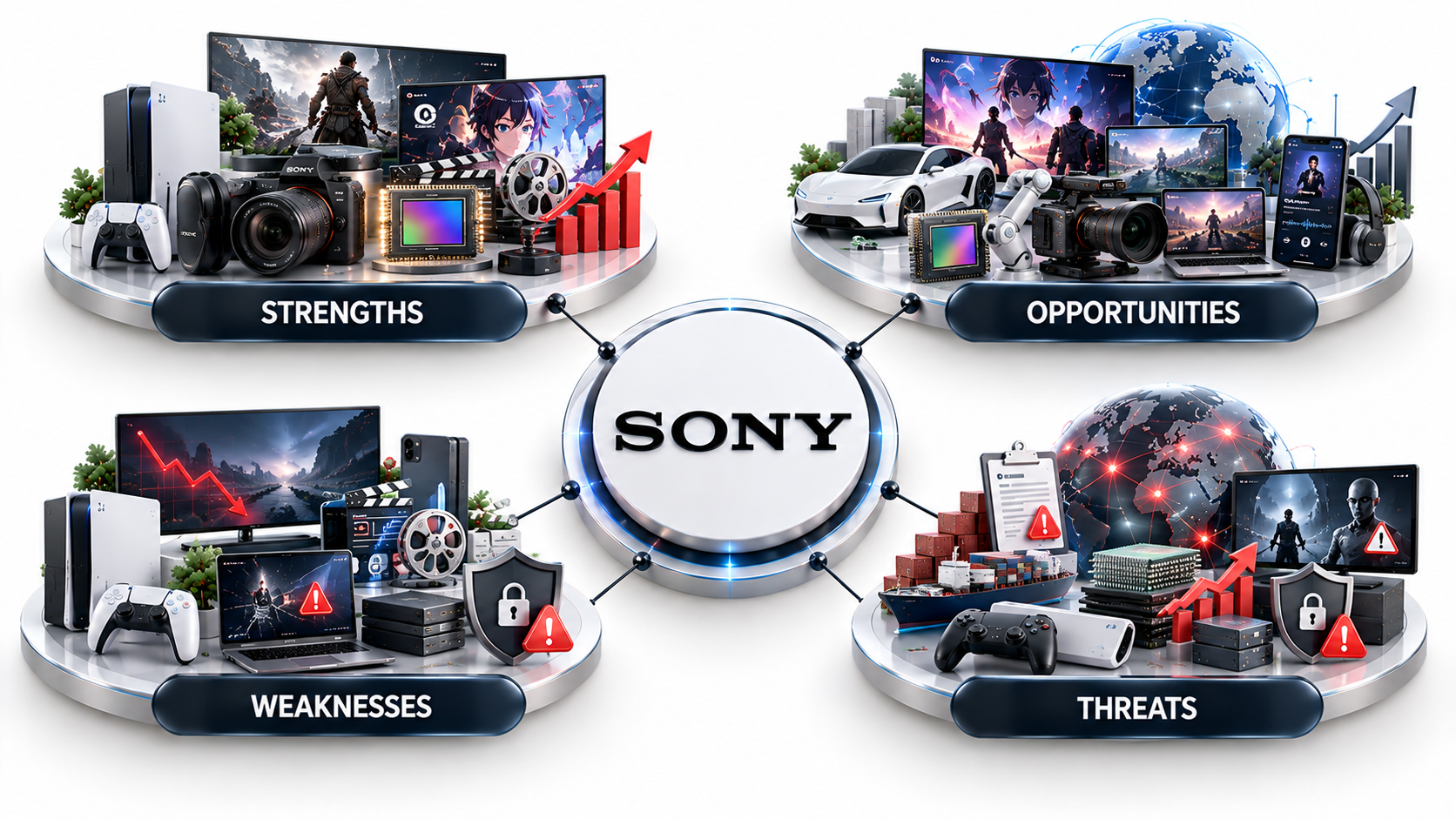
This SWOT Analysis of Sony provides a comprehensive overview of the company’s strengths, weaknesses, opportunities, and threats, examining its brand reputation, innovative technology, global presence, business portfolio, competitive position, market opportunities, and potential challenges. The analysis helps understand Sony’s current business position and the key factors that may influence its growth and performance in the future.
Strengths
Strengths are the things inside the company that already work and are hard for rivals to copy. In the SWOT analysis of Sony, the strongest points are not the famous logo or the nostalgia. They are specific businesses with real market positions and real profit. The six strengths below are ordered roughly by how much money they bring in and how difficult they are to replicate.
A Near-Monopoly Position in Image Sensors
Open almost any flagship phone and there is a decent chance the main camera sensor was made by Sony. The company holds around half of the global CMOS image sensor market by revenue, and Apple is one of its biggest customers. In fiscal 2025, the Imaging & Sensing Solutions segment grew sales 20% and operating income 37%, reaching a record ¥357.3 billion.
Why can’t others just copy it? Sensor making needs enormous factory investment, years of process know-how, and tight design links with phone makers. Samsung and OmniVision try hard, but Sony’s lead on quality is the reason Apple keeps coming back. Honestly, this is the quiet engine of the whole company.
The PlayStation Ecosystem and Its Huge Installed Base
PlayStation is the biggest profit pool at Sony. The Game & Network Services segment delivered ¥463.3 billion of operating income in fiscal 2025, up from ¥414.8 billion the year before. The PS5 has sold well north of 80 million units since late 2020, and that installed base keeps buying games, accessories, and PlayStation Plus subscriptions.
Here is what makes it sticky. Once you have friends on PSN, a library of digital games and a pile of DualSense controllers, switching to Xbox or Nintendo means giving up all that. Software and subscription income also carries much higher margins than console hardware, so the more the base grows, the better the business gets.
First-Party Studios That Actually Deliver
Sony owns studios like Naughty Dog, Insomniac, Santa Monica Studio, Sucker Punch and Guerrilla. They produce the games that make people buy the console: The Last of Us, God of War, Spider-Man, Ghost of Tsushima and its sequel Ghost of Yōtei. These are not throwaway releases. They win awards, sell tens of millions, and give PlayStation a story that cheaper rivals cannot match.
The studios also keep paying off after launch. Sony has been porting older hits to PC, which turns a single development cost into a second revenue stream. Helldivers 2, published by Sony Interactive, sits alongside a strong first-party slate… and yes, it sold around 12 million copies in its first 12 weeks. That is how a publisher grows without owning every studio.
A Top-Three Global Music Business
Sony Music is one of the three major labels, next to Universal and Warner, and Sony Music Publishing is the largest music publisher in the world by many counts. That means Sony collects money when a song streams, when it is played on the radio, and when someone licenses it for an ad or a film. Streaming income grows quietly every year with almost no extra cost.
The Music segment grew sales to ¥2,120.1 billion and operating income to ¥447.0 billion in fiscal 2025. Sony also keeps buying catalogs, including a reported deal of around $600 million for half of Michael Jackson’s catalog. Old songs never really expire, so catalogs behave like royalties on autopilot.
Anime, Film and Content Libraries
Sony owns Aniplex and Crunchyroll, which together make it one of the biggest names in anime. Demon Slayer: Infinity Castle did enormous box office numbers worldwide in 2025, and Crunchyroll has well over 15 million paying subscribers. Sony Pictures also holds the film rights to Spider-Man and its extended universe, plus a deep library of Columbia titles.
That library is a real asset. Sony does not run its own streaming service, so it licenses content to Netflix, Disney and others, collecting steady fees without the huge cost of building a Netflix rival. It is a clever, low-risk way to be in streaming without losing money on it.
Brand Trust, Engineering Depth and a Cleaner Portfolio
Sony still has one of the most recognized brands in electronics. Alpha cameras are among the top choices for professionals, Bravia and Walkman carry history, and PlayStation has a younger audience that grew up on it. People will pay more for a brand they trust, and Sony earns that premium across several product lines.
Management has also been trimming. The company dropped VAIO in 2014, spun off the financial arm in 2025, and is now moving the TV business into a joint venture. Under CEO Hiroki Totoki, the group is much tighter than the sprawling conglomerate of the 2000s. A focused portfolio makes every segment’s strengths easier to read.
Weaknesses
Weaknesses are the internal problems that drag results down or leave the company exposed. A fair SWOT analysis of Sony cannot only celebrate the record profit. Several parts of the group are shrinking, a few big bets have failed in public, and the profit depends on a handful of products. The six weaknesses below are the ones that matter most.
A Consumer Electronics Business in Slow Decline
TVs used to be Sony’s pride. Now the business is shrinking and being handed over. In the year to March 2025, Sony’s TV sales fell 9.6% to ¥564.1 billion, and the broader Entertainment, Technology & Services segment saw sales fall by about ¥148.7 billion in fiscal 2025, mostly due to weak display sales.
Look at what happened to the Japanese competition. Toshiba sold its TV business to Hisense, Hitachi quit, Sharp shrank. Sony held on longer than most, but cheap Chinese panels and brutal price wars made it hard. When your best product is premium but your rivals sell similar sets at half the price, margins disappear.
Heavy Dependence on PlayStation and a Few Big Hits
Game & Network Services is the single biggest profit contributor. That is great while it lasts, but it also means a weak console cycle or a few delayed games can drag down the whole group. PS5 unit sales have already been declining, and Sony expects that trend to continue, which is normal late in a console cycle.
The group is also leaning on mobile sensors, mainly sold to a few phone makers. If PlayStation slows and Apple changes a supplier, the profit picture changes quickly. Concentration is a weakness even when the numbers look excellent.
Costly Flops in Live-Service Games
Sony paid about $3.6 billion for Bungie in 2022 to get into live-service games, which are the multiplayer titles that keep players spending for years. Then came Concord, a hero shooter that launched in August 2024 and was pulled within about two weeks. Its studio, Firewalk, was shut down soon after, and the project reportedly cost hundreds of millions of dollars.
Sony has also booked impairment charges related to the Bungie deal. The lesson is simple: Sony is brilliant at single-player, story-driven games, and noticeably shakier when it tries to copy the Fortnite and Destiny formula. That gap is a real weakness, not a rounding error.
Weak Position in Mobile and Computing
Sony never won in smartphones. The Xperia line still exists, but it sells in tiny numbers and mainly appeals to camera and audio fans. Sony also sold its PC brand VAIO years ago. Apple, Samsung and Google own those spaces, and Sony’s best consumer tech ends up inside other companies’ devices.
That is the awkward truth for the sensor business: Sony makes money from phones it does not sell. Without its own phone or operating system, Sony has no direct relationship with the daily screen that people use for hours, so data, apps and services belong to somebody else.
Mixed Results at the Pictures Division
Sony Pictures is solid but not spectacular. In fiscal 2025, Pictures sales stayed around ¥1,499.3 billion, while operating income fell to ¥104.9 billion from ¥117.3 billion. The Spider-Man spin-off films, such as Madame Web and Kraven the Hunter, flopped. Venom: The Last Dance did better but could not match the earlier Venom runs.
There is also the KPop Demon Hunters story. Sony Pictures Animation made it, but Netflix released it and kept the upside, which turned into a global phenomenon. Selling the film upfront was safe, but it meant Sony watched a mega hit make someone else rich.
Security Scars and Fragile Online Trust
Sony has been hacked hard, twice. The 2011 PlayStation Network breach exposed around 77 million accounts and kept the service offline for weeks. The 2014 attack on Sony Pictures leaked unreleased films, scripts and private emails. Both events cost real money and trust.
Years later, the company is better prepared, but running PSN, Crunchyroll and music accounts means holding data on hundreds of millions of people. And Sony stumbled again in 2024 when it forced a PSN login for Helldivers 2 on PC, which angered players until the rule was reversed. Account friction is a recurring blind spot.
Opportunities
Opportunities are outside trends that Sony can use if it moves quickly. The opportunities for Sony are less about inventing new products and more about stretching what already works into bigger markets. Below are six realistic openings, each tied to something Sony already owns.
Anime Going Fully Global
Anime used to be a niche. Now it is a mainstream export, and Sony is one of the few companies owning the whole chain: studio production through Aniplex, global streaming through Crunchyroll, music, merchandise and games. When Demon Slayer blew up at the box office, Sony collected money from several directions at once.
That is a massive opportunity. If Sony can keep signing hit series, run live events, and sell merchandise worldwide, anime becomes a profit pool that rivals movies. One catch: a single franchise can make a year look amazing and the next look weak, so Sony needs more than one Demon Slayer.
Taking PlayStation Beyond the Console
PlayStation is expanding to PC, and has talked about mobile games and transmedia. Sony has turned its biggest games into shows and films, like The Last of Us on HBO and the Uncharted and Gran Turismo movies. Each adaptation sends new fans back to the games.
Think about the reach. A PC port reaches people who would never buy a console, and a TV show reaches people who do not play games at all. As console sales mature, these side doors are where growth lives, and Sony already owns the film and TV arm to push them forward.
Sensors for Cars, Robots and AI Devices
Phone sensors are the current cash cow, but the next wave is bigger. Cars need many cameras and LiDAR for driver assistance, factories use machine vision, and AI devices need sensors that process images on the chip itself. Sony makes chips that do exactly this.
Sony’s fiscal 2026 forecast projects sales of ¥2,070 billion and operating income of ¥400 billion for this segment, so management clearly expects more profit even with slightly lower sales. If cars and robots become big sensor buyers, Sony does not have to keep leaning only on Apple.
Growing Music Streaming and Catalog Value
Global streaming subscriptions keep growing, especially in India, Latin America and Africa. Sony Music has strong local labels in several of those markets, which means it can earn as new listeners come online. Every new subscriber adds royalties across a huge back catalog.
Catalog buying gives Sony another path. Older songs bring in stable income, and artists often sell catalogs when they want a payout. Sony has money to buy, and a publishing arm that knows how to squeeze more licensing from each song. It is a steady, almost boring opportunity, and boring works.
Strategic Partnerships Like TCL and Honda
Sony is learning to partner instead of fighting everywhere. The TV deal with TCL lets Sony keep the brand and 49% of the business while a cost-savvy Chinese manufacturer handles scale. Sony Honda Mobility, with its Afeela electric car, puts Sony tech into the vehicle market without Sony building a car factory.
These deals reduce risk. If the Afeela fails, the loss is shared. If it succeeds, Sony gets a showcase for its sensors, software and entertainment. Smart partnerships let Sony test big ideas without betting the whole company on them.
Creator Tools, Cameras and Virtual Production
Video creators, streamers and small studios are buying pro-level cameras like never before. Sony’s FX series cinema cameras, Alpha mirrorless bodies and Crystal LED displays fit this crowd, and film sets increasingly use LED walls for virtual production.
This creator economy sits right between Sony’s electronics side and its entertainment side. A YouTuber who buys an Alpha camera, edits music from Sony’s library, and watches anime on Crunchyroll is a customer in three divisions. That crossover is easy to overlook, and it is a genuine opportunity if Sony keeps the products compatible with each other.
Threats
Threats come from outside the company and cannot be fixed with a better strategy alone. The SWOT analysis of Sony shows threats from trade policy, supply costs, aggressive competitors and fast technology change. Here are six that deserve real attention.
Tariffs, Trade Policy and Currency Swings
Sony sells most of its products in the US, and manufactures across Asia. Tariffs raise costs, and when costs rise, Sony either takes lower margins or raises prices. In 2025, Sony raised US PlayStation 5 prices by around $50, and that kind of increase slows demand.
Currency matters just as much. A weak yen helps a lot. In fiscal 2025, foreign exchange added about ¥87.3 billion to Game & Network Services sales and ¥54.3 billion to its operating income. If the yen strengthens, that tailwind disappears, which makes profit look worse without anything changing in the business.
Rising Memory and Component Costs
Chips are getting more expensive, partly because AI data centers are soaking up memory supply. Sony expects higher profit this year in spite of this, but reports note that high costs for electronic parts needed to build the PS5 remain a pressure.
Here is the squeeze. Console owners hate price hikes, but the parts cost keeps climbing. Sony can protect the margin by pushing digital sales and subscriptions, but at some point a console that costs more every year starts losing buyers to PC or to older consoles. That is a tight rope.
Fierce Competition in Games
Microsoft has Xbox, Game Pass and a huge budget after buying Activision Blizzard. Nintendo launched the Switch 2 in June 2025 and sold it fast. Steam and PC gaming keep growing, and Chinese studios are making hit games on mobile and console.
Sony’s advantage is its exclusive library, but those exclusives are slowly moving to PC, which loosens the console lock-in. If gamers can play The Last of Us on a cheap gaming PC, the reason to own a PS5 gets weaker. Competition here is not one rival, it is everybody at once.
Rivals in Image Sensors and Cameras
Samsung, OmniVision and several Chinese makers are improving fast, and phone brands like Apple would love less reliance on one supplier. If Apple builds more of its own sensor technology or splits orders, Sony’s sensor profit would slip. Chinese policy support for local chip firms adds extra pressure.
Cameras face a separate fight. Canon and Nikon are strong in professional gear, and Fujifilm has built a loyal following with style and price. Sony can lose ground in the Alpha line if rivals match its autofocus and video quality at lower prices. Holding a lead in tech is harder than it looks.
Streaming Economics and AI in Music and Film
Music streaming pays tiny amounts per play, and the big platforms hold a lot of negotiating power. AI-generated music is a new headache: Sony Music joined other major labels in suing AI music startups Suno and Udio in 2024, because their tools were trained on copyrighted songs.
Film has its own headaches. Studios everywhere are cutting back, theater attendance has not returned to pre-2020 levels, and AI video tools raise new rights questions. Sony’s content library is valuable, but if AI floods the market with cheap content, the value of human-made catalogs gets harder to defend.
Geopolitics and Supply Chain Concentration
Advanced chip production leans heavily on Taiwan, South Korea and Japan. Sony has built a factory partnership in Kumamoto with TSMC, which spreads risk, but a conflict or severe tension in the region would hit the whole electronics world. China is both a huge market and a political risk for Japanese firms.
Then there is the plain stuff: shipping delays, disasters, labor costs. Japan has earthquakes. A big quake near a sensor plant would stop production for weeks. These threats are rare, but they have happened before, and a company this reliant on a few factories has to plan for them.
SWOT Matrix of Sony at a Glance
Here is the whole analysis in one table. It is built for students, marketers and anyone who needs a clean slide. Each cell is a short version of what the sections above explain at length, so use it as a summary and not as a replacement for the reasoning behind each point.
| Helpful | Harmful | |
|---|---|---|
| Internal | Strengths: image sensor leadership, PlayStation ecosystem and first-party studios, top-three music business, anime and film library, strong brand | Weaknesses: shrinking TV and electronics, dependence on PlayStation and a few sensor customers, costly live-service failures, no phone or PC presence, security history |
| External | Opportunities: global anime growth, PlayStation on PC and in TV and film, sensors for cars and AI, music catalog buying and streaming growth, partnerships with TCL and Honda | Threats: tariffs and yen swings, higher memory costs, strong game and sensor rivals, AI and streaming pressure, supply chain and geopolitical risk |
Read the table by rows first. The top row is what Sony controls, the bottom row is what Sony reacts to. Then read by columns. The left side is where growth comes from, the right side is where profit gets hurt. That reading habit makes any SWOT easier to use.
What the SWOT Analysis of Sony Says About Its Strategy
A SWOT only matters if it leads to a decision. When the strengths, weaknesses, opportunities and threats are read together, Sony’s direction becomes obvious. The company is steadily shifting from making products to owning content, platforms and key components. The three points below explain that shift in plain terms.
Sony Is Becoming an IP Company
Look at where the profit is. Games, music, anime and film are all intellectual property: stories, characters, songs and franchises that can be sold over and over. Hardware is still important for PlayStation, but even there the money is in software and subscriptions.
The TV deal makes the direction obvious. Sony is keeping the brand and a minority stake while someone else carries the factory risk. Management has described a focus on entertainment and growth areas, and the numbers back it up. Expect more moves like this, where Sony sheds capital-heavy hardware and puts money into content.
The Hidden Link Between Chips and Entertainment
It looks odd for one company to make sensors and anime. But there is a loop. Sensors power cameras and phones, cameras create content, content needs music and distribution, and games and film use the same technology. The pieces genuinely feed each other more than most analysts admit.
A Sony camera shoots a film for Sony Pictures that streams on Crunchyroll with Sony Music in the soundtrack, while a PlayStation game gets adapted into a series. This loop is hard for a pure chipmaker or a pure studio to copy. The risk is that Sony manages these divisions separately and wastes the connection.
What Sony Should Do Next
If this were a consulting exercise, three moves stand out. First, diversify sensor customers and push hard into automotive and industrial chips. Second, stop chasing weak live-service ideas and put money behind studios with proven records. Third, build more anime and game franchises so one hit cannot swing a whole year.
There is also a simple discipline: keep the portfolio clean. Every extra business that does not support games, music, film or sensors should be sold, partnered, or shrunk. Sony has already done that with finance and TVs. The next step is making sure no new distractions creep back in.
How to Use a SWOT Analysis of Sony in Your Own Work
Reading a SWOT is easy. Building one that holds up is the hard part. If you are a student, a marketer or a founder, the Sony example is a useful template because it has clear data, clear divisions and clear tradeoffs. The steps below show how to repeat it for any brand.
Start With Real Numbers, Not Adjectives
Skip “strong brand” and “good culture” until there is evidence. Open the company’s latest annual report or investor presentation and find segment sales, margins and growth rates. For Sony, that means the fiscal results page, which lists every segment with year-on-year changes.
Then ask a simple question for each number: is this good or bad, and compared to what? A 20% sales jump in sensors means something because Sony forecasts lower sales next year. Numbers with context create real strengths and weaknesses. For deeper marketing frameworks like this, the digital marketing learning hub has beginner-friendly guides.
Separate Internal From External Properly
The most common SWOT mistake is putting outside factors under strengths or weaknesses. Tariffs are not a weakness of Sony, they are a threat. A strong yen is not a Sony problem it created, it is an outside condition. Internal means what Sony controls: its products, people, money and brands.
A quick test helps. Ask whether the company could change it tomorrow if it wanted. If yes, it is internal. If not, it belongs in opportunities or threats. This sorting step prevents muddled matrices and makes the final action list cleaner.
Rank the Points and Turn Them Into Actions
A list of 20 bullets is useless. Rank each quadrant, keep the top three to five, and write one action next to each. For Sony, the action next to “sensor concentration” could be “grow automotive sales”. The action next to “TV decline” is already happening through the TCL joint venture.
Real case studies show how others do this, and the case studies section is a good place to compare approaches. The goal is a short document that someone can act on in a meeting, not a poster for the wall.
Mistakes That Make a SWOT Useless
Watch for four traps. Listing generic items that apply to any company (“competition exists”). Mixing up internal and external. Ignoring numbers. And writing the SWOT once and never updating it. A SWOT from last year is already stale.
For Sony, a 2023 version would not mention the TCL deal, the financial spin-off or the PS5 price hikes. Check the latest results every quarter, and use simple research tools to track changes, like those listed in the tools hub. Fresh facts matter more than a pretty template.
Conclusion
The SWOT analysis of Sony comes down to one honest sentence: the company is strongest where it owns something hard to copy, and weakest where it sells things anyone can make. Sensors, PlayStation, music and anime are the first group. TVs and generic electronics are the second. Sony knows it, which is why the portfolio keeps getting trimmed toward content and key components.
The next step for you is simple. Pick another company you follow, open its latest earnings report, and write a four-box SWOT with real numbers in each box. Then compare it to Sony’s. If you want more frameworks like this, browse the free guides in the Learn hub and keep practicing on companies you actually use.
Frequently Asked Questions
What is a SWOT analysis of Sony?
A SWOT analysis of Sony is a structured look at the company’s internal strengths and weaknesses and the outside opportunities and threats it faces. It sorts facts about Sony’s games, music, film, sensors and electronics into four boxes so you can see where the company is strong, where it is exposed, and what decisions follow.
What are Sony’s biggest strengths?
Sony’s biggest strengths are its image sensor leadership, the PlayStation ecosystem, a top-three music business and a deep anime and film library. These businesses generate most of its profit and are hard for competitors to copy. A trusted global brand and a more focused portfolio add to that.
What are Sony’s main weaknesses?
The main weaknesses are the shrinking consumer electronics business, especially TVs, and heavy reliance on PlayStation and a few sensor customers. Costly live-service game failures such as Concord also hurt. Sony has little presence in smartphones or PCs, and past security breaches damaged trust.
What opportunities does Sony have?
Sony can grow through global anime demand, PlayStation titles on PC and in TV and film, and sensors for cars, robots and AI devices. Music streaming growth in emerging markets and catalog acquisitions also help. Partnerships like the TCL TV venture and Sony Honda Mobility let it test ideas with shared risk.
What are the biggest threats to Sony?
The biggest threats are tariffs, currency swings, rising memory and component costs, and strong competition from Microsoft, Nintendo, Samsung and Chinese firms. AI disruption in music and film is another concern. Geopolitical tension and supply chain concentration in Asia can also interrupt production.
How much money does Sony make?
For the fiscal year ended March 2026, Sony reported sales of about ¥12.48 trillion from continuing operations and operating income of about ¥1.45 trillion, both records for operating profit. The profit came mainly from games, music and image sensors. Management forecasts higher operating income for the following year.
Is Sony still a consumer electronics company?
Partly, but less every year. Sony still sells cameras, headphones and TVs, yet most profit now comes from games, music, pictures and sensors. The TV and home audio business is moving into a joint venture with TCL, with TCL holding 51% and Sony 49%, starting around April 2027.
Why is Sony selling control of its TV business to TCL?
Sony’s TV sales have been falling while Chinese rivals compete on price and scale. Teaming with TCL lets Sony keep the Bravia brand and a 49% stake, while TCL handles manufacturing and cost control. It reduces Sony’s risk in a low-margin business and frees resources for entertainment and chips.
Does Sony depend too much on PlayStation?
PlayStation is the largest profit contributor, so a weak console cycle would hurt the group. Sony has partly offset that by growing sensors and music, which also posted record profits. Still, the dependence is real, and that is why diversification into anime, PC games and automotive sensors matters.
How does Sony compare to Microsoft and Nintendo in gaming?
Sony leads in console sales and first-party storytelling games, Microsoft has Game Pass and a big publishing portfolio, and Nintendo has family-friendly hardware and iconic franchises. Sony’s edge is its exclusive library and large PlayStation network. Its weakness is live-service games, where it has stumbled.
How should students use a SWOT analysis of Sony in a project?
Start with Sony’s latest annual results, sort facts into internal and external, and rank the top points in each box. Add one concrete action next to each. Use real numbers, such as segment profit and TV sales declines, and update the analysis after each earnings report.
What is the main limitation of a SWOT analysis?
A SWOT is a snapshot, so it can go stale quickly and does not weigh how important each point is. Two companies can list the same bullets with very different outcomes. It works best when backed by numbers, ranked by impact, and paired with specific actions.