


On 22 September 2024, 13 million fans tried to buy Coldplay tickets on BookMyShow. Thirteen million. For three stadium shows in Navi Mumbai. People sat in hours-long digital queues while the site crashed, and within days tickets priced at ₹2,500 were being listed for as much as ₹3 lakh on resale sites. Then the Mumbai Police Economic Offences Wing summoned the CEO. That one week holds almost everything a proper SWOT Analysis of BookMyShow has to explain: huge pull, huge pressure, and a company sitting in the middle of both.
Most SWOT write-ups on BookMyShow read like they were copied from a 2015 textbook. “Strong brand.” “Wide reach.” “Competition from Paytm.” Okay, but that tells you nothing. Paytm is gone from the picture. Zomato bought Paytm’s ticketing business for ₹2,048 crore, turned it into the District app, and is now close enough to rattle BookMyShow. Flipkart is reportedly planning its own entry. And in August 2026, KKR bought a minority stake. The ground moved, and the old lists never caught up.
So this guide does it the slow way. It looks at the actual numbers, the actual fights, and the actual mistakes. Some of it is opinion, and it says so. If you are a student writing a case study, a founder studying a marketplace, or a marketer trying to understand why this brand behaves the way it does, you should finish this with a clear view of where BookMyShow is strong, where it is exposed, and what happens next. A quick note on the basics: strengths and weaknesses live inside the company. Opportunities and threats come from outside it. Keep that split in your head and the rest gets easier.
What You Will Learn in This Guide
- How BookMyShow started, how it makes money, and who owns it
- The real strengths behind its market lead, with FY24 and FY25 numbers
- The weaknesses most SWOT posts skip, including the live events losses
- Where the next growth comes from: sports, small cities, overseas and official resale
- Why District, Flipkart and the multiplex chains are the threats to watch
- A one-table summary of the full SWOT Analysis of BookMyShow
- How to turn a SWOT into actual decisions instead of a pretty grid
- Mistakes students and analysts make when they write this kind of analysis
- Answers to 12 questions people keep searching about BookMyShow
TL;DR
- BookMyShow’s revenue hit ₹1,831 crore in FY25 with a net profit of ₹192 crore, so the core machine is healthy.
- Its biggest strength is the habit: people open BookMyShow before they think about alternatives.
- Its biggest weakness is how much rides on cinema footfall and on live events that lost money in FY24.
- The best opportunity is India’s live entertainment boom, now backed by KKR’s capital.
- The sharpest threat is District, which has grown fast and is already in IPL ticketing.
- The real test is whether BookMyShow can keep its lead on fees, trust and big-sale reliability.
Understanding the Business Before the SWOT Analysis of BookMyShow
A SWOT is only as good as the facts under it. Before getting into the grid, you need a clear picture of what BookMyShow is today, how it grew, who owns it and how much money it makes. This section gives you that foundation, so the strengths and threats later on have something solid to stand on.
How BookMyShow Went From Phone Bookings to a 700-Town Platform
BookMyShow belongs to Big Tree Entertainment, which started back in the late 1990s with phone-based and kiosk ticketing before the website arrived in 2007. Think about that timing. Online ticketing in India started when most people still queued at the cinema window and trusted cash more than a card. The company spent years teaching people to pick a seat on a screen.
Today it operates in more than 700 towns and cities in India, and it also runs in Singapore, Indonesia, Malaysia, the UAE and Sri Lanka. It is no longer a movie site. It sells cinema tickets, concerts, comedy shows, theatre, sports and experiences, and it also produces some of those events itself.
This history matters for the SWOT because it explains why the brand feels like a default and not a choice.
How BookMyShow Actually Makes Money
Here is the part that confuses beginners. BookMyShow does not earn only from the ticket price. In FY24, online ticketing brought in ₹801.57 crore, about 57% of total revenue, while live events brought in ₹454.27 crore. Food and beverage sales plus advertising and marketing added a further ₹140.57 crore.
Ticketing revenue mostly comes from the convenience fee, which gets shared with cinemas. In FY24, ₹323 crore went back to cinemas as revenue share. Live events work differently. BookMyShow often promotes the show itself, which means paying artists, booking venues and carrying risk.
So you have a steady fee business sitting next to a lumpy, risky show business. Keep that in mind, because it shapes both the strengths and the weaknesses.
Who Owns BookMyShow and Who Backs It
BookMyShow is run by founder and CEO Ashish Hemrajani. Network18, which sits inside the Reliance orbit, holds around 39%, and other investors include TPG Growth, Accel and Elevation Capital. TPG led the $100 million round in 2019, which was the last big raise before this year.
In August 2026, KKR agreed to buy about 6% for a reported $40 million to $50 million, implying a valuation between $667 million and $833 million. That figure comes from an unnamed source speaking to Reuters, so treat it as an estimate, not a confirmed price tag.
Ownership matters because it tells you who can fund a price war and who cannot.
Where the Numbers Stand After FY25
BookMyShow’s revenue from operations rose 31% to ₹1,831 crore in FY25, up from ₹1,397 crore a year earlier, and net profit climbed 77% to ₹192 crore. Go back to FY22 and revenue was only ₹277 crore, because cinemas and concerts were still recovering from the pandemic.
That is a six-fold jump in three years. It looks fantastic, and honestly, it is. But growth that fast also means a lot of it came from one-off surges such as Coldplay, so you should read the FY25 figure as a high point and not an easy baseline. If you want more breakdowns like this one, the case studies hub on this site covers how other brands are analysed.
Strengths
Strengths are the things BookMyShow does better than anyone else in India, and that rivals cannot copy in a quarter. The strongest ones are habit, relationships, reach, live events muscle, product quality and fresh capital. Each one below comes with the number or example that proves it.
A Brand People Open Without Thinking
Ask someone in Pune or Jaipur how they would book a movie and you will hear “BookMyShow” before you hear “app.” It has become a verb for many people, the way people say “Google it.” Estimates of its online movie ticketing share range from about 70% to 78% depending on the source and the year.
That habit is worth more than any ad spend. BookMyShow spent just ₹95.61 crore on advertising and promotion in FY25, which is tiny next to ₹1,831 crore in revenue. Direct app opens and branded search do the heavy lifting. If you want to understand why branded search is so valuable, the breaks it down.
Brand habit is the hardest strength to attack, which is why rivals attack the habit with discounts.
Deep Relationships With Cinema Chains
Behind the app sits a boring but powerful layer: integrations with exhibitors. BookMyShow plugs into cinema booking systems so seat maps update in real time, and it has long-term exclusive deals with nearly every major multiplex chain, according to The Ken’s reporting. suorcd
Why does that matter? Because a ticketing app is only useful if it has the shows. A new competitor can build a lovely interface in six months, but it cannot make every cinema list every show overnight. Those contracts take years and trust to build.
Of course, cinemas also use the relationship as leverage, and that comes up under threats. But right now this is a real moat.
Reach Across 700+ Towns and Cities
Plenty of apps look great in Mumbai and Bengaluru. Far fewer work in a town with one single-screen theatre and a patchy 4G signal. BookMyShow’s list of over 700 towns means that a Hindi, Tamil or Telugu release can sell tickets in places a new app has not even launched.
This matters more than people think. Small-city bookings are lower in value per ticket, but they happen all year round, and they build the habit early. A person who first books on BookMyShow in a tier-3 town will probably keep using it when they move to a metro.
Reach also gives BookMyShow data about what plays where, which feeds its recommendations and partnerships.
A Live Events Business That Can Handle Coldplay-Sized Shows
BookMyShow Live is no side project. Past events have included Lollapalooza India, Coldplay, Ed Sheeran and Cirque du Soleil. Pulling off a stadium concert needs permits, crowd control, ticketing that holds up under a flood of traffic, artist relationships and money to guarantee fees.
Few Indian companies can do all of that together. District is catching up, but it started building this muscle in 2024. BookMyShow has had a decade or more of practice, and promoters know it. Global artists and their agents often prefer a partner who has already done a stadium in India without a disaster.
The Coldplay row showed the risks, but it also showed that fans will still turn up in the millions.
Product Details That Quietly Win Customers
Strengths are not always big. Look at the small stuff: a seat map that shows what is taken, the option to pre-order food, saved cards, gift cards, bank offers and a reminder before the show. None of this is dramatic. All of it adds friction-free habit.
A customer who has booked ten times already knows where to tap. Switching to another app means learning a new layout and trusting a new checkout, and for a ₹300 ticket that effort feels bigger than any ₹50 discount. Sure, a big enough discount will make people try District or a bank’s app. But they often come back.
Product polish is a slow strength. It does not make headlines, and it keeps customers anyway.
Profits That Fund the Next Move
BookMyShow is not a cash-burning startup trying to survive. FY25 net profit of ₹192 crore is real money, and it gives the company room to fund artist guarantees, tech upgrades and marketing without begging investors.
Compare that with District. According to The Ken, District is still loss-making, although parent Eternal is happy to carry the loss. That tells you something about the two playbooks: BookMyShow has to make its model pay for itself, and District has a rich parent that can wait.
Profitability will matter even more if the market turns into a spending race.
Fresh Capital and a Global Investor
KKR’s stake is small, around 6% by the Reuters source’s estimate, but the signal is bigger than the cheque. KKR said it will back BookMyShow’s push to scale its live entertainment business and bring global artists to Indian audiences.
A global investor brings connections, a board that has seen other consumer platforms through price wars, and a benchmark valuation that makes future fundraising easier. Does it guarantee success? Nope. But it does mean BookMyShow can match a rival’s spending for longer than it could a year ago.
Weaknesses
Weaknesses are the soft spots inside BookMyShow that rivals aim for. They include fee anger, dependence on cinema footfall, unprofitable live events, trust damage during big sales and a thin everyday ecosystem. None of these is fatal, but all of them are real.
Convenience Fees That Customers Resent
Open any thread about BookMyShow on Reddit or X and you will find the same complaint: the “convenience fee” added at checkout. A ₹250 ticket turns into ₹290 or more, and for a family of four that adds up. The fee is the core of the ticketing business, so BookMyShow cannot just drop it.
Here is the problem. A resented fee turns a loyal user into a shopper hunting for the cheapest option, and District knows that. Any rival that waives the fee, even for a few months, gets attention for free.
State governments and consumer groups have also questioned convenience fees from time to time, which turns an annoyance into a regulatory risk.
Heavy Dependence on Cinema Footfall
Remember FY22? Revenue was just ₹277 crore. In FY20 the consolidated number had been ₹701 crore. When cinemas close or good films stop coming, the ticketing engine slows immediately.
The pandemic was the extreme case, but smaller versions happen all the time: a weak run of big releases, a strike, a clash with exhibitors, or a World Cup month when everyone watches cricket at home. Online ticketing was still 57% of revenue in FY24, so a bad year at the box office shows up straight in the accounts.
Diversifying into live events was partly a response to this problem. The catch is what live events cost.
Live Events Are Risky and Were Loss-Making in FY24
Revenue from live events jumped 91% in FY24 to ₹454 crore, but the segment still posted a loss of about ₹138 crore. Read that again. The fastest-growing business line was losing money.
It makes sense when you think about it. If you pay an artist a huge guarantee, book a stadium, build a stage and hire security, you have spent heavily before a single ticket sells. If the show sells out, great. If a sponsor pulls out or a date moves, you absorb the pain. Ticketing, by contrast, just takes a fee.
FY25 profits suggest things improved, but the segment is still the one that can swing results.
Trust Takes a Beating When Big Sales Go Wrong
The Coldplay sale damaged trust in a way no ad can repair. Fans complained about queues and crashes, and a lawyer filed a complaint alleging bots created an artificial digital queue. BookMyShow denied wrongdoing and filed its own FIR on 2 October against ticket scalping. A PIL was also filed in the Bombay High Court asking for rules against scalping.
Whatever the final legal outcome, the public takeaway was simple: “BookMyShow could not protect fans.” That perception sticks. Every sold-out concert now carries the same question, which is whether regular fans will get a fair chance.
This is a weakness of systems and trust, and fixing it means better bot detection, clearer queues and honest communication.
Support That Disappears When It Is Needed Most
Here is an opinion, and you can disagree: customer support is the part that lets BookMyShow down. When a show gets cancelled or a payment fails, refunds can take days and chatbot replies feel generic. Social media is full of people tagging the company for exactly that.
Support problems rarely hurt during normal weeks. They hurt during peak moments, when the stress is highest and the customer is already annoyed. A user who waits eight days for a refund will remember it every time they open a competitor’s app.
Fixing support is not glamorous, but it is cheaper than losing customers.
No Everyday Ecosystem Around the App
People open Zomato multiple times a week for food and Blinkit for groceries. They open BookMyShow a couple of times a month, if that. This is a structural weakness: BookMyShow lives on occasions, not habits.
District borrows Zomato’s daily traffic. A user who orders dinner can see a movie offer on the same app. BookMyShow has no equivalent daily-use hook, so it has to win each booking on its own merits.
It can partly fix this through memberships, offers and tie-ups with banks and brands. Still, it starts at a disadvantage compared with a rival that already sits on the home screen.
Opportunities
Opportunities come from outside BookMyShow: bigger crowds, new formats, new cities and new rules. The best ones sit close to what it already does well. Live events, sports, smaller towns, official resale, overseas markets and brand partnerships all fit that test.
India’s Live Entertainment Boom
Stadium tours that used to skip India now add dates. Coldplay, Ed Sheeran, Maroon 5 and others have played here, and fans have shown they will pay serious money. The FY25 numbers show BookMyShow ticketed and promoted shows including Coldplay and Maroon 5.
If this wave continues, BookMyShow is the best-placed company to capture it, since it can ticket, promote and sometimes produce. KKR’s cash is meant for exactly this.
The risk is that demand depends on a few mega acts. So the smarter play is building a calendar of mid-sized shows across cities, so revenue does not hinge on one tour.
Sports Ticketing Beyond Cricket
Cricket gets the headlines, but football leagues, kabaddi, tennis, motorsport and badminton all need ticketing and fan experience. Sports crowds also come back again and again, unlike a one-time concert.
Here BookMyShow faces a hard truth. In the IPL, District is exclusive ticketing partner for five of ten teams and sells tickets for nearly half the 70 league matches, against BookMyShow’s 25. That is a clear loss in the biggest sports league.
But the field is wide open outside cricket. A deal with a growing league or a venue operator can build a steady, repeat business.
Smaller Cities Where Entertainment Is Still Offline
Many tier-2 and tier-3 cities still have limited live entertainment: a comedy show once in a while, a concert once a year. Local organisers often sell tickets through WhatsApp and cash.
BookMyShow can offer them ticketing, payment collection, entry scanning and promotion in one package. That helps organisers and gives BookMyShow new inventory in places rivals have barely touched. It is slow, unglamorous work, yet it builds loyalty early.
Regional language content also grows fast, and a platform that handles Tamil, Telugu, Marathi or Bengali events well will win local trust.
A Proper Official Resale Marketplace
The Coldplay mess exposed a gap. Fans who could not attend had no safe way to sell tickets at face value, so brokers filled the space at crazy prices. Maharashtra’s rules already ban resale at inflated prices, which means a legal alternative could be welcomed.
An official resale tool, where fans list tickets at or below face value and BookMyShow verifies and transfers them, would cut scalping and earn a small fee. Zomato already launched a secondary market for event ticketing, so BookMyShow needs to move before it looks like a follower.
Done well, this turns a trust problem into a feature.
Growing Outside India
BookMyShow already operates in Singapore, Indonesia, Malaysia, the UAE and Sri Lanka. Those markets have large South Asian communities and Indian-film audiences, plus local live events.
Overseas revenue is small compared with India, but it diversifies. A weak monsoon of releases at home hurts less if the Gulf is busy. Indian artists touring abroad also need a ticketing partner who understands the diaspora.
This is a slow-burn opportunity, not a quick win, and it works best when it follows content and artists instead of chasing generic expansion.
Ads, Memberships and Brand Partnerships
Every booking is a moment when someone has planned an outing and is likely to spend on food, travel or a gift. Brands pay for that attention. In FY24, food and beverage plus advertising and marketing revenue was ₹140.57 crore, which is still small beside ticketing.
A paid membership with fee waivers, early access to sales and discounts could turn infrequent users into regulars, and it would soften the convenience-fee anger. Bank and brand tie-ups could grow too.
For anyone learning marketing, this is a great example of how to monetise attention without raising prices. The digital marketing hub has more on funnels like this one.
Threats
Threats are outside forces that can shrink BookMyShow’s lead. In 2026, the biggest ones are District, a possible Flipkart entry, multiplex chains with their own apps, regulation, changing viewing habits and the unpredictable nature of live events.
District and the Zomato Machine
This is the threat that matters most. After buying Paytm’s ticketing business in 2024, Zomato’s parent Eternal launched District. In FY26, District’s revenue was more than ₹970 crore, roughly four times what it was at the time of the acquisition, and its weekly active users have grown to over 60% of BookMyShow’s.
District is still losing money, but Eternal has deep pockets and a giant user base. It can offer discounts, bundle dining and event deals, and nudge people from the food app. District also isn’t copying BookMyShow’s game exactly. It is building around everything outdoors, from dining to events.
This is the first real challenger BookMyShow has faced since Paytm, and this one is serious about staying.
Flipkart and Other Deep-Pocketed Entrants
According to Reuters, Walmart-owned Flipkart is planning to enter the events and ticketing space. If that happens, BookMyShow is up against a second giant with a large user base and the ability to run offers for months.
New entrants usually start with discounts and cashbacks. They learn the market and then settle into a smaller share. But even a smaller share, taken from a leader, hurts. And every new player gives cinemas and artists a better negotiating position.
Watch what these entrants offer organisers: lower commission, faster payouts or better data. Price is only one lever.
Multiplex Chains Pushing Their Own Apps
PVR INOX, Cinepolis and others have their own apps and websites. When a customer books directly, the cinema skips the platform fee. Exhibitors would love to move more bookings in-house, especially loyal customers.
BookMyShow’s exclusive deals help, but contracts end and renegotiations get tense. A chain that controls hundreds of screens can demand better terms. The cinema is both a partner and a possible competitor.
The best defence is to give cinemas something they cannot easily build alone, like a huge audience, marketing and reliable checkout during peak traffic.
Regulation, Fee Caps and Anti-Scalping Rules
Entertainment regulation sits mostly with state governments, so rules differ across India. Fee caps, ticket price limits and anti-scalping laws are all on the table. The Coldplay row led to a PIL asking the Bombay High Court to lay down guidelines against black marketing and scalping.
Tighter rules would raise compliance costs and could limit how much BookMyShow charges. Convenience-fee rules in particular would hit the heart of the ticketing model.
It is not all bad. Clear rules also give legitimate platforms an edge over shady resellers. But uncertainty is itself a cost.
Streaming and Shifting Viewing Habits
Films now reach OTT platforms within weeks, sometimes sooner. If people think “I’ll just watch it at home,” cinema footfall drops, and so do ticket fees.
Premium formats and big event films keep drawing crowds. Mid-sized films struggle. BookMyShow’s streaming rental service never became a major earner, so it cannot easily offset a decline in cinema visits with a strong home-viewing product.
It is a slow threat, not a sudden one, but it shapes how much future growth ticketing can offer.
The Unpredictability of Events
Live events carry risks that ticketing never did: weather, artist health, security concerns, permits and geopolitical shocks. The Ken reports that some of District’s events were cancelled or moved because of an uncertain geopolitical situation, and BookMyShow faces the same hazard.
A cancelled stadium show means refunds, reputational damage and sunk costs. If BookMyShow promotes the event itself, it eats that loss directly.
Artist power is another piece. When a global act has options, it can push for higher guarantees, and that squeezes margins.
[Screenshot: BookMyShow and District app event listings for the same IPL match side by side, showing price, fees and seat selection steps]
SWOT Analysis of BookMyShow at a Glance
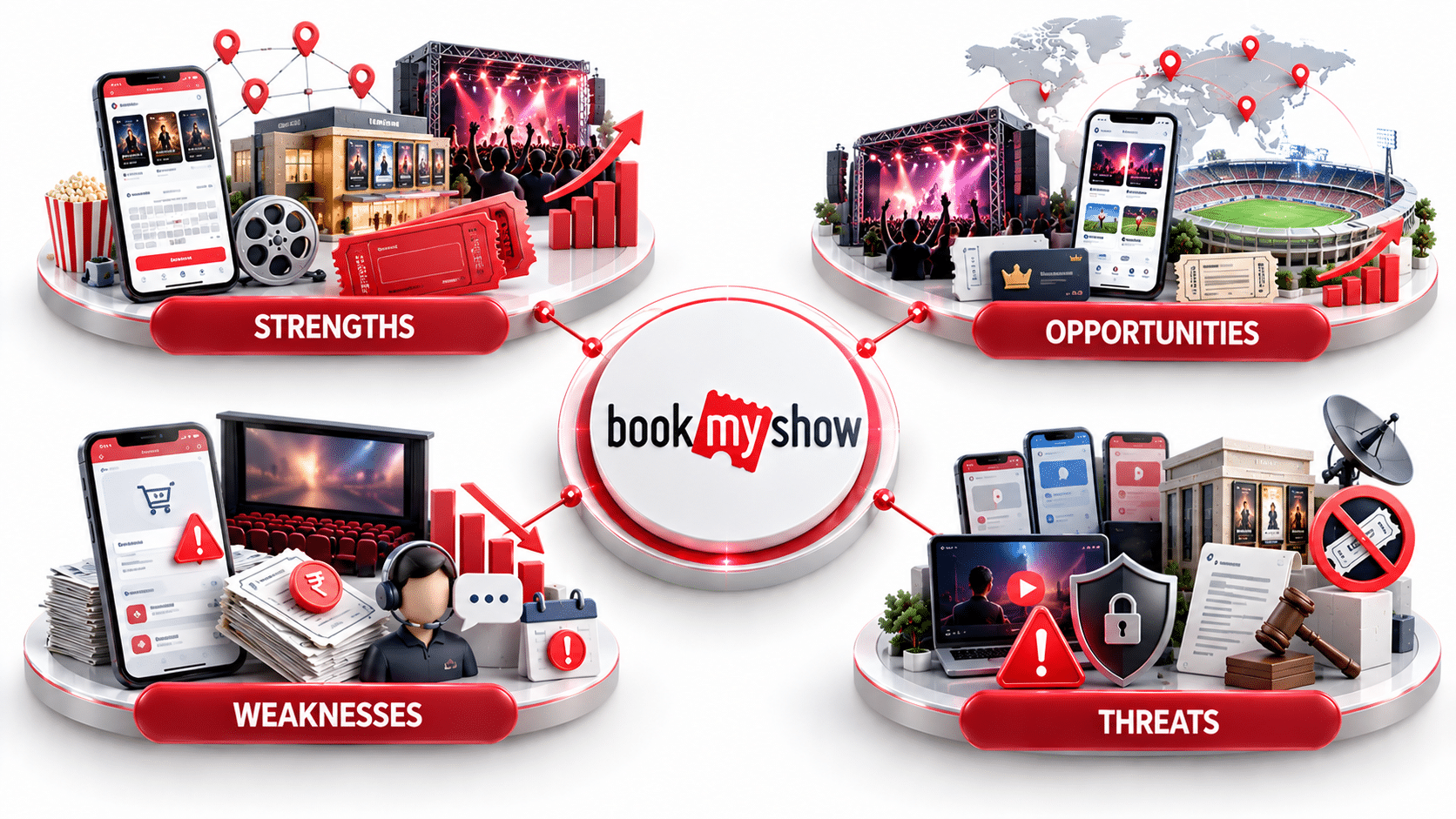
After all those details, a short summary helps. This table puts the full SWOT Analysis of BookMyShow in one place, so you can scan it, copy the logic into your own notes and see how the four boxes connect. Use it as a revision sheet, not a replacement for the explanations above.
| Factor | What It Looks Like in 2026 |
|---|---|
| Strengths | Habit-forming brand, cinema deals, 700+ towns, live events know-how, FY25 net profit of ₹192 crore, KKR capital |
| Weaknesses | Convenience-fee anger, cinema dependence, loss-making live events in FY24, trust damage after Coldplay, no daily-use hook |
| Opportunities | Live entertainment boom, non-cricket sports, smaller cities, official resale, overseas growth, memberships and brand deals |
| Threats | District, Flipkart’s planned entry, multiplex apps, regulation, OTT shift, event risk |
Look at how the boxes talk to each other. The strength of cinema relationships is also a dependency, which is a weakness. The opportunity in live events is also a source of loss and risk. Good SWOTs are never four tidy lists. They are a web of trade-offs.
How to Use the SWOT Analysis of BookMyShow in Real Work
A SWOT that lives only in a document does nothing. The point is to make choices. This section shows how to link the four boxes together, which move comes first, and what a marketer or student can borrow from BookMyShow’s story.
Match Strengths to Opportunities
Start with the strengths that fit the biggest opportunities. BookMyShow’s live events experience fits the entertainment boom. Its cinema relationships and checkout reliability fit an official resale marketplace. Its reach fits smaller-city events.
These are the moves where BookMyShow has a head start, so they cost less and work faster. A company that chases opportunities it is not ready for burns cash.
If you are writing a case study, this is the section where you show you understand strategy, not just list facts.
Fix Weaknesses Before Threats Exploit Them
Now look at weaknesses that rivals can attack. Convenience fees are the obvious one, because a competitor can undercut them tomorrow. Support during peak sales is another. Trust after Coldplay is the third.
BookMyShow can respond with fee transparency, memberships that cut costs for frequent users, better bot protection and faster refunds. None needs a technology breakthrough. They need attention and money.
The rule of thumb is simple: fix the weakness that a competitor can attack cheaply, first.
What Marketers Can Borrow From BookMyShow
Marketers should notice three things. First, habit beats ads, since BookMyShow spends little on promotion compared with revenue. Second, reliability during peak moments is brand marketing, because a crashed sale does more damage than any campaign can repair. Third, fees are a communication problem as much as a pricing one.
Conclusion
BookMyShow is a strong company in an uncomfortable moment. It has the habit, the relationships and the profits. It also has a loss-making live events arm, a trust problem to repair and the first well-funded challenger in years. The SWOT Analysis of BookMyShow comes down to one question: can it protect everyday ticketing while making live events pay?
My read, and it is only a read, is that the next two years depend on fees, reliability and sports. If BookMyShow handles big sales cleanly, softens the fee pain and wins non-cricket leagues, KKR’s money looks smart. If it does not, District keeps nibbling. For more breakdowns like this one, browse the Learn hub and try writing your own SWOT on another brand this week.
Frequently Asked Questions
What is the SWOT Analysis of BookMyShow?
It is a structured look at BookMyShow’s strengths, weaknesses, opportunities and threats. Strengths and weaknesses are internal, such as brand habit, cinema deals, fees and live event losses. Opportunities and threats are external, such as the live entertainment boom, District, Flipkart and regulation.
Who owns BookMyShow?
BookMyShow is owned by Big Tree Entertainment. Network18 holds around 39%, and TPG Growth, Accel and Elevation Capital are other investors. In August 2026, KKR agreed to buy a minority stake, reportedly around 6%, though the deal was still subject to regulatory approvals.
Is BookMyShow profitable?
Yes. BookMyShow reported a net profit of ₹192 crore in FY25, up from about ₹109 crore in FY24, on revenue of ₹1,831 crore. Note that its live events segment lost money in FY24, so profits come mainly from ticketing.
What is BookMyShow’s biggest strength?
Habit. Most Indians think of BookMyShow first when they want to book a movie or event, which keeps marketing costs low. Its relationships with cinemas and its live events capability back that habit up.
What is BookMyShow’s biggest weakness?
Dependence on cinema footfall and the convenience-fee backlash stand out. Live events, which grew fast, were also loss-making in FY24, so the company carries real risk. Support during big sales is another soft spot.
Who are BookMyShow’s main competitors?
District by Eternal (Zomato) is the main one, since it absorbed Paytm’s ticketing business including Paytm Insider and Ticketnew. Flipkart is reportedly planning to enter. Cinema chains with their own apps, such as PVR INOX, are also competitors for direct bookings.
How does BookMyShow make money?
It earns mostly from convenience fees on tickets, shared with cinemas, plus revenue from live events it promotes. It also earns from advertising, marketing and food and beverage sales. In FY24, online ticketing was about 57% of revenue.
What happened with the Coldplay ticket controversy?
Tickets sold out on 22 September 2024 amid long queues and crashes, and resale listings appeared at far higher prices. Mumbai Police summoned BookMyShow’s CEO, and a PIL was filed in the Bombay High Court. BookMyShow denied wrongdoing and filed its own FIR against scalping.
Does BookMyShow operate outside India?
Yes. It operates in Singapore, Indonesia, Malaysia, the UAE and Sri Lanka. These markets are small compared with India but add diversification.
Is BookMyShow a monopoly in India?
No, although it has a dominant position in online movie ticketing. Estimates of its share range from about 70% to 78%. District, Paytm’s former ticketing arms and cinema apps all compete, so dominant is a fairer word.
How big is District compared with BookMyShow?
District’s FY26 revenue was above ₹970 crore, according to The Ken, and its weekly active users have reached over 60% of BookMyShow’s. It is still loss-making. BookMyShow’s FY25 revenue of ₹1,831 crore remains much larger.
How can I use a SWOT Analysis of BookMyShow in a college project?
Use current numbers, label each point as internal or external and add one example per point. Then link the boxes, for example matching strengths to opportunities, and finish with a short recommendation. A table summary like the one in this guide also helps.