


Picture 2015. A gigabyte of mobile data costs somewhere around ₹250, most phones in people’s pockets are still 2G-only, and a video call on 3G buffers more than it connects. Then a new telecom company shows up with a pure 4G network, free voice calls and data priced so low that the older players spend the next three years bleeding cash just to keep up. That company was Jio. And that’s exactly why the marketing mix of Jio keeps showing up in college exams, MBA classrooms and founder conversations.

Here’s the thing most textbook summaries miss. Jio didn’t win because of one smart ad or one cheap plan. Every P in its mix pushed in the same direction. The product (a 4G-only network) made the price (almost free) believable. The price made the place (stores, apps, tower coverage) crowded within weeks. The place fed the promotion, because queues outside Jio stores were better advertising than any TV spot. Pull one piece out and the whole thing wobbles.
So this guide goes through the marketing mix of Jio the way a practitioner would, not the way a guide-book would. You’ll see the real plans, the real launch numbers, the JioPhone experiments that worked and the ones that didn’t, the IPL streaming gamble, the 2024 price hike and what it says about Jio’s strategy once the market was won. You’ll also get the extended 7Ps (people, process, physical evidence), a straight comparison with Airtel and Vi, and a list of lessons you can copy even if your budget is ₹50,000 and not ₹50,000 crore.
What You Will Learn in This Guide
- How Jio started, who built it and why its launch strategy broke the Indian telecom market
- What the marketing mix actually is, and how the 4Ps and 7Ps differ
- How Jio segmented, targeted and positioned itself before spending a rupee on ads
- Jio’s product line, from the 4G network and JioPhone to JioFiber, AirFiber, JioMart and JioHotstar
- How Jio priced its plans, from the free Welcome Offer to the 2024 tariff hike
- How Jio built distribution through retail stores, the MyJio app, eKYC and kirana partners
- How Jio promoted itself with cricket, celebrity faces, free content and relentless bundling
- How people, process and physical evidence make up the other three Ps
- How the marketing mix of Jio compares with Airtel and Vi, plus mistakes to avoid
- 12 FAQs that students and marketers actually search for
TL;DR
- Jio’s marketing mix worked because all seven Ps supported one move: make 4G data so cheap that millions of people switched at once.
- The product was a 4G-only, all-IP network with free calls, bundled with apps like JioTV, JioCinema and JioSaavn that gave people reasons to stay.
- The price strategy was penetration pricing: free for months, then plans starting at ₹149, then slow, steady increases once the base was locked in.
- Distribution leaned on Reliance Digital, Jio Points, eKYC activation and the MyJio app, so a new SIM could go live in minutes.
- Promotion came from cricket, free streaming, celebrity faces and bundles, but the biggest ad was always the offer itself.
- If you’re building a marketing mix of your own, copy Jio’s alignment, not its budget.
What Is the Marketing Mix of Jio? The Story Behind the Numbers
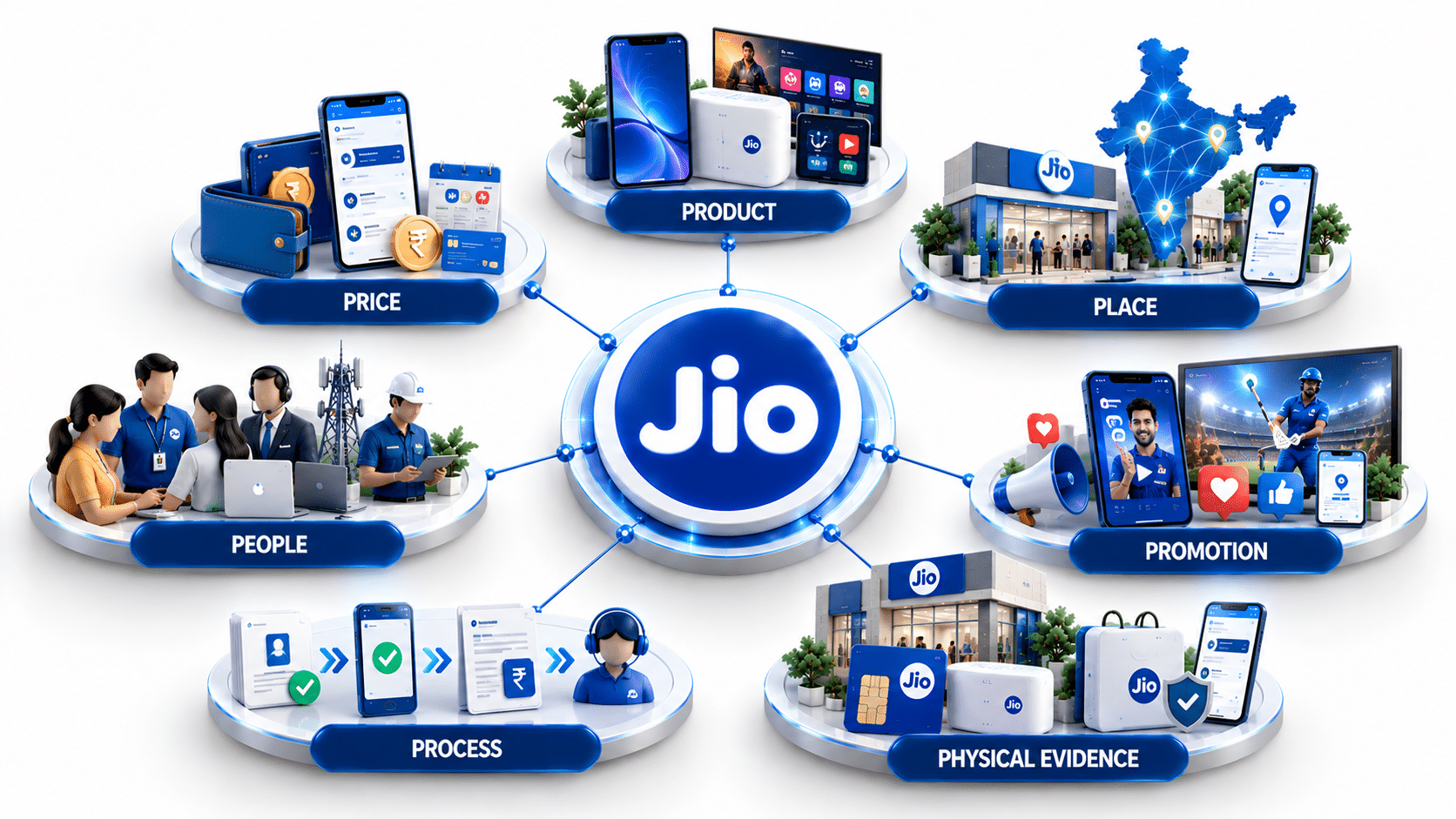
The marketing mix of Jio is the set of decisions on product, price, place, promotion, people, process and physical evidence that Reliance Jio used to enter the telecom market and pull hundreds of millions of customers. Understanding it means understanding the company first, then the framework, then the customers Jio picked.
A Quick Background: From Infotel to Jio Platforms
Jio’s story starts earlier than most people think. In 2010, Reliance Industries bought a majority stake in a small company called Infotel Broadband Services, which had just won 4G (broadband wireless) spectrum across all 22 telecom circles in India. Nobody else in the country held that kind of pan-India 4G footprint. That quiet purchase is what made everything later possible.
Mukesh Ambani’s team then spent years building the network, testing it with employees in late 2015, and launching commercially on 5 September 2016. By Mukesh Ambani’s own numbers, Jio crossed 100 million subscribers in about 170 days, which was the fastest any telecom operator had grown anywhere at that point. Today Reliance Jio sits under Jio Platforms, with Facebook (now Meta) and Google among its investors, and serves close to 500 million subscribers.
Notice the order of events. Spectrum first. Network second. Marketing third. That sequencing is the first lesson of the whole case: the marketing only worked because the product underneath was real.
What the Marketing Mix Actually Means
The marketing mix is a checklist of levers a company controls to sell something. Neil Borden used the phrase in the 1950s, and E. Jerome McCarthy boiled it down to the famous 4Ps in 1960: product, price, place and promotion. Booms and Bitner added three more in 1981 for service businesses: people, process and physical evidence. That gives you the 7Ps.
Telecom is a service, so the 7Ps fit better than the 4Ps. A SIM card is a plastic chip. What people really buy is a promise: calls connect, data loads, bills make sense, and somebody picks up when something breaks. That promise gets delivered by staff (people), by the way activation and billing work (process) and by everything the customer can see and touch, like stores, apps and packaging (physical evidence).
A small warning for students. Don’t memorise the Ps as seven separate boxes. The interesting part of the marketing mix of Jio is how they connect. The pricing needed the product. The product needed the distribution. We’ll keep tying them together as we go.
Segmentation: Who Jio Went After First
Segmentation means splitting a big market into groups with similar needs. Jio’s first group was obvious in hindsight: young, data-hungry people who were already on smartphones but rationing megabytes. Students who couldn’t afford a ₹300 data pack. Office workers hopping between Wi-Fi hotspots. Anyone who watched a YouTube video and then checked the balance in panic.
The second group was price-sensitive users on 2G and 3G who had a 4G-capable phone sitting in the drawer. Mobile manufacturers like Samsung, Xiaomi and Lava had been shipping 4G handsets for a while, and plenty of people owned one without a 4G plan to match. Jio effectively woke up a customer base that already existed.
The third, slower group was the feature-phone user, which is where JioPhone comes in later. Behavioural segmentation (how people use data), demographic segmentation (age and income) and device segmentation (4G-ready phones) all stacked together. That’s a lot more precise than “everyone in India.”
Targeting and Positioning: Digital Life for Everyone
Targeting is choosing which segments to chase hard. Jio went mass-market and aggressive, aiming at the largest pool of price-sensitive data users and refusing to cut a premium niche for itself. Airtel could afford to defend the rich customer. Jio went after the volume.
Positioning is the one-line idea you own in a customer’s head. Jio’s early line was “Live the Digital Life,” and the real message behind it was simple: data is no longer a luxury item. You don’t count megabytes anymore. You just use the internet like you use electricity.
That positioning mattered because rivals couldn’t copy it quickly. Airtel and Vodafone earned most of their money from data sold at high per-GB rates. Matching Jio’s price meant cutting their own revenue. Jio picked a position its competitors literally couldn’t afford to occupy, and that’s what a strong positioning does. It forces the other side into a bad choice.
Product Strategy
Product is the first P and the foundation of everything Jio did. The core product is a mobile network, but Jio wrapped it in handsets, home broadband, apps and content, so a customer rarely buys “just a SIM.” Each layer gives people another reason to stay.
The 4G-Only, All-IP Network
Jio built an all-IP network on 4G LTE with no legacy 2G or 3G equipment underneath. Voice calls ride on data using VoLTE (Voice over LTE), which means a single network carries both, with fewer parts to maintain. Older operators had to run 2G, 3G and 4G side by side, which cost more and slowed upgrades.
For the customer, this showed up as three things: HD voice quality, fast data and a network that didn’t feel like an old network with a new coat of paint. The catch was that early users needed a VoLTE-capable phone, which is why the handset side of the mix mattered so much.
Then in October 2022, Jio started rolling out True5G, a standalone 5G network that doesn’t lean on 4G for its core. By early 2024 it was live across every state and union territory. Same idea, different generation: build the new thing cleanly instead of patching the old one.
JioPhone and JioBharat: Winning the Feature-Phone Crowd
Here’s a problem Jio ran into fast. Hundreds of millions of Indians used basic feature phones, and those phones couldn’t connect to a 4G-only network properly. Selling to the smartphone crowd was never going to be enough.
So Jio announced the JioPhone in July 2017. Customers paid a refundable deposit of ₹1,500 and got a 4G feature phone with apps like JioTV and JioCinema. Effectively free, if you returned it after three years. Bookings piled up within days. Then came JioPhone Next in 2021, built with Google, with about ₹1,999 upfront and the rest on EMI, which was Jio’s first real swing at cheap smartphones.
The JioBharat phone, launched in 2023 at ₹999, pushed the same logic further. The plan attached to it cost ₹123 a month, noticeably less than what Airtel and Vi charged for the cheapest 4G bundle. The handset is the bait. The monthly plan is the real product.
JioFiber and AirFiber: Taking the Same Play Home
JioFiber launched commercially on 5 September 2019, exactly three years after the mobile launch. Plans started at ₹699 a month and went up to ₹8,499, with free voice calling, a set-top box on higher plans, and bundled OTT apps. The pitch was speed plus content plus a single bill.
AirFiber, introduced in September 2023, solved a physical problem. Laying fibre to every home is slow and expensive, so AirFiber beams 5G signals to a small outdoor or indoor device that acts like a Wi-Fi router. No trench digging. Installation in a day instead of weeks. For apartments where fibre isn’t available yet, that’s a real option.
What’s interesting is how Jio reused the same strategy. Cheap entry, bundled content, and a hardware device that locks the customer into the ecosystem.
The App Ecosystem: JioTV, JioSaavn, JioMart and More
A network alone is replaceable. An ecosystem isn’t. So Jio stacked apps on top: JioTV for live channels, JioSaavn after Reliance bought Saavn in 2018, JioCinema and later JioHotstar for video, JioCloud for storage, JioMeet for video calls and JioMart for groceries. MyJio ties it together as the account and recharge hub.
Many of these apps started free for Jio users. The logic: every hour a customer spends watching cricket on JioCinema is an hour they’re less likely to jump ship to a rival SIM. Content works as a retention tool dressed up as entertainment.
JioMart, launched in 2020 around a WhatsApp ordering partnership with Meta, extended the same idea into shopping. Whether you love or question this part of the strategy, the pattern is obvious. Jio wants to be the place you open when your phone wakes up, not just the company that carries the signal.
Product Strategy Lessons You Can Borrow
First, build the core product properly before making noise about it. Jio’s network was ready before the big ad pushes began. Second, fill gaps in the customer’s real situation, like the feature-phone problem, instead of ignoring them. Third, bundle extras that raise the cost of leaving.
Small businesses can do this at tiny scale. A local gym that adds a free diet-plan app, a yoga studio that bundles recorded sessions with live classes, a coaching centre that includes a doubt-clearing WhatsApp group. Nothing huge. All of it makes leaving a little less convenient. That’s the same muscle Jio flexes, only with a bigger bicep. If you want the broader fundamentals behind these ideas, the Digital Marketing learning hub covers funnels and positioning in plain language.
Pricing Strategy
Price is where the marketing mix of Jio got its fame. Jio started with free, moved to cheap, then to steady increases once millions of people were hooked. The pricing story has three clear phases, and each phase did a different job for the business.
Phase One: Penetration Pricing and the Free Welcome Offer
Penetration pricing means setting a very low price (sometimes zero) to grab market share fast, then raising it later. Jio’s Welcome Offer gave new users free voice, free data and free apps from launch on 5 September 2016 until 31 December 2016. Then it extended the freebie as the Happy New Year Offer through March 2017.
Think about what that does to a customer’s brain. A SIM that costs nothing to try has almost no friction. People who’d never switch networks for a 10 percent discount switched for 100 percent off. They also told their friends, their families, their whole hostel floor. Word of mouth did the rest.
The cost was enormous. Reliance had put well over a lakh crore rupees into building the network, and Jio was giving away the service while burning cash daily. This worked only because Reliance’s oil and gas business earned money elsewhere, which funded the war chest. A start-up copying this strategy without that cushion would’ve been dead in a quarter.
Phase Two: The Jio Prime Switch and Low-Cost Plans
Once the free period was winding down, Jio introduced Jio Prime: a one-time ₹99 membership plus a ₹303 monthly plan. Reports later suggested a huge chunk of users paid and stayed, which proved the free offer hadn’t just collected freeloaders. People actually valued the service enough to pay.
Jio’s published plans from September 2016 started at ₹149 and put data at about ₹50 per GB for pay-as-you-go use. Before Jio, data in India often cost roughly ₹200 to ₹250 per GB depending on the pack. That made Jio’s ₹50 feel like a sale, and the monthly unlimited plans made it feel cheaper still.
Look at what Airtel and Vodafone had to do in response. They slashed their own rates, launched “unlimited” packs and watched revenue drop. Idea and Vodafone eventually merged in 2018 to survive. Price became the weapon, and Jio held the only gun with real ammunition.
Phase Three: Bundling, Psychological Pricing and the Interconnect Charge
After the land grab, Jio shifted toward bundles. A plan wasn’t just data anymore. It was data plus unlimited calls plus JioTV plus JioCinema plus JioCloud, all in one price. Bundling hides individual prices and makes comparison harder, which protects margins.
Prices ending in 9 (₹199, ₹299, ₹399, ₹599) are classic psychological pricing, where the left digit feels smaller than it is. Jio and its rivals also used 28-day validity cycles, which quietly meant 13 recharges a year instead of 12. Small trick, large effect on yearly revenue.
One more wrinkle: in October 2019, Jio began charging 6 paise a minute for calls to other networks because of interconnect usage charges, and it sold data top-up vouchers to offset the cost. Those charges ended in January 2021, but the episode showed that “free forever” had limits once the base was big enough.
The July 2024 Tariff Hike: What Changed
In July 2024, Jio, Airtel and Vi all raised mobile tariffs within days of each other. For Jio, plan prices went up by roughly 12 to 25 percent depending on the pack. Unlimited 5G was also tied to plans with at least 2GB of data a day, which pushed many users toward costlier plans.
Why did customers mostly stay? Because Jio had already won the habit battle. Years of free apps, an always-working network and zero hassle recharge flows created switching costs. Raising prices once you own the market is a different game from cutting prices to get in.
Average revenue per user (ARPU, the monthly money a telecom earns from each customer) went from roughly ₹140 in 2020 to above ₹200 by 2025. Plan prices change often, so check MyJio or the official Jio website for the current numbers before quoting them in an exam or a report.
Device Pricing: Cheap Hardware, Recurring Revenue
Jio treated hardware like the razor in the razor-and-blades model. Sell the handle cheap, earn on the blades. The JioPhone’s refundable ₹1,500 deposit, the JioPhone Next EMI offer and the ₹999 JioBharat phone were all priced to get a device into a hand, because the real money sits in the monthly recharge that follows.
The maths is simple. A customer paying ₹123 a month for a year spends about ₹1,476, which is more than the phone itself cost. Multiply that across millions of feature-phone users and the handset subsidy looks small. It’s a long bet on repeat payments, and it only works if the network and plans keep customers from walking away.
Plenty of small businesses can use the same logic. Sell a low-cost starter kit, a trial class or a basic template, then earn through subscriptions, refills or advanced versions. Just be honest about your numbers. If a customer needs to stay for eight months before you break even, make sure your service is good enough to keep them there.
Pricing Lessons and the Mistake to Avoid
The lesson isn’t “be cheap.” Lots of businesses have tried that and died. The lesson is to price low only when you have something structural behind it: deep funding, a cost advantage, or a plan to raise prices once customers depend on you. Jio had all three.
Most small brands miss this. They slash prices to win customers, never build a reason for those customers to stay, and then can’t raise prices without losing everyone. If you’re running a course, a D2C store or a freelancing service, pair any discount with something sticky: a community, a habit, a bundled extra. That keeps the relationship alive after the offer ends.
Place and Distribution
Place is about where and how customers get the product. For a telecom company, that means stores, retailers, apps, activation systems and, most of all, network coverage. The place strategy in the marketing mix of Jio worked because buying a SIM was made almost as easy as ordering a pizza.
Retail Stores, Jio Points and Reliance Digital
Jio started with an advantage no start-up telecom has: a retail arm. Reliance Digital and Reliance Retail already had stores in hundreds of cities, so Jio SIMs and handsets landed on real shelves from day one. Then Jio added its own Jio Points and Jio Centres, smaller outlets set up to sell SIMs, take recharges and handle complaints.
Third-party retailers did the rest. Mobile shops, general stores and small recharge counters stocked Jio SIMs, earning commissions on activations. Rival networks had these retailers locked in for years, but Jio offered them something fresh: customers walking in and asking for a Jio SIM by name.
The part most guides skip is how those queues behaved as advertising. In late 2016, news channels showed long lines outside Reliance Digital stores. Millions of people who never saw a Jio ad saw a crowd, and crowds say “this is the thing to get” better than any slogan.
eKYC Activation: Making a SIM Live in Minutes
Before Jio, buying a SIM meant filling paper forms, photocopying ID proof and waiting a day or two for activation. Jio used Aadhaar-based eKYC, where a fingerprint scan at the store verified identity digitally and the SIM was usually live within minutes.
That process change, which falls under the “process” P too, was effectively a distribution advantage. Every retailer could onboard more customers per hour. Every customer felt the speed. Reliability of this sort builds trust without a single ad line.
Rules changed after the Supreme Court’s 2018 Aadhaar judgment, which limited private companies from using Aadhaar for verification. Telecom firms shifted to other digital KYC routes, including video-based verification and document uploads. Jio adapted, and the simple lesson holds: if your sales process feels slow, a faster process can beat a better offer.
The MyJio App and Digital Channels
MyJio is where Jio’s digital distribution lives. Customers check balance, recharge, buy plans, track data usage, raise complaints and open JioTV or JioCinema from one screen. The app has crossed 100 million downloads on Google Play, which makes it one of the most installed Indian apps outside social media and payments.
Recharging through MyJio is also cheaper to run than a retail counter. No commission to share, no cash handling, no queue. UPI integration and third-party wallets like PhonePe, Google Pay and Paytm made it even simpler. A recharge takes about twenty seconds.
From a marketing view, this matters because every app open is a chance to cross-sell a JioFiber plan, a new offer or a JioMart promo. The app works as a store, a help desk and an ad channel at the same time.
Network Coverage as the Real “Place”
Here’s a point most students miss. For telecom, the real place isn’t the shop. It’s the signal. A Jio SIM bought anywhere is useless if the tower coverage is patchy where the customer lives.
Jio built fibre backbone and towers at a speed that surprised everyone, with coverage in a very large share of the population within the first two years. Tower assets were later moved into an infrastructure trust, with Brookfield buying a stake in the portfolio in 2019, which freed money for other investments.
So when people say Jio’s distribution was strong, part of that means the physical network itself. Coverage was the product, the promise and the place in one package. Without it, retail queues would’ve turned into angry reviews within weeks.
JioMart and the Kirana Network
JioMart takes the distribution idea sideways. Instead of fighting Indian kirana (neighbourhood grocery) stores, Jio tried to connect them to its platform, letting customers order groceries online and local shops fulfil them. The 2020 partnership with Meta put WhatsApp ordering at the front of it.
Whether JioMart has fully delivered on its promise is a debate worth having. The grocery business has thin margins and plenty of competitors like BigBasket, Blinkit and Zepto. Still, as a place strategy it’s interesting because it uses existing shops instead of building everything from scratch.
Takeaway for your own work: when distribution is expensive, look for partners who already have the customer’s trust. A local clinic’s WhatsApp group, a college club, a creator’s audience. Borrowed distribution is cheaper than built distribution, and often just as effective.
Promotion Strategy
Promotion covers every way a brand talks to customers: ads, offers, sponsorships, public relations and word of mouth. In the marketing mix of Jio, the strongest promotion was never a campaign. It was the offer itself. Everything else, from cricket to celebrities, simply amplified a deal people already wanted to talk about.
The Launch Campaign: Celebrity Faces and Big Newspaper Ads
Jio’s early ads leaned on star power. Shah Rukh Khan was the first big face of the brand, fronting the “Digital Life” message that framed Jio as a lifestyle shift and not just a SIM card. Full-page newspaper ads and heavy TV rotation covered the launch weeks, and the brand went everywhere at once.
One launch ad also carried the Prime Minister’s photograph, which drew political criticism and complaints. It’s a useful reminder that big reach can come with big risk. A single creative choice turned a marketing story into a news cycle about something else.
What actually moved people, though, wasn’t the star. It was the line “free.” Celebrity faces got attention, but the offer converted it. If you’re new to ad creative, notice how often the strongest campaigns lead with a single concrete benefit, not a mood.
Cricket, JioCinema and the IPL Streaming Gamble
Cricket is the one thing nearly every Indian segment watches. Jio understood that early. In 2022, Viacom18, backed by Reliance, won the IPL digital streaming rights for 2023 to 2027 for roughly ₹23,758 crore. Then JioCinema streamed IPL matches free, mostly with ad support, even for people who weren’t Jio customers.
The numbers were startling. The 2023 final between Chennai Super Kings and Gujarat Titans hit about 3.2 crore concurrent viewers at peak on the platform, a streaming record in India at the time. Millions of first-time app installs followed. Jio turned a sport into an acquisition channel.
Later, in 2024, Reliance and Disney merged their India media operations into JioStar, and JioHotstar launched in February 2025. The cricket-and-content bet became even bigger. Whether it makes money long term is an open question, but as a promotion move it put Jio brand names in front of crores of people every match night.
Offers, Festivals and the Dhan Dhana Dhan Era
When a freebie period ends, brands often lose attention. Jio kept it alive with rolling offers. The “Dhan Dhana Dhan” plan in 2017, for example, gave roughly 84 days of unlimited calling and 1GB a day for ₹309, framed as a festival-style bonanza right after Prime membership began.
Diwali offers, New Year offers, cricket-season data packs and bundled streaming plans followed. Each had a name, a deadline and a reason to act now. Urgency drives action, which is old-school marketing, but it works because it matches how people actually behave: they postpone until a deadline shows up.
For students, here’s the pattern to copy. Name your offer. Give it an end date. Say who it’s for. A discount called “March Offer, ends Friday” outperforms a discount that quietly exists forever.
Public Relations, Founder Keynotes and Word of Mouth
Mukesh Ambani is Jio’s best PR asset. The Reliance Annual General Meeting works like a product launch event, with live streams, big announcements and headlines the next morning. JioFiber, JioPhone Next, True5G and AirFiber all got their stage there, and newsrooms covered each as a major story without Jio paying for the space.
Word of mouth did even more. When your cousin tells you “the Jio SIM is free,” you believe it more than you’d believe a TV ad. Referral behaviour spread through WhatsApp groups, college hostels and neighbourhood tea stalls. Earned attention beat paid attention.
If you’re running a small brand, copy the principle. Build one story worth repeating, then make it easy to repeat. A simple referral line, a screenshot-friendly offer or a founder who talks openly on social media often does more than a ₹50,000 ad budget. The social media learning hub has practical walkthroughs on getting this started without a big team.
Digital, Regional and Content Marketing
Jio ran a heavy digital push through YouTube, Instagram, Facebook and in-app banners, but regional language marketing is the quieter strength. Offers were localised, ads were shot in different languages and the MyJio app supports multiple Indian languages. A farmer in Punjab and a college student in Pune could both see Jio talking to them in a familiar tongue.
Content became marketing too. Free access to JioTV, JioSaavn and JioCinema gave people daily reasons to open Jio apps, so the brand was in front of them every day, not just on recharge day. That habit loop is more valuable than any single ad impression.
People, Process and Physical Evidence
The three extra Ps are where service brands win or lose customers after the first sale. Jio’s rivals matched its prices within a year or two. They struggled to match the way Jio handled staff, systems and visible touchpoints. That’s why these three Ps deserve their own section in any serious look at the marketing mix of Jio.
People: Leadership, Staff, Retailers and Support
People means everyone who touches the customer experience. At the top, Mukesh Ambani sets direction and acts as the face of big announcements, while his children Akash and Isha lead Jio and Reliance Retail respectively. Akash Ambani became chairman of Reliance Jio Infocomm in 2022, which signalled a younger leadership layer.
On the ground, the people who matter are retail staff, field engineers who build and fix towers, and customer support teams. A shop assistant who activates a SIM in five minutes shapes the first impression. A support agent who fixes a billing issue shapes the tenth.
Jio also trained a huge network of retailers and recharge-shop owners, since they are the real “staff” in front of most customers. Early Jio had plenty of complaints about customer care wait times, and that’s worth saying plainly. When a brand grows this fast, service quality usually lags behind sales. The fix came through chatbots, voice assistants like Hello Jio and WhatsApp-based support, which reduced pressure on call centres.
Process: Activation, Recharge, Billing and Support Flows
Process means how things work behind the scenes. Jio’s activation flow, the digital KYC, the instant recharge on MyJio and the self-service complaint system all reduced steps. Fewer steps mean fewer places for customers to get frustrated.
Mobile number portability (MNP) is a good example. Moving your number from Airtel to Jio, or the other way, needs a process that’s smooth enough for people to try it. Jio made porting-in simple through the app and stores, which helped it pull customers from rivals who had been comfortable with a sticky base.
Network operations are also a process. Jio automated much of its monitoring and fault detection from the start because it had a clean, single-technology network. Fewer outages and quicker fixes became a quiet part of the brand experience, even if customers never saw the system working.
Physical Evidence: Stores, Branding, Devices and the App
Physical evidence is anything tangible that tells the customer the service is real and trustworthy. For Jio, it includes the red gradient logo, the store layout, the SIM pack, the JioFi hotspot, the JioFiber router and set-top box, and the MyJio app interface.
Consistency is the secret. A Jio Point in Nagpur and one in Bengaluru look and feel recognisably the same. The app uses the same colours and icons as the billboard. When a brand looks the same everywhere, customers start trusting it without realising why.
Devices matter more than people think. A JioFi pocket Wi-Fi in 2016 let people with non-4G phones try the network. A branded router in a living room is a daily reminder that Jio is in the house. Hardware turns an invisible service into something you can point to.
How the Extended Ps Protect the Brand
Here’s the pattern most students overlook. Price and promotion are easy to copy. Airtel launched cheaper plans. Vi launched bundles. What’s harder to copy is a smooth experience built over years: stores that look right, apps that don’t crash, support that responds.
That’s where the real moat sits for any service business. If you’re learning marketing as a career, try this exercise: pick a brand you like and list what you see, what you touch and what you wait for as a customer. Those notes are your extended Ps. For a structured path into this kind of thinking, the Alpha Marketer Foundation Program walks through marketing fundamentals step by step.
Marketing Mix of Jio vs Airtel and Vi: What Jio Did Differently
Comparing the marketing mix of Jio with Airtel and Vi shows why Jio changed the rules and where it still has gaps. Airtel kept a premium lean, Vi fought for survival, and Jio played volume. Each choice shaped pricing, distribution and promotion differently.
Side-by-Side Comparison Table
| Element | Jio | Airtel | Vi (Vodafone Idea) |
|---|---|---|---|
| Product | 4G and 5G network, apps, JioFiber, AirFiber | 4G and 5G network, Airtel Xstream, broadband | 4G network, 5G rollout in select circles, bundles |
| Price | Low entry plans, bundled apps, rising prices after 2024 | Slightly higher, focuses on high-value customers | Mid to low, promotions to retain base |
| Place | Reliance retail, Jio Points, MyJio, JioMart | Own stores, partners, Airtel Thanks app | Retail partners, Vi app |
| Promotion | Cricket, JioHotstar, offers, founder events | Premium bundles, cricket sponsorships | Offers, campaigns focused on retention |
| Positioning | Digital life for everyone | Quality and premium service | Value plans, urban retention |
A table like this works as a quick revision tool, but remember that plans and rollouts change. Treat the entries as a snapshot of strategy, not a price list.
Where Jio Struggled: Interconnect Fights and Early Congestion
Jio’s rise wasn’t smooth. In 2016, Jio accused Airtel, Vodafone and Idea of not providing enough points of interconnect, the physical connections that let calls move between networks. Jio users reported call failures and drops. The incumbents denied wrongdoing and pointed at Jio’s network capacity. The dispute went to TRAI, the telecom regulator, and it became one of the loudest corporate fights of the year.
Early congestion also hurt. When millions of people join a free network in months, speeds drop in crowded areas. Reports of slow data during peak hours were common, and customers noticed.
Why include this in a marketing guide? Because honest analysis includes friction. Jio managed to hold its customers through these problems largely because the price and offers outweighed the annoyance. That says something about how much work value pricing can do, and also how fragile it would be if rivals matched it.
Mistakes and Weak Spots in Jio’s Marketing Mix
JioPhone Next got criticism for its performance on lower specifications. JioMart faced a tough grocery battle against quick-commerce players. And the heavy reliance on Reliance’s cash flow raises a fair question about how replicable the model is.
There’s also the 2024 price hike. Jio’s identity was built on being the cheap disruptor, so rising prices test the brand’s story. So far customers stayed, partly because rivals raised prices too. If competition thins out, that’s a different kind of risk for the market, and one regulators watch closely.
Another honest gap: many students copy Jio’s strategy into exam answers without noting the funding behind it. A marketing plan without the budget logic is only half an analysis. Case studies like this one are a good place to practise, and the case studies hub has more real-world breakdowns for comparison.
What Airtel and Vi Did in Response
Airtel moved up the value chain. It focused on high-paying postpaid customers, launched Airtel Black bundles, and pushed network quality messaging. Over time, its ARPU stayed higher than Jio’s, which means it earned more per customer even with fewer total subscribers.
Vi merged, then struggled with debt, including large adjusted gross revenue (AGR) dues to the government. Without the cash to fund a price war or a 4G and 5G build-out at Jio’s speed, it lost subscribers for years. Its story shows what happens when you’re stuck in the middle of a price fight with no funding.
How to Write About the Marketing Mix of Jio in an Exam, Interview or Case Study
Knowing the facts is half the job. The other half is arranging them so an examiner, interviewer or client sees a clear argument. Here’s a simple way to turn everything above into an answer that reads like analysis and not a memory dump.
Start With a One-Line Verdict
Open with a single sentence that states your view. For example: “Jio’s marketing mix worked because penetration pricing was backed by a 4G-only network and mass retail distribution, so low prices were sustainable and visible.” That line tells the reader where you’re headed and shows you’ve thought about how the Ps connect.
Examiners see hundreds of answers that list product, price, place and promotion in four neat paragraphs with no link between them. A verdict first, evidence second, makes yours stand out within the first ten seconds. Keep it to one sentence, and make sure it names at least two of the Ps.
Back Each P With One Number and One Example
For every P, pick a single fact that proves your point. Product: the VoLTE-based all-IP network. Price: the ₹149 starting plan and the free Welcome Offer. Place: eKYC activation in minutes and the MyJio app. Promotion: IPL streaming on JioCinema with about 3.2 crore peak viewers in the 2023 final.
Numbers make an answer believable. Vague phrases like “affordable prices” or “wide distribution” tell the reader nothing. If you can’t remember an exact figure, say “roughly” and give the right order of magnitude, then move on. A rough number beats no number every time.
Add a Critical Point to Show Real Understanding
The strongest answers include one honest weakness. You could mention the early interconnect dispute, the pressure on customer care during rapid growth, JioMart’s struggle in a crowded grocery market or the risk of depending on Reliance’s cash flow. One or two sentences is enough.
Interviewers in particular love this move. It signals that you can look at a famous success without worshipping it. Say what worked, say what didn’t, and say what you’d do differently. That’s analysis, and it’s what separates a good student from someone who has simply read a summary.
Lessons From the Marketing Mix of Jio You Can Apply Today
Studying the marketing mix of Jio only pays off if you can use something from it. You don’t have Reliance’s money, but you do have the same basic levers. These four lessons translate to a small shop, a freelance service or a new online business.
Make Every P Point the Same Way
Jio’s mix worked because the network, price, stores and ads all told one story: the internet is cheap and everywhere. Most small brands have mixed signals. A premium product with discount ads. A friendly tone with a confusing checkout. A cheap offer with a luxury-looking website.
Write your one-line promise first. Then check each P against it. Does the product deliver it? Does the price match it? Does the place where customers find you feel consistent with it? Anything that fights the promise needs to change or go.
Price for the Long Game, Not the First Sale
Free and cheap offers are tools, not strategies. Jio used them to build a base, then built reasons to stay, then raised prices slowly. If you cut your price today, ask what happens on day 91. Is there a habit, a community, a bundle or a data advantage keeping customers around?
A practical version: offer a low-priced first purchase, then show a clear path to the next one. A ₹99 starter product followed by a ₹999 main product beats a flat ₹499 product that people buy once and forget.
Remove Friction Before You Add Promotion
Jio’s eKYC, app-based recharge and fast activation did more for growth than a lot of advertising. Before you spend on promotion, look at your own process. How many clicks to buy? How long until a customer gets a reply? How many forms must they fill?
Fix the slow parts first. A promotion that sends people into a clumsy process only wastes money faster. Streamlined processes also make word of mouth easier, because people tell friends about things that were easy.
Borrow Distribution and Build Habits
Jio used Reliance Retail, local shops, kirana stores and WhatsApp as distribution partners. You can use college clubs, local communities, creators, WhatsApp groups and marketplaces. Don’t build every channel yourself when someone already has the audience.
Then give people a reason to come back daily or weekly. Jio’s free apps did it with entertainment. Your version might be a newsletter, a daily tip, a recipe card or a tracker. Habits make a brand harder to replace than any discount ever could.
Conclusion
The marketing mix of Jio shows what happens when product, price, place, promotion, people, process and physical evidence all push the same way. A pure 4G network made near-free data possible. Easy activation and retail reach made it simple to join. Cricket, content and festival offers kept it in everyone’s head. Rivals could copy one lever but not the whole machine.
Your next step is simple: pick one brand you use daily and map its seven Ps on a single page, the way this guide did for Jio. Then explore more real breakdowns and tutorials in the Learn hub and try rewriting one of them in your own words. That exercise teaches more than reading five more textbooks.
Frequently Asked Questions
These are the questions students, job seekers and marketers search most often about the marketing mix of Jio. Each answer is short and self-contained, so you can use it for revision, interviews or quick reference.
What is the marketing mix of Jio?
The marketing mix of Jio is the combination of product, price, place, promotion, people, process and physical evidence that Reliance Jio uses to sell its telecom and digital services. Jio offers 4G and 5G connectivity, bundled apps and broadband at low prices, sells through retail and digital channels, and promotes through cricket, offers and celebrity campaigns. It’s usually studied as a 7Ps case because telecom is a service.
What are the 4Ps of Jio?
The 4Ps are product, price, place and promotion. Jio’s product is mobile connectivity plus apps and devices. Its price is low-entry and bundled. Its place is retail stores, the MyJio app and the network itself. Its promotion includes cricket sponsorships, free streaming, festival offers and founder-led announcements.
What is Jio’s pricing strategy?
Jio used penetration pricing at launch, offering free services during the Welcome Offer in late 2016. It then moved to low-cost paid plans starting at ₹149, added bundled content and later raised prices gradually, including a hike in July 2024. The idea was to win the market first and increase revenue per user once customers depended on the service.
Who is the target market of Jio?
Jio targets price-sensitive data users first: students, young professionals and families who wanted affordable 4G. It later added feature-phone users through JioPhone and JioBharat, home users through JioFiber and AirFiber, and shoppers through JioMart. The common thread is a large, mass-market audience that values low cost and convenience.
What is the positioning of Jio?
Jio positions itself as the brand that made digital life affordable for everyone. Its early message, “Live the Digital Life,” framed data as a daily utility instead of a luxury. That positioning was hard for rivals to copy because matching it meant cutting their own data revenue.
How does Jio promote its products?
Jio promotes through celebrity-led ads, cricket streaming on JioCinema and JioHotstar, festival and seasonal offers, Reliance AGM announcements, social media and regional language campaigns. Free content and bundled apps also work as promotion because they keep Jio in front of users daily. Word of mouth from the early free offers was probably its single strongest channel.
What are the 7Ps of the marketing mix of Jio?
The 7Ps are product, price, place, promotion, people, process and physical evidence. People includes leadership, retailers and support teams. Process includes eKYC activation, app-based recharge and complaint handling. Physical evidence includes stores, the logo, SIM packs, routers, JioFi devices and the MyJio app.
Why did Jio offer free services at launch?
Jio offered free services to remove the cost of trying a new network, which pulled in tens of millions of users within months. A free trial also gave the company time to fix network problems and build habits around its apps. It could afford the free period because Reliance’s other businesses funded the heavy network investment.
How is the marketing mix of Jio different from Airtel’s?
Jio focuses on volume and affordability, while Airtel has leaned toward premium customers and higher revenue per user. Jio’s promotions centre on cricket, streaming and bundles. Airtel emphasises network quality, postpaid plans and premium offers. Both now sell 5G, but their price positioning and customer mix still differ.
What is Jio’s distribution strategy?
Jio sells SIMs and devices through Reliance Digital, Jio Points, third-party retailers and online channels. Digital KYC lets stores activate SIMs in minutes, and the MyJio app handles recharges and support. Network coverage is also part of distribution, since a SIM is only useful where the signal reaches.
Is Jio’s marketing mix still working after the 2024 price hike?
So far, yes. Jio’s customer base remained large after the July 2024 tariff increase, and average revenue per user has climbed. The main reasons are habits built through free apps, wide coverage and the fact that rivals raised prices too. Plan prices and market conditions keep changing, so check the latest data when you write a report.
What can small businesses learn from the marketing mix of Jio?
Small businesses can learn to align every part of their offer behind one promise, price for the long term, reduce friction in buying and borrow distribution from partners who already have an audience. Bundling a few extras and building a daily or weekly habit also helps retention. You don’t need Jio’s budget to use these ideas.
What is the USP of Jio?
Jio’s unique selling proposition is affordable high-speed data with free voice calling on a modern all-IP network, backed by a bundle of apps and a wide retail and digital presence. At launch, the free Welcome Offer made this stand out. Today the USP is more about ecosystem, coverage and value across mobile, home broadband and content.