


Here is a number that still sounds slightly unreal: 533.3 million. That is how many customers Reliance Jio had on 30 June 2026, which makes it the biggest telecom operator in India by a wide margin and, going by the company’s own claims, the second largest mobile operator on the planet. Ten years ago the same company had zero customers and a network nobody had stress-tested. A proper SWOT analysis of Jio has to start with that gap, because almost everything good and bad about the business traces back to how it got from zero to 533 million.

Most articles on this topic read like a school assignment. Four boxes, three bullets each, “strong brand” in the strengths and “competition” in the threats, done. That version is useless if you are a student trying to understand the case, a marketer trying to learn from it, or an investor staring at the biggest IPO in Indian history (Jio Platforms got SEBI’s nod on 28 August 2026 for an issue of roughly ₹37,700 crore). So this guide goes the other way. We will look at the actual numbers, the actual decisions, and the places where Jio’s story is less tidy than the headlines make it sound.
You will see why Jio’s ARPU (average revenue per user, the monthly money earned from each customer) still trails Airtel’s even after a decade. You will see why a company with a record EBITDA can still need an IPO to pay down debt. And you will see why Starlink, Airtel’s postpaid push and a possible tariff hike all sit in the same SWOT grid, pulling in different directions. Read it like a conversation with someone who has followed the sector for years, not a consultant’s slide deck.
What You Will Learn in This Guide
Before we get into it, here is exactly what this article covers, so you can jump to the part you need.
- What the SWOT analysis of Jio actually looks like in 2026, with real subscriber, ARPU and profit numbers
- Six strengths that explain why Jio sits at the top of the Indian telecom market
- Five weaknesses that rarely make it into the glossy summaries
- Six opportunities, from tariff hikes to AI and home broadband
- Five threats, including Airtel, satellite internet and regulation
- How to turn the SWOT into real strategy, using a simple TOWS matrix
- 12 FAQs on Jio’s business model, IPO, competitors and future
TL;DR
- Jio’s biggest strength is sheer scale: 533.3 million customers, about 285 million on 5G, and a 39% share of India’s wireless market.
- Its biggest weakness is monetisation: ARPU of ₹215.6 in Q1 FY27 sits well below Airtel’s ₹264, and the business carries heavy borrowings.
- The best opportunities are a long-awaited tariff hike, home broadband through JioAirFiber, and the IPO that will force clearer disclosure of digital services.
- The nastiest threats are Airtel’s steady gains in premium customers, satellite broadband and regulatory moves on pricing and spectrum.
- Jio’s SWOT is really a story about converting users into revenue, and that conversion is the thing to watch from here.
What Is the SWOT Analysis of Jio and Why Does It Matter Right Now?
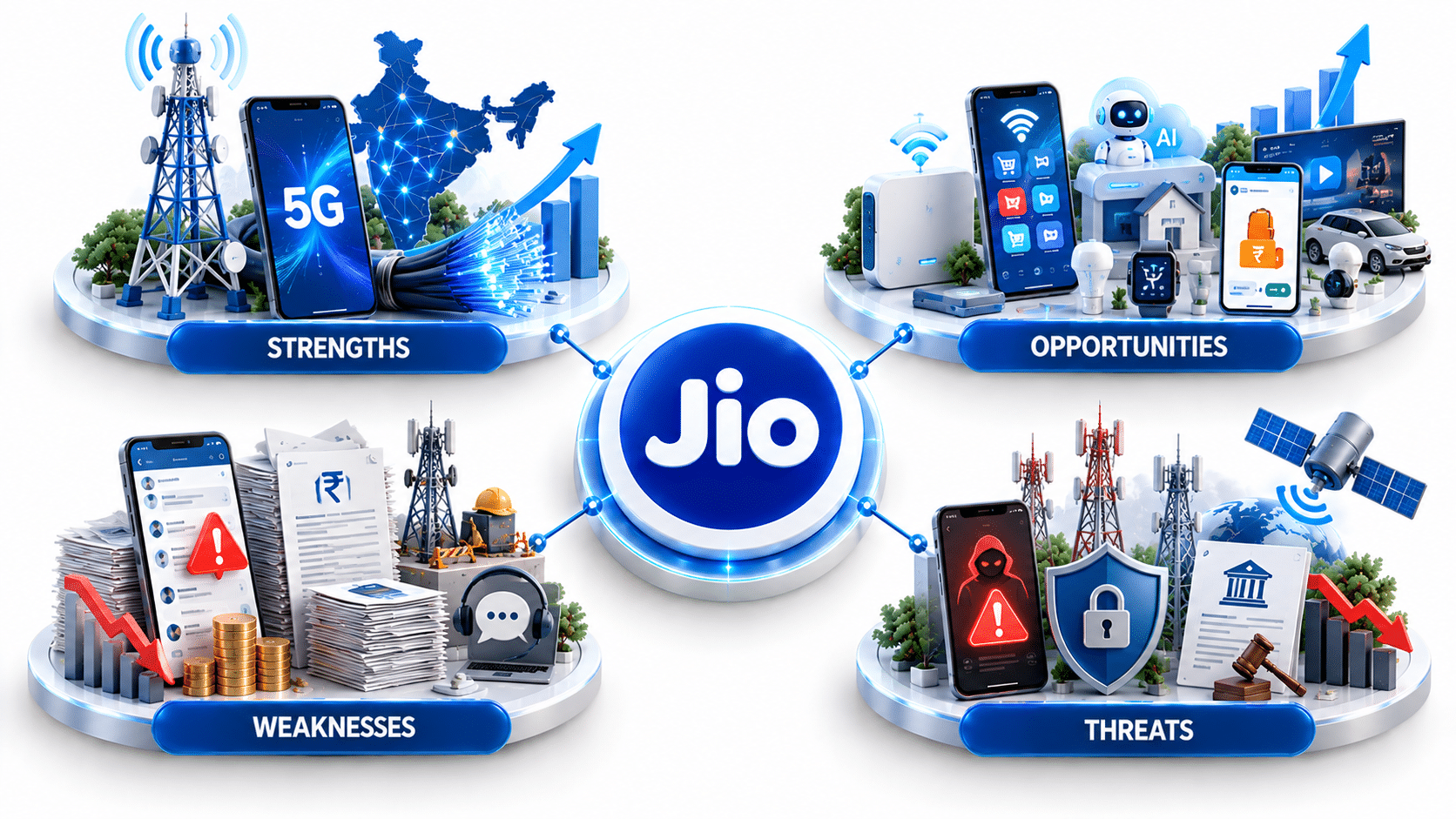
A SWOT analysis of Jio is a structured look at the company’s internal strengths and weaknesses alongside the external opportunities and threats in its market. It matters right now because Jio is heading into a public listing, which means every number in this article is about to get far more scrutiny than it ever did inside Reliance’s conglomerate walls.
Jio at a Glance: The Numbers That Frame Everything
Start with the scoreboard. In Q1 FY27 (April to June 2026), Jio Platforms reported gross revenue of ₹45,961 crore, up 12% from a year earlier. EBITDA (earnings before interest, tax, depreciation and amortisation, basically operating profit before the accounting adjustments) hit ₹20,865 crore, up 15.1%. Profit after tax landed at ₹7,764 crore, up 9.2%.
Now the customer side. Reliance Jio Infocomm, the connectivity arm, closed June with 533.3 million subscribers after adding 8.9 million in the quarter. About 285 million of them use 5G. Per customer data use averages 43.7 GB a month, and the company says its fixed wireless access share (home internet over 5G radio, no cable) is above 78%.
These figures matter because they show two things at once. The business is huge and growing. But look at revenue growth of 12% against profit growth of 9.2%, and you can already see costs eating into the gains. Keep that tension in mind, because it comes back in every quadrant.
A Short History: From Free Data to Standalone 5G
Jio launched commercially on 5 September 2016 with free voice and heavily subsidised data, and it reached 100 million users in about 170 days. The 2017 JioPhone followed, sold against a refundable deposit of ₹1,500, to bring feature phone owners onto 4G.
In 2020, Meta and Google bought stakes. In 2022, Jio spent about ₹88,000 crore at the spectrum auction and began its 5G rollout that October. By 2025 and 2026 the story had moved on to AirFiber, JioHotstar, AI offers and the IPO filing.
This timeline matters for any digital marketing student, because each step shows a pattern: aggressive entry, rapid scale, then slow monetisation. The SWOT below is basically a report card on stage three.
Who Gets the Most Out of This SWOT Analysis of Jio
Students will find a ready structure for assignments on strategy, telecom or marketing. Working professionals can use it as a case for pricing and positioning discussions. Investors get a quick reality check before reading the prospectus.
Founders sometimes ignore telecom cases because the scale feels irrelevant. That is a mistake. The decisions behind Jio’s launch, like removing price as a barrier and building habits first, apply to a ₹50 lakh startup as much as a ₹5 lakh crore company.
Whichever group you belong to, read the numbers first and the commentary second. Numbers do not have opinions, and they tend to age better than adjectives.
How a SWOT Analysis Works (And Where People Get It Wrong)
SWOT stands for strengths, weaknesses, opportunities and threats. Strengths and weaknesses are things inside the company that it controls, like network quality, balance sheet or brand. Opportunities and threats come from outside, like regulation, competitors or new technology. That split sounds simple, yet students mix it up constantly.
The classic mistake is listing a threat as a weakness. “Competition from Airtel” is a threat, because Jio does not control what Airtel does. “Low ARPU compared to Airtel” is a weakness, because it is a result of Jio’s own pricing and customer mix. Same fact family, different quadrant.
The second mistake is writing generic points. “Strong brand” tells the reader nothing. “A brand built on the free data launch of September 2016 that made 4G feel like a utility” tells them something. Specific beats vague every time, and this guide tries to stay on the specific side.
The Ownership and IPO Context You Cannot Ignore
Jio Platforms is the holding company for Reliance’s digital business. Reliance Industries owns about 66.4% of it, and Meta and Google together hold about 17.7%, according to the draft prospectus. Akash Ambani was named managing director in May 2026, with Mukesh Ambani as chairman.
The IPO involves a fresh issue of 27 crore shares, roughly 2.9% of the company after the issue. Media reports put the valuation near $137 billion. According to the draft papers, the proceeds will mostly repay about ₹27,500 crore of borrowings at Reliance Jio Infocomm. The price band and dates had not been announced in the reports we checked, so treat any specific listing date you see online with suspicion.
Why does this matter for a SWOT? Because a listed company has to explain itself every quarter. Analysts will pick at ARPU, capital spending and digital services revenue in a way the Reliance group results never forced them to. That changes the weight of every point below.
Strengths
The strengths side of the SWOT analysis of Jio is long, and honestly it should be. A company does not reach 39% of a market with 1.4 billion people by accident. Below are the six strengths that do real work, with the numbers behind each one rather than lazy adjectives.
Scale: 533 Million Customers and a 39% Market Share
TRAI’s data for July 2026 put Jio at about 506 million wireless subscribers and roughly 39.3% of the wireless market, ahead of Airtel at about 38%. Vodafone Idea sat near 15.5% and BSNL near 7.2%. Jio’s own count of 533.3 million is higher because it includes other connection types.
Scale is not just a bragging right in telecom. A network is a fixed-cost machine: towers, fibre, spectrum and data centres cost the same whether 100 million or 500 million people use them. More customers spread that cost thinner. It also gives Jio buying power with handset makers, content owners and equipment vendors.
Here is the catch worth remembering. Scale protects Jio from small rivals, yet it does nothing against a rival that is almost as big. Airtel is that rival, and we will get to it in the threats section.
A Network Built Entirely on 4G and 5G From Day One
Jio started in September 2016 as an all-IP, 4G-only network. No legacy 2G or 3G equipment to maintain, no old voice circuits to keep alive. That sounds like a technical footnote, but it is the reason Jio could sell data so cheaply. Its cost per gigabyte was simply lower than operators dragging older technology along.
The same logic carried into 5G. Jio bought the 700 MHz band and a large block of other spectrum in the 2022 auction, spending about ₹88,000 crore, and built a standalone 5G network rather than leaning on 4G cores. About 285 million customers are on it now, 73 million more than a year ago.
Standalone 5G also unlocks products other operators struggle to deliver at scale, like fixed wireless broadband over the air. Jio’s claimed 78% share of FWA in India comes straight out of this architecture choice made years earlier.
Reliance’s Balance Sheet and Patient Capital
Jio had parent money behind it from the first day, and that is a huge unfair advantage. When the free-data launch burned cash in 2016 and 2017, Reliance Industries absorbed the losses. A standalone startup would have been dead within a year. In 2020, Jio then raised roughly ₹1.5 lakh crore from investors including Meta (₹43,574 crore for 9.99%), Google (₹33,737 crore for 7.73%), Silver Lake, KKR and others.
That cash did two things. It paid down parent debt, and it brought in partners who gave Jio credibility with the global tech industry. Having Meta and Google as shareholders helps when negotiating deals on cheap smartphones, cloud and AI.
Patient capital is the real strength here. Telecom pays back over a decade, not a quarter, and Jio could afford to wait. Plenty of rivals could not, and several of them no longer exist as independent companies.
The Ecosystem: Content, Commerce, Finance and Devices
Jio is not only a phone company. JioHotstar, formed after the Disney Star merger created JioStar, reached 530 million monthly active users in Q1 FY27, a record. JioMart handles retail, Jio Financial Services was demerged and listed in 2023, and devices like the JioBharat phone (sold from around ₹999) pull feature phone users toward 4G.
An ecosystem matters because a customer using three Jio products is harder to lose than one using only a SIM. Cricket on JioHotstar, a UPI payment through JioFinance and a home broadband box from JioAirFiber can all sit under one login.
The honest caveat: ecosystems look better in presentations than in bank accounts. Reliance does not separately disclose profits for most digital services, and we will come back to that in the weaknesses.
Pricing Power and the Brand That Reset Indian Data Rates
In 2016, one gigabyte of mobile data in India cost several hundred rupees. Jio launched with free voice, free data and a Welcome Offer that ran for months, and crossed 100 million users in about 170 days. By the time tariffs came back, the whole market had been recalibrated around much lower prices.
That history gives Jio something rare: a brand that feels like it is on the customer’s side, even though it is now the price leader. When Jio raised tariffs by roughly 12% to 25% in July 2024, rivals followed within days. Jio has become the company that sets the price floor, and everyone else adjusts.
Pricing power is a muscle, though, and it works better in some customer groups than others. Budget users accept Jio’s moves. Premium users may move to Airtel instead, which is a weakness we will touch on in a minute.
In-House Technology and a Global Patent Footprint
Jio builds a lot of its own stack: network software, core systems, 5G radio access gear, cloud services and even AI models. Reliance’s Q1 FY27 presentation notes that Jio Platforms ranked among the fastest rising innovators globally in WIPO’s PCT patent rankings.
In-house tech reduces dependence on foreign vendors, which helps with cost and with supply chain surprises. It also lets Jio sell its tech stack to others. The company has talked about exporting its 5G stack, and that opens an income stream most operators cannot even imagine.
Whether that export business becomes real revenue is still unproven. The strength today is the capability and the cost advantage, not a large external order book.
Cost Leadership and Operating Leverage
Q1 FY27 EBITDA of ₹20,865 crore on gross revenue of ₹45,961 crore works out to a margin of roughly 45%. That is high for any industry, and it came while revenue grew 12% and EBITDA grew 15.1%. When EBITDA outpaces revenue, the company is getting better at spreading fixed costs, which is what operating leverage means.
The mechanism is simple. Jio’s network costs do not rise in line with customers or data traffic, since the same tower handles more users as software and spectrum are used better. Data traffic grew 26.9% in the quarter, and the cost of carrying it did not grow nearly as fast.
Cost leadership gives Jio room to survive a price war that would bleed weaker rivals. It also gives room to give away promotions on AirFiber or JioHotstar bundles without wrecking the income statement.
Distribution Reach From Retail Stores to Village Kiosks
A SIM that nobody can buy is worth nothing, and Jio worked on this early. Reliance Retail’s stores, Jio’s own outlets and thousands of small partner shops put a recharge counter within walking distance of most Indian towns. Digital onboarding through the MyJio app handles the rest, with KYC done in minutes.
Rural reach matters more than most analysts admit. TRAI’s May 2026 data shows Jio added about 0.28 million rural wireless subscribers while Airtel added 1.56 million, so Jio is not winning every village. But the base it already holds in smaller towns is enormous, and the JioBharat phone is designed to pull feature phone users in at a price they can stomach.
Distribution is a slow-moving strength. It takes a decade to build and a rival cannot copy it in a quarter. That makes it one of the quieter reasons Jio stays on top.
Customer Stickiness and Improving Churn
Monthly churn at Jio improved to 1.6% in Q1 FY27. For a market where customers can port their number in a few days, that is a good figure. It tells you people are not constantly hunting for the next deal.
Stickiness comes from bundling. A customer who has a Jio SIM, a home AirFiber box, a JioHotstar login and a JioFinance wallet has four reasons not to leave. Even something small, like free access to an AI service through a 5G plan, adds a bit of friction against switching.
What most people get wrong is treating churn as a loyalty score. It is partly loyalty, partly laziness, and partly a lack of better options. Low churn is a strength Jio can bank on until a tariff change tests it.
Weaknesses
Every honest SWOT analysis of Jio has to spend real time on the weak side, because the strengths get loud press releases and the weaknesses get footnotes. None of the points below is fatal. All of them shape what Jio can and cannot do over the next three to five years.
ARPU Still Trails Airtel by a Wide Margin
In Q1 FY27, Jio’s ARPU was ₹215.6. Airtel’s was ₹264, the highest in the industry. That is a gap of nearly 22% on each customer, every month, across hundreds of millions of customers. Jio’s ARPU rose only 3.3% year on year, while its customer base grew by 35.2 million.
The reason is mix. Jio has a huge base of budget users, JioPhone customers and low-priced plan buyers. Airtel went after premium postpaid users, families with multiple SIMs and urban professionals. Each Airtel customer is simply worth more.
Look, this is the single most important weakness in the analysis. Revenue growth of 12% while the customer base grows faster than ARPU means Jio is growing mostly by adding people, not by earning more from each one. That is a slower road to profit.
A Heavy Debt Load and Capital Intensity
Telecom is expensive. Jio paid about ₹88,000 crore for spectrum in 2022, then spent massively on towers and fibre to roll out standalone 5G. The IPO draft says proceeds will mainly go to repay about ₹27,500 crore of borrowings at Reliance Jio Infocomm.
That repayment tells you debt is a real line item, not a rounding error. Finance costs rose in Q1 FY27 faster than operating profit, which is partly why PAT grew only 9.2% while EBITDA rose 15.1%.
Capex (capital expenditure, money spent on network equipment) should ease as the 5G build matures. But it never fully stops. A network needs constant upgrades, spectrum renewals and new capacity, and 27% annual growth in data traffic means Jio has to keep adding capacity just to stand still.
Perception Problems at the Premium End
Ask a few heavy data users in Mumbai or Bengaluru about their network, and the answer is often “Jio is fine, Airtel is smoother.” That is a perception more than a measurement, and measurements often show Jio doing well. But perception in telecom drives behaviour.
Part of this comes from how Jio grew. A network built for hundreds of millions of low-ARPU users carries crowding at peak hours in dense cities. Another part is branding: Jio is seen as the value choice, which helps with budget buyers and hurts when someone is willing to pay more for premium service.
Airtel has leaned on this gap deliberately. Its record 1 million postpaid additions in Q1 FY27, taking the base to 30 million, shows premium customers are available and Airtel is winning more of them than Jio.
Digital Services Contribute Little Disclosed Profit
Jio talks a lot about its platforms: JioHotstar, JioCloud, JioAICloud, JioMart, JioFinance and enterprise services. Yet the profit numbers still come overwhelmingly from connectivity. Reliance reports growth in cloud, content, IoT and managed services, but not clean standalone profit for each.
That makes valuation fuzzy. An investor paying a premium for a “deeptech platform” wants evidence that the non-telecom businesses make money, not only that they have users. 530 million JioHotstar monthly users is a vanity metric until advertising and subscription revenue per user are visible.
The IPO should fix some of this, since the draft prospectus has to break out segments. Until then, this stays a weakness: a lot of promise, a thin paper trail.
Customer Service and Churn Pain Points
Jio’s monthly churn improved to 1.6% in Q1 FY27, which is healthy for the sector. Still, ask around and you will hear the same complaints repeatedly: slow resolution of billing disputes, automated support that goes in circles, and difficulty reaching a human being.
Churn is low partly because Jio’s customers are sticky: bundled plans, digital wallets, phones locked into the ecosystem. But sticky is not the same as happy. After the July 2024 tariff hike, Jio lost roughly eight million wireless subscribers in a single TRAI reporting month, partly because inactive SIMs were cleared and partly because some users moved to BSNL for cheaper plans.
The lesson: low churn holds when prices are stable. It gets tested the moment prices rise, and another hike looks likely.
Promotions and Discounts Dragging Down Broadband ARPU
Reliance admitted in its Q1 FY27 commentary that promotional schemes for fixed broadband customers partly hit ARPU. That is the honest side of the AirFiber success story: 14 million subscribers did not arrive at full price.
Discounts are fine as an acquisition tool. The trouble starts when promotions become the default, because customers learn to wait for deals and rivals copy the offers. Then the whole segment gets stuck at a lower price point.
So the question for broadband is not how many boxes Jio can ship. It is how many customers stay at full price six months later. Until that number is visible, the broadband growth story carries an asterisk.
Heavy Dependence on Reliance and Related Party Transactions
Jio’s strength as part of Reliance is also a weakness once it goes public. Reliance Industries has taken shareholder approval for internal transactions of more than ₹16.64 lakh crore over the next five fiscal years involving Jio Platforms and Reliance Jio Infocomm. That is an eye-watering number for transactions between group companies.
These dealings are normal in a conglomerate, covering things like infrastructure sharing, services and financing. But outside investors tend to look at related party transactions closely, because pricing between sister companies is not always set by the market.
For a SWOT, the point is simple. Jio’s independence is partial, and governance questions will follow it into the market. Clear disclosure will calm that. Vague disclosure will not.
Opportunities
The opportunity side of a SWOT analysis of Jio is where the IPO story lives. Some of these opportunities are almost certain to play out, like tariff hikes. Others, such as AI and exporting a telecom stack, are bets that may take years to show up in the income statement.
Tariff Hikes and a Better Subscriber Mix
India has some of the cheapest mobile data in the world, and everyone in the industry knows it. Operators have said openly that ARPU needs to reach ₹300 or more for returns to look healthy. One brokerage note we saw already assumes a tariff increase of around 12% arriving by November or December 2026.
Even a modest hike does a lot of work. With over 500 million customers, a 10% rise in average revenue adds thousands of crores a year, and almost all of it falls straight to EBITDA because the network cost barely changes. That is why analysts keep their eyes glued to every rate card.
The risk is timing and execution. If Jio moves first, it risks losing price-sensitive users. If it waits for Airtel, it forgoes months of income. Last time, both went within days of each other.
Home Broadband: JioAirFiber and the FWA Land Grab
Jio’s fixed broadband subscribers reached 28.6 million in June 2026, with 8.6 million added in a year, and JioAirFiber has passed 14 million, accounting for more than 75% of those additions. Jio holds a share of over 43% of fixed broadband. India’s homes still lag in fibre coverage, which makes fixed wireless access a quick route to more households.
The economics are attractive: a household pays ₹600 to ₹1,000 or more a month, far above a mobile ARPU of ₹215.6. One box can also serve as an anchor for a whole home, cross-selling OTT bundles and smart devices.
Promotional pricing did dent ARPU in Q1 FY27, which means growth is being bought with discounts at the moment. The opportunity is real, but the payoff comes when promos end and customers stay anyway.
The IPO as a Reset on Disclosure and Valuation
A listing could raise about ₹37,700 crore, put a market price on Jio, and pay down borrowings at the telecom subsidiary. A lower debt burden means lower finance costs, which feed straight into profit growth that has been trailing EBITDA.
There is also a softer benefit. A listed Jio has currency for acquisitions and employee share plans, and a public valuation that forces management to show digital services numbers. Strong disclosure can attract long-term domestic funds, which prefer companies they can model.
But the opportunity cuts both ways. At around $137 billion, expectations are enormous. If quarterly numbers disappoint, a newly listed stock can drop sharply, and that can hurt brand perception at the worst moment.
Enterprise, Cloud and AI Services
Jio has been building data centres, cloud services and AI products, and has partnered with Google and Meta on AI infrastructure. The company has also bundled AI tools into offers for 5G users. For enterprises, a telecom that can offer connectivity, cloud and AI under one contract is appealing, especially for Indian businesses wary of foreign cloud dependence.
Compare that with consumer ARPU, which grows in small increments. Enterprise contracts can be large, recurring and sticky. Even a small slice of India’s spending on cloud and IT services is huge in rupee terms.
Competition here is serious, though. Microsoft, Amazon and Google already own the top spots, and Tata, Airtel’s Nxtra and others are building too. Jio’s advantage is distribution and price, not technology leadership.
Fintech, Commerce and the JioHotstar Audience
JioHotstar’s 530 million monthly active users are a captive audience for advertising, payments and commerce. Cricket, especially, draws audiences that few advertising platforms in India can match. Linking payments (JioFinance), shopping (JioMart) and entertainment inside one set of apps could produce revenue per user that connectivity alone never delivers.
For marketers, this is the most interesting piece. Jio can sell advertisers something almost nobody else offers: telecom data, viewing data and purchase data in a single package, within privacy rules. Anyone studying social media and content distribution in India should keep a close eye on how JioHotstar monetises that reach.
The weak point is execution. Fintech needs trust and lending needs risk management, and Jio’s financial arm is still young compared to established banks and apps like PhonePe and Paytm.
Exporting the Jio Stack and Satellite Partnerships
Jio has pitched its telecom technology, built in-house, to operators abroad. If even one large international operator adopts it, Jio gets a new revenue line with minimal incremental network investment. Reliance has also formed a satellite venture with SES, positioning Jio for rural coverage and backhaul.
This is a long game. Export deals take years to close and telecom buyers are conservative. But the upside is outsized because software and licensing earn far higher margins than selling connectivity.
For now, treat it as an option rather than a forecast. It belongs in the opportunities box because the capability exists, and it stays small until contracts show up in reported revenue.
Deeper Ties With Meta, Google and Other Global Partners
Meta and Google together own about 17.7% of Jio Platforms. Those stakes are more than money on a cap table. They connect Jio to WhatsApp commerce, Android and cloud and AI infrastructure, all of which matter for the digital services push.
Think of low-cost smartphones, Google’s early involvement in JioPhone Next, or WhatsApp-based shopping through JioMart. Each partnership gives Jio something it would otherwise spend years building, and gives its partners access to hundreds of millions of Indian users.
Partnerships come with limits, since partners also have their own agendas and sometimes compete with Jio’s products. Still, the relationships are an asset few Indian companies can match.
Moving Rural and Feature Phone Users Up to 5G
About 285 million of 533 million customers are on 5G. That leaves roughly 248 million on 4G or feature phones. Each one who upgrades usually moves to a bigger data plan, and that is how ARPU climbs without a headline price hike.
Cheap 5G smartphones are the key. When handsets under ₹10,000 support 5G bands properly, the upgrade cycle speeds up. Jio’s own Q1 commentary credits subscriber upgrades for part of the ARPU improvement, so the mechanism is already working.
The practical watch point is how fast the 5G share rises. If it goes from about 53% of the base to 70% over the next two years, ARPU gets a steady lift that does not depend on regulators or competitors.
Smart Devices, IoT and Connected Homes
India has about 26.6 million M2M connections on Jio, roughly 19% share, against Airtel’s 61%. That gap is a weakness today, but it is also a big opportunity. Smart meters, connected vehicles, logistics trackers and industrial sensors all need SIMs, and the volumes run into the hundreds of millions.
Jio’s cloud and managed services arm positions the company to offer more than connectivity here, such as dashboards and analytics. Reliance’s own retail and energy businesses give Jio a ready customer base to prove the models.
IoT revenue per connection is tiny. The money lies in volume and in the software layer on top, which is where Jio’s in-house technology can help.
Threats
The threats section of the SWOT analysis of Jio is where most students run out of ideas after “competition.” There is much more to say. Some threats come from rivals, some from regulators, and some from technology that did not exist when Jio was designing its business.
Airtel’s Steady Gains in Premium and Rural Customers
Look at TRAI’s monthly data and a pattern shows up. In May 2026, Airtel added 2.92 million wireless subscribers against Jio’s 2.15 million. In April it was 3.13 million against 2.94 million. Airtel is out-adding Jio most months, and its market share has crept up to about 38% while Jio sits at about 39.3%.
Airtel also leads in ARPU (₹264 against ₹215.6), in M2M connections (about 61% share against Jio’s 19%) and in postpaid. It is playing the premium game while Jio plays the volume game.
Honestly, this is the main threat. If Airtel keeps closing the subscriber gap while holding a large ARPU lead, Jio’s advantage shrinks from both sides.
Regulation: Spectrum Costs, Pricing and Policy
Telecom lives and dies by regulation. Spectrum auctions, licence fees, rules on pricing and consumer protection, and decisions on satellite spectrum allocation can all swing profit. A regulator that pressures operators to keep tariffs low would block the ARPU gains the IPO story depends on.
Satellite spectrum is a live example. Jio argued for auctioning it, and global players argued for administrative allocation. Whichever way it goes, the outcome changes the competitive map.
Policy risk also includes data protection law. India’s privacy rules put real obligations on companies holding data on 533 million customers, and a breach or compliance failure would hit the brand hard.
Satellite Broadband and Global Challengers
Starlink and other satellite operators have obtained approval to operate in India, and details on pricing and rollout keep shifting. In the near term, satellite broadband costs far more than JioAirFiber, so it is not a mass-market threat.
The risk sits in specific segments: remote regions, enterprise connectivity, ships, aircraft and backup links. Those are areas where Jio is also trying to grow, and a global brand with its own launch infrastructure has a tough-to-copy cost base.
Jio’s answer is the SES venture plus its own fixed wireless lead. But if satellite prices fall quickly, the premium broadband customers Jio wants could get a new option.
The Vodafone Idea and BSNL Wildcard
India’s market is nearly a duopoly. Vodafone Idea has about 15.5% share with roughly 199 million subscribers, and BSNL has about 7.2%. Vi’s dues were converted into government equity, making the state its largest shareholder.
A healthy third player might sound bad for Jio. It is partly good news, though: a weak Vi has kept tariff discipline in place. If Vi or BSNL revived strongly, they would likely compete on price, and price wars would hurt Jio most because it has the biggest low-ARPU base.
BSNL’s 4G and 5G rollout is also something to watch. After the July 2024 tariff hikes, BSNL gained subscribers as private customers looked for cheaper plans. That showed there is a price at which customers do switch.
Macro Risk, Subscriber Saturation and Customer Backlash
India has about 1.3 billion telephone connections already and wireless teledensity above 93%. New SIM growth will slow. When everyone who wants a phone has one, growth has to come from ARPU, which means convincing people to pay more.
That is the hardest sell in consumer business. Higher tariffs can trigger backlash, SIM consolidation and a move to cheaper rivals. Currency swings also matter: handsets and network equipment are imported, so a weaker rupee raises capex costs.
Reliance itself warned of heightened macro volatility and an energy market shock in the Q1 FY27 presentation. Telecom is more defensive than oil, but not immune.
Content Costs and Streaming Competition for JioHotstar
JioStar reported Q1 FY27 revenue of ₹10,946 crore, up 14%, with operating EBITDA up 30.7%. That looks healthy, but live sports rights are expensive and cricket rights come up for renewal on a regular cycle. If a rival bids aggressively, Jio either overpays or loses the content that draws 530 million monthly users.
Streaming competition is real, too. Netflix, Amazon Prime Video, YouTube and regional services all chase the same screen time and the same household budgets. Jio’s telecom bundling gives it an edge, but a bundle does not hold a viewer if the content is thin.
This threat is more about margins than survival. Content wars squeeze the profit from the one digital service that already has serious scale.
Cybersecurity and Data Privacy Exposure
Holding the records of 533 million customers makes Jio a juicy target. Telecom networks carry call records, location data, payment details and identity documents. One serious breach would damage trust, attract regulatory penalties and give competitors an easy talking point.
India’s data protection rules are tightening, and operators will carry more obligations on consent, storage and breach reporting. Compliance costs money, and it also limits how freely Jio can use customer data for advertising and personalisation, which the ecosystem story depends on.
This is a low-probability, high-impact threat. Most years nothing happens. The year something does, it dominates every headline.
Listing Pressure and Sky-High Expectations
A valuation near $137 billion sets a bar. Public investors will compare Jio with global telecom and tech companies, and they will expect steady growth in ARPU, margins and digital revenue every quarter.
Quarterly reporting also exposes things Jio could once smooth over inside a conglomerate. Slow ARPU growth, rising finance costs and promotional discounts in broadband all become visible and debatable.
The threat is not that the IPO fails. It is that early share price swings shape how people see the business. A bad first year as a listed company can overshadow years of solid execution.
Putting the SWOT Analysis of Jio to Work: Strategy and Marketing Lessons
A SWOT is only useful if it leads to decisions. This part of the SWOT analysis of Jio converts the four quadrants into strategy moves, and then pulls out the marketing lessons that apply to any business, big or small.
Building a TOWS Matrix From Jio’s SWOT
TOWS is SWOT turned into actions. You cross each internal factor with each external one. Strength plus opportunity: use scale and 5G to push AirFiber into homes (SO). Strength plus threat: use balance sheet and pricing power to defend against Airtel (ST). Weakness plus opportunity: use IPO funds to pay down debt and a tariff hike to lift ARPU (WO). Weakness plus threat: fix premium perception before Airtel takes more postpaid users (WT).
Write it as four short sentences, one per cell, and you have a proper strategy summary. Most exam answers stop at the SWOT list, which is why the TOWS step stands out.
Try it yourself with a pen. Pick one strength and one threat and ask: what could Jio do with the first to blunt the second? Concrete answers beat bullet points.
What Marketers Can Learn From Jio’s Launch and Positioning
Jio’s 2016 launch is a masterclass in what a free offer does when it is tied to a real shift in behaviour. It was not a coupon. It was free data at a time when data was scarce, and it created habits. People started streaming, using video calls and sharing clips. Once those habits formed, paying for data stopped feeling optional.
If you want to study this properly, read a few real case studies on market entry and pricing. The pattern repeats: lower the barrier, build the habit, then monetise the habit. It also carries risk, since the price cut that wins customers makes the later price hike harder.
Small businesses can borrow the logic without Reliance’s wallet. A free tier, a trial or a low-cost starter product works when the product creates a habit. It fails when the product is easy to leave.
How to Present the SWOT Analysis of Jio in an Exam, Interview or Report
Keep it tight. Four quadrants, five to six points each, every point with a number or a named event. Start with the verdict in one line: Jio is the largest operator with the strongest balance sheet support, but it earns less per customer than Airtel and carries heavy debt.
Then show your reasoning. For a report, add a small table of key metrics (subscribers, ARPU, EBITDA, market share) and keep sources visible. For an interview, pick one point per quadrant and tell it like a story rather than reciting a list.
If you want a structured way to learn this kind of brand analysis, the Alpha Marketer Foundation Program covers market research and positioning in a practical way. Work through a few real brands there and the Jio exercise gets much easier.
A Simple Scorecard: Which Quadrant Weighs Most?
Not all four boxes carry equal weight. Strengths currently outweigh weaknesses, because scale and technology are hard to replicate while ARPU and debt can be fixed with time and tariff moves. On the outside, opportunities slightly outweigh threats, mainly because a tariff hike is more likely than not.
Here is a quick way to check it yourself. Score each point from 1 to 5 for impact and 1 to 5 for likelihood, multiply, and add up each quadrant. The ARPU gap and Airtel’s premium push will score high. Satellite broadband will score lower for now, because probability is small even if impact is large.
The exercise is rough and subjective, and that is fine. It forces you to rank points instead of listing them, which is exactly what a good analyst does.
Five Questions to Ask Before You Trust Any SWOT
First, does every point carry a number or a named event? If not, it is probably filler. Second, is each point in the right box, internal for strengths and weaknesses and external for opportunities and threats?
Third, is the source recent? Telecom changes fast, and a SWOT using 2022 data on Jio will miss 5G scale, JioHotstar and the IPO entirely. Fourth, does the analysis admit uncertainty, or does everything sound certain? Be careful with anything that does not mention a downside.
Fifth, does it lead somewhere? A SWOT without conclusions is a list. Ask what the writer would actually do or recommend, and whether the evidence supports it. Apply these five checks to this article too, and push back wherever the numbers look thin.
Where to Track Jio’s Numbers After This Article
Four sources cover almost everything. TRAI’s monthly subscription reports show market share and net additions. Reliance Industries’ quarterly results and analyst presentation give Jio’s ARPU, EBITDA and subscriber detail. The SEBI filing for the Jio Platforms DRHP is where segment data and risk factors live. And Airtel’s quarterly results let you compare ARPU and postpaid growth.
For templates and research helpers, the tools hub is a decent place to start. Then build a simple habit: every quarter, update four numbers in a spreadsheet. Jio ARPU, Airtel ARPU, Jio wireless share and Jio EBITDA margin. In a year you will have a live version of this SWOT, and you will spot shifts before the headlines do.
If the IPO goes through, add one more row: segment revenue for digital services. That is the number the market is waiting for.
Conclusion
The SWOT analysis of Jio comes down to one question. Can a company with 533 million customers and a record network earn enough from each of them to justify its size? Strengths say yes on scale, technology and backing. Weaknesses say not yet on ARPU and debt. Opportunities point to tariffs, home broadband and the IPO. Threats come mostly from Airtel, regulators and satellite players.
The next two to four quarters are the test. Watch the tariff decision, ARPU against Airtel’s ₹264, and the first segment disclosures after listing. Then build your own SWOT grid for Jio, and compare it against this one in six months.
Frequently Asked Questions
What is the SWOT analysis of Jio in simple words?
It is a four-part summary of Jio’s position. Strengths include 533.3 million customers, 5G scale and Reliance’s financial backing. Weaknesses include lower ARPU than Airtel and heavy debt. Opportunities include tariff hikes, JioAirFiber and the IPO. Threats include Airtel, satellite broadband and regulation.
What is Jio’s biggest strength?
Scale is the biggest strength. Jio had 533.3 million subscribers at the end of June 2026, about 285 million of them on 5G, and a wireless market share near 39%. That scale lowers cost per customer, strengthens negotiating power and supports products like fixed wireless broadband.
What is Jio’s biggest weakness?
The biggest weakness is monetisation. Jio’s ARPU was ₹215.6 in Q1 FY27, against ₹264 for Airtel. Combined with a large debt load and heavy capital spending, this means Jio grows by adding customers more than by earning more from each one.
How much is Jio’s ARPU and how does it compare with Airtel?
Jio’s ARPU was ₹215.6 per month in the June 2026 quarter, up from ₹208.8 a year earlier and ₹214 in the previous quarter. Airtel reported ₹264 for the same period, the highest in the industry. The gap is roughly ₹48 per customer per month.
Who are Jio’s main competitors?
Bharti Airtel is the main rival, with about 38% of the wireless market. Vodafone Idea holds around 15.5% and BSNL around 7.2%. In fixed broadband, Airtel, ACT, BSNL and others compete, and satellite providers such as Starlink are new entrants to watch.
What is the Jio Platforms IPO and when will it happen?
Jio Platforms received SEBI’s final observations on 28 August 2026 for an IPO of roughly ₹37,700 crore, reportedly at a valuation near $137 billion. Price band and opening dates had not been announced in the reports we reviewed, so check the exchanges and the company’s filings for updates.
Will Jio increase tariffs again?
Nothing is confirmed, but many analysts expect a hike of around 10% to 12% in late 2026 because ARPU is still low by global standards. The last major increase was in July 2024, when Jio raised prices by roughly 12% to 25%. Any new hike would depend on Airtel’s move too.
How many 5G users does Jio have?
Jio had about 285 million 5G subscribers at the end of June 2026, up by roughly 73 million over twelve months. That is more than half of its customer base, and the company says it leads the Indian 5G market.
Is Jio profitable?
Yes. Jio Platforms reported profit after tax of ₹7,764 crore in Q1 FY27, up 9.2% from a year earlier, and EBITDA of ₹20,865 crore, up 15.1%. Profit growth is slower than EBITDA growth because finance costs and depreciation are high.
What is JioAirFiber and why does it matter?
JioAirFiber is Jio’s fixed wireless access service, which delivers home broadband over 5G radio rather than fibre cables. It crossed 14 million subscribers and accounted for more than 75% of Jio’s fixed broadband additions in the last twelve months, so it is central to the home internet strategy.
Who owns Jio Platforms?
Reliance Industries holds about 66.4% of Jio Platforms. Meta and Google together hold about 17.7%, according to the draft prospectus. The rest is held by other investors from the 2020 funding round. Mukesh Ambani is chairman and Akash Ambani is managing director.
How is Jio different from Airtel?
Jio is bigger by customers and built as an all-IP 4G and 5G network. Airtel earns more per customer, leads in postpaid and M2M connections, and wins slightly more monthly additions. Jio plays on volume and ecosystem, while Airtel plays on premium customers and enterprise services.
What does the Jio SWOT analysis mean for investors?
It shows a business with a strong competitive position and visible profit growth, but with expectations already high. Investors should watch ARPU growth, finance costs, the pace of tariff changes and whether digital services start showing real profit. This is general information, not financial advice.
Is Jio better than Airtel?
It depends on what you value. Jio is larger, usually cheaper and strong in 5G and home wireless broadband. Airtel earns more per customer, leads in postpaid and has a premium image. For investors, neither is automatically better, because they are chasing different customers.
What are the main risks of investing in the Jio IPO?
The key risks are a high valuation, slow ARPU growth, heavy debt and regulatory changes to pricing or spectrum. Disclosure on digital services profit is another gap. Read the final prospectus before deciding, and note that this is general information rather than financial advice.
How often should a SWOT analysis of Jio be updated?
At least once a quarter, right after Reliance and TRAI publish new data. Telecom numbers move fast, and a single tariff hike, spectrum decision or competitor launch can shift several points between quadrants. Updating the four key metrics each quarter keeps the analysis current.