


WhatsApp has more than 3 billion monthly users, and it never spent serious money convincing any of them to download it. No jingles. No celebrity on a sofa. Your aunt in Cuttack installed it because her nephew in Pune was already on it, and that was the entire campaign. So when a teacher or a client asks you to explain the marketing mix of WhatsApp, the honest first reaction is a shrug. The textbook 4Ps were written for soap and cars, not for a free green app that changed how the planet sends a message.

That’s the odd part, and it’s also why this topic is worth your time. The product is free for users. Distribution runs on people, not ads. The money comes from a side of the app most users never touch, the business side, where a brand pays Meta a small fee every time it sends you a message. Once you see that split, the marketing mix of WhatsApp clicks into place. You’ll also notice that most write-ups online skip it. They drop five bullet points under each P, repeat the line about Facebook paying $19 billion in 2014, and call it done.
This guide does it differently. First we go through the 7Ps as they apply to WhatsApp the company: product, price, place, promotion, people, process and physical evidence. Then we flip it around and use the same framework to plan marketing for your own business on WhatsApp, because that’s what most readers actually want to do on a Monday morning. You’ll get real numbers, real feature names and a few opinions you’re free to disagree with.
One warning before we start. WhatsApp changes its pricing and features often, and Meta has rewritten its billing rules more than once. Where a number can go stale, this guide says so and tells you where to check. If you’re a student, you’ll have enough here for a solid assignment. If you run a shop, a coaching class or a small agency, you’ll finish with a setup you can build this week.
What You Will Learn in This Guide
Here’s the plain list of what’s coming, so you can jump to the part you care about. Each point below gets its own section later, with examples, mistakes to avoid and a few things most guides leave out because they’re a bit messy to explain.
- What the marketing mix actually means: the 4Ps and 7Ps in simple words, and why WhatsApp needs a slightly different reading than a normal consumer brand like Nike or Amul.
- WhatsApp’s product line: the personal app, the Business app, the Business Platform (API), Channels, Communities, Payments and Meta AI, and which of these actually makes money.
- How WhatsApp prices things: why the app is free, what happened to the old $1 yearly fee, and how businesses pay per message under the current rules.
- Place and promotion: how an app grew to billions of users through phone contacts and word of mouth, and how Meta now promotes it through click-to-WhatsApp ads.
- People, process and physical evidence: the small team behind the early app, the phone-number sign-up flow, and the small visual cues like the green tick and blue ticks that build trust.
- A working plan for your business: how to apply the marketing mix of WhatsApp to your own sales, from first setup to broadcast rules, automation and simple tracking.
TL;DR
- WhatsApp gives the core app away free and earns money from businesses that message customers through the Business Platform.
- Its growth came from phone contacts and word of mouth, not ad spend, which makes “place” and “promotion” unusual compared with normal brands.
- Trust features like end-to-end encryption and the double tick are part of the product, not decoration.
- The 7Ps work best when you read them twice: once for WhatsApp the company, once for a business using WhatsApp as a channel.
- For your own marketing, permission and relevance beat volume every single time, and blasting a purchased list is the fastest way to lose your number.
What Is the Marketing Mix of WhatsApp? (And Why It Breaks the Textbook)
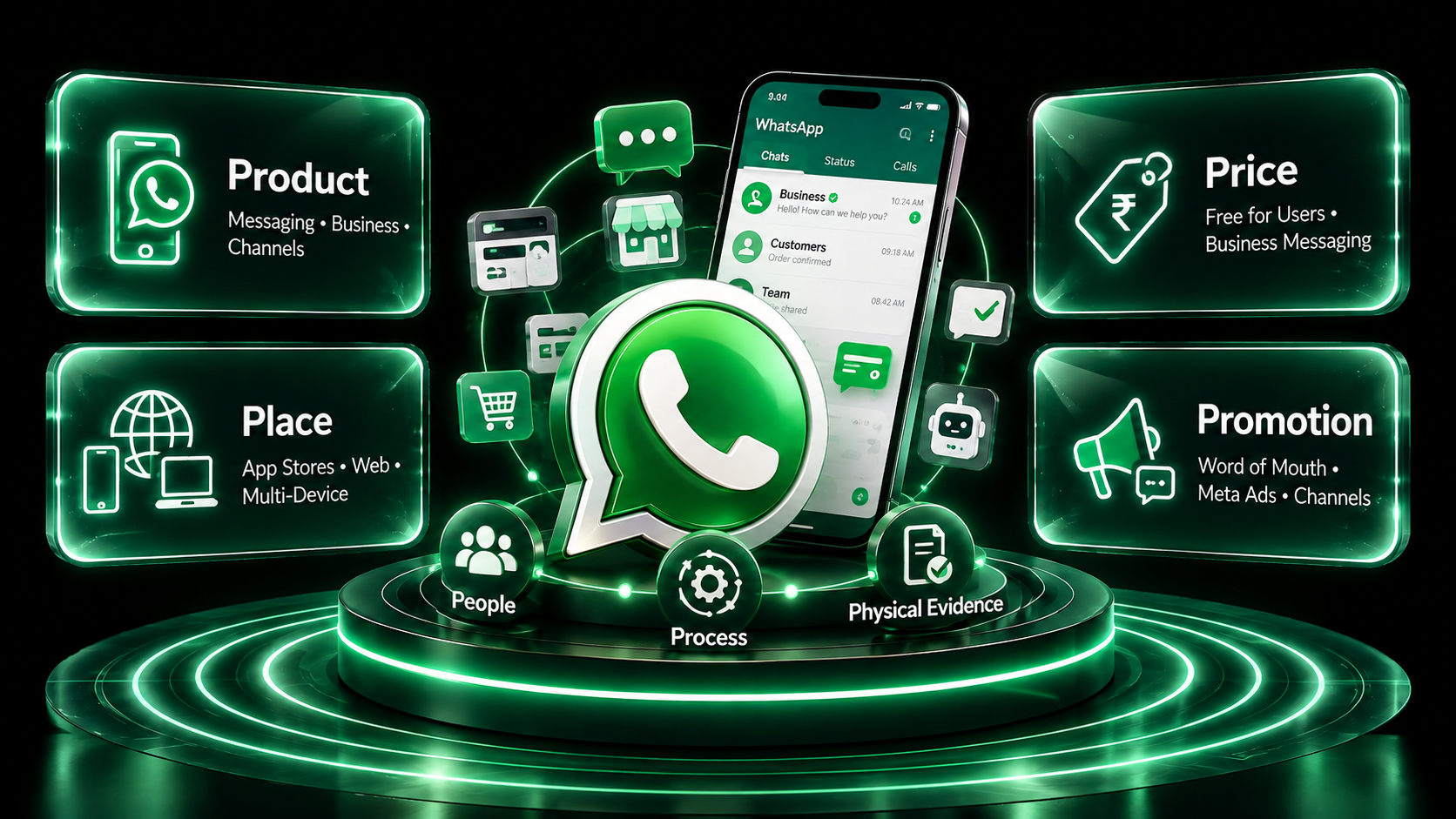
The marketing mix of WhatsApp is the set of decisions Meta makes about what WhatsApp offers, what it charges, where people get it, how it gets known, who runs it, how it works and what it looks like. It’s the standard 7Ps, applied to a product that behaves nothing like a shampoo brand.
The 4Ps and the 7Ps in Plain English
The marketing mix started as four Ps: product, price, place and promotion. Someone in the 1960s boiled marketing down to what you sell, what it costs, where it’s sold and how people hear about it. Simple enough, and still useful for a quick check on any business.
Services and software need three more. People covers who delivers the experience. Process is how the service actually runs for the customer. Physical evidence is anything visible that makes an invisible product feel real, like an interface, a logo or a receipt. For an app, the 7Ps fit far better than the original four.
Why WhatsApp Doesn’t Fit a Normal Marketing Case Study
Look at what a normal case study expects. A brand sets a price, buys ads, fights for shelf space and measures sales. WhatsApp did almost none of that for years. Its early price was a dollar or free, its shelf was the app store, and its ad budget was close to zero. Growth came from the fact that a messaging app is useless alone.
That’s the real engine here. Every new user makes the app more valuable for their friends, which is called a network effect. So a lot of what other brands solve with promotion, WhatsApp solved with product design. If your assignment treats it like a soft drink brand, the marks you lose will be about that.
Two Ways to Read the Marketing Mix of WhatsApp
Reading number one treats WhatsApp as the brand. You look at what Meta builds, how it prices, how it distributes the app and how it earns revenue. This is the version teachers and interviewers want when they say “explain the marketing mix of WhatsApp”.
Reading number two treats WhatsApp as a channel your business rents. You ask what you’ll sell there, what your price looks like inside a chat, how customers reach you and how you promote without annoying them. This guide covers both, in that order, because reading one makes reading two much easier to plan.
Product
Product is the biggest P for WhatsApp because the product line is wider than most people think. Ask ten friends and they’ll say “a chat app”. Meta would say it’s a family of six or seven products, each aimed at a different group, and only one of them brings in serious money.
The Core Messaging App: Simple on Purpose
The heart of the product is still a phone number, a contact list and a chat window. Text, photos, voice notes, documents and stickers, all synced to the people already saved on your phone. There’s no username to invent, no feed to scroll and no algorithm deciding who sees your message.
That restraint is deliberate. Jan Koum and Brian Acton built WhatsApp around speed and reliability on cheap phones and weak networks, which is exactly why it took off in India, Brazil and Indonesia. A message either arrives or it doesn’t. That plain promise is the product.
Calls, Status, Groups and Communities
Around the core chat sits a set of features that keep people inside the app. Voice and video calls replaced expensive international calls for millions of families. Status lets you post a photo or text that disappears after 24 hours, much like Instagram Stories. Groups became the default place for school parents, office teams and housing societies.
Communities arrived in late 2022 to bundle several groups under one roof, for example a school with separate groups for each class. Honestly, groups are the sleeper feature. Most of the real daily use in India happens in groups, and that’s also where forwarded messages and misinformation spread.
Privacy and End-to-End Encryption as a Product Feature
Since April 2016, personal chats and calls on WhatsApp use end-to-end encryption based on the Signal protocol. That means only the sender and the receiver can read a message, not WhatsApp and not Meta. For a lot of users this is the reason they trust it with bank details, medical reports and family arguments.
Here’s the thing marketers miss. Encryption isn’t a technical footnote, it’s a selling point that competes directly with Telegram, where normal chats aren’t end-to-end encrypted by default. The January 2021 privacy policy row showed how fast users react when that trust is questioned. Millions tried Signal and Telegram within days.
WhatsApp Business App: The Free Tool for Small Shops
Launched in January 2018, the WhatsApp Business app is a separate free download built for small sellers. It adds a business profile with address and hours, a product catalogue, quick replies for common questions, greeting and away messages, and labels to sort customers into groups like “new lead” or “payment pending”.
Meta has said that more than 200 million people use the Business app every month, though that number dates back to 2023, so treat it as a rough scale rather than today’s exact figure. A saree seller in a small town can run a whole shop from one phone with it. It doesn’t earn Meta much directly, but it fills the pipeline for what does.
WhatsApp Business Platform: The Product That Earns the Money
The Business Platform, often called the WhatsApp API, is built for medium and large companies. It lets a bank, airline or e-commerce brand send order updates, boarding passes, payment links and reminders to millions of people, and it connects to CRMs and chatbots. Most companies access it through a Business Solution Provider such as Gupshup, Twilio, Interakt or WATI.
This is where the marketing mix of WhatsApp turns commercial. Businesses can’t just message anyone. Customers must opt in, and message types are grouped into marketing, utility, authentication and service, each with different rules and different prices. Meta also offers a free Cloud API hosted by itself, which lowered the cost of getting started.
Channels, Payments and Meta AI: The Newer Layers
Channels launched in 2023 as a one-way broadcast tool, a bit like following an account on Instagram, and they sit in the Updates tab. A creator, a news outlet or a brand can post there without exposing followers’ phone numbers. In 2025, Meta announced ways to earn from that space through channel subscriptions, promoted channels and ads in the Updates tab.
Payments is another layer. In India, WhatsApp Pay runs on UPI, though NPCI limited how many users could join for years before loosening the cap. Meta AI now sits inside the search bar too, answering questions or drafting text. Some of these layers matter a lot, some barely register, and only the business side has real revenue behind it.
Price
Price is where WhatsApp gets interesting, because the person using the app pays nothing while a company on the other end of the chat does. The pricing side of the marketing mix of WhatsApp is really two prices: a zero for users and a per-message fee for businesses.
Why the App Is Free for Users
Every messaging app dies without users, so charging at the door was always a bad idea. Facebook (now Meta) paid roughly $19 billion for WhatsApp in 2014 when it had around 450 million users and about 55 employees. The bet was on reach, not revenue. A free app removes every excuse not to install it.
Free also fits the real market. In much of India, Brazil and Africa, people don’t have a card to pay a subscription and won’t pull out a wallet for a chat app anyway. So zero isn’t generosity. It’s the only price that makes a global network possible.
The $1 Yearly Fee Experiment
Early WhatsApp did charge. Users got the first year free and then paid about $0.99 a year, which the founders liked because it kept spam accounts down and avoided ads. Payment was clunky in a lot of countries, though, since it needed a credit card. That’s why many users simply kept using it for free anyway.
In January 2016 WhatsApp dropped the fee for everyone. Look at how that decision shaped everything after it. With no subscription revenue, the company needed another way to pay for servers and staff, and that pushed it toward the business side that exists today.
How Businesses Pay: Per-Message Pricing
On the Business Platform, Meta moved in July 2025 from charging per 24-hour conversation to charging per delivered template message. Messages fall into categories: marketing, utility, authentication and service. Marketing messages cost the most. Service replies inside the 24-hour customer window are free, and utility messages sent inside that window are free too.
Rates differ by country and change regularly, so check Meta’s official rate card before you budget. In India, a marketing message has cost under a rupee, but treat that as a ballpark, not a quote. A brand sending 100,000 promotional messages will notice the bill quickly, which is exactly why the category rules matter.
Free Entry Points and Where the Real Cost Hides
Some paths are cheaper on purpose. If someone taps a click-to-WhatsApp ad on Facebook or Instagram and starts a chat, the business gets a free window to reply for 72 hours. Meta wants ads to lead into WhatsApp conversations, so it removes the messaging fee for that first exchange.
The number on the rate card also isn’t your true cost. Add the fee of your Business Solution Provider, often a monthly plan for the dashboard and chatbot builder, plus the salary of whoever answers chats. A cheap message with no one to reply to is just an expensive way to annoy people.
Ads and Subscriptions: The Next Price Layer
In 2025 Meta said it would show ads in the Updates tab, not inside private chats, and it would let channel owners charge for subscriptions. Advertisers can also promote channels so more people find them. If you care about chat privacy, that separation is the line to watch.
It’s a real shift from the old no-ads promise, and some longtime fans grumbled about it. Still, the logic is clear: billions of daily users are too big an audience to leave unsold. To see how this fits into wider paid-media planning, the digital marketing guides on our learning hub cover how platforms package ads and attention.
Place
Place means how a product reaches the customer. For WhatsApp that answer is almost boringly simple: it’s on your phone already or one tap away. Still, the way it spread, through contact lists and phone numbers, is the smartest part of the marketing mix of WhatsApp and worth slowing down for.
App Stores and Phone Pre-Installs
The official places to get WhatsApp are the Google Play Store and Apple’s App Store, plus desktop apps and a web version at web.whatsapp.com. In many Android markets, phone makers also pre-install it, or sellers at a mobile shop install it for you before handing over the box. Nobody has to hunt for it.
That last point deserves attention. In India, the phone shop guy is a distribution channel. When you buy a new phone in a Kanpur or Lucknow market, the first apps installed are WhatsApp, YouTube and maybe a payments app. That’s shelf space no ad budget can buy.
The Contact List as a Distribution Engine
Here’s what actually happens when someone installs WhatsApp. It reads the contact list, matches numbers already on the network and instantly shows who you know. Ten seconds after signup, the empty app becomes a live conversation with your mother, your boss and your cousin.
This is why the phone number was such a clever choice. Other apps asked you to invite friends or find them by username. WhatsApp skipped that step entirely. The address book you’d already built became its growth engine, and every install pulled a few more people in after it.
India and Other Emerging Markets as Home Turf
India is WhatsApp’s largest market by users, with well over half a billion people on it. Cheap data after Jio arrived in 2016, cheap Android phones and family groups did most of the work. A shopkeeper in a small town sending a price list on WhatsApp isn’t doing something advanced, it’s just Tuesday.
That behaviour created the business opportunity. Because customers were already messaging shops, Meta’s business tools fit naturally. Brazil and Indonesia followed a similar pattern. The map of where WhatsApp is strongest is basically the map of where phone calls were expensive and smartphones were cheap.
Web, Desktop and Multi-Device Access
WhatsApp Web appeared in 2015, first as a mirror of the phone and later, since around 2021, as a version that works even when the phone is off. Desktop apps for Windows and Mac followed. For customer support teams and sellers, this matters a lot because typing on a laptop is far faster than thumbs on glass.
Multi-device also changed how businesses answer chats. One number can now link to several devices, so a small team can share an inbox without passing one phone around like a hot potato. That’s a quiet distribution upgrade, and it’s part of why the Business app spread so quickly among small shops.
Promotion
Promotion usually means ads, sales offers and public relations. WhatsApp’s story is unusual, because for most of its first decade the honest summary of its promotion strategy was “we didn’t do any”. The promotion side of the marketing mix of WhatsApp shifted only after Meta took over and the business layer needed customers.
Word of Mouth and the Product Being the Ad
Every message is a tiny advertisement. If you send a photo to a friend who isn’t on WhatsApp, you’ll eventually tell them to install it, because that’s the only way they’ll see it. Nobody at WhatsApp designed a referral scheme. The app’s usefulness did the recruiting.
Acton and Koum famously refused ads, and Koum kept a note on his desk that read “No ads, no games, no gimmicks”. That stance became a brand promise in itself. Users trusted it because it wasn’t trying to sell them things, and that trust spread from person to person for free.
Meta’s Click-to-WhatsApp Ads
After the acquisition, Meta had a better way to promote WhatsApp: use its own ad platforms. Click-to-WhatsApp ads run on Facebook and Instagram and, instead of opening a website, open a chat with the business. The advertiser pays for the ad, not the message, and the first reply window is free.
This is where a small business gets to play. A tutor in Pune can run a ₹300 a day ad targeted to parents in one pincode, and every click lands in a chat where the tutor answers questions and books a demo class. It’s promotion and sales support wrapped into a single flow.
Brand Campaigns and Regional Storytelling
WhatsApp does run traditional advertising in some markets. In India it has used TV and digital campaigns around safety, for example teaching people to spot fake forwards after lynching incidents linked to viral rumours in 2018. It also ran a “Forwarded many times” label and a limit on forwards to slow down misinformation.
That’s PR as much as advertising. It shows a promotion strategy built on protecting the brand from reputation risk, not on chasing new downloads. The user base was already big, so the job shifted from telling people the app exists to making them comfortable using it.
Status, Channels and Promoted Content
Inside the app, promotion now has more room. Status sits in the Updates tab, and Meta’s ad plans there let brands reach people who follow channels or view Status. Channels let creators and companies broadcast to followers without sharing phone numbers, which is a lot less spammy than a broadcast list.
Think about how that changes the promotion mix for a normal seller. Instead of asking customers to save your number first, you can build a channel and let interested people follow. To plan that kind of content properly, the social media resources at Academy Of Digital Marketing show how to build a posting calendar you’ll actually keep up.
People, Process and Physical Evidence
The last three Ps are the ones students forget, and they’re the ones that explain why people trust a free app with their private lives. In the marketing mix of WhatsApp, people are the builders and the users, process is the way the app works step by step, and physical evidence is every small visual cue on your screen.
People: A Tiny Team and a Big Philosophy
At the time of the 2014 deal, WhatsApp had roughly 55 employees serving hundreds of millions of users. Koum, who grew up in Ukraine and later worked at Yahoo, and Acton, another Yahoo veteran, built the company around a small engineering team and a strict rule: do one thing well. That culture is part of the product story.
Both founders left Meta later, Acton in 2017 and Koum in 2018, partly over disagreements about privacy and ads. Will Cathcart has led the app since 2019. The people side also includes users themselves, since family groups and community admins drive the daily habit. And on the business side, support agents and chatbot designers shape how a brand feels in chat.
Process: From Phone Number to First Message
Setup takes about a minute. You enter a phone number, get a six-digit code by SMS or call, confirm your name, and you’re in. No email, no password, no long form. Contacts sync, and the first chat is already there. Fewer steps means fewer people quitting halfway, which is exactly how a service process should behave.
Behind the scenes there’s a second process for businesses. A company applies through a Business Solution Provider or Meta’s Cloud API, verifies its business, submits message templates for approval and starts at a low daily messaging limit. Quality rating rises or falls depending on how many people block or report the number, so process discipline directly protects reach.
Process: Message Templates, Opt-Ins and Quality Ratings
Here’s a part most blogs skip. Businesses can’t just write whatever they want in a proactive message. Templates have to be submitted and approved, and customers must have opted in before a marketing message goes out. Reply inside the 24-hour window and you can chat freely. Outside it, only approved templates work.
Quality rating is Meta’s spam filter in disguise. If lots of people block you, your rating drops, your daily send limit can shrink and in bad cases the number gets restricted. That’s the real process a marketer needs to understand. The rules aren’t red tape for its own sake, they’re what keeps the inbox tolerable for everyone.
Physical Evidence: The Green Tick, Blue Ticks and the Look of Trust
An app has no shop front, so users judge it by its visuals. The green icon, the bubble-shaped chat, the single grey tick, double grey ticks and blue double ticks all communicate one thing: your message went, was delivered and was read. Those little marks became a piece of culture. People argue over blue ticks in real relationships.
For businesses, the green verified badge next to a name plays the same role. It tells customers this really is the airline or the bank, not an impostor. Meta also offers a paid Meta Verified option for some businesses. In a place where scam messages are everywhere, physical evidence like that isn’t cosmetic, it’s how strangers decide whether to reply.
How to Use the Marketing Mix of WhatsApp for Your Own Business
Now flip it around. Suppose you run a small brand and want to use WhatsApp as a sales channel. The same 7Ps work as a planning checklist. Instead of asking what Meta does, you ask what you’ll sell, how you’ll price it inside a chat and how customers find you. Here’s a workable version.
Product: Decide What You Actually Sell in the Chat
Don’t try to sell everything on WhatsApp. Pick the offer that suits a quick, informal conversation: repeat orders, appointments, consultations, small-ticket items or order status updates. A bakery can sell cakes there. A CA firm can book consultations. A furniture showroom probably needs a website and just uses WhatsApp to close the deal.
Build a catalogue in the Business app with clear photos, prices and short descriptions. Keep it under about 30 items at the start, because scrolling through 400 products on a small screen loses people. Your product on WhatsApp is really a mix of the item plus how fast and helpfully you answer.
Price: Keep It Visible and Simple
Chat customers expect a quick answer to “how much”. If you make them ask three times, they’ll leave. Put prices in the catalogue, add delivery charges up front and share a UPI link or payment QR in the reply. Fewer back-and-forth messages before the payment is the whole goal.
Also think about your own price to serve. Each broadcast message costs money on the API, and each chat costs staff time. A ₹150 impulse item may not justify a long chat. A ₹5,000 service usually does. Test with a small batch, count the cost per order and adjust the offer before scaling.
Place: Make the Chat Easy to Reach
Your place is a link, a QR code and a number. Use a wa.me link with a pre-filled message such as “Hi, I want to order the chocolate truffle cake”, and add it to your Instagram bio, Google Business Profile, website button and printed menu. One tap should open a chat with context, not a blank screen.
Put a QR code on shop counters, delivery boxes and packaging. Customers who already bought from you are the easiest people to reach again. Also save a business number that only your team uses. Mixing your personal number with orders is how sales messages get buried under family memes.
Promotion: Use Ads, Status and Channels, Not Spam
Three routes work without wrecking your reputation. First, click-to-WhatsApp ads on Facebook and Instagram, where the ad leads straight into a chat. Second, regular Status updates showing new arrivals or offers. Third, a Channel for people who want updates without sharing a number. Each has a different job, and none needs a bought list.
Broadcast lists on the Business app reach only people who saved your number and are capped at 256 contacts each. That limit is annoying but healthy. Send no more than one or two useful messages a week, and offer an easy way to opt out. If your open rate drops or blocks rise, your content is the problem.
People: Decide Who Answers and How Fast
Speed is the whole game in chat marketing. If a lead messages at 8 pm and gets a reply the next afternoon, the sale has gone to someone else. Set business hours, use an away message and assign a person or a small shift team to reply within a few minutes during working hours.
Give staff a short guide with tone rules, common answers and when to hand over to a human. With multi-device, several people can answer from one number. Label chats “hot”, “waiting for payment” or “delivered” so nothing falls through. A good process beats a smart chatbot when the volume is still small.
Process: Set Up Quick Replies, Labels and Automation
Start with the free tools. In the Business app, add quick replies for the five questions you get every day, like price, delivery time, return policy, payment method and address. Use labels to track stages. Set a greeting message that tells new customers what you sell and how to order.
When volume grows, move to the API through a provider like Interakt, WATI or AiSensy, which add chatbots, shared inboxes and template broadcasts. Before spending on tools, browse the marketing tools directory and compare features, since many providers charge monthly fees on top of Meta’s message cost.
Physical Evidence: Build Trust Before the First Sale
Customers on WhatsApp are cautious, because scams also happen there. Show real proof: a complete business profile with address and website, a profile photo that matches your logo, customer photos with permission, delivery screenshots and clear invoices. Consistency between your Instagram, website and chat profile matters more than fancy design.
Apply for the verified badge only when you have the profile ready and the business needed to meet Meta’s requirements. Until then, keep everything consistent. Same name, same logo, same phone number everywhere. It sounds boring, but it’s the difference between a customer trusting a payment link and reporting it as fraud.
A Realistic Walkthrough: A Small Sweet Shop in a Tier-2 Town
Take a mithai shop selling festival boxes, and treat this as a made-up example. In week one, the owner sets up the Business app, adds 12 boxes to the catalogue and prints a QR code on every bill. During Diwali season, ₹500 a day goes to a click-to-WhatsApp ad targeted at a 10 km radius.
Ads bring in leads, quick replies handle common questions, and the owner sends a Status update every morning with the day’s stock. By week three the shop keeps a labelled list of repeat buyers and messages them once before Raksha Bandhan. No fancy tech. Just a tidy version of the marketing mix of WhatsApp applied with discipline.
How to Measure Whether It Works
Track four simple numbers in a sheet: chats started, chats that got a price quote, orders closed and repeat orders. Add ad spend and staff time. Divide spend by orders to get your cost per order. If it beats your other channels, scale it. If not, fix the reply speed first.
On the API, providers show delivered, read and reply rates for each broadcast. Watch the block rate more than the open rate. A message that gets read but also blocked is hurting you. If you’d like a structured path through measurement and funnels, the Alpha Marketer Foundation Program walks beginners through this from scratch.
Marketing Mix of WhatsApp vs Telegram, Signal and Email
A marketing mix makes more sense when you compare it with rivals. WhatsApp competes with other messaging apps for attention and with older channels like email and SMS for business messages. Each one wins on a different P, and that’s what makes this comparison useful for both exams and campaigns.
WhatsApp vs Telegram
Telegram is also free, but it grew differently. It supports huge public channels, large file uploads and bots, and it attracted communities, news and creators. Normal chats aren’t end-to-end encrypted by default. WhatsApp’s product is more personal and phone-number based, and its business tools are more developed for customer service.
For a marketer, Telegram works for content communities and course groups, while WhatsApp works better for one-to-one selling and support. In India, customers simply expect a WhatsApp number on a business card. Telegram has fewer everyday users there, so reach on your first day is smaller, even if the format is flexible.
WhatsApp vs Signal
Signal is the privacy purist. It’s non-profit-backed, encrypts nearly everything and collects very little data. After the 2021 privacy policy row, it gained a lot of downloads, but many people drifted back because their friends and family were still on WhatsApp. That’s the network effect working exactly as designed.
Signal has no real business tools, no catalogues and no marketing layer. So from a marketing mix angle, Signal has a strong product story on privacy but weak price and place for businesses. WhatsApp’s advantage isn’t that it’s better at everything, it’s that everyone you know is already there.
WhatsApp vs Email and SMS
Email is cheap and great for long content, receipts and newsletters, but inboxes are crowded and open rates are mediocre. SMS is instant but limited in length and looks like spam. WhatsApp sits in between, with richer media, buttons, and a more personal feel, but it also costs per message.
Vendors love quoting 90 percent plus open rates for WhatsApp, and honestly that number is more sales pitch than science, so test on your own list. If you want to see how email compares in a full funnel, the email marketing tutorials explain list building and deliverability step by step.
A Quick SWOT of the Marketing Mix of WhatsApp
Strengths: massive user base, simple product, strong encryption, a low-friction sign-up and deep habits in India and Brazil. Weaknesses: heavy reliance on Meta’s ecosystem, past privacy trust issues and slower monetisation than other Meta apps. Opportunities: business messaging, payments, channels and AI assistants for customer service.
Threats come from regulators, competing apps and user pushback if ads or spam creep into private chats. Worth noting, too, that misinformation on forwards remains a reputational risk. A SWOT like this is a handy closing paragraph in an assignment, because it shows you’ve connected the 7Ps to strategy and not only described them.
Where the Marketing Mix of WhatsApp Is Heading
WhatsApp is slowly moving from a chat app toward a place where people talk to businesses, pay, and find updates. That direction changes how Meta prices, promotes and packages the product, and it changes what you, as a marketer, need to prepare for over the next couple of years.
Business Messaging as the Main Revenue Line
Meta has been clear that business messaging is its bet for WhatsApp revenue. More companies are using it for customer support, order updates and even checkout inside the chat. Expect more tools around catalogues, payments and AI agents that answer common questions without a human.
For a small business, that means the tools you use today may get simpler and cheaper, or at least easier to connect. The message is to build the habit now. A shop that already answers chats fast and keeps clean customer lists will adapt to anything Meta launches later.
More Discovery, More Ads, More Rules
As Status ads, promoted channels and click-to-WhatsApp campaigns grow, discovery on the app will become a normal marketing job. That means more competition for attention and probably stricter rules on quality. Meta has repeatedly tightened its template and policy rules, and there’s no reason to expect it to stop.
Practical takeaway: don’t build your entire business on any single rented channel. Keep your own customer list in a sheet or CRM, collect emails alongside phone numbers, and treat WhatsApp as your best conversation channel rather than your only one. That’s how you stay safe if a policy shifts.
Marketing Mix of WhatsApp at a Glance: Summary Table and Exam Answer Tips
Sometimes you just need the whole thing on one screen, either for revision the night before an exam or for a quick client pitch. This section squeezes the marketing mix of WhatsApp into a table, then shows how to turn it into a short answer that reads like you understood it.
The 7Ps Summary Table
| P | What WhatsApp does |
|---|---|
| Product | Free messaging app, Business app, Business Platform (API), Channels, Communities, Payments, Meta AI |
| Price | Free for users, per-message pricing for businesses, ads and subscriptions in the Updates tab |
| Place | App stores, phone pre-installs, web and desktop, contact-list syncing, strongest in India and Brazil |
| Promotion | Word of mouth, safety campaigns, click-to-WhatsApp ads, Status and Channels |
| People | Small founding team, Meta leadership, group admins, support agents on the business side |
| Process | Phone-number sign-up, contact sync, template approval, opt-ins and quality ratings |
| Physical evidence | Green icon, chat bubbles, delivery ticks, verified badges |
Read the table from top to bottom and you’ll see the pattern: users pay nothing, and businesses pay for access to those users.
How to Turn It Into a Good Exam Answer
Open with one sentence that names the split: free for users, paid by businesses. Then give two or three lines for each P, using a real detail such as the 2014 acquisition, the end of the $1 fee in 2016 or the July 2025 shift to per-message pricing. Finish with a short SWOT or a recommendation.
Length depends on marks. For a five-mark question, one line per P is enough. For fifteen marks, add a paragraph on the network effect and one on business messaging. Examiners reward connections between the Ps, so say how free pricing supports distribution and how encryption supports trust.
How to Present It in a Client Meeting
If you’re a freelancer or agency person, skip the theory and show a single slide. Left side: what WhatsApp does. Right side: what it means for this client’s shop, coaching centre or clinic. Clients don’t care about Meta’s strategy, they care whether a chat number will bring in bookings.
Add two numbers they can check: expected cost per message and expected reply time. Then propose a two-week test with a small budget. A pilot that costs a few thousand rupees is an easy yes, and the results tell you far more than any framework slide could.
Conclusion
The marketing mix of WhatsApp boils down to one clever trade. Give the personal app away free, protect it with trust features and let contact lists spread it, then charge the businesses that want to talk to those people. Product, place and promotion all serve that trade, and people, process and physical evidence keep it credible.
If you’re writing about it, lead with that split and back it with the numbers in this guide. If you’re using it for your own business, start small: a Business app profile, a tidy catalogue, one QR code, one useful message a week and a reply time under ten minutes. Do that for a month, then decide whether the API is worth paying for.
Frequently Asked Questions
What is the marketing mix of WhatsApp?
The marketing mix of WhatsApp is the combination of product, price, place, promotion, people, process and physical evidence Meta uses to run the app. Users get the app free, businesses pay per message, and growth comes mainly from contact lists and word of mouth. The 7Ps framework is used because WhatsApp is a service.
Which of the 7Ps matters most for WhatsApp?
Product matters most, because the app’s usefulness is what drives growth and trust. A messaging app is worthless without friends on it, so the product and the network effect do the job that ads do for other brands. Place, through contact-list syncing and app stores, comes a close second.
Is WhatsApp really free?
Yes, for personal users. The core app, calls and the free Business app cost nothing to download or use, apart from your data plan. Companies using the Business Platform pay Meta per delivered template message, and they also pay a Business Solution Provider if they use one. Payment features and ads are separate layers.
How does WhatsApp make money?
Mostly from businesses. Companies pay for marketing, utility and authentication messages sent through the Business Platform, and they pay for click-to-WhatsApp ads on Facebook and Instagram. Meta has also announced ads in the Updates tab, channel subscriptions and promoted channels. Private chats are not used to show ads.
How much does a WhatsApp marketing message cost?
It depends on the country and the message category. Meta moved to per-message pricing in July 2025, with marketing messages costing the most and service replies inside the 24-hour window being free. Rates change, so check Meta’s official rate card for your country before setting a budget.
Does WhatsApp advertise itself?
Very little in its early years. Growth came from word of mouth and network effects. Later it ran brand and safety campaigns in some markets, and Meta now promotes the business side using click-to-WhatsApp ads. So the answer is that it advertises selectively, not heavily, and mostly to businesses.
What is the difference between the WhatsApp Business app and the API?
The Business app is a free tool for small sellers, with a catalogue, labels, quick replies and a business profile, used on a phone or a linked device. The API, or Business Platform, is for larger companies that need automation, many agents and integration with CRMs, and it charges per message.
Can I send bulk marketing messages on WhatsApp?
Yes, but only within the rules. On the Business app, broadcast lists reach contacts who saved your number and are limited to 256 people each. On the API, you need opt-in consent and approved templates. Sending unwanted bulk messages leads to blocks, a low quality rating and possible account restrictions.
What is a WhatsApp Channel and how is it different from a group?
A Channel is a one-way broadcast where an admin posts updates and followers can react but not reply publicly. Followers’ phone numbers are hidden from each other. A group is a shared chat where everyone can talk and see the members. Channels suit announcements, while groups suit discussion.
How does the 24-hour rule work on WhatsApp Business?
When a customer sends you a message, a 24-hour window opens. During that time you can reply freely with normal text, images and links. After it closes, you can only send an approved message template, and that may be charged. Each new customer message reopens the window.
Is WhatsApp marketing better than email marketing?
Neither wins in every case. WhatsApp gets quicker replies and feels personal, which suits offers, support and order updates. Email is cheaper for long content, newsletters and large lists. Most businesses do best using both, with WhatsApp for conversation and email for detailed content and records.
Can students use this framework for an assignment on WhatsApp?
Yes. Structure your answer around the 7Ps, explain the free user versus paying business split, add a few real numbers like the 2014 acquisition and the 3 billion user milestone, and end with a short SWOT. Avoid copying generic 4P lines, and mention that ads are outside private chats.
What is the biggest risk of using WhatsApp for marketing?
Losing access to your number. If customers report or block you often, Meta can lower your quality rating, limit sending or restrict the account. Since you don’t own the platform, keep a separate customer list, collect consent properly and send only messages people actually want to receive.