


Here’s a number that should stop you for a second. More than 3 billion people open WhatsApp every month, and it still doesn’t show a single ad inside your personal chats. No subscription either. So how does an app that gives everything away hold one of the best spots on your phone, and how long can that last? That’s exactly what a proper SWOT Analysis of Whatsapp helps you figure out.

Most SWOT write-ups you’ll find online are lazy. Four bullet lists, five words each. “Strong brand.” “Privacy concerns.” Done. That doesn’t help a student who has an assignment due on Monday, and it definitely doesn’t help a shop owner deciding whether to run customer support entirely through WhatsApp. So this guide goes slower. Every strength, weakness, opportunity and threat gets a real explanation, with names, dates and numbers behind it.
Think about October 4, 2021. Facebook, Instagram and WhatsApp all went dark for roughly six hours, and small sellers across India, Brazil and Indonesia couldn’t take a single order because their whole business lived inside one chat app. Nobody wrote that down in a strategy deck beforehand. A SWOT is supposed to catch exactly that kind of thing before it bites. Read on, and you’ll see the good, the ugly and what probably happens next.
What You Will Learn in This Guide
This guide is long on purpose, and every section stands on its own, so feel free to jump around. Reading top to bottom gives you the full picture, though, including the messy parts most summaries skip. Here’s what you’ll walk away with:
- What a SWOT analysis really is, and how to keep the four boxes from bleeding into each other
- A quick company snapshot: who built WhatsApp, who owns it, who uses it and how it earns money
- Six real strengths, with the reasoning behind each one
- Five weaknesses that Meta can’t wave away
- Six opportunities, from business messaging to payments to AI
- Five threats, including regulators, rivals, spyware and government blocks
- A summary table you can drop into an assignment or a slide
- How to use this analysis for your own business, campaign or exam answer
- Mistakes that make a SWOT look weak, plus 15 FAQs answered straight
TL;DR
Short on time? This is the quick version, and the rest of the article backs up every line with detail.
- Strengths: A base of 3 billion plus monthly users, default end-to-end encryption and a simple app that runs on cheap phones
- Weaknesses: Almost all of its money is hidden inside Meta, privacy trust took a hit in 2021 and forwarded misinformation is a stubborn problem
- Opportunities: Business messaging, click-to-WhatsApp ads, Channels, payments in India and AI assistants for customer support
- Threats: Tightening privacy and encryption laws, Telegram, Signal and iMessage, government blocks, and spyware or scam attacks
- Bottom line: WhatsApp wins on habit and reach, and its next few years depend on making money without wrecking the trust that got it here
What Is a SWOT Analysis of WhatsApp and Why Bother Doing One
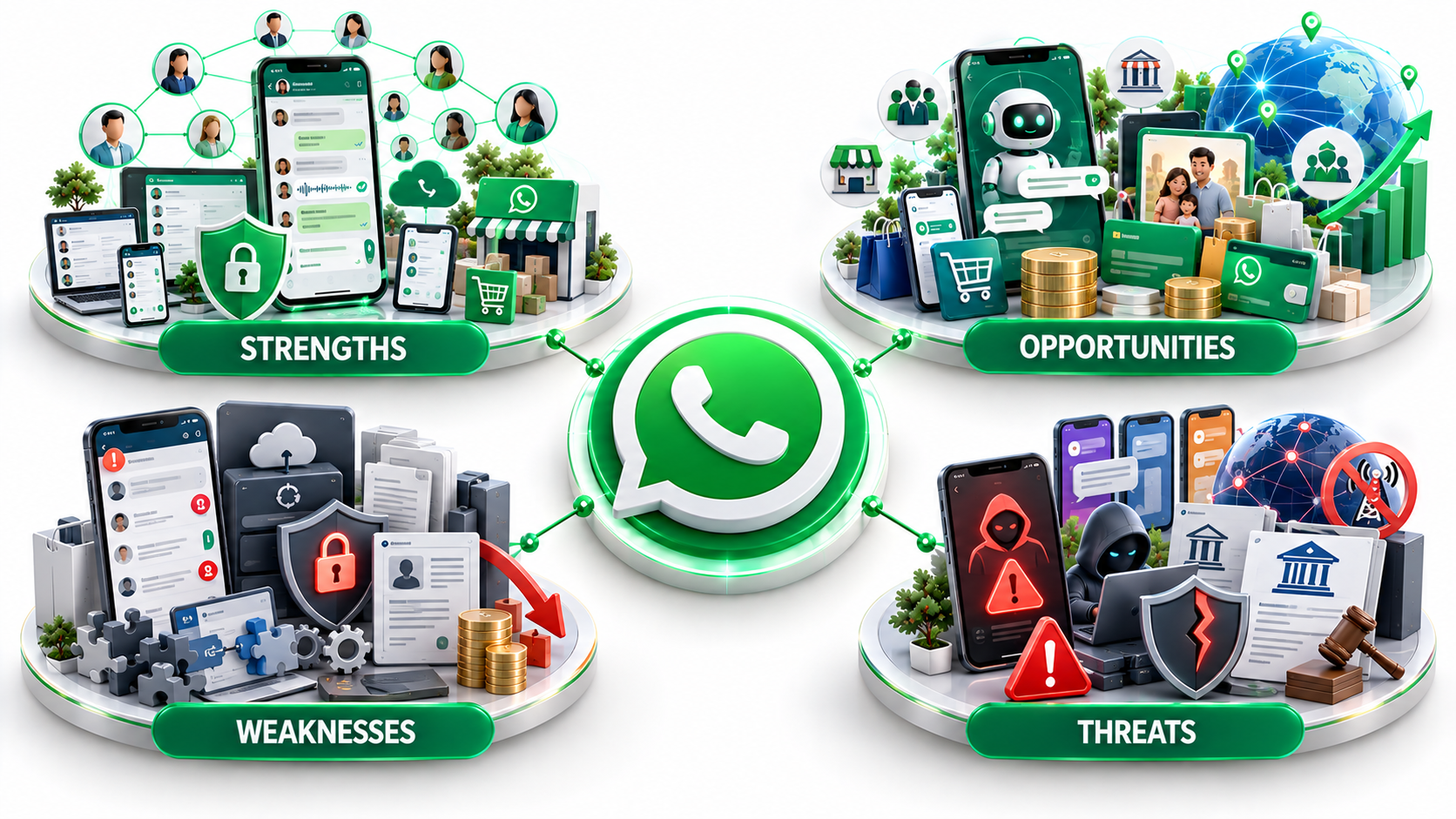
A SWOT analysis of Whatsapp is a structured look at the app’s internal strengths and weaknesses, plus the outside opportunities and threats that can help or hurt it. That’s the whole idea. You sort a big, messy company into four boxes so the pattern shows up, and then you decide what the pattern means.
What SWOT Actually Means in Plain English
SWOT stands for Strengths, Weaknesses, Opportunities and Threats. Strengths and weaknesses live inside the company: its product, its people, its money, its brand. Opportunities and threats come from outside: markets, laws, competitors, new technology. The framework grew out of business planning work in the 1960s, and it has survived because it’s dead simple.
Here’s the part beginners get wrong. If Telegram launches a new feature, that goes under threats, not weaknesses, because WhatsApp can’t control what Telegram does. What WhatsApp does in response, or fails to do, is where a weakness might show up. Keep that inside versus outside split clean and your analysis instantly looks sharper.
Why WhatsApp Is Such a Good Company to Study
WhatsApp is a rare case where the product is almost boringly simple and the business around it is anything but. Two people can chat for free, yet the same app now carries billions of dollars of business conversations, government helplines and family arguments about who forgot to bring the tiffin.
That gap between a simple product and a complicated business is why teachers love it as a case study. You get privacy fights, antitrust cases, emerging markets, payments, AI and a founder story with real drama, all in one company. Few brands give you that much material for a single assignment.
How to Read This Analysis Without Getting Lost
Read it like a conversation, not a checklist. Each point below has a claim, a reason and an example. If you’re new to frameworks like this, the digital marketing basics hub on this site explains how SWOT sits next to tools like PESTLE and Porter’s Five Forces.
One more tip. Numbers in tech move fast, so treat every figure here as a snapshot and double check the latest number before you publish it or put it in a graded assignment. Meta updates user counts and policies often, and a stale number is the fastest way to lose marks or credibility.
WhatsApp Company Snapshot Before the SWOT Analysis of Whatsapp
Before you sort anything into boxes, you need the basics: who started WhatsApp, who owns it now, who uses it and how it makes money. Skipping this step is how people end up writing generic points that could describe any app. Let’s get the facts on the table first.
From Two Ex-Yahoo Engineers to a 19 Billion Dollar Deal
Jan Koum and Brian Acton, both former Yahoo engineers, started WhatsApp in 2009. The first version was just a status message next to your name. Then Apple added push notifications to the iPhone, and suddenly the status could ping friends when it changed. People started using it as a chat tool, and the app pivoted into messaging almost by accident.
In February 2014, Facebook bought WhatsApp for roughly 19 billion dollars, when the company had around 55 employees and about 450 million users. That’s still one of the biggest tech acquisitions ever. Acton left Meta in 2017 and Koum followed in 2018, and both are widely reported to have clashed with Facebook over ads, data and encryption.
Who Uses WhatsApp and Where
WhatsApp passed 2 billion monthly users in 2020, and Meta said in 2025 that the number had crossed 3 billion. India is the biggest single market, with hundreds of millions of users, and Brazil, Indonesia, Mexico and much of Africa and the Middle East lean on it heavily too.
The United States is the odd one out. Many Americans stick with iMessage because iPhones are so common there, so WhatsApp is more of an international-family app than a default. That geography matters later, because WhatsApp’s biggest growth and its biggest political risks both sit in countries where it has become basic infrastructure for daily life.
How WhatsApp Makes Money Without Ads in Your Chats
Meta doesn’t report WhatsApp revenue as a separate line, which is itself a clue. The money mostly comes from businesses. Companies pay per message on the WhatsApp Business Platform (Meta moved to per-message pricing in July 2025), and advertisers pay for click-to-WhatsApp ads that start on Facebook or Instagram and open a chat.
There’s also newer stuff. In 2025, Meta announced ads and paid channel subscriptions inside the Updates tab, where Status and Channels live, while promising personal chats stay ad-free. Payments through WhatsApp Pay in India and Meta Verified for business accounts add small extra streams.
Strengths
Strengths are the things WhatsApp does well on its own, without needing luck or a favorable law. In this part of the SWOT Analysis of Whatsapp, the big themes are scale, trust in the encryption, low-friction design, a working business toolkit and a very deep-pocketed owner. Here’s each one, with the reasoning.
A Massive User Base and a Network Effect Nobody Has Cracked
More than 3 billion monthly users is the headline, but the real strength is what it does to switching. Your mom, your cousin’s wedding group, your building’s society chat and the local plumber are all on WhatsApp. Moving to a “better” app means convincing every one of them to move too, and that’s basically never going to happen.
That’s a network effect, which just means an app gets more useful as more people join it. WhatsApp’s version is unusually sticky because it’s tied to your phone number, so your existing contacts show up on day one. Signal can be more private, Telegram can have more features, but neither can hand you your entire address book already connected.
End-to-End Encryption Turned On by Default
In April 2016, WhatsApp switched on end-to-end encryption for every chat and call, using the Signal Protocol. Nobody had to find a setting. Only the sender and receiver can read the messages, not WhatsApp, not the phone company, not a hacker on the same coffee shop wifi.
That matters for more than privacy nerds. Journalists, activists, doctors sharing reports and ordinary families sending bank details all get protection without doing anything. Encrypted backups came in 2021 as an option, which closed a gap where cloud backups could be read. Competitors like Telegram only encrypt “secret chats,” so WhatsApp’s default is a real selling point.
A Simple App That Works on Cheap Phones and Bad Networks
Open WhatsApp on a 6,000 rupee Android phone with a patchy 4G signal and it still works. Messages go through on weak connections, voice notes compress well, and the app doesn’t punish you with heavy animations. That’s a design decision, and it comes straight from the founders’ obsession with keeping things lean.
For millions of first-time smartphone users in India, Nigeria and Indonesia, WhatsApp is the first app they learn, sometimes the only one. Voice notes are a big deal here, because typing in a regional language on a small keyboard is slow. Speak, send, done. Rivals often ignore that reality and build for fast phones in rich countries.
Free to Use and Available on Every Device You Own
WhatsApp used to charge one dollar a year in some countries. Koum and Acton dropped that in 2016, and the app has been free ever since. There are no premium tiers to unlock personal chats, and no ads sitting between you and your friend’s message.
Reach across devices matters too. There’s an Android app, an iPhone app, a desktop app and WhatsApp Web, and since the multi-device update in 2021 you can link several devices without keeping your phone switched on nearby. A single account works across all of them. That convenience is easy to overlook, but it removes a lot of small reasons to try something else.
A Working Toolkit for Small and Medium Businesses
WhatsApp Business launched in January 2018, and Meta has said more than 200 million people use the Business app each month. It’s built for shops and service providers: a catalog for products, quick replies for repeat questions, labels to tag customers and an away message so nobody feels ignored at midnight.
In India this got real fast. In 2020, Meta announced a 5.7 billion dollar investment in Jio Platforms, and JioMart started taking grocery orders through WhatsApp chats. A kirana store owner can now run orders, payments links and delivery updates from one phone. Larger firms use the Business Platform (the API) for order alerts, appointment reminders and support at scale.
Meta’s Money, Servers and a Household-Name Brand
Being owned by Meta is a mixed bag (more on that under weaknesses), but it’s a clear strength on infrastructure. Running chat and calls for billions of people takes enormous server capacity, spam filtering, security teams and legal muscle. WhatsApp gets all of that without begging investors for cash each year.
There’s also the brand itself. In many countries “WhatsApp me” is a verb, the way “Google it” is. Nobody has to be told what the app does. That kind of automatic recall takes decades to build and is almost impossible to buy, which is why the WhatsApp name still opens doors with businesses and governments.
Weaknesses
Weaknesses are internal problems, meaning things WhatsApp or Meta could fix if they chose to. Being honest here separates a real SWOT Analysis of Whatsapp from a fan page. The main issues are money, trust, misinformation, product gaps and messy business tools.
Very Little Revenue Visibility and Heavy Dependence on Meta
Here’s an awkward fact. Meta made roughly 164 billion dollars in revenue in 2024, nearly all of it from ads on Facebook and Instagram, and WhatsApp is a small, hard-to-see slice of that. There’s no public WhatsApp income statement, so nobody outside Meta can say how profitable it is. Analysts mostly guess.
That’s a weakness because WhatsApp’s priorities are set by a parent company with its own agenda. Monetization decisions, from the Updates tab ads to AI features, get pushed from the top. If Meta decides WhatsApp needs to earn more this quarter, users feel it. The founders warned about exactly this when they left.
A Privacy Reputation That Never Fully Recovered From 2021
The encryption is solid, but trust is about more than encryption. In January 2021, WhatsApp announced a privacy policy update that many users read as “your data goes to Facebook.” Signal and Telegram downloads exploded within days, and WhatsApp delayed the rollout to May and spent a fortune on ads explaining itself.
Regulators didn’t let it go either. Ireland’s Data Protection Commission fined WhatsApp 225 million euros in 2021 over transparency failures, and in November 2024 India’s competition regulator fined Meta about 213 crore rupees over the same policy. Message content stays encrypted, but metadata such as who you talk to and when isn’t. People care about that.
Misinformation and Forward Chains That Are Hard to Control
Because messages are encrypted, WhatsApp can’t read a rumor and remove it. That’s the trade-off. In 2018, a wave of false child-kidnapping rumors spread through WhatsApp groups in India, and several people were killed by mobs. The company responded by limiting forwards to five chats in India, and later globally.
It helped, but forwarded misinformation is still a daily headache, especially around elections and health scares in India and Brazil. Labels like “forwarded many times” and limits on highly forwarded messages slow things down without stopping them. The design that protects privacy also makes moderation close to impossible, and no one has fully solved that.
Product Gaps: Backups, Storage, Identity and Unwanted Features
Small annoyances add up. Chat backups depend on Google Drive for Android and iCloud for iPhone, so moving history between the two has been clunky for years. The app also eats phone storage with photos and videos, and the file size limit is 2 GB, which is fine for most people but annoying for creators.
Identity is another gap. Your account is tied to your phone number, so sharing it with a stranger means sharing something personal, though WhatsApp has been testing usernames to fix that. And plenty of users have complained about the Meta AI circle sitting in the app that can’t be turned off. Features people didn’t ask for erode goodwill fast.
Business Tools That Confuse Small Sellers
The Business app is friendly, but the step up to the Business Platform gets messy. You typically go through a third-party provider, pay per message, and wait for Meta to approve message templates before you can start a conversation with a customer. Outside a 24-hour customer service window, you can’t send free-form text at all.
New sellers often don’t realize this until their first campaign gets blocked. Mass messaging can get a number restricted or banned, and appeals are slow. Small businesses in India, who are WhatsApp’s most enthusiastic users, end up learning the rules the hard way. Better onboarding and clearer pricing would fix a lot of this.
Opportunities
Opportunities come from outside: markets, technology and habits that WhatsApp could grab if it moves right. This is the most interesting box in any SWOT Analysis of Whatsapp, because the company still has room to grow in both revenue and use cases. Here are six that look real.
Business Messaging and Click-to-WhatsApp Ads at Scale
Customers hate phone trees and slow emails, and they already live in WhatsApp. Click-to-WhatsApp ads let a brand run an Instagram or Facebook ad where the button opens a chat instead of a landing page. For a small business, that’s often a lower-friction way to get an inquiry than a form nobody fills out.
The opportunity is huge in India, Brazil and Indonesia, where buying through chat is normal. Meta has been steadily raising its business messaging push, and per-message pricing gives it predictable revenue per conversation. If even a fraction of the world’s small businesses move sales and support to WhatsApp, that’s a large, steady income stream.
Channels, Communities and the Updates Tab
In 2022 WhatsApp launched Communities to group related chats, and in 2023 it launched Channels, a one-way broadcast feature (think a newsletter or a creator feed inside the app). Cricketers, news outlets and brands set up Channels quickly. Meta has said well over a billion people use the Updates tab every day.
That’s a real opening because attention on WhatsApp is enormous and mostly unmonetized. If you’re building an audience, the same social media marketing instincts apply: consistent posting, a clear reason to follow and a call to action. The risk is cluttering the app, but the upside is turning a messaging tool into a media platform.
Payments and Financial Services in India and Beyond
WhatsApp Pay launched in India in 2020, using the UPI system. It was slow to grow, partly because India’s regulator, NPCI, capped how many users WhatsApp could onboard at 100 million. NPCI lifted that cap at the end of 2024, which finally opened the door.
India runs more digital payments than any country on Earth, and it already sends money through chats the way people once sent WhatsApp jokes. If payments, bill splitting, small loans and merchant checkout work inside a conversation, WhatsApp becomes a wallet as well as a chat app. GPay and PhonePe are strong, so this isn’t easy, but it’s a genuine opening.
AI Assistants and Automated Customer Support
Meta AI is already inside WhatsApp, but the bigger prize is AI for businesses. A bakery that gets 200 messages a day asking about prices and delivery times could let an assistant answer 150 of them accurately, and hand over the rest to a human. That saves hours and stops missed sales.
Large firms already do a version of this with chatbots on the Business Platform, like airlines sending boarding passes and banks answering balance queries. Better language models make these bots less robotic, and Meta owns both the models and the channel. That combination is hard for anyone else to match, which is why this could become one of WhatsApp’s fastest growth areas.
Public Services and Emerging Markets That Are Still Coming Online
Hundreds of millions of people in India, Africa and South Asia are still getting their first smartphone, and WhatsApp is usually the first thing installed. Governments have noticed. India’s MyGov Helpdesk on WhatsApp handled COVID information in 2020, and later let people download vaccination certificates, and DigiLocker documents can also be fetched through chat.
That’s a big deal, because a service that lives inside an app people already use has a much higher completion rate than a government app nobody downloads. More states, banks, schools and utilities will move here, and each new integration makes WhatsApp harder to replace and more valuable to the country it operates in.
Paid Features, Subscriptions and Verified Business Accounts
WhatsApp has always avoided charging ordinary users, but there’s room for optional paid extras. Meta already sells Meta Verified for businesses, which adds a blue badge and better support. Channel subscriptions let creators charge followers, and Meta gets a share. None of this touches everyday chatting.
There’s also room for premium tools aimed at small teams, such as better shared inboxes, analytics and multi-agent support. Plenty of Indian sellers already pay third-party tools for this. If WhatsApp builds it natively, users get a smoother experience and Meta gets recurring revenue without a single ad in personal chats.
Threats
Threats sit outside WhatsApp’s control, and they are the part most students under-write. In a serious SWOT Analysis of Whatsapp, the threats section is where the drama lives: laws that could break the product, rivals that could copy it and governments that could switch it off.
Privacy, Encryption and Competition Laws Getting Tougher
Regulators are circling. The European Union’s Digital Markets Act forced WhatsApp to open up to third-party chat apps (interoperability), which is technically hard while keeping encryption intact. The UK’s Online Safety Act raised fears of forcing message scanning, and WhatsApp’s head has said it would rather leave a market than weaken encryption.
India adds its own pressure. Its 2021 IT Rules ask messaging apps to trace the “first originator” of a message, and WhatsApp went to the Delhi High Court arguing that breaks encryption. In the US, the FTC’s case seeking to force Meta to sell WhatsApp and Instagram went to trial in 2025. Any of these fights can reshape the product.
Rivals: Telegram, Signal, iMessage and Local Champions
Telegram crossed 1 billion monthly users in 2025 and keeps shipping features fast, including large channels, bots and huge groups. Signal is the privacy favorite whenever WhatsApp has a trust wobble. Apple’s iMessage dominates the US, and RCS support on iPhones since 2024 makes green-bubble chats better too.
Then there are regional players: WeChat in China, LINE in Japan, and Russia’s state-backed Max app. None of them beat WhatsApp everywhere, but they don’t need to. Each one only has to chip away at a country or a use case. The bigger danger is that Instagram DMs, also owned by Meta, start competing internally for the same conversations.
Government Blocks, Throttling and Shutdowns
When a government gets nervous, messaging apps are the first thing to go. China has restricted WhatsApp for years, Iran blocked it during the 2022 protests, and Russia started limiting WhatsApp calls in 2025 while pushing its own domestic app. Even democracies have cut internet access in specific regions during unrest.
The scary part is dependence. When a country runs schools, banks and small business orders through one app and a ban lands, millions of people lose their income overnight, and WhatsApp loses a whole market. Encryption also makes the app a political target in places where authorities want message access. The company has very little bargaining power against a determined state.
Security Exploits, Spyware and Scams
In 2019 WhatsApp sued the Israeli spyware maker NSO Group after its Pegasus tool was used to hack about 1,400 phones through a WhatsApp calling vulnerability, including journalists and activists. A US jury sided with WhatsApp in 2025. Still, one exploit can damage years of trust.
Ordinary people face different risks: fake job offers, UPI payment traps, “hi mom, I lost my phone” scams and OTP theft that hijacks accounts. WhatsApp says it bans millions of accounts every month in India alone. Scammers adapt faster than moderation rules can, and every story about a drained bank account lands on WhatsApp’s reputation.
Monetization Backlash That Breaks the No-Ads Promise
This one is sneaky. The founders sold WhatsApp on a clean, ad-free experience, and users still remember that. Every step toward ads, subscriptions and AI nudges risks a backlash like the January 2021 privacy panic, when millions tried Signal and Telegram in a week.
Meta has to earn more from WhatsApp, and that’s exactly why it’s a threat: the pressure to monetize pushes against the reason people trust the app. Putting ads only in the Updates tab is a careful compromise. But if the line ever blurs, and people feel their chats are being mined, switching costs will feel smaller than anyone at Meta expects.
SWOT Analysis of Whatsapp at a Glance: Summary Table
If you just need the skeleton for a slide, an exam answer or a quick team discussion, this table covers the four boxes in one place. Each row compresses the longer explanations above into the points that matter most. Use it as a memory aid, and use the sections above when someone asks you to explain a line.
| SWOT Box | Key Points | One-Line Takeaway |
|---|---|---|
| Strengths | 3 billion plus monthly users, default end-to-end encryption, lightweight app, free to use, Business app with 200 million plus monthly users, Meta’s backing | Habit and reach are almost impossible to copy |
| Weaknesses | Hidden revenue inside Meta, 2021 privacy trust damage, misinformation in forwards, product gaps, messy business tools | The trust and money questions are self-inflicted |
| Opportunities | Click-to-WhatsApp ads, Channels and Updates tab, UPI payments, AI customer support, public services, paid extras | Business messaging is the biggest growth lever |
| Threats | Privacy and antitrust laws, Telegram, Signal and iMessage, government blocks, spyware and scams, monetization backlash | Regulators and trust matter more than rivals |
Whatsapp vs Telegram and Signal: How It Stacks Up
A SWOT gets more useful when you hold it against a rival. WhatsApp’s strengths look different next to Telegram’s features and Signal’s privacy stance. This comparison shows where WhatsApp is genuinely ahead, where it’s exposed, and why simple “which app is better” arguments miss the point.
WhatsApp vs Telegram: Reach Against Features
Telegram gives you things WhatsApp only recently copied: channels with unlimited subscribers, big groups, bots, cloud storage that syncs across devices and files up to 2 GB (4 GB for premium users). Telegram feels like a power tool, and heavy group and channel users love it.
WhatsApp wins on the thing that decides most switching: where your people are. Also, Telegram’s normal chats aren’t end-to-end encrypted unless you start a secret chat, which is a real gap for anyone who cares about privacy. So Telegram threatens WhatsApp mainly among communities and creators, while WhatsApp keeps the everyday, close-circle conversations.
WhatsApp vs Signal: Trust Against Convenience
Signal is run by a non-profit, collects almost no metadata and uses the same encryption protocol that WhatsApp borrowed. On pure privacy, Signal is ahead, and Brian Acton, WhatsApp’s co-founder, went on to help fund it after leaving Meta.
But Signal has a much smaller user base, fewer business tools and a less polished feature set for groups and status updates. Most people who install it during a WhatsApp scare end up back on WhatsApp within weeks, because their friends never followed. That pattern happened in January 2021 and it says a lot about how strong WhatsApp’s network effect really is.
Where WhatsApp Sits Against iMessage and Instagram DMs
iMessage is smooth and deeply tied to Apple devices, but it only works on Apple hardware, which is why WhatsApp remains the universal choice in most countries. Apple’s move to RCS in 2024 improved iPhone to Android messaging and slightly weakens WhatsApp’s cross-platform advantage.
Instagram DMs are the quieter competitor. Younger users often chat there, share reels and never open WhatsApp for those conversations. Since Meta owns both, it isn’t a threat to the company, but it’s a threat to WhatsApp’s share of attention. Meta’s own products end up competing for the same messages.
Turning the SWOT Analysis of Whatsapp Into Strategy With a TOWS Matrix
A SWOT on its own is a list. The useful part starts when you cross the boxes to decide what to do. That’s what a TOWS matrix does: you pair strengths with opportunities, weaknesses with threats, and so on. It’s simple, and it’s the step most write-ups forget.
Using Strengths to Grab Opportunities
WhatsApp’s massive user base and business tools fit perfectly with its biggest opportunities. A sensible plan: push click-to-WhatsApp ads and business messaging hard in India, Brazil and Indonesia, where people already chat with sellers, and pair them with AI assistants that answer common questions instantly.
The encryption strength helps too. Payments and public services only work if people trust the app with sensitive details. So the strategy is to grow through business and payments use cases while keeping personal chats untouched, so each new feature borrows credibility from the core product rather than spending it.
Fixing Weaknesses Before Threats Hit
The weakness in trust and the threat from regulators feed each other, so one plan can handle both. Publish plain-language explanations of what metadata is collected, make choices like the Meta AI button optional, and be transparent about ads in the Updates tab. That’s cheaper than another 225 million euro fine.
Similarly, clunky business onboarding gives scammers and rivals an opening. Clearer pricing, easier template approvals and faster ban appeals would keep small sellers happy and loyal. Fixing boring operational stuff often protects a company better than launching another shiny feature.
Using Strengths to Fight Threats
Scale is WhatsApp’s best defense against rivals and regulators alike. When 3 billion people rely on you, a government thinks twice before a full ban, and a competitor needs years to catch up on reach. WhatsApp can also keep investing in security teams and legal fights that smaller apps can’t afford.
The catch is that scale can’t cover for a trust problem. If the ad rollout goes badly or another security scandal appears, people leave in bursts, as they did in 2021. So the smart move is to use the strengths defensively but not lean on them as an excuse to ignore user feelings.
How to Use This SWOT Analysis of Whatsapp for Your Own Work
Reading a SWOT is fine, but you probably want to do something with it. Whether you’re writing an assignment, running a small shop or planning a campaign, the same analysis can be reshaped for different goals. Here’s how to use it depending on who you are.
If You Are a Student Writing an Assignment
Don’t copy the four lists. Pick two or three points from each box, and for each one write a claim, a reason and a real example, exactly like the sections above. Use one recent number with a source, such as the user count or a fine, and mention the date so your teacher knows it’s current.
Then add a short strategy paragraph using the TOWS ideas above. That’s what separates a B answer from an A. Close with a one-line verdict, for example: “WhatsApp is strong on reach and weak on monetization trust, so its growth depends on business services rather than ads.” Graders love a clear opinion backed by evidence.
If You Run a Small Business That Sells on WhatsApp
Start with the strengths and opportunities that apply to you: set up the WhatsApp Business app, add a catalog, write quick replies for your top five questions and label customers as new, paid or waiting. Then protect yourself against the threats. Don’t depend on one number, keep customer contacts backed up elsewhere and avoid mass messaging that could get you banned.
If you’re deciding between chat tools, CRMs or automation add-ons, the free options at Adm Education’s tools are a fair place to start comparing. Small sellers often overspend on software before they’ve figured out their basic message flow. Get the flow right on the free app first.
If You Are a Marketer Planning Campaigns
Treat the SWOT as a channel brief. WhatsApp’s strength is direct, personal reach, its opportunity is click-to-WhatsApp ads and Channels, and its threats are spam complaints and account bans. That means campaigns should be conversation-first: short, permission-based and easy to opt out of.
Track results properly. Compare cost per lead from a click-to-WhatsApp ad against a landing page form, and watch reply rates, not just message sends. If you want a structured path to build these skills, the Alpha Marketer Foundation Program covers ads, funnels and analytics in one place.
Real Examples That Show the SWOT Analysis of Whatsapp in Action
Frameworks feel dry until you watch them play out. Three real moments from WhatsApp’s recent history show how a single event can touch several boxes at once. Reading them this way also gives you ready-made examples for an assignment or presentation, so use them freely.
The October 2021 Outage: A Weakness and a Threat at Once
On October 4, 2021, WhatsApp, Facebook and Instagram all went offline for about six hours after a configuration change on Meta’s networks. It was an internal failure, so it counts as a weakness: sharing infrastructure with the parent company means one mistake can take down everything at the same time.
It also exposed a threat that sits outside WhatsApp’s control, which is how much small businesses depend on it. Sellers in India and Brazil lost orders for a full working day. Telegram reported tens of millions of new sign-ups that day, a reminder that rivals are always waiting for a slip. Neither box alone tells the whole story.
The January 2021 Privacy Update: Strength Meets Weakness
The privacy policy update is the best example of a strength turning into a weakness. WhatsApp’s encryption is genuinely strong, and its brand is trusted by billions. But the wording of the notice, and the fact that Meta owns the app, made people assume the worst within hours.
Signal and Telegram gained millions of downloads in a week, and WhatsApp had to delay the rollout and buy newspaper ads to explain itself. Then it eventually kept most of its users, which proves the network effect is a real strength. The lesson for your analysis: scale can absorb one mistake, but it can’t absorb a pattern of them.
A Small Shop on WhatsApp: Opportunity and Risk Side by Side
Picture a tailoring shop in a mid-sized Indian city. The owner runs everything from one WhatsApp Business number: photos of designs go in the catalog, measurements come as voice notes, and payment links close the sale. That’s the business-messaging opportunity working exactly as Meta hopes.
Now picture that number getting restricted after a festival broadcast to a few hundred contacts who never opted in. Orders stop, and the appeal takes days. That’s the weakness in business tooling meeting a threat from policy enforcement. Same shop, same app, both boxes in the same week, which is why the SWOT is worth doing.
What Happens Next: The Future Outlook for WhatsApp
Predictions are easy to get wrong, so treat this as a grounded guess rather than a forecast. The SWOT points in different directions, and what happens next depends on a few visible pressure points: monetization, regulation and AI.
The Money Question Gets Louder
Meta needs WhatsApp to pay for itself in a bigger way. Expect more business messaging revenue, more Channel and Status ad experiments, and more paid tools for sellers. The safe path is growing business income while keeping personal chats clean, since that’s the line users care about most.
If Meta stays disciplined, this can work well. If it gets impatient and starts nudging ads or AI into private chats, the 2021 pattern could repeat. Watch how Meta words its updates. Vague language usually means a bigger change is coming.
Regulation Decides How Encrypted the Future Is
The fight over encryption versus access won’t disappear. The UK, the EU and India are all pushing in different ways, and any country that forces traceability or scanning puts WhatsApp in a corner. Either it weakens the product or it leaves the market, and it has said it prefers leaving.
Interoperability under the EU’s Digital Markets Act is the other big test. If third-party chats can connect to WhatsApp without breaking privacy, users may get more freedom and WhatsApp may lose a little of its lock-in. That’s worth watching closely over the next few years.
AI Becomes the Next Layer on Top of Chat
Expect WhatsApp to become more of an assistant platform. Businesses will use AI agents to answer, sell and follow up, and users will lean on built-in helpers for summaries and quick questions. Done well, it feels like having a shop assistant in every chat.
Done badly, it feels like spam with a friendly face. The winners will be the companies that let people reach a human easily and keep the AI honest about what it is. WhatsApp’s job is to give both sides control, since trust is the one asset it can’t afford to lose.
What to Watch Over the Next Twelve Months
If you want your SWOT to stay fresh, track four things. First, Meta’s quarterly earnings calls, where WhatsApp business messaging gets mentioned more each time. Second, any changes to per-message pricing, since that hits every seller. Third, court and regulator decisions in the EU, India and the US. Fourth, anything Meta says about ads or AI in the Updates tab.
Set a calendar reminder to check those four every quarter and update your notes. It takes maybe twenty minutes, and it keeps your analysis from going stale. A SWOT written once and never revisited becomes a history essay pretty fast, while one that’s refreshed becomes a working tool for decisions.
Conclusion
Boil the whole SWOT Analysis of Whatsapp down and one idea sticks: WhatsApp wins on habit, and habit is fragile when trust slips. Its scale, encryption and lean design are real strengths. Its opaque revenue, privacy history and misinformation problem are real weaknesses. Business messaging, payments and AI are big openings, while regulators, rivals and scammers keep pushing from outside.
So what should you do next? Pick one box, say Opportunities, and go find the latest number for one point in it, like the current Business app user count or the latest per-message price. Then rewrite that point in your own words with a source. That single habit will make any SWOT you write stronger, whether it’s for an exam, a client or your own shop.
Frequently Asked Questions
These are the questions people ask most often about WhatsApp’s strengths, weaknesses, opportunities and threats. Each answer is written to stand on its own, so you can copy the idea into notes or an assignment and still make sense.
What is a SWOT analysis of WhatsApp?
A SWOT analysis of WhatsApp is a framework that sorts the app’s internal strengths and weaknesses and its external opportunities and threats. It helps students, marketers and business owners judge where WhatsApp is strong, where it’s exposed and what strategic moves make sense. The internal versus external split is the most important rule to follow.
What are the main strengths of WhatsApp?
WhatsApp’s main strengths are its base of more than 3 billion monthly users, default end-to-end encryption, a simple app that works on cheap phones, free personal use and a Business app used by over 200 million people monthly. Backing from Meta gives it money, servers and security resources that smaller competitors can’t match.
What are the biggest weaknesses of WhatsApp?
The biggest weaknesses are the lack of visible revenue outside Meta, damaged privacy trust after the 2021 policy change, difficulty controlling forwarded misinformation, product gaps like clunky backups and phone-number-only identity, and confusing tools for small businesses using the Business Platform.
What opportunities does WhatsApp have?
WhatsApp’s main opportunities are business messaging and click-to-WhatsApp ads, Channels and the Updates tab, payments through UPI in India, AI customer support, government services delivered through chat and paid extras such as Meta Verified and channel subscriptions. Emerging markets give it room to keep growing.
What are the biggest threats to WhatsApp?
The biggest threats are stricter privacy, encryption and antitrust laws, competition from Telegram, Signal, iMessage and regional apps, government blocks or throttling, security exploits such as spyware, scams that damage trust, and a possible user backlash if monetization goes too far.
How does WhatsApp make money if it is free?
WhatsApp earns most of its money from businesses. Companies pay per message on the WhatsApp Business Platform, and advertisers pay for click-to-WhatsApp ads on Facebook and Instagram. Meta has also introduced ads and channel subscriptions inside the Updates tab. Personal chats don’t carry ads. Meta doesn’t publish WhatsApp’s revenue separately.
Is WhatsApp really end-to-end encrypted?
Yes. Since April 2016, messages, calls, photos and files in personal and group chats are end-to-end encrypted by default using the Signal Protocol, so only the participants can read them. Chat backups are encrypted only if you turn on the optional encrypted backup feature. Metadata, such as who you contact and when, is still collected.
Why did people leave WhatsApp for Signal and Telegram in 2021?
In January 2021, WhatsApp announced a privacy policy update that many users understood as sharing more data with Facebook. Signal and Telegram saw huge download spikes within days. WhatsApp clarified that message content stays private, delayed the change to May 2021 and ran explanatory campaigns, and most users eventually returned.
Who are WhatsApp’s main competitors?
WhatsApp’s main competitors are Telegram, Signal, Apple’s iMessage, WeChat, LINE, Google Messages with RCS and Meta’s own Messenger and Instagram Direct. The mix varies by country: WeChat dominates in China, iMessage is strong in the United States and Telegram is popular for large communities and channels.
Is WhatsApp banned in any countries?
WhatsApp is blocked or heavily restricted in several places. China has restricted it for years, Iran has blocked it during periods of unrest, and Russia began limiting WhatsApp calls in 2025 while promoting a domestic messaging app. Rules and enforcement change often, so check current news for a specific country.
How can a small business use WhatsApp safely?
Use the WhatsApp Business app, keep messages permission-based and avoid mass messaging to numbers that haven’t opted in, since that can lead to bans. Set up a catalog, quick replies and labels, keep a separate backup of customer contacts and never share OTPs or payment PINs in chat. Warn customers about scam messages too.
What is the best way to write a SWOT analysis of WhatsApp for an assignment?
Pick two or three strong points for each box, and give every point a claim, a reason and a real example with a date or number. Keep internal and external factors separate, mention the market you are talking about, and finish with a short strategy paragraph and a one-line verdict.
Does WhatsApp show ads in personal chats?
No. WhatsApp has said personal chats will stay ad-free. Meta’s ads appear in the Updates tab, where Status and Channels live, and in click-to-WhatsApp ads that start on Facebook or Instagram. Businesses can also send paid marketing messages to customers who opted in, but that isn’t the same as ads inside private conversations.
Can WhatsApp read my messages?
No, not the content of personal chats or calls, because they are end-to-end encrypted. WhatsApp can see some metadata, such as your phone number, when you use the app and account details, and it can act on messages that users report. If you report a chat, the recent messages from it are sent to WhatsApp for review.
How often should a SWOT analysis of WhatsApp be updated?
Review it at least every quarter. WhatsApp’s numbers, pricing, laws and competitor moves change quickly, and Meta announces new features several times a year. Check the latest user count, business messaging pricing, regulator decisions and any new monetization changes, then adjust the points that no longer match reality.
Is WhatsApp owned by Meta or Facebook?
WhatsApp is owned by Meta Platforms, the company formerly called Facebook Inc. Facebook acquired WhatsApp in February 2014 for roughly 19 billion dollars, and the parent company was renamed Meta in October 2021. WhatsApp still operates as its own product alongside Facebook, Instagram and Messenger.