


Salesforce closed fiscal 2026 with $41.5 billion in revenue, up 10% year over year. Yet by late May 2026 its shares were down about 33% for the year while the S&P 500 was climbing. A company that big, that profitable and that deeply wired into how the world sells things, and investors were still selling. That gap is exactly why a good SWOT analysis of Salesforce is more interesting right now than it has been in years. Salesforce CNBC
Most SWOT write-ups on this company read like a brochure. Strong brand, big ecosystem, some competition, done. Nope. That version tells you nothing. The real picture has a business that owns the CRM category but is growing at a pace that surprises nobody who has watched it slow down. It has a huge AI bet called Agentforce that is genuinely growing fast from a small base, and a nervous market asking whether AI helps Salesforce or quietly eats it.
So this guide takes the long route. You will see where the company came from, what it sells, what the numbers say, and then each of the four SWOT boxes with real examples, real figures and some opinions. Look, you can disagree with the opinions. That is fine. What matters is that every point comes with a reason you can defend in an assignment, an interview or a client meeting.
The numbers here run through Salesforce’s fiscal 2026 results and its second quarter of fiscal 2027, reported in the past few weeks. Salesforce’s fiscal year ends on January 31, which trips people up constantly, so keep that in mind whenever you see “FY27” below.
What You Will Learn in This Guide
Here is what this guide covers, in the order it shows up:
- What a SWOT analysis actually is, and why Salesforce is such a popular company to run one on
- A short history and product map, so the analysis has context
- Six strengths of Salesforce, backed by revenue, margin and customer numbers
- Six weaknesses, including pricing, slowing growth and integration mess
- Five opportunities, led by Agentforce, Data 360 and the Informatica deal
- Six threats, from Microsoft bundling to AI-native startups and seat-based pricing pressure
- A summary table you can copy into your own notes
- Mistakes people make when writing this analysis, plus 12 FAQs
TL;DR
- Salesforce’s biggest strength is its installed base: a $72 billion revenue backlog means most of next year’s income is already contracted.
- Its biggest weakness is growth. About 10% a year is fine for a normal company but slow for one still priced like a growth stock.
- Agentforce is the main opportunity, and it passed $1.5 billion in annual recurring revenue, which is real but still small next to $46 billion in expected revenue.
- Microsoft is the most dangerous rival because it can bundle CRM, Teams and Copilot into contracts Salesforce cannot touch.
- The scariest threat is quiet: if AI agents shrink customer headcount, per-seat CRM pricing shrinks with it.
What a SWOT Analysis of Salesforce Actually Tells You
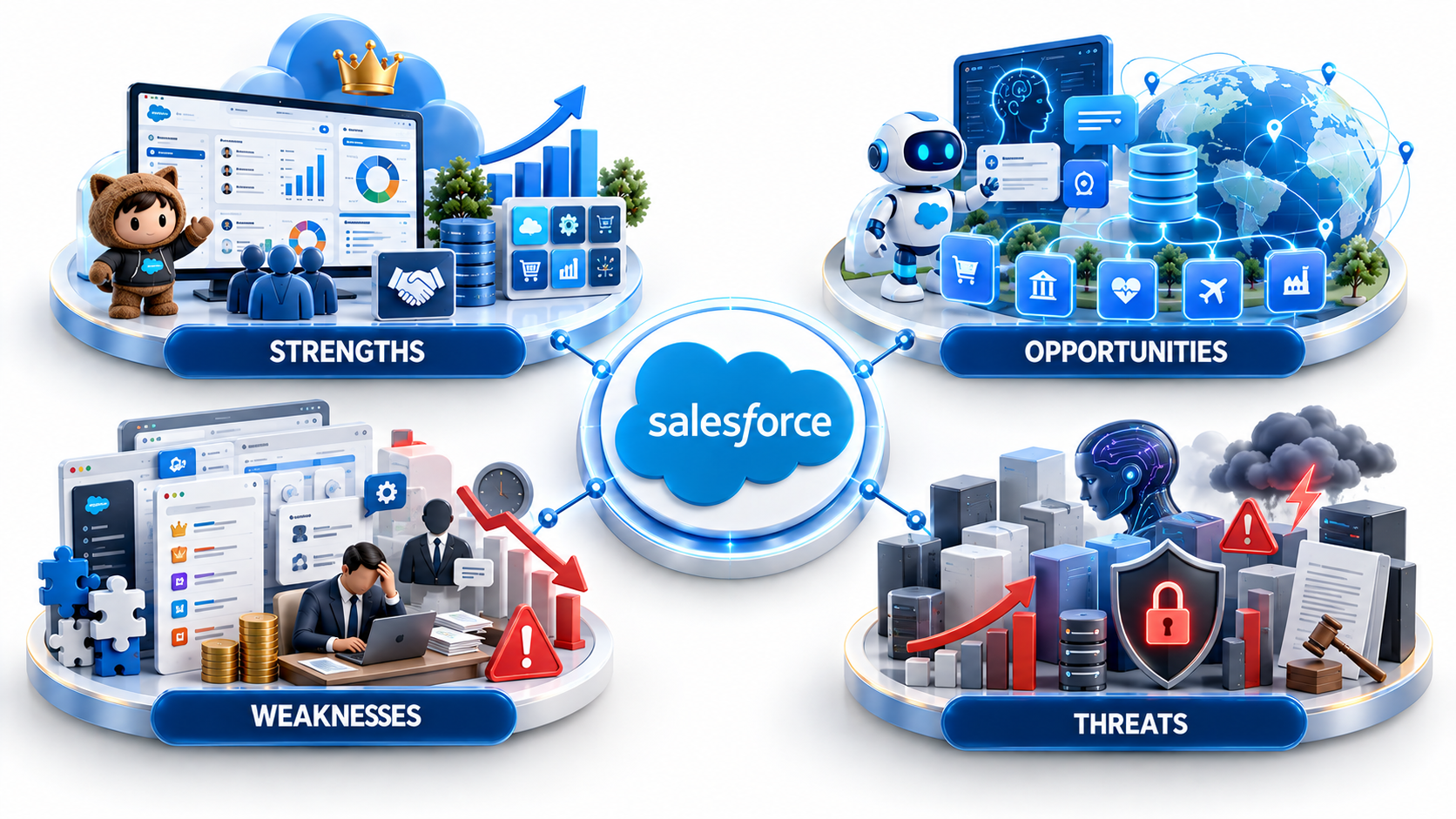
A SWOT analysis of Salesforce sorts everything about the company into four boxes: what it does well, where it is weak, what outside forces could help it, and what outside forces could hurt it. The value is not the boxes. It is the judgment you apply while filling them.
The Plain Definition of SWOT
SWOT stands for Strengths, Weaknesses, Opportunities and Threats. Strengths and weaknesses are internal, meaning things the company controls: its products, people, money and brand. Opportunities and threats are external, meaning things happening around it: competitors, technology shifts, regulation and customer behavior.
That internal versus external split sounds basic, but it is where most beginners slip. If Salesforce raises prices, that is an internal decision, so it belongs in strengths or weaknesses. If Microsoft bundles a rival product for free, that is external, so it lands in threats. Get that split right and half the analysis is already clean.
Why Salesforce Is a Favorite Case Study
Business students love this company because it touches everything. Software as a service, enterprise sales, mergers and acquisitions, platform ecosystems, activist investors, AI strategy, even corporate philanthropy. One company, and you can pull an example for almost any chapter of a strategy course.
It also has a public paper trail. Salesforce files a 10-K every year, publishes detailed earnings releases every quarter, and its CEO Marc Benioff talks constantly. That means you can back every claim with a number instead of a guess, which is exactly what examiners and interviewers want to see from a SWOT analysis of Salesforce.
How This SWOT Analysis of Salesforce Is Built
Every figure here comes from Salesforce’s own filings and earnings releases, or from named news coverage of them. Where a point is opinion, it is written as opinion. Where a number moves fast, like the share price, the date is included so you know how stale it might get.
One warning before you start. Salesforce reports on a fiscal calendar, and it now blends acquired revenue from Informatica into its totals. Some growth rates you see online include that acquired revenue and some do not. The difference matters, and it shows up in the weaknesses section below.
Company Snapshot Before the SWOT Analysis of Salesforce
You cannot judge strengths and threats without knowing what the company is made of. This short snapshot covers where Salesforce started, what it sells in 2026, and the handful of numbers that anchor everything else in the analysis.
From a Rented Apartment to a $41.5 Billion Company
Salesforce started in 1999 in a rented apartment on Telegraph Hill in San Francisco. Marc Benioff, an Oracle veteran, founded it with Parker Harris, Dave Moellenhoff and Frank Dominguez. The pitch was blunt: stop installing expensive software on your own servers and rent it through a web browser instead. They even ran an “End of Software” marketing stunt, complete with protesters outside a competitor’s event.
That idea sounds ordinary now. In 1999 it was borderline crazy, and the big incumbents laughed at it. Twenty-seven years later Salesforce reported $41.5 billion in revenue for the year ended January 31, 2026. The lesson for your analysis is simple: this company has a history of betting early on a shift and being right, which matters when we get to AI. Salesforce
What Salesforce Actually Sells Today
The core is still CRM, short for customer relationship management, meaning software that tracks every lead, deal, support case and customer conversation. Around that core sit Sales, Service, Marketing and Commerce products, plus Slack for team chat, Tableau for analytics, MuleSoft for connecting systems, and Data 360 for pulling customer data into one place.
Since late 2024 the headline product has been Agentforce, a set of AI agents that can answer customers, qualify leads and handle routine service tasks. The company also finished buying data management firm Informatica in November 2025 and has since announced deals to acquire Contentful and Fin. If you run a marketing team, that content and data direction connects straight to digital marketing work like personalization and campaign tracking.
The Numbers That Matter Right Now
Five numbers carry most of the weight. First, remaining performance obligation, meaning contracted revenue not yet recognized, was $72.4 billion at the end of fiscal 2026. Second, FY27 revenue guidance was raised to $46.1 billion to $46.4 billion. Third, Agentforce ARR (annual recurring revenue) now exceeds $1.5 billion. Salesforce.
Fourth, Americas revenue was about $27.2 billion, Europe about $10.0 billion and Asia Pacific about $4.3 billion in fiscal 2026. That tells you Salesforce is still a very American business. Fifth, the company has a stated goal of $63 billion in revenue by fiscal 2030. Keep those five in your pocket. They come back in almost every section.
Strengths
Strengths are the things Salesforce does better than nearly anyone else, and that competitors cannot copy quickly. Six of them stand out. Each one below gets a plain explanation, a number or example, and a reality check so it does not read like advertising.
Category Leadership in CRM
Salesforce has been the biggest CRM vendor in the world for well over a decade. IDC’s market share tracking has put it at roughly one fifth of worldwide CRM revenue for years, which is a huge slice in a market with thousands of vendors. Microsoft, SAP, Oracle and Adobe each sit far behind on CRM alone.
Why does that matter beyond bragging rights? Because leadership feeds itself. Analysts write about Salesforce first, consultants train on it first, and job postings ask for “Salesforce admin” the way they used to ask for “Excel.” A buyer picking a CRM for the first time hears the name before any other, and that head start is worth real money.
A Huge, Sticky Customer Base
Here is the strength people underrate. Once a company runs its sales pipeline, support cases and reporting inside Salesforce, ripping it out is a nightmare. Years of custom fields, automations, integrations and reports are baked in. Switching means retraining hundreds of people and rebuilding processes, so most customers just renew.
The numbers show it. That $72.4 billion RPO figure, up 14% year over year, means a giant chunk of future revenue is already signed. Compare that to a consumer app that has to win every user again every month. Salesforce sells to companies that treat it like plumbing. Plumbing does not get replaced on a whim.
A Money-Making Machine
Salesforce does not just grow, it prints cash. In the third quarter of fiscal 2026 the company reported a non-GAAP operating margin of 35.5% and operating cash flow of $2.3 billion. For the full fiscal 2026 year, the headline in its results release was $15 billion in operating cash flow. Non-GAAP means it strips out things like stock compensation, so treat it as the flattering version. Even the GAAP margin, in the low 20s, is solid.
That cash buys freedom. Salesforce announced a $50 billion share repurchase program and started a $25 billion accelerated buyback, and it pays a quarterly dividend. It can also write an $8 billion check for Informatica without begging anyone. Few software firms can absorb a mistake that size. Salesforce can.
The Ecosystem: AppExchange, Trailhead and Partners
Salesforce is not one product, it is a whole economy. AppExchange, its app marketplace, has thousands of third-party apps built by other companies. A huge network of consulting partners like Accenture and Deloitte earns billions implementing it. Trailhead, the free learning platform, has trained millions of people, many of whom now build careers on the platform.
Think about what that does. Every trained admin, developer and consultant is a small salesperson for Salesforce inside some company. Rivals can copy a feature in a year. Copying a million certified professionals takes a decade. If you are writing this section in an exam, the phrase to remember is “network effects around a talent pool.”
A Data and Integration Stack Few Rivals Match
Over the last eight years Salesforce bought MuleSoft (about $6.5 billion in 2018), Tableau (about $15.7 billion in 2019), Slack (about $27.7 billion in 2021) and Informatica (roughly $8 billion, closed November 18, 2025). Add Data 360 and you get one vendor that can connect systems, clean data, analyze it, chat about it and act on it.
That matters most in the AI era. AI agents are only as good as the data they can see. Benioff put it bluntly at the Informatica close, saying you have to get your data right to get your AI right. Whether every product in that stack works smoothly together is a fair question, and it comes up under weaknesses, but the breadth itself is a genuine strength.
Brand, Events and Industry Depth
Dreamforce, held in San Francisco every year, is one of the largest software conferences on earth, and it works as a giant annual sales event. Add the Salesforce brand, a CEO who is famous enough to shape headlines, and a track record of pushing ideas like the 1-1-1 philanthropy model, and the company gets attention money cannot easily buy.
There is also growing depth in specific industries. Salesforce said its industry businesses finished fiscal 2026 at $6.6 billion in ARR, up nearly 20% year over year. Healthcare, financial services and public sector customers want software that already speaks their language. Industry clouds give Salesforce that edge over generic tools.
Weaknesses
Weaknesses are internal problems, and Salesforce has real ones. Some are a side effect of its size, some are choices it made, and a few are just ugly. Being honest about them is what separates a useful SWOT analysis of Salesforce from a fan page.
Pricing Complexity and a Steep Per-User Bill
Salesforce is expensive, and everybody knows it. At list price, Sales Cloud Enterprise Edition has been around $175 per user per month, and the top Agentforce editions climb into the hundreds. Then come add-ons, extra storage, sandbox environments, support tiers and integrations. The final bill often looks nothing like the first quote.
The company also raised list prices around 6% in both 2023 and 2025. Small and mid-size buyers feel that most. A 20-person team paying $175 per seat spends over $40,000 a year before any consultant touches the setup. That is why cheaper rivals keep winning the low end, and it is a persistent weakness.
Slower Growth Than a Company With This Valuation Needs
Salesforce grew revenue about 25% in fiscal 2022. In fiscal 2026 it grew about 10%. Guidance for FY27 sits at up 11% to 12%, but a chunk of that comes from buying Informatica, not from selling more Salesforce. The company itself said Informatica contributed about four points to current RPO growth.
Strip out acquisitions and organic growth is lower than the headline. Management keeps saying organic revenue will re-accelerate in the second half of FY27. Maybe. But investors have heard promises about re-acceleration before, and the market has clearly decided to wait for proof rather than trust the word.
Implementation Pain and Consultant Dependence
Buying Salesforce is the easy part. Making it work is the hard part. A serious rollout can take six to eighteen months, needs a certified admin or two, and often a paid consulting partner. Plenty of companies end up with a heavily customized, fragile setup that only one person understands.
That dependency is a weakness for Salesforce even though partners profit from it. Frustrated customers blame the product, not the integrator. Every horror story about a failed CRM project on a forum or LinkedIn becomes free negative marketing. Rivals like HubSpot built entire brands on being easier to set up, and they are not wrong.
Integration Debt From Too Many Acquisitions
Salesforce has spent over $60 billion on big acquisitions in less than a decade. Each one arrived with its own technology, its own logins, its own pricing and its own culture. Making Slack, Tableau, MuleSoft, Informatica and the core CRM feel like one product is genuinely hard, and customers have noticed the seams.
The Informatica deal shows the challenge. It adds a massive data platform, but Salesforce has to merge it with Data 360 and MuleSoft, three products with overlapping jobs. If that overlap confuses buyers or sales teams, the money spent buys less than the pitch suggested. Integration debt rarely shows up on an earnings slide, but customers feel it daily.
Heavy Reliance on Sales and Service Clouds
The older core apps still carry most of the weight. In the first quarter of fiscal 2027, subscription and support revenue from Agentforce apps, including sales, service, marketing, commerce and Slack, was $6.91 billion, up almost 9%. Growth in the core is barely single digit.
The fast-growing pieces are still smaller. Data 360, the headless platform and other subscription revenue grew 25% to $3.68 billion, but $428 million of that quarter came from Informatica. So the story is a slow giant and a fast small one. Until the fast one is big enough to move the total, the slow giant sets the pace.
Trust Dents: Security Incidents and Layoff Optics
In 2025 a wave of data theft hit dozens of Salesforce customers. The attackers did not break Salesforce’s core platform. They abused stolen access tokens tied to a third-party app and tricked employees with phone calls, then leaked or tried to sell customer records. Salesforce said publicly it would not pay a ransom. Fair enough, but the headlines still carried its name.
Then came the workforce story. Salesforce cut about 10% of staff in early 2023, and in 2025 Benioff said AI agents let the company reduce customer support headcount from about 9,000 to about 5,000. Customers reasonably ask: if the company replaces its own support people with AI, what happens to the support I pay for? That question is a trust issue Salesforce has to answer.
Opportunities
Opportunities are outside trends Salesforce could ride if it plays them well. Five matter most, and one of them, AI agents, is big enough to change how the whole company looks by the end of the decade.
Agentforce and the Rise of AI Agents
Agentforce is the headline bet. It launched in late 2024, and the growth since has been fast: ARR reached $800 million by early 2026, up 169% year over year, then about $1.2 billion in the first quarter of FY27, and above $1.5 billion in the second quarter. The company also said it has closed more than 29,000 Agentforce deals. Salesforce Delivers Record Fourth Quarter Fiscal 2026 Results – Salesforce +3
Keep it in perspective. $1.5 billion is roughly 3% of expected annual revenue. But triple-digit growth from a base that size matters, and the customer service use case, where an agent resolves a ticket without a human, has clear savings a finance team can measure. If agents become a standard part of every CRM contract, Salesforce sits in the best seat.
Data 360 and the Informatica Bet
AI agents fail when the data underneath is messy, and most companies’ data is a disaster. Duplicate customers, conflicting records, spreadsheets nobody trusts. Salesforce spotted that and bought Informatica, a long-standing leader in data integration, cleaning and governance, then tied it to Data 360.
The early numbers look promising. In Q2 of FY27, Data 360 ingested 104 trillion records, up 355% year over year, and combined Agentforce and Data 360 ARR reached nearly $3.9 billion, up over 210%. Data work is boring, sticky and expensive, which is the perfect combination for a vendor that wants long contracts. If Salesforce becomes the place where clean customer data lives, agents follow.
Industry Clouds and Vertical Depth
Generic CRM is a crowded fight. Healthcare CRM, banking CRM and government CRM are much less crowded, and buyers in those fields pay a premium for software that already knows compliance rules, patient journeys or loan workflows. Salesforce already has an industries business at $6.6 billion in ARR, growing near 20%.
That growth rate is double the company average, which tells you where the momentum sits. Deeper vertical products also raise switching costs even further, and they give Salesforce something Microsoft’s generic bundle struggles to match. For a student, this is a clean example of a company defending its market by getting narrower, not broader.
Slack as the Front Door for Work
Slack was a $27.7 billion purchase that many people questioned. Now it looks smarter, because agents need somewhere to live. Salesforce said Slack delivered its fastest quarterly net new annual order value growth since the acquisition, with Slackbot users up over 150% quarter over quarter.
If employees ask questions and give tasks to an AI assistant inside Slack, then Slack becomes the interface and Salesforce data sits behind it. That fight is against Microsoft Teams, which has the bundling advantage, so Slack is no sure thing. Still, a strong chat interface gives Salesforce a daily-use product, and daily-use products are hard to cancel.
International Growth, Especially Asia Pacific
Roughly two thirds of revenue still comes from the Americas. Asia Pacific was about $4.3 billion in fiscal 2026, around 10% of the total, and Europe about $10.0 billion. Markets like India, Japan, Southeast Asia and the Middle East have fast-growing digital economies, and many mid-size companies there are just moving from spreadsheets to real CRM.
Salesforce has been building local data centers, partnerships and sales teams in these regions. The catch is price. A $175 per-seat tool is a tough sell where teams are small and margins thin. So the opportunity is real, but it needs lower-priced editions and strong local partners. Done well, it is one of the cleaner long-term growth stories on this list.
Threats
Threats are outside forces that can hurt Salesforce no matter how well it executes. Some are old, like Microsoft. Some are new and hard to size, like AI-native startups. And one, the seat pricing squeeze, might be the most serious threat of all.
Microsoft’s Bundling Machine
Microsoft Dynamics 365 is a decent CRM, but its real weapon is everything around it. Companies already pay Microsoft for Office, Teams, Azure and now Copilot. Adding Dynamics and Copilot to the same enterprise agreement is easy, and the discount can make the bundle look nearly free.
Salesforce cannot match that. Slack against Teams is a good example: Teams comes bundled, Slack costs extra, and procurement teams notice. Microsoft does not have to be better. It only has to be good enough and already on the invoice. Historically, that strategy has crushed standalone software vendors, which is why this threat gets the top spot.
Mid-Market Challengers: HubSpot, Zoho and ServiceNow
At the low and middle end, HubSpot sells easier setup, transparent pricing and a free starter tier. Zoho undercuts almost everyone on price. Meanwhile ServiceNow, a workflow giant, has been pushing into customer service and CRM, going straight after Salesforce Service Cloud customers.
For anyone comparing CRM software, the pattern is obvious. Small teams choose HubSpot or Zoho, large enterprises pick between Salesforce, Microsoft and increasingly ServiceNow. Salesforce gets squeezed from both sides, losing price-sensitive buyers below and facing well-funded platform rivals above.
AI-Native Startups and Model Labs Going Direct
Startups built for agents from day one can move fast without legacy baggage. Sierra, founded by Bret Taylor, who used to be Salesforce’s co-CEO, sells AI customer service agents. Decagon does similar work. Neither has to protect a 25-year-old product line, and enterprise buyers are curious.
Then there are the big AI labs, who increasingly sell agents straight to businesses. If a company can plug a strong model into its own data and skip the CRM vendor’s markup, Salesforce loses a layer. Investors clearly worry about it. That fear is a big reason the stock dropped, even while revenue kept growing.
The Seat-Based Pricing Squeeze
Traditional software pricing works like this: more employees means more licenses. Salesforce built its empire that way. But if AI agents do the work of ten support reps, the customer needs fewer human seats, and Salesforce collects fewer seat fees. Its own support team shrinking from 9,000 to 5,000 is a live example.
Salesforce knows this and is moving toward pricing based on work done, using its Agentic Work Unit measure, which counted 7.0 billion units delivered to date. Whether customers happily pay per unit of AI work, and whether it adds up to more than seats paid, is unproven. This is the threat worth watching most closely.
Security, Privacy and Regulation
Salesforce holds sensitive customer data for thousands of companies, so it is a giant target. The 2025 data theft campaign showed attackers will go around the platform and hit people and connected apps instead. Every incident risks customer trust, even when the core platform is not to blame.
Regulation adds pressure. Europe’s GDPR fines, the EU AI Act, and India’s Digital Personal Data Protection Act all place rules on how customer data and AI decisions get handled. Salesforce has the money to comply, but every new rule slows product launches and raises legal costs, especially for AI agents that act on personal data.
Agent Hype Backlash and Investor Impatience
Gartner predicted in 2025 that over 40% of agentic AI projects would be cancelled by the end of 2027, citing costs, unclear value and weak risk controls. If enterprise buyers get burned by early agent projects, Agentforce growth could stall no matter how good the demo looks.
Investors are also impatient. Activists like Elliott and Starboard showed up in 2023 and pushed for margins, and the market is now punishing the stock over AI fears despite record results. That pressure can force short-term decisions, like more buybacks or job cuts, over long-term product bets. It is a threat from the outside that turns into a management problem inside.
SWOT Analysis of Salesforce at a Glance (Summary Table)
After thousands of words, you probably want everything on one page. This section gives you a clean table, shows how to read it across the boxes, and explains how to use it in an assignment or interview without sounding like you copied a template.
The Quick Table
Here is the full SWOT analysis of Salesforce in compact form. Copy it, trim it, or rewrite it in your own words, but keep the numbers because they are what make each point believable.
| Strengths | Weaknesses |
|---|---|
| CRM category leader with roughly a fifth of the global market | Premium pricing, with regular list price increases |
| $72.4B RPO shows deep customer stickiness | Growth near 10%, with acquisitions doing part of the lifting |
| Strong cash flow, around $15B operating cash flow in FY26 | Complex implementations that depend on consultants |
| Huge ecosystem: AppExchange, Trailhead, partners | Integration debt from Slack, Tableau, MuleSoft and Informatica |
| Data stack: Data 360, MuleSoft, Tableau, Informatica | Core apps growing under 10% |
| Brand, Dreamforce and industry clouds | Security incidents and layoff optics |
| Opportunities | Threats |
|---|---|
| Agentforce, above $1.5B ARR and growing over 200% | Microsoft bundling Dynamics, Teams and Copilot |
| Data 360 plus Informatica as an AI data foundation | HubSpot, Zoho and ServiceNow squeezing both ends |
| Industry clouds at $6.6B ARR | AI-native startups and model labs selling direct |
| Slack as the front door for agents | Seat-based pricing pressure as AI cuts headcount |
| Asia Pacific and other emerging markets | Security, privacy and AI regulation |
What the Table Says When You Read It Sideways
A good SWOT does not stop at four lists. Read across the boxes. A strength can fix a weakness, or a threat can attack a strength. For example, the huge customer base (strength) is the exact audience Agentforce sells to (opportunity), which means growth can come cheaply, without chasing new customers.
Now flip it. Microsoft bundling (threat) attacks the ecosystem and Slack (strengths and opportunity) at once. And the seat-pricing squeeze (threat) hits the core apps, which are already slow (weakness). Spotting those links is what turns a list into an argument, and that is what examiners reward.
Using This SWOT Analysis of Salesforce in an Assignment or Interview
For an assignment, pick three or four points per box, not twenty. Give each one a number, a short explanation and a link to another box. Then end with a recommendation, like “Salesforce should price Agentforce by outcome before Microsoft resets buyer expectations.” A firm recommendation stands out from most submissions.
For interviews, especially for consulting, product or sales jobs, memorize five numbers and one opinion. Interviewers care less about whether you agree with the panel and more about whether you can defend a view. If you want more real-world breakdowns like this one, the case studies section shows how to build arguments from public data.
Conclusion
The SWOT analysis of Salesforce comes down to a simple tension. The company owns the customer relationship market, prints cash and has a $72 billion backlog, but grows near 10% and faces an AI shift that could either extend its lead or shrink the seat-based model it was built on. Agentforce and Data 360 are the evidence for the good version. Microsoft and seat pricing are the evidence for the bad one.
So watch three numbers: Agentforce ARR, organic growth in the core apps, and how pricing moves from per-seat to per-outcome. If you want the full structured path into marketing and CRM skills, the Alpha Marketer Foundation Program covers the fundamentals. And if you just want more free breakdowns like this one, the Learn hub is the place to go next.
Frequently Asked Questions
What is the SWOT analysis of Salesforce?
A SWOT analysis of Salesforce is a framework that sorts the company’s internal strengths and weaknesses alongside external opportunities and threats. Strengths include CRM leadership and a $72 billion backlog. Weaknesses include high prices and slower growth. Opportunities center on Agentforce and data, while threats include Microsoft and AI-native startups.
What is Salesforce’s biggest strength?
Its biggest strength is the installed base. Thousands of companies run sales, service and reporting inside Salesforce, so switching is painful and expensive. That stickiness produces predictable revenue, shown by the $72.4 billion in remaining performance obligation, and it gives the company steady cash to fund acquisitions and buybacks.
What is Salesforce’s biggest weakness?
Growth is the biggest weakness. Revenue grew about 10% in fiscal 2026, far below the roughly 25% pace of fiscal 2022, and part of the current growth comes from buying Informatica rather than organic sales. High pricing and complicated implementations come close behind.
What are the main opportunities for Salesforce?
The main opportunities are Agentforce, Data 360 with Informatica, industry-specific clouds, Slack as an AI interface, and expansion in Asia Pacific. Agentforce ARR passed $1.5 billion, and combined Agentforce and Data 360 ARR neared $3.9 billion, both growing more than 200% year over year.
What are the biggest threats to Salesforce?
Microsoft’s bundling of Dynamics 365, Teams and Copilot is the most direct threat. AI-native startups, direct sales from AI labs, cheaper rivals like HubSpot and Zoho, and pressure on per-seat pricing all add risk. Security incidents and new AI regulation are further outside pressures.
Who are Salesforce’s main competitors?
Salesforce competes with Microsoft Dynamics 365, SAP, Oracle, Adobe and HubSpot in CRM and marketing. In service and workflow, ServiceNow is a growing rival. Zoho competes on price, and newer AI startups like Sierra and Decagon compete for customer service automation.
Is Salesforce better than HubSpot?
It depends on the buyer. Salesforce is stronger for large companies with complex sales processes, custom workflows and heavy integration needs. HubSpot is usually easier to set up and cheaper for small and mid-size teams. Neither wins across the board, so match the tool to team size, budget and technical resources.
How much revenue does Salesforce make?
Salesforce reported $41.5 billion in revenue for fiscal 2026, which ended January 31, 2026, up 10% year over year. For fiscal 2027 it has raised guidance to between $46.1 billion and $46.4 billion. Its long-term goal is $63 billion in revenue by fiscal 2030.
What is Agentforce and why does it matter?
Agentforce is Salesforce’s platform for AI agents that handle tasks like answering customer questions, qualifying leads and routing service cases. It matters because it could turn Salesforce from a system of record into a system that does the work. Agentforce ARR now exceeds $1.5 billion.
Why did Salesforce buy Informatica?
Salesforce bought Informatica, a data management company, for roughly $8 billion in equity, closing the deal on November 18, 2025. The goal is to give AI agents clean, connected and governed data. Without reliable data, agents make mistakes, so Informatica strengthens Data 360 and MuleSoft.
Why did Salesforce’s stock fall despite strong results?
Investors worry that AI will reduce demand for traditional software, especially per-seat licenses, and that AI-native rivals will take business. Salesforce’s revenue and cash flow kept growing, but the market is pricing in future risk. By late May 2026, the shares were down roughly a third for the year.
How do you write a good SWOT analysis of Salesforce for an assignment?
Pick three or four points per box, attach a number and a reason to each, and keep internal factors (strengths, weaknesses) separate from external ones (opportunities, threats). Connect points across boxes, use the latest earnings data, and end with a clear recommendation rather than four disconnected lists.