


Every time the repo rate changes, half of India seems to have an opinion about it. Your EMI goes up, your neighbour who runs a small textile export unit starts complaining about the rupee, and some uncle in the family WhatsApp group forwards a message claiming the Reserve Bank of India is either “saving the economy” or “ruining it,” depending on his mood that week. Nobody sits down and actually explains what the RBI is good at, where it struggles, what’s coming next for it, and what could genuinely knock it off balance. That’s exactly the gap this piece is trying to close.

A SWOT analysis of RBI sounds like something out of an MBA textbook, and honestly, it usually is written that way, dry, bullet-pointed, forgettable. But strip away the jargon and it’s really just four honest questions. What does the RBI do really well? Where does it fall short? What chances is it sitting on that it hasn’t fully used yet? And what external forces could hurt it if it’s not careful? Once you frame it like that, the whole thing stops feeling like an exam answer and starts feeling like a conversation you’d actually have with someone who tracks monetary policy for a living.
This guide walks through all four sides of that picture in detail, with real numbers, real events from the last few years, and real comparisons to how other central banks handle similar problems. Whether you’re preparing for a banking exam, writing a college assignment, researching for an investment decision, or just trying to understand why the rupee keeps sliding against the dollar, this is written to answer the follow-up questions too, not just the surface-level ones.
What You Will Learn in This Guide
- What RBI actually is and why applying a SWOT framework to a central bank makes sense in the first place
- The core strengths that make RBI one of the more respected central banks among emerging economies
- The structural weaknesses that show up again and again, from NPA cycles to communication slip-ups
- The opportunities sitting in front of RBI right now, including the digital rupee and fintech regulation
- The threats that could genuinely destabilize RBI’s plans, both from outside India and from within the financial system
- A side-by-side comparison of RBI’s position against the US Federal Reserve and the European Central Bank
- What all of this practically means if you’re an investor, a business owner, or a student preparing for competitive exams
- Answers to the most commonly searched questions about RBI’s SWOT profile
SWOT Analysis of RBI: Why This Framework Actually Fits a Central Bank
People assume SWOT analysis is strictly a business tool, something you’d use to evaluate a company before an investor pitch. But a central bank is, in a lot of ways, an institution with a mandate, a balance sheet, competitors in the sense of other regulators, and external risks it can’t fully control. That’s not so different from a company. The SWOT analysis of RBI works because RBI has internal capabilities (strengths and weaknesses) and it operates inside an environment full of shifting variables (opportunities and threats) that it has to respond to, not dictate.
Quick History of the Reserve Bank of India
RBI was set up in 1935 under the Reserve Bank of India Act, originally as a privately owned institution before it was nationalized in 1949. Its early job was fairly narrow: manage currency issuance and keep banking stable after partition-era chaos. Fast forward to now, and the mandate has stretched into monetary policy, foreign exchange management, financial system supervision, developmental role in rural credit, and increasingly, oversight of digital payments and fintech. The point is, RBI in 2026 is doing five jobs that used to belong to five different departments. That expansion is part of why its SWOT profile looks the way it does today.
Why Applying SWOT to a Regulator Works Better Than People Expect
A regular company gets judged on revenue and market share. RBI gets judged on inflation control, currency stability, and how well the banking sector survives shocks. The metrics are different, but the exercise of mapping internal strengths against external threats is exactly as useful. If anything, it’s more useful here because a central bank’s mistakes don’t just hurt shareholders, they ripple into every household’s cost of living. That’s the real stake behind this analysis.
SWOT Analysis of RBI: The Big Picture Before We Break It Down
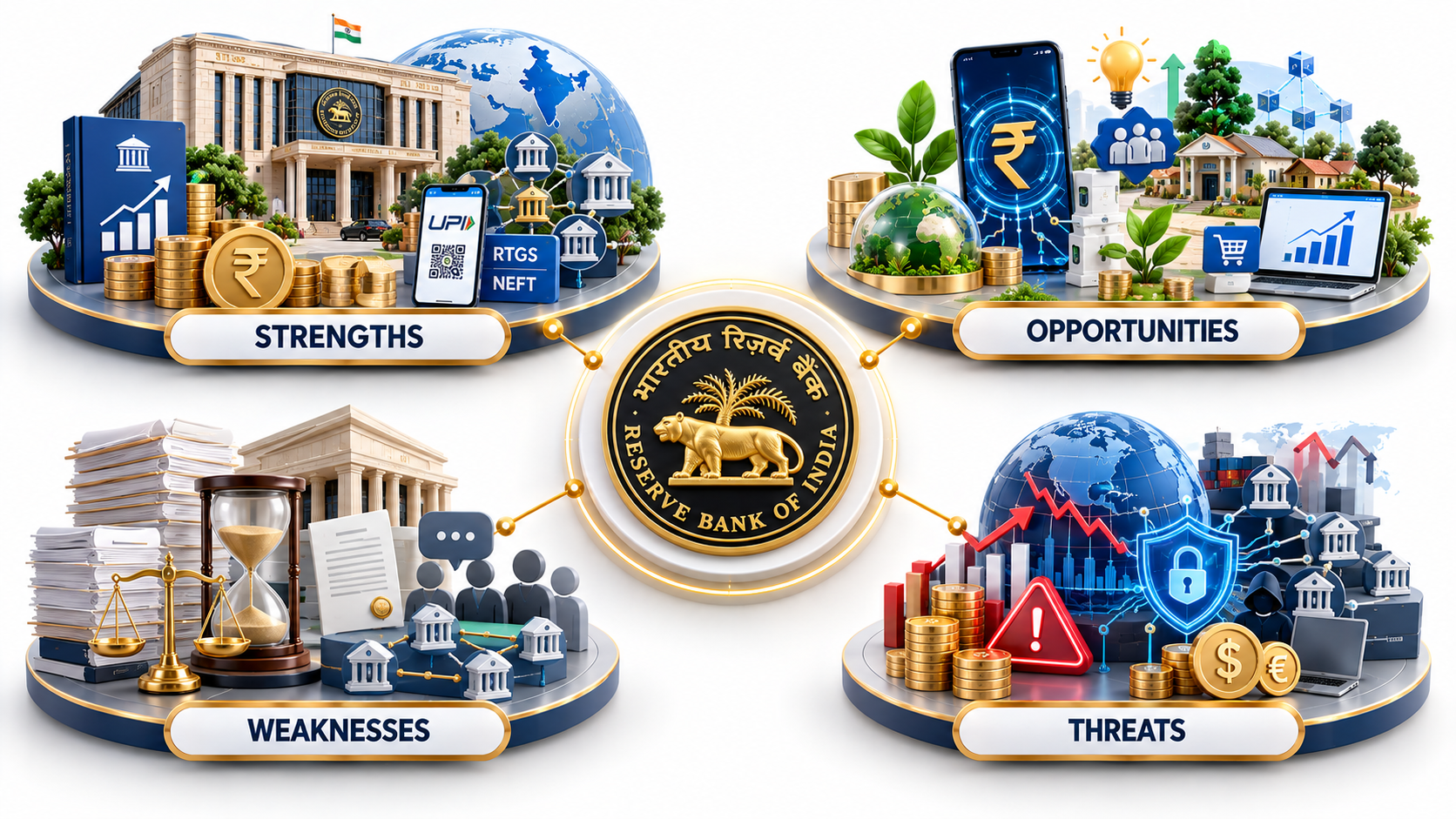
Before going section by section, here’s the shorthand version so you know where this is headed. RBI’s strengths center on independence in monetary policy, forex reserve management, and regulatory reach over banks and NBFCs. Its weaknesses show up in slow crisis response, political pressure on rate decisions, and patchy communication with the public. The opportunities in front of it are mostly digital, the digital rupee, fintech regulation, green finance. And the threats are a mix of global volatility, cybersecurity gaps, and domestic credit risk that never fully goes away. Now let’s actually get into the details, because the headline version doesn’t tell you anything you couldn’t guess.
Strengths of RBI
This is the part people underestimate. RBI isn’t just another government department stamping approvals. It has built genuine institutional muscle over the decades, and some of that muscle is honestly better than what several G20 central banks have.
Monetary Policy Independence Through the MPC Structure
Since 2016, RBI’s monetary policy decisions run through the Monetary Policy Committee, a six-member panel with three RBI representatives and three external economists appointed by the government. This structure was a genuine upgrade from the old system where the RBI Governor alone decided the repo rate, often under heavy behind-the-scenes pressure. The MPC has an explicit inflation target, keep CPI inflation at 4%, with a tolerance band of plus or minus 2%. That’s not vague language, it’s a number RBI is legally accountable to hit. Compare that to a lot of developing economies where the central bank’s inflation target changes depending on who’s in power that year. The MPC framework gives RBI a rulebook it can point to when a politician wants a rate cut before an election. That’s a real strength, not a theoretical one.
Massive Foreign Exchange Reserves as a Buffer
RBI’s forex reserves have stayed in the range of 640 to 700 billion dollars through 2025 and into 2026, making India one of the top four reserve holders globally, sitting alongside China, Japan, and Switzerland. Why does this matter so much? Because when the rupee comes under pressure, like it did in 2022 when it touched 83 against the dollar, RBI can step in and sell dollars from these reserves to slow the fall without triggering a full-blown currency crisis. Countries without this cushion, think Sri Lanka in 2022 or Pakistan around the same period, had to run to the IMF within months because they simply didn’t have the ammunition to defend their currency. RBI’s reserve pile is the financial equivalent of keeping a fire extinguisher in every room. You hope you never need it, but when the smoke shows up, you’re not scrambling.
Regulatory Grip Over the Banking and NBFC Sector
RBI doesn’t just set interest rates, it directly supervises every scheduled commercial bank, cooperative bank, and non-banking financial company in the country. That’s a big deal because it means RBI can force a bank to raise capital, restrict a bank’s lending, or in extreme cases, supersede a bank’s board, like it did with Yes Bank in March 2020 when the bank was collapsing under bad loans. RBI stepped in, reconstructed the board within days, and got State Bank of India and other lenders to inject capital before depositors panicked. That kind of speed and authority in a crisis is a genuine strength most regulators in emerging markets don’t have. The RBI’s Prompt Corrective Action framework also means weak banks get flagged and restricted well before they become the next headline collapse.
Ownership of India’s Digital Payments Backbone
This one gets underrated constantly. RBI, through the National Payments Corporation of India, essentially built and now oversees UPI, the payment system that processed over 16 billion transactions in a single month by early 2025. That’s not a small side project, that’s infrastructure that changed how an entire country pays for chai and cars. RBI’s regulatory oversight of UPI, RTGS, NEFT, and the newer Central Bank Digital Currency pilot puts it years ahead of central banks in the US or UK when it comes to real-time payment rails. Look at what actually happens when a foreign fintech founder studies India’s payment stack, they’re usually stunned that a government-linked institution built something this efficient. That’s not something you say about most regulators.
Deep Institutional Talent and Global Credibility
RBI recruits through one of the toughest competitive processes in India, the Grade B officer exam, and its research department produces some of the more credible economic data coming out of any emerging market. Governors like Raghuram Rajan and Urjit Patel built international reputations that gave RBI a seat at the table in global forums like the Bank for International Settlements. When RBI makes a statement about inflation trajectory, global investment banks actually factor it into their India outlook reports. That credibility took decades to build and it’s not something a weaker institution could replicate overnight.
Weaknesses of RBI
No institution is flawless, and pretending otherwise would be dishonest. RBI has structural weak spots that show up again and again across different crises, and it’s worth being blunt about them.
Historically Slow Response to the NPA Crisis
Between 2014 and 2018, India’s banking sector was sitting on a mountain of bad loans, non-performing assets that ballooned past 10 lakh crore rupees at their peak, mostly from corporate lending to infrastructure and steel companies that never should have gotten that much credit in the first place. RBI’s Asset Quality Review, launched in 2015 under Raghuram Rajan, was necessary but arrived years after the rot had already set in. Banks had been quietly rolling over bad loans instead of declaring them, a practice called evergreening, and RBI’s supervision missed it for far too long. The honest read here is that RBI’s on-ground bank inspection process wasn’t rigorous enough during the boom years, and by the time it tightened up, the damage was already baked into balance sheets.
Limited Real Autonomy From the Government
On paper, RBI is independent. In practice, the Governor answers to a Finance Ministry that has its own political priorities, and there have been visible clashes because of it. The most public one was in 2018, when then-Deputy Governor Viral Acharya gave a speech warning that undermining central bank independence was “potentially catastrophic,” a clear jab at government pressure over RBI’s reserves and lending norms. That standoff eventually contributed to Governor Urjit Patel’s resignation in December 2018. The RBI Act itself technically allows the government to issue directions to the Governor under Section 7, a provision that’s rarely used but sits there as a reminder of who ultimately holds the leash. That’s a structural weakness that doesn’t go away just because a particular Governor happens to be strong-willed.
Communication That Often Confuses More Than It Clarifies
RBI’s policy statements are written in a style that assumes the reader already has a finance degree. Terms like “accommodative stance,” “calibrated tightening,” or “orderly evolution of the yield curve” show up constantly, and most retail investors and small business owners have no real idea what these phrases mean for their loans or savings. Compare this to how the US Federal Reserve’s Jerome Powell handles press conferences, plain language, direct answers, visible effort to make sure markets aren’t left guessing. RBI’s communication has improved under Governor Shaktikanta Das, who does hold press briefings, but the underlying policy documents remain dense and jargon-heavy. For an institution that affects every borrower in the country, that’s a real gap.
Overlapping and Sometimes Conflicting Regulatory Roles
RBI regulates banks, but SEBI regulates markets, IRDAI regulates insurance, and PFRDA regulates pensions. Sounds clean until you hit products that blur these lines, like bank-sold insurance policies or NBFC-issued market-linked debentures. There have been genuine turf disputes, like the 2014 to 2015 fight between RBI and SEBI over who regulates certain deposit-taking schemes, or more recent friction over how digital lending apps that partner with banks should be supervised. When two regulators aren’t fully aligned, the entity being “regulated” sometimes exploits the gap, and it’s usually the retail customer who gets burned when a scheme collapses in the space between two rulebooks.
Opportunities for RBI
This is where things get genuinely interesting, because RBI is sitting on chances right now that could define its next decade, if it moves fast enough.
Scaling the Digital Rupee Beyond Pilot Stage
RBI launched its Central Bank Digital Currency, the e-rupee, in pilot form back in late 2022, first for wholesale interbank settlements and later for retail use through partner banks. By 2025, daily retail CBDC transactions were still modest compared to UPI’s scale, sitting in the low millions rather than billions. That gap is actually the opportunity. If RBI can get merchant adoption up and make the e-rupee interoperable with UPI QR codes, which it’s been testing, it could reduce the cost of currency printing and give RBI far more granular visibility into money flow without compromising the privacy protections it has promised. Countries like the Bahamas and Nigeria launched CBDCs earlier but never got real traction. RBI has a genuine shot at being the first large economy to make a digital currency actually stick at scale.
Building a Real Fintech Regulatory Sandbox
India’s fintech sector, from Razorpay to Cred to a hundred smaller lending apps, has grown faster than most regulators anywhere have kept pace with. RBI’s regulatory sandbox, first launched in 2019, lets fintech firms test new products under RBI supervision before a full public rollout. The opportunity here is scaling this sandbox into something closer to the UK’s Financial Conduct Authority model, where innovation and consumer protection genuinely coexist instead of RBI reacting after a digital lending scandal, like the 2020-2021 wave of predatory instant loan apps that RBI eventually had to crack down on through stricter digital lending guidelines in 2022. Getting ahead of fintech innovation instead of chasing it would be a meaningful shift for RBI’s regulatory posture.
Leading on Green Finance and Climate-Linked Banking Norms
RBI joined the Network for Greening the Financial System in 2021, a coalition of central banks working on climate risk in the financial sector. Since then, it’s pushed banks to start disclosing climate-related financial risks and has floated the idea of a Sovereign Green Bond framework, which India actually used to raise funds in early 2023. The opportunity is real: as global capital increasingly flows toward ESG-linked instruments, RBI has a chance to position Indian banks as credible players in green finance rather than laggards. Given how much of India’s growth still depends on infrastructure and energy financing, getting the green finance regulatory framework right isn’t just good optics, it affects how cheaply Indian companies can borrow from global green capital pools.
Deepening Financial Inclusion Through Jan Dhan and Beyond
Over 530 million Jan Dhan bank accounts have been opened since the scheme launched in 2014, and RBI’s push for account aggregators and the India Stack ecosystem means financial data can now move between banks, lenders, and fintechs with customer consent, something that used to require mountains of paperwork. The opportunity for RBI here is using this infrastructure to extend credit to the roughly 190 million Indians who remain outside formal banking access, according to World Bank Findex estimates. If RBI can push banks and NBFCs to actually lend against this data instead of just collecting it, financial inclusion stops being a slogan and becomes a functioning credit market for people who’ve never had one before.
Threats to RBI
Every strength has a matching risk, and RBI’s list of external threats is long enough that it genuinely keeps policymakers up at night.
Global Rate Cycles and US Federal Reserve Decisions
When the US Fed raises rates, capital tends to flow out of emerging markets like India and back into safer, higher-yielding US assets. This happened hard in 2022 when the Fed hiked rates aggressively to fight inflation, and the rupee fell from around 74 to the dollar to above 83 within the year. RBI had to burn through tens of billions in reserves defending the currency. The threat here isn’t hypothetical, it’s a recurring cycle. Every time the Fed shifts stance, RBI’s own policy options narrow, because raising rates too slowly risks more capital flight, but raising them too fast chokes India’s own growth. That’s a genuinely difficult needle to thread, and RBI doesn’t fully control the thread or the needle.
Cybersecurity Risks Across a Massive Digital Payment Network
UPI processes over a billion transactions a day at this point, and every one of those transactions is a potential attack surface. RBI has pushed banks toward stronger authentication and fraud detection systems, but India’s digital payment fraud cases still run into thousands of crores annually according to RBI’s own annual reports. A large-scale breach, especially one that hits a major public sector bank or the National Payments Corporation infrastructure itself, could shake public trust in digital payments overnight. Given how central UPI has become to daily commerce, this isn’t a minor operational risk, it’s closer to a systemic one.
Shadow Banking and NBFC Contagion Risk
The 2018 collapse of IL&FS, a major infrastructure financing NBFC that defaulted on payments and triggered a liquidity crunch across the shadow banking sector, is the clearest example of this threat. NBFCs often lend money they’ve borrowed short-term from banks and mutual funds, and when one large NBFC defaults, it can freeze credit across the entire system within weeks. RBI has tightened NBFC regulation since then, including bringing large NBFCs under a scale-based regulatory framework in 2021, but the sector remains large, interconnected, and only partially transparent. Another IL&FS-style event isn’t off the table.
Geopolitical Pressure and Currency Weaponization Risk
With sanctions increasingly used as a geopolitical tool, whether against Russia after 2022 or in ongoing tensions around trade with China, RBI has had to navigate rupee-based trade settlement mechanisms and manage reserve diversification carefully. There’s a slow but real global conversation about reducing dollar dependency, and while that could eventually benefit the rupee’s international standing, in the near term it adds volatility RBI has to manage without a clear playbook. No central bank has fully solved this problem yet, and RBI is no exception.
SWOT Analysis of RBI: Quick Reference Table
| Category | Key Points |
|---|---|
| Strengths | MPC-driven policy independence, large forex reserves, strong regulatory control over banks and NBFCs, ownership of UPI and digital payments infrastructure, deep institutional talent |
| Weaknesses | Slow historical response to NPA crisis, limited real autonomy from government, jargon-heavy communication, overlapping regulatory turf with SEBI and IRDAI |
| Opportunities | Scaling the digital rupee (CBDC), building a stronger fintech sandbox, leading on green finance, deepening financial inclusion through India Stack |
| Threats | Global rate cycles and Fed policy spillover, cybersecurity risk in digital payments, NBFC contagion risk, geopolitical and currency pressures |
How RBI’s SWOT Profile Compares to Other Central Banks
Context matters here. RBI doesn’t operate in a vacuum, and comparing it to how other major central banks handle similar strengths and threats makes the picture sharper.
RBI Versus the US Federal Reserve
The Fed has a dual mandate, price stability and maximum employment, while RBI’s mandate leans almost entirely on inflation targeting through the MPC. The Fed also enjoys a currency that’s the world’s primary reserve currency, which means it never has to worry about defending the dollar’s value the way RBI has to defend the rupee. On the flip side, RBI’s direct control over a fast-growing digital payments system like UPI is something the Fed doesn’t have an equivalent of, the US still relies heavily on card networks and slower ACH transfers. So while the Fed has structural advantages tied to dollar dominance, RBI has an operational edge in payment system innovation that’s honestly ahead of its time.
RBI Versus the European Central Bank
The ECB has to set one interest rate policy for nineteen different countries with wildly different economic conditions, Germany’s economy doesn’t behave like Greece’s, and that creates policy tension RBI never has to deal with since it only answers to one national economy. But the ECB benefits from operating within a currency union that has deep, liquid bond markets and less currency volatility risk internally. RBI’s challenge is closer to Brazil’s or Indonesia’s central bank than to the ECB’s, managing a single, fast-growing, but still-developing economy that’s exposed to global capital flow swings in a way mature currency zones simply aren’t.
What This SWOT Analysis Actually Means for You
Understanding RBI’s SWOT profile isn’t just academic. It changes how different people should actually act.
For Investors Tracking Interest Rates and the Rupee
If you’re watching RBI’s MPC meetings to time a bond purchase or decide when to lock in a fixed deposit, understanding that RBI’s biggest external threat is global rate spillover means you should be watching the US Fed’s calendar just as closely as RBI’s own announcements. RBI rarely moves in a vacuum, it moves in response to global conditions layered on top of domestic inflation data. Investors who only track domestic CPI numbers and ignore what’s happening with Fed policy are missing half the picture.
For UPSC and Banking Exam Aspirants
If you’re preparing for RBI Grade B, NABARD, or UPSC economics papers, examiners love asking about RBI’s autonomy debate, the NPA crisis timeline, and the MPC framework, because these show up constantly in current affairs sections. Knowing the actual events, Urjit Patel’s resignation, the Yes Bank rescue, the 2022 rupee slide, gives you concrete examples to cite instead of vague statements, which is exactly what scores better in both prelims and mains-style answers.
For Business Owners and Startup Founders
If you run a business that depends on credit, whether that’s a manufacturing unit waiting on working capital loans or a fintech startup navigating RBI’s digital lending guidelines, understanding RBI’s regulatory weaknesses, like the sandbox gaps and overlapping jurisdiction issues, tells you where compliance risk is highest right now. Founders building in digital lending or payments specifically need to track RBI’s evolving fintech rules closely, because RBI has shown it will tighten regulation fast once it spots a pattern of consumer harm, as it did with instant loan apps in 2022.
Conclusion
Look, RBI isn’t perfect, and nobody serious claims it is. It’s slow sometimes, its language is dense, and it’s not fully insulated from political pressure no matter what the RBI Act says on paper. But when you actually lay out the SWOT analysis of RBI honestly, strengths like the MPC framework, forex reserves, and UPI oversight genuinely outweigh the weaknesses in terms of what keeps the Indian financial system functioning day to day. The opportunities in front of it right now, especially the digital rupee and fintech regulation, could define whether RBI stays a step ahead or ends up playing catch-up the way it did during the NPA crisis. And the threats, global rate cycles, cyber risk, NBFC contagion, aren’t going anywhere soon. If you take one thing from this, it’s that RBI’s next big test won’t come from inside its own building, it’ll come from how well it manages forces it doesn’t fully control.
Frequently Asked Questions
What is the biggest strength of RBI according to SWOT analysis?
RBI’s biggest strength is the Monetary Policy Committee framework combined with its large foreign exchange reserves. The MPC gives it a rule-based, accountable process for setting interest rates, while reserves above 640 billion dollars give it the ability to defend the rupee during currency shocks without immediately needing outside help.
What is the main weakness of RBI as a regulator?
RBI’s most cited weakness is its historically slow response to systemic risks, most visibly during the 2014 to 2018 non-performing assets crisis, when bad loans piled up for years before RBI’s Asset Quality Review forced banks to acknowledge them. Limited practical autonomy from the government is the second major weakness.
Is RBI truly independent from the Indian government?
Legally, RBI has operational independence, especially over monetary policy through the MPC. In practice, the government retains influence through Governor appointments, reserve transfer demands, and Section 7 of the RBI Act, which allows the government to issue directions in specific circumstances. So independence exists, but it’s not absolute.
How does RBI’s digital rupee fit into its SWOT analysis?
The digital rupee, or e-rupee CBDC, is classified as an opportunity in RBI’s SWOT profile. It’s still in pilot stages with modest transaction volumes compared to UPI, but if RBI scales it successfully and makes it interoperable with existing payment rails, it could become a major strength rather than just a pilot project.
Why is NBFC risk considered a threat to RBI?
NBFCs borrow short-term and lend long-term, which creates liquidity mismatches. When a large NBFC like IL&FS defaults, as it did in 2018, it can freeze credit flow across the entire shadow banking sector within weeks. RBI has tightened oversight since then, but the sector remains large and interconnected enough to pose a systemic threat.
How does RBI compare to the US Federal Reserve in terms of strengths?
RBI’s strength lies in owning and regulating one of the world’s most advanced real-time digital payment systems, UPI, something the Fed doesn’t have an equivalent of. The Fed’s strength comes from the US dollar’s status as the global reserve currency, which RBI’s rupee doesn’t share, making currency defense a bigger recurring task for RBI than for the Fed.
What role did the 2018 RBI-Government conflict play in its weaknesses?
The 2018 standoff, which included Deputy Governor Viral Acharya’s public warning about central bank independence and Governor Urjit Patel’s eventual resignation, exposed how much political pressure can affect RBI’s decision-making, particularly around reserve transfers and lending norms. It remains a reference point whenever RBI’s autonomy is discussed.
What opportunities does RBI have in financial inclusion?
RBI can build on the Jan Dhan Yojana’s over 530 million bank accounts and the India Stack’s account aggregator framework to extend formal credit to the roughly 190 million Indian adults still outside the banking system. The infrastructure already exists; the opportunity is in pushing banks and NBFCs to actually lend against that data.
Why is cybersecurity listed as a threat in RBI’s SWOT analysis?
Because RBI oversees a payment ecosystem processing over a billion UPI transactions daily, any large-scale breach or fraud event could damage public trust in digital payments nationwide. Digital payment fraud already runs into thousands of crores annually according to RBI’s own reporting, making this an active, not hypothetical, risk.
Does RBI’s SWOT profile change during election years?
Historically, yes, in subtle ways. Political pressure to cut rates or ease lending norms tends to rise before elections, testing RBI’s independence more visibly during those windows. The MPC’s rule-based framework is specifically designed to reduce this pressure’s actual impact on rate decisions, but the pressure itself doesn’t disappear.
How does RBI manage the threat of global interest rate cycles?
RBI monitors US Federal Reserve policy closely and adjusts its own rate stance, forex intervention levels, and reserve deployment based on how capital flows are shifting globally. It doesn’t control the Fed’s decisions, but it tries to build enough of a reserve buffer and policy flexibility to absorb the shock when global rates move sharply, as they did in 2022.
What is the biggest opportunity RBI hasn’t fully capitalized on yet?
Scaling the digital rupee to UPI-level adoption is probably the biggest unrealized opportunity. UPI processes billions of transactions monthly while the CBDC pilot is still comparatively small. Closing that gap could meaningfully reduce currency management costs and give RBI far better visibility into money movement across the economy.