


Walk into a mobile market in a Tier 2 town, say Muzaffarpur or Nashik, and count how many shopfronts have the word “Vivo” painted across the top before you spot a Samsung sign or an Apple logo. In most towns, Vivo wins that count without even trying hard. That is not luck. That is the direct result of a marketing mix built over a decade of retail-first thinking, cricket sponsorships, and a product line that covers every price bracket a middle-class Indian household can imagine.

Here is the number that makes this worth studying: Vivo ended 2025 as the number one smartphone brand in India by shipment volume, with a market share hovering between 19% and 23% depending on which research firm you check (IDC, Counterpoint, and Omdia all placed it at the top through the year). Samsung sat second, Oppo third. That is not a fluke quarter. Vivo has held pole position in India for several consecutive quarters, and it did that while operating in the most price-sensitive, most fragmented smartphone market on the planet.
This guide breaks down the Marketing Mix of Vivo piece by piece: product, price, place, and promotion, and then goes one layer further into people, process, and physical evidence, the extended framework marketers use for brands that sell through physical retail and service touchpoints. The goal here is not to just list what Vivo does. It is to explain why each decision works, where competitors get it wrong, and what a marketing student or small business owner can actually lift from this playbook and use elsewhere.
One more thing before diving in: this is not a promotional piece about Vivo phones, and it does not need to be. Vivo has real weaknesses too, including a reputation problem around bloatware on its custom Android skin and a brand perception, fair or not, that still trails Samsung and Apple among buyers over the age of forty. The point of pulling this apart is not to praise the brand. It’s to understand, mechanism by mechanism, why the marketing decisions behind it worked well enough to build the biggest smartphone business in the world’s second-largest smartphone market, so that the underlying logic can be reused somewhere else, on a completely different product, at a completely different budget.
What You Will Learn in This Guide
- How Vivo uses a multi-series product strategy (Y, T, V, X, and iQOO) to avoid competing with itself across price bands.
- Why Vivo prices for perceived value instead of matching competitors feature-for-feature.
- How offline retail, not e-commerce, became Vivo’s real competitive edge in a country everyone assumed had gone online.
- The real story behind the Vivo-IPL sponsorship deal, including what it cost and why the bet paid off.
- How the extended marketing mix (people, process, physical evidence) explains why Vivo’s retail experience feels different from Xiaomi’s or Realme’s.
- Common mistakes students make when they write up Vivo’s marketing mix as a college assignment or case study.
What Is the Marketing Mix of Vivo and Why It Works So Well
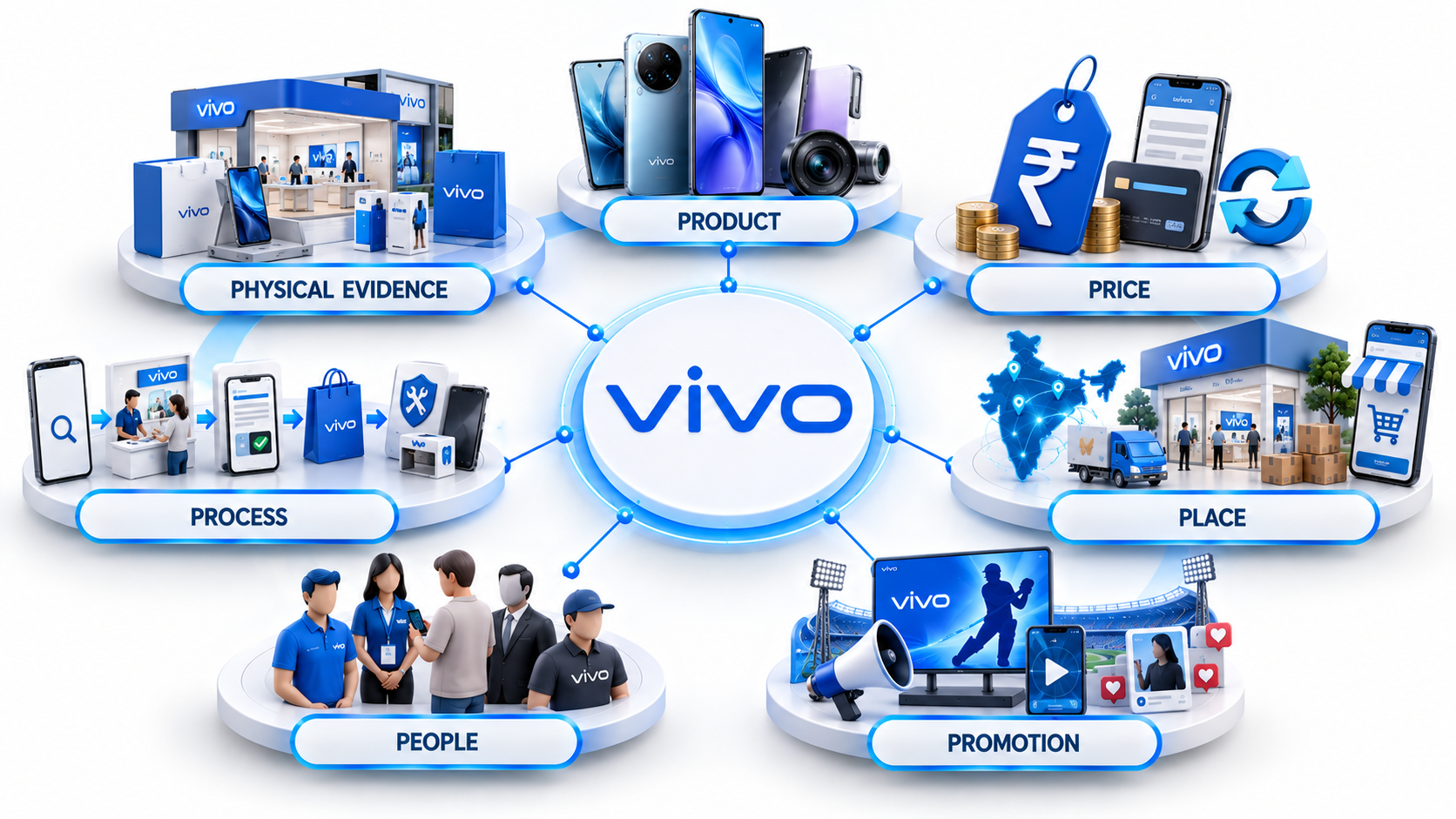
The Marketing Mix of Vivo refers to the combination of product, price, place, and promotion decisions the company uses to sell smartphones profitably across dozens of countries, with India as its single biggest and most closely watched market. Where most brand analyses treat these four elements separately, Vivo’s real advantage comes from how tightly they are stitched together. A budget phone launched under the Y series will always show up in a small-town Vivo store before it shows up on Flipkart. A flagship X series launch will always run alongside an IPL campaign. Nothing here happens in isolation.
Marketing students usually meet this concept as the “4Ps,” a framework first popularised by E. Jerome McCarthy back in the 1960s. For a company like Vivo that depends heavily on physical retail and after-sales service, three more Ps get added on top: people, process, and physical evidence. Together these seven elements form what is often called the extended marketing mix, and Vivo happens to be one of the cleanest real-world examples of all seven working in sync.
The 4Ps and 7Ps Framework Explained
Product covers what the company actually sells, meaning the phone itself, its features, its design, and the range of models on offer. Price covers what the customer pays and how that number is set, whether through cost-based pricing, competitor-based pricing, or value-based pricing. Place covers distribution: where and how the product reaches the customer, from a company-owned Greater Noida factory to a mobile shop in Bhubaneswar. Promotion covers everything used to create demand and awareness, from a fifteen-second Instagram reel to a five-year, Rs 2,199 crore IPL title sponsorship deal.
The extended three (people, process, physical evidence) matter most for service-heavy or retail-heavy businesses. People means the staff at a Vivo Service Center or a retail counter who influence how a customer feels about the brand after the sale. Process means how smoothly things like warranty claims, EMI approvals, and exchange offers actually run. Physical evidence means the tangible, visible signals of quality, like store design, packaging, and even the weight and feel of the box a Vivo phone ships in. Skip any one of these seven and the analysis of a retail-heavy brand like Vivo falls apart.
Here’s a simple way to see why all seven matter and not just the famous four. Imagine Vivo got product, price, and promotion exactly right for a new V-series launch: a great camera, a fair price, a strong IPL-tied ad campaign. If the phone is only available at 200 stores nationwide (a place failure), most of that demand never converts. If the retail staff selling it are poorly trained and can’t answer a basic comparison question (a people failure), the customer walks out and buys a Realme instead. If the warranty claim process takes six weeks (a process failure), that same customer never buys a Vivo phone again and tells five friends not to either. Every P is a potential leak in the same bucket, and Vivo’s growth numbers only make sense once you accept that the company plugged nearly all of them at once.
Why Vivo Is a Textbook Case Study for Marketing Students
Most smartphone brands lean hard on one or two Ps and hope the rest sort themselves out. Apple wins almost entirely on product and brand positioning. OnePlus built its early identity almost entirely on promotion and community. Vivo is different because every one of the seven elements pulls its weight, and none of them was left to chance.
That balance is exactly why professors and content sites keep coming back to Vivo when they need a real, numbers-backed case study instead of a textbook hypothetical. A student analysing Coca-Cola’s marketing mix is working with a hundred-year-old brand and abstract global data. A student analysing Vivo’s marketing mix in India can walk into a local market, see the retail signage, check the EMI plan on a shop counter, and watch a Vivo ad run during an IPL match, all in the same week. If you’re building your own understanding of how these frameworks apply outside the classroom, a structured look at digital marketing fundamentals is a good place to see how the same logic plays out across other industries, not just phones.
What Happens When a Brand Gets This Mix Wrong
It helps to see the other side of this too. Chinese electronics brand LeEco entered India around 2016 with aggressive flash-sale pricing and huge promotional spend, chasing headlines with heavily discounted phones and even free content bundles. The product and price legs looked strong on paper. But distribution was almost entirely online-only, service infrastructure barely existed outside a couple of metro cities, and within two years the brand had effectively exited the Indian smartphone market entirely.
That is not a coincidence, and it’s not really a product failure either. LeEco built a mix with two strong legs (price, promotion) and two missing ones (place, people and process). A customer in a smaller town who bought a discounted LeEco phone during a flash sale had nowhere to take it when something went wrong, and word of that experience travelled fast in exactly the same small-town networks that later worked in Vivo’s favour. Compare that to Vivo entering the same market around the same period and building retail and service depth before chasing volume, and you get two very different outcomes from two brands that, on paper, sold similar products at similar prices.
Product Strategy
Vivo’s product strategy solves one specific problem: how do you sell smartphones to a nineteen-year-old college student in Kanpur spending Rs 12,000 and to a working professional in Bangalore spending Rs 90,000, using the same brand name, without either customer feeling like they got the “cheap” version? The answer is strict series-based segmentation, where each product line has a distinct job and almost no overlap with the one next to it.
Here’s the thing most people miss when they look at Vivo’s lineup for the first time: it looks cluttered from the outside, with what feels like a new phone launching every few weeks. But look closer and each series maps to a specific price band, a specific customer, and a specific dominant feature. That is deliberate, not accidental sprawl.
Camera-First Positioning Across Every Price Band
Vivo built its entire brand identity around camera performance, long before “camera phone” became a marketing cliché every brand copied. The company partnered with Zeiss, the German optics company, to co-engineer camera lens systems, and that partnership shows up in marketing material across every price tier, not just the flagship X series. A Rs 15,000 Vivo phone will still mention “Zeiss-tuned optics” or similar language on the box, even if the actual hardware is a scaled-down version of what ships in the X100 or X200 series.
Why does this matter? Because in a market where most buyers cannot tell the difference between a Snapdragon and a MediaTek chipset, camera output is something they can actually see and compare in a shop demo. Vivo’s retail staff are trained to hand a customer the phone and let them take a selfie under the store’s fluorescent lighting, which is a deliberately unflattering test condition. When the photo comes out clean, that single moment closes more sales than any spec sheet comparison ever could. Competing brands like Realme chase raw megapixel numbers; Vivo chases the moment the customer looks at their own face on screen and likes what they see.
The Y, T, V, X, and iQOO Series Segmentation
The Y series is Vivo’s volume engine, priced roughly between Rs 8,000 and Rs 20,000, and it is built for first-time smartphone buyers and small-town markets where price sensitivity beats every other consideration. The T series sits just above it, usually online-first, aimed at customers who compare specs on Flipkart before walking into a store, chasing buyers who want a fast processor and a big battery without paying for camera extras they will not use.
The V series is where Vivo makes its real margin and its real brand statement, priced between roughly Rs 30,000 and Rs 45,000, marketed heavily around portrait photography and selfie performance, and pushed through offline retail more than any other line. The X series sits at the top, Vivo’s flagship line including devices like the X200 series and the X Fold line, competing directly with Samsung’s S-series and Apple’s iPhone Pro models on both price and camera specification. Then there is iQOO, technically a Vivo sub-brand but run almost as a separate company, built specifically for gamers and online-first buyers who want raw performance numbers and don’t care much about camera marketing at all.
This segmentation means a Vivo customer almost never directly compares a Y-series phone to an X-series phone, because the company’s own retail staff and advertising steer each customer toward the series built for their budget and their specific need. Competing brands like Xiaomi, by contrast, have historically let their Redmi and Mi lines blur together, confusing customers about which line actually offers the better value at a given price point.
Localisation for the Indian Market
Vivo does not sell the same phone in India that it sells in China or Indonesia, and that distinction goes deeper than just language settings. Indian-market Vivo phones typically carry larger battery capacities to handle inconsistent charging habits and longer commute times, dedicated microSD card slots long after many global competitors dropped them, and software tuned around regional language support across more than a dozen Indian languages built directly into FunTouch OS, Vivo’s custom Android skin.
The company also runs India-specific manufacturing through its Greater Noida facility, which began with a Rs 125 crore first-phase investment and grew into one of the largest single smartphone manufacturing plants in the country, built specifically to qualify for “Make in India” incentives and to cut import duty costs that would otherwise inflate retail prices. That single decision, building locally instead of importing, is arguably as important to Vivo’s price competitiveness as anything in its actual pricing strategy.
Design Language and Build Quality Across Price Tiers
There’s another product decision that doesn’t get talked about enough: Vivo keeps a recognisable design language across nearly its entire range, from the curved-edge glass back on a mid-range V-series phone down to a textured polycarbonate back on an entry-level Y-series device. The materials change with price, obviously; nobody expects a Rs 10,000 phone to use the same glass as a Rs 90,000 one. But the silhouette, the camera module placement, and the color-finish options stay close enough that a Vivo phone is recognisable as a Vivo phone across the lineup.
This matters more than it sounds like it should. A cousin who owns an X-series flagship and a college student who owns a Y-series budget phone can still look at each other’s devices and feel like they own the “same brand,” not a premium product and a cheap knockoff wearing the same logo. Competitors that let their budget and flagship design languages drift too far apart (and this has happened to more than one Chinese OEM entering India) end up with a brand perception problem where the budget line quietly drags down how the flagship line gets perceived, or vice versa.
Price Strategy
Pricing is where Vivo makes its most consistent, most disciplined decision across every market it operates in: price for perceived value relative to the nearest competitor, not for raw component cost. That sounds simple, but it takes real pricing intelligence to pull off month after month, especially in a market where Chinese rivals like Realme and Xiaomi are constantly undercutting on paper specifications.
Value-for-Money Positioning in the Mid-Range
Look at what actually happens when a new Y-series or T-series Vivo phone launches. It rarely leads on the cheapest possible price in its segment. Instead, it launches at a price roughly five to ten percent above the nearest Redmi or Realme equivalent, and it justifies that gap through camera quality, build material, or a slightly bigger battery, features the target buyer can notice without reading a spec sheet.
This is a textbook example of value-based pricing rather than cost-based pricing. Vivo is not asking “what does this phone cost us to build, plus margin.” It is asking “what would a customer happily pay for this exact combination of features compared to what Oppo or Xiaomi charges for something similar.” That question changes the whole pricing conversation, and it is why Vivo’s average selling price in India climbed alongside its market share through 2025, even as the overall market stayed flat. Industry data from IDC showed India’s average smartphone selling price rose about 8% year-on-year in 2025 to around $282, driven by exactly this kind of premiumisation trend, and Vivo captured a large share of that shift.
Premium Push With the X Series and X Fold
The X series tells a completely different pricing story. Here, Vivo is not chasing value-conscious buyers at all. It is going head-to-head with Samsung’s Galaxy S line and, at the very top with the X Fold series, with Samsung’s Galaxy Z Fold. Pricing an X200 Pro or an X Fold device above Rs 1,00,000 is a deliberate signal, not a cost calculation. It tells the market Vivo belongs in the same conversation as the brands people consider “premium,” a conversation the company was completely shut out of just five years ago.
What makes this work rather than backfire is patience. Vivo did not jump straight from mid-range to flagship pricing. It built up years of trust through the V series first, proving it could deliver genuinely good cameras at Rs 35,000, before asking customers to trust it at Rs 1,00,000-plus. Skip that middle step and a premium launch usually flops, because nobody believes the brand suddenly “levelled up” overnight.
EMI, Exchange, and Bank Partnerships
Sticker price is only half the pricing story in India, and Vivo understands this better than most competitors. Walk into any Vivo retail counter and the salesperson will quote the EMI number before the full price, because for a huge share of Indian buyers, “how much per month” matters more than “how much total.” Vivo runs no-cost EMI tie-ups with major banks and card networks, plus exchange offers that let a customer trade in an old phone for instant price reduction at the counter, no separate resale hassle required.
This is not a minor add-on feature. It is a core pricing lever, because it effectively lowers the psychological barrier to a purchase without touching the actual sticker price or the margin Vivo books on the sale. A Rs 40,000 phone that costs Rs 1,900 a month for two years feels like a completely different purchase decision to a salaried buyer than the same phone quoted as one lump sum, even though the total cost is nearly identical once interest is factored in.
Vivo runs these financing tie-ups with a spread of banks and NBFCs rather than locking into one exclusive partner, which matters because a customer’s bank of choice varies wildly by region and income bracket in India. A shop in a smaller town will typically offer Bajaj Finserv-style no-cost EMI for a customer without a strong credit card history, while a metro retail counter leans on card-linked EMI from HDFC, ICICI, or SBI Card for salaried buyers who already have that infrastructure. Stocking multiple financing options at every counter, rather than just one, means the sales conversation almost never dies at the “I don’t have that card” objection, which is exactly the kind of quiet operational detail that never makes it into a flashy ad campaign but shows up directly in conversion numbers at the till.
Place and Distribution
If there is one P that explains Vivo’s rise more than any other, it’s place. While Xiaomi bet heavily on online-only sales through Flipkart and Mi.com in its early India years, and OnePlus built its reputation almost entirely on Amazon flash sales, Vivo went the other direction and bet hard on physical retail, right when most of the industry assumed offline mobile stores were a dying format. That bet turned out to be exactly right.
Offline Retail Dominance Through Vivo Exclusive Stores
Vivo built one of the largest offline retail networks of any smartphone brand in India, running tens of thousands of retail touchpoints, including dedicated Vivo Experience Stores in malls and high streets across major cities, alongside a massive network of multi-brand mobile shops that stock Vivo as a preferred line. The company did this by offering retailers better margins than competitors were willing to match, along with faster restocking and dedicated regional sales staff who actually show up to train shop owners on how to sell each new launch.
This decision looks almost contrarian in hindsight, given how much of Indian retail commentary through the 2010s assumed e-commerce would eventually swallow offline electronics sales entirely. It did not happen that way. Offline retail actually grew to capture 57% of India’s total smartphone market value in 2025, its highest share in six years, according to IDC data, and that resurgence disproportionately benefited exactly the brands with strong physical networks: Vivo and Samsung. Vivo essentially built the infrastructure for a trend before the trend was visible to everyone else.
The Retail Partner Incentive Structure
Here’s what most surface-level case studies skip entirely: why would an independent multi-brand mobile shop in a small town choose to push Vivo over Samsung or Xiaomi when all three sit on the same counter? Margin is the honest answer. Vivo has consistently offered retail partners a noticeably fatter margin per unit sold compared to several rivals, plus volume-based incentive slabs that pay out extra once a shop crosses a monthly unit target. On top of that, Vivo’s regional sales teams visit these shops regularly, not just to restock inventory but to run quick product training sessions so the shop owner’s staff can actually explain a new launch’s camera features instead of just reading the price off a sticker.
A shop owner running a business on thin margins responds to exactly this kind of incentive, every single day, with every customer who walks in undecided between two or three brands. That is not a glamorous part of the marketing mix, and it will never show up in an ad campaign. But it is arguably as responsible for Vivo’s shelf visibility as any billboard, because it decides which phone the shop owner actually picks up first when a customer says “just show me something good.”
Tier 2 and Tier 3 City Penetration
Metro cities get all the marketing attention, but the real battle for Indian smartphone volume happens in Tier 2 and Tier 3 towns, places like Kota, Bhagalpur, and Rajkot, where brand loyalty is often decided by which shop owner the local buyer trusts, not which app they downloaded. Vivo invested heavily in exactly this layer of distribution, recruiting local retail promoters, sometimes called “brand promoters” or “feet on street” teams, whose entire job is to stand inside multi-brand mobile shops and actively steer walk-in customers toward Vivo devices.
Canalys analysts specifically credited this approach for Vivo’s growth through 2025, noting that its Y-series “sustained momentum in smaller cities and semi-urban markets through deep distribution and promoter push,” while flagship-adjacent lines gained traction through “large-format retail and wedding-led campaigns” in bigger towns. That phrase, “wedding-led campaigns,” is worth sitting with for a second: Vivo specifically times promotional pushes around the Indian wedding season, when families make coordinated big-ticket electronics purchases, a purchase pattern that is genuinely unique to how India shops and one most global brands never bother designing around.
Online Marketplace Expansion
None of this means Vivo ignored e-commerce. It runs dedicated online-exclusive models, particularly under the T series and through iQOO, sold through Flipkart and Amazon, priced and specced specifically to compete with online-native brands. The distinction Vivo maintains carefully is which models go where: camera-led V and X series phones stay concentrated in offline retail where the in-person demo matters most, while performance-and-spec-led T series and iQOO phones go online, where buyers are already comparing benchmark numbers before they ever touch the device.
That channel discipline avoids a trap a lot of brands fall into, where the exact same phone is available both online and offline at slightly different prices, creating retailer resentment and customer confusion. Vivo mostly avoids that by keeping its channels product-differentiated rather than just price-differentiated. If you are studying how brands split inventory and pricing across online and offline channels, this kind of case pattern shows up constantly in real case studies across categories well beyond smartphones, from FMCG to fashion.
Promotion Strategy
Promotion is where Vivo spends the most visible money, and the centerpiece of that spend, by a huge margin, is cricket. Specifically, the Indian Premier League. Understanding this one sponsorship deal explains more about Vivo’s brand recognition in India than any other single marketing decision the company has made.
The IPL Title Sponsorship Story
Vivo entered the IPL as title sponsor in 2016, taking over from PepsiCo, paying a reported Rs 150 to 200 crore for a two-year deal. That alone was a bold opening bid for a brand that had only entered India in December 2014. Vivo’s own leadership was explicit about the logic at the time: CEO Alex Feng said the company looks at value rather than price when making business decisions, and framed IPL as the right platform to connect with young Indian consumers at scale.
The bet paid off fast enough that Vivo came back and bid again. In 2017, the company retained the title sponsorship for five more years (2018 through 2022), paying Rs 2,199 crore, a 554% jump over the previous contract. That number alone tells you everything about how the first deal performed internally. Nobody increases a marketing line item by 554% unless the data behind it is extremely convincing.
There was one visible wrinkle: in 2020, amid heightened India-China border tensions, Vivo stepped back from the title sponsorship for that single season (the tournament briefly ran as the Dream11 IPL instead), but the company continued running spot ad buys through the tournament rather than disappearing entirely, and returned to full title sponsorship the following year. That single decision, staying visible through spot buys even during a politically sensitive year instead of going dark, protected years of brand association at a fraction of the title sponsorship cost.
Why Cricket Specifically Works for Vivo
A former Vivo India marketing executive summed up the logic well in an industry interview: most of the brand’s biggest launches and announcements get scheduled around the IPL calendar deliberately, because television remains the single strongest medium for a mass-market brand in India, and IPL delivers the single largest television audience of any recurring event in the country. Digital advertising has grown, but for a brand trying to reach buyers across every income bracket and every state simultaneously, nothing else comes close to IPL’s reach.
There’s also a subtler fit here worth pointing out. Vivo sells across every single price band, from a Rs 8,000 Y-series phone to a Rs 1,00,000-plus X Fold. IPL’s audience is exactly that broad too: it reaches the rickshaw driver watching on a shared shop television and the software engineer watching on a smart TV at home, in the same broadcast, at the same time. Few other sponsorship properties in India offer that kind of unified reach across income levels, which is precisely why the fit works so cleanly for a brand with Vivo’s product spread.
Celebrity Brand Ambassadors and Bollywood Tie-Ups
Cricket is the anchor, but it is not the only celebrity play in Vivo’s promotion strategy. The brand has consistently signed Bollywood actors as brand ambassadors for specific product lines, particularly the camera-focused V series, using them in television and digital ads that demonstrate portrait mode and selfie features rather than just showing the actor holding the phone. The logic mirrors the cricket strategy in one important way: pick a face with broad, cross-regional recognition rather than someone with a narrow, niche fanbase, because the audience Vivo needs to reach spans every state and every age group between roughly sixteen and forty.
What makes this work rather than feel like generic celebrity-endorsement filler is that Vivo ties the ambassador directly to a specific, demonstrable feature rather than a vague brand feeling. An ad showing an actor’s portrait shot taken specifically on a V-series phone, with the actual photo shown on screen, does more work than an ad simply featuring a famous face standing next to a product. It turns a celebrity endorsement into something closer to a product demo with extra reach attached, and that distinction is exactly why the format keeps getting reused launch after launch instead of going stale.
Social Media and Influencer Campaigns
Cricket sponsorship builds mass awareness, but it does not do the work of making a nineteen-year-old feel like a specific phone is “for them.” That job goes to Instagram and YouTube. Vivo runs consistent influencer partnerships with photography-focused creators, fashion influencers, and regional-language YouTubers, timed to coincide with each new launch, focused heavily on camera sample content: side-by-side portrait shots, low-light comparisons, and “which phone took this photo” guessing content that performs well specifically because it invites engagement rather than just broadcasting a spec list.
The company also runs consistent hashtag campaigns tied to festivals and cultural moments, adapting creative for regional audiences rather than running one national campaign unchanged across every state. That kind of localisation, running a Bengali-language creative for Durga Puja season in West Bengal alongside a Marathi-language creative for Ganesh Chaturthi in Maharashtra, is expensive and operationally messy compared to one national campaign, but it consistently outperforms generic pan-India creative on engagement metrics. Anyone building out a content calendar for a brand with regional reach should study this pattern closely; it’s exactly the kind of structured thinking covered in a proper social media strategy course, where planning campaigns around specific regional and cultural moments rather than a single generic push makes the real difference in engagement.
Offline BTL Activities and Event Marketing
Beyond television and social media, Vivo runs consistent below-the-line (BTL) activity, a marketing term for promotion that happens through direct, local, in-person channels rather than mass broadcast media: college campus activations, mall kiosks during festive shopping windows, and local cricket viewing events sponsored at the neighborhood level in smaller towns. These activities rarely make headlines, but they compound with the offline retail network described earlier, because the same regional teams running retail promotion often run these localized events too.
This layered approach, national TV reach through IPL, targeted digital reach through influencers, and hyperlocal reach through BTL events, means a single Vivo campaign touches a potential buyer at three completely different moments: while watching cricket at home, while scrolling Instagram between classes, and while walking through a local mall. Few competitors run promotion with that much channel diversity at once.
People, Process, and Physical Evidence: The Extended Marketing Mix of Vivo
This is the part of Vivo’s strategy that gets skipped in most quick summaries, and it’s honestly the part that separates a strong case study from a shallow one. Product, price, place, and promotion get a phone in front of a customer and get them to buy it. People, process, and physical evidence determine whether that customer comes back, recommends the brand to a cousin, or walks straight into a Samsung store next time.
Service Network and After-Sales Support
Vivo built one of the densest smartphone service networks in India, with authorized service centers reaching well beyond metro cities into smaller district towns where competitors often route repairs through slower regional hubs. For a buyer in a Tier 3 town, the honest question is rarely “which phone has the better chipset.” It’s “if this screen cracks, how far do I have to travel to get it fixed, and how long will it take.” Vivo answers that question better than most rivals, and retail staff are trained to actively mention service center proximity during the sales pitch itself, because it directly addresses a real anxiety buyers carry into the purchase.
This matters more in India than in markets like the US or Western Europe, where a broken phone gets mailed off and replaced without much friction. In smaller Indian towns, a service center that is a two-hour bus ride away effectively means the phone stays broken for a week or more. Vivo’s density here is a genuine structural advantage, not just a marketing claim.
Warranty and Exchange Process Efficiency
Process, in the marketing mix sense, means the operational steps a customer actually experiences, not what the company promises on a poster. For Vivo, this shows up most clearly in how fast a warranty claim or exchange transaction actually completes at the counter. Retail staff are trained to quote and process an exchange valuation on the spot using a standardised app-based tool, rather than sending the customer away to “get it checked and come back,” a step that kills a huge share of exchange-driven sales at competing counters simply through friction and delay.
The same discipline applies to basic repairs. Vivo’s authorized service centers work off standardised turnaround time targets for common issues like screen and battery replacement, and staff are measured against those targets internally. None of this is visible to a customer walking in for the first time, but it becomes very visible the second time, when that customer needs a repair and remembers whether the process was quick or painful. A smooth process on the second interaction is often what actually decides whether that customer buys Vivo again for their next upgrade, two or three years down the line.
In-Store Experience and Staff Training
Vivo invests heavily in training retail staff, running what the company internally calls demo-led selling, where staff are taught to physically hand the phone to the customer within the first thirty seconds of interaction rather than talking through features first. That single behavioral rule, hand over the device fast, sounds trivial, but retail psychology research consistently shows that once a customer physically holds a product, their likelihood of purchase jumps significantly compared to just looking at it on a shelf or hearing about it.
Staff are also trained on a specific comparison script for whichever two or three competitor phones sit closest in price at that moment, updated regularly as competitor pricing shifts. That means a Vivo salesperson in Coimbatore and one in Guwahati are trained on the same competitive talking points in the same week, keeping the sales pitch consistent even though the two stores are thousands of kilometers apart and run by completely different local retail owners.
Retail Store Design as a Brand Signal
Physical evidence, the tangible cues that signal quality before a customer says a word, shows up clearly in how Vivo designs its Experience Stores. Clean white and blue color schemes, well-lit demo counters, and consistent signage across every location create a sense of scale and reliability that a cluttered, generic mobile shop cannot match, even if that generic shop is selling the exact same phone at the exact same price.
This is a deliberate contrast with how budget competitors like Realme or Poco often get sold, frequently through the same cluttered, multi-brand counters with no dedicated branded space at all. A customer walking into a clean, branded Vivo Experience Store subconsciously associates that physical environment with the product quality itself, even before the phone comes out of the display case. That transfer effect, environment shaping perceived product quality, is one of the oldest tricks in retail psychology, and Vivo applies it with more discipline than most of its direct competitors in the Indian market.
What Marketers Can Learn From the Marketing Mix of Vivo
Step back from the phone industry entirely for a second, because the real value of studying Vivo’s marketing mix isn’t really about smartphones. It’s about seeing how tightly seven separate business decisions can reinforce each other when a company refuses to treat any one of them as an afterthought.
Common Mistakes Students Make While Analysing Vivo’s Strategy
The most common mistake is treating the IPL sponsorship as the whole story, writing an entire assignment or case study around cricket marketing while barely mentioning distribution. That misses the actual mechanism: the IPL deal builds awareness, but awareness alone does not convert to a sale in a Tier 3 town without a Vivo store already sitting on that town’s main market road. Cricket gets people to know the name. Retail density gets people to actually buy the phone.
A second common mistake is assuming Vivo competes purely on price against Xiaomi and Realme. Look closer at the actual pricing data and Vivo is rarely the cheapest option in any given segment; it is the “worth paying slightly more for” option, which is a completely different pricing strategy requiring completely different marketing support. A third mistake, and this one shows up constantly in rushed assignments, is skipping the extended 3Ps (people, process, physical evidence) entirely and treating this as a simple 4Ps case, which misses exactly the layer that explains Vivo’s customer retention and word-of-mouth advantage in smaller towns.
A fourth mistake, and honestly the sneakiest one, is quoting a single market share number as if it’s permanent. Different research firms (IDC, Counterpoint, Canalys, Omdia) publish slightly different figures for the same quarter because they use different survey methods and shipment-tracking definitions, and India’s smartphone leaderboard genuinely shifts quarter to quarter as brands launch new models. A strong case study says “Vivo led the market through most of 2025 according to multiple research firms” rather than pinning everything on one exact percentage pulled from a single source, because that single number can look outdated within a few months of publishing.
How to Apply These Lessons to Your Own Brand
For a small business or a D2C brand without Vivo’s budget, the transferable lesson isn’t “spend crores on cricket sponsorship.” Nobody reading this needs that advice, and it wouldn’t help anyway. The transferable lesson is smaller and more useful: pick the one or two marketing mix elements your specific customer actually cares about most, and refuse to compromise on those while keeping the rest solid but unglamorous.
For Vivo, that priority pairing is camera-led product design plus dense offline distribution. For a different brand, it might be pricing transparency plus fast customer service response time, or packaging design plus a tight influencer niche. The framework itself, thinking in terms of product, price, place, promotion, people, process, and physical evidence, works at any budget level. What changes is which one or two elements get the disproportionate investment.
Take a small D2C skincare brand as a stand-in example. It cannot outspend a big competitor on advertising, so promotion is not where it wins. But it can absolutely out-execute a bigger, slower competitor on process, specifically how fast a customer service query about a delayed order or a damaged product gets resolved. A founder who reads Vivo’s case study correctly does not walk away thinking “I need a cricket sponsorship.” They walk away thinking “which one or two of these seven levers can I genuinely control better than the market leader, given my actual budget,” and then they build the rest of the business around defending that one edge. Anyone building this kind of strategic thinking from scratch, especially students or early-stage founders, benefits from working through it inside a structured program rather than piecing it together from scattered blog posts; the Alpha Marketer Foundation Program walks through exactly this kind of framework application across real brand case studies, not just theory slides.
Conclusion
The Marketing Mix of Vivo works because none of its seven elements were left to chance and none of them were asked to do more than their fair share. Product segmentation keeps a college student and a software engineer both feeling well served by the same brand. Pricing captures value without racing to the bottom. Distribution bet on offline retail years before that bet looked smart. Promotion through IPL bought mass reach that digital ads alone could never replicate. And the quieter layer, people, process, and physical evidence, is what turned first-time buyers into repeat customers and word-of-mouth referrals in towns where trust in the local shop matters more than any online review.
The real takeaway for anyone studying this case is not to copy Vivo’s specific tactics. It’s to copy the discipline: decide which two or three marketing mix elements matter most for the specific customer being served, and fund those properly instead of spreading a thin, equal budget across all seven and hoping something sticks.
Markets shift, and Vivo’s exact numbers will look different a year from now than they do today. Competitors will close some of these gaps, memory chip shortages and rising component costs will keep pushing average prices up through 2026, and some rival will eventually crack offline distribution the way Vivo did. None of that changes the underlying lesson this case teaches. A marketing mix is not a checklist to fill in for an assignment. It’s a set of interlocking bets, and the brands that win are the ones that make those bets line up instead of pulling in different directions.
Frequently Asked Questions
What is the marketing mix of Vivo?
The marketing mix of Vivo is the combination of product, price, place, and promotion decisions the company uses to sell smartphones across India and other global markets. It includes series-based product segmentation (Y, T, V, X, and iQOO), value-based pricing rather than pure cost-based pricing, a distribution strategy weighted heavily toward offline retail, and promotion built around IPL cricket sponsorship alongside social media and influencer marketing.
Why does Vivo focus so much on offline retail instead of e-commerce?
Vivo built one of India’s largest offline retail networks because a large share of Indian smartphone buyers, especially in Tier 2 and Tier 3 towns, still prefer to physically test a phone’s camera and get EMI details explained in person before buying. Offline retail also grew to capture 57% of India’s total smartphone market value in 2025, its highest share in six years, which directly favored brands with strong physical store networks like Vivo.
How much does Vivo spend on IPL sponsorship?
Vivo’s first IPL title sponsorship deal in 2016 cost a reported Rs 150 to 200 crore for two years. When the company retained the rights in 2017 for the 2018 to 2022 seasons, it paid Rs 2,199 crore, a 554% increase over the previous contract, reflecting how strongly the first deal performed for the brand.
What is the difference between Vivo’s Y series, T series, V series, and X series?
The Y series is Vivo’s budget line aimed at first-time buyers and price-sensitive small-town markets. The T series sits slightly above it and is typically sold online to spec-conscious buyers. The V series is a mid-to-premium line built around camera and portrait photography, sold mainly through offline retail. The X series is Vivo’s flagship line, including foldable devices under the X Fold name, competing directly with Samsung’s premium models.
Is iQOO the same brand as Vivo?
iQOO is a sub-brand owned by Vivo but marketed and positioned almost entirely separately, targeting gamers and performance-focused buyers who shop primarily online. While it shares manufacturing and supply chain resources with Vivo, iQOO’s branding, retail presence, and marketing messaging are built to feel distinct from the main Vivo lineup.
Why did Vivo pause its IPL title sponsorship in 2020?
Vivo stepped back from the IPL title sponsorship for the 2020 season due to heightened India-China border tensions that year, and the tournament temporarily ran under a different sponsor’s name. Vivo continued running smaller spot advertising buys during that tournament rather than disappearing from the broadcast entirely, and returned as full title sponsor the following season.
Is Vivo cheaper than Xiaomi or Realme?
Not usually. Vivo typically prices its phones slightly above the nearest Xiaomi or Realme equivalent in the same segment, relying on value-based pricing rather than being the lowest-cost option. The brand justifies that price gap through camera performance, build quality, and after-sales service density rather than competing purely on the cheapest sticker price.
What is the extended marketing mix, and why does it matter for Vivo?
The extended marketing mix adds three elements, people, process, and physical evidence, to the traditional 4Ps framework, and it is especially relevant for retail-heavy or service-heavy businesses. For Vivo, this covers trained retail staff, warranty and service center efficiency, and the design of its branded Experience Stores, all of which shape customer trust and repeat purchases beyond the initial sale.
How did Vivo become the top smartphone brand in India?
Vivo became India’s top smartphone brand through a combination of dense offline retail distribution, aggressive but disciplined pricing across every income segment, sustained IPL sponsorship for mass brand awareness, and camera-focused product positioning that resonated with buyers who value visible, demonstrable features. Research firms including IDC, Counterpoint, and Omdia all placed Vivo at the top of India’s smartphone market by shipment volume through 2025.
What mistakes do people make when analysing Vivo’s marketing strategy?
The most common mistake is treating the IPL sponsorship as the entire strategy while ignoring the distribution network that actually converts that awareness into sales in smaller towns. Another common mistake is assuming Vivo wins purely on low pricing, when the brand actually competes on perceived value at a slight price premium. Many analyses also skip the extended people, process, and physical evidence elements entirely, missing the layer that explains customer retention.
Does Vivo manufacture its phones in India?
Yes. Vivo operates a large manufacturing facility in Greater Noida, Uttar Pradesh, which began with an initial investment of around Rs 125 crore and grew into one of the country’s largest single smartphone production plants. Local manufacturing helps the company qualify for “Make in India” incentives and avoid import duties that would otherwise raise retail prices.
What is Vivo’s target audience in India?
Vivo targets a wide range of buyers across nearly every income bracket, using its series-based product lineup to serve each segment differently. The Y series targets first-time and budget-conscious buyers, the T series targets spec-focused online shoppers, the V series targets camera-conscious buyers in the mid-to-premium range, and the X series targets buyers who want a flagship device that competes directly with Samsung and Apple.
Which company owns Vivo?
Vivo is owned by BBK Electronics, a Chinese conglomerate that also owns Oppo, OnePlus, and Realme as separate, independently operated brands. Despite sharing a parent company, these brands compete against each other directly in the Indian market with separate marketing teams, separate retail networks, and distinct product strategies, which is why their marketing mixes look noticeably different from one another rather than coordinated.
Why does Vivo use Zeiss-branded camera technology?
Vivo partnered with Zeiss, the German optical technology company, to co-engineer camera lens systems and image processing for its phones, and it prominently features the Zeiss name in marketing material across its lineup. This partnership gives Vivo a credible, recognisable quality signal for camera performance that a customer can trust even without technical knowledge of sensors or aperture specifications, which strengthens the brand’s camera-first positioning at every price tier.