


Walk into any office in the world and there’s a decent chance a Dell machine is sitting on a desk somewhere. Maybe it’s a OptiPlex tower humming under a receptionist’s counter. Maybe it’s a Latitude laptop a sales rep is dragging to a client meeting. Maybe it’s an XPS that a college student saved up three months of part-time wages to buy. Dell is everywhere, and it didn’t get there by accident. It got there because the company built a marketing mix that broke the rules everyone else in the PC industry was following in the 1980s and 1990s, and then kept adjusting that formula as the market changed under its feet.

Most people who study business already know the origin story in some form. Michael Dell started selling upgraded PCs out of his dorm room at the University of Texas at Austin in 1984, cutting out the retail store and going straight to the customer. That single decision, sell direct, skip the middleman, is the seed that the entire Dell marketing mix grew from. But knowing the origin story and understanding how the marketing mix actually works today are two very different things. Dell in 2026 is not a dorm room operation. It’s a company that reported tens of billions of dollars in annual revenue, sells everything from budget laptops to enterprise servers running AI workloads, and competes against HP, Lenovo, Apple, Asus, and a dozen smaller players who all want the same customers.
This guide breaks down the marketing mix of Dell the way it actually functions, not the simplified textbook version. We’ll go through product, price, place, and promotion in detail, then push into the extended marketing mix (people, process, and physical evidence) because a hardware and services company like Dell genuinely lives or dies on those three extra Ps. Along the way, expect real product line names, actual pricing behavior, and specific examples of how Dell competes, not vague generalities about “customer focus” and “quality products.”
What You Will Learn in This Guide
- How Dell’s direct-to-consumer model reshaped its entire marketing mix from day one
- A full breakdown of Dell’s product strategy, including consumer, gaming, and enterprise lines
- How Dell prices products differently for individuals, small businesses, and large enterprises
- The distribution channels Dell uses beyond its own website, including retail and B2B partnerships
- How Dell promotes itself through advertising, digital channels, and enterprise sales teams
- Why the extended marketing mix (people, process, physical evidence) matters so much for a hardware and services brand
- How Dell stacks up against HP, Lenovo, and Apple on positioning and pricing
- Practical lessons other brands, especially in tech and manufacturing, can borrow from Dell’s approach
- The real weaknesses and criticisms of Dell’s marketing strategy, not just the highlight reel
- Answers to the most common questions people search about Dell’s marketing mix
Marketing Mix of Dell: Why This Framework Still Matters in 2026
The marketing mix, also called the 4Ps, is a framework for figuring out how a company gets a product from an idea into a customer’s hands and keeps that customer coming back. It covers what you sell (Product), what you charge for it (Price), where and how customers can get it (Place), and how you tell people it exists and convince them to buy it (Promotion). It sounds almost too simple to be useful, which is exactly why so many companies skip past it and go straight to tactics like running ads or launching a new SKU without thinking through the whole system.
Dell is one of the better case studies for this framework because the company didn’t just tweak one of the four Ps, it rebuilt all four around a single core idea: sell computers directly to the people who use them, cut the retail markup, and use the savings to compete on price and customization. That decision touched product design (build-to-order configurations), pricing (lower margins passed to customers), place (no traditional retail network for years), and promotion (catalog and phone sales instead of TV ads for a long stretch). Understanding the marketing mix of Dell means understanding how tightly these four pieces were wired together, and how the company has had to rework that wiring as computing shifted from desktops to laptops to cloud services to AI infrastructure.
A Quick Look at Dell’s Business Model Before We Break Down the Mix
Before diving into product, price, place, and promotion individually, it helps to understand what Dell actually sells and who it sells to, because the company is not a single-audience business. It sells to college students buying their first laptop, gamers who care about frame rates, small business owners who need five reliable workstations, and enterprise IT departments deploying ten thousand servers. That range shapes every decision inside the marketing mix.
From Dorm Room Startup to a $88+ Billion Revenue Company
Michael Dell’s original pitch was blunt: computer retailers were marking up machines by 25 to 30 percent for basically no added value, so why not sell the same hardware directly and split the savings between the company and the customer? PC’s Limited, the original name of the business, grew fast enough that Dell dropped out of college to run it full time. By 1988 the company went public. By the mid-1990s, Dell was posting growth rates that made HP and Compaq nervous, and by 2001 it had become the largest PC manufacturer in the world by unit shipments.
The company has changed shape more than once since then. It went private again in 2013 under Michael Dell and Silver Lake Partners, then made its biggest move in 2016 by acquiring EMC Corporation for around $67 billion, the largest tech acquisition in history at the time. That deal folded in EMC’s enterprise storage business and VMware, turning Dell from a PC company with a side business in servers into Dell Technologies, a full-stack IT provider. Dell returned to public markets in 2018. Every part of the marketing mix discussed below has to account for this dual identity: a consumer electronics brand and an enterprise infrastructure company living under one roof.
Direct-to-Consumer Roots That Still Shape the Company
Even after decades of expansion into retail stores and third-party resellers, Dell.com and direct enterprise sales still account for a massive share of revenue. That direct relationship means Dell collects more first-party data on what customers actually configure, return, and complain about than a company selling exclusively through Best Buy or Amazon ever could. It also means Dell’s customer service infrastructure, its website checkout flow, and its build-to-order manufacturing process are not side features. They’re core parts of the product experience, which is a big part of why the extended marketing mix matters so much later in this guide.
Marketing Mix of Dell: Breaking Down Product, Price, Place, and Promotion
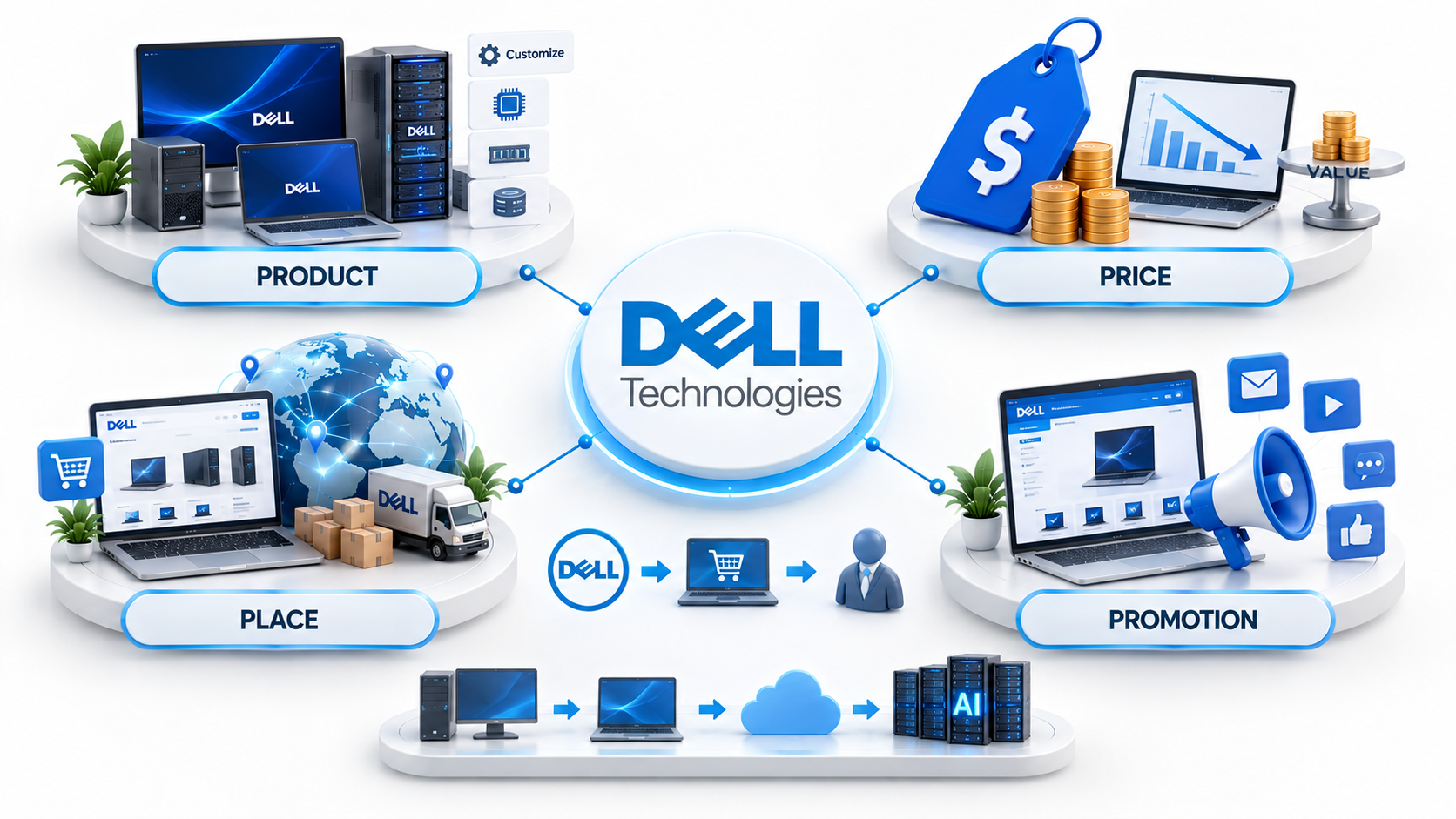
Here’s the short version before the deep dive. Dell’s product strategy is built on segmentation into distinct sub-brands for different buyer needs, from Inspiron for everyday users to Alienware for gamers to PowerEdge for data centers. Its pricing strategy blends direct-to-consumer discounting with tiered enterprise pricing and financing options through Dell Financial Services. Its place strategy started as pure direct sales and has grown into a hybrid of its own website, enterprise account teams, and retail partnerships with stores like Best Buy, Costco, and Walmart. And its promotion strategy has shifted from mail-order catalogs and phone sales in the 1990s to a mix of digital advertising, influencer and gaming sponsorships, and a heavily trained enterprise sales force. Now let’s go section by section.
Product Strategy in Dell’s Marketing Mix
Product is the most visibly complicated part of Dell’s marketing mix because the company doesn’t sell one thing. It sells laptops, desktops, monitors, servers, storage systems, networking gear, workstations, peripherals, and a growing slate of services tied to all of it. Managing that many product lines without confusing customers or cannibalizing sales between brands takes real discipline, and Dell handles it through clear sub-brand segmentation.
Product Range and Segmentation Across Consumer, Gaming, and Business Lines
Dell splits its hardware into distinct family names, and each one targets a specific type of buyer instead of trying to be everything to everyone. Inspiron covers budget-to-midrange laptops and desktops for everyday tasks like browsing, schoolwork, and streaming. XPS sits at the premium end for consumers who want a thinner, better-built machine with a sharper display and don’t mind paying more for it. Alienware, a brand Dell acquired back in 2006, handles the gaming market with high-refresh displays, dedicated graphics cards, and aggressive styling that looks nothing like a standard Dell machine on purpose, because gamers don’t want their rig to look like the one in an accountant’s office.
On the business side, Latitude laptops and OptiPlex desktops are built for durability and IT manageability rather than flash, with features like spill-resistant keyboards and long support cycles that appeal to procurement managers buying five hundred units at once. Precision workstations step up from there for engineers, video editors, and anyone running CAD or 3D rendering software that needs serious graphics horsepower. And then there’s the enterprise side of the house: PowerEdge servers, PowerStore and PowerScale storage systems, and networking hardware that has nothing to do with a typical consumer’s buying journey and everything to do with keeping a company’s data center running.
This segmentation matters for the marketing mix because it lets Dell run different pricing, different advertising, and different sales channels for each line without diluting the others. Nobody sees an Alienware ad and assumes OptiPlex desktops are flashy gaming machines. Nobody buying a PowerEdge server compares it against an Inspiron laptop on price. The product architecture does a lot of the positioning work before a single ad even runs.
The Build-to-Order Model and Customization as a Product Feature
One thing that separated Dell from competitors for decades, and still does to a meaningful degree, is that customers can configure a machine before it’s built rather than choosing from a shelf of fixed models. Go to Dell’s website, pick an XPS or a Latitude, and you can usually adjust the processor, RAM, storage size, screen resolution, and sometimes the color or finish, all before checkout. That’s not just a nice feature, it’s a manufacturing philosophy. Dell historically kept very little finished inventory sitting in warehouses, building machines closer to the point of sale based on actual order data.
This customization approach changes how “product” functions inside the marketing mix. Instead of Dell guessing what specs will sell and stocking accordingly, the customer effectively tells Dell what to build. That reduces the risk of unsold inventory sitting around losing value as newer chips come out, which is a real problem in an industry where a processor generation can make last year’s spec sheet look outdated within twelve months. It also lets Dell offer configurations that a retail store shelf could never carry, because a physical store has finite shelf space and a website configurator does not.
Product Quality, Innovation, and the Support Layer Around Hardware
Dell doesn’t usually win “most innovative” awards for radical design the way Apple does, and it would be dishonest to pretend otherwise. What Dell has built instead is a reputation for reliability and support that matters enormously to business buyers, even if it doesn’t generate as much buzz on social media as a flashy new gadget. ProSupport, Dell’s premium support tier, offers things like next-business-day onsite repair and a single point of contact for IT issues, which is a genuinely different value proposition than a consumer warranty. For a company managing three thousand laptops across regional offices, that kind of support contract is often a bigger factor in the purchase decision than the exact processor inside the machine.
On the innovation side, Dell has pushed into areas like OLED displays on XPS laptops, sustainable packaging made from bamboo and recycled ocean plastics, and modular designs on some Latitude and Precision models that make repairs and upgrades easier instead of forcing a full replacement. None of this makes Dell the trendiest brand in tech, but it keeps the product line credible against competitors who are also iterating fast.
Testing and validation are also a bigger part of the product story than most buyers realize. Dell runs its laptops through military-grade durability testing standards (MIL-STD-810H) on business lines like Latitude and Precision, checking for resistance to drops, dust, vibration, and temperature swings before a device ever ships. That kind of testing doesn’t sell a consumer on impulse the way a flashy screen does, but it’s exactly the sort of detail an IT procurement manager researching a five-hundred-unit order will actually dig into, because a laptop that survives being dropped in an airport terminal saves the company real money on replacement and repair costs down the line.
Product Line Comparison at a Glance
| Product Line | Target Buyer | Core Selling Point |
|---|---|---|
| Inspiron | Everyday consumers, students | Affordable, reliable, wide configuration range |
| XPS | Premium consumers, creatives | Thin design, high-resolution displays, build quality |
| Alienware | Gamers, esports enthusiasts | High refresh rates, dedicated GPUs, bold design |
| Latitude | Business professionals | Durability, manageability, long support cycles |
| OptiPlex | Office and enterprise desktops | Reliability, IT fleet management, compact form factors |
| Precision | Engineers, video editors, CAD users | Workstation-grade graphics and processing power |
| PowerEdge | Enterprise data centers | Scalable server compute, AI-ready configurations |
A table like this is exactly the kind of structure Dell’s own marketing team would use in a sales enablement document, because it forces clarity about who each product actually serves instead of letting the lines blur into a wall of similar-sounding names.
Price Strategy in Dell’s Marketing Mix
Price is where Dell’s direct model shows its teeth most clearly, and it’s worth being specific about what “direct pricing” actually buys the company, because the phrase gets thrown around vaguely a lot.
The Direct Pricing Model and What It Actually Saves
When a retailer sells a laptop, that laptop typically carries a markup to cover the retailer’s shelf space, staff, warehousing, and profit margin, often somewhere in the range of 20 to 30 percent depending on the category and the retailer’s negotiating power. Dell’s original insight was that if the company sold the machine itself instead of through a middleman, it could either pocket that margin or pass a chunk of it back to the customer as a lower price, and use the rest to fund better components or aggressive pricing on high-volume configurations. That’s still true today for a large share of Dell’s consumer and small-business sales that go through Dell.com rather than a retail partner.
This doesn’t mean Dell is always the cheapest option on the market, because it isn’t. What it means is that Dell has more room to run promotions, bundle in accessories, or discount aggressively during sales events like Black Friday without eating into profitability the way a company dependent entirely on retail distribution would. Anyone who has watched Dell’s website during a holiday sale period has seen list prices get slashed by 30, 40, sometimes over 50 percent on certain configurations. That’s not just marketing theater. It’s a pricing lever that exists because Dell controls more of the sales chain than competitors who rely heavily on third-party retail.
Competitive and Value-Based Pricing Across Segments
Dell doesn’t price every product the same way. For consumer laptops and desktops, pricing tends to track closely against HP, Lenovo, and Acer in the same spec bracket, because these buyers comparison shop hard and a five or ten percent price gap can lose a sale. For premium lines like XPS or Alienware, pricing shifts toward value-based positioning, where Dell charges more because the display quality, build materials, or gaming performance genuinely justifies it to the buyer who cares about those specifics, similar to how Apple prices a MacBook against a budget Windows laptop.
Enterprise pricing works on an entirely different logic. PowerEdge servers, storage arrays, and networking equipment rarely have a simple sticker price a customer can just click and buy at, because large deals involve negotiated discounts based on volume, multi-year service contracts, and bundled software licensing. A company buying two servers pays a very different effective price per unit than one deploying two thousand across multiple data centers, and Dell’s enterprise sales teams are built specifically to manage that kind of tiered, relationship-driven pricing.
Financing, Leasing, and Bundled Pricing Through Dell Financial Services
Dell Financial Services lets both consumers and businesses spread out the cost of a purchase instead of paying the full amount upfront, which matters a lot for larger enterprise deals where a company might be financing a hardware refresh across an entire department. Leasing options also let businesses treat hardware as an operating expense rather than a capital expenditure, which has real accounting and tax implications that IT procurement teams care about deeply, even if it sounds boring compared to talking about processors and screens.
Bundling is another pricing tool Dell leans on, especially around software and support. A business laptop sold with a three-year ProSupport plan, Microsoft Office licensing, and an extended warranty is priced as a package, not as separate line items, which makes the total feel more manageable and locks the customer into Dell’s support ecosystem for the life of the device. This is a quiet but important piece of the marketing mix because it extends the revenue relationship well past the initial hardware sale.
Trade-in and upgrade pricing programs add another layer worth mentioning. Dell offers credit for old devices, including machines from other brands, toward the purchase of a new one, which softens the sticker shock on premium configurations and keeps customers inside the Dell ecosystem instead of shopping around when their current machine starts to feel slow. For business clients managing large fleets, Dell also offers asset recovery services that handle secure data wiping and recycling of old hardware as part of a refresh contract, folding what would otherwise be a separate cost and separate vendor relationship into the overall pricing conversation.
Place (Distribution) Strategy in Dell’s Marketing Mix
Place used to be the simplest part of Dell’s marketing mix to explain: it sold direct, full stop, no retail stores, no middlemen. That’s no longer the full picture, and pretending otherwise would be lazy.
The Direct Sales Channel Still Anchors the Business
Dell.com remains a massive sales channel on its own, offering configuration tools, financing options, and enterprise account portals that a retail store simply can’t replicate. For businesses, Dell Premier gives IT departments a dedicated portal with pre-approved configurations, purchase history, and streamlined reordering, which matters a lot when a company is buying the same laptop model fifty times over a fiscal year and doesn’t want to reconfigure it from scratch every time. Direct sales also apply heavily to the enterprise side, where dedicated account managers and solutions architects work directly with a client’s IT team to design a server or storage deployment, something that never happens through a shelf purchase.
Retail Partnerships Filled a Gap Direct Sales Couldn’t
Dell learned the hard way that not every buyer wants to configure a machine online and wait days for it to ship. A lot of consumers want to walk into a store, see the laptop, touch the keyboard, and walk out with it that day. That’s why Dell expanded into retail partnerships with Best Buy, Walmart, Costco, and various regional electronics chains starting in the mid-2000s, offering a curated set of pre-built configurations rather than the full custom catalog available online. This move added an entirely new customer segment, the impulse or convenience buyer, without abandoning the margin advantages of the direct channel for customers who prefer it.
In markets outside the US, particularly across parts of Asia and the Middle East, local retail and distributor relationships play an even bigger role, because buying habits and trust in online-only purchases vary a lot by region. Dell adjusts its channel mix country by country rather than forcing the same direct-heavy model everywhere.
Global Supply Chain and Manufacturing Footprint
Dell’s build-to-order approach depends entirely on a supply chain that can move fast. The company operates manufacturing and assembly facilities across multiple countries, sources components from a wide global supplier base, and has invested heavily in logistics that can get a custom-configured laptop from a factory floor to a customer’s door in days rather than weeks. This isn’t glamorous marketing content, but it’s foundational to place strategy, because a build-to-order promise is worthless if the supply chain can’t deliver on it consistently. Dell has also worked to diversify manufacturing locations in recent years to reduce dependency on any single country, partly in response to chip shortages and geopolitical trade tensions that hit the entire PC industry hard in the early 2020s.
This diversification isn’t just a defensive move, it’s become part of how Dell pitches itself to enterprise and government buyers who care about supply chain resilience and, in some cases, regulatory requirements around where hardware components are sourced and assembled. A government agency or a company in a regulated industry like defense or finance may have specific rules about supply chain origin, and Dell’s ability to offer flexibility on where a given order gets built is a real competitive factor in those bids, not just a background operational detail. Place strategy, in this sense, stretches all the way back into factory location decisions that a typical customer never sees or thinks about.
Promotion Strategy in Dell’s Marketing Mix
Promotion is the part of the marketing mix most people notice first, even though it’s built entirely on top of the product, price, and place decisions already covered. Dell’s promotional approach looks very different depending on whether the target is a consumer buying one laptop or an enterprise IT director signing off on a seven-figure infrastructure contract.
Advertising Campaigns and Brand Positioning
Dell’s advertising history includes some genuinely memorable moments, like the “Dude, You’re Getting a Dell” campaign that ran through the early 2000s and made the brand feel approachable to a younger, less technical buyer at a time when computers still felt intimidating to a lot of households. More recent campaigns lean into performance and design credibility for lines like XPS and Alienware, using visuals that emphasize thin bezels, display color accuracy, and gaming frame rates rather than trying to be quirky or humorous the way older campaigns did.
On the enterprise side, advertising looks almost nothing like consumer marketing. Dell Technologies runs campaigns around themes like AI infrastructure readiness, cybersecurity, and hybrid cloud solutions, aimed at CIOs and IT decision-makers rather than everyday consumers. These ads show up in trade publications, LinkedIn feeds, and industry conference sponsorships rather than primetime television, because the buyer and the buying process are completely different.
Digital Marketing, Social Media, and Gaming Sponsorships
Dell runs a heavy digital marketing operation across search, display, and social platforms, which makes sense given how much of its sales funnel already lives online through Dell.com. Search advertising captures people already looking to buy a specific configuration, retargeting brings back visitors who configured a machine but didn’t finish checkout, and email marketing keeps past customers aware of upgrade cycles and financing offers.
Alienware in particular leans hard into gaming culture, sponsoring esports tournaments, partnering with streamers and content creators, and showing up at gaming conventions where the target audience actually spends time. This is a sharp contrast to how Dell promotes OptiPlex or Latitude, because gamers respond to a completely different set of cues than IT procurement managers, and Dell’s promotional spend reflects that split rather than trying to force one message across every audience.
B2B Marketing and the Role of the Enterprise Sales Force
A huge share of Dell’s revenue, especially on the Dell Technologies side covering servers, storage, and networking, doesn’t come from anyone clicking an online ad. It comes from a trained enterprise sales force building relationships with corporate IT departments, government agencies, and large institutions over months or years. Promotion here looks like account-based marketing, invitation-only briefings, case studies published for specific industries like healthcare or financial services, and appearances at events like Dell Technologies World, where the company showcases new enterprise products directly to the people who’ll actually decide whether to buy them.
This B2B promotional layer rarely shows up in a typical marketing mix breakdown, but for a company where enterprise and cloud-related revenue makes up such a large share of the business, ignoring it would leave out one of the most important promotional engines Dell actually runs.
Content Marketing, Case Studies, and Industry-Specific Messaging
A less flashy but genuinely important promotional tool is content marketing built around specific industries. Dell publishes case studies and white papers targeted at sectors like healthcare, manufacturing, and financial services, walking through how a hospital network modernized its storage infrastructure or how a manufacturing company deployed edge computing on the factory floor. This kind of content doesn’t chase viral reach, it targets a narrow, high-value audience of IT decision-makers who are actively researching a purchase and want proof that a similar organization solved a similar problem with Dell’s help. Combined with webinars, analyst reports, and speaking slots at industry conferences, this content layer builds the kind of trust that a thirty-second ad simply can’t, which matters enormously when the purchase decision involves a six or seven-figure budget and multiple stakeholders signing off before a deal closes.
The Extended Marketing Mix: People, Process, and Physical Evidence
Because Dell sells both physical hardware and ongoing services, the traditional four Ps don’t cover the full picture. The extended marketing mix, originally developed for service-heavy businesses, adds three more elements that matter enormously to how customers experience the Dell brand after the sale is made.
People: Sales Teams, Support Staff, and the Human Side of the Brand
Every laptop or server Dell sells eventually needs support, whether that’s a consumer calling about a cracked screen or an enterprise IT team troubleshooting a server rack at 2 a.m. Dell’s support staff, sales engineers, and account managers are as much a part of the customer’s experience of the brand as the hardware itself. This has historically been a mixed bag for Dell’s reputation, honestly. The company faced real criticism in the mid-2000s over offshore call center quality, with customers complaining about long wait times and scripted responses that didn’t solve real problems. Dell responded by investing more heavily in support quality, expanding ProSupport options, and training enterprise account teams to function more like consultants than order-takers, especially for large deals where the relationship matters as much as the product spec sheet.
Process: From Configuration to Delivery to Ongoing Support
Process covers everything that happens between a customer deciding to buy and actually getting full value from the purchase: the website configuration flow, the manufacturing and shipping timeline, the onboarding of new hardware into a company’s IT systems, and the ongoing support ticket process if something goes wrong. Dell has spent real engineering effort making its online configurator intuitive enough that a non-technical buyer can still build a machine that fits their needs without needing to understand every spec. On the enterprise side, process includes things like asset tagging services, where Dell can pre-configure and label hundreds of machines before they even arrive at a client’s office, cutting down the IT department’s setup workload dramatically. That kind of process design doesn’t show up in an advertisement, but it’s a real reason large clients stick with Dell across multiple purchase cycles.
Physical Evidence: Packaging, Retail Displays, and Brand Consistency
Physical evidence refers to the tangible cues that reassure a customer they made the right choice, and for Dell that includes everything from the packaging a laptop arrives in to the retail store displays at Best Buy to the visual consistency of the Dell Technologies logo across a data center full of PowerEdge servers. Dell has pushed sustainability into this space in recent years, using recycled materials and reducing plastic in packaging, which matters to environmentally conscious buyers and also to corporate clients who have their own sustainability targets to hit and want vendors that align with them. In enterprise settings, physical evidence also shows up as the actual hardware sitting in a data center, where a wall of neatly labeled PowerEdge servers signals reliability and scale to visiting clients or auditors in a way that a spec sheet alone never could.
How Dell’s Marketing Mix Stacks Up Against HP, Lenovo, and Apple
No breakdown of Dell’s marketing mix is complete without looking at how it compares against the companies fighting for the same customers. HP shares a lot of Dell’s DNA, competing hard on similar consumer and business laptop segments, but HP leans more heavily on traditional retail distribution than Dell historically has, which shapes a different pricing and promotion strategy built around retail partner relationships rather than direct-to-consumer discounting. Lenovo, which acquired IBM’s ThinkPad business back in 2005, competes aggressively on price in global markets, particularly in Asia, and has built a manufacturing scale advantage that lets it undercut on cost in ways Dell sometimes struggles to match in budget segments.
Apple sits in a completely different lane, and comparing it directly to Dell only works up to a point. Apple controls its entire hardware and software stack, prices at a premium across the board, and sells through a mix of its own retail stores and a tightly controlled set of authorized resellers. Dell doesn’t try to compete with Apple on design minimalism or software integration, and it shouldn’t, because Dell’s strength has always been flexibility and configurability, letting a customer choose exactly the specs and price point that fit their budget rather than accepting a fixed set of options at a premium price. Dell wins the customers who want choice and value across a huge range of price points; Apple wins the customers who want one polished experience and are willing to pay for it.
There’s also a smaller but scrappy tier of competitors worth mentioning, brands like Acer and Asus, which compete almost entirely on price in the budget and gaming segments. Asus in particular has carved out real market share in gaming with its ROG line, competing directly against Alienware on similar specs but often at a lower price point, which forces Dell to justify Alienware’s premium through build quality, brand cachet in esports circles, and design rather than raw spec-for-spec pricing. On the enterprise side, the real competitive pressure doesn’t just come from HP and Lenovo anymore. Cloud providers like AWS, Microsoft Azure, and Google Cloud have shifted a meaningful share of what used to be on-premises server spending into cloud infrastructure spending instead, which is part of why Dell has pushed so hard into hybrid cloud and edge computing messaging rather than treating cloud as a threat to be ignored.
What Other Brands Can Learn From Dell’s Marketing Mix
A lot of the lessons buried in Dell’s marketing mix apply well beyond the PC industry, especially for manufacturing and hardware businesses trying to figure out how to compete against bigger, more established players. First, cutting out a distribution layer can fund real price advantages, but only if the company builds the operational muscle, supply chain, website, and support infrastructure to handle direct sales well. Dell didn’t just skip retail, it built an entire logistics and manufacturing system designed around direct fulfillment, and companies trying to copy the “sell direct” playbook without that infrastructure usually struggle.
Second, segmentation by clear sub-brands works better than trying to stretch one product line across wildly different customer needs. Nobody confuses an Alienware gaming rig with a PowerEdge server, and that clarity lets Dell run completely different pricing and promotional strategies for each without diluting either one. Third, the extended marketing mix elements, people, process, and physical evidence, matter enormously for any company selling durable goods that require ongoing support, not just for service businesses like hotels or airlines where those concepts usually get taught. A laptop or server is really the start of a multi-year relationship, not a one-time transaction, and Dell’s marketing strategy reflects that reality more explicitly than a lot of hardware competitors manage to.
Challenges and Criticism of Dell’s Marketing Strategy
It would be dishonest to write a full breakdown of the marketing mix of Dell without addressing where the strategy has struggled, because no company’s approach is flawless, and Dell has had some genuinely rough stretches.
The offshore customer support backlash in the mid-2000s did real damage to consumer trust for a period, and it took years of reinvestment for Dell’s support reputation to recover in the eyes of everyday buyers. The company has also faced criticism for a confusing product naming structure, with lines like Inspiron, Vostro, and Latitude sometimes overlapping in spec range enough that even attentive shoppers struggle to know which line actually fits their needs without doing real research first. Retail expansion, while necessary to reach convenience-focused buyers, also diluted some of the pure cost advantage that made the direct model so disruptive in the first place, since retail partners still take their cut.
On the enterprise side, the EMC acquisition loaded Dell with a huge amount of debt that took years to pay down, and integrating two massive, previously separate sales and product organizations created real friction internally that occasionally showed up as inconsistent messaging to enterprise clients during the transition years. None of this erases what Dell has built, but a genuinely useful case study includes the messy parts, not just the highlight reel version that shows up in business school slide decks.
There’s also a structural tension worth naming directly. Dell’s direct model was built to cut costs by removing intermediaries, but as the company expanded into retail, financing, leasing, and a growing services business, it added layers of complexity that partially work against that original simplicity. Managing pricing consistency across a direct website, a dozen retail partners, and negotiated enterprise contracts is genuinely hard, and inconsistencies do occasionally show up, like a configuration priced differently through Dell Premier versus the general consumer site, which can frustrate business buyers who expect a single source of truth on pricing. None of this is unique to Dell. Any company that scales from a single clean model into a multi-channel, multi-segment giant runs into similar friction. But it’s worth acknowledging that the elegant simplicity of “we sell direct and skip the markup” from the 1980s doesn’t fully describe how complicated pricing and distribution have become across a company this size.
Dell’s Marketing Mix in the Age of AI and Cloud Computing
Computing has shifted a lot since the days when Dell’s entire pitch was “cheaper desktop, delivered to your door.” A big chunk of workloads now run in the cloud, AI training and inference need specialized hardware, and a lot of everyday computing happens on phones and tablets rather than traditional PCs. Dell’s marketing mix has had to bend around all of that without losing the core identity that made it successful in the first place.
Positioning Around AI Infrastructure and Enterprise Compute
On the enterprise side, Dell has pushed hard into AI-ready infrastructure, marketing PowerEdge servers configured with GPUs and high-speed networking specifically for training and running large AI models. This is a product and promotion shift happening at the same time. The product lineup now includes reference architectures built in partnership with chip makers like Nvidia, and the promotional messaging around Dell Technologies World and enterprise campaigns has moved noticeably toward AI readiness, data center modernization, and hybrid cloud, because that’s what CIOs are actually budgeting for right now. Dell isn’t trying to build its own AI models. It’s positioning itself as the company that sells the physical infrastructure everyone else needs to run theirs, which is a smart lane to occupy given how much capital is flowing into AI hardware spending.
Client Devices in a World Where Fewer People Need a Traditional PC
On the consumer and business laptop side, Dell has had to work harder to justify upgrade cycles as devices simply last longer and casual users increasingly do more on phones and tablets. This shows up in product strategy through features tied to on-device AI processing, like Copilot+ PC capable laptops in the Latitude and XPS lines, marketed around local AI features rather than just raw processor speed. It also shows up in pricing, where Dell has had to lean more heavily on financing, trade-in programs, and device-as-a-service subscriptions for business clients who want predictable IT budgets rather than large upfront hardware purchases every few years. None of this replaces the core direct model, but it adds a subscription-flavored layer on top of what used to be a pure one-time-purchase business.
Common Mistakes Brands Make When Trying to Copy Dell’s Playbook
Plenty of companies look at Dell’s direct-to-consumer success and try to replicate it without understanding what actually made it work, and it’s worth naming the mistakes explicitly since they show up constantly in newer hardware and consumer product startups.
Skipping Retail Without Building the Infrastructure to Support It
Cutting out a distributor sounds simple on a slide deck. It’s a lot harder in practice, because someone still has to handle warehousing, shipping, returns, and customer service that a retail partner used to absorb. Dell spent decades building manufacturing plants, logistics networks, and support call centers specifically to make direct sales viable at scale. A smaller brand that skips retail without investing in that operational backbone usually ends up with slower shipping, worse returns handling, and frustrated customers, which erases any price advantage almost immediately.
Treating Segmentation as a Naming Exercise Instead of a Real Strategy
A lot of companies slap different names on products without actually differentiating the audience, pricing, or promotion behind them, which just creates confusion rather than clarity. Dell’s segmentation works because Alienware genuinely has different design language, different retail presence, different sponsorships, and different pricing logic than OptiPlex. If a company creates three product lines with different names but identical marketing, pricing, and audience targeting, it hasn’t actually segmented anything. It’s just added complexity to its own catalog for no real customer benefit.
Ignoring the Extended Marketing Mix Until Something Breaks
Startups chasing Dell’s product and pricing playbook often underinvest in support, process, and physical evidence until a wave of angry customer reviews forces the issue. Dell learned this lesson expensively during the offshore call center backlash and had to spend years rebuilding trust afterward. Any brand selling durable hardware, not just laptops, should treat support quality and post-purchase process as core parts of the marketing mix from day one, not an afterthought bolted on after the first bad reviews start piling up.
Final Thoughts on the Marketing Mix of Dell
The marketing mix of Dell isn’t a static formula frozen in the 1990s dorm-room era. It’s a system that started with one disruptive idea, sell direct and skip the retail markup, and has been rebuilt piece by piece as the company grew into laptops, gaming, enterprise servers, and cloud infrastructure. Product segmentation keeps wildly different customer bases from stepping on each other’s toes. Pricing flexes hard between consumer discounting and negotiated enterprise deals. Place has grown from pure direct sales into a genuine hybrid of online, retail, and enterprise account channels. And promotion splits cleanly between consumer advertising and a full B2B sales and marketing operation most people never see.
What makes Dell worth studying isn’t that the company got everything right. It’s that the marketing mix has proven flexible enough to survive four decades of a technology industry that has changed almost beyond recognition since 1984, while still keeping the core idea, more direct control over the customer relationship than most hardware competitors ever built, intact the entire way through.
Frequently Asked Questions About the Marketing Mix of Dell
What is the marketing mix of Dell?
The marketing mix of Dell refers to how the company manages its product range, pricing strategy, distribution channels, and promotional activities to reach both consumer and enterprise customers. It’s built around a direct-to-consumer sales model, sub-brand segmentation like XPS and Alienware, tiered pricing for different buyer types, and a mix of consumer advertising and enterprise B2B sales.
What are the 4Ps of Dell’s marketing strategy?
Dell’s 4Ps are Product (a segmented lineup from budget Inspiron laptops to enterprise PowerEdge servers), Price (direct pricing with heavy discounting alongside negotiated enterprise contracts), Place (Dell.com and enterprise sales channels, plus retail partnerships with stores like Best Buy), and Promotion (consumer advertising, digital marketing, and a dedicated B2B enterprise sales force).
Why is Dell’s direct-to-consumer model important to its marketing mix?
Selling directly lets Dell skip the retail markup that traditionally added 20 to 30 percent to a computer’s price, giving the company room to discount aggressively or invest savings into better components. It also gives Dell direct access to customer data and buying behavior that companies selling purely through retail don’t get.
Does Dell still sell through retail stores?
Yes. Dell expanded into retail partnerships with chains like Best Buy, Walmart, and Costco starting in the mid-2000s to reach customers who prefer to see and buy hardware in person rather than configuring it online. This runs alongside, not instead of, its direct sales channel through Dell.com.
How does Dell price its products differently for consumers and businesses?
Consumer pricing tends to track closely against competitors like HP and Lenovo in similar spec brackets and includes frequent promotional discounting. Enterprise pricing is largely negotiated, based on order volume, multi-year service contracts, and bundled software licensing, so two companies buying the same server model can end up paying very different effective prices.
What is Dell’s product segmentation strategy?
Dell splits its hardware into distinct sub-brands aimed at specific buyer types: Inspiron for budget and midrange consumers, XPS for premium consumer laptops, Alienware for gaming, Latitude and OptiPlex for business laptops and desktops, Precision for engineering and creative workstations, and PowerEdge along with related storage and networking lines for enterprise data centers.
How does Dell promote its products differently for consumers versus businesses?
Consumer promotion relies on advertising campaigns, digital marketing, social media, and gaming sponsorships through Alienware. Business and enterprise promotion relies far more heavily on a trained sales force, account-based marketing, industry-specific case studies, and events like Dell Technologies World aimed directly at IT decision-makers.
What is Dell Financial Services and how does it fit into the marketing mix?
Dell Financial Services offers financing and leasing options that let consumers and businesses spread the cost of a purchase over time instead of paying upfront. This fits into pricing strategy by making higher-end configurations more accessible and lets businesses structure large purchases as operating expenses rather than upfront capital costs.
Is Dell’s marketing mix better than HP’s or Lenovo’s?
Neither is objectively better, they’re built around different strengths. Dell leans harder into direct sales and configurability, HP relies more on traditional retail distribution, and Lenovo competes aggressively on manufacturing scale and price, especially in global and budget markets. The right comparison depends on what a specific customer segment values most.
How did the EMC acquisition change Dell’s marketing mix?
The 2016 acquisition of EMC, which included VMware, transformed Dell from primarily a PC and hardware company into Dell Technologies, a full-stack IT provider covering storage, virtualization, and cloud infrastructure. This expanded Dell’s product range dramatically and shifted a larger share of promotion and sales activity toward enterprise B2B marketing rather than consumer advertising alone.
What role does customer support play in Dell’s marketing mix?
Customer support falls under the “people” and “process” elements of Dell’s extended marketing mix. Support quality directly affects customer retention and brand trust, which is why Dell offers tiered support options like ProSupport with faster response times and dedicated account contacts, especially for enterprise clients managing large hardware deployments.
What is Alienware’s role in Dell’s overall marketing strategy?
Alienware, acquired by Dell in 2006, operates as a distinct gaming-focused sub-brand with its own product design, pricing, and promotional strategy built around esports sponsorships, streamer partnerships, and gaming convention presence. It lets Dell compete seriously in the gaming hardware market without diluting the more business-focused image of its other product lines.
How has Dell adjusted its marketing mix for sustainability?
Dell has introduced recycled and sustainable packaging materials, including bamboo and reclaimed ocean plastics, and has worked on more repairable and modular hardware designs in some of its Latitude and Precision lines. These changes touch both the product and physical evidence elements of the marketing mix and appeal to environmentally conscious consumers as well as enterprise clients with their own sustainability requirements.
How does Dell use build-to-order manufacturing in its marketing strategy?
Build-to-order lets customers configure a laptop or desktop’s specifications before it’s manufactured rather than choosing from a fixed set of pre-built models. This reduces the risk of unsold inventory becoming outdated as new processors launch, and it lets Dell offer far more configuration combinations than a physical retail shelf could ever hold, which functions as both a product and a place advantage at the same time.
What is the difference between Dell’s consumer and enterprise marketing mix?
Dell’s consumer marketing mix relies on advertising, digital marketing, and retail partnerships with pricing aimed at individual buyers comparing specs and price across brands. Its enterprise marketing mix relies on a trained B2B sales force, account-based marketing, negotiated multi-year contracts, and industry-specific case studies aimed at IT decision-makers managing large infrastructure budgets rather than a single purchase.