


Most SaaS companies raise a Series A, burn through it on Google Ads and LinkedIn sponsored posts, and hope the math works out before the next funding round. Zoho never did any of that. No outside investors, no venture debt, no big ad spend, and yet it built a suite of 55+ business applications used by more than 100 million users worldwide, competing directly with Salesforce, Microsoft, and HubSpot. That’s not a fluke. That’s a marketing mix built with a completely different set of assumptions about how a software company should grow.

If you’ve studied the standard 4Ps model in a marketing textbook, Zoho breaks half the rules on paper and still wins. It prices lower than almost every competitor in its category, sells with almost no traditional advertising, builds its own data centers instead of renting from AWS, and hires engineers from villages in Tamil Nadu instead of only from top-tier engineering colleges. Every one of those choices is a marketing decision, even if it doesn’t look like one at first glance.
This guide breaks down the Marketing Mix of Zoho piece by piece: what it sells, how it prices, where it distributes, how it promotes without a traditional marketing budget, and the people and processes that hold the whole thing together. If you’re a student trying to understand real-world marketing strategy, a small business owner evaluating Zoho as a tool, or someone studying SaaS business models, this is the version that goes past the surface-level “they’re cheap and good” explanation you’ll find everywhere else.
What You Will Learn in This Guide
- How Zoho’s product strategy of building 55+ apps in-house instead of acquiring startups shapes its entire marketing mix.
- Why Zoho prices 40 to 60 percent below Salesforce and HubSpot and still stays profitable without outside funding.
- How Zoho’s distribution model skips resellers, system integrators, and even AWS, and what that means for control over the customer experience.
- The exact promotional channels Zoho uses instead of paid advertising, including its founder’s personal brand and its own university.
- How Zoho’s hiring philosophy and rural office strategy function as unspoken marketing signals.
- The mistakes companies make when they try to copy Zoho’s pricing or promotion without understanding the cost structure underneath it.
Why Zoho’s Version Looks Different

A marketing mix is the set of controllable decisions a company makes to get its product in front of the right buyer and get them to pay for it. Traditionally, that means the 4Ps: Product, Price, Place, and Promotion. For service-heavy businesses like SaaS, most marketers extend it to 7Ps by adding People, Process, and Physical Evidence, because software isn’t just a static product, it’s a service experience delivered continuously.
Here’s the thing about applying this framework to Zoho: almost every business book assumes a company either competes on price by cutting corners, or competes on premium positioning by charging more and justifying it with brand value. Zoho does neither. It charges less than its competitors while investing heavily in R&D, owning its own infrastructure, and building products most companies would outsource. That’s not a contradiction if you understand what’s actually funding it: no VC money means no pressure to inflate valuations, no pressure to burn cash on customer acquisition, and no pressure to IPO on an aggressive timeline. Founder Sridhar Vembu has said openly that staying private lets Zoho make 10-year decisions instead of quarterly ones, and that single fact reshapes every other P in the mix.
Marketing Mix of Zoho
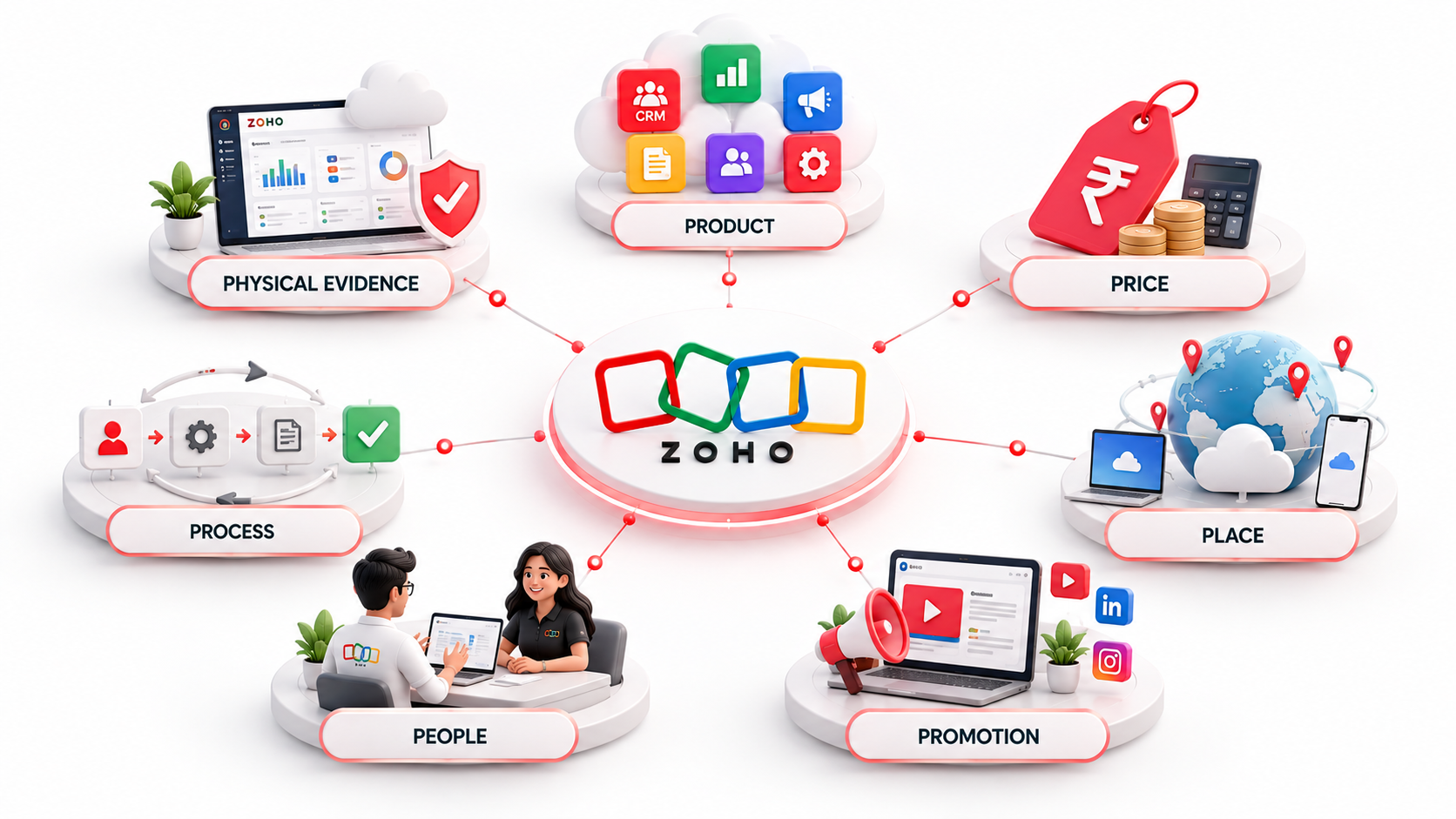
The 7Ps Framework Explained in Plain Language
Product is what you’re actually selling, the features, the quality, the range. Price is what you charge and how you structure that charge, monthly versus annual, tiered versus flat. Place is how the product reaches the customer, direct sales, resellers, cloud marketplaces, or app stores. Promotion is everything you do to make people aware of the product and want it, ads, content, referrals, events. People covers everyone involved in delivering the product and the customer experience, including support staff and the company culture visible to buyers. Process is the operational backbone: how a customer onboards, how a support ticket gets resolved, how fast a bug gets fixed. Physical Evidence is the tangible proof a customer sees that the service is real and reliable, in software’s case this usually means UI consistency, uptime, documentation, and the interface itself.
Most case studies stop at 4Ps because they’re easier to write about. But if you actually want to understand why Zoho works the way it does, you need all seven, because Zoho’s competitive edge lives almost entirely in the last three, the ones most companies treat as an afterthought.
Why Zoho Doesn’t Follow the Typical SaaS Marketing Mix
Look at how a typical venture-backed SaaS company operates. They raise money specifically to spend on customer acquisition, they price aggressively high to fund a large sales team, and they outsource infrastructure to AWS or Azure because building your own data center is capital-intensive and slow. Zoho inverted every one of those defaults. It built its own data centers starting back in the mid-2000s. It kept prices low instead of high because the founder believed software had gotten artificially expensive across the industry. And it grew through word of mouth and search traffic instead of a sales-heavy go-to-market motion.
None of this happened by accident. Sridhar Vembu has been explicit in interviews that Zoho deliberately avoided the “growth at all costs” model that dominated Silicon Valley through the 2010s. That philosophical choice is the root of the entire Marketing Mix of Zoho, and it’s why comparing Zoho to Salesforce using a standard SaaS playbook misses the point entirely.
Product Element
Zoho’s product strategy is the foundation everything else sits on top of. Instead of picking one product category and dominating it, Zoho built an entire operating system for business, covering CRM, email, finance, HR, project management, and dozens of niche tools most competitors don’t even attempt. As of 2026, the Zoho suite includes CRM, Books, Mail, WorkDrive, Desk, Projects, Analytics, People, Recruit, Sign, and many more, all built and maintained in-house rather than acquired.
This matters for marketing because a bundled ecosystem changes the sales conversation entirely. A prospect doesn’t just evaluate “is Zoho CRM good enough,” they evaluate “can I run my entire back office on one connected platform instead of stitching together five different vendors.” That’s a fundamentally different value proposition than a point solution, and it’s the reason Zoho can undercut specialized competitors on price while still growing revenue, because the average customer ends up using multiple apps, not just one.
Zoho One and the Bundling Strategy
Zoho One launched in 2017 as an all-you-can-eat bundle, giving businesses access to the entire suite of 45+ (now 55+) applications for a single per-employee price. This was a genuinely unusual move in enterprise software, where the standard practice is to charge separately for every module and upsell relentlessly. Zoho took the opposite bet: give customers everything, remove the friction of deciding which tools to buy, and let usage naturally expand across the organization once they’re inside the ecosystem.
The pricing for Zoho One sits around 45 dollars per employee per month (billed annually) for the full suite, which is often cheaper than buying just a CRM and an email marketing tool separately from two different vendors. That single decision does more marketing work than any ad campaign could, because it removes the “which product do I actually need” hesitation that kills a lot of B2B software deals before they even start.
Building 55+ Products In-House Instead of Buying Startups
Most large SaaS companies grow their product line through acquisition. Salesforce bought Slack, Tableau, and MuleSoft for billions combined. HubSpot has acquired multiple smaller companies to round out its suite. Zoho has done almost none of this. Nearly every product in the Zoho lineup was built by Zoho’s own engineering teams from scratch, which is a slower path but a more controlled one.
Why does this matter for the marketing mix? Because acquired products almost always come with integration headaches, inconsistent UI, and different backend architectures that show up as bugs and friction for the end user. Zoho’s in-house approach means every product shares design language, data models, and support infrastructure. When a customer moves from Zoho CRM to Zoho Books, the experience feels like one company, not five companies stapled together. That consistency becomes a promotional asset by itself: customers recommend Zoho specifically because “it all just works together,” which is not something you hear often about acquisition-heavy suites.
Freemium Tiers and Product-Led Growth
Several of Zoho’s core products, including Zoho CRM, Zoho Mail, and Zoho Invoice, offer genuinely usable free tiers, not the crippled 14-day trial model most SaaS companies use. Zoho CRM’s free plan supports up to 3 users with core lead and contact management. Zoho Mail’s free plan covers up to 5 users on a single domain. This isn’t charity, it’s a deliberate product-led growth tactic: get a small team or a solo founder using the free tier, let their business grow inside the Zoho ecosystem, and let the natural need for more seats or more features convert them to paid plans without a single sales call.
This free-tier approach also functions as a distribution channel in disguise. Every free user who eventually recommends Zoho to a colleague or writes a review comparing it to a paid-only competitor is doing unpaid promotional work that a traditional advertising budget would otherwise need to buy.
Price Strategy
If there’s one decision that defines the Marketing Mix of Zoho more than any other, it’s pricing. Zoho consistently prices 40 to 60 percent below comparable tools from Salesforce, Microsoft, or HubSpot, and it does this without external funding to subsidize the gap. That’s the part most competitors can’t replicate, because most companies pricing that aggressively are doing it with venture capital covering the losses. Zoho does it profitably, which means the pricing decision is backed by an equally disciplined cost structure, not a marketing gimmick.
The 40 to 60 Percent Cheaper Positioning Against Salesforce and HubSpot
Take Zoho CRM’s Enterprise plan, priced around 40 dollars per user per month billed annually, against Salesforce’s comparable Enterprise Edition, which runs closer to 165 dollars per user per month. That’s not a small gap, it’s roughly a quarter of the price for a tool covering similar core CRM functionality. HubSpot’s pricing for its Professional CRM tier sits in a similar range to Salesforce once you factor in contact tier limits and add-ons, making Zoho’s positioning even more stark for small and mid-sized businesses watching every dollar.
This pricing gap isn’t accidental positioning, it’s the direct result of Zoho’s decision to build its own infrastructure instead of renting cloud servers from AWS or Azure, and to keep its sales organization lean instead of building the large enterprise sales teams that Salesforce and HubSpot rely on to justify their price points. Every dollar Zoho doesn’t spend on cloud hosting fees or six-figure sales commissions is a dollar it can shave off the customer’s invoice.
Zoho’s Refusal to Raise Prices Aggressively
Sridhar Vembu has repeatedly gone on record saying software pricing across the industry has become inflated, and that Zoho deliberately resists the temptation to raise prices just because customers would tolerate it. Compare that to the typical SaaS playbook, where annual price increases of 10 to 15 percent are treated as standard practice to boost average revenue per user for investor reports. Zoho doesn’t answer to quarterly investor pressure, so it doesn’t play that game.
The marketing effect of this is subtle but powerful: customers who’ve been burned by a competitor’s surprise price hike become Zoho’s most vocal advocates once they discover pricing has stayed stable for years. That kind of trust is nearly impossible to manufacture through advertising. It has to be earned through actual behavior over time, and Zoho has had over two decades to build that reputation.
Annual Billing Discounts and Currency-Based Pricing for Emerging Markets
Zoho offers meaningful discounts for annual billing across nearly every product, typically saving customers 20 to 34 percent compared to monthly billing. But the more interesting pricing decision is regional adaptation. Zoho prices differently across markets based on local purchasing power rather than applying one flat global rate converted at the exchange rate. This means a small business in India or Southeast Asia pays a price that reflects local economic conditions, not a Silicon Valley price tag translated into rupees.
This regional pricing sensitivity has made Zoho disproportionately dominant in emerging markets where Salesforce and Microsoft Dynamics are considered too expensive for small and mid-sized businesses to even evaluate seriously. It’s a quiet but deliberate market segmentation strategy that expands Zoho’s addressable market well beyond what a flat global price would allow.
Place and Distribution Decisions
Place, in a SaaS context, isn’t about physical shelves, it’s about how the software actually reaches and stays in front of the customer, and what infrastructure sits behind that delivery. Zoho’s distribution decisions are some of the most unconventional in the entire industry, starting with the fact that it owns and operates its own data centers instead of building on top of AWS, Google Cloud, or Azure like almost every other SaaS company on the planet.
Direct-to-Cloud Distribution Without Resellers
Zoho sells directly to customers through its own website and in-app upgrade flows, with almost no reliance on third-party resellers, system integrators, or channel partners for its core product line. This is a stark contrast to enterprise software giants like SAP or Oracle, which rely heavily on implementation partners and resellers to reach customers, often adding markup and complexity along the way.
The direct model means Zoho controls the entire buying experience, from the free trial signup to the final invoice, without a reseller’s margin sitting in between. That control keeps prices lower (feeding directly back into the pricing strategy above) and keeps the customer relationship entirely in Zoho’s hands, which matters enormously for renewal rates and cross-selling additional apps within the suite.
Data Centers in Chennai and the “Made in India” Angle
Where most competitors rent server capacity from Amazon or Microsoft, Zoho built and operates its own data centers, with a significant concentration around Chennai, India. This decision started well before “data sovereignty” became a buzzword in enterprise software conversations. Owning the infrastructure gives Zoho control over uptime, latency, and cost that renting cloud capacity simply doesn’t allow at the same scale of savings.
There’s also a distribution and brand angle here that shouldn’t be underestimated. As global buyers, particularly in Europe and government sectors, became more sensitive to data residency and sovereignty requirements, Zoho’s owned infrastructure and regional data center presence (including centers in the Netherlands and other regions) became a genuine sales advantage, not just a cost-saving measure. It positions Zoho as a company that controls its own supply chain end to end, from the code to the server rack, which is a rare claim in this industry.
Rural Offices Strategy: Tenkasi and Renigunta
This is the distribution decision most business school case studies skip entirely, but it’s genuinely central to the Marketing Mix of Zoho. Instead of concentrating all operations in Bangalore or Chennai like most Indian tech companies, Zoho deliberately opened offices in small towns like Tenkasi and Renigunta, hiring local talent and building satellite development hubs far from the usual tech hotspots.
Why does an office location count as a “place” decision in marketing terms? Because it changes where and how the product gets built and supported, and it feeds directly into the brand story Zoho tells the world: a company that succeeds without needing to be headquartered in a metro hub or Silicon Valley. That narrative becomes promotional material in interviews, conference talks, and press coverage, effectively turning a real estate and hiring decision into a distribution and brand story simultaneously.
Promotion Tactics
Here’s where Zoho looks the most different from every competitor in its category. There’s no Super Bowl ad, no billboard campaign, no aggressive outbound sales development team cold-calling prospects all day. Zoho’s promotional strategy runs almost entirely on organic content, founder-led credibility, and community, and it does this at a scale that reaches over 100 million users globally.
Content and SEO at Scale
Zoho publishes an enormous volume of educational content across its blog network, spanning CRM strategy, finance tips, HR guidance, and general small business advice, most of it structured to rank in search results for the exact questions its target customers are typing into Google. This content isn’t thin filler either, it’s detailed, product-adjacent material that builds trust before a prospect ever sees a pricing page.
What most people get wrong when they try to copy this is assuming volume alone works. Zoho’s content strategy succeeds because every article ties back naturally to a real product feature the reader can try immediately, inside the same ecosystem they just read about. That tight loop between content and product is what makes the SEO investment pay off in actual signups, not just traffic numbers that look good on a report.
Sridhar Vembu’s Personal Brand on Social Media
Founder Sridhar Vembu has built a substantial personal following on X (formerly Twitter), where he regularly shares thoughts on rural development, engineering philosophy, and Zoho’s business decisions in a tone that reads nothing like a corporate press release. This personal brand functions as an unpaid promotional channel that no advertising budget could replicate, because it carries the credibility of a founder speaking directly and unscripted, rather than a marketing department crafting a message.
This matters more than it might seem on the surface. B2B software buyers, especially technical decision-makers, are increasingly skeptical of polished corporate messaging and drawn instead to founders who talk plainly about tradeoffs and mistakes. Vembu’s willingness to discuss Zoho’s philosophy openly, including disagreements with mainstream Silicon Valley thinking, builds a kind of trust that traditional B2B marketing struggles to manufacture.
Zoho University and Community-Led Marketing
Zoho University is an internal training program that recruits students straight out of high school, often from rural and economically disadvantaged backgrounds, and trains them for two years before hiring them directly into engineering roles, bypassing the traditional four-year engineering degree entirely. On the surface this looks purely like a hiring and talent decision. But it doubles as one of Zoho’s most powerful promotional stories, repeatedly covered in business press and used in talks and interviews as proof that Zoho does business differently.
This story gets retold constantly in media coverage, LinkedIn posts, and conference talks without Zoho paying a cent for that coverage. It’s earned media in the truest sense, generated because the underlying decision was genuinely unusual and newsworthy, not because a PR team crafted a campaign around it.
Conference Presence: Zoholics
Zoho runs its own user conference, Zoholics, held annually across multiple cities including the US, UK, and Australia, where existing customers, partners, and prospects gather to learn advanced use cases directly from the Zoho product teams. Unlike sponsoring someone else’s industry conference and fighting for booth attention among a hundred other vendors, owning the event means every attendee is there specifically because of Zoho, giving the company complete control over the messaging, the agenda, and the customer relationships built during the event.
This kind of owned-event strategy tends to convert existing customers into deeper, higher-value users far more effectively than acquiring net-new leads through a rented conference booth, because attendees are already invested in the ecosystem and are looking for reasons to expand their usage, not reasons to switch away.
People, Process and Physical Evidence
These three Ps rarely get the attention Product, Price, and Promotion get, but for Zoho they might matter more than any other part of the mix, because they’re the parts a customer actually experiences every single day after the sale closes.
Hiring from Rural Colleges Instead of Only IIT and IIM
Zoho has been explicit about avoiding the standard Indian tech hiring pattern of recruiting almost exclusively from the top-tier IIT and IIM institutions. Instead, a meaningful portion of its workforce comes through Zoho University or from smaller regional colleges that most competitors overlook entirely. This isn’t framed internally as corporate social responsibility, it’s framed as a genuine talent strategy: Vembu has argued publicly that raw intelligence and work ethic are distributed far more broadly across the population than elite credential filtering assumes.
For the marketing mix, this hiring philosophy shapes the “People” element directly, because the support staff, engineers, and customer-facing teams a buyer interacts with come from a genuinely different talent pipeline than a typical Silicon Valley company. That diversity of background often shows up in how support tickets get handled, with a notably practical, non-scripted tone that customers frequently comment on in reviews.
Customer Support as a Marketing Signal
Zoho’s support model leans on responsive, human support across most tiers, including live chat and phone support on many of its plans, rather than gating meaningful support behind the most expensive enterprise tiers the way several competitors do. When a small business owner on a budget plan can still get a real person to help troubleshoot an issue, that experience gets shared in reviews, forums, and word-of-mouth conversations that function as unpaid promotion.
The mistake most guides skip is treating support purely as a cost center. Zoho treats it as a retention and referral mechanism, understanding that a customer who feels genuinely supported on a cheaper plan becomes a long-term advocate, which matters enormously more to a bootstrapped company relying on organic growth than it does to a venture-funded competitor chasing quarterly acquisition numbers.
UI and UX Consistency Across 55+ Apps as Physical Evidence
In physical retail, “physical evidence” means the store layout, the packaging, the receipt. In software, it means the interface itself, the dashboards, the onboarding flow, the documentation. Because Zoho builds nearly all its products in-house rather than acquiring them, it can enforce a shared design system across the entire suite. A user moving from Zoho Books to Zoho Inventory encounters familiar navigation patterns, similar iconography, and consistent terminology, which reduces the learning curve dramatically compared to switching between unrelated tools from different vendors.
This consistency becomes tangible proof of quality that customers can point to, and it’s frequently cited in comparison articles and reviews as a differentiator against suites cobbled together through acquisitions, where switching between products can feel like using entirely different software companies.
Mistakes Brands Make When Copying the Marketing Mix of Zoho
A lot of founders look at Zoho’s success and try to copy the surface-level tactics without understanding the structural decisions underneath them. That usually backfires, and it’s worth breaking down exactly why.
Copying the Price Without the Cost Structure
The most common mistake is slashing prices to compete with Zoho’s rates without first building the low-cost infrastructure that makes those prices sustainable. Zoho can price aggressively because it owns its data centers, keeps its sales team lean, and has no investor pressure demanding aggressive revenue multiples. A startup that copies Zoho’s price point while still paying full AWS hosting rates and running a traditional enterprise sales team will burn cash far faster than Zoho ever has, because the cost side of the equation was never actually matched.
Ignoring the R&D-Heavy Culture Behind It
The second mistake is assuming Zoho’s low prices mean low investment in the product. The opposite is true. Zoho reinvests a significant share of revenue back into engineering and product development every year, which is exactly why it can maintain 55+ apps without the quality gaps you’d expect from a low-cost provider. Companies that try to replicate Zoho’s pricing while cutting R&D spending to protect margins end up with a cheap product that feels cheap, which is the opposite of what Zoho has actually built.
Conclusion
The Marketing Mix of Zoho isn’t a checklist you can lift and apply to a different business overnight. It’s the downstream result of one core decision made over two decades ago: stay private, avoid the pressure of outside investors, and make decisions on a 10-year horizon instead of a quarterly one. Every other choice, from owning data centers to hiring from rural colleges to refusing to raise prices just because the market would tolerate it, flows directly from that single founding philosophy.
If there’s one takeaway to walk away with, it’s this: pricing and promotion tactics are the easiest parts of Zoho’s playbook to copy and the least useful parts to copy in isolation. The real advantage sits in the boring, unglamorous decisions around infrastructure ownership, hiring philosophy, and product consistency that most competitors never bother to build because they take years to pay off.
Frequently Asked Questions
What is the marketing mix of Zoho?
The marketing mix of Zoho covers its product strategy of building 55+ in-house business apps, its pricing that sits 40 to 60 percent below competitors like Salesforce, its direct distribution model without resellers, and its promotion through content, founder branding, and its own conferences instead of paid advertising.
Why is Zoho cheaper than Salesforce and HubSpot?
Zoho keeps prices lower because it owns its own data centers instead of renting from AWS or Azure, runs a lean sales organization instead of a large enterprise sales team, and has no venture capital pressure forcing it to inflate revenue per customer through aggressive price hikes.
Does Zoho use paid advertising?
Zoho relies far more on organic channels than paid advertising, including SEO-driven blog content, founder Sridhar Vembu’s personal social media presence, and its own Zoholics conference, rather than large-scale paid campaigns on platforms like Google Ads or LinkedIn.
What is Zoho One?
Zoho One is an all-in-one bundle giving businesses access to the entire suite of 55+ Zoho applications for a single per-employee monthly price, removing the need to purchase and manage separate licenses for each individual product.
How many products does Zoho offer?
Zoho offers more than 55 applications spanning CRM, finance, HR, email, project management, and analytics, nearly all of which were built in-house rather than acquired from other companies.
Is Zoho a venture-backed company?
No, Zoho is privately owned and bootstrapped, with no outside venture capital funding, which is a significant part of why its pricing and growth strategy differ so much from typical Silicon Valley SaaS companies.
What is Zoho University?
Zoho University is an internal training program that recruits students directly out of high school, often from underprivileged and rural backgrounds, trains them for roughly two years, and hires them into full engineering roles without requiring a traditional four-year college degree.
Where are Zoho’s data centers located?
Zoho operates its own data centers in multiple regions, with a significant concentration around Chennai, India, along with additional regional facilities including locations in the Netherlands, allowing it to offer data residency options to customers with regulatory requirements.
How does Zoho’s pricing compare across different countries?
Zoho adjusts pricing based on regional purchasing power rather than applying a single flat global rate, which makes its products significantly more accessible to small businesses in emerging markets compared to competitors with uniform global pricing.
What makes Zoho’s product strategy different from competitors?
Unlike competitors that grow their suite through acquisitions, Zoho builds nearly every product in-house, which keeps the user interface, data architecture, and support experience consistent across its entire ecosystem instead of feeling like separate tools stitched together.
Why did Zoho open offices in small towns like Tenkasi?
Zoho deliberately opened development offices in small towns to hire local talent outside the usual metro tech hubs, reflecting founder Sridhar Vembu’s belief that skilled talent exists broadly across the population and doesn’t need to be concentrated in major cities.
Is Zoho suitable for small businesses or only large enterprises?
Zoho is widely used by small and mid-sized businesses because of its lower price points, generous free tiers on products like Zoho CRM and Zoho Mail, and the ability to start with a single app and expand into the broader suite as the business grows.