


Zoho doesn’t run ads during IPL matches. It doesn’t have a Super Bowl commercial. It doesn’t chase headlines the way most billion-dollar software companies do. And yet, somewhere between a small office in Chennai in 1996 and a campus in rural Tenkasi today, this company built a suite of over 55 products, crossed a billion dollars in revenue, and did it all without taking a single rupee of venture capital. No investors. No debt. No pressure to hit quarterly numbers that make sense to a boardroom in San Francisco.

That alone makes Zoho worth studying. Most SaaS companies you’ve heard of, Salesforce, HubSpot, Freshworks, took the well worn path: raise money, burn cash to grow fast, go public, keep raising more money to keep growing. Zoho looked at that playbook and basically said no thanks. Founder Sridhar Vembu built the company on the idea that profitability isn’t optional, it’s the whole point. That decision shapes everything about how Zoho operates today, and it’s exactly why a SWOT analysis of Zoho looks so different from a SWOT analysis of, say, Salesforce or Microsoft Dynamics.
So why does this matter to you? Maybe you’re a student trying to understand how a real SaaS company thinks about strategy. Maybe you’re a small business owner weighing Zoho One against HubSpot or Microsoft 365. Or maybe you’re prepping for an MBA case study and got assigned Zoho because your professor is tired of everyone writing about Apple and Amazon again. Whatever brought you here, this guide breaks down Zoho’s strengths, weaknesses, opportunities, and threats in a way that actually explains the “why” behind each point, not just a bullet list you could’ve gotten from a five minute Google search.
Here’s the thing about most SWOT analyses floating around online: they’re generic. They say things like “strong brand” or “increasing competition” without ever explaining what that actually looks like on the ground. This one is different. Every point here comes with specifics, actual product names, actual numbers, actual competitor comparisons, so you walk away understanding not just what Zoho’s situation is, but why it got there and what it means going forward.
What You Will Learn in This Guide
Before diving in, here’s a quick map of where this article is headed, so you know exactly what you’re getting into and can jump around if you need to.
- How Zoho actually makes money and why its bootstrapped model changes its entire strategy compared to funded competitors like Salesforce or HubSpot.
- The real strengths that make Zoho genuinely dangerous to bigger, better funded rivals, not just the obvious “it’s cheap” argument.
- The weaknesses that hold Zoho back from being a household name in the US and Europe, even after three decades in business.
- Where Zoho has room to grow, including AI, government contracts, and markets outside India that remain mostly untapped.
- The threats that could slow Zoho down, from aggressive competitors to changing data laws in different countries.
- A side by side comparison of Zoho against Salesforce, HubSpot, and Microsoft so you can see where it actually wins and where it doesn’t.
- Practical takeaways for anyone deciding whether Zoho is the right software stack for their business.
- Answers to the most common questions people search about Zoho’s business strategy and market position.
Company Overview

You can’t really do a proper SWOT analysis of Zoho without first understanding how weird its business model is compared to everyone else in the SaaS space. Most companies in this industry follow a pretty standard formula. Raise a seed round, raise a Series A, hire a huge sales team, spend aggressively on marketing, and hope growth outpaces the cash burn until you can either go public or get acquired. Zoho skipped every single step of that.
Zoho’s History and Growth Story
Sridhar Vembu and his brothers started the company in 1996 under the name AdventNet, originally building network management software for telecom companies. It wasn’t glamorous work. It was infrastructure software sold to engineers who cared about uptime, not user experience. That early focus on solving real, unsexy technical problems ended up shaping the company’s DNA in a big way.
The pivot to what we now know as Zoho happened gradually through the early 2000s, when the company started building web based office tools, Zoho Writer, Zoho Sheet, things that competed directly with what Google was doing with its own suite. By 2009, the AdventNet brand was retired entirely and everything became Zoho. Fast forward to today, and Zoho has grown into a company with more than 100 million users worldwide and a product lineup that touches CRM, finance, HR, email, project management, and even low code app development.
What’s genuinely rare here is that none of this growth came from acquisitions in the way Salesforce or Microsoft grows, buying up smaller companies and bolting their tech onto an existing platform. Zoho builds almost everything in house. That’s a deliberate choice, and it shows up later in both the strengths and weaknesses sections of this SWOT analysis of Zoho.
Zoho’s Product Ecosystem
Zoho’s product catalog is honestly a bit overwhelming the first time you look at it. There’s Zoho CRM, obviously, which is the flagship product most people know. But then there’s Zoho Books for accounting, Zoho Desk for customer support, Zoho Projects for project management, Zoho Mail for email hosting, Zoho Creator for building custom apps without writing code, and dozens more.
The idea behind all this is Zoho One, a bundle that gives businesses access to the entire suite for a flat per employee price. Instead of stitching together Salesforce for sales, Slack for communication, QuickBooks for accounting, and Asana for projects, a company can theoretically run its entire operation on Zoho products that are already built to talk to each other. That’s the pitch, anyway, and it’s a genuinely compelling one for small and mid sized businesses trying to keep software costs under control.
Zoho’s Revenue Model and Financials
Zoho crossed the one billion dollar revenue mark a few years back, which is a milestone worth pausing on given the company never took outside funding. Compare that to Freshworks, a company that also came out of Chennai, which raised hundreds of millions in venture capital before going public on the Nasdaq. Zoho took the opposite path and still got to a similar scale of business.
The revenue comes almost entirely from subscription fees across its products, with pricing that undercuts most Western competitors by a significant margin. Zoho CRM’s paid plans start at a fraction of what Salesforce charges for comparable functionality. That pricing gap isn’t an accident, it’s core to how Zoho wins customers who’d otherwise default to the bigger, more recognizable brand.
SWOT Analysis of Zoho
The Core Strengths Driving Its Growth
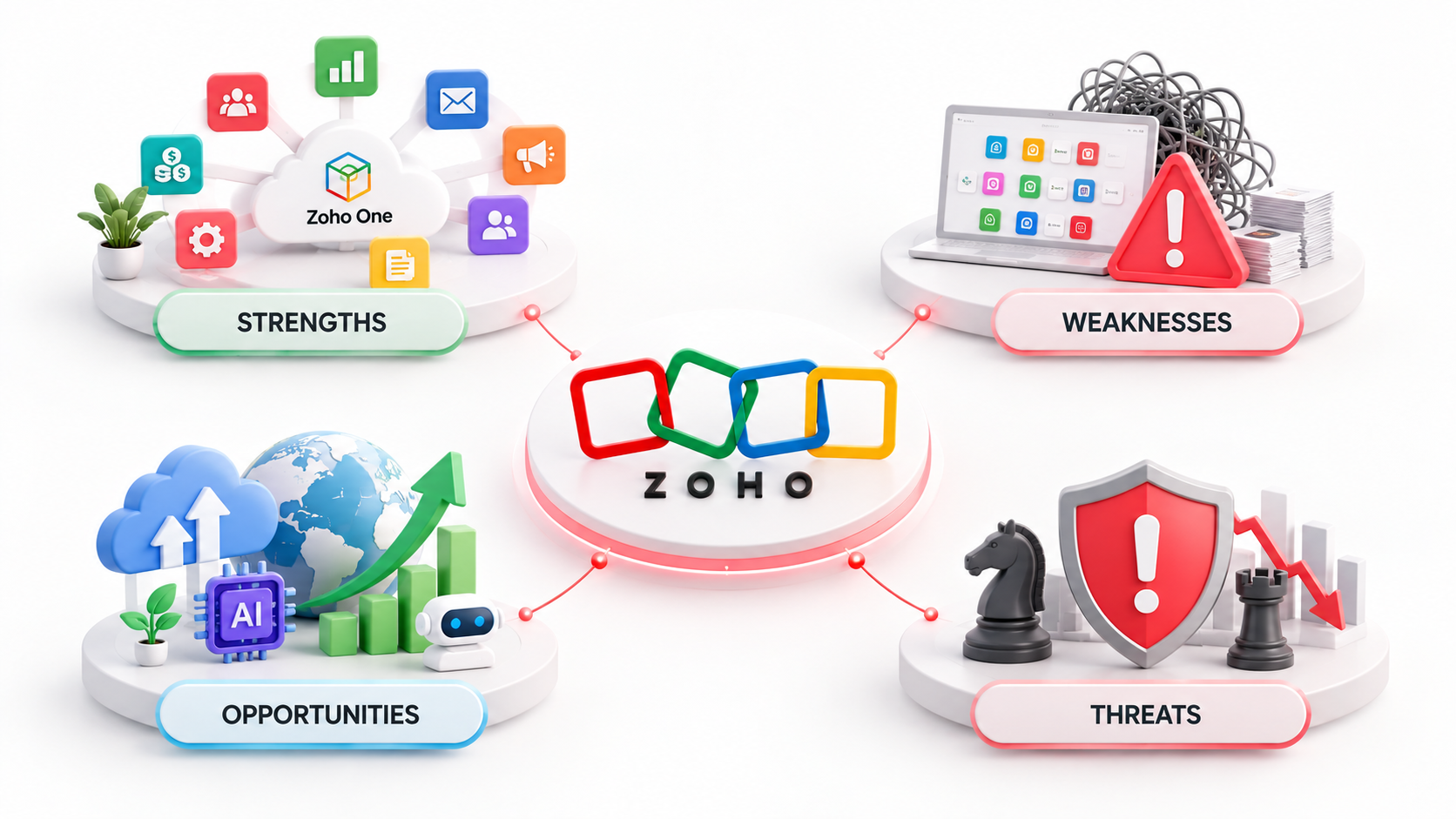
Now let’s get into the actual SWOT analysis of Zoho, starting with what the company genuinely does well. And look, some of these strengths are the kind of thing competitors quietly admit they can’t easily copy, because they’d have to unwind years of investor expectations to do it.
Bootstrapped and Debt-Free Business Model
This is the strength that shapes every other strength and weakness on this list, so it’s worth unpacking properly. Zoho has never taken venture capital, never taken on debt, and has always funded its growth from its own profits. That means there’s no investor breathing down anyone’s neck demanding 40% year over year growth no matter the cost. Decisions get made on a multi decade timeline instead of a next quarter timeline.
What this actually buys Zoho is patience. The company can invest in things like rural offices in Tenkasi, a small town far from any tech hub, or spend years building out Zoho University to train engineers from scratch, without anyone asking when that investment pays off. Try explaining that to a board at a VC backed startup and see how far you get.
Massive All-in-One Product Suite
Zoho One isn’t just a marketing bundle, it’s a genuinely different value proposition than what most competitors offer. A small business that signs up gets access to over 55 applications for one price per user. That’s CRM, HR, finance, marketing, and collaboration tools all under one roof, built by the same engineering teams, sharing the same data layer.
Compare that to the typical small business software stack: Salesforce for sales, Mailchimp for email marketing, QuickBooks for accounting, Slack for chat, and Trello for projects. Each of those is a separate subscription, a separate login, and a separate integration headache. Zoho’s pitch of “just use us for everything” genuinely resonates with founders who are tired of managing six different vendor relationships.
Affordable Pricing Compared to Competitors
This one’s straightforward but still worth stating clearly with numbers. Zoho CRM’s entry level paid plans run somewhere around 20 dollars per user per month, while Salesforce’s comparable tier can run two to three times that depending on the features you need. For a 50 person sales team, that price gap adds up to tens of thousands of dollars a year.
Small businesses and startups, especially in price sensitive markets like India, Southeast Asia, and parts of Latin America, notice that gap immediately. Zoho built its entire customer base on being the software that does 80% of what the expensive option does for 30% of the price, and for a huge chunk of the market, that 80% is more than enough.
Strong Presence in India and Emerging Markets
Zoho has a home field advantage that Salesforce and Microsoft simply don’t have in India and similar markets. It understands local business practices, GST compliance requirements, and price sensitivity in a way a foreign company headquartered in San Francisco genuinely struggles to replicate. Zoho Books, for example, has GST filing built directly into the product because Indian accounting rules were a day one design consideration, not an afterthought bolted on later.
This local depth extends beyond India too. Zoho has been steadily expanding into Southeast Asian markets like Indonesia and Vietnam, regions where SME digitization is happening fast but budgets are tight. Being the affordable, locally aware option gives Zoho a real foothold that’s hard for bigger competitors to dislodge once it’s established.
Zoho University and Talent Pipeline
Most tech companies complain about a talent shortage and then go fight over the same small pool of engineering graduates from top universities. Zoho did something different: it built its own pipeline. Zoho University recruits students straight out of high school, many from rural and low income backgrounds who might never have gotten into a traditional engineering college, and trains them in house for two years before hiring them as full engineers.
This solves two problems at once. It gives Zoho a steady supply of loyal, well trained talent that didn’t cost a fortune to recruit, and it builds genuine goodwill in the communities where these offices are located. Sridhar Vembu has talked openly about wanting to bring tech jobs to rural India instead of concentrating everything in Bangalore, and this program is the clearest expression of that philosophy.
Data Privacy and Self-Hosted Infrastructure
Here’s a detail that doesn’t get enough attention: Zoho runs its own data centers instead of hosting everything on AWS, Google Cloud, or Azure like most of its SaaS competitors. That’s an unusual and expensive choice, but it gives Zoho tighter control over data privacy and lets it make specific promises to customers, especially government and enterprise clients, about where their data physically lives and who can access it.
In a world where data localization laws are getting stricter by the year, this infrastructure choice is starting to look less like an eccentricity and more like a genuinely smart long term bet. It’s also part of why Zoho markets itself as a privacy respecting alternative to companies that build their business models around advertising and data monetization.
The Weaknesses Nobody’s Sugarcoating
No SWOT analysis of Zoho is complete without an honest look at where the company genuinely falls short. And there are real weaknesses here, not just nitpicks.
Brand Recognition Gap vs Salesforce and Microsoft
Ask a random business executive in New York or London to name a CRM, and you’ll hear Salesforce nine times out of ten. Ask them to name Zoho, and you’ll probably get a blank stare. Despite crossing a billion dollars in revenue, Zoho still doesn’t have the brand recognition that its scale would suggest, especially in Western markets where the buying decisions carry the most enterprise budget.
Part of this comes back to that same bootstrapped philosophy. Zoho doesn’t spend the way Salesforce does on Super Bowl ads, massive conference sponsorships like Dreamforce, or aggressive outbound sales teams cold calling every mid sized company in America. That discipline protects margins, but it also means awareness grows slower, and slower brand growth means longer sales cycles for enterprise deals that require trust before anyone signs a contract.
UI/UX Inconsistency Across Products
Because Zoho builds so many products in house across different internal teams, the user experience doesn’t always feel unified. Someone who’s comfortable navigating Zoho CRM might find Zoho Projects or Zoho Creator feels like a completely different company built it. Buttons are in different places, workflows follow different logic, and the visual design language shifts from product to product.
This matters more than it sounds like on paper. When you’re selling an “all in one suite” as your core value proposition, the products need to feel like one connected system, not 55 separate apps that happen to share a login page. Competitors with tighter, more centralized design teams, or ones that grew through fewer, more carefully integrated acquisitions, often deliver a more polished, consistent feel across their platform.
Limited Marketing and Sales Aggression
Zoho’s low key marketing style is a double edged sword. Yes, it keeps costs down and lets the company stay profitable without external funding. But it also means Zoho loses mindshare in a market where louder, more aggressive competitors are constantly running retargeting ads, sponsoring podcasts, and flooding LinkedIn with content. HubSpot in particular built an entire empire on inbound marketing content, and Zoho has never really matched that playbook.
The result is that a lot of potential customers simply never hear about Zoho as an option when they’re evaluating software. They default to whatever name came up first in a Google search or whatever their peers at other companies already use, and that’s usually not Zoho, at least not outside India and a handful of other markets where word of mouth carries more weight.
Integration Complexity Across Zoho One
The all in one suite that’s a major strength also creates a real weakness: with 55 plus apps, actually configuring Zoho One to work smoothly for a specific business can get complicated fast. Businesses often need outside consultants or Zoho certified partners just to set things up properly, which adds cost and friction that undercuts the “everything just works together” pitch.
Smaller businesses without dedicated IT staff sometimes end up using maybe five or six of the apps in the bundle and ignoring the rest simply because the learning curve to configure everything else is steep. That’s a missed opportunity for Zoho, since customers are paying for a suite they’re not fully using, and it opens the door for point solution competitors who do one thing extremely well and require zero configuration headache.
Customer Support Challenges at Scale
As Zoho has grown its user base into the hundreds of millions, support quality has become a more frequent complaint in user reviews and forums. Response times can lag, especially for customers on lower tier plans, and the sheer breadth of the product catalog means support staff sometimes struggle to have deep expertise across every single application a customer might be using.
Salesforce and Microsoft, by contrast, have built out massive partner ecosystems and certified consultant networks specifically to handle implementation and support at scale, something Zoho’s smaller partner network hasn’t fully matched yet. For a company whose whole appeal rests on being reliable and affordable, support friction is a genuine risk to customer retention.
The Opportunities on the Table
This is where things get interesting, because Zoho has some genuinely large, mostly untapped opportunities sitting right in front of it.
Growing SME Market in India and Southeast Asia
India alone has over 60 million small and medium businesses, and a huge chunk of them are still running on spreadsheets and WhatsApp for core business operations. As digitization accelerates, driven by government pushes like Digital India and increasing smartphone and internet penetration, that entire market represents a massive greenfield opportunity for Zoho’s affordable, India-built product suite.
The same story is playing out across Indonesia, Vietnam, and the Philippines, where SME digitization is happening fast but budgets remain tight. Zoho’s pricing model and cultural understanding of price sensitive markets position it well to capture a big share of this growth, provided it keeps investing in localization, language support, and region specific compliance features.
AI Integration Across the Zoho Suite (Zia)
Zoho’s AI assistant, called Zia, has been quietly getting more capable, handling things like sentiment analysis in support tickets, sales forecasting in CRM, and anomaly detection in financial data. The opportunity here is significant: if Zoho can weave genuinely useful AI features across all 55 plus products in a way that feels cohesive, it creates a differentiator that’s hard for point solution competitors to match.
The risk of not seizing this opportunity is real too. Every SaaS company right now is racing to bolt AI features onto their products, and customers are starting to expect it as table stakes rather than a nice to have. Zoho has the product surface area to make AI genuinely transformative across an entire business workflow, from lead scoring to invoice processing, but it needs to execute fast before AI native startups eat into specific product categories.
Expansion into Western Enterprise Market
Zoho has made real inroads with small and mid sized businesses in the US and Europe, but the large enterprise segment, the Fortune 500 companies that pay Salesforce and Microsoft massive multi year contracts, remains mostly untouched. Cracking this segment would require a level of sales infrastructure, security certifications, and brand trust building that Zoho has historically underinvested in.
That said, the opportunity is enormous if executed well. Enterprise contracts come with far higher contract values and stickier customer relationships than SME deals. Zoho has already built out enterprise focused offerings like Zoho CRM Plus and dedicated data residency options, showing it’s aware of this gap and slowly moving to close it.
Government and Public Sector Digitization
Zoho’s self-hosted infrastructure and strong data privacy story make it a natural fit for government contracts, an area where data sovereignty concerns often disqualify cloud giants that rely on foreign hosted servers. As governments worldwide push digitization initiatives for public services, Zoho is positioned to win contracts that competitors relying on AWS or Azure hosting might struggle to secure due to data residency requirements.
India’s own push toward digital governance, along with similar initiatives in other emerging economies, gives Zoho a credible entry point into a sector that tends to offer long, stable, high value contracts once a vendor relationship is established.
Vertical-Specific SaaS Products
Right now, Zoho mostly sells horizontal products, CRM, accounting, HR, that work across any industry. But there’s a growing opportunity in building deeper, vertical specific versions of these tools for industries like healthcare, real estate, legal services, or manufacturing, where generic software often misses industry specific workflows and compliance needs.
Competitors and startups building purpose built vertical SaaS products have shown there’s real money to be made here, because businesses in specialized industries are often willing to pay a premium for software that actually understands their specific regulatory and operational quirks. Zoho has the underlying platform and engineering capacity to build these vertical products faster than a startup starting from scratch, if it chooses to prioritize this direction.
The Threats That Could Slow It Down
Every strong business faces real threats, and Zoho is no exception. Here’s what could genuinely knock the company off its growth trajectory.
Competition from Salesforce, HubSpot, and Microsoft
The obvious threat, but worth detailing properly. Salesforce continues to dominate enterprise CRM with a massive partner ecosystem and brand trust built over two decades. HubSpot has captured the inbound marketing and mid market CRM segment with genuinely excellent content marketing and a freemium model that hooks smaller businesses early. Microsoft bundles Dynamics 365 with Office 365 and Teams, making it an easy default choice for companies already deep in the Microsoft ecosystem.
Each of these competitors has resources Zoho simply doesn’t, whether that’s Salesforce’s marketing budget, HubSpot’s inbound machine, or Microsoft’s ability to bundle software with products businesses already use daily. Zoho competes on price and breadth, but that only works as long as customers are willing to trade some brand familiarity and polish for cost savings.
Rise of Vertical SaaS Startups
While Zoho builds broad, horizontal tools, a growing wave of startups is building narrow, deeply specialized software for specific industries and use cases. A dedicated real estate CRM built specifically for property management workflows, or a purpose built legal practice management tool, can often out-execute Zoho’s generic equivalent for that specific niche, even if Zoho’s product is cheaper overall.
This is the classic innovator’s dilemma playing out in SaaS. Broad platforms are efficient for businesses that want one vendor for everything, but they’re vulnerable to losing specific product categories to startups that go deeper on a narrower problem. If enough of these vertical challengers chip away at individual pieces of the Zoho One bundle, the overall value proposition weakens.
Global Economic Slowdown Affecting SME Spending
Zoho’s customer base skews heavily toward small and medium businesses, which are historically the first to cut software spending during economic downturns. A global recession or prolonged slowdown in key markets like India could squeeze SME budgets hard, leading to canceled subscriptions or downgrades to cheaper plans across Zoho’s customer base.
This is a structural risk built into serving price sensitive customers. Enterprise focused competitors with longer, contractually locked in relationships tend to weather economic downturns more predictably than a business model built on month to month or annual subscriptions from smaller companies with thinner cash reserves.
Data Localization and Regulatory Pressure
While Zoho’s self-hosted infrastructure is generally a strength, the regulatory landscape around data privacy keeps shifting, and compliance requirements differ wildly from country to country. The European Union’s GDPR, India’s Digital Personal Data Protection Act, and various US state level privacy laws all impose different obligations, and keeping pace with all of them across a 55 plus product suite operating in dozens of countries is a genuinely difficult, resource intensive task.
Any misstep here, a data breach, a compliance failure, a fine from a regulator, could do real damage to the privacy focused reputation Zoho has spent years building. That reputation is a core part of its pitch to government and enterprise clients, so protecting it isn’t optional.
Talent Retention in a Competitive Job Market
Zoho’s rural talent pipeline through Zoho University is a genuine strength, but retaining that talent long term is a separate challenge. As these engineers gain experience and skills, they become attractive hires for better funded competitors and multinational tech companies that can offer higher salaries, stock options, and the prestige of a globally recognized brand name on a resume.
Zoho has generally maintained good retention through its culture and mission driven appeal, but as competition for skilled engineers intensifies across India’s tech sector, the company will need to keep finding ways to make staying at Zoho more attractive than jumping to a funded startup or a foreign tech giant with deeper pockets.
Zoho vs Competitors: A Quick Comparison
| Factor | Zoho | Salesforce | HubSpot | Microsoft Dynamics |
|---|---|---|---|---|
| Funding model | Bootstrapped, no VC | Publicly traded, heavily funded | Publicly traded, VC backed pre-IPO | Part of Microsoft, no separate funding |
| Pricing | Low cost, entry plans around $20/user/month | Premium pricing, often 2 to 3x Zoho | Mid to high, freemium entry | Bundled with Microsoft 365, mid to high |
| Product breadth | 55+ apps under Zoho One | Focused on CRM plus acquired add-ons | CRM, marketing, service hub | CRM, ERP, tightly tied to Office ecosystem |
| Brand strength | Strong in India, weaker in West | Global enterprise leader | Strong in SME and marketing teams | Strong where Microsoft already dominates |
| Data hosting | Self-hosted data centers | Public cloud infrastructure | Public cloud infrastructure | Azure cloud infrastructure |
Look at what actually happens when a small business chooses between these four. If cost is the deciding factor and the business is comfortable with a bit of a learning curve, Zoho usually wins. If brand trust, integrations with a huge partner ecosystem, and enterprise scale matter more than price, Salesforce still takes it most of the time. HubSpot tends to win with marketing heavy teams who want a slick, easy to use interface without deep configuration. And Microsoft Dynamics wins by default in companies already committed to the Microsoft stack for everything else.
What This SWOT Analysis of Zoho Means for Businesses Choosing Zoho
So, should you actually use Zoho? Honestly, it depends entirely on what you’re optimizing for. If you’re a small or mid sized business trying to consolidate a messy stack of five or six different software tools into one affordable subscription, Zoho One makes a genuinely strong case. The pricing gap alone can be worth tens of thousands of dollars a year for a growing team, and the breadth of the product suite means you’re probably not going to outgrow it anytime soon.
That said, if your business needs a polished, highly consistent user experience across every tool, or you’re operating at an enterprise scale where you need deep, specialized support and a massive certified partner network for implementation, you might find Zoho’s rougher edges more frustrating than the cost savings are worth. Salesforce and Microsoft still have an edge there, at least for now.
The bigger picture takeaway from this SWOT analysis of Zoho is that the company’s bootstrapped, patient, privacy focused approach has built something genuinely durable. It’s not the loudest player in the room, and it probably never will be. But it’s built a real, profitable, billion dollar business by playing a completely different game than everyone else in SaaS, and that’s a strategy worth paying attention to regardless of whether you ever become a customer.
Conclusion
Zoho’s story isn’t the typical Silicon Valley SaaS story, and that’s exactly what makes it worth studying. No venture capital, no debt, a genuine commitment to affordable pricing, and a willingness to build things like rural talent pipelines and its own data centers instead of taking the easy, well funded shortcut. Those choices created real strengths: profitability, pricing power, and a privacy story competitors can’t easily match. They also created real weaknesses, brand recognition gaps and UI inconsistency chief among them, that the company still has to work through.
Going forward, the opportunities in AI, government contracts, and emerging markets are Zoho’s to lose, and the threats from bigger, louder competitors and nimble vertical startups aren’t going away. Whether you’re evaluating Zoho as a customer or studying it as a business case, the pattern here is clear: patient, profitable growth built on genuine product value can compete with venture backed giants, even if it takes longer to get the recognition it deserves.
Frequently Asked Questions
What is Zoho and what does the company actually do?
Zoho is a software company based in Chennai, India, that builds a suite of over 55 business applications, including CRM, accounting, HR, email, and project management tools. It’s best known for Zoho One, a bundle that gives businesses access to its entire product suite for one flat price per employee.
Is Zoho a good alternative to Salesforce?
For small and mid sized businesses that are price sensitive and don’t need deep enterprise level customization, Zoho CRM is a genuinely solid alternative to Salesforce at a fraction of the cost. Larger enterprises with complex needs and a preference for a massive certified partner ecosystem often still lean toward Salesforce.
Why is Zoho not as well known as Salesforce or Microsoft in the US?
Zoho spends far less on marketing, advertising, and aggressive sales outreach compared to funded competitors like Salesforce, largely because it has never raised venture capital and prioritizes profitability over rapid brand expansion. This keeps costs low but slows brand recognition growth in Western markets.
How does Zoho make money without venture capital funding?
Zoho generates revenue entirely through subscription fees for its software products, primarily Zoho CRM, Zoho Books, Zoho Desk, and the Zoho One bundle. The company has been profitable and self funded since early in its history, reinvesting its own earnings into growth instead of relying on outside investment.
What is Zoho One and how is it different from buying individual Zoho apps?
Zoho One is a bundle that gives a business access to Zoho’s entire suite of 55 plus applications for one flat price per employee per month, rather than paying separately for each app like Zoho CRM or Zoho Books individually. It’s designed for businesses that want to run most of their operations on a single connected software ecosystem.
Is Zoho’s data secure, and where is it hosted?
Zoho operates its own data centers rather than relying on third party cloud providers like AWS or Azure, giving it direct control over data security and residency. This self-hosted approach is a key part of Zoho’s pitch to privacy conscious customers, including government and enterprise clients with strict data sovereignty requirements.
What is Zia in Zoho’s product suite?
Zia is Zoho’s built in AI assistant, integrated across products like Zoho CRM and Zoho Desk to handle tasks such as sales forecasting, sentiment analysis on support tickets, and anomaly detection in financial data. It’s part of Zoho’s broader push to weave AI capabilities across its entire product ecosystem rather than launching it as a standalone product.
What is Zoho University and why did the company start it?
Zoho University is an in house training program that recruits students straight out of high school, often from rural or economically disadvantaged backgrounds, and trains them for two years before hiring them as full time engineers. Sridhar Vembu started the program to build a loyal talent pipeline and bring tech jobs to areas outside major cities like Bangalore.
How does Zoho’s pricing compare to HubSpot and Salesforce?
Zoho CRM’s entry level paid plans typically start around 20 dollars per user per month, while comparable Salesforce plans can cost two to three times as much, and HubSpot’s mid tier plans also tend to run higher, especially as you add marketing and service hub features. Zoho consistently positions itself as the lower cost option across most of its product categories.
What are the biggest weaknesses in Zoho’s business strategy?
The biggest weaknesses include limited brand recognition in Western markets, inconsistent user interface design across its many products, and support quality that hasn’t always kept pace with its rapidly growing global user base. These weaknesses stem largely from Zoho’s low key marketing approach and the sheer scale of building 55 plus products in house.
Can a small business run entirely on Zoho software?
Yes, many small businesses use Zoho One to handle nearly every operational function, including sales, accounting, HR, customer support, and internal communication, all under a single subscription. Some businesses do supplement Zoho with specialized third party tools for specific niche needs that Zoho’s generic products don’t fully cover.
Is Zoho only popular in India, or does it have a global presence?
While Zoho has particularly strong adoption in India and other price sensitive markets, it serves over 100 million users worldwide across more than 180 countries, with growing presence in Southeast Asia, the Middle East, and increasingly the United States and Europe among small and mid sized businesses.
What industries or company sizes benefit most from using Zoho?
Small and medium sized businesses across industries like retail, services, and technology tend to benefit most from Zoho, given the pricing and breadth of its product suite. Larger enterprises with highly specialized workflows or a need for extensive third party integrations sometimes find Zoho’s offering less tailored compared to more established enterprise software vendors.