


Back in 2008, three guys couldn’t pay rent in San Francisco, so they threw an air mattress on the floor and called it “Airbed and Breakfast.” Nobody in that apartment thought they were building a company that would one day be valued higher than Marriott and Hilton combined on certain trading days. That’s the part people forget when they study the Marketing Mix of Airbnb. It wasn’t planned out on a whiteboard with neat little boxes labeled Product, Price, Place, and Promotion. It was messy, it nearly failed multiple times, and the marketing mix that eventually emerged was built out of survival, not theory.

That’s exactly why the Marketing Mix of Airbnb is worth studying properly instead of skimming a listicle. Most breakdowns you’ll find online just slap the classic 4Ps on top of Airbnb like a template and call it done. That approach falls apart fast because Airbnb doesn’t sell a physical product. It sells trust between two strangers, one of whom is about to hand over their house keys and the other of whom is about to sleep in someone else’s bed. Any honest marketing mix analysis of Airbnb has to deal with that reality, which is why marketers extend the framework to 7Ps: adding People, Process, and Physical Evidence on top of the original four.
This guide walks through every single element of the Marketing Mix of Airbnb with real examples, actual numbers where they matter, and the reasoning behind each decision Airbnb made. No filler, no vague “industry experts say” nonsense. Just a clear look at how a two-sided marketplace built one of the most studied business models in the world.
TL;DR: Marketing Mix of Airbnb
- Airbnb runs on a 7Ps marketing mix, not the traditional 4Ps, because it sells a service between two strangers, not a physical good.
- The core product isn’t the apartment or the room. It’s the trust layer built through verified profiles, reviews, and the Superhost system.
- Pricing is host-controlled but algorithm-assisted through Smart Pricing, and Airbnb earns through a service fee on both sides of the transaction.
- Place, in Airbnb’s case, means the app and website acting as the entire distribution channel, replacing the need for physical offices or travel agents.
- The referral program and the “Belong Anywhere” campaign remain two of the sharpest promotion moves in the travel industry’s recent history.
- Physical Evidence for a digital-first company comes from photos, verified badges, and guest reviews, since there’s no storefront to walk into.
What You Will Learn in This Guide
- How the 7Ps framework applies to a two-sided marketplace like Airbnb, and why the standard 4Ps model doesn’t cut it here.
- What Airbnb actually sells as its “product,” beyond just listing rooms and apartments on an app.
- How Airbnb’s pricing model gives hosts control while still using data to nudge outcomes.
- Why Airbnb never needed physical stores or travel agencies to reach a global market.
- The exact promotional tactics, including the referral program and content strategy, that got Airbnb to scale.
- The mistakes brands make when they try to copy Airbnb’s marketing playbook without understanding the mechanics behind it.
- Practical takeaways any marketer, student, or founder can apply from studying this case.
The Marketing Mix of Airbnb Framework
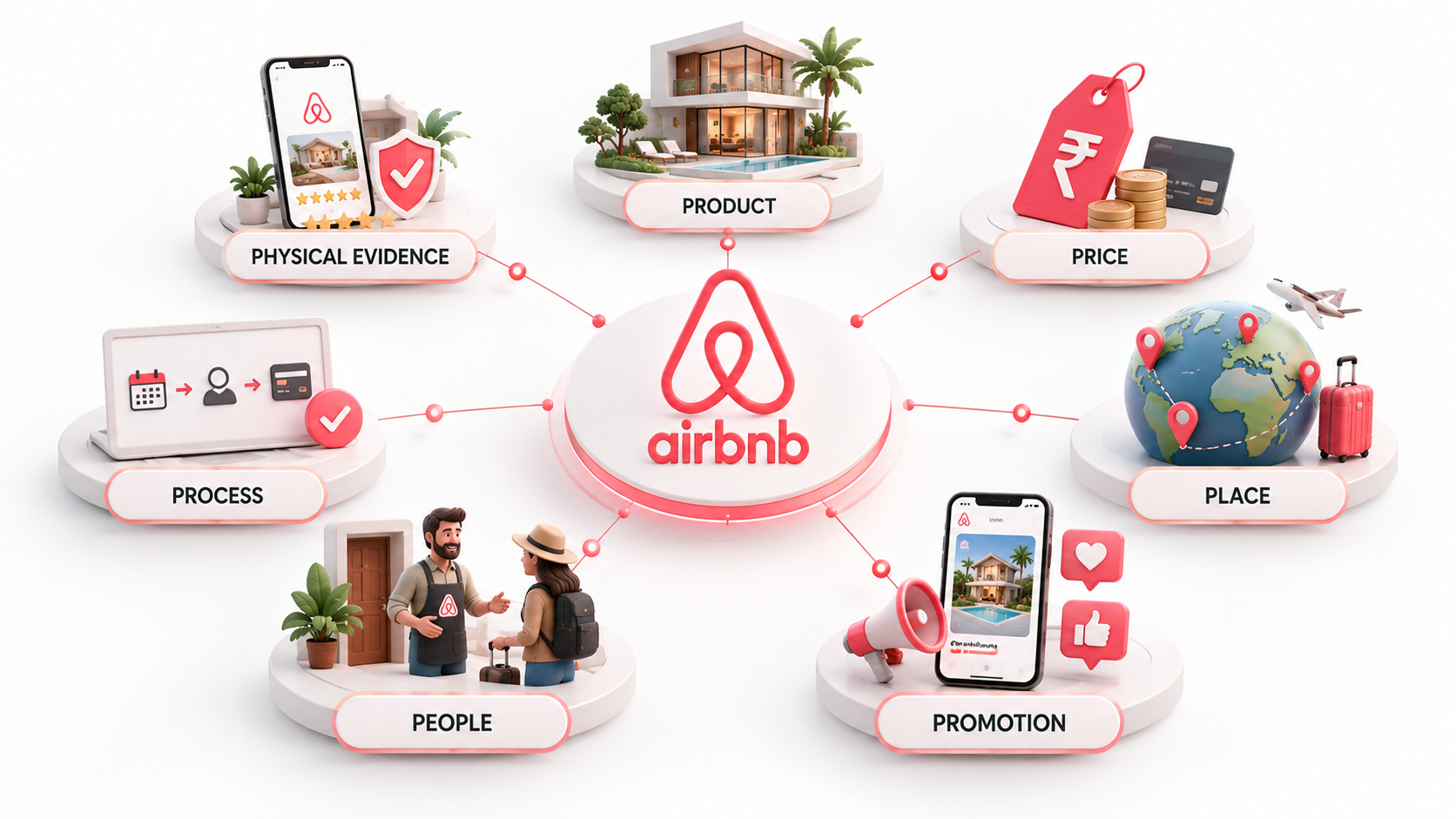
The Marketing Mix of Airbnb can’t be explained with the old 4Ps model that was built for companies selling soap and soft drinks. Airbnb sells an experience that depends on a stranger’s apartment, a stranger’s behavior, and a transaction that happens entirely online before two people ever meet in person. That’s a service business with massive trust risk baked in, and service businesses need three extra Ps: People, Process, and Physical Evidence, on top of Product, Price, Place, and Promotion.
What is a Marketing Mix and Why Service Brands Use 7Ps
A marketing mix is just the set of controllable variables a company adjusts to influence how customers respond to its offering. The original 4Ps model, created by E. Jerome McCarthy in the 1960s, worked fine for manufactured goods sitting on shelves. But once you’re dealing with a service, especially one delivered through people and technology instead of a factory line, three gaps show up immediately. Who delivers the service? What’s the actual process the customer goes through? And what physical cues does the customer use to judge quality when there’s no product to hold in their hands? Booms and Bitner added People, Process, and Physical Evidence in 1981 specifically to close those gaps, and Airbnb is close to a textbook case for why that extension matters.
Why Airbnb’s Business Model Forces a Different Marketing Mix
Airbnb doesn’t own a single property. Not one bed, not one apartment, not one villa. Every unit on the platform belongs to someone else, which means Airbnb’s actual job is matching supply and demand while managing risk on both sides. A hotel chain controls quality by training staff and enforcing brand standards across every location. Airbnb can’t do that because it has no employees inside any of the four million plus listings on its platform. So the entire marketing mix has to compensate for that lack of direct control, using verification systems, review mechanisms, and host education instead of physical oversight. That single structural fact shapes every other decision in this guide.
Product Element in the Marketing Mix of Airbnb
When people think about the product in the Marketing Mix of Airbnb, they usually picture the listing itself, the apartment, the cabin, the shared room. That’s only half the story. The actual product Airbnb sells is confidence: confidence that a stranger’s home will match the photos, confidence that the host won’t cancel last minute, and confidence that if something goes wrong, there’s a system to fall back on. Strip away the trust mechanisms and Airbnb is just a classifieds site. Keep them, and it’s a company that hosted over 1.5 billion guest arrivals cumulatively by the end of 2023.
Core Product: The Listing Itself
At the most basic level, the listing is a host’s space, described through photos, amenities, house rules, and location data. But Airbnb doesn’t just let anyone throw up a blurry photo and a two-line description. The platform pushes hosts toward professional photography, encourages detailed amenity tagging (fast wifi, workspace, self check-in), and ranks listings partly based on completeness and responsiveness. A host who skips these steps gets buried in search results, so the incentive structure quietly forces product quality upward without Airbnb touching a single property. This is the part most competitor analyses skip: the “product” is partly self-policed through search algorithm pressure, not manual curation.
Airbnb Experiences and Diversification
In 2016, Airbnb launched Experiences, letting locals sell activities like cooking classes, hiking tours, or photography walks, completely separate from lodging. This mattered for the marketing mix because it changed what “product” even meant for the brand. Airbnb stopped being just a place to sleep and started positioning itself as the operating system for travel itself. During the pandemic, when travel collapsed, Airbnb leaned on Online Experiences, virtual sessions like cocktail making with a bartender in Tokyo, to keep revenue and brand relevance alive when actual bookings dropped by more than 70% in some markets during early 2020.
Trust and Safety Features as Product
Verified ID checks, AirCover (Airbnb’s host and guest protection program covering damage and liability up to one million dollars), and 24/7 support lines aren’t marketing add-ons. They’re core product features because without them, the entire model of staying in a stranger’s home collapses under liability fear. AirCover was rolled out broadly in 2022 after years of smaller protection programs, and it exists specifically to answer the one objection that kills conversion for a first-time user: “what happens if something goes wrong?” A product decision like this does more for the Marketing Mix of Airbnb than any advertisement ever could, because it removes the single biggest barrier to a first booking.
Price Element in the Marketing Mix of Airbnb
Pricing inside the Marketing Mix of Airbnb works differently than almost any other consumer platform you can name. Airbnb doesn’t set prices. Hosts do. But Airbnb built an entire layer of tools, nudges, and fee structures around that host-controlled pricing to make sure the marketplace stays competitive and Airbnb still earns a healthy cut on both ends of the transaction.
Dynamic and Host-Set Pricing
Every host sets their own nightly rate, but Airbnb surfaces comparable listings, occupancy data, and seasonal demand trends right inside the hosting dashboard to influence that number. A host in Goa during peak December season sees very different suggested pricing than the same host listing the same property in the monsoon off-season. This isn’t Airbnb dictating price the way a retailer sets a shelf tag. It’s Airbnb shaping the decision environment so hosts price closer to what the market will actually bear, which keeps supply flowing and keeps guests from feeling gouged.
Service Fees and Commission Structure
Airbnb makes money by charging both sides. Hosts typically pay a fee ranging from roughly 3% to 5% of the booking subtotal under the split-fee model, while guests pay a service fee that usually lands somewhere between 6% and 20% of the reservation total depending on the booking size and location. That double-sided fee structure is a big reason Airbnb reported over $9.9 billion in revenue for 2023. It’s a model borrowed from marketplaces like eBay, but tuned specifically for high-value, infrequent purchases like a week-long stay instead of a $20 item.
Smart Pricing Tool and Algorithm
Airbnb’s Smart Pricing feature automatically adjusts a host’s nightly rate within a range the host sets, based on demand signals like local events, day of the week, and booking lead time. Here’s the thing most people miss about this tool: it’s opt-in, not forced, which matters a lot for the brand’s positioning. Airbnb wants hosts to feel like independent entrepreneurs running their own small business, not employees being told what to charge. Making Smart Pricing optional protects that “you’re the boss of your own listing” narrative while still nudging serious hosts toward data-backed decisions. Uber and Amazon use algorithmic pricing too, but neither gives sellers this much visible control over whether to accept the algorithm’s suggestion.
Place Element in the Marketing Mix of Airbnb
Place in a traditional marketing mix means physical distribution, warehouses, retail shelves, delivery trucks. Airbnb has none of that. Its entire “place” is a mobile app and a website, which sounds simple until you realize that app has to work flawlessly across more than 220 countries and regions, in over 60 languages, handling currency conversion, local tax rules, and regional payment methods all at once.
App and Website as Primary Channels
Roughly half of Airbnb’s gross nights booked come through its mobile app rather than the desktop site, based on company disclosures in recent years. That single stat tells you where Airbnb has poured its distribution investment: not into physical presence, but into making the booking flow on a five-inch screen feel as trustworthy as booking a hotel through a familiar chain. Every redesign Airbnb has done to its app, cleaner search filters, map-based browsing, wishlist folders, exists to reduce the friction of booking a stranger’s home from a phone while standing in an airport.
Global Market Penetration Strategy
Airbnb didn’t expand country by country the slow way most hospitality brands do, building local offices and negotiating regional partnerships one market at a time. It leaned on organic growth in early markets like the US and parts of Europe, then used targeted market entry (localized customer support, region-specific host onboarding campaigns, and local language support) to break into markets like Japan, South Korea, and India. In India specifically, Airbnb ran on-ground host acquisition drives in cities like Goa and Jaipur because homestay culture already existed there informally, and Airbnb just needed to formalize and monetize a behavior people were already doing.
Partnerships and Integrations
Place also covers who Airbnb partners with to get discovered. Integration with Google Assistant and Google Maps lets a listing show up when someone searches “places to stay near me.” Partnerships with airlines and travel booking aggregators occasionally bundle Airbnb stays into broader trip packages. None of this replaces the core app experience, but it widens the number of doors through which a potential guest can walk into the Airbnb ecosystem without ever opening the app first.
Promotion Strategy in the Marketing Mix of Airbnb
This is the part of the Marketing Mix of Airbnb that gets studied the most, and for good reason. Airbnb spent its early years with almost no marketing budget and had to get scrappy in ways that turned into some of the most referenced growth stories in startup history.
Content Marketing and Storytelling
Airbnb built an entire magazine-style content arm, including Airbnbmag (a print and digital travel publication it ran between 2017 and 2020) and ongoing city guides that read like travel journalism instead of ads. The goal was never direct conversion from a blog post. It was building an association between the Airbnb name and the feeling of authentic travel, staying like a local instead of a tourist. That emotional positioning is why “belong anywhere” worked as a tagline instead of falling flat like most corporate slogans do.
Referral Program
Airbnb’s referral program, especially the early version rolled out around 2010-2011, is one of the most cited case studies in growth marketing. Both the referrer and the new user received travel credit once the referred friend completed a stay. That single mechanic turned existing happy customers into an acquisition channel, cutting reliance on paid ads during a period when Airbnb had almost no marketing budget to speak of. Sean Ellis, credited as one of the earliest growth advisors to the company, has spoken publicly about how referral loops like this became a blueprint other startups (Dropbox included) later copied almost exactly.
Social Media and Influencer Approach
Rather than chasing celebrity endorsements the way traditional hospitality brands do, Airbnb built its social presence around user-generated content, real guests and hosts sharing their actual stays, actual photos, actual stories. Instagram became a channel for showcasing unusual and eye-catching listings (treehouses, converted airplanes, igloos) which drove organic shares far beyond what a paid campaign could achieve for the same spend. This matters for the marketing mix because it kept promotion costs relatively lean while still generating reach comparable to brands spending far more on traditional advertising.
SEO and the Belong Anywhere Campaign
Launched in 2014, “Belong Anywhere” replaced Airbnb’s earlier, more transactional positioning with something built around identity and community. Alongside the campaign, Airbnb invested heavily in SEO, city and neighborhood guide pages, “things to do in [city]” content, and structured data that helped individual listings rank in search results for hyper-specific local searches. That SEO layer quietly became one of Airbnb’s biggest organic acquisition channels, reducing dependency on paid search spend that competitors like Booking.com and Expedia pour billions into every year.
People, Process, and Physical Evidence in the Marketing Mix of Airbnb
These three extended Ps are where the Marketing Mix of Airbnb really separates itself from a standard product-based analysis. Since Airbnb has no direct control over the physical spaces being rented, these three elements do the heavy lifting of maintaining quality and trust across the entire platform.
People: Hosts, Guests, and Support Teams
Hosts are effectively Airbnb’s unpaid, distributed workforce, and the entire brand experience hinges on how well they perform. Airbnb responded to this dependency by building the Superhost program, a status awarded to hosts who maintain a 4.8+ rating, low cancellation rates, and quick response times, along with dedicated Superhost perks like priority support and a badge that boosts search visibility. On the guest side, Airbnb’s community support and trust and safety teams handle disputes, safety incidents, and refund cases, which matters enormously given the platform processes millions of transactions between strangers who’ve never met.
Process: Booking Flow and Verification
The process a guest goes through, browsing, messaging a host, submitting ID verification, paying, and receiving a digital key code or check-in instructions, is deliberately engineered to reduce anxiety at each step. Airbnb introduced Instant Book, letting guests reserve a place immediately without waiting for host approval, specifically because the older request-and-wait system created drop-off at exactly the moment a guest was most ready to commit. Every friction point removed from that process directly protects conversion rates, which is why Airbnb keeps testing changes to checkout flow, cancellation policy clarity, and messaging response prompts.
Physical Evidence: Reviews, Photos, and Superhost Badges
Since there’s no storefront to walk past, Airbnb had to manufacture physical evidence entirely through digital cues. Reviews left by both guests and hosts (a two-way review system, which is rare and deliberate) act as the trust signal a customer would normally get from walking into a clean, well-reviewed retail location. High-resolution photography, verified badges, and the visible Superhost tag all function as substitutes for the physical reassurance a hotel lobby or a branded storefront would normally provide. This is arguably the most underrated part of the entire Marketing Mix of Airbnb, because it’s invisible when it works and catastrophic when it doesn’t.
Mistakes Brands Make When Copying Airbnb’s Marketing Mix
Plenty of startups have tried to copy pieces of the Marketing Mix of Airbnb without understanding why each piece existed in the first place, and most of them stumble in predictable ways.
Copying the Referral Program Without the Retention to Back It
A referral program only works if the core product retains users long enough for word of mouth to compound. Companies launch Airbnb-style referral credits, then wonder why growth stalls, without realizing Airbnb’s referral loop worked because the underlying product (a genuinely useful travel booking experience) already had strong retention. Referral mechanics amplify a good product. They don’t fix a weak one.
Ignoring the Trust Layer
Several travel and rental startups have tried to replicate Airbnb’s marketplace model without investing seriously in verification, insurance, or dispute resolution. The result is predictable: a handful of bad experiences go viral, trust collapses fast, and the platform never recovers momentum. Trust isn’t a nice-to-have feature bolted on after growth. In a peer-to-peer model, it’s the actual product.
Treating “Belong Anywhere” as Just a Slogan
Brands sometimes borrow Airbnb’s emotional positioning language without doing the operational work to back it up. “Belong Anywhere” only landed because Airbnb had already built the infrastructure (diverse global listings, local experiences, community-driven content) that made the phrase feel earned rather than hollow. Copying the tagline without the substance behind it just produces empty marketing that customers see through almost immediately.
What Marketers Can Learn From the Marketing Mix of Airbnb
Studying the Marketing Mix of Airbnb closely gives marketers a genuinely useful framework for building trust into a service-based business model, not just travel companies. The biggest lesson is that in a two-sided marketplace, marketing and product are basically the same function. AirCover isn’t a legal department decision that marketing happened to promote afterward, it’s a growth lever disguised as an insurance policy. The Superhost badge isn’t just a loyalty gimmick, it’s a search ranking mechanism that also motivates supply-side behavior.
Another underrated lesson sits in how Airbnb handled the extended Ps. Most businesses obsess over Product, Price, Place, and Promotion because those are the classic four everyone learns first, then treat People, Process, and Physical Evidence as afterthoughts. Airbnb’s biggest wins, AirCover, Superhost, the two-way review system, all sit inside those three “extra” Ps. Any founder or marketer studying this case should walk away paying closer attention to the parts of the marketing mix that don’t show up in a typical Marketing 101 course. The businesses that get this right end up with a marketing mix that reinforces itself: better trust drives more bookings, more bookings generate more reviews, more reviews reinforce trust, and the cycle compounds without needing constant new ad spend to keep it moving. That’s the real reason the Marketing Mix of Airbnb keeps getting studied in business schools years after the company’s founding: it shows what a marketing mix looks like when it’s built to solve an actual trust problem instead of just moving inventory off a shelf.
Conclusion
The Marketing Mix of Airbnb works because every single P reinforces the others instead of operating in its own silo. The Product builds trust, the Price stays flexible enough to keep both sides happy, the Place removes the need for physical infrastructure entirely, and the Promotion strategy turned satisfied users into an acquisition channel instead of relying on ad spend alone. Layer People, Process, and Physical Evidence on top, and you get a marketing mix designed from the ground up to solve the one problem that could have killed the company before it started: convincing a stranger to sleep in another stranger’s home. Anyone studying marketing frameworks would get more value picking apart this case study line by line than memorizing a textbook chapter on the 4Ps, because it shows exactly what happens when a company builds its marketing mix around a genuine trust gap instead of a manufactured one.
Frequently Asked Questions
What is the Marketing Mix of Airbnb?
The Marketing Mix of Airbnb refers to the 7Ps framework, Product, Price, Place, Promotion, People, Process, and Physical Evidence, that explains how Airbnb positions and delivers its peer-to-peer accommodation and experiences platform. It goes beyond the traditional 4Ps because Airbnb operates as a service marketplace rather than a company selling a manufactured product.
Why does Airbnb use 7Ps instead of the traditional 4Ps?
Airbnb uses the 7Ps model because it’s fundamentally a service business built on trust between strangers. The three extra Ps, People, Process, and Physical Evidence, address how hosts and guests interact, how the booking journey unfolds, and what signals (reviews, photos, badges) replace the physical reassurance a traditional storefront would provide.
What is Airbnb’s core product?
Airbnb’s core product isn’t the physical listing itself, it’s trust and confidence in a peer-to-peer stay. This is delivered through verified host and guest profiles, a two-way review system, and protection programs like AirCover, which together make strangers comfortable transacting directly with each other.
How does Airbnb make money?
Airbnb earns revenue mainly through service fees charged on both hosts and guests for every completed booking. Under the standard split-fee structure, hosts typically pay around 3% to 5% of the booking subtotal, while guests pay a variable service fee, often between 6% and 20%, depending on the reservation size and region.
Does Airbnb control the prices hosts set?
No. Hosts set their own nightly rates and can adjust them anytime. Airbnb provides tools like Smart Pricing that suggest rates based on demand, local events, and comparable listings, but using these suggestions is entirely optional and hosts stay in full control of their pricing decisions.
What made Airbnb’s referral program so successful?
Airbnb’s referral program worked because it rewarded both the person referring and the new user with travel credit once a stay was completed, turning existing satisfied customers into an acquisition channel during a period when the company had almost no advertising budget. It succeeded specifically because the underlying product already had strong retention, which meant referrals compounded instead of fizzling out.
What is the Superhost program and why does it matter for marketing?
Superhost is a status Airbnb awards to hosts who consistently maintain high ratings, low cancellation rates, and fast response times. It functions as both a quality signal for guests and a search ranking boost for hosts, which means it directly supports the Physical Evidence and People elements of Airbnb’s marketing mix at the same time.
How did the “Belong Anywhere” campaign change Airbnb’s positioning?
Launched in 2014, “Belong Anywhere” shifted Airbnb’s brand message from a purely transactional booking platform toward one centered on identity, community, and authentic local travel. The campaign worked because Airbnb had already built the infrastructure, diverse global listings and local experiences, needed to make that emotional positioning feel genuine rather than forced.
What is AirCover and why is it part of Airbnb’s product strategy?
AirCover is Airbnb’s protection program for both hosts and guests, covering things like property damage and liability, rolled out broadly in 2022. It’s considered part of the product strategy, not just a legal safeguard, because it directly removes the biggest psychological barrier, “what if something goes wrong”, that stops first-time users from completing a booking.
Is Airbnb’s marketing mix relevant to businesses outside the travel industry?
Yes. Any peer-to-peer or two-sided marketplace, whether it’s in freelancing, rentals, or resale, faces the same trust and coordination challenges Airbnb had to solve. The lessons around building trust through Physical Evidence, structuring incentives through People and Process, and using referral loops for Promotion apply well beyond the travel sector.
What mistakes do companies make when trying to copy Airbnb’s marketing strategy?
The most common mistakes are copying surface-level tactics, like referral programs or emotional taglines, without building the underlying trust infrastructure or product retention that made those tactics work for Airbnb in the first place. A referral loop amplifies a strong product; it doesn’t fix a weak one, and a slogan like “Belong Anywhere” only works when the operational reality behind it actually matches the promise.
How does Airbnb’s distribution strategy differ from traditional hotel chains?
Traditional hotel chains rely on physical properties, franchise agreements, and often travel agent networks for distribution. Airbnb’s entire distribution channel is its app and website, supported by integrations with services like Google Maps, which lets it scale into over 220 countries and regions without owning or managing a single physical property.