


Open any tea stall in a small town in Madhya Pradesh today and there’s a good chance you’ll see a torn, sun-faded sticker taped near the counter with a QR code on it. Scan it, type an amount, and the payment lands in the shopkeeper’s account before you’ve even picked up your chai. That sticker, more often than not, says PhonePe on it. Not Paytm. Not Google Pay. PhonePe.

That’s not an accident. That’s years of deliberate work across product design, pricing calls, distribution muscle, advertising spend, people on the ground, backend processes, and even the purple colour on the app icon. Put those pieces together and you get what marketers call a marketing mix. Understanding the marketing mix of PhonePe means understanding how a company that started in 2015, inside a garage-style setup in Bangalore, ended up processing more UPI transactions every month than the rest of the country’s fintech apps combined.
This isn’t a case study written by someone who just read PhonePe’s press releases. It’s a breakdown of what actually happened, what choices PhonePe made when it had cheaper options available, why some of those choices looked risky at the time, and what any marketer, student, or founder can actually borrow from it. Numbers change every quarter in this space, so treat specific figures here as directional rather than gospel, but the strategic pattern hasn’t changed in years and that pattern is what matters.
Look, most people think PhonePe just “got lucky” because UPI took off in India. That’s lazy thinking. Google Pay had the same UPI rails. Paytm had a five-year head start and a Modi-era demonetisation tailwind. Amazon Pay had Amazon’s user base sitting right there. PhonePe still came out on top of UPI market share for years running. That didn’t happen because of luck. It happened because of a marketing mix that got almost every lever right, one after another, and kept adjusting as the market shifted under its feet.
And honestly, that’s the part worth sitting with before diving into the seven Ps one by one. Every one of PhonePe’s competitors had money, engineering talent, and a similar starting point on paper. The difference came down to sequencing and follow-through: which lever got pulled first, how long the company stayed patient with a strategy that wasn’t paying off yet, and how consistently it kept showing up in the same towns, on the same cricket broadcasts, with the same purple branding, year after year.
What You Will Learn in This Guide
- What a marketing mix actually means and why the 7Ps model fits a fintech app like PhonePe better than the classic 4Ps
- How PhonePe’s product stack evolved from a single payments app into a full-blown financial services platform
- The pricing logic behind “free” UPI transfers and why that free-ness was never actually free for PhonePe
- How PhonePe built one of India’s largest offline merchant networks store by store, sticker by sticker
- The promotion playbook, from scratch cards to cricket jerseys to regional language ads
- Why the people and process side of a fintech company matters just as much as the app’s UI
- How trust signals and physical evidence work in a mix where there’s no physical product to hold
- A side by side comparison of PhonePe against Google Pay and Paytm
- The real challenges PhonePe is dealing with right now, including the zero MDR policy problem
- Practical lessons any marketer can lift from this case, regardless of industry
- A dedicated FAQ section answering the questions people actually search for on this topic
What Is a Marketing Mix and Why the Marketing Mix of PhonePe Is Worth Studying
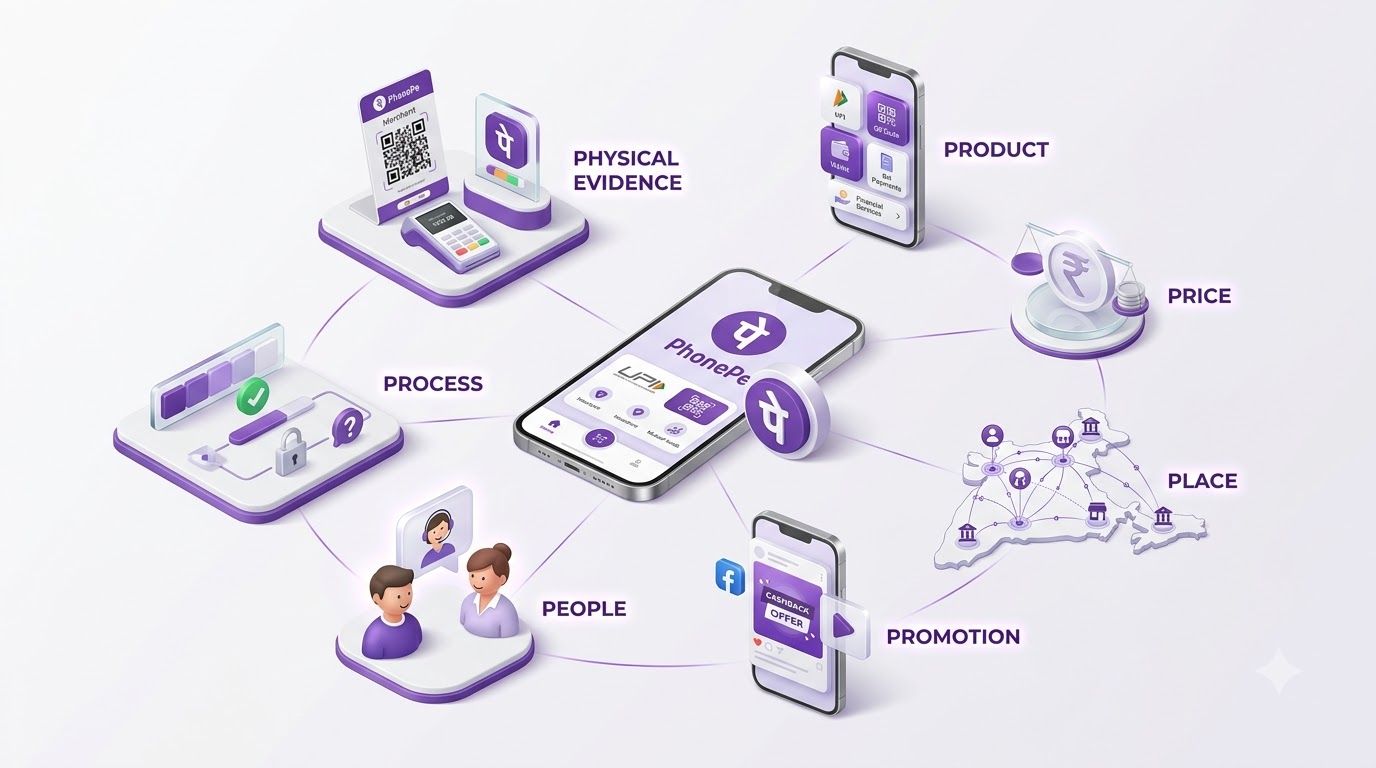
A marketing mix is simply the set of controllable decisions a company makes to get its product in front of the right people and get them to actually use it. The classic version is the 4Ps: Product, Price, Place, Promotion. For services, especially something like a fintech app where the “product” is invisible and trust matters more than packaging, marketers extended it to 7Ps by adding People, Process, and Physical Evidence. The marketing mix of PhonePe genuinely needs all seven, because a payments app lives or dies on things a physical product never has to worry about: what happens if a transaction fails at 2am, who picks up the phone when a merchant’s money doesn’t show up, and whether the app looks trustworthy enough that a fifty-year-old shopkeeper in Nagpur is willing to hand over their bank details to it.
The 7Ps Framework Explained in Plain Language
Product means what PhonePe actually offers beyond sending money, things like insurance, gold, and mutual funds bundled inside the same app. Price covers what it costs users and merchants to transact, including the invisible cost of merchant discount rates. Place is about where and how people can access PhonePe, from app stores to a physical QR sticker on a vegetable cart. Promotion is the advertising and campaigns that got the app downloaded in the first place. People refers to PhonePe’s engineering teams, sales force, and support staff. Process is the backend machinery, onboarding flows, KYC checks, settlement cycles. Physical Evidence is everything that makes an invisible service feel real and trustworthy, like the purple branding, the QR sticker, and the transaction sound.
Why PhonePe Is a Textbook Case Study for Marketers
Most marketing mix case studies are built around FMCG brands selling soap or biscuits, where the product sits on a shelf and you can literally touch it. PhonePe forces you to think differently because there’s nothing to touch. You can’t taste-test a UPI transfer. So every decision PhonePe made had to build trust and habit at the same time, in a market where most first-time users had never used a smartphone for banking before 2016. That combination, building a new behaviour and building trust in the same motion, is rare, and it’s exactly why business schools and marketing students keep coming back to this case.
A Quick History Before We Get Into the Marketing Mix of PhonePe

Context matters here because none of the marketing decisions make sense without knowing the timeline. PhonePe launched in August 2015, founded by Sameer Nigam, Rahul Chari, and Burzin Engineer, three guys who’d worked together at Flipkart before. Flipkart acquired PhonePe in April 2016, before it even had a public app, which gave it something almost no other UPI player had on day one: a massive existing customer base and serious capital backing from day zero.
The Founding Story and the Flipkart Acquisition
Sameer Nigam had led product at Flipkart earlier in his career, so he understood Indian e-commerce and consumer behaviour at a level most fintech founders didn’t. When Flipkart bought PhonePe for a reported figure north of twenty million dollars in 2016, it wasn’t just an acqui-hire. Flipkart wanted a payments layer it controlled, especially with Paytm growing close to Alibaba’s orbit and Amazon eyeing the Indian market aggressively. That acquisition meant PhonePe never had to fight for its first round of funding or its first million users the way a bootstrapped startup would have. It launched inside an ecosystem that already had scale.
The UPI Wave That PhonePe Rode Early and Rode Hard
The Unified Payments Interface, or UPI, launched by the National Payments Corporation of India in 2016, changed everything for apps like PhonePe. Before UPI, moving money between bank accounts digitally meant dealing with IMPS, NEFT, or wallets that couldn’t talk to each other. UPI created a common rail where any bank account could talk to any other bank account instantly, using a simple ID like a phone number or a custom handle. PhonePe was one of the earliest apps to build fully on top of UPI rather than running its own closed wallet system like Paytm initially did. That single architectural decision, betting on UPI early instead of building a closed wallet, turned out to be the single biggest strategic call in the entire marketing mix of PhonePe, because it meant PhonePe never had to convince users to “load money” into a separate wallet balance. Users could pay directly from their existing bank account, which removed a massive amount of friction.
Product Strategy in the Marketing Mix of PhonePe
Product is where most people assume PhonePe is “just an app that sends money.” That’s true only if you looked at it in 2016. By the time you’re reading this, PhonePe’s product stack looks more like a financial supermarket than a single payments tool, and that expansion wasn’t random. Each addition was designed to increase the amount of time users spent inside the app and the number of reasons they’d open it on a normal day, not just when they needed to pay someone.
Core UPI Payments and Why It’s Still the Anchor
Everything else in PhonePe’s product line sits on top of the core UPI payment function. Sending money to a friend, paying a shopkeeper, splitting a bill, recharging a phone, paying an electricity bill: these are the daily habit-forming actions that get someone to open PhonePe multiple times a week. Without nailing this basic function first, with fast load times, minimal failed transactions, and a UPI PIN flow that doesn’t confuse a first-time user, nothing else in the product stack would matter. PhonePe invested heavily in transaction success rates specifically because a failed payment at a shop counter, with a queue of people behind you, is the fastest way to lose a user forever.
Beyond Payments: Insurance, Mutual Funds, and Digital Gold
Once PhonePe had users opening the app regularly for payments, it started layering in financial products that most people previously accessed through banks, agents, or separate apps. PhonePe added mutual fund investments, digital gold purchases starting from amounts as small as one rupee, and insurance products covering things like health, life, and even mobile phone screen damage. The logic here is simple: acquiring a user through payments is expensive, so once you have their attention and their trust, you sell them more products through the same acquisition cost. This is basic cross-selling, but it works especially well in fintech because trust, once earned, transfers easily from “I trust this app to send my rent money” to “I trust this app to hold my mutual fund investment.”
PhonePe Switch and the Mini App Store Bet
In 2018, PhonePe launched Switch, essentially a mini app store inside the PhonePe app where users could access other services like Ola, Myntra, or Decathlon without leaving PhonePe or downloading separate apps. The idea copied WeChat’s mini-program model from China, where a single super app becomes the entry point for dozens of services. Switch never became the dominant force WeChat’s mini programs became in China, partly because Indian users were already comfortable with separate apps for separate tasks, but it signalled PhonePe’s ambition clearly: don’t just be a payments app, be the app people open first.
Merchant Side Products: Business App and POS Devices
Product strategy isn’t only about consumer-facing features. PhonePe built a separate Business app for merchants, giving shopkeepers a dashboard to track daily transactions, settlement status, and even simple analytics on their sales patterns. It also rolled out PhonePe branded POS devices and sound boxes, small speaker devices that announce “Rupees five hundred received” out loud when a payment lands, which solved a real trust problem for merchants who couldn’t watch their phone screen constantly while serving customers. That sound box, oddly enough, became one of the most effective physical trust signals in PhonePe’s entire toolkit, because it gave the merchant instant audio confirmation without needing to check a screen.
Price Strategy in the Marketing Mix of PhonePe
Pricing in a UPI-based app is genuinely strange compared to a normal product, because the core transaction is free for the end user by regulation. NPCI mandates zero charges on UPI person to person and most person to merchant transactions for users. So how does pricing even factor into the marketing mix of PhonePe if the core service can’t be priced? The answer is that PhonePe’s real pricing decisions happen on the merchant side, on the ancillary product side, and in the invisible cost of acquisition it pays through cashbacks and rewards.
Zero Cost Transactions for Users and Why That Was Never Optional
Because UPI is a public utility rail regulated by NPCI and backed by the RBI, no player, not PhonePe, not Google Pay, not Paytm, gets to charge users for basic UPI transfers. This wasn’t a generous choice PhonePe made to win customers. It was the rule of the game from day one. What PhonePe did control was how frictionless and fast that free transaction felt, and it invested engineering resources specifically into transaction success rates because a free service that fails often is worse than a paid service that works reliably.
The Merchant Discount Rate Battle That Nobody Talks About Enough
Here’s where it gets interesting. For years, UPI merchant transactions also carried zero Merchant Discount Rate, or MDR, meaning PhonePe couldn’t charge merchants a percentage cut either, unlike what Visa or Mastercard charge on card transactions. This zero MDR policy, introduced by the government to push UPI adoption, actually hurt PhonePe’s revenue model directly because the single biggest monetisation lever available to any payments company, taking a cut of transaction value, was regulated away. PhonePe had to build revenue elsewhere: through lending partnerships, insurance commissions, mutual fund distribution fees, and advertising within the app, rather than through the transactions themselves. This is a genuinely rare situation in business where the core product had to be priced at zero by law, forcing the entire monetisation strategy sideways into adjacent products.
Cashback Campaigns as a Customer Acquisition Cost, Not a Discount
When PhonePe ran its scratch card and cashback campaigns in the early years, that wasn’t a pricing discount in the traditional sense. It was customer acquisition cost, dressed up as a reward. Every rupee handed out in cashback was effectively PhonePe paying for a new user or a repeat transaction, calculated against the lifetime value it expected to extract later through cross-selling insurance, gold, or lending products. This is why the cashback amounts were often small, five or ten rupees, random and unpredictable through the scratch card mechanic, rather than large fixed discounts. Behavioural psychology around variable rewards, similar to a slot machine, kept users transacting more often to see what they’d win next, which is a far cheaper way to drive repeat usage than handing out flat discounts.
Place and Distribution Strategy in the Marketing Mix of PhonePe
Distribution for a digital product sounds like it should just mean “available on the App Store and Play Store,” but that’s a lazy answer for a company operating in India, where a huge chunk of the target audience doesn’t discover apps through app store search. PhonePe’s distribution strategy had two completely different battles to fight: getting the app onto phones, and getting QR codes onto physical counters across a country of over a billion people.
App Store Presence, Pre-Installs, and Easy Onboarding
PhonePe made early deals to get pre-installed on certain Android phones sold in India, particularly budget smartphones from brands popular in tier 2 and tier 3 cities. This matters more than it sounds like, because a huge segment of first-time smartphone buyers in India never actively search app stores; they use whatever comes pre-loaded or whatever their local phone shop guy sets up for them during purchase. Beyond pre-installs, PhonePe simplified its onboarding flow aggressively, cutting the number of steps between download and first successful transaction, because every extra screen in that flow was a point where a nervous first-time user could drop off.
The Offline QR Code Army That Built PhonePe’s Real Moat
This is the part of PhonePe’s distribution strategy that competitors genuinely struggled to copy fast enough. PhonePe built one of the largest offline merchant QR networks in India, sending feet-on-street sales agents into small towns and even villages to onboard local shopkeepers, one at a time, sticker by sticker. This wasn’t glamorous work. It involved a salesperson sitting with a paan shop owner explaining what a QR code even is, helping them download the Business app, and physically sticking a laminated QR code near the till. Doing this across tens of thousands of towns, at scale, requires serious operational muscle, not just advertising budget. That offline density is exactly why, even today, PhonePe QR stickers outnumber competitors in a lot of smaller markets, and why a user who’s used to scanning a PhonePe code at their regular shop rarely bothers switching apps for a marginally better cashback elsewhere.
Tier 2 and Tier 3 City Penetration as a Deliberate Choice
Metro cities like Mumbai, Delhi, and Bangalore get saturated fast with any new fintech product because urban users are early adopters by default. The real growth in Indian digital payments over the last several years has come from tier 2 and tier 3 towns, places like Indore, Coimbatore, and Siliguri, where smartphone and internet penetration caught up later but grew faster. PhonePe deliberately pushed distribution resources into these markets earlier than some competitors, betting correctly that whoever became the “default” app in a small town first would be very hard to dislodge later, because switching payment apps involves real friction once your shopkeeper relationships are already built around one QR code.
Promotion Strategy in the Marketing Mix of PhonePe
Promotion is probably the most visible part of the marketing mix of PhonePe to an average consumer, because it’s the ads, the jersey sponsorships, and the scratch cards people actually remember. But underneath the flashy campaigns, PhonePe’s promotion strategy followed a clear arc: build initial habit through gamified rewards, then shift toward trust and mass reach once the user base matured.
The Scratch Card Era That Defined Early PhonePe Usage
Anyone who used PhonePe between 2017 and 2019 remembers the scratch card. Every transaction, sometimes even a failed one, triggered a little animated card you’d scratch on screen to reveal a random cashback amount. This single UX element did more for PhonePe’s transaction frequency than almost any billboard campaign could have. It turned a mundane act, paying an electricity bill, into a tiny moment of anticipation. Competitors copied the mechanic quickly, but PhonePe’s early execution and consistency with it built a habit loop that stuck.
Sports Sponsorships: IPL, Team India, and Cricket’s Mass Reach
PhonePe went big on cricket sponsorships, including association with the Indian cricket team and IPL advertising slots, because cricket remains the single fastest way to reach a mass, pan-India, multi-language audience in one shot. A thirty second ad during an IPL match reaches grandmothers in Kerala and college students in Punjab in the same evening, something no digital-only ad campaign can replicate at that scale in India. This wasn’t about brand image the way a car company might sponsor cricket for prestige. It was blunt-force reach, aimed at making “PhonePe” a household name pronounced correctly even by people who’d never used a UPI app before.
Regional Language Advertising and Why It Mattered More Than English Campaigns
A huge part of PhonePe’s promotional budget went toward advertising in regional languages, Tamil, Telugu, Marathi, Bengali, Kannada, rather than assuming English or Hindi ads would work nationwide. This decision recognised something a lot of Bangalore-headquartered startups get wrong: India isn’t one market, it’s dozens of linguistic markets stitched together, and a fifty-five-year-old shop owner in rural Tamil Nadu trusts an ad in Tamil far more than a slick English one. Running localized campaigns is expensive and operationally messy, but it directly supported the offline merchant onboarding push, because a shopkeeper who’d already seen a PhonePe ad in their own language was easier for a sales agent to convince.
Festive and Seasonal Campaigns Tied to Real Spending Moments
PhonePe timed a lot of its bigger promotional pushes around Diwali, Holi, and other festival seasons, when Indian consumer spending genuinely spikes for shopping, gifting, and travel. Running a cashback-heavy campaign during Diwali isn’t just about seasonal goodwill messaging; it’s about capturing transaction volume during the exact weeks when people are spending the most money anyway, maximizing the return on every rupee spent on promotion.
People Strategy in the Marketing Mix of PhonePe
It’s easy to forget that a fintech app is still run by actual people making decisions, writing code, sitting across a counter from a shopkeeper, and answering a support call at 11pm when someone’s salary hasn’t shown up in their account. The people dimension of PhonePe’s marketing mix covers three very different groups: the engineering and product teams, the on-ground sales force, and customer support.
Engineering Talent and the Culture Behind Reliability
PhonePe built its reputation partly on transaction reliability, and that doesn’t happen without serious engineering investment. The company hired aggressively from top Indian engineering institutes and poached senior talent from Flipkart, given the shared founding team background. A payments system handling tens of millions of transactions daily has zero room for the kind of “move fast and break things” culture that works for a social media app; a broken transaction means someone’s real money is stuck, possibly their rent or their child’s school fee. That reliability-first engineering culture is a people decision as much as it’s a technical one, and it directly protects the trust that the entire brand depends on.
The On-Ground Sales Force Behind Merchant Onboarding
Nobody talks enough about how many actual human beings PhonePe employed or contracted just to walk into shops and convince owners to accept digital payments. This wasn’t a desk job. Sales agents had to explain UPI to shopkeepers who’d never used a smartphone for business, handle objections about fraud and complexity, and physically install QR stickers. The quality, training, and incentive structure of this sales force directly determined how fast PhonePe’s offline network grew in any given region, making them just as important to the marketing mix as any ad campaign.
Customer Support as a Trust-Building Function
When money goes missing, even temporarily, users panic. A refund that takes two days instead of two hours can turn a loyal user into someone who deletes the app and switches to a competitor out of fear. PhonePe invested in support infrastructure, in-app chat support, an IVR system, and escalation processes for high-value merchant disputes, because in fintech, support isn’t a cost centre to be minimized, it’s a trust mechanism that determines whether users feel safe keeping their financial life inside the app.
Process Strategy in the Marketing Mix of PhonePe
Process refers to everything happening behind the scenes that a user never sees directly but absolutely feels the effect of. In a payments company, process failures are the fastest way to destroy trust, because unlike a late food delivery, a failed or delayed payment involves someone’s actual money.
The User Onboarding Process and KYC Flow
Getting a new user from app download to a completed first transaction involves linking a bank account, verifying a mobile number, setting a UPI PIN, and in many cases completing KYC, or Know Your Customer, verification using an Aadhaar or PAN card. PhonePe worked to compress this flow as much as regulation allowed, because every additional step is a point of drop-off. A confusing KYC screen at 9pm, when someone just wants to pay for groceries, is enough to make them switch to whichever app their friend recommended instead.
Merchant Settlement Process and Why Speed Matters
For merchants, the process that matters most isn’t the payment itself, it’s how fast that money actually lands in their bank account and how clearly they can track it. A shopkeeper running on thin margins can’t afford confusion about whether yesterday’s transactions have settled. PhonePe built dashboard tools inside its Business app specifically to give merchants clarity on settlement timing, because merchant trust in the settlement process directly determines whether they keep the QR code taped to their counter or rip it down for a competitor’s.
Fraud Detection and Risk Process Behind the Scenes
As transaction volume grew into the hundreds of millions per month, fraud attempts grew right alongside it, from fake QR codes to social engineering scams where fraudsters trick users into approving payment requests disguised as receiving money. PhonePe had to build increasingly sophisticated risk detection systems, flagging suspicious transaction patterns in real time, without slowing down the millions of completely legitimate transactions happening at the same time. Getting this balance wrong in either direction, too strict and legitimate users get blocked, too loose and fraud slips through, directly damages the brand’s core promise of being a safe place to keep your money moving.
A lot of this risk process work happens completely invisibly to a normal user. Behind every transaction, PhonePe’s systems check for things like unusual transaction velocity from a single device, mismatched geolocation signals, and patterns that match known scam templates circulating at that moment. When a fraud pattern spikes in one part of the country, say a fake customer care number scam doing the rounds in Kerala, the response usually involves both a backend detection tweak and a fresh round of in-app safety pop-ups warning users specifically about that scam type. That combination of automated detection and manual, fast-turnaround user education is what keeps the fraud rate from spiralling even as absolute transaction volume keeps climbing year after year.
Physical Evidence in the Marketing Mix of PhonePe
Physical evidence is the trickiest of the 7Ps to apply to a digital-first company, because there’s no store shelf, no packaging, no physical retail experience in the traditional sense. But PhonePe actually has more physical evidence than people initially assume, and each piece does real work in building trust.
App Interface, Colour, and Design as Trust Signals
The deep purple and white colour scheme of PhonePe isn’t just a branding choice made for aesthetics. Consistent, simple visual design across every screen reduces cognitive load for a first-time user who might already be nervous about digital payments. Clean interfaces with large, obvious buttons for “Send Money” or “Scan QR” reduce the chance of a fumbled transaction, which matters enormously when the user base includes people using a smartphone for financial tasks for the very first time in their lives.
The QR Sticker and Sound Box as Physical Trust Anchors
The laminated QR sticker on a shop counter and the little speaker box announcing payments out loud aren’t just functional tools, they’re physical proof of legitimacy. A shop with a visible, slightly worn QR sticker signals to customers “this place accepts digital payments regularly,” which is a subtle but real trust cue, similar to how a card machine on a counter signals legitimacy in Western retail contexts. The audio confirmation from the sound box does double duty too: it reassures the customer their payment went through and reassures the merchant without them needing to stare at a phone screen constantly.
Brand Consistency Across Offline and Online Touchpoints
From the app icon to the QR sticker to the cricket jersey sponsorship to the customer support chat window, PhonePe kept its visual identity remarkably consistent. This matters because trust in fintech is built cumulatively across many small touchpoints, not from one single ad. Someone who sees the same purple logo on a cricket broadcast, then on their local shop’s counter, then on their own phone screen, builds familiarity through repetition, and familiarity is a large part of what makes people comfortable handing over financial trust to a brand.
Funding, Valuation, and How Capital Shaped the Marketing Mix of PhonePe
It’s worth pausing on money for a second, because a lot of the aggressive marketing moves described above, the cashback campaigns, the cricket sponsorships, the army of offline sales agents, cost real cash, and none of that would have been possible without serious capital sitting behind PhonePe.
Flipkart, Walmart, and the Deep Pockets Behind the Scenes
Once Flipkart acquired PhonePe in 2016, and Walmart later acquired a majority stake in Flipkart in 2018, PhonePe effectively had access to one of the deepest-pocketed retail parents in the world. This mattered enormously for the marketing mix, because subsidizing millions of cashback transactions, running national television ad campaigns, and paying thousands of field agents to onboard merchants all require sustained cash burn over years before any of it turns profitable. Startups without that kind of backing often have to slow down growth marketing the moment investor patience runs thin. PhonePe didn’t face that same pressure for a long stretch of its growth phase.
The Move to an Independent, India-Domiciled Structure
More recently, PhonePe restructured to become a separate, India-domiciled entity, raising its own funding rounds from investors like General Atlantic and others, rather than sitting purely as a Flipkart subsidiary. This shift matters for the marketing mix going forward because independent investors evaluating PhonePe on its own merits, ahead of a potential public listing, tend to push harder for demonstrable revenue growth rather than pure user acquisition numbers. Expect the marketing mix to keep tilting further toward monetizable products, insurance, lending, wealth management, rather than pure top-of-funnel cashback spending, as this shift plays out.
Marketing Mix of PhonePe vs Google Pay vs Paytm: A Direct Comparison
Comparing PhonePe against its two biggest rivals makes the strategic differences a lot clearer, because all three companies had access to roughly the same UPI infrastructure but made very different marketing mix decisions around it.
Product Comparison Across the Three Apps
Google Pay stayed relatively lean on product for a long time, focusing almost entirely on peer-to-peer and merchant payments with minimal cross-selling into insurance or investments, largely because Google’s global product philosophy tends toward simplicity over aggressive bundling. Paytm went the opposite direction from the start, building out a wallet, an e-commerce marketplace, a payments bank, and later a stock trading app, arguably spreading itself thinner than PhonePe’s more focused expansion into adjacent financial products. PhonePe sat in the middle, expanding deliberately into insurance, gold, and mutual funds without trying to become an e-commerce player the way Paytm did.
Distribution Comparison and the Offline Battle
This is where PhonePe’s edge shows most clearly. Google Pay historically under-invested in offline merchant sales relative to PhonePe, relying more on its brand recognition and Android integration to drive downloads. Paytm actually had an earlier offline merchant push, since it started well before UPI even launched, using its own wallet QR codes from around 2014 onward. But PhonePe’s aggressive expansion into smaller towns in the years following UPI’s launch let it catch up and, in many markets, overtake Paytm’s offline density, particularly as Paytm dealt with regulatory issues around its payments bank license later on.
Digital Marketing Tactics Inside the Marketing Mix of PhonePe
Beyond the big-picture 7Ps, PhonePe ran a whole layer of day-to-day digital marketing work that rarely gets discussed in case studies but actually drove a huge chunk of its download numbers and repeat usage. This layer sits mostly inside Promotion and Place, but it deserves its own space because it’s the part most marketers can copy directly, regardless of industry.
App Store Optimization and Why Ranking High Mattered
Getting found on the Play Store and App Store when someone searches “UPI app” or “send money app” required real App Store Optimization work: keyword-rich app titles and descriptions, high-quality screenshots showing the QR scan feature and cashback screen, and a steady stream of positive reviews to keep the star rating above competitors. A lower star rating or a confusing app store listing loses downloads before a user even opens the app once, so PhonePe treated its app store presence as an active marketing channel, not a passive listing to set up once and forget.
Social Media Presence and Meme-Friendly Content
PhonePe’s social media accounts on platforms like Instagram and Twitter leaned into lighthearted, meme-adjacent content around Indian spending habits, festival shopping, and relatable money jokes, rather than dry corporate announcements. This tone matched the demographic PhonePe needed to keep engaged: younger, urban users who share funny content in group chats, extending reach organically without extra ad spend. A post that gets shared thirty thousand times for being genuinely funny does more for brand recall among twenty-something users than a banner ad ever could.
Influencer and Creator Partnerships for Trust Building
As influencer marketing matured in India, PhonePe worked with creators across YouTube and Instagram, particularly finance-focused creators explaining things like how mutual funds work or how digital gold investment compares to physical gold. This served two purposes at once: it drove awareness of PhonePe’s newer financial products beyond payments, and it borrowed the creator’s existing trust with their audience, which is often more persuasive than a branded ad for financial products specifically, since money decisions are personal and people trust recommendations from someone they already follow over a company talking about itself.
Search and Content Marketing Around Financial Literacy
PhonePe also invested in educational content, blog posts, in-app explainers, and short videos, teaching users what UPI actually is, how digital gold pricing works, or how to read a mutual fund’s past performance. This wasn’t charity. Financial literacy content ranks well in search for terms like “what is UPI” or “how to buy digital gold,” pulling in organic traffic from people who are still in the research phase before making their first transaction, and positioning PhonePe as the trustworthy source right at the moment someone is deciding whether to try digital payments at all.
Promotion Comparison and Spending Philosophy
Paytm was famous in its early years for splashing its founder, Vijay Shekhar Sharma, across ad campaigns personally, building a founder-led brand image similar to how some Western tech founders operate. PhonePe kept a lower-profile, product-and-reach-focused promotion style, leaning on cricket, festival campaigns, and the scratch card mechanic rather than founder visibility. Google Pay’s promotion in India has generally been the quietest of the three, relying more on its default presence on Android devices and word-of-mouth trust in the Google brand than on heavy standalone ad campaigns. These three different promotion philosophies, founder-led, product-and-reach-led, and platform-trust-led, show there’s more than one valid way to win attention in a crowded fintech market, depending on what assets a company already has.
Challenges Facing the Marketing Mix of PhonePe Right Now
No case study is complete without looking at what’s actually going wrong, because a marketing mix isn’t a static thing that gets built once and left alone. It’s a set of decisions that has to keep adjusting as the market, regulation, and competition shift.
The Zero MDR Policy Squeeze on Revenue
The government’s zero MDR mandate on UPI transactions, discussed earlier under pricing, remains one of the biggest structural challenges for PhonePe’s business model. Processing hundreds of millions of transactions monthly with zero direct transaction revenue means the company has had to lean heavily on other lines, like lending distribution and insurance commissions, to build a sustainable business. There have been ongoing industry conversations about the government introducing some form of MDR or incentive structure to support UPI infrastructure costs, but as of now, the core transaction remains a cost centre rather than a revenue line for PhonePe.
Competition From a Genuinely Free, Well-Funded Rival in Google Pay
Google Pay doesn’t need UPI payments in India to be profitable on their own, because Google can subsidize the product using revenue from its global advertising business. That’s a genuinely different competitive position than PhonePe, which needs its India payments business to eventually justify its own economics, especially after Flipkart and Walmart’s ownership structure and PhonePe’s eventual move toward an independent, India-domiciled entity ahead of a planned public listing. Competing against a rival that doesn’t face the same profitability pressure is a real structural challenge baked into the market, not something a clever ad campaign fixes.
Trust and Fraud Issues That Never Fully Go Away
As UPI fraud, including fake customer care numbers, screen-sharing scams, and QR code tampering, has grown across the industry, PhonePe has had to keep investing in user education campaigns warning people not to share OTPs or approve unfamiliar payment requests. This is a never-ending arms race. Every new fraud pattern that emerges requires a fresh round of in-app warnings, support escalation processes, and sometimes public awareness campaigns, and any single major fraud incident that goes viral on social media can damage trust built over years in a matter of days.
This trust problem gets harder, not easier, as PhonePe’s user base grows into demographics with lower digital literacy. A college student who grew up with smartphones can usually spot a suspicious payment request. A first-time smartphone user in their sixties, using PhonePe mainly because their children set it up for them, is a much easier target for scammers, and a single bad experience in that demographic spreads fast through word of mouth within families and neighbourhoods, doing outsized damage to trust relative to the actual number of people affected.
Regulatory Uncertainty and Policy Dependence
Because PhonePe’s entire core business sits on top of a government-built payment rail, it’s unusually exposed to regulatory decisions outside its own control. Changes to KYC requirements, transaction limits, data localization rules, or even discussions around introducing MDR on UPI transactions can reshape the economics of the business overnight, in a way that a company selling a product it fully controls simply doesn’t have to worry about. This dependence means PhonePe’s marketing and business teams have to stay unusually close to policy conversations happening at NPCI and the RBI, adjusting the marketing mix reactively whenever the regulatory ground shifts.
Lessons Marketers Can Actually Take From the Marketing Mix of PhonePe
Stepping back from PhonePe specifically, there are genuinely transferable lessons here for anyone building or marketing a product, especially in a market like India where infrastructure and consumer behaviour vary wildly across regions.
Build the Habit Before You Try to Monetize It
PhonePe spent years subsidizing transactions through cashback and scratch cards before seriously pushing revenue-generating products like insurance and mutual funds. That sequencing wasn’t accidental. Trying to monetize a habit that hasn’t formed yet almost always backfires, because users haven’t developed the muscle memory or trust needed to accept a paid upsell. Build the daily habit first, worry about monetization once the habit is unbreakable.
Localize Aggressively Instead of Assuming One Language or City Represents the Whole Market
The regional language advertising push and the deliberate focus on tier 2 and tier 3 cities reflect a lesson that applies well beyond fintech: a country as linguistically and economically diverse as India can’t be marketed to as one homogenous block. Whatever market you’re in, check whether you’re accidentally building your entire strategy around the assumptions of one city or one language group, because that’s usually where growth ceilings quietly appear.
Own the Offline Channel Even When Your Product Is Digital
It’s tempting for a digital-first company to assume offline distribution doesn’t matter, but PhonePe’s QR sticker army proves the opposite. Sometimes the biggest competitive moat isn’t a better app feature, it’s the unglamorous, expensive, operationally heavy work of physically showing up in places your competitors haven’t bothered to reach yet.
Conclusion
Put all seven pieces together and the picture becomes clear: PhonePe didn’t win the UPI race through one clever trick. It stacked a habit-forming product, a pricing structure forced by regulation but managed smartly around the edges, an aggressive offline distribution push that competitors underestimated for years, mass-reach promotion tied to cricket and festivals, a reliability-obsessed engineering culture, tight merchant-facing processes, and consistent physical trust signals, and let all of it compound together over nearly a decade. The marketing mix of PhonePe works as a case study precisely because none of the seven levers alone would have been enough. It took all of them, pulled in the same direction, at the same time, for years, to build what’s now one of the most recognisable financial brands in the country. Anyone studying this case should walk away with one clear takeaway: a strong marketing mix isn’t about picking the flashiest lever and pulling hard on it, it’s about getting every single lever right and keeping them consistent long enough for trust to build.
Frequently Asked Questions
What is the marketing mix of PhonePe based on?
The marketing mix of PhonePe is best analyzed using the 7Ps framework rather than the classic 4Ps, because it’s a service business. That means looking at Product, Price, Place, Promotion, People, Process, and Physical Evidence together, since a fintech app depends heavily on trust and reliability, not just advertising and pricing.
Why does PhonePe not charge for UPI transactions?
UPI transactions between individuals and most merchant categories carry zero charges by regulation, set by the National Payments Corporation of India and supported by government policy to encourage digital payment adoption. PhonePe, along with every other UPI app, has no choice in this matter for standard person-to-person or person-to-merchant transfers.
How does PhonePe make money if UPI transactions are free?
PhonePe generates revenue through non-transaction sources, including commissions from insurance product sales, distribution fees from mutual fund investments, lending partnerships where it earns a referral or servicing fee, advertising placements within the app, and its Business app tools for merchants. The core UPI transfer itself does not generate direct revenue.
Is PhonePe more popular than Google Pay in India?
For several years, PhonePe has held the largest share of UPI transaction volume in India, ahead of Google Pay, based on data regularly published by NPCI. Market share shifts over time, so it’s worth checking the most recent NPCI data for current figures, but PhonePe’s offline merchant network has historically given it an edge in transaction volume.
What is the role of the QR code sticker in PhonePe’s marketing strategy?
The QR code sticker serves both a functional and a promotional purpose. Functionally, it lets any customer pay a merchant instantly using any UPI app, since QR codes are interoperable. Promotionally, a PhonePe-branded sticker acts as a constant, low-cost advertisement at the point of sale, reinforcing brand visibility every time a customer visits that shop, even if they end up using a different UPI app to actually scan it.
Why did PhonePe sponsor cricket and the Indian cricket team?
Cricket sponsorship gave PhonePe access to a mass, pan-India audience across every state and language group in a single broadcast, something almost no other advertising channel can replicate in India. Given that trust and brand recognition matter enormously for a payments app, especially among first-time digital payment users, cricket sponsorship was a direct way to build nationwide brand recall quickly.
What is PhonePe Switch and is it still relevant?
PhonePe Switch was a mini app store launched in 2018, allowing users to access services from other companies, like ride booking or online shopping, without leaving the PhonePe app. It was inspired by the mini-program model popularized by WeChat in China. It hasn’t reached the same dominance in India, since Indian users remain comfortable using separate dedicated apps, but it remains part of PhonePe’s broader super-app ambitions.
How did PhonePe expand into small towns and rural India?
PhonePe built a large field sales force that physically visited shops in tier 2, tier 3, and even smaller towns to onboard merchants onto its QR code system. This involved explaining how UPI worked to shopkeepers unfamiliar with digital payments, helping install the Business app, and physically placing QR stickers at checkout counters, a slow but effective way to build offline distribution density.
What financial products does PhonePe offer besides UPI payments?
Beyond core payments, PhonePe offers digital gold purchases starting from very small amounts, mutual fund investments, insurance products covering health, life, and device protection, and lending products through partner financial institutions. These additions were designed to increase the value PhonePe extracts from an already-acquired, trusted user base.
What challenges does PhonePe currently face in its marketing mix?
The biggest structural challenge is the zero Merchant Discount Rate policy on UPI transactions, which removes the most obvious revenue lever available to payments companies elsewhere in the world. PhonePe also faces intense competition from Google Pay, which is backed by Google’s global advertising revenue and doesn’t face the same profitability pressure, plus an ongoing battle against UPI-related fraud that requires constant user education and risk system upgrades.
Is PhonePe planning to go public, and how does that affect its marketing strategy?
PhonePe restructured its ownership to become an India-domiciled entity, separate from its parent Flipkart Walmart structure, largely to prepare for a future public listing on Indian stock exchanges. This kind of move typically pushes a company toward demonstrating clearer, sustainable revenue streams beyond subsidized growth tactics like cashback campaigns, which is part of why cross-selling into insurance, lending, and investment products has become increasingly important to PhonePe’s business model over time.
How does PhonePe compare to Paytm in terms of marketing strategy?
Paytm started earlier, before UPI even existed, using its own closed wallet system and building out a much broader business including e-commerce and a payments bank. PhonePe entered slightly later but built directly on UPI rails from the start and focused its product expansion more narrowly on payments plus adjacent financial products, without diversifying into e-commerce. PhonePe’s offline merchant push eventually matched or exceeded Paytm’s in many regions, especially as Paytm dealt with regulatory setbacks around its payments bank license.
What is the sound box and why did PhonePe introduce it?
The PhonePe sound box is a small speaker device installed at a merchant’s counter that announces the amount received out loud in the local language whenever a payment lands. It solves a real problem for busy shopkeepers who can’t watch their phone screen constantly while serving customers, giving instant audio confirmation instead. It also acts as a subtle, repeated brand reminder every single time a customer pays at that shop.
Does PhonePe target rural India differently from urban India?
Yes. PhonePe’s marketing mix treats rural and small-town India quite differently from metro cities, relying much more heavily on in-person merchant onboarding, regional language advertising, and offline QR code distribution in smaller towns, compared to a more app-store and digital-ad-driven approach that works fine in metro areas where smartphone literacy and existing digital payment habits are already higher.