


If you have spent any time around the outsourcing or business process management industry, you have run into Genpact somewhere. Maybe you saw it on a client’s vendor list. Maybe you interviewed with them. Maybe you are a student trying to figure out how a company that started as a back-office unit inside General Electric turned into a $5 billion global services firm listed on the NYSE. Whatever brought you here, the question usually comes down to the same thing: is Genpact actually a strong company to bet on, work for, or partner with, or is it coasting on a legacy name in an industry that is getting eaten alive by automation and AI?

That is exactly what a SWOT analysis is supposed to answer. Not a glossy brochure version, but a real one, where you look at what the company is genuinely good at, where it is exposed, where the growth is actually coming from, and what could knock it off course in the next few years. Genpact is a particularly interesting case for this kind of exercise because it sits at a weird crossroads. It was born out of GE Capital’s internal process reengineering unit back in the late 1990s, spun off in 2004-2005, and has spent the last two decades rebuilding itself from a low-margin BPO shop into something it now calls an “agentic AI” and advanced technology services company. That is a big transformation story, and like most transformation stories, it is only half finished.
This guide walks through Genpact’s business the way an analyst, a recruiter, or a competitor would actually look at it. We are not going to lean on vague phrases like “industry-leading” or “world-class capabilities.” We are going to look at actual revenue numbers, actual client concentration risk, actual competitors, and actual moves the company has made in the last two or three years, including its acquisitions and its bet on generative and agentic AI. By the end, you should have a clear, honest picture of where Genpact stands, not a marketing pitch.
One more thing before we get into it. SWOT frameworks get a bad reputation because a lot of people fill them in lazily, tossing “strong brand” into strengths and “competition” into threats without saying anything specific. That is not useful to anyone. So every section here tries to name names, cite real figures from Genpact’s own financial filings, and explain why a particular point matters instead of just stating that it exists.
There is also a bigger reason this particular company is worth studying closely right now, beyond just Genpact itself. Genpact is a decent proxy for what is happening across the entire business process outsourcing industry as generative and agentic AI tools mature. WNS, EXL, TTEC, and a dozen other outsourcing firms are wrestling with the exact same question Genpact is wrestling with: how much of the traditional headcount-driven service model survives the next five years, and can a legacy provider actually out-execute a wave of AI-native startups that have no legacy headcount to protect. If you understand how Genpact is positioned on that question, you understand a lot about where the whole industry is headed, not just one company’s stock chart.
What You Will Learn in This Guide
- How Genpact evolved from a GE back-office unit into an independent, publicly traded technology services company
- A breakdown of Genpact’s core strengths, including its process expertise, its Data-Tech-AI segment, and its global delivery footprint
- The real weaknesses in Genpact’s model, from client concentration to margin pressure in commoditized BPO work
- Where the actual growth opportunities are, particularly around agentic AI, and which acquisitions built that capability
- The threats facing Genpact, including AI-driven disruption of the very services it sells and intense competition from IT majors
- How Genpact stacks up against rivals like Accenture, TCS, Infosys, WNS, and EXL
- What this analysis means in practical terms if you are an investor, a job seeker, or a company evaluating Genpact as a vendor
- Answers to the most common questions people ask about Genpact’s business model and financial position
Company Overview: Who Is Genpact, Really
Before you can judge a company’s strengths and weaknesses, you need to understand what it actually does and where it came from. A lot of people assume Genpact is “just another Indian BPO,” and that assumption is out of date by about fifteen years. Here is the actual story.
From GE Capital to Independent Giant
Genpact did not start as a startup chasing venture funding. It started in 1997 as GE Capital International Services, an internal unit built to handle GE’s own back-office processes: finance, accounting, collections, and customer service work that GE wanted done cheaper and faster, mostly out of India. For years it was not even a separate company, just a cost center that got very good at process reengineering because that was literally its job description. In 2004, General Electric spun the unit off as a separate company, and by 2005 it was operating under the name Genpact, majority owned by private equity firms General Atlantic and Oak Hill Capital, with GE retaining a minority stake. Genpact went public on the New York Stock Exchange in 2007 under the ticker G.
That GE lineage matters more than people give it credit for. It means Genpact’s DNA is not “call center vendor,” it is “process reengineering unit that happened to serve one of the most operationally demanding companies on earth.” Six Sigma, Lean, process mapping, that whole toolkit came baked into the company from day one, and it still shows up in how Genpact pitches itself to clients today.
What Genpact Actually Does Today
Genpact now describes itself as an “agentic and advanced technology services” company, which is a mouthful, but the underlying business breaks down into two reporting segments as of 2025: Advanced Technology Solutions and Core Business Services (the company also still reports the older Data-Tech-AI and Digital Operations split for comparison purposes). In plain terms, Core Business Services is the traditional outsourced work: finance and accounting, procurement, supply chain, customer service operations, and industry-specific processes like insurance claims handling. Advanced Technology Solutions is the newer, faster-growing piece: data engineering, AI and generative AI implementation, cloud modernization, and software engineering services.
The client list includes some of the largest companies in banking, insurance, healthcare, consumer goods, and manufacturing. Genpact does not usually name individual client revenue figures publicly beyond broad categories, but its 10-K filings note that a meaningful share of revenue still comes from financial services, and GE itself, while no longer the parent, has historically remained one of its largest customers under long-term contracts.
Genpact By The Numbers (2025)
Numbers ground a SWOT analysis in reality, so here is where things stood at the end of fiscal 2025, based on Genpact’s own reported results. Net revenue for the full year came in at $5.08 billion, up 6.6% year over year (6.4% on a constant currency basis). Advanced Technology Solutions revenue hit $1.204 billion, up a sharp 17.0%, while Core Business Services grew a much slower 3.7% to $3.876 billion. Average headcount for the year rose to roughly 146,000 employees, up from about 135,400 in 2024. Adjusted diluted earnings per share came in at $3.65, up 11.3%, and the board raised the quarterly dividend by 10% heading into 2026. Gross margin sat around 36%.
If you only remember one number from this section, remember the growth gap between the two segments: 17% versus under 4%. That single fact tells you almost everything about where this company’s future is being written, and it sets up a lot of what follows in the strengths and weaknesses sections below.
SWOT Analysis of Genpact: The Framework Explained
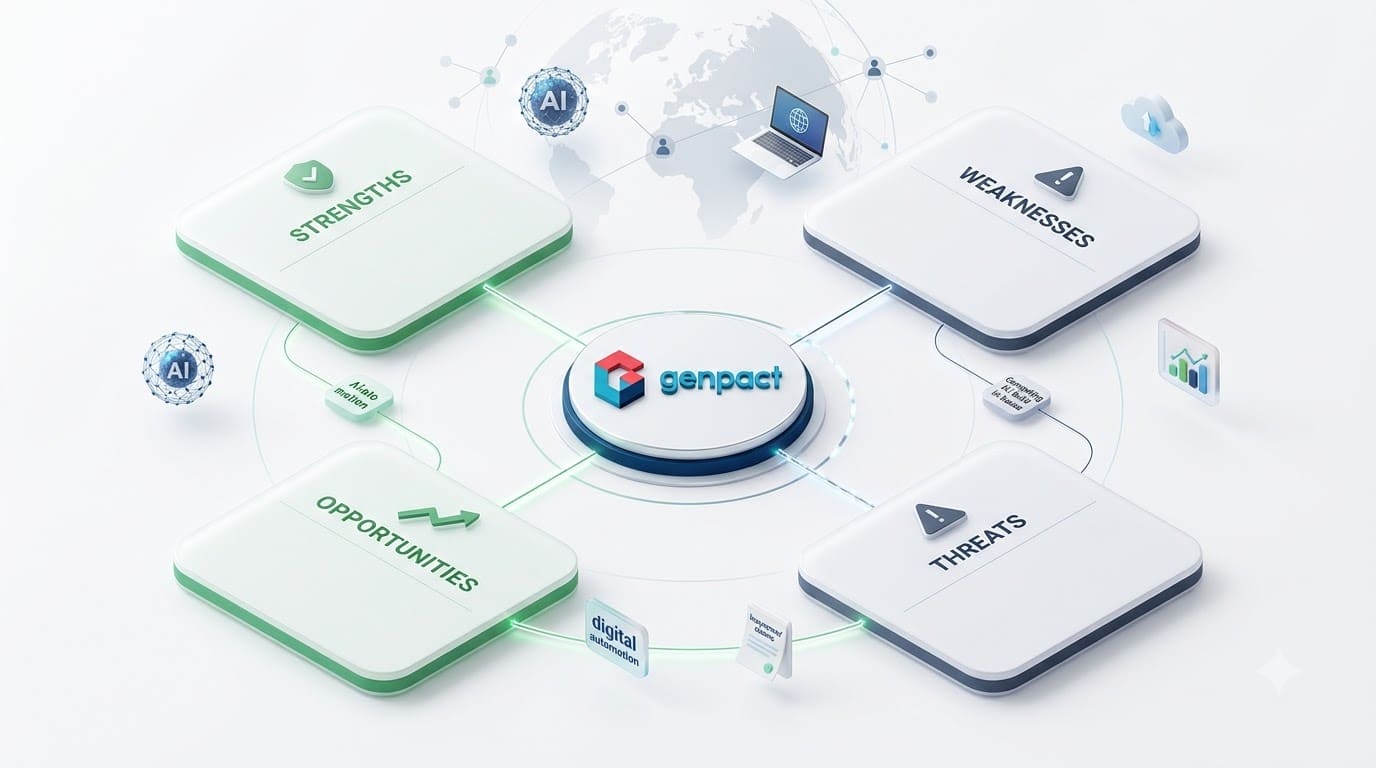
Before diving into each quadrant, it helps to be clear about what a SWOT analysis of Genpact should actually accomplish. Strengths and weaknesses are internal, they are about the company’s own capabilities, cost structure, and client relationships. Opportunities and threats are external, they are about the market Genpact operates in, including competitors, technology shifts, and macroeconomic conditions. A good SWOT does not just list four boxes of buzzwords. It connects them. A strength like “deep domain expertise in insurance claims” only matters because there is an opportunity in insurers wanting AI-driven claims automation, and it only matters as a defense because there is a threat of AI tools letting insurers build that automation in-house.
Why SWOT Still Matters for a Company Like Genpact
Some people think SWOT is an outdated business school exercise, and honestly, when it is done badly, it kind of is. But for a company in the middle of a business model transition, like Genpact clearly is, it is one of the few frameworks that forces you to hold two truths at once: the legacy business is still the majority of revenue, and the new business is where the growth and the market’s attention actually sits. That tension between old and new is the entire story of Genpact right now, and SWOT is a decent lens for examining it without pretending the transition is finished.
Strengths of Genpact
Genpact’s strengths are not accidental. They come from thirty years of doing one type of work over and over for demanding clients, and from a series of deliberate bets made over the last five to seven years. Here is where the company genuinely has an edge.
Decades of Process Expertise from the GE Days
This is the strength that everything else is built on. Genpact was not assembled by a private equity firm buying random call centers and slapping a logo on them. It grew out of GE’s internal Six Sigma and Lean process reengineering culture, and that shows in how it approaches client work even today. When Genpact takes over a finance and accounting function or a claims process for a client, its pitch is not just “we’ll do it cheaper,” it’s “we will map the process, find the waste, and redesign it before we even start running it.” That is a genuinely different sales motion than a lot of pure labor-arbitrage competitors, and it is hard to fake three decades of institutional muscle memory around process design. Clients in regulated, complex industries like insurance and banking value that a lot, because a mistake in a claims or reconciliation process is not just annoying, it is a compliance problem.
Data-Tech-AI Segment Growing Fast
Look at the growth numbers again: Advanced Technology Solutions grew 17% in 2025 while the legacy Core Business Services grew under 4%. That is not a rounding error, that is a structural shift happening inside the company’s revenue mix in real time. Genpact has clearly succeeded at repositioning a meaningful chunk of its business around data engineering, analytics, and AI implementation work, and that segment now makes up close to a quarter of total revenue and is growing at multiples of the core business. This matters because it changes how investors and clients should think about Genpact. It is no longer purely a BPO stock riding labor cost arbitrage, it has a genuine, fast-growing technology services line sitting inside it.
Massive Global Delivery Network
With roughly 146,000 employees spread across delivery centers in India, the Philippines, Poland, Romania, Guatemala, China, and a growing number of other countries, Genpact has the kind of geographic diversification that lets it route work to wherever labor costs, language skills, or time zone coverage make the most sense for a given client. This is not a small thing. A client running global operations wants a partner who can service North America overnight from the Philippines, cover European hours from Poland, and run high-volume back-office processing from India, sometimes for the same contract. Building and maintaining that kind of multi-country delivery network takes years and real capital, and it is a genuine barrier to entry for smaller competitors trying to break into large enterprise deals.
Deep Client Relationships and High Retention
Genpact’s business model depends on long-term contracts, often five years or longer, covering entire business functions like finance operations or claims processing. That is very different from project-based consulting work that ends after a few months. Once a client hands over an entire back-office function to Genpact, switching providers becomes genuinely painful, involving new transition costs, new training, and operational risk during the handover. This creates sticky revenue. It also means Genpact’s relationships with its largest clients, some going back to the GE Capital days, run deep enough that expansion into new service lines within an existing account is often easier than winning a brand-new logo. That is reflected in the company’s new bookings figures, which regularly include large renewal and expansion components alongside net-new client wins.
Strong Financials and Shareholder Returns
A $5.08 billion revenue base, adjusted operating margins running around 17%, and a dividend the board just raised by 10% heading into 2026, this is not a company burning cash to chase growth. Genpact generates real, consistent free cash flow and has used it for a mix of shareholder returns and bolt-on acquisitions rather than one giant bet-the-company move. For a services business, that kind of financial discipline is a genuine strength, particularly compared to some competitors in the AI hype cycle who are spending aggressively on unproven technology bets with much thinner margin cushions.
Domain Expertise Across Regulated Industries
Insurance claims, banking compliance, healthcare revenue cycle management, these are not generic business processes, they come loaded with regulatory requirements that punish sloppy execution. Genpact has built specific, named capabilities here, including its BrightClaim insurance claims unit and riskCanvas financial crime compliance platform, both acquired to deepen exactly this kind of vertical expertise. A generalist competitor without this depth has to either build it slowly or acquire it, and Genpact already has a head start in several of the industries where enterprise clients are least willing to gamble on an inexperienced provider.
Weaknesses of Genpact
None of the above means Genpact is without real problems. Some of these weaknesses are structural to the outsourcing industry as a whole, and some are specific to how Genpact’s business is currently built.
Heavy Dependence on a Few Large Clients
Genpact does not publicly break out exact percentages for most individual clients, but its financial services vertical, and historically GE itself, have made up a large enough share of revenue that losing or significantly shrinking even one or two major accounts would leave a real dent in the top line. Long-term contracts cut both ways: they create sticky revenue, but they also mean a huge amount of the company’s fortunes rest on a relatively concentrated set of relationships. If a major bank decides to bring finance operations back in-house, or a large insurer switches providers after a service failure, the impact shows up quickly in quarterly numbers, and there is no fast way to backfill that kind of revenue with new logos.
Core Business Services Growing Slower Than the Overall Market
The 3.7% growth rate in Core Business Services for 2025 is not a disaster, but it is not exciting either, especially when you set it against inflation and wage growth in a lot of the countries where Genpact operates. This is the traditional finance and accounting, procurement, and customer service outsourcing work, and it is maturing. Clients in this space are increasingly asking why they should pay a services markup for work that generative AI tools can now handle with a fraction of the human headcount. Genpact is aware of this, which is exactly why it has been pushing so hard into Advanced Technology Solutions, but the slower-growing legacy segment still makes up roughly three quarters of total revenue, and that mix shift takes years to fully play out.
Margin Pressure in a Price-Sensitive Market
Business process outsourcing has always been a margin-thin business, and gross margins sitting around 36% with adjusted operating margins near 17% reflect an industry where clients negotiate hard on price every renewal cycle. Wage inflation in delivery hubs like India and the Philippines has been running well above US or European inflation for years, and Genpact cannot always pass those cost increases fully onto clients without risking the relationship. Every percentage point of margin has to be defended through automation, productivity gains, or moving work to lower-cost locations, and that treadmill never really stops.
Brand Recognition Behind Bigger Rivals
Ask a random enterprise IT buyer to name outsourcing or AI services companies, and Accenture, IBM, TCS, and Infosys probably come up before Genpact does, even though Genpact is a legitimate, publicly traded, multi-billion-dollar player. Part of this is just scale, Accenture alone pulls in revenue many multiples of Genpact’s, but part of it is also that Genpact’s marketing and brand presence has historically been quieter than its bigger IT-services competitors. In competitive RFP situations, especially for large transformation deals that blend consulting, technology, and operations, that name recognition gap can matter, even when Genpact’s actual delivery capability is comparable.
Talent Attrition Common Across the BPO Industry
Attrition has always been a structural headache in outsourcing, and Genpact is not immune to it. Entry-level and mid-level roles in finance operations or customer service centers tend to see higher turnover than, say, a core software engineering team, because the work can be repetitive and the local job markets in delivery hubs are competitive. Every departing employee represents lost training investment and a knowledge transfer risk for the client account they were supporting. Genpact has invested in career pathing and reskilling programs specifically to address this, moving people from routine process roles into higher-value analytics or AI-adjacent roles, but the underlying pressure of the labor market in cities like Gurugram, Manila, or Bucharest is not something any single company fully controls.
Opportunities for Genpact
This is where the more interesting part of the story sits. Genpact’s opportunities are not vague “growth in the market” statements, they are specific bets the company has already started placing.
Generative AI and Agentic AI Services
Genpact has rebranded a chunk of its identity around “agentic AI,” meaning AI systems that do not just answer questions but actually take multi-step actions inside a business process, like reconciling an account, flagging a fraud pattern, and initiating the correction, without a human doing each step manually. This is not just marketing language. The 17% growth rate in Advanced Technology Solutions during 2025 is the receipt for this strategy actually working commercially, not just in press releases. If enterprise clients keep moving budget from traditional headcount-based outsourcing contracts toward AI-driven transformation projects, and Genpact keeps capturing a meaningful share of that spend, this segment could realistically become the majority of company revenue within the next several years rather than staying a growth pocket inside a larger legacy business.
Expanding Beyond Finance and Accounting Into New Verticals
Genpact’s roots are heavily in finance operations, but its acquisition history over the last several years shows a deliberate push into adjacent verticals: BrightClaim in insurance claims, riskCanvas in financial crime compliance, Barkawi in supply chain and aftermarket services consulting. Each of these gives Genpact a foothold in an industry vertical where it can cross-sell its broader AI and data capabilities on top of a domain-specific starting point. The opportunity here is straightforward: take the process reengineering and AI playbook that worked in finance and accounting, and replicate it in insurance, healthcare, and supply chain, industries that are all under similar pressure to modernize and automate.
Mid-Market and New Geography Expansion
Genpact has historically focused on large enterprise clients, the kind that can commit to multi-year, multi-million-dollar contracts. There is a real, mostly untapped opportunity in mid-market companies that want AI-driven process transformation but cannot afford the massive transformation programs that large enterprises run. As AI tooling makes it cheaper to deliver customized automation, Genpact could package smaller, faster-to-deploy offerings for this segment. There is also geographic upside: continued expansion in delivery locations like Poland, Romania, and Guatemala gives Genpact nearshore options for European and North American clients who increasingly want delivery closer to their own time zones, not just the lowest-cost location on a map.
Strategic Acquisitions Continue to Fill Capability Gaps
Genpact’s acquisition history, TandemSeven for customer experience design in 2017, Barkawi for supply chain consulting in 2018, riskCanvas for financial crime compliance and Rightpoint for digital experience in 2019, Something Digital for e-commerce in 2020, and Enquero for data engineering in 2021, shows a company that is comfortable buying capability instead of only building it internally. This pattern of acquisitions gives Genpact a repeatable playbook: identify a capability gap that clients are asking about, acquire a smaller specialist firm that already has it, and integrate that team’s expertise into the broader delivery organization. As agentic AI, industry-specific data models, and new automation tooling keep emerging, expect more of these bolt-on deals rather than one enormous transformative acquisition.
Partner Ecosystem With Major Technology Vendors
Genpact has built partnerships with the big cloud and AI platform providers, positioning itself as an implementation and managed services layer on top of tools from companies like Microsoft, Google, and various generative AI model providers. This matters because most enterprise clients do not want to build their own AI infrastructure from scratch, they want a partner who already knows how to wire a given platform into an existing finance or claims process without breaking compliance requirements. Every dollar Microsoft or another platform vendor spends convincing enterprises to adopt their AI stack indirectly creates implementation demand that companies like Genpact are positioned to capture.
Cross-Selling AI Capabilities Into the Existing Client Base
One of the most underrated opportunities sitting in front of Genpact is not winning new logos at all, it is selling more into the clients it already has. A bank or insurer that has trusted Genpact to run its finance operations or claims processing for a decade already has the contractual relationship, the data access, and the institutional trust in place. Layering AI-driven automation on top of a process Genpact already owns is a much shorter sales cycle than pitching a brand-new client cold. Every long-term contract in Genpact’s existing book is, in a real sense, a built-in pipeline for Advanced Technology Solutions expansion, and management has talked openly about this cross-sell motion as a core part of the growth strategy going into 2026 and beyond.
Threats Facing Genpact
Now for the uncomfortable part. Every strength and opportunity above has a mirror-image risk, and some of these threats are serious enough that they could genuinely reshape the outsourcing industry within a decade.
AI Automating Away the Core Business It Sells
Here is the uncomfortable irony sitting at the center of Genpact’s whole strategy: the same generative and agentic AI technology it is selling to clients as a service is also the technology most likely to shrink the market for traditional, headcount-heavy outsourcing. If AI tools can increasingly handle reconciliation, basic claims processing, or tier-one customer service without a large offshore team behind them, the Core Business Services segment that still makes up roughly three quarters of Genpact’s revenue faces real structural pressure, not just competitive pressure from other vendors. Genpact is betting it can ride this wave by selling the AI transformation itself, but that bet requires successfully cannibalizing its own legacy business faster than a competitor does it for them, which is a genuinely difficult balancing act for any large organization to pull off cleanly.
Intense Competition From Bigger and More Diversified Players
Accenture, IBM, TCS, Infosys, Cognizant, Wipro, and Capgemini are all chasing the exact same AI and digital transformation budgets Genpact is targeting, and most of them are considerably larger, with deeper balance sheets and broader existing client relationships across more industries. On the more direct BPO side, companies like WNS, EXL, and Concentrix compete for the same kind of process outsourcing contracts. Genpact has to win deals against companies that can sometimes underprice on a single line item because they make it up elsewhere in a bigger relationship. Staying competitive on both price and technology credibility against that wide a field of rivals is a permanent, structural challenge, not a temporary one.
Client Concentration and Contract Renewal Risk
This threat mirrors the client concentration weakness discussed earlier, but it is worth calling out separately as an external risk factor. Large enterprise clients periodically run competitive rebids on major outsourcing contracts, and losing even one significant renewal to a rival can create a meaningful revenue gap that takes time to backfill. Economic downturns also tend to trigger cost-cutting reviews at large clients, and while outsourcing sometimes benefits from downturns as companies look to cut costs, it can also suffer if clients freeze large multi-year commitments during uncertain periods.
Currency and Macroeconomic Exposure
With delivery centers spread across India, the Philippines, Poland, Romania, and other countries, but revenue booked mostly in US dollars and euros from Western enterprise clients, Genpact carries real foreign exchange exposure. The company’s own quarterly guidance regularly separates “as reported” growth from “constant currency” growth precisely because currency swings, particularly in the Indian rupee and other emerging market currencies, can meaningfully move reported results even when the underlying business performance is stable. A sharp move in the rupee or a slowdown in Genpact’s client base’s home economies, especially the US and European financial services sector, would flow directly into the numbers.
Regulatory and Data Privacy Complexity
As Genpact handles more sensitive data for AI-driven processes, particularly in financial crime compliance, healthcare, and insurance claims, it takes on growing regulatory exposure across multiple jurisdictions with different and sometimes conflicting data privacy rules. GDPR in Europe, various US state privacy laws, and emerging AI-specific regulation in different countries all add compliance overhead and legal risk. A serious data breach or compliance failure at a company handling this much sensitive financial and healthcare information for major global enterprises would be a genuinely damaging event, both financially and reputationally, and the more AI-driven automation Genpact deploys, the more this risk surface expands rather than shrinks.
A Quick Timeline of Genpact’s Evolution
Understanding Genpact’s strengths and weaknesses gets a lot easier once you see how the company moved through distinct phases rather than growing in a straight line. Each era left a fingerprint on how the business runs today, and honestly, you can still see traces of all three eras coexisting inside the company right now.
The Pure BPO Era, Roughly 2005 to 2012
This is the period right after the GE spinoff and the 2007 NYSE listing. Genpact was, for most practical purposes, a large-scale finance and accounting outsourcing operation with a growing customer service and collections practice layered on top. Growth in this period came mostly from adding new logos and expanding the scope of work inside existing accounts, plus continuing to build out delivery centers across India. Margins were driven almost entirely by labor cost arbitrage, meaning the core value proposition to a client was doing the same work GE or a bank was already doing internally, just cheaper and with tighter process discipline. It worked, and it built the balance sheet and client base that everything since has been layered on top of.
The Digital Transformation Era, Roughly 2013 to 2019
This is when Genpact started buying its way into new capabilities instead of only growing organically. TandemSeven in 2017 brought customer experience design. Barkawi in 2018 brought supply chain consulting depth. Rightpoint and riskCanvas in 2019 brought digital experience design and financial crime compliance respectively. The pitch to clients shifted from “we’ll run your back office cheaper” to “we’ll redesign your back office and the digital experience around it.” This was also the period where Genpact started positioning itself less as a BPO company and more as a digital transformation partner, a rebrand that took years to actually land with the market but laid the groundwork for what came next.
The AI and Agentic Era, Roughly 2020 to Present
Something Digital in 2020 and Enquero in 2021 pushed Genpact deeper into e-commerce and, more importantly, data engineering, exactly the foundation needed for serious AI work. From there, the company leaned hard into generative AI as the technology matured, and by 2025 it had rebranded a large chunk of its identity around “agentic AI,” systems that do not just generate text but actually execute multi-step business processes. The 17% growth rate in Advanced Technology Solutions during 2025 is the clearest evidence yet that this era is not just a rebrand, it is showing up in real revenue numbers. Where this era ends, or what it evolves into next, is genuinely an open question, and it is the one most worth watching if you are trying to understand where Genpact is headed.
Common Mistakes People Make When Writing a SWOT Analysis of Genpact
If you are putting together your own SWOT analysis of Genpact for a class assignment, a competitive research report, or an investment memo, it helps to know where people usually go wrong. A few patterns show up constantly, and avoiding them will make your version noticeably better than the generic ones floating around online.
Treating It Like a Generic BPO Company
The single most common mistake is writing a SWOT analysis of Genpact that could just as easily describe any large Indian outsourcing firm, without engaging with the specific segment data, the specific acquisition history, or the specific shift toward Advanced Technology Solutions. Genpact in 2026 is meaningfully different from Genpact in 2015, and an analysis that does not reflect the 17% versus under 4% growth split between its two segments is missing the entire point of what makes this company interesting to study right now. Generic strengths like “large workforce” or “cost advantage” are not wrong, they are just incomplete without the technology transition layered on top.
Ignoring the Contradiction Between AI as Opportunity and AI as Threat
A lot of SWOT write-ups list “AI capabilities” as a strength and then separately list “automation disrupting outsourcing” as a threat, without ever connecting the two points. That disconnect is a missed opportunity, because the real insight is that these two things are the same phenomenon viewed from different angles. Genpact is racing to build AI revenue faster than AI erodes its legacy revenue, and any analysis that does not draw that connection explicitly is leaving out the most important dynamic in the entire business.
Geopolitical and Trade Policy Risk
A business built around routing white-collar work to lower-cost countries is always exposed to politics, not just economics. Immigration policy changes affecting visas for onshore staff, trade tensions between the US and countries like India or China, or a domestic political push in a client’s home country to “bring jobs back” can all directly affect demand for outsourcing services, regardless of how well Genpact executes operationally. This is not a hypothetical risk either, offshoring has been a recurring political talking point in the US and parts of Europe for years, and any serious policy shift, like tariffs on services or restrictions tied to specific countries, would hit Genpact’s delivery model more directly than it would hit a company whose workforce sits entirely onshore.
Genpact SWOT Summary Table
Putting all four quadrants side by side makes the overall picture easier to hold in your head at once. Strengths center on process depth and a fast-growing technology segment. Weaknesses center on client concentration and margin pressure in the legacy business. Opportunities center on agentic AI and vertical expansion. Threats center on the same AI technology disrupting the core business and a crowded competitive field. None of these four quadrants exist in isolation, they actively push against each other, which is exactly why this is a genuinely interesting company to analyze rather than a straightforward growth or decline story.
Strengths, in short: GE-rooted process expertise, a 17% growth Advanced Technology Solutions segment, a delivery footprint spanning multiple continents, sticky long-term client contracts, disciplined financials with a growing dividend, and named domain depth in insurance and financial crime compliance. Weaknesses, in short: concentration in a handful of large financial services clients, a legacy Core Business Services segment growing under 4%, persistent margin pressure from wage inflation, a brand that sits behind the largest IT services players, and industry-wide attrition pressure. Opportunities, in short: agentic AI adoption accelerating client demand, cross-selling into an existing client base, expansion into insurance, healthcare, and supply chain verticals, a repeatable bolt-on acquisition playbook, and deepening partnerships with major cloud and AI platform vendors. Threats, in short: the same AI wave eroding the traditional outsourcing model, a crowded field of much larger IT services competitors plus lean AI-only startups, contract renewal and client concentration risk, currency exposure tied to emerging market delivery hubs, and rising regulatory complexity around data and AI governance. Read together, these sixteen points do not point toward an easy verdict, and that is the honest conclusion, not a cop-out. Genpact’s next few years depend on execution speed more than on any single structural advantage or disadvantage listed here.
How Genpact Compares to Its Closest Competitors
A SWOT analysis means more when you can place it next to the competition. Accenture operates at a completely different scale, with revenue many times larger than Genpact’s and a much broader consulting and systems integration footprint, but that scale also makes Accenture a slower, more expensive option for clients who mainly want operational outsourcing rather than large strategy engagements. TCS and Infosys bring massive Indian delivery scale and strong technology engineering credentials, often underpricing on pure IT services work, but they historically have not matched Genpact’s depth in specific business process domains like finance operations or insurance claims. WNS and EXL sit closer to Genpact’s original BPO roots and compete hardest for pure process outsourcing deals, though neither has built as visible an AI and data engineering brand as Genpact has over the past few years. Cognizant and Wipro compete across a similarly broad range as TCS and Infosys.
The honest read is that Genpact is not the biggest player in any single category it competes in, but it has carved out a credible middle position: more process depth than the pure IT services giants, more AI and technology credibility than the traditional BPO players, and a client base concentrated enough in specific industries to defend real domain expertise. That middle position is a genuine strength when it works and a genuine vulnerability when a client wants either pure scale or pure specialization instead.
There is also a newer set of competitors worth naming, the pure-play AI automation startups that do not carry any legacy BPO headcount at all. These companies pitch themselves directly against firms like Genpact, arguing that a lean, software-only automation layer can replace a chunk of what an outsourcing provider does with a fraction of the human cost. Most of these startups are still small relative to Genpact’s client base and delivery scale, and they usually lack the domain-specific compliance experience that regulated industries demand, but they represent a genuinely different competitive threat than the traditional rivals above. A large IT services firm competes with Genpact for the same type of contract. A software-only AI startup competes with Genpact by trying to make an entire category of contract unnecessary, which is a much more structural kind of pressure to watch over the next several years.
What This SWOT Analysis Means for Different Audiences
A SWOT analysis is not just an academic exercise. Different people reading about Genpact are looking for different things, so it helps to spell out what each of the sections above actually implies depending on why you are here.
For Investors Evaluating Genpact Stock
The core investment question is whether the shift toward Advanced Technology Solutions can keep growing fast enough, and become large enough as a share of total revenue, to offset the slower growth and margin pressure in Core Business Services. The 2025 numbers, 17% growth in the AI-driven segment against under 4% in the legacy segment, suggest the transition is real and already showing up in results, not just in slide decks. The dividend increase and consistent margin profile suggest financial stability rather than a company scrambling to fund an uncertain pivot. The risk to watch is whether that growth rate in Advanced Technology Solutions can be sustained as the segment gets larger and comparisons get tougher, and whether client concentration in financial services creates lumpiness in any single quarter.
For Job Seekers Considering Genpact
The internal picture at Genpact right now genuinely differs depending on which part of the business a role sits in. Roles tied to the growing Advanced Technology Solutions segment, data engineering, AI implementation, analytics, are where the company is investing and where career growth is most likely. Roles in the more traditional Core Business Services side still make up the bulk of headcount and offer real, stable career paths, but the growth trajectory and reskilling opportunities tend to be stronger for people who can move toward the technology and AI-adjacent side of the business over time. Attrition pressure is a real, industry-wide dynamic worth going in aware of, not a Genpact-specific red flag.
For Companies Evaluating Genpact as a Vendor
If you are a potential client, the strongest fit for Genpact is in industries where it already has named, demonstrated depth, financial services, insurance, healthcare, and supply chain, and where you want a partner that combines process reengineering discipline with genuine AI implementation capability rather than a pure staffing arrangement. If your need is primarily pure-play IT systems integration at massive scale, a company like Accenture or TCS might be a more natural fit. If your need is narrow, low-complexity process outsourcing at the lowest possible price point, a smaller regional BPO provider might undercut Genpact on cost. Genpact’s sweet spot is complex, regulated, data-heavy processes where getting it wrong is expensive and where AI-driven transformation is genuinely part of the roadmap, not just a talking point.
Final Thoughts on Genpact’s Position Going Forward
Genpact is not a company standing still, and it is also not a company that has fully finished reinventing itself. It is somewhere in the middle of a real transition from a GE-born back-office outsourcing business into a technology-forward AI implementation partner, and the 2025 financial results back that story up with actual growth numbers rather than just messaging. The strengths are real: decades of process depth, a genuinely fast-growing AI segment, a global delivery footprint that took years to build, and financial discipline that shows up in consistent margins and a rising dividend. The weaknesses are also real: heavy reliance on a shrinking-growth legacy segment, client concentration risk, and margin pressure that never fully goes away in this industry.
The opportunities are the most interesting part of this whole analysis, because they are not hypothetical, they are already showing up in the segment growth numbers. Agentic AI, vertical expansion into insurance and healthcare, and a steady acquisition strategy give Genpact a real shot at becoming a fundamentally different, higher-margin business over the next several years. But the threats are equally real and, honestly, a little ironic: the exact technology Genpact is betting its future on is the same technology most likely to erode the traditional outsourcing revenue that still funds most of the company today. How that race plays out, AI-driven growth outrunning AI-driven disruption of the legacy base, is the single most important question for anyone trying to understand where Genpact goes from here.
Leadership and the Strategic Direction Behind the Numbers
None of the strategy described above happened by accident, and it helps to put a name on who is actually driving it, because the strategic direction of a services company usually flows pretty directly from whoever is running it.
BK Kalra and the Pivot to “Agentic Operations”
Balkrishan Kalra, who goes by BK, became President and CEO of Genpact in February 2024. He is not an outside hire brought in to shake things up, he was a founding team member going back to the original spin-out from GE, which means the strategic pivot he is now leading is coming from someone who has watched the company move through every phase described in the timeline above. Under his leadership, Genpact has rebranded itself explicitly as “the Agentic Operations company,” a positioning that leans directly into the idea that the company’s real differentiator is not AI models themselves, which are increasingly a commodity available to everyone, but the decades of process intelligence and proprietary operational data that Genpact can wire those models into. That is a specific, defensible argument, not just a marketing slogan, and it lines up with the acquisition and hiring pattern the company has followed, including bringing in a dedicated Chief Product and Platform Officer in 2026 to build out owned AI-driven platforms rather than just reselling other vendors’ tools.
What the Leadership Bet Actually Implies
The strategic wager here is fairly explicit once you read between the lines of how Kalra and other executives talk about the business: Genpact is betting that owned intellectual property built on top of its operational history, not just access to large language models, is what will keep clients from switching to a cheaper AI-only alternative. That is a reasonable bet, and it is consistent with the acquisition pattern of buying specialist firms rather than just partnering broadly, but it is still a bet. Whether decades of process data turns out to be as defensible a moat as leadership believes will show up clearly in whether Advanced Technology Solutions growth rates hold up as the segment scales and as competitors make similar claims about their own proprietary data advantages.
Conclusion
So where does all of this leave you if you just wanted a straight answer on Genpact. It is a company that is not sitting still, and it is not coasting on its GE pedigree either. The old BPO engine still pays most of the bills, but it is growing slowly and facing real pressure from the very AI tools Genpact itself now sells. The new engine, Advanced Technology Solutions, is small by comparison but growing fast enough, 17% in 2025 and guided even higher into 2026, that it could plausibly become the center of the business within a few years rather than staying a side project.
None of the four SWOT quadrants here cancel each other out cleanly. The strengths are real and earned over three decades. The weaknesses are structural and will not disappear just because leadership wants them to. The opportunities are already showing up in the revenue mix, not just in press releases. And the threats, especially AI eating into the traditional service model, are the same forces Genpact is trying to ride for growth. That tension is the whole story. Whether you are looking at Genpact as a stock, a potential employer, or a vendor, the honest takeaway is that this is a company mid-transition, betting its future on outrunning its own past, and the next couple of years of segment growth numbers will tell you whether that bet is paying off.
Frequently Asked Questions
What is Genpact’s biggest strength according to this SWOT analysis?
Its combination of decades-old process reengineering expertise, inherited from its GE Capital origins, and a genuinely fast-growing Advanced Technology Solutions segment that posted 17% growth in 2025. Few competitors can claim both deep process discipline and credible AI implementation capability at the same time.
What is Genpact’s biggest weakness right now?
Heavy dependence on the slower-growing Core Business Services segment, which still makes up roughly three quarters of total revenue but grew under 4% in 2025. Client concentration in financial services adds to this risk, since losing a major account can create a real revenue gap.
Is Genpact considered a strong company financially?
Yes, based on its 2025 results. Revenue reached $5.08 billion with about 6.6% year-over-year growth, adjusted operating margins around 17%, and the board raised its quarterly dividend by 10% heading into 2026. That points to consistent cash generation rather than a company burning through capital to fund growth.
What does Genpact actually do as a company?
Genpact provides business process outsourcing and, increasingly, AI-driven technology services. Its work spans finance and accounting operations, procurement, supply chain management, insurance claims processing, financial crime compliance, and data engineering and AI implementation for large enterprise clients.
How did Genpact start?
Genpact began in 1997 as GE Capital International Services, an internal unit built to handle General Electric’s own back-office processes. It was spun off as an independent company around 2004-2005 and went public on the NYSE in 2007 under the ticker symbol G.
Who are Genpact’s biggest competitors?
Accenture, TCS, Infosys, Cognizant, and Wipro compete across broader IT and consulting services, while WNS, EXL, and Concentrix compete more directly in traditional business process outsourcing. Genpact sits in between these groups, combining process depth with growing AI credibility.
What is Genpact’s Advanced Technology Solutions segment?
It is the newer, faster-growing part of Genpact’s business, covering data engineering, analytics, cloud modernization, generative and agentic AI implementation, and related software engineering services. It generated $1.204 billion in revenue in 2025, up 17% year over year.
Is AI a threat or an opportunity for Genpact?
Honestly, it is both, and that is the central tension in this whole analysis. AI is Genpact’s fastest-growing opportunity through its Advanced Technology Solutions segment, but it is also a long-term threat to the traditional, headcount-based outsourcing work that still makes up most of company revenue.
What industries does Genpact focus on the most?
Financial services and insurance remain the largest verticals, reflecting Genpact’s roots in GE Capital, along with healthcare, consumer goods, manufacturing, and high tech. Acquisitions like BrightClaim and riskCanvas show a deliberate push to deepen expertise in insurance claims and financial crime compliance specifically.
How many employees does Genpact have?
Average headcount for 2025 was approximately 146,000 employees, up from about 135,400 in 2024, spread across delivery locations including India, the Philippines, Poland, Romania, Guatemala, and China.
What recent acquisitions has Genpact made?
Recent notable acquisitions include Enquero in 2021 for data engineering and analytics, Something Digital in 2020 for e-commerce capabilities, Rightpoint and riskCanvas in 2019 for digital experience and financial crime compliance, Barkawi in 2018 for supply chain consulting, and TandemSeven and BrightClaim in 2017 for customer journey design and insurance claims expertise.
Is Genpact a good stock to research for long-term investing?
This guide is not financial advice, but the SWOT framework here should give you the actual factors to weigh: strong current financials and dividend growth against client concentration risk and the uncertain pace of the legacy business decline. Anyone considering the stock should look at more recent quarterly filings before making a decision, since segment growth rates can shift from one year to the next.
Does Genpact still work with General Electric?
GE was Genpact’s parent company before the 2004-2005 spinoff and has historically remained a significant client under long-term contracts even after becoming a fully independent, publicly traded company. The exact scope of that relationship has evolved over the years as Genpact diversified its client base.
What ticker symbol does Genpact trade under?
Genpact trades on the New York Stock Exchange under the ticker symbol G. It has been listed there since its 2007 initial public offering, several years after the original spinoff from GE Capital.
Who is the current CEO of Genpact? Balkrishan “BK” Kalra has been President and CEO since February 2024. He was a founding team member of Genpact going back to its spin-out from GE, and under his leadership the company has rebranded itself as “the Agentic Operations company,” leaning into AI-driven process automation as its core identity.
How is a SWOT analysis of Genpact different from one done for a pure IT services company like Infosys? A pure IT services firm is usually judged mostly on technology delivery and engineering talent. Genpact’s SWOT has to weigh business process depth alongside technology capability, since a large share of its revenue still comes from actually running a client’s operations, not just building software for them. That operational layer creates different risks, like process compliance failures, and different strengths, like process reengineering expertise, that a typical IT services SWOT would not need to cover in the same way.