


Look, when Ola launched in 2010, it was three guys and a rented car in Mumbai. No fleet, no drivers on payroll, nothing that looked like a company that would one day operate in 250+ cities and take on Uber on its home turf. That gap between “three guys with a rented car” and “a company valued in billions” doesn’t happen by accident. It happens because someone got the marketing mix right, tore it up when it stopped working, and rebuilt it again.
That’s really what this article is about. The marketing mix of Ola isn’t a theory exercise you memorize for an exam and forget. It’s a working example of how a company figures out what to sell, what to charge, where to be available, and how to get people talking about it, all while the ground keeps shifting under its feet. Fuel prices change. Regulations change. A pandemic wipes out ride demand overnight. Ola had to rework its product, pricing, and promotion strategy through every single one of those shocks, and studying how it did that teaches you more about real-world marketing than most textbooks ever will.
So here’s what you’re getting in this guide. You’ll go through Ola’s product lineup and see how it went from one type of cab to an entire transportation ecosystem. You’ll see the pricing logic behind surge pricing and why people hate it and use it anyway. You’ll look at how Ola built distribution without owning a single road, how it got its name into everyday conversation through promotion, and how the “extra” Ps like people, process, and physical evidence actually decide whether a rider trusts the app enough to open it again tomorrow. By the end, you won’t just know the marketing mix of Ola on paper. You’ll understand why each decision was made and what you can borrow from it for your own business or coursework.
What You Will Learn in This Guide
- What the marketing mix of Ola actually looks like across all 7Ps, not just the basic 4
- How Ola’s product range evolved from cabs to autos, bikes, rentals, and electric vehicles
- Why Ola’s pricing model relies on surge pricing and how that decision plays out with customers
- How Ola built a distribution network without owning any physical stores
- The exact promotional tactics Ola used to build brand recall against a much better funded Uber
- Where the people, process, and physical evidence elements fit into a ride-hailing business
- The real mistakes in Ola’s marketing strategy that you can learn from
TL;DR / Quick Summary
- The marketing mix of Ola runs on all 7Ps, not just Product, Price, Place, and Promotion, because it’s a service business where trust and consistency matter as much as the app itself.
- Ola’s product strategy isn’t one product. It’s a stack: Ola Mini, Ola Prime, Ola Auto, Ola Bike, Ola Rentals, Ola Outstation, and Ola Electric, each targeting a different budget and use case.
- Surge pricing is the most talked-about part of Ola’s pricing strategy, and it exists purely to balance driver supply against rider demand in real time, not to squeeze customers for fun.
- Ola never owned a single showroom. Its entire “place” strategy runs through a mobile app and a driver-partner network, which is a completely different distribution model than a taxi company from the 1990s.
- Promotion for Ola leaned hard on digital marketing, referral discounts, and regional advertising rather than one big national campaign, which is why it felt local even in a country as large as India.
- The extra 3Ps (people, process, physical evidence) explain why two rides on the same app, in the same city, can feel completely different depending on the driver and the car.
What Is the Marketing Mix of Ola?
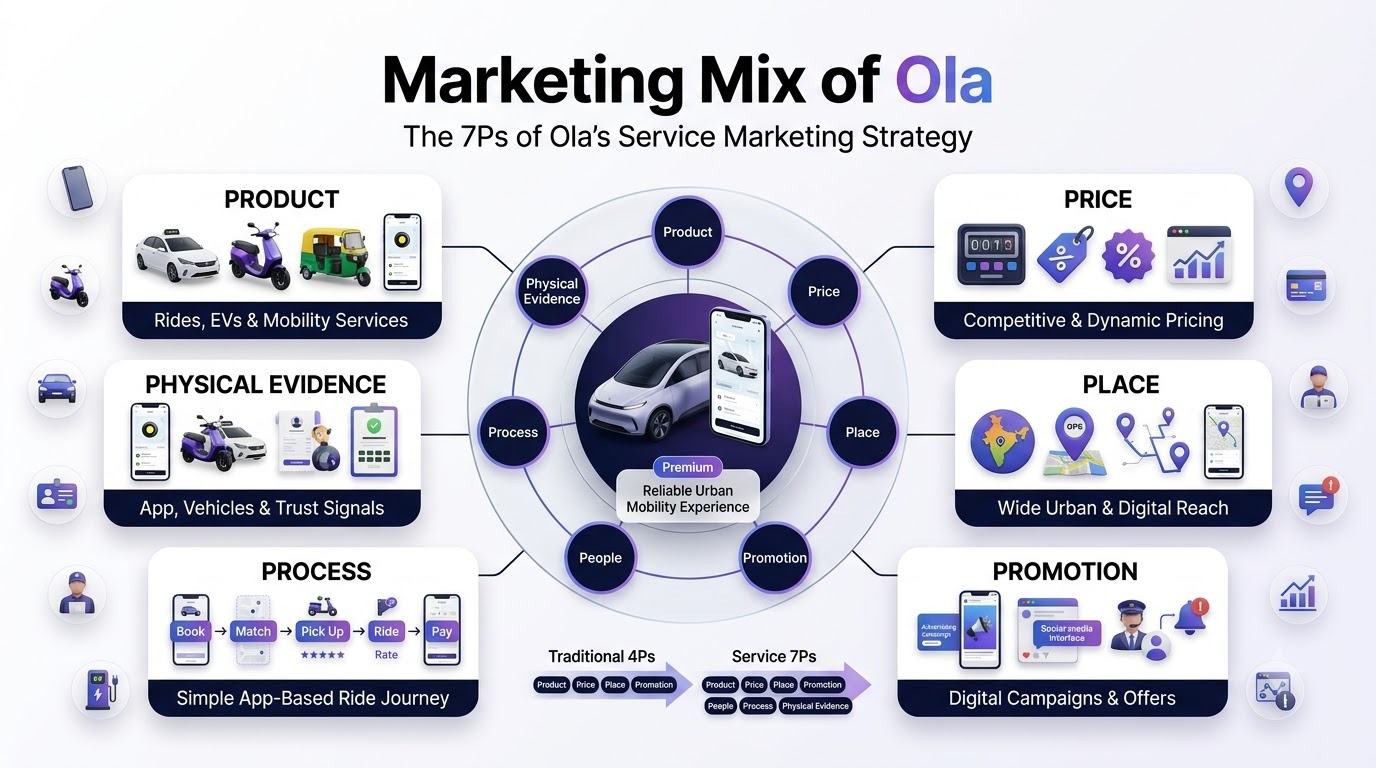
The marketing mix of Ola is the combination of product, price, place, promotion, people, process, and physical evidence that the company uses to get riders to choose Ola over walking, a bus, an auto they flag down on the street, or Uber sitting right next to it on their phone. That’s the direct answer. Now here’s why it needs all 7Ps and not just the classic 4.
Most people learn marketing mix as the 4Ps: Product, Price, Place, Promotion. That framework was built for physical goods, think soap, shoes, packaged food. You can hold those. You can inspect them before buying. A ride-hailing service isn’t like that. You’re buying something intangible: a promise that a car will show up in six minutes, driven by someone you’ve never met, and get you where you’re going safely. That’s a service, and services fail or succeed on three extra factors that physical products don’t need to worry about as much: who delivers it (people), how it’s delivered (process), and what tangible cues tell you it’s trustworthy (physical evidence). Booms and Bitner extended the original 4Ps into 7Ps back in the 1980s specifically for service businesses, and a cab-hailing app is about as pure a service business as you’ll find.
Why Ola’s Marketing Mix Is a Textbook Case Study
Ola is worth studying because it had to build every single P from scratch, in a market that didn’t have the infrastructure for it. India in 2010 had almost no organized cab-hailing culture outside a handful of airport taxi counters. There was no playbook to copy. Uber hadn’t even entered India yet. So Ola’s founders, Bhavish Aggarwal and Ankit Bhati, had to figure out pricing without surge-pricing precedent, distribution without any app-based transport habit among users, and promotion in a country with more than 20 major languages and wildly different city behaviors. Delhi riders don’t behave like Bengaluru riders, and neither behaves like someone booking a cab in a tier-2 city like Indore. That forced Ola to build a marketing mix that’s regionally flexible rather than a single rigid national formula, and that’s precisely the kind of adaptability worth breaking down in detail.
The 7Ps Framework Explained
Quickly, before diving into Ola specifically, here’s what each of the 7Ps means in plain terms so nothing in the rest of this guide feels like jargon. Product is what’s actually being sold, in Ola’s case, different categories of rides and related services. Price is what the customer pays and how that number is calculated. Place covers how and where the service becomes accessible, which for Ola means the app and city coverage, not a physical shop. Promotion is everything done to make people aware of and interested in the service. People refers to everyone involved in delivering the service, drivers most of all. Process is the actual sequence of steps a customer goes through, from opening the app to getting dropped off. Physical evidence is every tangible signal that builds trust, the app design, the car’s cleanliness, even the driver’s ID badge. Keep these definitions in mind because every section from here on builds directly on top of them.
How Ola’s Marketing Mix Changed Over Time
The marketing mix of Ola in 2011 looked almost nothing like it does now, and that gap is worth noting before going any deeper. In its earliest years, Ola operated closer to a radio-cab aggregator, calling drivers by phone and coordinating rides manually with a small fleet in Mumbai. There was barely a “product line” to speak of, just one type of car booking, priced with a fairly standard flat-rate model, and promoted mostly through word of mouth among early adopters in a single city. Every P you’ll read about in this guide, the multi-tier product lineup, the algorithmic surge pricing, the app-first distribution, the vernacular promotion, got built in stages, usually in direct response to a competitive threat or a funding round that gave Ola the capital to move faster. Understanding that this mix was assembled piece by piece, not designed all at once on a whiteboard, matters because it’s the same way most real businesses actually build their marketing strategy: reactively, under pressure, then refined once something starts working.
Product Strategy in the Marketing Mix of Ola
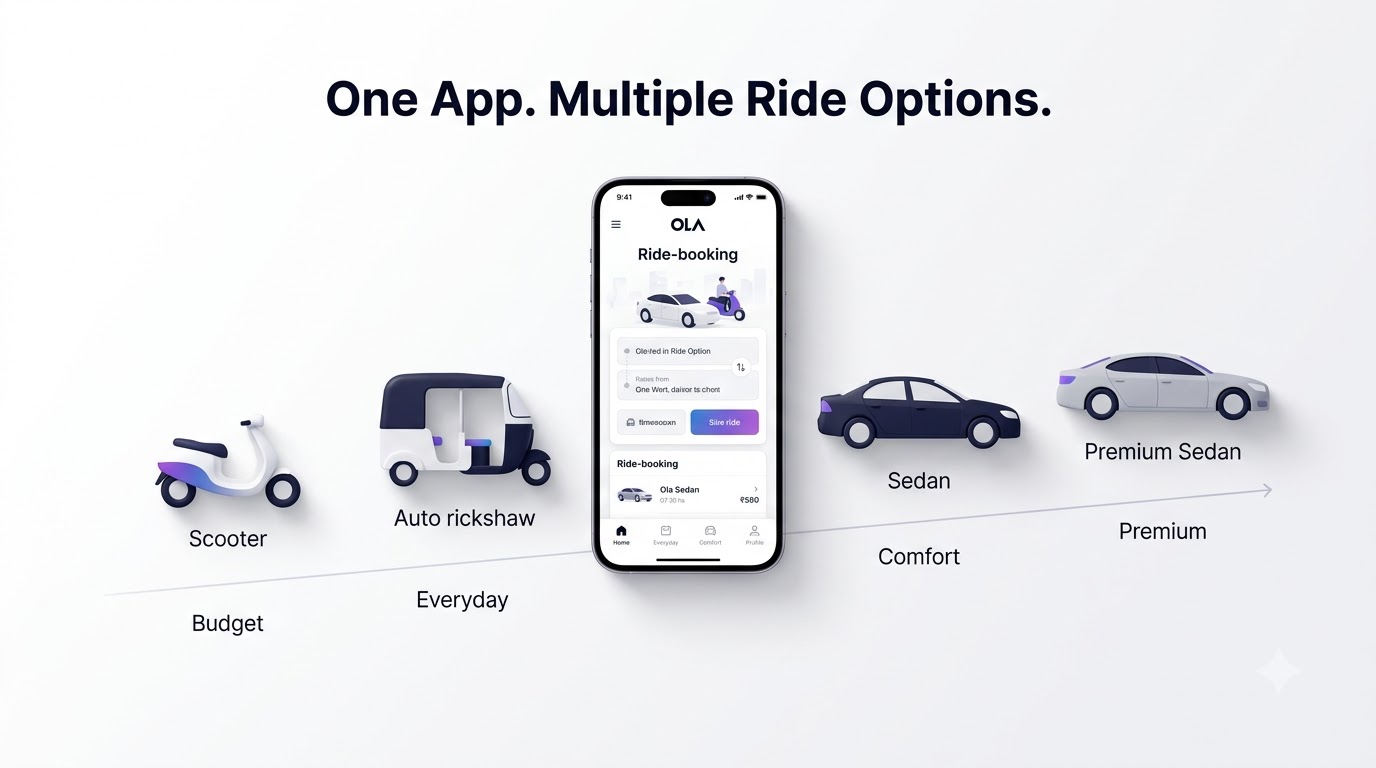
The product strategy in the marketing mix of Ola is built around one core idea: don’t sell one ride option, sell a ladder of options so almost anyone, at almost any budget, has a reason to open the app. That’s the direct answer, and it’s the reason Ola didn’t stay a “cab company” for very long. Within a few years of launch, Ola was offering everything from a two-wheeler pickup for ₹15 to a premium sedan for a business client, all inside the same app.
Here’s the thing most competitors got wrong early on: they assumed price-sensitive Indian consumers only wanted the cheapest option, or that premium riders only wanted premium cars. Ola bet that the same person might want Ola Auto on a Tuesday morning commute and Ola Prime on a Friday night out with a client. Building the product range around occasions instead of fixed customer segments is what let Ola capture volume across income brackets in the same city, sometimes even the same user.
Core Ride Categories: Mini, Prime, Auto, and Bike
Ola Mini was the entry point, a hatchback-class ride built for daily commuters who wanted an AC car without paying for one. Ola Prime sat above it as the sedan-class option aimed at business travelers and anyone willing to pay more for comfort and a slightly higher standard of driver and vehicle. Ola Auto brought the humble three-wheeler auto-rickshaw, something millions of Indians already trusted and used daily, directly into the app, which mattered because it meant Ola didn’t have to convince people to trust a new mode of transport, only to trust booking that transport through an app instead of flagging one down. Ola Bike, a motorcycle taxi service, went even further down the price ladder and specifically targeted short-distance, traffic-heavy routes in cities like Bengaluru and Hyderabad where a two-wheeler beats a car in a traffic jam every single time. Each of these categories solves a genuinely different problem instead of being a repackaged version of the same ride at a different price tag.
Ola Rentals and Ola Outstation
Ola Rentals let a customer book a car with a driver by the hour, which turned out to be a big win for people running multiple errands in a day, like a parent doing school pickup, a grocery run, and a doctor’s visit without wanting to book and cancel three separate rides. Ola Outstation solved a completely different need: intercity travel, where someone books a one-way or round trip to another city with a set fare agreed upfront rather than a meter running the whole way. Both of these products matter for the marketing mix of Ola because they stretched the brand beyond “the app I use for a 15-minute ride to the office” into “the app I use whenever I need a car for pretty much anything.” That’s a much stickier position to hold in a customer’s mind, and it’s a large part of why Ola kept usage frequency high even as competition on straightforward city rides got brutal.
Ola Electric and the Bigger Diversification Bet
Ola Electric is where the product strategy stopped being about ride categories and became about owning the entire mobility stack. Instead of only providing rides, Ola moved into manufacturing electric scooters through Ola Electric, running one of the largest electric two-wheeler factories in India in Tamil Nadu. This wasn’t a random side bet. It’s a direct response to two pressures: rising fuel costs eating into driver margins on the ride-hailing side, and a government push toward electric vehicles that was going to reshape the entire transport category whether Ola participated or not. By manufacturing its own EVs, Ola positioned itself to eventually electrify its own driver fleet, cutting the single biggest cost line in ride-hailing (fuel), while also selling directly to consumers who had nothing to do with ride-hailing at all. It’s an aggressive move, and a genuinely smart one, because it turns Ola from “an app that connects riders and drivers” into a company that touches the vehicle itself.
Ola Money and the Ecosystem Layer
Ola Money started as an in-app wallet so riders could pay without fumbling for cash, and it grew into a broader payments product used for bill payments and recharges too. This might look like a minor feature, but it’s a smart retention play. Once a rider’s money sits inside Ola’s ecosystem, switching to a competitor app carries a small but real friction cost. That’s a classic product-line extension tactic: add adjacent services that increase switching costs without ever mentioning “switching costs” to the customer. They just feel like convenience.
Ola Play took the same ecosystem logic and applied it to the in-car experience itself, turning the car’s dashboard screen into an entertainment system where riders could stream music or content during their trip. It’s a small feature on paper, but it reflects a broader pattern worth noticing across all of Ola’s product decisions: almost nothing gets added purely for novelty. Ola Money reduces payment friction and increases switching cost. Ola Play extends the average ride time a rider stays engaged with the brand instead of just staring at their phone. Corporate accounts capture a completely different buyer entirely. Each addition to the product line earns its place by solving a specific, identifiable problem rather than existing just to pad out a features list, and that discipline is worth paying attention to if you’re mapping out a product strategy for any service business, not just a ride-hailing app.
Corporate Bundling and B2B Product Extensions
Beyond individual riders, Ola built out a business-facing product line aimed at corporate clients, letting companies set up centralized billing for employee travel, monthly ride reports, and pre-approved spending limits for staff. This matters for the product strategy because it opens up a completely different buyer, an HR or admin team booking rides for hundreds of employees, instead of one person booking a single ride. Corporate accounts also tend to be far stickier than individual riders, since switching a company-wide travel vendor involves paperwork, approvals, and IT setup that an individual switching apps never has to deal with. A business that only sold to individual consumers would have missed this entirely, but building a B2B layer on top of the same driver network let Ola extract more revenue from infrastructure it had already paid to build, without needing a single additional driver just for that segment.
Price Strategy in the Marketing Mix of Ola
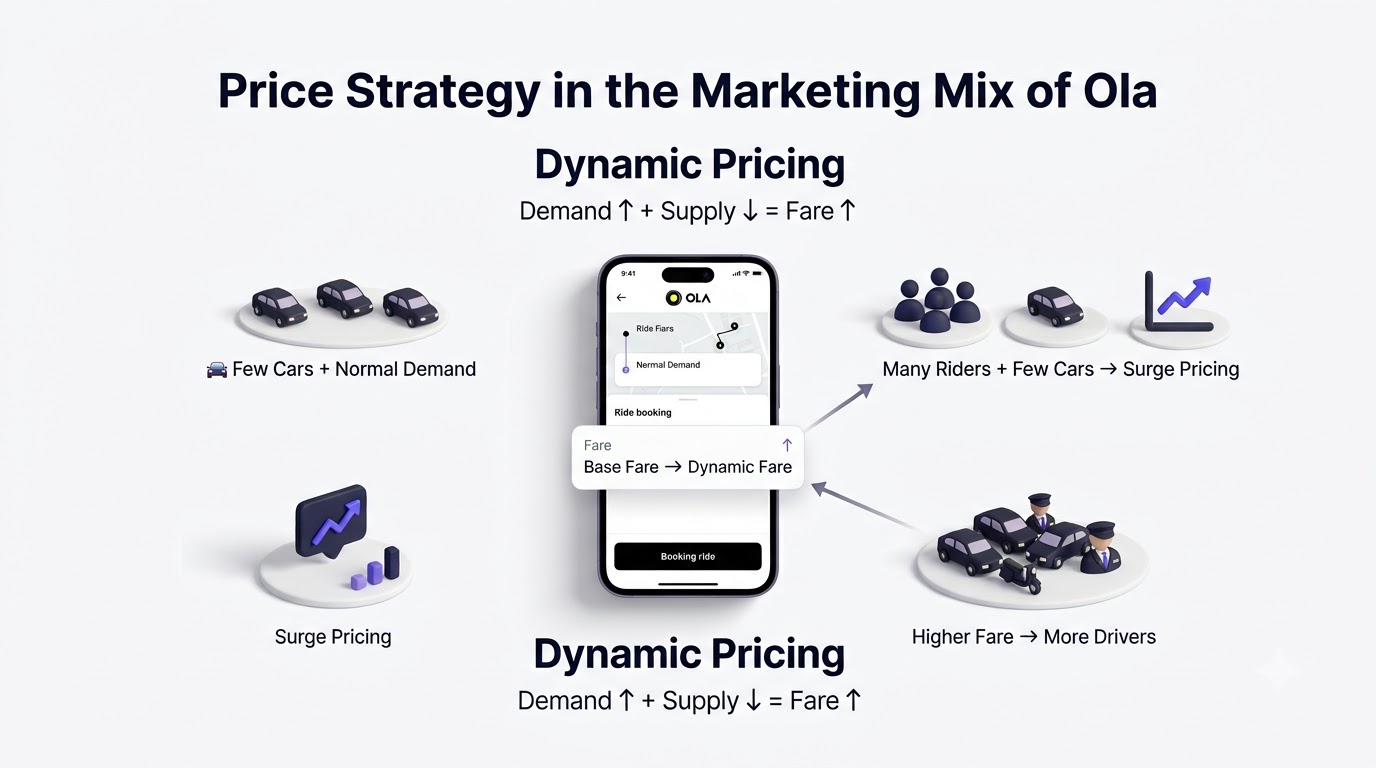
Ola’s pricing strategy is built on dynamic pricing, meaning the fare isn’t fixed, it shifts in real time based on how many riders are requesting cars versus how many drivers are actually available nearby. That’s the direct answer to how Ola prices a ride, and it’s also the single most argued-about part of Ola’s entire marketing mix. Nobody complains about Ola’s app design on Twitter. Plenty of people complain about surge pricing.
Here’s why the model exists in the first place, and it’s genuinely a supply-demand problem, not a money grab. On a normal weekday afternoon, there are more drivers online than riders requesting cars in most areas, so prices stay close to the base fare. But during Mumbai’s evening monsoon rush, or a Friday night bar-crawl hour in Bengaluru’s Indiranagar, demand spikes far past the number of available drivers. If prices stayed flat, riders would keep requesting cars, more and more of those requests would go unfulfilled because there simply aren’t enough drivers, and the whole system would feel unreliable. Surge pricing raises the price during those windows, which does two things at once: it nudges some riders to wait ten minutes or choose Ola Auto instead of Ola Prime, and it pulls more drivers onto the road because a higher fare means better earnings for that hour. It’s ugly to experience as a customer, but it’s the mechanism that keeps the whole marketplace from collapsing during peak hours.
Dynamic and Surge Pricing Explained
The mechanics behind surge pricing come down to a real-time multiplier applied to the base fare, calculated using an algorithm that factors in the ratio of open ride requests to available drivers in a specific geographic zone at that specific moment. A 1.5x surge means the fare is one and a half times the normal rate, and that multiplier can climb much higher during extreme demand events like New Year’s Eve or a sudden citywide downpour that shuts down public transport. What most riders don’t realize is that surge zones are hyperlocal. You can be in a 2x surge zone and walk 400 meters to a spot with no surge at all, because the algorithm is reading driver density block by block, not city-wide. That granularity is what makes the system efficient even if it feels random to a rider staring at their phone wondering why the fare jumped.
Subscription and Loyalty Pricing With Ola Select
Beyond surge pricing, Ola introduced Ola Select, a subscription plan where riders pay a flat monthly or quarterly fee upfront in exchange for perks like ride discounts, no surge pricing on eligible rides, and priority allocation during high-demand periods. This is a straightforward move borrowed from subscription economics: convert an unpredictable, occasional user into a predictable, recurring one. A rider paying ₹99 a month for Ola Select has already made a small commitment, and behavioral economics shows people who’ve paid for a membership use the service more often just to feel like they’re getting value out of what they already paid for. It also gives Ola a data advantage: subscribers are easier to forecast demand around because they ride more consistently, which helps with everything from driver allocation to inventory planning for Ola Electric’s charging infrastructure.
Price Wars With Uber and the Discount Era
Between roughly 2015 and 2019, Ola and Uber fought one of the most aggressive discount wars seen in Indian consumer tech, burning through massive amounts of venture capital to offer rides at prices that often didn’t cover the actual cost of running them. Coupon codes stacked with referral credits meant some riders paid a fraction of the real fare for months at a stretch. This wasn’t sustainable pricing, and everyone involved knew it. It was customer acquisition dressed up as a pricing strategy, betting that habit formed during the discount period would carry over once prices normalized. Ola’s bet largely worked in tier-2 and tier-3 Indian cities, where it had built stronger driver relationships and hyperlocal knowledge than Uber, even while Uber matched or beat Ola on discounts in metro cities. That’s a useful lesson buried in this price war: a “lower price wins” strategy only works if the underlying unit economics and local trust can support it once the discounts stop, and Ola picked its battlegrounds carefully instead of fighting Uber evenly across all of India. If you’re studying pricing strategy as part of a broader digital marketing foundation, this price war is one of the cleanest real-world examples of acquisition-driven pricing you’ll find in Indian business history.
How the Base Fare Itself Gets Calculated
Before any surge multiplier gets applied, Ola starts with a base fare built from three components: a fixed base amount for simply starting the trip, a per-kilometer rate that scales with distance, and a per-minute rate that accounts for time spent in traffic rather than actual distance covered. This structure matters because it protects Ola and its drivers from a situation where a short trip through heavy traffic ends up paying less than a longer trip on an open highway, even though the short traffic-heavy trip might actually take longer and use more of a driver’s time. Waiting charges get added on top if a rider takes too long to show up after a driver arrives, and toll or parking charges get passed through separately rather than baked into the fare estimate. Once you understand this base structure, surge pricing makes a lot more sense too, since it’s simply a multiplier layered on top of a fare that was already designed to reflect distance, time, and effort rather than a single flat number for every trip.
Place and Distribution Strategy in the Marketing Mix of Ola
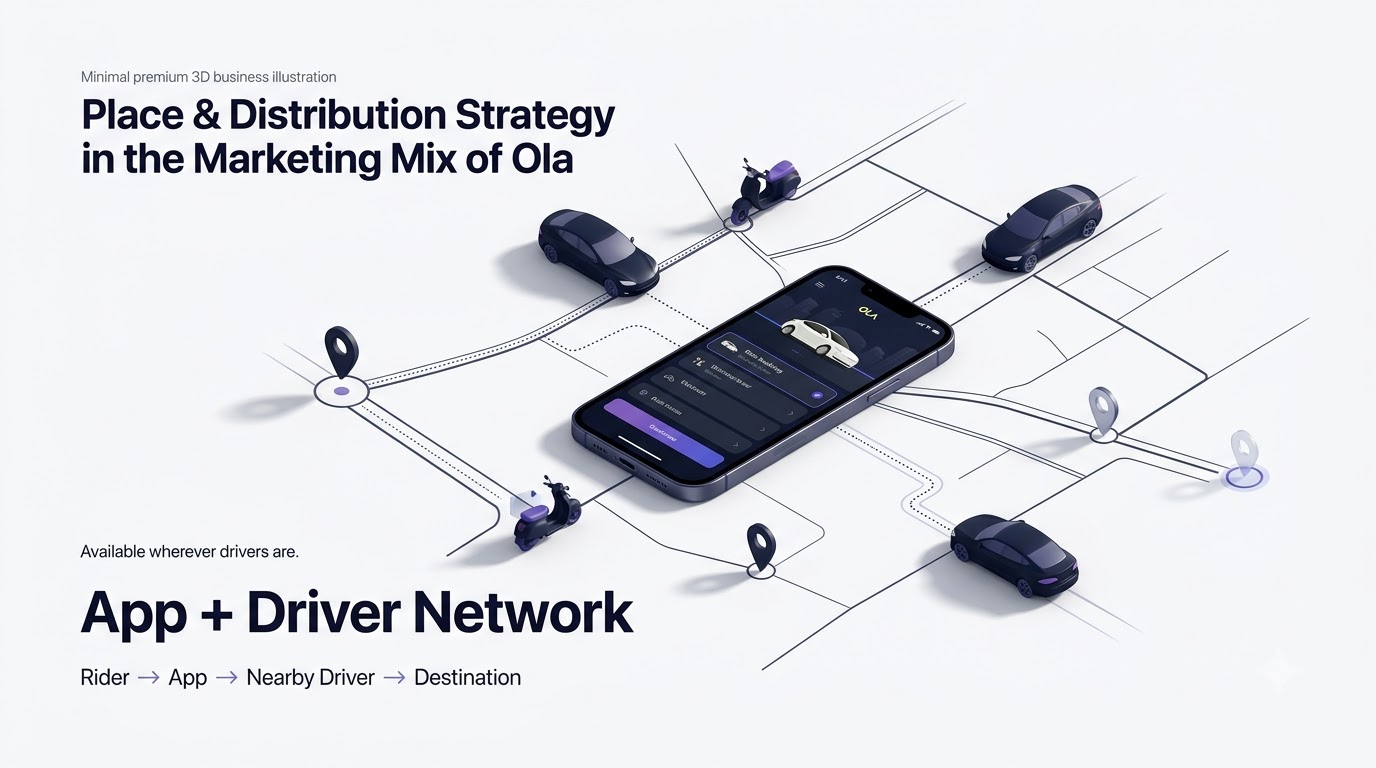
Place in the marketing mix of Ola doesn’t mean a physical location at all, it means the mobile app plus the live network of drivers spread across a city, because that combination is what makes the service accessible wherever a rider happens to be standing. That’s the direct answer, and it’s worth sitting with for a second because it’s a genuinely different distribution model than almost any product taught in a standard marketing course. Ola never needed a retail footprint. Its “store” is wherever a driver’s car currently is, which changes location every few minutes.
App-First Distribution and Why It Works
Every part of the Ola experience routes through the app, from booking to payment to rating the driver afterward, and that app-first design is the backbone of Ola’s entire distribution strategy. Building distribution around a smartphone app rather than physical infrastructure meant Ola could scale into a new city almost overnight compared to how long it would take a traditional taxi company to set up a dispatch office, phone lines, and a fleet in that city. The only real requirement was getting enough drivers signed up locally and getting the app into enough riders’ hands, both of which could be done through targeted local marketing rather than heavy capital investment in brick-and-mortar. This is also why Ola could expand into smaller cities faster than legacy taxi operators ever managed, since the marginal cost of entering city number 150 wasn’t meaningfully different from entering city number 50.
City-Wise and Tier-2 Expansion Strategy
Ola made a deliberate call to push aggressively into tier-2 and tier-3 Indian cities, places like Nashik, Coimbatore, and Guwahati, well before Uber prioritized them. This mattered because those cities had almost no organized cab culture at all, meaning Ola wasn’t stealing market share from a competitor, it was creating an entirely new category of behavior. Once someone in a smaller city got used to booking Ola Auto for a college commute, that habit stuck, and Ola had effectively locked in a customer with far less competitive pressure than in Mumbai or Delhi. This is a classic case of a company choosing “underserved but reachable” over “large but contested,” and it paid off with a loyal user base in dozens of cities where Ola faced little to no direct competition for years.
The Driver Network as the Real Distribution Backbone
Here’s what most people miss: Ola’s actual distribution network isn’t the app, it’s the drivers. The app is just the interface. Without a dense enough network of drivers actively online in a given area, the app is useless no matter how well designed it is. That’s why Ola invested heavily in driver onboarding, driver financing programs to help people buy or lease vehicles, and driver incentive structures that paid bonuses for completing a certain number of rides in a week. Every one of those programs is, functionally, a distribution investment, because more active drivers in a neighborhood means shorter wait times for riders in that neighborhood, which is the actual product experience customers are paying for. A rider doesn’t care how good your app’s UI is if no car shows up for 12 minutes.
Peak-Hour Driver Allocation and Availability
A rider tapping “book” during Monday morning rush hour is quietly relying on a whole allocation system working behind the scenes to match them with the nearest available driver, and this system is as much a part of “place” as the app itself, because availability is what determines whether the service feels accessible at the exact moment someone needs it. Ola’s allocation logic weighs driver proximity, driver rating, and sometimes driver preference for certain trip types, then offers the ride to the driver most likely to accept and complete it quickly. During heavy demand windows, Ola also nudges idle drivers in low-demand zones toward high-demand zones through in-app notifications and temporary incentive bonuses, effectively redistributing supply across a city in real time rather than just reacting to wherever drivers happen to already be. This kind of dynamic supply-shifting is invisible to most riders, but it’s the actual engineering behind why an Ola car usually shows up within a few minutes even in a city as congested as Bengaluru during evening rush hour.
Promotion Strategy in the Marketing Mix of Ola
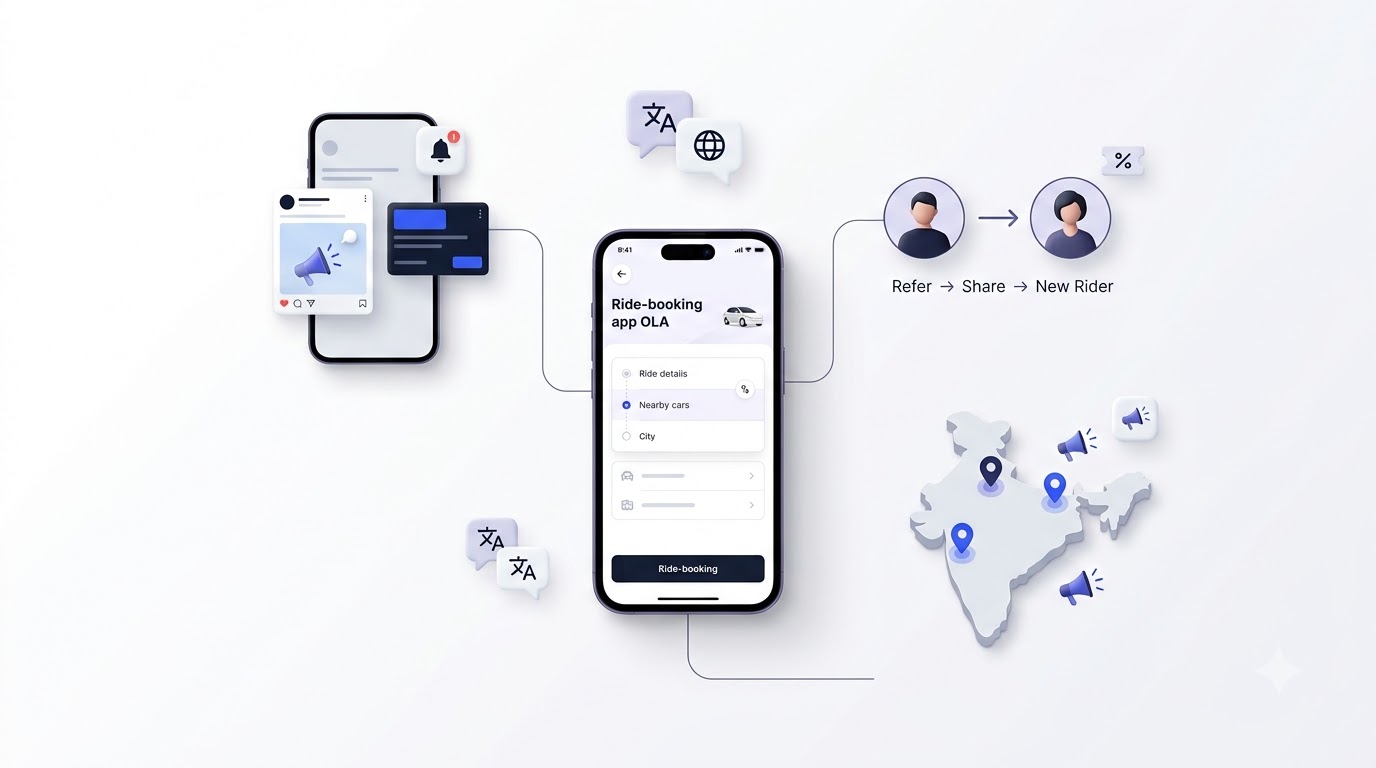
Promotion in the marketing mix of Ola centers on digital marketing, referral-based growth, and hyperlocal regional campaigns rather than one enormous, uniform national ad blitz, and that choice was less about budget and more about matching India’s fragmented, multilingual media landscape. That’s the direct answer. A single Hindi-language TV ad wasn’t going to land the same way in Chennai as it did in Lucknow, so Ola’s promotional playbook leaned toward tactics that could be localized fast.
Digital Marketing and Social Media Campaigns
Ola ran targeted digital campaigns across Facebook, Instagram, and Google Ads, tailoring creative and offers by city and even by specific neighborhoods where new driver supply had just come online. This let Ola push promotions exactly where they were needed most, for example offering a first-ride discount specifically in a newly launched zone to seed demand fast, instead of blasting the same national offer everywhere and wasting spend in cities that already had strong usage. Social media also became Ola’s fastest channel for damage control and brand voice, responding to rider complaints publicly on Twitter and turning some of those interactions into examples of responsive customer service that other frustrated riders could see. Anyone building out a similar playbook for a service business would do well to study how social media can function as both a marketing channel and a live customer service desk at the same time, because that dual role is exactly what Ola leaned into.
Referral Programs and Discount-Led Growth
Ola’s referral program, where existing users got ride credits for bringing in a friend who completed their first ride, was one of the cheapest and most effective growth channels available during Ola’s scaling years. The logic behind referral marketing is simple but powerful: a recommendation from a friend carries more trust than any ad, and rewarding both the referrer and the new user creates a two-sided incentive that’s hard to ignore when the reward is essentially free money toward a ride you were probably going to take anyway. This tactic compounded especially well in college towns and office parks, where word about a good referral code spread through group chats faster than any formal campaign could have managed.
Celebrity Endorsements and National Brand Positioning
Alongside grassroots digital tactics, Ola also used celebrity association and sponsorships to build broader brand recall, aligning itself with major cricket tournaments and popular entertainment moments that put the Ola name in front of a mass audience beyond just app users. This is a different kind of promotion than a referral code, it’s not trying to drive an immediate download, it’s trying to make sure that when someone in a small town who’s never used a ride-hailing app hears the word “Ola” for the first time from a friend, there’s already a flicker of recognition. Combining that top-of-funnel brand awareness with bottom-of-funnel referral discounts is what let Ola run a promotional strategy that worked at both the “never heard of it” stage and the “about to book my tenth ride” stage of the customer journey.
Regional and Vernacular Marketing
India has more than 20 official languages, and Ola built its promotional content, and eventually its app interface, to reflect that instead of defaulting to English or Hindi everywhere. Running ad creative in Tamil in Chennai, Kannada in Bengaluru, and Bengali in Kolkata isn’t a nice-to-have, it’s the difference between an ad that feels like it was made for the viewer and one that feels imported from somewhere else. This regional sensitivity in promotion tied back directly to Ola’s tier-2 and tier-3 expansion strategy under the place element of the mix, since a rider in a smaller city was far more likely to trust and respond to marketing in their own language than a national English-language campaign built for a metro audience.
Offline and On-Ground Promotion Tactics
Digital ads got most of the attention, but Ola also ran a serious offline promotion push, setting up branded kiosks at airports and railway stations, placing signage in high-footfall areas like malls and office parks, and running on-ground teams that helped first-time users install the app and complete their first booking on the spot. This part of the promotion strategy mattered more than it might sound, because a huge chunk of Ola’s target audience in tier-2 and tier-3 cities wasn’t necessarily comfortable downloading and configuring a new app without a bit of hand-holding the first time. Standing an actual human next to a QR code at a bus stand and walking someone through their first ride booking converts far better than a banner ad ever could for that specific audience segment. It’s a slower, more expensive way to acquire users than a Facebook ad, but it reaches people digital-only campaigns simply miss.
People, Process, and Physical Evidence in the Marketing Mix of Ola
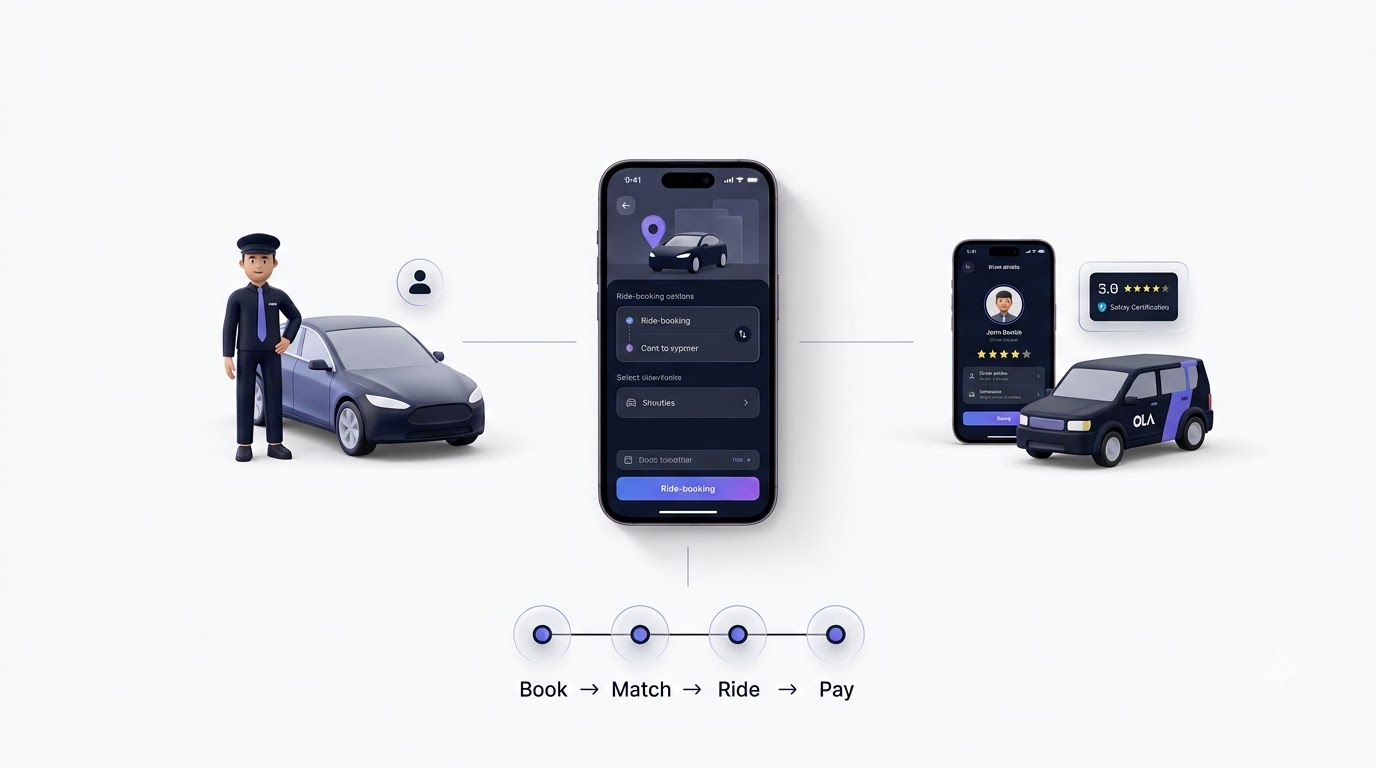
These three extended Ps are where a lot of guides on the marketing mix of Ola stop short, but they’re arguably the most important part for a service business, because they decide whether a rider trusts the app enough to open it again after one bad experience. That’s the direct answer to why these Ps matter here: product, price, place, and promotion get someone to download the app and take their first ride, but people, process, and physical evidence decide whether that rider becomes a repeat customer or deletes the app after one sketchy trip.
Driver Partners as the People Element
Drivers are the single point of human contact in the entire Ola experience, and that makes them the most important “people” element in the whole marketing mix by a wide margin. A polite, safe, well-groomed driver in a clean car creates a completely different brand impression than a rushed driver in a car that smells like it hasn’t been cleaned in weeks, even though both trips technically deliver the same core service of getting a rider from point A to point B. Ola addressed this through driver training programs, in-app rating systems that let riders flag poor experiences, and incentive structures tied partly to driver ratings, not just ride volume. The mistake a lot of ride-hailing companies made early on was treating drivers purely as supply, a number to maximize, rather than as the actual face of the brand in every single customer interaction. Ola learned, sometimes the hard way through high-profile safety incidents that damaged trust, that investing in driver vetting and training isn’t a cost center, it’s a core part of the product itself.
Booking and Ride Process
Process covers the entire sequence a rider goes through: opening the app, entering a destination, choosing a ride category, watching the driver’s car move toward them on the map, taking the ride, and rating it at the end. Every friction point in that sequence costs Ola riders. If the app takes too long to find a driver, if the estimated arrival time is wildly inaccurate, or if payment fails at the end of a trip, that’s a process failure, not a product failure, and it damages trust just as much. Ola invested continuously in reducing these friction points, adding features like live driver location sharing with family members for safety, in-app SOS buttons, and simplified in-app payment options including UPI, which is the dominant digital payment method in India. Streamlining the process this way is a direct example of how a service business competes on something that has nothing to do with the core price of the ride at all.
Physical Evidence: App Design, Vehicle Standards, and Safety Cues
Physical evidence is every tangible signal a rider sees that tells them the service is legitimate and trustworthy before, during, and after the ride, and for Ola that spans the app’s interface design, the driver’s ID badge visible in the car, vehicle cleanliness standards, and safety features like the in-app SOS button and trip-sharing option. None of these things are the “product” in a strict sense, a clean car doesn’t get you to your destination any faster than a messy one, but they’re the cues that make a rider feel safe enough to book again. This matters even more for women riders and late-night trips, where visible safety signals like driver verification badges and easy access to emergency features directly influence whether someone chooses Ola over an unregulated alternative. Companies that ignore physical evidence in a service business are making a real mistake, because customers judge trustworthiness through these small, tangible details far more than they judge it through a company’s mission statement.
Customer Support as Part of the Service Experience
Customer support might not sound like a marketing element at all, but it’s really an extension of the process and people Ps working together, because how a company handles a complaint after something goes wrong shapes brand perception just as much as the ride itself did. Ola built out in-app support tickets, a dedicated safety response team for urgent incidents, and public-facing responses on social platforms for complaints that went viral before Ola’s internal team could catch them. The mistake a lot of companies make here is treating support as a cost to minimize, routing everything through slow, generic chatbots that frustrate riders further. Ola’s better moments in this area came from fast, specific human responses, refunding a fare immediately when something clearly went wrong instead of making a rider argue their case through five menu options first. A good support interaction after a bad ride can actually rebuild trust faster than a discount code ever would.
Marketing Mix of Ola vs Uber: What’s Actually Different
The core difference between the marketing mix of Ola and Uber isn’t the technology, both apps do fundamentally the same job, it’s localization: Ola built its product, pricing, and promotion around Indian city-specific realities like auto-rickshaws, tier-2 expansion, and vernacular marketing, while Uber initially applied a more standardized global playbook before adapting to India over time. That’s the direct answer, and the gap between those two approaches explains a lot of Ola’s early market share advantage.
Product Range Comparison
Ola’s decision to bring Ola Auto into its core product lineup early gave it a category Uber had to play catch-up on, because auto-rickshaws are a mode of transport deeply embedded in Indian daily life that international competitors simply didn’t have built-in intuition for. Uber eventually added its own auto category, but Ola had years of head start collecting driver relationships and rider trust in that specific segment. Similarly, Ola’s move into manufacturing its own electric vehicles through Ola Electric is a diversification bet Uber hasn’t made in India at anywhere near the same scale, giving Ola a long-term cost and sustainability angle that’s genuinely distinct from ride-hailing alone.
Pricing and Local Cost Structures
Both companies use dynamic surge pricing, that part of the model is nearly identical, but Ola’s deeper driver relationships in tier-2 and tier-3 cities historically let it operate with a better understanding of local cost structures, fuel prices, and driver earnings expectations outside the big metros. Uber’s pricing algorithm is globally consistent by design, which is efficient to build but doesn’t always account for hyperlocal economic differences the way a company built ground-up in India, city by city, naturally does.
Brand Positioning and Trust
Ola positioned itself, intentionally or not, as the more “local” and relatable option, while Uber carried the brand cachet of a global tech company. Depending on the customer segment, that either helped or hurt each company. Younger, English-speaking urban professionals sometimes gravitated toward Uber’s polish, while a broader mass-market audience across smaller cities responded better to Ola’s grounded, familiar positioning. Neither approach is universally better, they’re just different bets on which trust signal matters more to which audience, and it’s a genuinely useful comparison if you’re studying brand positioning as part of a broader case study of how two competitors serving the exact same core need can win different segments of the same market.
Mistakes and Lessons From the Marketing Mix of Ola
Not everything in Ola’s marketing mix worked cleanly, and pretending otherwise would make this guide less useful, not more. The direct lesson here is that even a strong 7Ps strategy has weak points, and studying where Ola stumbled teaches you as much as studying where it succeeded.
Over-Reliance on Discounts Hurt Unit Economics
The discount-heavy price war with Uber acquired a huge number of users fast, but it also trained a large segment of riders to expect artificially low fares, and pulling back those discounts once investor pressure shifted toward profitability caused real churn and public backlash. This is a mistake plenty of growth-stage companies make: optimizing a pricing strategy purely for acquisition speed without a clear plan for how pricing transitions once the discounts have to end. If you’re building a pricing strategy for any subscription or service business, this is the exact trap to plan around from day one, not after the fact.
Driver Trust and Safety Controversies
Several high-profile safety incidents involving Ola drivers created real damage to the “people” and “physical evidence” elements of the marketing mix, and no amount of clever promotion could fully offset the trust lost through those events. It’s a hard lesson but an important one: in a service business built on strangers getting into a car with other strangers, safety failures aren’t a PR problem to manage with a statement, they’re a core product failure that has to be fixed at the process and people level first.
Slower App Performance Compared to Global Competitors
For stretches of its growth, Ola’s app faced criticism for slower load times, less reliable driver ETA estimates, and occasional payment glitches compared to Uber’s more polished, globally resourced engineering. This is a reminder that physical evidence in a digital service isn’t just about a clean car, the app itself is physical evidence, and underinvesting in product engineering quietly undermines every other P in the mix no matter how good the pricing or promotion strategy is.
Regulatory and Legal Pushback
Ola has faced its share of regulatory friction across different Indian states, including disputes over surge pricing caps, driver licensing rules, and occasional bans or fines tied to compliance issues with local transport authorities. This is a part of the marketing mix that doesn’t fit neatly into product or price, but it directly affects both, because a state-imposed surge pricing cap changes the pricing strategy overnight whether Ola wants it to or not, and a temporary suspension in a city instantly wipes out place-based availability there. The broader lesson is that any business operating in a heavily regulated industry, transport, finance, healthcare, has to treat regulatory relationships as an ongoing part of its strategy, not a legal afterthought handled only when something goes wrong. Companies that ignore this end up reacting to bans and fines instead of anticipating and shaping the rules before they get written.
Conclusion
The marketing mix of Ola works because it doesn’t treat any single P as more important than the others. A great product lineup with confusing pricing fails. Smart pricing with weak driver trust fails just as fast. What made Ola competitive against a much larger global rival was stitching product, price, place, promotion, people, process, and physical evidence together into one coherent local strategy, then adjusting each piece as fuel costs, competition, and customer expectations shifted underneath it. That’s the real takeaway from studying the marketing mix of Ola: a service business lives or dies on the Ps that don’t show up in a typical 4Ps textbook diagram.
Frequently Asked Questions
What is the marketing mix of Ola?
The marketing mix of Ola is the combination of product, price, place, promotion, people, process, and physical evidence the company uses to attract and retain riders. It covers everything from its range of ride categories to its surge pricing model, app-based distribution, digital promotion tactics, and driver quality standards.
Why does Ola use the 7Ps model instead of the traditional 4Ps?
Ola uses the 7Ps model because it’s a service business, not a physical product business. The extra 3Ps, people, process, and physical evidence, account for the driver quality, booking experience, and trust signals that directly affect whether a customer books again, none of which the original 4Ps framework was built to capture.
How does Ola’s surge pricing actually work?
Ola’s surge pricing applies a real-time multiplier to the base fare when the number of ride requests in a specific zone exceeds the number of available drivers there. The multiplier rises during high-demand periods like rush hour or bad weather and pulls back to normal once driver supply catches up with demand.
What are the main product categories under Ola?
Ola’s main products include Ola Mini, Ola Prime, Ola Auto, Ola Bike, Ola Rentals, Ola Outstation, and Ola Electric. Each targets a different budget, distance, or use case, ranging from short daily commutes to intercity travel and now electric vehicle manufacturing.
Is Ola cheaper than Uber?
Neither app is consistently cheaper than the other, since both use dynamic surge pricing that shifts based on real-time demand in a specific area. Fares can vary by city, time of day, and even by which app currently has more drivers active nearby, so pricing comparisons change constantly rather than following a fixed rule.
What is Ola Select and how does it fit into the pricing strategy?
Ola Select is a subscription plan where riders pay a recurring fee in exchange for benefits like reduced or no surge pricing on eligible rides and priority driver allocation. It’s designed to convert occasional riders into predictable, recurring customers while giving Ola more consistent demand data to plan around.
How did Ola expand into smaller Indian cities so quickly?
Ola expanded into tier-2 and tier-3 cities by prioritizing app-based distribution over physical infrastructure, meaning it could enter a new city mainly by signing up local drivers and marketing to local riders rather than building offices or dispatch centers. This let it move into dozens of smaller cities faster and with less capital than traditional taxi operators.
What role do drivers play in Ola’s marketing mix?
Drivers represent the “people” element of Ola’s marketing mix and are the only human point of contact in the entire service. Their behavior, vehicle cleanliness, and professionalism directly shape a rider’s trust in the brand, which is why Ola invests in driver training, ratings systems, and incentive programs tied to service quality.
What is Ola Electric and why did Ola get into vehicle manufacturing?
Ola Electric is Ola’s electric vehicle manufacturing arm, producing electric scooters through one of India’s largest EV factories. Ola entered vehicle manufacturing to reduce long-term fuel costs across its driver fleet and to capture a share of India’s growing electric vehicle market beyond ride-hailing alone.
How does physical evidence apply to a ride-hailing app like Ola?
Physical evidence for Ola includes every tangible trust signal a rider encounters, such as the app’s interface design, the driver’s visible ID badge, vehicle cleanliness, and safety features like in-app SOS buttons and live trip sharing. These cues matter because they shape a rider’s sense of safety and legitimacy independent of the actual ride itself.
What mistakes has Ola made in its marketing strategy?
Ola’s biggest marketing mistakes include over-relying on deep discounts during its price war with Uber, which trained users to expect artificially low fares, and facing driver safety controversies that damaged trust in the brand. Both issues show how pricing and people-related decisions can undercut an otherwise strong product and promotion strategy.
Does Ola use different marketing strategies in different Indian cities?
Yes, Ola runs region-specific promotion, including vernacular language advertising and localized discount campaigns, because customer behavior and language preferences vary significantly between cities like Chennai, Bengaluru, and Delhi. This localized approach is a core part of why Ola built stronger early traction in smaller, non-metro cities than a standardized national campaign would have achieved.
Does Ola offer services for corporate clients?
Yes, Ola runs a business travel program that lets companies set up centralized billing, monthly usage reports, and pre-approved travel limits for employees. This B2B layer sits on top of the same driver network used for individual riders, giving Ola an additional, stickier revenue stream beyond one-off consumer bookings.
Why does Ola sometimes get banned or fined in certain Indian states?
Ola has faced regulatory action in various states over issues like surge pricing limits, driver licensing compliance, and local transport authority rules. These regulatory disputes directly affect the pricing and place elements of its marketing mix, since a pricing cap or temporary suspension changes what Ola can actually offer in that region overnight.
How has Ola’s customer support strategy affected its brand image?
Ola’s customer support directly shapes rider trust because it determines how the company handles complaints after something goes wrong during a ride. Fast, specific responses like immediate fare refunds tend to rebuild trust quickly, while slow or generic responses tend to amplify frustration, which is why support functions as part of the marketing mix rather than a separate department.