


Google does not run TV commercials during every cricket match or plaster billboards across every highway the way a soft drink brand does. Yet almost everyone reading this has used a Google product today, probably in the last hour. That gap between “barely advertises like a normal company” and “used by 4 billion people” is the whole story behind the marketing mix of Google, and it is way more interesting than the average textbook explanation of the 4Ps.

Most articles on this topic just list Product, Price, Place, and Promotion, slot Google into each box, and call it done. That is not how Google actually built a business worth over two trillion dollars. Google’s marketing mix works because the four classic elements plus three extra ones, People, Process, and Physical Evidence, are stitched together in a way that turns free products into a data engine that funds a $200 billion-plus advertising business. Once you see the mechanics, you cannot unsee them, and honestly, this framework becomes way more useful once you stop treating it like a school assignment and start treating it like a lens for understanding any large tech company.
This guide breaks the marketing mix of Google into all seven components, with real product names, real pricing structures, and real distribution tactics, not vague statements like “Google uses digital marketing.” By the end, you will understand exactly how Search, Android, Chrome, Ads, Cloud, and Workspace fit into one coordinated strategy, and how you can borrow pieces of that thinking for your own brand or business, no matter how small it currently is.
What You Will Learn in This Guide
- How Google structures Product as a layered ecosystem instead of a single offering
- Why Google gives away Search, Gmail, and Android for free, and where the actual revenue comes from
- How the Place element works when your main “store” is a browser and an operating system
- The real difference between Google’s brand marketing and its performance marketing
- How People, Process, and Physical Evidence quietly support everything else in the mix
- Common mistakes marketers make when they try to copy Google’s strategy at a smaller scale
- Answers to the most searched questions about the marketing mix of Google
Marketing Mix of Google
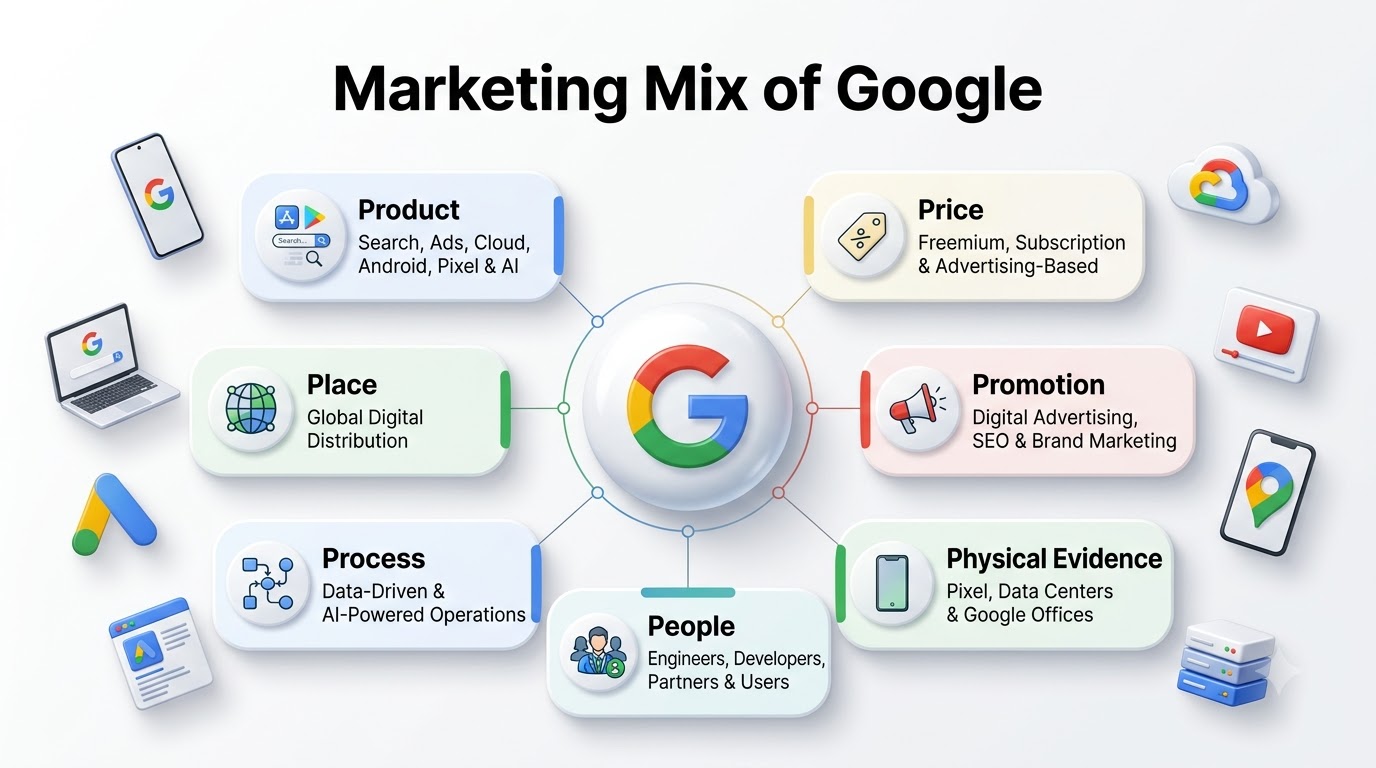
The Marketing Mix of Google explains how the company combines its products, pricing strategies, distribution channels, promotional activities, people, processes, and physical presence to create value for users and businesses. Unlike traditional companies that mainly sell physical products, Google operates across search, advertising, cloud computing, mobile software, hardware, artificial intelligence, and digital services. This makes its marketing mix more complex and technology-driven. The 7Ps framework provides a useful way to understand how Google attracts users, generates revenue, builds its global brand, and maintains its competitive position in the technology industry. The following sections examine each element of Google’s marketing mix in detail.
Product Strategy
The product layer of the marketing mix of Google is not one product. It is a stack of more than 15 major services that all feed into each other, and understanding that stack is the starting point for understanding everything else Google does. Search is the anchor, but Search alone does not explain why Google owns the mobile operating system market, the browser market, and a growing chunk of the cloud infrastructure market at the same time.
Here is the thing most guides skip: Google’s product strategy is not about building the best standalone tool in every category. It is about building tools that increase the amount of time and data flowing through Google’s ecosystem, because that time and data is what makes the advertising business work. A slightly better calendar app does not matter on its own. A calendar app that keeps someone inside Gmail, which keeps them signed into Chrome, which keeps their search history flowing into Google’s ad targeting engine, matters a lot.
Google Search and the Core Product Layer
Search is the product that everything else in Google’s marketing mix is built to protect and extend. It handles more than 8.5 billion searches a day according to Google’s own reported figures, and that scale is what makes the entire advertising model viable. Nobody pays a premium to advertise next to a search engine that ten people use. Advertisers pay because Search sits in front of billions of buying decisions daily, from “best running shoes under 3000 rupees” to “emergency plumber near me.”
What most people miss is that Search itself is not the product Google sells. Search is the product Google gives away so it can sell placement inside Search results through Google Ads. This is the core trick behind the entire marketing mix of Google: build something so useful that billions of people choose to use it daily, then monetize the attention that usage generates, rather than charging the user directly. It is the same logic behind free-to-play mobile games, just executed at a planetary scale with far better data infrastructure.
The mistake beginner marketers make when studying this model is assuming they need to build something at Google’s scale before this logic applies to them. That is not true. A free tool, a free calculator, or a free template on your own website works on the exact same principle, minus the trillions in infrastructure. If you are building out a content or lead-generation strategy, this is the same thinking behind good search engine optimization work: give away genuine value first, and structure the monetization around the attention that value earns you.
There is also a compounding effect at play that most people never bother to notice. Every search query fed into Google’s system does two jobs at once. It answers the user’s immediate question, and it teaches Google’s ranking systems a tiny bit more about intent, phrasing, and what a “good” result looks like for that query. Multiply that by 8.5 billion queries a day, and you get a feedback loop no competitor can match by simply hiring more engineers. Bing and DuckDuckGo can write comparable code. Neither one gets billions of daily training signals refining their systems in real time the way Google does, because neither one has the query volume to generate that signal in the first place.
What most guides also skip is that Search is not a static product Google finished building years ago. It gets meaningfully rewritten multiple times a year through what Google calls “core updates,” and more recently through AI Overviews that summarize answers directly at the top of the results page. Each of these changes ripples through the entire marketing mix, because a shift in how Search behaves changes what advertisers need to bid on, changes how websites need to structure content, and changes how much time users spend on the results page itself before clicking anywhere. Search is not a finished product sitting at the center of the mix, it is a constantly moving target that every other P has to adjust around.
Android, Chrome, and the Ecosystem Play
Android and Chrome are not side projects. They are distribution weapons disguised as free products. Android alone runs on roughly 70 percent of smartphones worldwide, and every one of those phones ships with Google Search, Google Maps, Gmail, and the Play Store pre-installed as defaults. Chrome does the same job on desktop, holding around 65 percent of global browser market share, with Google Search set as the default engine out of the box for most users.
This is the part competitors cannot easily copy. Apple can build a phone. Microsoft can build a browser. Neither one gets to quietly funnel billions of daily searches into their own ad auction the way Google does through Android and Chrome, because Google owns both the operating system and the browser that most of the internet runs through. When you zoom out, Android and Chrome are not competing with other operating systems and browsers on features alone. They are competing on distribution, and distribution is what actually decides who wins the attention war.
The mistake a lot of business owners make is thinking distribution only matters for giant companies. It does not. If you run a small Shopify store or a local service business, your version of “owning the browser” might be owning a niche keyword on Search, owning a WhatsApp broadcast list, or owning an email list nobody else can access. The principle scales down: control your own channel to the customer, and everything else in your marketing becomes easier and cheaper.
Android also does something subtler that rarely gets discussed outside internal strategy documents. It sets the technical standards that most of the mobile internet has to build around. Web developers optimize sites for Chrome’s rendering engine first because it holds the largest browser share. App developers build for Android first, or simultaneously with iOS, because of raw device volume, especially outside North America and Western Europe. That means Google is not just distributing its own products, it is quietly shaping how millions of other companies build their products too, which reinforces Google’s position as the default layer the internet runs on top of.
The mistake bigger companies make when trying to compete here is assuming they need to out-build Android or Chrome feature-for-feature. Samsung tried a custom app store. Several manufacturers have tried alternative browsers. Almost none of them have meaningfully dented Google’s share, because the fight was never really about features. It was about the fact that switching a default requires the user to make an active decision, and most users, across every study on choice architecture, simply do not bother. Removing a default is a much harder marketing problem than winning a feature comparison, and that is the real reason Google’s ecosystem play has proven so durable.
Google Workspace and the B2B Product Line
Workspace, which includes Gmail, Docs, Sheets, Slides, Meet, and Drive, is where Google’s product strategy shifts from free-and-ad-supported to a direct subscription model aimed at businesses. Plans typically range from a Business Starter tier around 150 to 200 rupees per user per month up to Enterprise tiers priced individually for large organizations, depending on region and current pricing.
This matters for the marketing mix of Google because it shows Google does not use one pricing philosophy across the whole company. Consumer products stay free to maximize reach and data. Business products, where organizations already expect to pay for productivity software and where the buyer has a real budget line for it, get monetized directly through subscriptions. Google essentially runs two different business models under one brand, and Workspace proves the company is flexible about monetization rather than dogmatic about “everything must be ad-supported.”
Workspace also plays a defensive role that gets overlooked. Microsoft 365 has been the dominant office suite for decades in enterprise environments, and Google needed a credible product to prevent Microsoft from owning the entire productivity category uncontested. Every business that signs up for Workspace instead of Microsoft 365 is a business whose employees now default to Gmail, Google Calendar, and Google Meet daily, which keeps them inside Google’s ecosystem for a huge chunk of their working hours. That is a strategic win even in cases where the subscription margin itself is thin, because the ecosystem lock-in matters more long term than the per-seat revenue.
A common misconception among students studying this is assuming Workspace exists purely to generate direct profit. In reality, Workspace functions almost like an insurance policy against losing the enterprise productivity category entirely to a competitor. If Google only had free consumer tools and no serious paid B2B offering, businesses would default to Microsoft for everything, including search-adjacent tools bundled into Microsoft’s ecosystem, which would slowly chip away at Google’s broader relevance inside corporate environments.
Price Element in the Marketing Mix of Google
Price is where the marketing mix of Google gets genuinely clever, because Google runs at least four separate pricing models at once depending on the product and the customer. Consumers pay nothing for Search, Gmail, Maps, and YouTube’s basic tier. Advertisers pay through an auction system. Businesses pay recurring subscriptions for Workspace and Cloud. Developers pay usage-based fees for API access. None of these pricing models look alike, and that is intentional, not accidental.
Here is the framework worth remembering: Google prices based on who is actually able and willing to pay, not based on what the product costs to build. A search query costs Google real infrastructure money to serve, but charging the searcher directly would kill adoption instantly, since free alternatives exist. So Google prices the searcher at zero and prices the advertiser, who has a clear commercial reason to pay, through an auction that can scale from a few rupees to hundreds of rupees per click depending on competition.
The Free Model and How Google Actually Makes Money
Alphabet, Google’s parent company, reported advertising revenue north of 260 billion dollars in recent annual filings, and that figure comes almost entirely from Google Search, YouTube ads, and the Google Display Network, all of which sit behind free consumer products. This is the part that trips people up when they first study the marketing mix of Google: the price to the end user and the price that actually generates revenue are two completely different numbers attached to two completely different customers.
Think of it like a two-sided marketplace. On one side, you have billions of users who pay nothing and get search results, email, maps, and video. On the other side, you have millions of advertisers who pay real money to reach those same users at the exact moment they are searching for something relevant. Google’s real customer, in a revenue sense, is the advertiser. The searcher is the product being delivered to that advertiser, packaged as attention and intent data.
That is not a criticism, by the way. It is a legitimately smart structure, and it is the same logic that powers Meta, most free mobile games, and a huge chunk of the modern internet. Understanding this distinction is genuinely useful if you are trying to structure pricing for your own business, because it forces you to ask: who is actually willing to pay for what I am building, and who am I just trying to reach?
There is a second layer worth calling out here too. Alphabet’s revenue mix is not perfectly static. YouTube ads, Google Cloud, and hardware sales like Pixel and Nest have all grown as a share of total revenue over the last several years, meaning the “Search plus ads” story, while still the biggest slice, is slowly becoming one part of a wider portfolio rather than the entire business. This diversification matters because it reduces how much risk Google carries if Search advertising ever gets disrupted by something like AI-driven answer engines that reduce the number of clickable ad placements on a results page.
What most people also do not realize is how much of this free-to-paid structure gets reinforced through habit rather than active choice. Once someone has used Gmail for ten years, has a Google Photos library with thousands of memories in it, and has Google Calendar synced across every device, switching away from the free tier becomes emotionally and practically expensive, even though it costs nothing to leave. That sunk cost, built entirely on convenience and memory rather than money, is arguably a stronger retention tool than any subscription contract could ever be.
Google Ads Auction Pricing
Google Ads does not use a fixed price list. It runs a real-time auction called Ad Rank, which combines your maximum bid with a Quality Score built from expected click-through rate, ad relevance, and landing page experience. This is why two advertisers bidding the exact same amount can pay very different prices per click, and why a lower bid with a stronger Quality Score can beat a higher bid with a weak one.
What most beginner advertisers get wrong is assuming the highest bidder always wins the top spot. That is not how the auction works. Google explicitly rewards relevance because a bad ad experience drives users away from Search entirely, and losing user trust threatens the entire model described above. So Quality Score is not just a courtesy metric, it is Google protecting its own core product by punishing advertisers who would degrade the search experience.
For someone learning this for the first time, the practical takeaway is simple: you do not need the biggest budget to compete in Google Ads, you need the most relevant ad and landing page for the keyword you are targeting. A well-matched, specific ad copy paired with a fast, relevant landing page will consistently out-earn a generic ad with a bigger budget behind a mismatched landing page.
The auction also runs differently depending on the campaign type, which is another detail beginners tend to miss. Search campaigns bid on explicit keyword intent, meaning someone typed a specific phrase into the search bar. Display and YouTube campaigns bid on audience targeting and placement instead, since there is no direct keyword to match against on a video or a banner. Shopping campaigns bid based on product feed data pulled directly from a merchant’s inventory. Treating all three campaign types with the same bidding logic is one of the most common mistakes new advertisers make, and it usually shows up as wasted spend within the first few weeks of a campaign going live.
There is also a psychological layer to why this auction model works so well for Google specifically. Because advertisers only pay when someone actually clicks, in the standard cost-per-click structure, the perceived risk of trying Google Ads feels lower than buying a fixed-price billboard or a print ad that runs regardless of results. That lower perceived risk gets more businesses, including very small ones with modest budgets, to try the platform, which widens Google’s advertiser base far beyond what a fixed-price model would ever attract.
Cloud and Subscription Pricing Tiers
Google Cloud Platform uses consumption-based pricing, meaning businesses pay for the exact compute, storage, and API calls they use, with committed-use discounts available for companies willing to lock in usage over one or three years. This model competes directly against AWS and Microsoft Azure, and it reflects a very different pricing philosophy than the free consumer side of Google’s marketing mix.
Workspace, as covered earlier, uses flat monthly subscription tiers per user. Cloud uses variable consumption pricing. Ads uses an auction. Consumer products use zero pricing funded by ads. Four different models, one company, and each one is matched to how that specific customer segment actually buys. That flexibility is honestly one of the most underrated parts of the marketing mix of Google, because most companies default to one pricing model across their entire product line and wonder why conversion rates differ wildly between customer types.
Google Cloud also competes on a specific pricing behavior that AWS, the market leader, has historically been slower to adopt: automatic sustained-use discounts that apply without requiring the customer to commit upfront. AWS traditionally rewarded long-term commitment through reserved instances that had to be purchased in advance. Google Cloud’s model reduces the cost automatically as usage increases within a billing cycle, which lowers the risk for a business testing Cloud for the first time. That single pricing decision has been part of how Google Cloud has slowly grown its market share against much larger, more established competitors over the past several years.
The mistake many businesses make when comparing Cloud providers purely on sticker price is ignoring egress costs, meaning the fee charged to move data out of the cloud environment. Google, like its competitors, generates meaningful revenue from these transfer fees, and a company that only compares the advertised compute price without modeling data transfer volume can end up with a bill far higher than expected. Any serious Cloud pricing comparison has to include this detail, and its absence from most beginner-level comparisons is a genuine gap worth flagging.
Place: Distribution Strategy Inside the Marketing Mix of Google
Place, in a traditional marketing mix, means where the product is sold and how it reaches the customer. Google does not have physical stores in any meaningful sense for its core products, so Place gets redefined as digital distribution: which devices, which defaults, and which partnerships put Google products in front of users before those users ever have to make an active choice.
This is honestly the most underappreciated part of the marketing mix of Google. Most competitors focus on out-competing Google on product features. Very few can compete on distribution, because Google spends billions of dollars a year, reportedly over 20 billion in payments to Apple alone in some years, just to remain the default search engine on iPhones. That single deal tells you everything about how seriously Google treats the Place element. Being the default option, the thing a user does not have to actively choose, is worth more than almost any feature improvement.
Owning the Browser and the Operating System
Chrome and Android are the two biggest Place assets Google owns. Every Android phone ships with Google Search, Maps, Gmail, Play Store, and Chrome pre-loaded as the default experience. Every Chrome installation defaults to Google Search in the address bar. Multiply that by billions of devices, and Google has built the largest default distribution network in the history of software, without needing a single retail store.
The strategic point here is that defaults beat choice almost every time. Studies on consumer behavior across categories consistently show that most users stick with whatever is pre-selected rather than actively switching, even when a better alternative exists. Google understood this earlier and more aggressively than most competitors, which is why owning the operating system and the browser matters so much more than owning a slightly better search algorithm on its own.
Regulators have started pushing back on exactly this dynamic, which is worth mentioning because it shows how central this part of the strategy actually is. The European Union’s Digital Markets Act forced Google to introduce a choice screen on Android devices, prompting users to actively pick a search engine and browser instead of defaulting silently to Google’s own apps. Early data from that rollout showed some erosion in Google’s share within the EU specifically, which is a strong real-world signal that the default advantage was doing far more work than product quality alone. When you remove the default and force an active choice, the numbers move, even for a product used by billions daily.
This regulatory pressure also reveals something important for anyone studying Google’s strategy: the Place element of the marketing mix of Google is not permanently guaranteed. It exists because of deals, defaults, and device relationships that regulators, competitors, and shifting user habits can all chip away at over time. Nothing about owning 70 percent of the smartphone operating system market is a law of nature, it is a negotiated, defendable, but ultimately contestable position.
Global Data Centers and Localization
Distribution is not just about defaults on a phone. It is also physical infrastructure. Google operates data centers across more than a dozen countries, which reduces latency, meaning search results and Gmail load faster for users closer to that infrastructure. Faster load times directly improve user retention, and retention is what keeps the ad-funded model working at scale.
Localization is the other half of this. Google Search, Maps, and Ads all adapt to local language, local currency, and local search behavior. A shop owner in Chhatrapur searching in Odia gets a meaningfully different experience than someone searching in English from a different region, and Google’s infrastructure is built specifically to support that kind of localized delivery at a global scale. This is Place strategy applied to software: instead of shipping a product to a warehouse, Google ships infrastructure closer to the user.
Google Maps deserves a specific mention here, because it is arguably the clearest example of Place strategy doubling as a product. Local businesses across India and other markets rely on Google Business Profile listings to show up in local search and map results, often as their primary source of discovery ahead of a proper website. That means Google is not just distributing its own products efficiently, it has become the literal storefront through which millions of small businesses get found by customers, which deepens dependency on the ecosystem from both the consumer side and the business side simultaneously.
Localization also extends into payment infrastructure, which rarely gets discussed in marketing case studies but matters enormously in markets like India. Google Pay integrates directly with the Unified Payments Interface, letting Search, Maps, and Ads all connect to a transaction layer that feels native to how people already pay for things locally. A foreign competitor trying to replicate Google’s reach in a market like India has to rebuild this entire localized stack from scratch, not just translate their interface into a local language, and that is a much harder problem than it looks from the outside.
Partnerships and Default Placements
Beyond Apple, Google pays for default placement across multiple other channels: browser toolbars, some third-party devices, and select telecom partnerships in certain markets. Every one of these deals exists for the same reason. Being the pre-selected option removes friction, and removing friction increases usage volume, which increases ad inventory, which increases revenue.
If you are running a smaller business, the lesson scales down cleanly. You may not be able to pay for default placement on a billion devices, but you can absolutely fight for default placement in smaller ways: being the first result in a niche Google search, being the recommended tool inside a community your customers already trust, or being pre-selected as the default option inside a bundle or partnership. The principle is identical even when the budget is nowhere close.
Carrier partnerships add another layer worth naming specifically. In several markets, Google has worked directly with telecom providers to pre-load Google apps, offer discounted or bundled data plans tied to YouTube or Search usage, and in some cases subsidize entry-level Android devices to widen access in price-sensitive regions. This is Place strategy operating one level below the operating system itself, targeting the physical device supply chain and the connectivity layer that determines whether someone can even reach the internet in the first place. Very few competitors have the balance sheet or the negotiating leverage to operate at that level of the stack.
What most case studies get wrong here is treating Place as a solved, static category once a company reaches Google’s scale. In reality, Google’s Place strategy requires continuous renegotiation. The Apple default search deal gets revisited periodically. Regulatory reviews reassess these arrangements regularly across different countries. Carrier agreements expire and get renewed on commercial terms that shift as competitors like Bing’s AI-powered search or emerging regional search engines apply pressure. Distribution dominance is a maintained position, not a finished achievement, and that ongoing maintenance is itself a core part of the marketing mix of Google that rarely gets the credit it deserves.
Promotion Strategy in the Marketing Mix of Google
Promotion is the part of the marketing mix of Google that surprises people most, because Google barely advertises itself compared to its own ad revenue scale. There is no constant stream of Google-branded TV commercials the way there is for Coca-Cola or Nike. Instead, Google’s promotion strategy leans heavily on brand storytelling during major moments, content marketing through its own platforms, and a large dose of straightforward self-promotion through its own ad products.
Here is what most people get wrong about this: Google does not need heavy promotion for Search itself, because Search already has near-total market share and functions more like a public utility than a product competing for attention. Where Google does spend real promotional effort is on newer or less habitual products: Pixel phones, Google Cloud, Bard and Gemini AI tools, and Workspace, all of which face real competition and need active marketing to build adoption.
Brand Marketing and Emotional Storytelling
Google’s most memorable ad campaigns rarely mention product features at all. The “Year in Search” video series, released annually, recaps the year through the lens of what the world searched for, set to emotional music and real footage. It does not pitch Google Ads or Search technology. It reminds people that Google is present during every major human moment of the year, from elections to sports finals to personal milestones.
This kind of promotion works because it reinforces trust and habit rather than pushing a hard sell. Google does not need to convince you Search works well, you already use it daily. What it needs is to keep the brand emotionally relevant so competitors like Bing or emerging AI search tools do not slowly chip away at habitual usage. Emotional brand storytelling is a retention tool disguised as an awareness campaign, and that distinction matters if you are trying to plan your own brand marketing.
Google’s Super Bowl ads follow the exact same pattern. The “Parisian Love” ad from years back, still cited in marketing classrooms today, showed nothing but a sequence of search queries tracking a relationship from a study-abroad romance to marriage and a baby announcement, with zero spoken dialogue and no product pitch. It worked because it demonstrated Search’s role in real human moments without ever describing a feature. That approach has repeated across nearly every major Google brand campaign since: show the product in use through a genuine human story, and let the utility speak for itself rather than narrating it.
The mistake smaller brands make when trying to copy this style is skipping straight to emotional storytelling before they have earned the right to it. Google can run a wordless ad because billions of people already know exactly what Search does. A newer brand without that existing awareness usually needs to combine emotional storytelling with a clear enough product explanation that a first-time viewer still understands what is being sold. Borrowing the tone without borrowing the underlying awareness advantage is a common reason smaller brand campaigns underperform after being inspired by Google’s style.
Content Marketing Through Google’s Own Blogs and Tools
Google runs multiple official blogs, including The Keyword for company-wide news and product-specific blogs for Search Central, Ads, and Cloud. These serve a dual purpose: they inform users and developers about updates, and they establish Google as the authoritative voice on how its own systems work, which is a smart move considering entire industries, like SEO, exist around interpreting Google’s rules.
Google also promotes itself indirectly through free tools: Google Trends, Google Analytics, PageSpeed Insights, and Google Search Console. Every one of these tools is free, useful on its own, and quietly reinforces Google’s ecosystem by making marketers dependent on Google’s data and infrastructure to run their own campaigns. If you want to understand your own website’s health or keyword opportunities, tools like these are usually the first stop, and getting genuinely skilled at reading them is a core part of any real digital marketing foundation.
Performance Marketing and Self-Promotion via Google Ads
Google is, unsurprisingly, one of its own biggest advertisers. It regularly promotes Pixel phones, Google One storage plans, and Workspace subscriptions through its own Display Network and YouTube ad inventory. This is not vanity spending, it is proof of concept. If Google’s own performance marketing team is willing to run their internal products through the same ad auction external businesses use, that is a strong signal the system genuinely works at scale.
There is also a self-reinforcing loop here worth noticing. Every rupee Google spends promoting Pixel or Workspace through Google Ads circulates back into Google’s own revenue reporting in a roundabout way, since the ad spend happens on Google’s own platform. It is a closed loop that very few companies can replicate, because very few companies own both the product being promoted and the advertising platform doing the promoting.
People, Process, and Physical Evidence: The Extended Marketing Mix of Google
The traditional 4Ps framework was built for physical goods, which is why service-heavy, tech-heavy companies like Google are usually better analyzed through the extended 7Ps model. People, Process, and Physical Evidence do not get discussed as often, but they explain a huge chunk of why Google’s other four Ps actually function as well as they do in practice.
Skipping this part of the marketing mix of Google is where most textbook explanations fall short. A company can have a great product, smart pricing, wide distribution, and solid promotion, and still fail if the internal talent, workflows, and trust signals behind the brand are weak. Google’s execution on these three elements is arguably what separates it from competitors who have tried to copy the free-plus-ads model and failed.
People: Talent and Culture as a Marketing Asset
Google’s hiring reputation is itself a marketing asset. The company built a public image around hiring the smartest engineers, offering famous workplace perks, and encouraging internal experimentation through initiatives like the historic “20 percent time” policy, which allowed engineers to spend a portion of their work hours on independent projects. Gmail itself reportedly began as a 20 percent time project before becoming a core product.
This matters for the marketing mix of Google because talent quality directly shapes product quality, and product quality is what keeps billions of users returning daily without needing to be convinced through advertising. A company culture that attracts top engineering talent produces better search ranking algorithms, better ad targeting systems, and better cloud infrastructure, all of which strengthen every other P in the mix. People are not a background HR function here, they are a visible part of why the brand is trusted.
Process: How Google Ships and Iterates Products
Google is known for shipping products in beta for extended periods, testing features on small user segments before wide rollout, and killing underperforming products relatively quickly, sometimes controversially, through what the internet has nicknamed the “Google Graveyard.” Google Reader, Google+, and Stadia are well-known examples of products that got shut down once they failed to hit adoption targets.
This process, while frustrating for users attached to a discontinued product, actually protects the brand’s core promise: whatever Google keeps running, works reliably and gets improved constantly. The willingness to kill underperforming products fast, rather than propping them up indefinitely, keeps engineering and marketing resources focused on the products that actually move the business forward, which are the same products carrying the rest of the marketing mix.
The mistake smaller businesses make is either the opposite extreme: keeping a failing product line alive out of sunk-cost attachment, or copying Google’s aggressive product-killing habit without having Google’s user trust cushion to survive the backlash. The lesson is not “kill things fast,” it is “measure honestly and act on what the data tells you,” which is a process discipline, not a one-size-fits-all rule.
Google’s development process also relies heavily on A/B testing at a scale most companies cannot imagine. Search result page layouts, ad formats, and even shades of blue used for links have famously been tested across millions of users simultaneously to measure tiny differences in click behavior. This obsession with testing before wide rollout is a process choice that directly protects the revenue engine described earlier in the Price section, since even a small drop in click-through rate across billions of daily searches translates into real revenue impact. Process discipline here is not a nice-to-have, it is load-bearing for the entire business model.
Physical Evidence: Google’s Offices, UI Design, and Trust Signals
Physical Evidence in a service marketing sense refers to the tangible cues that build trust in an otherwise intangible product. For Google, this shows up as the clean, minimalist interface design consistent across Search, Gmail, Docs, and Android, the famous colorful logo used consistently across every touchpoint, and the physical Googleplex campus itself, which has become a recognizable symbol of the tech industry even for people who have never visited it.
Interface consistency matters more than people realize. When Gmail, Drive, Docs, and Search all share the same visual language, fonts, and color system, it reduces cognitive load and reinforces that all these separate tools belong to one trustworthy ecosystem. That consistency is a deliberate design decision, not an accident, and it is one of the clearest examples of Physical Evidence supporting brand trust in the entire marketing mix of Google.
Google’s Material Design system, first introduced publicly and refined continuously since, is the actual document that enforces this consistency across every product team internally. It specifies shadow depth, spacing units, animation timing, and typography rules that any designer working on any Google product has to follow. That single shared design language is why an app as simple as Google Keep and a tool as complex as Google Cloud Console still feel like they come from the same company, even though they solve completely different problems for completely different users. Very few companies invest this level of discipline into something as easy to deprioritize as internal design standards, and it shows in how coherent Google’s brand feels across dozens of products.
The Googleplex campus and Google’s famously colorful office culture, widely covered in media and documented across countless workplace tours, extend this Physical Evidence layer beyond the screen. Even people who have never worked there or visited in person recognize the aesthetic: open floor plans, bright primary colors echoing the logo, and a general sense of playful, engineering-driven culture. That recognizable physical identity reinforces the same brand impression the product interfaces already create, which is a company that is capable, modern, and a little less corporate than the traditional tech giants that came before it.
Mistakes People Make When Studying Google’s Marketing Mix
A lot of marketing students and even working professionals misread this framework in a few predictable ways, and it is worth naming them directly so you do not repeat them.
The first mistake is treating “free” as the whole strategy. Free is just the acquisition mechanism. The actual strategy is converting free usage into monetizable attention through ads, or into upgrade paths through Workspace and Cloud subscriptions. Copying “make it free” without copying the monetization layer behind it usually just burns cash with nothing to show for it.
The second mistake is ignoring Place entirely, since it is the least glamorous P to talk about. Most case studies obsess over Google’s product features or ad campaigns and barely mention that billions of dollars get spent every year just to stay the default search engine on other companies’ devices. Distribution deals like that are boring to discuss but arguably more important than any single feature Google has shipped in the last decade.
The third mistake is assuming this model only works at massive scale. It does not. A local business giving away a genuinely useful free resource, tool, or piece of content, then monetizing the audience that resource attracts through a paid offer, is running a smaller version of the exact same logic. The scale is different, the mechanics are not.
A fourth mistake, and probably the most common one among students preparing case study answers, is describing each P in complete isolation, as if Product, Price, Place, and Promotion were four separate strategies running side by side. They are not. Android is simultaneously a Product decision and a Place decision. Google Ads is simultaneously a Price mechanism and a Promotion channel. The strongest way to analyze the marketing mix of Google, or any company’s marketing mix for that matter, is to trace how a decision in one P creates leverage in another, rather than listing all seven elements as a disconnected checklist.
Conclusion
The marketing mix of Google works because every single P reinforces the others instead of operating in isolation. Free products drive distribution, distribution drives data and attention, attention gets monetized through ads and subscriptions, and the revenue from that monetization funds better products, better talent, and better infrastructure that keep the cycle going. That is the real answer whenever someone asks what makes the marketing mix of Google different from a standard textbook example: it is not one clever tactic, it is a closed loop where product, price, place, and promotion all feed the same engine.
If you are studying this framework for an exam, for a case study, or because you are building your own marketing strategy, the actual takeaway to walk away with is this: figure out what your version of “free Search” is, the thing that earns trust and attention without asking for money upfront, and then get honest about what your version of “Google Ads” is, the actual mechanism that turns that attention into revenue. If those two pieces are not clearly connected in your strategy right now, that is the gap worth fixing first.
It is also worth remembering that none of the seven Ps covered here stay fixed forever. AI-generated answers are already changing how people interact with Search results, regulators are actively challenging the default-placement advantage that anchors Google’s Place strategy, and competitors keep chipping away at individual pieces of the ecosystem, from Cloud market share to browser share. The marketing mix of Google is not a museum exhibit to memorize, it is a live strategy that keeps getting rebuilt in response to pressure, and that ongoing adjustment is exactly what makes it worth studying closely rather than just summarizing once and moving on.
Frequently Asked Questions
What is the marketing mix of Google?
The marketing mix of Google refers to how the company structures its Product, Price, Place, and Promotion, along with People, Process, and Physical Evidence, to turn free consumer tools like Search, Gmail, and Android into a business funded primarily through advertising revenue and enterprise subscriptions.
Why does Google offer so many products for free?
Google offers products like Search, Gmail, and Maps for free because free access maximizes daily usage and data collection at a massive scale. That usage becomes the audience Google sells access to through Google Ads, meaning advertisers, not everyday users, are the ones actually paying for the ecosystem.
How does Google make money if most of its products are free?
Google generates most of its revenue through Google Ads, which places paid results in Search, YouTube, and across the Google Display Network. Additional revenue comes from Google Cloud, Google Workspace subscriptions, Play Store commissions, and hardware sales like Pixel phones.
What are the 7Ps of the marketing mix applied to Google?
The 7Ps are Product, Price, Place, Promotion, People, Process, and Physical Evidence. For Google, Product covers Search, Android, and Workspace; Price covers free consumer access plus auction-based ads and subscriptions; Place covers device defaults and global infrastructure; Promotion covers brand storytelling and self-promotion; People covers hiring and culture; Process covers agile product development and shutdowns; Physical Evidence covers consistent UI design and brand recognition.
How does Google Ads pricing actually work?
Google Ads uses a real-time auction system based on Ad Rank, which combines your maximum bid with a Quality Score built from expected click-through rate, ad relevance, and landing page experience. This means a lower bid with strong relevance can outrank a higher bid with poor relevance.
Is Google’s marketing strategy mostly about advertising itself?
No. Google spends relatively little on traditional self-promotion for Search itself because it already dominates that category. Most active promotional spending goes toward newer or more competitive products like Pixel phones, Google Cloud, and AI tools like Gemini, where Google still needs to build adoption against real competitors.
Why does Google pay Apple billions of dollars every year?
Google pays Apple to remain the default search engine on Safari across iPhones and iPads. This deal is part of Google’s Place strategy, since being the pre-selected default option drives significantly more usage than competing purely on product quality and hoping users switch manually.
What is the difference between Google’s B2C and B2B marketing mix?
Google’s B2C marketing mix, covering Search, Gmail, and Maps, relies on free access funded by advertising. Its B2B marketing mix, covering Workspace and Google Cloud, relies on direct subscription and usage-based pricing, since businesses already budget for productivity and infrastructure tools and expect to pay for them directly.
How does Android fit into Google’s overall marketing strategy?
Android functions as a distribution channel more than a standalone product. Since Android powers roughly 70 percent of smartphones globally, every device shipped with Google apps pre-installed as defaults extends Google’s reach into billions of daily interactions without requiring separate marketing spend for each app.
What can small businesses learn from the marketing mix of Google?
Small businesses can apply the same core logic at a smaller scale: offer something genuinely useful for free to build trust and attention, then create a clear paid offer that converts that attention into revenue. The scale is different, but the underlying loop between free value and monetized attention works the same way regardless of company size.
Why did Google shut down products like Google+ and Stadia?
Google generally discontinues products that fail to reach meaningful adoption or fail to justify continued engineering investment. This process discipline, while unpopular with affected users, keeps company resources concentrated on products that support the broader marketing mix rather than propping up underperforming services indefinitely.
Does Google’s marketing mix change across different countries?
Yes. Google localizes Search results, Ads targeting, and language support by region, and it operates data centers in multiple countries to reduce latency for local users. Pricing for Workspace and Cloud also varies by currency and market, meaning the core framework stays the same while execution adapts locally.