


Accenture doesn’t sell a product you can put in a cart. It sells trust, delivered by nearly 800,000 people spread across more than 120 countries, and somehow that trust generates almost $70 billion a year. Look at that number for a second. That’s not a company selling software licenses or sneakers. That’s a company selling its own judgment, at scale, over and over again, to organizations that could theoretically hire their own people to do the same work. So how does a services business with nothing physical to show a customer build a marketing engine strong enough to outsell Deloitte in some categories and out-brand IBM in others? That’s the real question behind the Marketing Mix of Accenture, and it’s a lot more interesting than the standard “4Ps applied to a big company” exercise you’ll find on most business school slides.
What makes this case genuinely worth studying, instead of just another company profile to memorize for an exam, is that Accenture had to solve a marketing problem most businesses never face: how do you build brand loyalty around a service that changes shape depending on which client you ask. A retail bank buying Accenture’s help with a core banking migration is buying something completely different from a manufacturer buying Accenture’s help with a smart factory rollout, yet both need to walk away convinced they picked the right partner. That’s the tightrope the entire marketing mix has to walk.
Most marketing mix breakdowns treat every company the same way, as if selling a $2 million cloud transformation project works the same way as selling a bar of soap. It doesn’t. Accenture sits in the professional services category, where the product is intangible, the price is negotiated rather than printed on a tag, and the “place” isn’t a store shelf, it’s a client’s boardroom or a data center in Bangalore. That’s why the Marketing Mix of Accenture needs the extended 7Ps model instead of the basic four, because People, Process, and Physical Evidence carry as much weight here as what the company actually sells.
This guide walks through every element of the Marketing Mix of Accenture with real numbers, named campaigns, and specific business decisions the company has made over the last few years, not vague theory. You’ll see how a 30-year-old consulting firm rebuilt its entire brand identity after firing Tiger Woods, why its pricing model is quietly shifting away from hours billed toward outcomes delivered, and what smaller businesses and marketing students can actually take from how a $70 billion services giant positions itself.
What You Will Learn in This Guide
- How the 7Ps framework applies differently to a services company like Accenture compared to a product business
- The five service lines that make up Accenture’s actual “product” and how they’ve shifted toward AI and cloud
- How Accenture prices engagements, and why outcome-based pricing is becoming more common than hourly billing
- How a company with no physical stores still runs a “place” strategy through delivery centers and digital channels
- The real story behind Accenture’s promotional strategy, from Tiger Woods to its current NFL sponsorship
- Why People, Process, and Physical Evidence matter more here than in almost any other industry
- Common mistakes people make when analyzing the Marketing Mix of Accenture, and what marketers can actually learn from it
Quick Summary
- Accenture’s “product” isn’t one thing, it’s five service lines (Strategy & Consulting, Technology, Operations, Industry X, and Song) sold as one bundled offering.
- Pricing at Accenture blends time-and-materials billing with fixed-price and increasingly outcome-based contracts tied to client results.
- Its “place” strategy runs through a global delivery network spanning offshore hubs in India, the Philippines, and Eastern Europe, alongside local innovation centers near major clients.
- Promotion shifted hard after the 2009 Tiger Woods fallout, moving through “High Performance. Delivered.”, “Let There Be Change,” and now “Reinvented with Accenture,” including a 2025 NFL International Games sponsorship.
- People are the actual product being sold. Accenture reports over 350,000 cloud-skilled practitioners and 53,000+ Data & AI professionals as proof points in its own marketing.
- Process and Physical Evidence, things most marketing mix breakdowns skip, are where Accenture actually differentiates from smaller consulting shops.
What is the Marketing Mix of Accenture
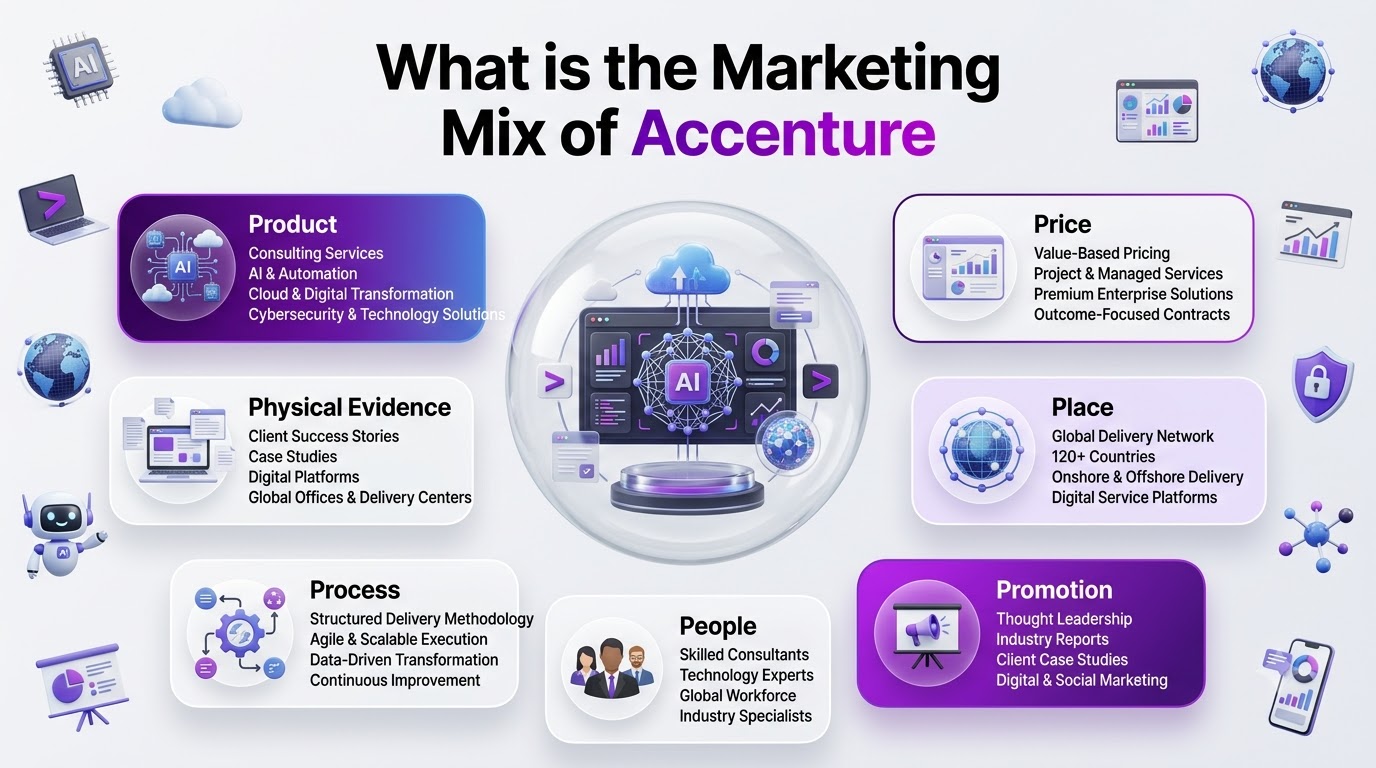
The classic marketing mix, Product, Price, Place, Promotion, was built with physical goods in mind. A car company designs a car, prices it, ships it to dealerships, and advertises it. None of that maps cleanly onto a company whose “product” is a team of consultants sitting in a client’s office for eighteen months redesigning their supply chain software. That’s exactly why the Marketing Mix of Accenture has to be studied through the extended 7Ps model that Booms and Bitner proposed for service businesses back in 1981, adding People, Process, and Physical Evidence to the original four.
Here’s the thing most students get wrong when they first study this. They assume the extra 3Ps are just filler, extra boxes to tick for a full mark on an assignment. For a company like Accenture, they’re not optional at all, they’re arguably the most important part. When a Fortune 500 CFO signs a nine-figure contract, they’re not evaluating a product spec sheet. They’re evaluating whether the specific people assigned to their account are good enough, whether Accenture’s delivery process has worked for similar companies before, and whether the physical and digital evidence of past work (client logos, case studies, dashboards, project rooms) gives them confidence to sign. Skip those three Ps and you don’t understand how Accenture actually wins deals.
The 7Ps Framework Applied to the Marketing Mix of Accenture
Breaking the Marketing Mix of Accenture into seven distinct elements gives a much clearer picture than lumping everything under “services marketing” as one vague blob. Product covers what Accenture actually delivers: strategy advice, technology builds, managed operations, engineering, and creative work, sold individually or bundled as end-to-end transformation. Price covers how those services get billed, and this is where things get genuinely interesting because Accenture is actively moving away from the old “bill by the hour” model. Place covers how and where services get delivered, which for Accenture means a mix of onshore consultants, offshore delivery centers, and increasingly remote digital collaboration. Promotion is the most visible part externally, covering everything from Super Bowl-adjacent ad spend to LinkedIn thought leadership. People, Process, and Physical Evidence round it out, and they’re the part that separates a firm clients trust with billion-dollar transformations from one that only gets small, low-risk projects.
If you’re studying digital marketing strategy more broadly, this framework is worth memorizing beyond just this one case study, because most B2B service businesses, agencies, SaaS companies with heavy onboarding, consulting shops, follow a version of this same logic even if they never call it the “7Ps.”
Product Strategy Inside the Marketing Mix of Accenture
Accenture’s product isn’t one thing, and that’s the point. The company organizes its offering into five service lines: Strategy & Consulting, Technology, Operations, Industry X, and Song. Strategy & Consulting is the advisory front door, the MBB-style work where Accenture helps a client figure out what to do before anyone builds anything. Technology, the largest revenue segment by a clear margin, covers systems integration, cloud migration, data platforms, and cybersecurity. Operations runs managed services and business process outsourcing on multi-year contracts, the unglamorous but highly profitable engine room work. Industry X handles engineering and connected-product R&D, think smart factories and IoT-enabled manufacturing. Song, formerly Accenture Interactive, covers brand, marketing, design, and customer experience work, essentially a creative agency bolted onto a consulting firm.
What makes this product mix work as a marketing asset rather than just an org chart is the bundling. Accenture doesn’t pitch “hire us for strategy” and then separately pitch “hire us for tech build.” It pitches the whole chain: we’ll tell you what to do, then we’ll build it, then we’ll run it for you afterward. That’s a fundamentally different sales motion than a boutique strategy firm that hands you a PowerPoint deck and walks away, and it’s the single biggest reason Accenture’s average deal size and contract length dwarf smaller competitors.
This is why Accenture, under Gartner’s new “Digital Technology and Business Consulting Services” Magic Quadrant introduced in January 2026, packages its five service lines into what it calls Reinvention Services, a single integrated unit combining strategy, consulting, technology, operations, Song, and Industry X rather than presenting them as five separate menu items a client picks from individually. Group Chief Executive-Strategy Muqsit Ashraf has described the positioning around one core idea: clients don’t just want advice on adapting, they want a partner who can help redefine the business itself. Being named a Leader in that inaugural report matters commercially, but it also matters as a promotional asset. Analyst recognition from a firm like Gartner functions as third-party validation that Accenture didn’t write itself, which carries more weight with skeptical enterprise buyers than any amount of self-authored marketing copy ever could.
Cloud, Data and AI as the New Core Product
If you look at where Accenture actually points its marketing budget and its hiring right now, cloud, data, and AI have quietly become the real core product, even though they technically sit inside the Technology segment. The company reports more than 350,000 cloud-skilled practitioners and over 53,000 Data & AI professionals on staff, numbers it repeats constantly in investor decks, sales pitches, and press releases because those figures are the actual proof of product credibility in a market where every competitor claims to “do AI.”
By mid-2025, Accenture had over 1,600 generative AI projects in flight, built on expanded partnerships with Microsoft, OpenAI, and Google. Here’s what most competitors miss when they try to copy this positioning: it’s not enough to say “we do AI.” Accenture backs the claim with a specific, quotable headcount number every single time it talks about AI capability, which makes the claim verifiable and quotable by journalists and analysts, not just a marketing slogan. That’s a small but deliberate GEO-style move (making your claims specific enough that they get cited accurately), and it works because vague claims get ignored while specific ones get repeated.
Accenture Song and the Creative-to-Code Product Bundle
Song is the part of the product mix that surprises people who only think of Accenture as “the IT consulting company.” Built through a string of creative and marketing agency acquisitions, most notably Droga5 in 2019 and social agency Whalar more recently, Song lets Accenture pitch a full chain from brand strategy and creative campaigns all the way through to the technology that powers the customer experience. A retail client doesn’t need to hire one agency for their rebrand and a separate vendor for their e-commerce platform. Accenture can theoretically do both under one contract.
This matters for the Marketing Mix of Accenture because it changes what “product” even means here. Song has picked up Cannes Lions recognition in both 2024 and 2025, which is a creative-industry credential Accenture uses to prove it’s not just technically competent but also creatively credible, a claim almost no pure IT consultancy can make. If your business is trying to understand how to bundle services in a way that increases deal size, Song is the clearest example: don’t just sell the strategy, own the entire value chain down to execution.
Acquisitions as a Product Expansion Tool
Accenture rarely builds a brand-new capability from scratch when it can buy one that already has clients and credibility. This is worth calling out separately because it’s a product strategy decision as much as a financial one. Every acquisition, Droga5 for creative firepower, Whalar for social and creator marketing, and dozens of smaller AI and cloud specialist firms over the past few years, gets absorbed and then immediately marketed as proof that Accenture’s product portfolio is current. The acquisition itself becomes a promotional event, generating press coverage that a slow internal capability build never would.
The mistake smaller companies make when trying to copy this is assuming acquisition is only about capability. It’s also about narrative. Every time Accenture buys a specialist firm, it gets a fresh news cycle proving it’s staying ahead of where the market is heading, and that narrative reinforcement is arguably worth as much as the actual technical capability being acquired.
Look at how this plays out with AI specifically. Rather than only training existing staff on generative AI tools internally and quietly rolling them into projects, Accenture pairs organic capability building with public-facing partnerships, expanded deals with Microsoft, OpenAI, and Google announced through 2024 and 2025 that generated their own press coverage independent of any specific client win. Each partnership announcement functions as a mini product launch even though nothing physically new is being sold, it’s proof the company’s product roadmap is current, timed and framed specifically for external visibility rather than just quietly documented in an internal memo.
Price Strategy in the Marketing Mix of Accenture
For decades, the default pricing model across the consulting industry, Accenture included, was time and materials: clients pay for consultant hours at agreed rates, plus expenses. It’s simple to administer and it protects the consulting firm from underestimating project scope, but it puts all the financial risk of a project running long onto the client, which has made clients increasingly unhappy with it over the last decade.
Fixed-price contracts flipped that risk. Accenture quotes a total price for a defined scope of work, and if the project takes longer than expected, that’s Accenture’s problem, not the client’s. This shift matters in a pricing strategy conversation because it changes the entire sales pitch from “trust us and pay as we go” to “we’re confident enough in our delivery process to guarantee an outcome for a fixed number.” Most large enterprise deals with Accenture today use some blend of both, fixed price for well-defined phases like a system implementation, time and materials for exploratory or ongoing advisory work where scope genuinely can’t be nailed down in advance.
Outcome-Based Pricing and Why Clients Are Asking for It
The more interesting shift, and the one that actually matters for anyone studying the Marketing Mix of Accenture in 2026, is outcome-based pricing. Instead of billing for hours or even a fixed project fee, Accenture increasingly ties a portion of its compensation to measurable business results: a percentage of cost savings generated, a share of revenue growth from a new digital channel, or bonus payments tied to hitting specific KPIs like customer churn reduction.
This model is harder to sell internally (it requires Accenture to be genuinely confident in its delivery capability, since underperformance now directly costs the firm money) but it’s a powerful marketing tool externally. It lets sales teams say “we’re willing to put our fee at risk against your results,” which is a dramatically more convincing pitch to a skeptical CFO than a flat hourly rate. Look at what actually happens in a boardroom when two vendors pitch the same project: the one offering outcome-based pricing signals confidence, and confidence closes deals that pure price competition never would.
How Accenture Prices Against Deloitte, IBM and Big Four Rivals
Accenture’s closest competitive set includes Deloitte, PwC, EY, KPMG (the Big Four, which also bundle strategy, technology, and operations), plus pure-play technology services firms like IBM Consulting, Infosys, and TCS. Pricing across this group is rarely public, contracts are negotiated privately and vary hugely by scope, but the general pattern holds: Accenture tends to price at a premium versus the Indian IT majors like Infosys and TCS, reflecting its stronger brand and higher-touch strategy work, while pricing competitively against the Big Four on large-scale technology and operations deals where delivery capability, not brand prestige, is the deciding factor.
What’s genuinely underappreciated here is that Accenture rarely competes purely on price. Reporting on the company’s positioning shows it outperforms peers by roughly 2.3 times on revenue growth and return on invested capital over a five-year period and 1.5 times on shareholder return over three years, numbers Accenture uses in sales conversations to justify not being the cheapest option in the room. If a client pushes back on price, the sales team’s answer isn’t “we’ll match the competitor’s rate,” it’s “here’s the data on why paying more for us produces a better return.”
Place and Distribution Strategy in the Marketing Mix of Accenture
Place, in a traditional marketing mix, means retail locations or distribution channels. For Accenture, it means something closer to “where the actual work gets done,” and the answer is a genuinely massive global delivery network. With roughly 784,000 employees spread across 120-plus countries, Accenture has built delivery hubs in India, the Philippines, Poland, and other locations chosen specifically for a combination of skilled talent, favorable labor costs, and time-zone coverage that lets work continue around the clock as projects hand off between regions.
This delivery network is a genuine competitive moat, not just a cost play. A boutique consulting firm with 200 employees simply cannot promise a Fortune 100 client that work will continue overnight in Manila while the New York team sleeps. Scale itself becomes part of the pitch. When Accenture’s sales team talks about “place” in a client conversation, they’re really talking about risk reduction: we have enough people, in enough locations, that your project won’t stall because one office is short-staffed or one region has a public holiday.
Local Client Proximity and the Innovation Hub Model
Alongside the offshore delivery network, Accenture runs a parallel local presence strategy through innovation hubs and client-facing offices in more than ten major cities, including New York, London, and Singapore. These aren’t just office space, they’re built specifically to host client workshops, live demos of emerging technology, and co-creation sessions where a client’s leadership team can walk through a working prototype rather than reviewing a slide deck.
This dual approach, low-cost offshore delivery paired with high-visibility local proximity, solves a real tension in services marketing. Clients want the cost efficiency of offshore delivery, but they also want to feel like their account gets senior, local attention, not just a distant back-office team. Accenture’s place strategy is built specifically to let it claim both simultaneously, and that’s a harder balancing act than it looks from the outside.
Digital Delivery Channels and Client Collaboration Tools
The third layer of place in the Marketing Mix of Accenture is digital delivery itself. A meaningful and growing share of Accenture’s work now happens through remote collaboration platforms, client portals, and shared digital workspaces rather than consultants physically sitting in a client’s office five days a week. This shift accelerated hard during 2020 and has never fully reversed, because both Accenture and its clients found that remote delivery on many project types works just as well and costs less.
This matters for the marketing mix conversation because “place” for a modern services company isn’t fixed anymore. It’s a spectrum from fully offshore, to fully digital and remote, to high-touch in-person, and Accenture actively markets its flexibility across that entire spectrum as a selling point. Clients aren’t asked to choose one delivery mode, they’re sold on Accenture’s ability to shift between all three depending on what a specific project phase actually needs.
Promotion Strategy in the Marketing Mix of Accenture
No honest breakdown of the Marketing Mix of Accenture can skip the Tiger Woods story, because it’s genuinely one of the more instructive brand recovery cases in modern marketing history. From 2003 to 2009, Accenture’s entire promotional identity was built around Woods, with slogans like “Go on. Be a Tiger” and “We know what it takes to be a Tiger.” When revelations about Woods’ personal life broke in December 2009, Accenture cut ties within days, and suddenly a company that had spent six years building its brand around one athlete had nothing.
What Accenture did next is the part worth studying. Rather than rushing out a replacement celebrity endorsement, it pivoted to a metaphor-driven campaign built around animals, giraffes, elephants, polar bears, under the theme “High Performance. Delivered.” It was safer, less dependent on any single person’s reputation, and it bought time to rebuild. By 2020, the company had moved on again, launching “Let There Be Change” with creative agency Droga5 (which it had acquired in 2019), tripling its annual media spend to roughly $90 million, the largest brand investment in the firm’s history at that point. The lesson here isn’t subtle: never build a decade of brand equity around something you don’t fully control.
Sports Sponsorships and the NFL Playbook
Accenture’s return to sports marketing, after the Woods fallout kept it cautious for over a decade, has been deliberate and structural rather than personality-driven. In 2025, Accenture became the official sponsor of the NFL’s International Games, held across São Paulo, Dublin, London, Berlin, and Madrid, and launched “Beyond the Goalposts” with Droga5 to coincide with the sponsorship. The ad debuted during the Eagles-Cowboys season opener on NBC and Peacock, drawing an average of 53 million viewers and peaking at 62.5 million, one of the highest-viewership placements a B2B services brand can buy.
Notice what’s different from the Tiger Woods era here. Accenture isn’t sponsoring a single athlete whose personal choices could blow up the brand overnight. It’s sponsoring a league, a structural, institutional partnership that’s far more resilient to individual scandal. The campaign’s tagline, built around shifting goalposts as a metaphor for business adaptability, ties directly back to Accenture’s “reinvention” positioning rather than existing as a standalone sports ad, which is exactly how sponsorship should work: reinforce the core brand message, don’t just borrow attention from an unrelated event.
Thought Leadership, Research Reports and Fjord Trends
A huge and often underrated chunk of Accenture’s promotional strategy runs through content that doesn’t look like advertising at all: annual research reports, industry point-of-view papers, and joint publications with outlets like Harvard Business Review. The Fjord Trends report (Fjord being Accenture’s design consultancy, now part of Song) has become a genuinely anticipated annual publication that journalists, other consultancies, and business leaders cite as a primary source, which is exactly the goal of thought leadership content done right: get cited by people you didn’t pay to cite you.
This is the clearest AEO and GEO lesson buried inside the Marketing Mix of Accenture. Every report is packed with specific, quotable statistics and named frameworks rather than vague generalities, which makes the content genuinely useful to journalists writing on deadline and to AI systems generating summaries of industry trends. If you’re building content strategy for a B2B brand, the model is straightforward even if executing it well is hard: produce research specific enough that other people want to cite you, not content vague enough that nobody bothers.
Digital Presence, SEO and Website Content Strategy
Beyond the big campaigns and sponsorships, a huge share of Accenture’s day-to-day promotional work happens quietly through its own website and search visibility, and it’s worth calling out separately because most people studying the Marketing Mix of Accenture only look at the flashy stuff. Accenture.com functions less like a corporate brochure and more like a content hub, with dedicated pages for every industry vertical, every service line, and dozens of ongoing research series, all built to rank for the exact terms a CFO or CTO would type into a search bar when researching a transformation project.
The SEO strategy here prioritizes terms tied to cloud migration, generative AI adoption, and data modernization, since those are the highest-intent searches in the current market. Paid search and paid social spend concentrates heavily on LinkedIn, with lighter, more selective use of platforms like YouTube and X for broader awareness plays. What’s smart about this is the targeting discipline. Accenture doesn’t try to be everywhere equally. It puts serious budget behind the one platform where enterprise decision-makers actually spend time professionally, and treats everything else as secondary reach rather than a primary channel. If you’re mapping out where to spend limited marketing budget as a B2B business, that discipline, picking the one or two channels your actual buyer lives on instead of spreading thin across every platform, is a far more transferable lesson than the size of Accenture’s NFL sponsorship budget.
Account-based marketing tooling also sits quietly behind a lot of this digital work. Because a single closed deal can be worth hundreds of millions of dollars, Accenture’s marketing operations lean on tightly integrated ABM platforms to track which specific named accounts are engaging with which piece of content, then feed that signal straight to the sales team responsible for that relationship. That’s a very different model from consumer marketing, where the goal is broad reach across an anonymous audience. Here the goal is precision: knowing that a specific VP at a specific Fortune 500 company just downloaded a specific AI adoption report, and making sure the right account executive follows up within days, not weeks.
Employer Branding as a Marketing Channel
Here’s a piece most business-school case studies on the Marketing Mix of Accenture skip entirely: employer branding. Because Accenture’s actual product is its people, and because winning and keeping the best consultants, engineers, and data scientists directly determines whether it can deliver on client promises, recruitment marketing functions as a genuine extension of the overall marketing strategy, not a separate HR silo.
LinkedIn plays a central role here, both for external client-facing content and for internal culture storytelling that doubles as recruitment marketing. When Accenture’s AAPAC marketing lead posted about employees creating personalized versions of the company’s “>” logo as an engagement exercise, that wasn’t just an internal culture moment, it functioned as public proof of a healthy, engaged workforce for anyone considering a job offer or, just as importantly, for any client evaluating whether Accenture’s people are motivated enough to deliver good work. That dual audience, talent and clients, reading the same content for different reasons, is a smart use of one channel serving two goals at once. If you’re building out a social presence with a similar dual purpose in mind, a proper content calendar that plans for both audiences from the start will save a lot of rework later.
People, Process and Physical Evidence in the Marketing Mix of Accenture
In a services business, the People element of the marketing mix isn’t a supporting factor, it’s arguably the core product itself. When a client signs with Accenture, they’re not buying a piece of software, they’re buying access to specific skill sets, and the company’s marketing constantly reinforces this by quoting exact numbers: 350,000-plus cloud-skilled practitioners, 53,000-plus Data & AI professionals, 20,000-plus security specialists. Those aren’t abstract brand claims, they’re inventory figures, proof that the capacity being sold genuinely exists at scale.
This has a direct implication for how Accenture recruits and retains talent, because losing skilled people doesn’t just hurt delivery capacity, it directly undermines the marketing claims being made to prospective clients. That’s why the firm invests heavily in structured career development programs and leadership tracks, not purely out of altruism, but because in a people-as-product business, employee retention is a marketing metric as much as an HR one.
There’s a second layer here worth calling out: named leadership as a trust signal. Under CEO Julie Sweet, the first woman to lead the company since taking over in September 2019, Accenture’s leadership team appears consistently in press coverage, industry panels, and client-facing content, not hidden behind a generic “Accenture” byline. Naming specific executives and letting them speak with authority on record, the way Group Chief Executive-Strategy Muqsit Ashraf does in analyst report commentary, turns individual credibility into brand credibility. A client evaluating a nine-figure contract wants to know real, accountable people are behind the promise, not just a logo.
Process, How a Typical Engagement Actually Runs
Process covers the actual mechanics of how Accenture delivers, and it’s a genuine differentiator against smaller consulting firms that can advise but can’t reliably execute at scale. A typical large Accenture engagement moves through a defined arc: a discovery and diagnostic phase where Strategy & Consulting teams assess the client’s current state, a design phase where a solution architecture gets built and validated, an implementation phase where Technology and Industry X teams actually build the thing, and finally a run phase where Operations takes over ongoing management, often for years under a managed services contract.
What makes this process a marketing asset rather than just internal methodology is repeatability. Accenture can point a prospective client to dozens of prior engagements that followed the same structured arc and succeeded, which is a fundamentally more convincing pitch than “trust our expertise,” because it’s evidence of a proven system rather than a claim about individual talent. The mistake smaller consultancies make is treating every project as a custom, one-off build. Accenture treats its delivery process itself as a productized, sellable asset.
Physical Evidence, Offices, Innovation Hubs and the Accent Symbol
Physical Evidence covers every tangible or visible signal that reassures a client the service being promised will actually get delivered. For Accenture, this spans the innovation hubs mentioned earlier, the consistent “>” brand symbol applied across every touchpoint from web to social to client proposals, and the sheer visual weight of its published case studies and client logos on its website and in sales decks.
The “>” symbol specifically deserves a mention because it’s been part of Accenture’s identity for more than two decades and gets treated as a genuine brand asset, not just a logo mark. It shows up consistently enough across every channel, web, proposals, social, event branding, that it functions as instant recognition, the visual equivalent of a name-brand product’s packaging on a shelf. For a services company with nothing physical to hand a customer, that kind of consistent visual and tangible proof matters more than most marketers give it credit for.
How the Marketing Mix of Accenture Compares to Its Biggest Rivals
No breakdown of the Marketing Mix of Accenture is complete without putting it next to the firms it actually loses and wins deals against, because positioning only means something in relation to competitors. Accenture sits in an unusual spot in the professional services landscape: too big and too technology-heavy to be judged purely against pure strategy houses, but too consulting-heavy and too expensive to be judged purely against Indian IT services giants. That in-between positioning is deliberate, and it shows up clearly once you compare the marketing mix element by element against each competitor set.
Accenture vs Deloitte and the Big Four
Deloitte, PwC, EY, and KPMG are Accenture’s closest structural peers, since all four bundle strategy, technology, and operations under one roof the same way Accenture does. The real difference in the marketing mix isn’t Product, since the service lines look broadly similar on paper, it’s Promotion and Physical Evidence. Accenture spends far more visibly on brand campaigns, its NFL sponsorship and Droga5-produced ads being the clearest example, while the Big Four firms lean more heavily on their audit and tax heritage for institutional trust and spend comparatively little on consumer-facing brand advertising.
This creates a genuine tension for CFOs comparing quotes. A Big Four firm can lean on decades of audit relationship trust to win a technology contract almost by default, while Accenture has to actively market its technology credibility since it never had an audit practice to fall back on. That’s part of why Accenture invests so heavily in specific, quotable capability numbers, cloud practitioners, AI professionals, security specialists, because it doesn’t have the built-in institutional trust the Big Four inherited from their audit roots.
Accenture vs McKinsey, BCG and Bain on Strategy Positioning
Against the pure strategy houses, McKinsey, BCG, and Bain (commonly shortened to MBB), Accenture’s marketing mix tells almost the opposite story. MBB firms sell prestige and small, elite teams delivering high-level advice, then walk away and leave implementation to someone else. Accenture’s entire pitch is the reverse: we’ll give you the advice and then actually build and run the thing ourselves, so you’re not stuck translating a strategy deck into working software with a different vendor six months later.
This is why Accenture rarely competes head-to-head with MBB for the exact same engagement. When it does win strategy work against them, the pitch almost always centers on execution risk: a client that’s been burned before by a beautiful MBB strategy document that never got properly implemented becomes a prime target for Accenture’s “we’ll see it through” positioning. That’s a Product-and-Process argument dressed up as a Promotion pitch, and it’s one of the more subtle competitive plays in the entire Marketing Mix of Accenture.
Accenture vs IBM and Indian IT Majors on Technology Delivery
On pure technology delivery, Accenture’s closest rivals are IBM Consulting and the large Indian IT services firms like Infosys, TCS, and Wipro. Here the competitive battle shifts almost entirely to Price and People. Indian IT majors typically compete on lower delivery costs backed by large domestic talent pools, while Accenture positions itself as the premium option, justified through its blended strategy-plus-execution model and its heavier investment in emerging capabilities like generative AI.
IBM sits somewhere in between, carrying strong brand recognition in enterprise technology but without the same scale of consulting and creative capability Accenture has built through acquisitions like Droga5. What most comparisons miss is that Accenture doesn’t try to win every technology deal on price. In client conversations where cost is the primary decision driver, Accenture will often lose to a cheaper Indian IT major, and that’s an accepted trade-off, because the firm’s marketing mix is built to attract clients who value the full strategy-to-execution bundle over the lowest possible hourly rate.
Common Mistakes People Make When Studying the Marketing Mix of Accenture
A lot of case study write-ups on this topic stop at Product, Price, Place, and Promotion and either skip People, Process, and Physical Evidence entirely or treat them as an afterthought paragraph. That’s backwards for a company where the actual value being sold is talent and delivery capability, not a physical good. If you’re writing an assignment or a business analysis on this topic, weighting the last three Ps as lightly as the first four will make the analysis noticeably shallower than it should be.
Another common mistake is assuming Accenture’s pricing is purely hourly and hasn’t evolved. The shift toward fixed-price and outcome-based contracts is one of the more interesting recent developments in the entire consulting industry, and skipping it means missing the most current, relevant part of the pricing story. A third mistake is treating the Tiger Woods sponsorship failure as ancient history irrelevant to today’s brand. It’s actually the single most useful lesson in the entire case, because Accenture’s current promotional strategy (league sponsorships instead of individual athletes, institutional partnerships instead of personality bets) is a direct, deliberate response to that exact failure.
What Marketers Can Learn from the Marketing Mix of Accenture
The biggest takeaway from studying the Marketing Mix of Accenture isn’t really about consulting at all, it’s about how services businesses of any size should think about their own marketing mix. Bundle capabilities instead of selling them piecemeal, the way Accenture ties strategy, build, and run together into one relationship rather than three separate transactions. Never build a brand identity around something outside your control, whether that’s a single celebrity or a single trend, the way the Tiger Woods collapse forced a complete rebuild. Make claims specific and quotable rather than vague, the way Accenture’s exact headcount and capability numbers get cited by journalists and analysts instead of ignored the way generic marketing copy usually is.
And maybe the most underrated lesson: treat your people, your delivery process, and your visible proof of past work as marketing assets in their own right, not just operational details that happen behind the scenes. Most service businesses, agencies, freelancers, consultancies of any size, focus almost all their marketing energy on Promotion and completely under-invest in making their Process and Physical Evidence visible and credible to prospective clients. Accenture’s scale makes this easier to execute, but the underlying principle scales down just fine to a five-person agency deciding what to put on its website’s case studies page.
There’s also a lesson in patience that gets overlooked. Accenture didn’t fix its brand overnight after the Tiger Woods fallout. It took roughly a decade, moving from the safe, low-risk animal metaphor campaigns of the early 2010s to the confident “Let There Be Change” repositioning in 2020, before finally landing on the current “Reinvented with Accenture” platform backed by a major sports league sponsorship. Smaller businesses often expect a rebrand or a new campaign to fix a reputation problem within a single quarter, and then get discouraged when it doesn’t. Accenture’s own history is proof that rebuilding brand trust after a genuine setback is a multi-year project, not a one-off campaign, and treating it that way from the start avoids the frustration of expecting an overnight turnaround.
One more transferable point sits in how Accenture handles competitive pressure without racing to the bottom on price. Rather than matching cheaper Indian IT majors on hourly rates, the firm doubles down on proving the value of its bundled model through hard numbers like its 2.3 times revenue growth outperformance versus peers. Any business getting undercut by a cheaper competitor faces the same choice: match the price and shrink margins, or get specific and confident about the value the higher price actually buys. Accenture consistently picks the second option, and its financial performance over the past several years suggests that choice has paid off.
Conclusion
The Marketing Mix of Accenture works precisely because it stopped trying to fit a services business into a framework built for physical products decades ago. Product means five bundled service lines built around cloud, data, and AI. Price means a genuine shift from hourly billing toward outcome-based contracts that put Accenture’s own fee at risk. Place means a global delivery network paired with local innovation hubs and flexible digital delivery. Promotion means a brand that learned a brutal lesson from the Tiger Woods collapse and rebuilt itself around institutional sponsorships and specific, quotable thought leadership instead of a single celebrity bet. And People, Process, and Physical Evidence, the three elements most case studies skip, are quietly where a lot of the real competitive advantage lives.
If you’re studying this as a marketing student, a business analyst, or someone running your own services business trying to figure out how to position what you sell, the real lesson isn’t to copy Accenture’s specific tactics. It’s to take the 7Ps framework seriously enough to apply all seven, not just the four that fit neatly into a product-marketing mindset, because that’s exactly where the Marketing Mix of Accenture pulls ahead of most competitors who never bother going that deep.
Frequently Asked Questions
What is the marketing mix of Accenture?
The marketing mix of Accenture is best understood through the extended 7Ps framework: Product (five bundled service lines covering strategy, technology, operations, engineering, and creative work), Price (a mix of hourly, fixed-price, and outcome-based contracts), Place (a global delivery network plus local innovation hubs), Promotion (brand campaigns and sponsorships built around reinvention), and People, Process, and Physical Evidence, which reflect the company’s talent, delivery methodology, and visible proof of past work.
Why does Accenture use 7Ps instead of the traditional 4Ps?
Accenture is a professional services company, not a physical product business, so the traditional 4Ps model (Product, Price, Place, Promotion) doesn’t fully capture what drives client decisions. The extended 7Ps model adds People, Process, and Physical Evidence, which matter enormously in services marketing because clients are essentially buying trust in a company’s talent and delivery capability rather than a tangible item.
What are Accenture’s five main service lines?
Accenture’s five service lines are Strategy & Consulting, Technology, Operations, Industry X, and Song. Technology is the largest revenue contributor and covers cloud, data, and cybersecurity work, while Strategy & Consulting is smaller in revenue but carries the highest margins and often serves as the entry point into larger client relationships.
How does Accenture price its consulting services?
Accenture uses a blend of time-and-materials billing, fixed-price contracts for well-scoped project phases, and a growing share of outcome-based pricing tied to measurable client results like cost savings or revenue growth. The shift toward outcome-based pricing reflects client demand for vendors willing to share financial risk rather than simply billing by the hour.
Does Accenture do its own SEO and content marketing?
Yes. Accenture runs an extensive content and SEO strategy through its own website, publishing industry-specific pages and research content built to rank for high-intent search terms around cloud migration, generative AI, and data modernization. Paid media spend is concentrated heavily on LinkedIn, where its enterprise buyers spend the most professional time, with lighter, more selective use of other platforms.
How does Accenture compare to McKinsey, BCG, and Bain?
Accenture and the MBB strategy firms (McKinsey, BCG, Bain) rarely compete for identical engagements because their models differ fundamentally. MBB firms typically deliver high-level strategic advice and step away, leaving implementation to the client or another vendor, while Accenture pitches itself on carrying a project from initial strategy all the way through technology build and ongoing operations under one contract.
What happened with Accenture and Tiger Woods?
From 2003 to 2009, Accenture built its entire brand campaign around golfer Tiger Woods with slogans like “Go on. Be a Tiger.” After personal scandal revelations broke in December 2009, Accenture ended the sponsorship within days and pivoted to a metaphor-driven “High Performance. Delivered.” campaign built around animals instead of a single celebrity endorsement.
What is Accenture Song?
Accenture Song, formerly known as Accenture Interactive, is the company’s creative, brand, design, and customer experience division. It was built through acquisitions including creative agency Droga5 in 2019 and social agency Whalar more recently, letting Accenture pitch clients on everything from brand strategy to the technology that powers the resulting customer experience under one contract.
Is Accenture’s marketing mix different from IBM or Deloitte’s?
The overall structure is similar since all three are professional services firms competing on strategy, technology, and operations delivery, but Accenture differentiates through its Song creative division, heavier sports sponsorship investment like its 2025 NFL International Games partnership, and a more aggressive push toward outcome-based pricing than many of its closest competitors.
How many employees does Accenture have and why does that matter for its marketing?
Accenture reports approximately 784,000 employees across more than 120 countries. This scale matters directly for its marketing mix because the company constantly cites specific talent numbers, such as 350,000-plus cloud-skilled practitioners, as proof points in sales conversations, since its actual product is the skill and availability of its workforce.
What is Accenture’s current brand campaign called?
Accenture’s current brand platform, “Reinvented with Accenture,” launched in 2024 as an expansion of the “Let There Be Change” campaign introduced in 2020 with creative agency Droga5. It includes the 2025 “Beyond the Goalposts” NFL campaign tied to Accenture’s sponsorship of the league’s International Games.
Why is Place a meaningful part of Accenture’s marketing mix if it doesn’t sell physical products?
Place, for Accenture, refers to how and where its services actually get delivered rather than a retail location. This includes offshore delivery centers in countries like India and the Philippines, local innovation hubs in major cities for high-touch client work, and digital collaboration platforms that let projects run remotely, giving Accenture flexibility across the full delivery spectrum.
What can small businesses learn from Accenture’s marketing mix?
Small service businesses can learn to bundle related offerings instead of selling them separately, avoid building brand identity around something outside their control, make marketing claims specific and quotable rather than vague, and treat their team’s skills, delivery process, and visible case studies as real marketing assets rather than purely operational details.
How does Accenture use thought leadership as a marketing tool?
Accenture publishes annual research like the Fjord Trends report and collaborates with outlets such as Harvard Business Review to produce industry point-of-view content packed with specific, citable statistics. This positions the company as an authoritative source that journalists and other businesses reference, generating credibility and visibility without functioning as traditional paid advertising.
Does Accenture compete mainly on price or on value?
Accenture generally avoids competing on price alone, especially against lower-cost Indian IT services firms. Instead, its marketing mix leans on proving value through specific performance data, such as outperforming peers by roughly 2.3 times on revenue growth and return on invested capital over a five-year period, to justify premium pricing rather than matching cheaper competitors on rate.
How long did it take Accenture to rebuild its brand after the Tiger Woods scandal?
It took roughly a decade for Accenture’s brand strategy to fully recover its confidence after ending the Tiger Woods sponsorship in December 2009. The company moved through a cautious, metaphor-driven “High Performance. Delivered.” phase before launching the more assertive “Let There Be Change” campaign in 2020 and its current “Reinvented with Accenture” platform in 2024, showing that meaningful brand recovery is a multi-year process, not a single campaign.