


Walk into any boardroom discussing digital transformation and someone will eventually say the word Accenture. Maybe it’s the CFO asking why the consulting bill hit eight figures again. Maybe it’s a startup founder wondering how a company nobody outside the industry can properly pronounce ended up running the backend of half the Fortune 500. Either way, Accenture keeps showing up. It’s the kind of company that touches banking systems, government payrolls, retail supply chains, and airline booking engines, often all in the same quarter, without most customers ever knowing its name is stitched into the machinery.
That invisibility is actually the point. Accenture doesn’t sell a product people queue up for. It sells the unglamorous, expensive, absolutely necessary work of making other companies function better, migrate faster, and not fall apart when a legacy mainframe finally gives out. With revenue north of $69 billion for fiscal 2025 and close to 799,000 employees on the books by mid-2026, it isn’t a small player anymore. It’s closer to a parallel economy, one built entirely on billable hours, delivery centers, and increasingly, on AI systems that are starting to replace the very headcount the company built its empire on.
This piece breaks down where Accenture stands right now, not the polished version from its own investor decks, but a working analysis of what’s actually strong, what’s cracking, where the money could come from next, and what could genuinely hurt the business over the next few years. A SWOT Analysis of Accenture only means something if it’s honest about the messy parts too, not just a list of achievements dressed up as strengths. So expect some pushback here, not just a highlight reel.
There’s also a bigger question hanging over this whole exercise, one that applies to every large services firm right now, not just Accenture. Generative AI is changing what “consulting” even means. A company that built a $69 billion empire on staffing thousands of smart, expensive humans onto client projects now has to figure out how to sell the very technology that could shrink the need for those humans. That tension shows up again and again through this analysis, in the Strengths, in the Weaknesses, and especially in the Opportunities and Threats sections, because it genuinely cuts both ways.
Before diving into the analysis itself, it helps to understand what Accenture actually does day to day, who it’s fighting for market share against, and how a company that started as an internal audit division of Arthur Andersen turned into one of the largest professional services firms on the planet. That context makes the SWOT far more useful than reading the four boxes cold, because strengths and weaknesses only make sense once you know what the business actually looks like on the ground.
What You Will Learn in This Guide
- How Accenture built its business model and what actually generates its revenue
- The company’s history, leadership, and how it grew from 384,000 to nearly 800,000 employees
- The core services Accenture offers across consulting, technology, and operations
- Who Accenture’s real competitors are and where the pressure is coming from
- A detailed Strengths breakdown covering scale, client relationships, and talent
- The structural Weaknesses that show up in margins, layoffs, and dependency risk
- Where the genuine Opportunities sit, especially around AI-led reinvention work
- The Threats that could reshape the business faster than leadership expects
- Answers to the most common questions people ask about Accenture’s position today
About Accenture
Accenture traces back to 1989, when it split off from Arthur Andersen as a technology consulting arm called Andersen Consulting. The Enron collapse and the resulting implosion of Arthur Andersen in the early 2000s actually worked out fine for this side of the business, since it had already rebranded to Accenture in 2001 and kept its hands clean of the accounting scandal that took down its former parent. That timing, whether it was luck or foresight, gave Accenture a fresh identity right as the dot-com crash was reshaping how companies thought about technology spending, and it walked away from the Andersen name at exactly the moment that name became radioactive.
Headquartered in Dublin, Ireland, for tax and regulatory reasons, Accenture today operates in more than 120 countries and runs offices in over 200 cities. The scale is genuinely hard to picture. Close to 799,000 people work under the Accenture name as of the third quarter of fiscal 2026, up from 384,000 just a decade earlier in 2016. That’s not organic headcount growth in the normal sense, it’s a company that has been acquiring, hiring, and scaling delivery centers in India, the Philippines, and Eastern Europe at a pace few competitors can match. Fiscal 2024 alone added 41,000 people, a 5.6% jump in a single year, which tells you how aggressively the company was staffing up even before the AI narrative fully took over investor calls.
Julie Sweet has run the company as Chair and CEO since 2019, taking over from David Rowland, who briefly served as interim CEO after Pierre Nanterme passed away that same year while still in the role. Sweet came up through the legal and North America business side rather than the traditional consulting track, and under her leadership the messaging has shifted hard toward “reinvention,” a word that shows up in nearly every earnings call transcript now, sometimes to the point of sounding like a buzzword rather than a strategy. Whatever you think of the branding, the financial results underneath it have generally held up.
Fiscal 2025 revenue landed at $69.67 billion, net income came in around $7.83 billion, and operating income sat at approximately $10.23 billion. Total assets were reported at $65.39 billion with total equity around $32.24 billion, and the company serves roughly 9,000 clients, including a large chunk of the Fortune Global 500. Numbers like that make Accenture bigger than most of its clients, which is a strange but accurate way to think about the relationship, a firm hired to advise companies that are, in many cases, smaller in revenue and headcount than the advisor itself.
Accenture trades on the NYSE under the ticker ACN and sits in both the S&P 100 and Russell 1000 indexes, which matters because it means large index funds and institutional investors hold significant stakes almost by default, giving the stock a kind of structural stability that smaller consulting firms without public listings simply don’t have. It also means every quarterly earnings call gets scrutinized heavily by analysts trying to read the tea leaves on where enterprise technology spending is heading next, since Accenture’s results are often treated as a bellwether for the entire IT services sector.
Services by Accenture
Accenture organizes its work into a handful of broad categories, though in practice the lines blur constantly because a single client engagement often spans several of them at once. Strategy and Consulting sits at the top, where teams help executives figure out what to actually do before anyone writes a line of code, covering everything from corporate strategy to operating model redesign, mergers and acquisitions support, and sustainability strategy. This is the highest margin part of the business and the one Accenture leans on hardest when pitching itself as a partner rather than a vendor, because it’s the entry point that often leads into years of follow-on implementation work.
Technology services make up the largest single chunk of revenue, and this is where the company builds, integrates, and maintains systems, everything from cloud migrations to enterprise software implementations for platforms like SAP, Salesforce, Oracle, and Workday. Accenture has quietly become one of the largest system integrators on the planet, and a huge share of its workforce spends its days configuring, patching, and extending software that other companies built rather than writing proprietary code from scratch. It’s unglamorous work, but it’s sticky, because once a company’s core systems run through Accenture’s implementation, switching providers becomes genuinely painful, both technically and politically inside the client organization.
Operations is the third leg, and it covers the business process outsourcing side, things like finance and accounting operations, supply chain management, procurement, and customer service functions that companies hand off entirely rather than staffing internally. This part of the business tends to run on longer contracts with more predictable, annuity-like revenue, since a client that hands over its entire finance back office isn’t going to rip that arrangement out on a whim, the transition costs alone make switching a multi-quarter decision.
Industry X focuses on engineering and manufacturing-related digital work, blending physical and digital transformation for industrial clients, things like connected factories, digital twins, and product engineering services. It’s a smaller piece of the pie than Technology or Operations but it’s grown steadily as manufacturers try to modernize plants that, in some cases, are running on control systems installed decades ago. Then there’s Song, formerly Accenture Interactive, which handles marketing, creative, and customer experience work, essentially competing with advertising agencies after Accenture went on an acquisition spree buying up creative shops like Droga5 and building out design, content, and commerce capabilities under one roof.
Layered across all of this now is the advanced AI push. Accenture defines this narrowly, generative, agentic, and physical AI work, separate from the classical AI it already used to deliver services for years before ChatGPT made the term mainstream. Revenue in that specific bucket tripled to $2.7 billion in fiscal 2025, and new bookings nearly doubled to $5.9 billion. Cumulative bookings since the company started tracking the metric back in 2023 have reached about $11.5 billion across roughly 11,000 projects, with $4.8 billion in cumulative revenue recognized so far. That’s the fastest growing piece of the business by a wide margin, and it’s reshaping how Accenture talks about itself in every recent filing, investor call, and marketing campaign, sometimes to the point where the older service lines barely get a mention anymore even though they still generate the bulk of actual revenue.
Cybersecurity has also emerged as a standalone practice rather than a feature bolted onto technology projects, covering everything from cyber-resilience strategy to managed detection and response services. As clients push more of their operations into cloud environments and AI systems, the demand for dedicated security work has grown independently of the broader technology budget, and Accenture has structured its offering to sell this as its own line item rather than an add-on.
Competitors of Accenture
The competitive field around Accenture is crowded, and it comes from multiple directions rather than one clean category of rival. On the traditional consulting side, McKinsey, Boston Consulting Group, and Bain compete for the high-level strategy work, though they’re smaller and typically don’t build or run the technology systems afterward the way Accenture does. That gap is actually one of Accenture’s structural advantages, since it can sell the strategy and then bill for years executing it, capturing revenue at every stage of a transformation rather than handing off the implementation to someone else once the PowerPoint deck is delivered.
Then there’s the Big Four, Deloitte, PwC, EY, and KPMG, all of whom have built out consulting and technology arms that overlap heavily with Accenture’s offerings, sometimes underbidding on price because their audit and tax practices subsidize other parts of the business in ways Accenture’s pure-play model can’t match. Deloitte in particular has grown its consulting arm aggressively over the past decade and now competes directly with Accenture on many of the same large-scale digital transformation deals, often going head to head in the same RFP process for a single client contract.
IBM Consulting remains a direct rival too, particularly in enterprise technology integration, though IBM has been shrinking that division for years while trying to focus more on its Red Hat and hybrid cloud story, selling off pieces of its services business and repositioning the remaining consulting arm as a smaller, more focused practice tied tightly to IBM’s own software stack rather than a broad, vendor-agnostic offering like Accenture provides.
On the technology and outsourcing side, Cognizant, Infosys, Tata Consultancy Services, and Wipro compete aggressively, especially on price, since these firms built their models around lower-cost delivery out of India from the start rather than layering it on later like Accenture did. TCS in particular has grown into a genuine scale competitor, with a market capitalization that periodically rivals Accenture’s own, and it wins deals specifically by underpricing on standardized implementation work where deep strategic input matters less than execution speed and cost.
Capgemini in Europe and Genpact in operations-heavy outsourcing round out the field, with Capgemini competing especially hard on European government and enterprise contracts where local presence and language capability matter more than global scale. And increasingly, the cloud providers themselves, AWS, Microsoft, and Google, run their own professional services arms that eat into implementation work Accenture used to own outright, particularly for clients already committed to a specific cloud platform who’d rather buy the implementation directly from the platform owner than pay a third party to configure someone else’s infrastructure.
That’s a newer, sharper threat than the traditional list, and it’s worth remembering when reading through the Threats section further down, because unlike McKinsey or Deloitte, these cloud providers control the underlying rails everything else runs on, giving them a structural pricing advantage that a services-only competitor simply can’t replicate no matter how many consultants it hires.
SWOT Analysis of Accenture
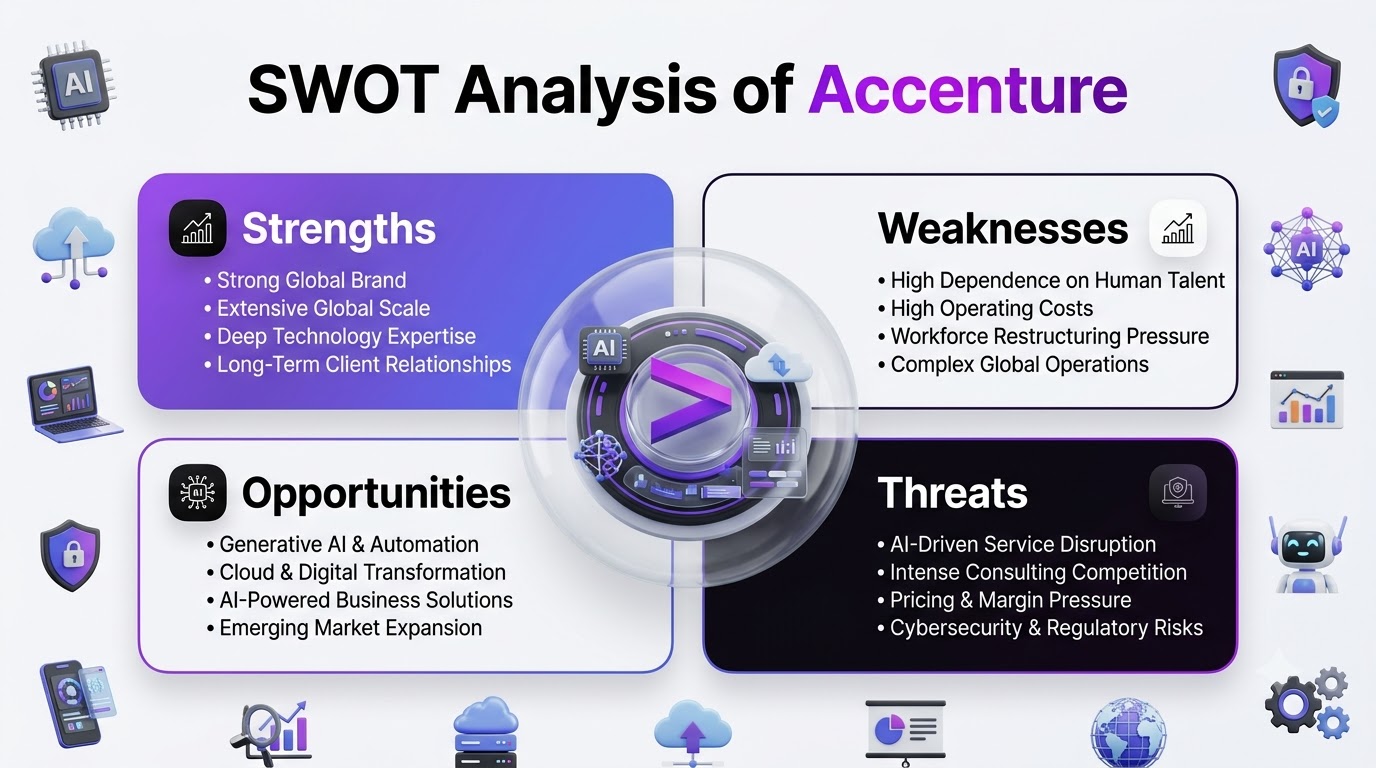
A proper SWOT Analysis of Accenture has to hold two things at once: this is a company with enormous scale, financial firepower, and client trust built over decades, and it’s also a company facing real structural pressure from AI automation, price competition, and a workforce model that’s starting to look expensive in a world where clients want fewer billable hours, not more. Both of those things are true simultaneously, and pretending otherwise would make this analysis useless. What follows breaks the picture into the four standard categories, but each one gets real depth instead of a bullet-point summary that could apply to any large consulting firm, because Accenture’s specific situation right now, mid-transition from headcount-driven services to AI-driven products, deserves more than a generic template.
1. Strengths of Accenture
Massive global scale with delivery capacity nobody else matches. Almost 799,000 employees spread across 120-plus countries means Accenture can staff a project of nearly any size, in nearly any region, often within weeks. That kind of bench depth is genuinely rare. A mid-size consulting firm might struggle to find fifty qualified SAP consultants on short notice, Accenture can pull from delivery centers in Bangalore, Manila, and Prague simultaneously and still meet a deadline most competitors would need to subcontract out. Scale like this also means Accenture can absorb a bad quarter in one region without the whole company feeling it, something a smaller, regionally concentrated competitor can’t do.
Deep, sticky client relationships that survive economic downturns. Roughly 9,000 clients work with Accenture, and a significant share of the Fortune Global 500 are among them. These aren’t one-off projects, they’re multi-year engagements where Accenture’s systems become embedded in a client’s core operations. Once a bank’s transaction processing runs through Accenture-built infrastructure, ripping that out and switching vendors is a multi-year, multi-million dollar undertaking most CFOs won’t sign off on, which gives Accenture pricing power that smaller rivals simply don’t have, and it shows up in renewal rates that tend to hold up even when clients grumble about cost.
A genuinely diversified revenue base across services and geography. Nobody can point to a single client, industry, or region that would sink the company if it disappeared tomorrow. Products was the largest industry group in fiscal 2025 at $21.2 billion, but Financial Services grew fastest at 10% in local currency, and the Americas, EMEA, and Asia Pacific all contribute meaningfully rather than one region carrying the whole business. That spread cushions Accenture against regional recessions or industry-specific slowdowns in a way a narrower competitor can’t replicate, and it means a soft quarter in one geography can be offset by strength somewhere else.
Early and aggressive positioning in generative and agentic AI work. While plenty of consulting firms are still figuring out their AI messaging, Accenture already has real numbers behind it. Advanced AI revenue tripled to $2.7 billion in fiscal 2025, cumulative bookings since 2023 have hit roughly $11.5 billion across about 11,000 projects, and the company has stated a goal of building out 80,000 AI and data professionals. Whether that number holds up under scrutiny is a fair question, but the scale of the bet itself puts Accenture ahead of most rivals who are still building pilot programs rather than closing billion-dollar bookings.
Brand trust built over decades of large-scale delivery. Being boring and reliable is underrated. When a Fortune 100 company needs to migrate a mission-critical system without breaking anything, they don’t usually want the cheapest bidder, they want the firm that’s done this exact migration a hundred times before and has the case studies to prove it. Accenture has built that reputation methodically since the early 2000s, and it shows up in win rates on large transformation deals where risk aversion matters more than price, especially in heavily regulated industries like banking and insurance where a failed migration can trigger real regulatory consequences.
A war chest for acquisitions that keeps capabilities current. Accenture has bought companies like Droga5 for creative and marketing capability, Ookla for network intelligence data, and TalentSprint and Udacity for skilling and education platforms. This buy-rather-build approach means the company can plug capability gaps fast instead of spending years growing internal expertise from scratch, which matters enormously in a field like AI where the competitive window is measured in quarters, not years, and where waiting to build something internally often means missing the deal entirely.
A public listing that gives it capital access competitors without one don’t have. Because Accenture trades on the NYSE and sits inside major indexes like the S&P 100, it has access to public capital markets in a way privately held rivals like McKinsey or BCG simply don’t. That means easier financing for large acquisitions, more straightforward equity compensation to attract talent, and a level of financial transparency that, whether leadership loves the quarterly scrutiny or not, actually builds trust with large institutional clients doing due diligence before signing a nine-figure contract.
Strong balance sheet giving room to invest through downturns. With total assets around $65.39 billion and total equity near $32.24 billion, Accenture isn’t a company that has to pull back hard the moment a recession hits. That financial cushion lets leadership keep investing in AI talent and acquisitions even during softer demand periods, a luxury that smaller, more leveraged competitors often don’t have when client budgets tighten and new bookings slow down.
Vendor-agnostic positioning across every major enterprise platform. Unlike Microsoft’s own services arm or IBM’s consulting practice, which naturally push clients toward their parent company’s software, Accenture can walk into a room and recommend SAP, Oracle, Salesforce, or a competitor’s platform based on what actually fits the client rather than what sells more of its own product. That neutrality is a real selling point for CIOs who don’t want to be locked into an implementation partner with an obvious conflict of interest baked into the recommendation.
2. Weakness of Accenture
Margins that stay thin no matter how much revenue grows. Consulting and IT services are labor-intensive businesses, and Accenture’s operating margin sits in a range that looks solid compared to raw services firms but pales next to software companies with similar market caps. Operating income of $10.23 billion against $69.67 billion in revenue works out to roughly a 14-15% margin, respectable, but it means growth has to come largely from adding more billable people, not from software-style scaling where marginal costs shrink toward zero as revenue climbs.
Heavy reliance on a workforce model that AI is actively eroding. This is the uncomfortable one. Accenture’s entire business historically depended on stacking large teams of consultants on client projects and billing by the hour or by the engagement. Generative AI tools are now automating chunks of the exact grunt work junior consultants used to do, code review, documentation, basic data analysis, first-draft reports. In September 2025 the company announced plans to lay off employees who can’t be trained on AI skills fast enough, a signal that the traditional pyramid staffing model is under real strain from the inside, not just from outside competitors, and it raises an uncomfortable question about how many of the company’s nearly 800,000 employees are doing work that AI could eventually handle at a fraction of the cost.
Exposure to government and public sector contracts that can dry up fast. Health and Public Service revenue has stayed roughly flat in recent quarters, and management has openly flagged a drag from the US federal business specifically, at times pointing to a roughly 1.5% hit to Americas growth from that single segment. Government contracts come with political risk baked in, budget freezes, administration changes, procurement reform, all of which can stall or cancel work that Accenture had counted on for years of steady billing, and unlike commercial clients, governments can change priorities overnight based purely on election outcomes.
Client concentration risk in specific industries during downturns. Products being the largest industry group at $21.2 billion sounds like strength until a consumer spending slowdown hits and manufacturing or retail clients pull back on discretionary transformation spending first. Accenture’s revenue is diversified across industries broadly, but within any given downturn, certain sectors get hit disproportionately, and Products has historically been one of the more cyclical categories in the mix, meaning a broad consumer pullback could hit this segment harder and faster than the rest of the business.
A reputation problem around cost and value that never fully goes away. Ask almost any CFO who has worked with a top-tier consulting firm and you’ll hear some version of the same complaint: the invoices are enormous, the junior staff on the ground are still learning on the client’s dime, and results sometimes take longer than promised. Accenture isn’t uniquely guilty of this compared to McKinsey, Deloitte, or IBM, but the perception sticks across the whole industry, and it’s part of why procurement teams increasingly push back on rate cards or split large engagements across multiple vendors to force competition rather than handing one firm the entire contract.
Slower internal agility than the disruptors it’s now racing against. A company with nearly 800,000 employees moves differently than a 200-person AI startup. Decision cycles, internal training rollouts, and reorganizations at Accenture’s scale take quarters where a smaller competitor could pivot in weeks. That size advantage in delivery capacity becomes a liability when the market shifts fast, and generative AI has been shifting fast for the last three years straight, meaning the same scale that lets Accenture win huge staffing bids also slows down how quickly the whole organization can retrain toward a fundamentally different way of working.
Wage and benefits cost pressure across a workforce this large. Running a global workforce of nearly 800,000 people means enormous fixed costs in compensation, benefits, training, and office infrastructure, even when utilization on billable projects dips. Unlike a software company where headcount can stay lean relative to revenue, Accenture’s cost base moves roughly in step with its people count, and when demand softens in any given quarter, that mismatch between fixed labor costs and variable client revenue puts direct pressure on margins.
Dependency on a small number of large technology platform partners. A huge share of Accenture’s technology implementation revenue runs through partnerships with SAP, Salesforce, Microsoft, Oracle, and similar platform vendors. If any of these partners decided to build out stronger direct implementation and services arms of their own, the way Microsoft and AWS already have to a degree, Accenture’s positioning as the go-to third-party integrator for these platforms could weaken, and the company has limited control over decisions made inside those partner organizations.
Utilization pressure that shows up quietly until it doesn’t. Consulting firms live and die by a metric most clients never hear about: utilization, the percentage of staff actively billing on projects at any given time. When new bookings slow down even slightly, thousands of consultants can end up on the bench between engagements, still drawing salary and benefits without generating revenue against it. That lag between hiring decisions made months earlier and actual demand on the ground is a persistent, structural weakness of the staffing-heavy model Accenture still runs on for most of its business.
3. Opportunities for Accenture
Riding the AI reinvention wave as the trusted implementation partner. Companies want to use generative and agentic AI, but most don’t have the internal talent or governance frameworks to deploy it safely at scale. That gap is exactly where Accenture’s consulting-plus-technology model shines. The $5.9 billion in new advanced AI bookings in fiscal 2025 alone suggests clients are already paying for this positioning, and the total addressable market for AI transformation work is still in its early innings industry-wide, which means there’s a long runway ahead if Accenture can keep winning the trust battle against smaller, more specialized AI consultancies popping up every quarter.
Expanding cybersecurity and trust services as a standalone growth line. As companies push more operations into AI systems and cloud infrastructure, the surface area for security risk grows right alongside it. Accenture has built out cyber-resilience offerings as a distinct practice rather than a bolt-on to technology work, and this is a category where demand tends to be far less discretionary than general transformation spending, since breaches and compliance failures carry real financial and legal consequences for clients, making cybersecurity budgets much harder to cut than a general strategy engagement.
Growing the Song creative and experience business into a genuine agency rival. Buying Droga5 and folding creative capability into the broader Accenture umbrella lets the company pitch full-funnel work, strategy, technology, and brand experience, under one contract. Traditional ad agencies don’t have the technology delivery muscle to match that, and traditional consultancies don’t have the creative pedigree. If Accenture can keep talent from fleeing to more culturally agile agency competitors, Song has room to grow meaningfully faster than the core business, especially as brands increasingly want their marketing and their backend commerce systems built by the same team rather than stitched together from separate vendors.
Deepening delivery in lower-cost geographies without sacrificing quality perception. India, the Philippines, and parts of Eastern Europe continue to produce large pools of skilled technical talent at costs well below US or Western European rates. Accenture has already built substantial delivery infrastructure in these regions, and doubling down further lets the company protect margins even as clients push back harder on rate cards, so long as quality perception among Western clients doesn’t slip in the process, which has historically been the main risk of leaning too hard into pure cost arbitrage.
Industry-specific AI products that move beyond pure services billing. Selling packaged, repeatable AI solutions for specific industries, say, a claims-processing AI product for insurers, rather than custom-building everything from scratch for each client, would let Accenture capture some of the higher-margin, more scalable economics that pure software companies enjoy. This is still early, but the company’s acquisition pattern and advanced AI investment suggest leadership sees this shift coming and wants a foothold before pure-play AI vendors lock up the space first, and it represents a genuine chance to escape the labor-for-hours trap that’s capped margins for decades.
Sustainability and ESG-linked transformation work as regulation tightens. Regulatory requirements around carbon reporting, supply chain transparency, and sustainability disclosures are expanding across the EU and increasingly in other markets. That creates a genuine new category of consulting and technology work, helping clients build the systems needed to track, report, and act on these requirements, and Accenture is positioned to sell into it as an extension of existing operations and technology engagements rather than starting from zero, since much of the underlying data infrastructure work overlaps with projects it’s already running.
Mid-market expansion beyond the traditional large enterprise client base. Historically, Accenture’s biggest deals have come from Fortune 500-scale clients with budgets large enough to justify enterprise-grade transformation work. As AI tools lower the cost of delivering some services, there’s room to package smaller, more standardized offerings for mid-sized companies that couldn’t previously afford Accenture-level engagement, opening up a client segment the company has largely left to smaller regional consultancies until now.
Building recurring, subscription-style revenue around managed AI operations. Rather than a one-time implementation project, there’s a real opportunity to sell ongoing management of AI systems, monitoring model performance, retraining, governance, and compliance, as a recurring service. That kind of annuity revenue is more predictable and often higher margin than project-based consulting, and it plays directly into the operations expertise Accenture already has from decades of running business process outsourcing contracts for clients.
4. Threats to Accenture
Cloud providers building out their own professional services arms. AWS, Microsoft, and Google all now run substantial consulting and implementation teams tied directly to their own platforms. When a client is already migrating to Azure, Microsoft’s own services team can underbid Accenture on the implementation work while bundling in platform discounts Accenture can’t match. This threat has gotten sharper over the last few years and it’s structurally different from the old rivalry with IBM or Deloitte, because these competitors control the underlying infrastructure itself, and they can subsidize services pricing with platform revenue in a way Accenture never could.
Lower-cost Indian IT firms squeezing margins on commoditized work. TCS, Infosys, and Wipro built their entire businesses around cost advantages Accenture has had to bolt on later. For standardized technology implementation work that doesn’t require deep strategic input, price competition from these firms puts constant downward pressure on Accenture’s rate cards, especially on renewal negotiations where clients have leverage and options, and where the work itself has become commoditized enough that brand reputation matters less than the number on the invoice.
Generative AI shrinking the billable hours that consulting has always monetized. This cuts both ways for Accenture, it’s an opportunity as discussed above, but it’s also a genuine existential threat to the core business model. If AI tools let a client’s own internal team do work that used to require a team of twenty consultants, the entire pyramid staffing structure that generates Accenture’s revenue starts to erode from underneath, regardless of how well the company sells AI transformation services on top, and there’s no guarantee the new AI-services revenue will fully replace what gets lost from shrinking traditional engagements.
Macroeconomic slowdowns that hit discretionary transformation spending first. When companies tighten budgets, large-scale digital transformation and strategy consulting engagements are often among the first line items cut, since the ROI is longer-term and less immediately visible than operational cost savings. A global recession or a sustained high-interest-rate environment would likely hit new bookings before it hits existing contracts, but it would hit them hard, and given how much of Accenture’s forward growth narrative depends on new AI bookings specifically, a slowdown in that category alone could spook investors even if the core business holds steady.
Talent attrition and the difficulty of retaining top AI and data talent. Every large tech company, every AI startup, and every hedge fund is competing for the same pool of skilled AI engineers and data scientists Accenture needs to deliver on its 80,000-person AI talent goal. Accenture can offer scale and stability, but startups often offer equity upside and speed that’s hard for a company this size to replicate culturally, and losing the best AI talent to competitors would directly undercut the company’s biggest growth bet just as it’s trying to prove the strategy actually works at scale.
Political and regulatory risk around government contracts and immigration policy. A meaningful share of Accenture’s delivery model depends on visa programs and offshore staffing arrangements to move talent where it’s needed. Tightening immigration policy in the US or Europe, combined with the kind of federal budget drag already showing up in Health and Public Service numbers, creates a real risk to both revenue and the operating model that built the company in the first place, since a large chunk of the delivery workforce relies on cross-border mobility that political shifts could restrict with little warning.
Client-side AI adoption reducing the perceived need for outside consultants altogether. As generative AI tools become more capable and more familiar to in-house teams, some clients may decide they can manage AI-driven transformation projects internally rather than paying premium rates for outside consultants to guide them through it. That shift wouldn’t happen overnight, but it’s the kind of long-term behavioral change that consulting firms have to watch closely, because it strikes directly at the advisory value proposition that firms like Accenture have sold for decades.
Reputational and delivery risk from AI errors on high-stakes client projects. As Accenture pushes clients toward adopting agentic and generative AI systems in critical operations, the risk of visible, damaging failures grows alongside the opportunity. An AI system that makes a costly error in a bank’s compliance process or a hospital’s patient scheduling system, especially one implemented by Accenture, could trigger reputational damage and legal exposure that a traditional, human-run implementation project would never have carried in the first place.
Conclusion
Pull back from the individual points and the picture that emerges is a company with genuine, hard-earned advantages sitting right next to genuine structural risk, and neither side cancels the other out. Accenture’s scale, client relationships, and early AI positioning are real assets that took decades and billions of dollars to build, and competitors can’t just copy that overnight. At the same time, the labor-intensive model that generated all of that wealth is facing pressure from the exact technology Accenture is now selling to its clients, which is a strange, almost ironic position for any company to be in.
Whether Accenture comes out ahead over the next five years probably depends less on any single strength or threat listed here and more on execution speed, specifically, how fast leadership can shift the internal workforce and revenue model toward higher-margin AI products before cheaper competitors and client-side automation eat into the traditional consulting business. The September 2025 layoffs tied to AI retraining aren’t a side note, they’re a preview of how disruptive this transition could get internally, even for the company leading the AI consulting narrative in its own marketing.
A SWOT Analysis of Accenture done honestly has to admit that outcome isn’t guaranteed either way. This is a company betting big on being the bridge between old enterprise systems and an AI-driven future, and that bridge is either going to be the most valuable real estate in the industry or a very expensive place to be standing when the ground shifts underneath it. For now, the financial numbers say the bet is working, $2.7 billion in advanced AI revenue and $69.67 billion overall don’t happen by accident. But numbers this size take years to build and can erode faster than most people expect once a structural shift like this one really gets moving, and that’s worth keeping in mind before treating any single quarter’s earnings call as proof of where things are headed long term.
Frequently Asked Questions
What is Accenture’s core business model?
Accenture makes money by billing clients for consulting, technology implementation, and outsourced operations work, typically through large multi-year contracts. Revenue comes from a mix of strategy advice, system integration, cloud migrations, and running back-office functions for other companies, with technology services making up the largest single share of overall revenue and Operations providing more predictable, annuity-style income on top.
How many employees does Accenture have in 2026?
Accenture reported approximately 799,000 employees as of the third quarter of fiscal 2026, which ended May 31, 2026. That’s up from 779,000 at the close of fiscal 2025 and a massive jump from 384,000 back in 2016, reflecting a decade of aggressive hiring and delivery center expansion across dozens of countries.
Who are Accenture’s biggest competitors?
The competitive field spans several categories at once: McKinsey, BCG, and Bain on pure strategy consulting; Deloitte, PwC, EY, and KPMG among the Big Four; IBM Consulting on enterprise technology; and TCS, Infosys, Wipro, and Cognizant on lower-cost IT services and outsourcing. Cloud providers like AWS, Microsoft, and Google have also become direct rivals through their own professional services arms, which is one of the newer and sharper competitive pressures Accenture faces.
Why is AI considered both a strength and a threat for Accenture?
Accenture is generating billions in new revenue by helping clients implement generative and agentic AI, which counts as a strength. But the same technology is automating parts of the consulting work Accenture has traditionally billed hourly for, which threatens the core staffing-based revenue model from the inside. Both dynamics are happening at the same time, which makes this one of the more complicated parts of the whole analysis, and it’s part of why the September 2025 layoffs matter so much as a signal.
What was Accenture’s revenue in fiscal 2025?
Accenture closed fiscal 2025, the twelve months ended August 31, 2025, with $69.67 billion in revenue, up roughly 7% in US dollars compared to the prior year. Net income came in around $7.83 billion, and operating income was approximately $10.23 billion for the same period, with total assets sitting around $65.39 billion.
Why did Accenture announce layoffs in September 2025?
Accenture said it would lay off employees who couldn’t be trained on AI skills fast enough to match where the business is heading. It’s a direct sign that the company is restructuring its workforce around AI capability rather than the traditional pyramid staffing model, and it reflects broader pressure across the consulting industry as generative AI tools change what junior-level work actually looks like.
Where is Accenture headquartered and why?
Accenture is headquartered in Dublin, Ireland, a move tied to corporate structuring and tax considerations made back in the mid-2000s. Despite the Dublin address, the company’s operational center of gravity remains heavily tilted toward the United States, which is still its largest market by revenue, alongside significant operations across EMEA and Asia Pacific.
What industries generate the most revenue for Accenture?
Products was the largest industry group in fiscal 2025 at $21.2 billion, covering consumer goods, retail, and industrial manufacturing clients. Financial Services was the fastest-growing industry group, expanding 10% in local currency, while Health and Public Service stayed roughly flat, weighed down by a slowdown in US federal government spending that management has flagged repeatedly on recent earnings calls.
How does Accenture’s Song division fit into the business?
Song, formerly known as Accenture Interactive, handles creative, marketing, and customer experience work, built up largely through acquisitions like Droga5. It lets Accenture pitch a combined package of strategy, technology, and brand experience under one contract, competing directly with traditional advertising and creative agencies in addition to its usual consulting rivals, and it represents one of the clearer diversification bets the company has made outside pure technology delivery.
Is Accenture a good long-term investment based on this SWOT?
This isn’t investment advice, and nothing here should be read as a recommendation to buy or sell Accenture stock. What can be said is that the company shows real financial strength and an aggressive, well-funded push into AI, balanced against genuine structural risk from margin pressure, workforce disruption, and intensifying competition from both low-cost rivals and cloud providers building their own services arms.
How does Accenture make decisions about acquisitions?
Accenture has consistently used acquisitions to plug capability gaps quickly rather than building every new skill set internally from scratch, buying companies like Droga5 for creative work, Ookla for network data, and Udacity and TalentSprint for skilling platforms. This buy-to-capability approach lets the company stay current in fast-moving areas like AI without waiting years for internal expertise to mature organically.