


Open any Indian household’s phone bill from the last five years and there’s a decent chance Airtel shows up somewhere in that story. Maybe it’s the postpaid connection, maybe it’s the broadband line running the smart TV, maybe it’s the payments bank app sitting quietly on a relative’s phone. Airtel isn’t a company that grabbed headlines with flashy launches the way its biggest rival did in 2016. It grew the slow way, fixing network gaps, buying spectrum, cutting debt piece by piece, and betting on the idea that customers who pay a little more will stick around a little longer if the service actually works. That bet has mostly paid off, and it’s worth understanding exactly why.

But a SWOT analysis of Airtel isn’t just a cheerleading exercise, and it shouldn’t read like one either. Bharti Airtel sits in a market with three real competitors left standing after a brutal tariff war wiped out half a dozen smaller players, and even now the company carries scars from that fight. It has one of the healthiest average revenue per user numbers in the country, and it also has a debt pile that would make most CFOs lose sleep. It runs networks across nineteen African countries and still gets flak for call drops in Indian metros during peak hours. None of this fits neatly into a “strengths good, weaknesses bad” box. That’s the point of doing this properly, and rushing through it does the company, and anyone trying to actually understand it, a disservice.
This piece walks through where Airtel actually stands today: what’s working in its favor, where the cracks are, what’s opening up on the horizon, and what could genuinely hurt the business if things go sideways. Numbers are used where they help make a point, not to pad the word count. Airtel has been public for over two decades now, it survived the entry of a competitor that most analysts assumed would kill it outright, and it’s still standing as the second largest operator by subscriber count and, in many quarters, the leader by revenue quality. That’s not a small achievement in an industry that has eaten weaker players alive.
Look at what actually happened to the rest of the field. Reliance Communications collapsed into bankruptcy. Aircel shut down entirely. Tata Docomo exited the consumer mobile business. Vodafone and Idea had to merge just to survive, and even that merged entity has needed government intervention to stay afloat. Against that backdrop, Airtel not just surviving but actually growing its revenue per customer says something real about how the company is run, and that’s exactly the kind of context a proper SWOT analysis needs to hold onto throughout.
The goal here isn’t to convince you Airtel is either a hero or a villain in India’s telecom story. It’s to give you a clear-eyed read on a company that’s been quietly consolidating power in one of the toughest, most price-sensitive telecom markets on the planet. Whether you’re studying this for a business course, tracking Airtel as a competitor, sizing it up as an investor, or just trying to understand why your own phone bill looks the way it does, the four sections below should give you a genuinely useful picture rather than a recycled list of generic talking points.
One more thing worth saying upfront. A lot of business write-ups treat SWOT analysis as a dusty classroom exercise, four boxes, a handful of bullet points, done. That approach misses the whole point. Every strength here has a cost attached to maintaining it. Every weakness has a reason it exists and a path, however slow, toward fixing it. Treating this as a living picture of a real company competing in a real, occasionally brutal market is what makes the exercise worth doing at all.
What You Will Learn in This Guide
- How Airtel’s brand and network quality translate into pricing power that Jio and Vi struggle to match
- Why the company’s debt load is both a historical weakness and a current risk factor investors watch closely
- Where 5G, broadband, and bundled offerings like Airtel Black are opening fresh revenue lines
- What threats from government intervention, taxation, and switching behavior could dent Airtel’s momentum
- A full breakdown of strengths, weaknesses, opportunities, and threats with real context behind each point, not just a bullet list
- Answers to the most common questions people ask when researching Airtel’s competitive position in India and Africa
SWOT Analysis of Airtel
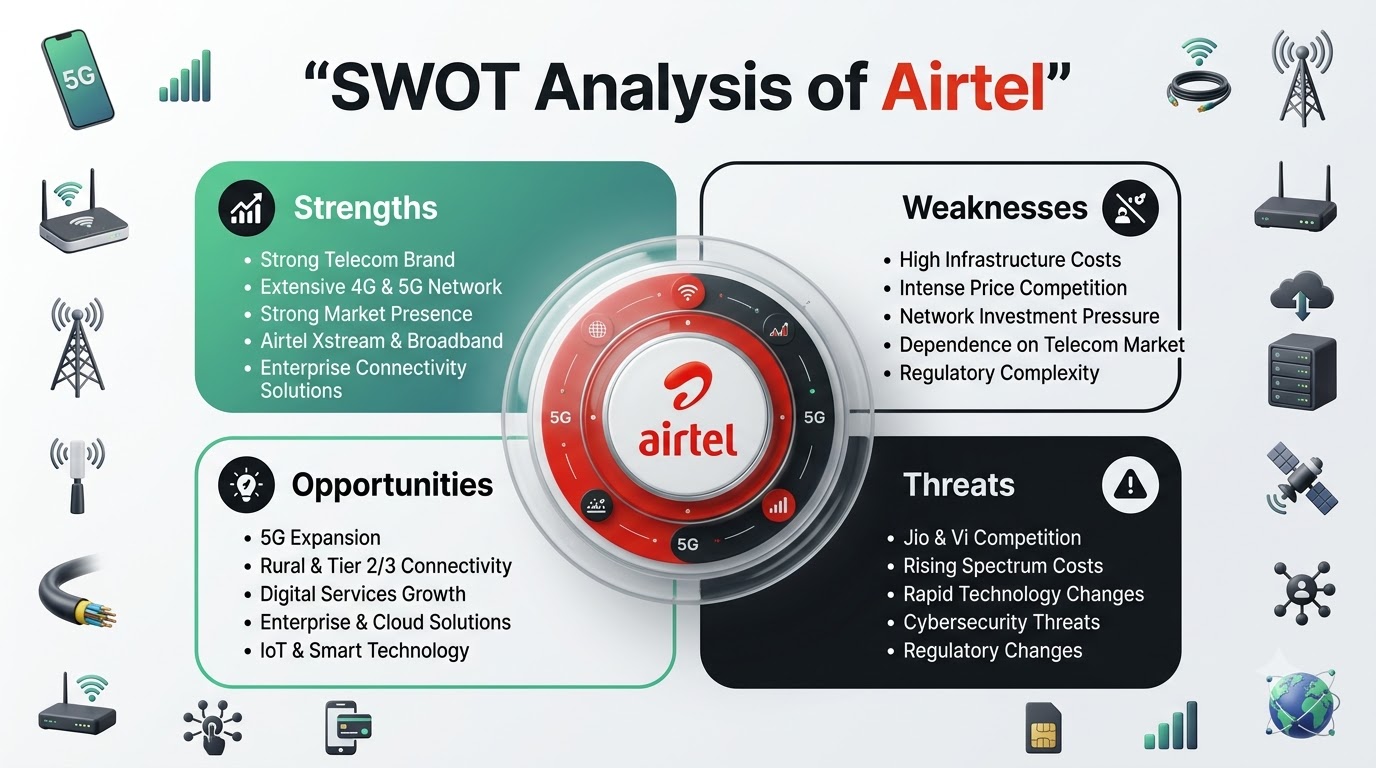
A SWOT analysis provides a structured way to understand Airtel’s current market position by examining its Strengths, Weaknesses, Opportunities, and Threats. As one of India’s leading telecommunications companies, Airtel operates across mobile connectivity, broadband, 5G, digital services, enterprise solutions, and related communication technologies. This makes SWOT analysis useful for understanding not only where Airtel is strong today but also where it may face challenges and where future growth can come from.
Strengths in Airtel SWOT Analysis
Airtel’s strengths didn’t happen by accident. Every one of them traces back to a decision the company made years ago and stuck with, even when it cost money in the short term. This SWOT Analysis of Airtel starts with these strengths because they explain why the company survived a price war that killed off Reliance Communications, Aircel, and eventually swallowed Vodafone India into a shrinking Vi. Here’s what Airtel actually has going for it, and why each point holds up under scrutiny rather than sounding good on paper alone.
What ties these eight strengths together is that none of them are one-time achievements. Brand equity has to be maintained through every ad campaign and every customer interaction. Network quality has to be defended through continuous capital spending. Governance has to be upheld through every quarterly filing. These are ongoing commitments, not boxes Airtel checked once and moved on from, and that discipline is exactly why the strengths still hold up years after they were first built.
1. Brand Equity
Airtel has been a household name in Indian telecom since the late 1990s, and that kind of longevity builds trust that a newer entrant simply cannot buy overnight. People associate the red logo with reliability, not because of a slogan, but because their parents used the same SIM card for over a decade without major complaints. That kind of generational familiarity matters more in telecom than in almost any other consumer category, because switching a phone number is genuinely annoying, and most people would rather pay a bit more than deal with the hassle.
Brand equity like this shows up directly in Airtel’s ability to charge a premium over Jio and Vi without losing subscribers in bulk, something almost no other Indian telecom operator can claim right now. It also gives Airtel a head start whenever it launches something new, a fresh 5G plan, a bundled offer, an enterprise product, because the market already trusts the name attached to it. That trust took twenty-five years to build and it isn’t something a rival can replicate with a big advertising budget alone.
That kind of trust also cushions Airtel during rough patches. When a network outage or a billing glitch makes the news, a brand with decades of goodwill absorbs the hit better than a newer operator would, because customers are more willing to write off a bad week as an exception rather than a pattern.
Consider how differently the market reacted when Airtel raised tariffs compared to when a lesser-known operator tried the same thing in the past. Airtel’s move was largely accepted as reasonable, while similar hikes from operators without that trust often triggered sharper subscriber losses.
2. Huge customer base
Airtel serves well over 380 million subscribers across India alone, and when you add its African operations spanning Nigeria, Kenya, Uganda, Chad, and a dozen other markets, the total customer base crosses 600 million. That scale gives Airtel negotiating power with handset makers, tower companies, and content partners that a smaller regional operator would never get near. It also means the company has a genuinely massive pool of data on usage patterns, which feeds into everything from network planning to targeted upsells for Airtel Black bundles.
A base this size is sticky too. Even a small percentage of subscribers upgrading from prepaid to postpaid or adding a broadband connection moves the revenue needle by hundreds of crores. And because the base spans such different markets, from dense urban India to rural sub-Saharan Africa, Airtel isn’t dependent on any single economy or regulatory environment for its growth, which spreads out risk in a way a purely domestic operator can’t match.
Scale like this also means Airtel can spread fixed costs, network maintenance, spectrum fees, corporate overhead, across a far larger revenue base than a smaller operator, which quietly improves margins even when per-customer pricing stays flat.
It also gives Airtel leverage in spectrum auctions and government negotiations, since a company serving hundreds of millions of citizens carries a different kind of policy weight than a niche regional player, and regulators tend to factor that reach into how they approach industry-wide decisions.
3. Advertising
Airtel has run some of the most memorable campaigns in Indian television history, from the early “Har Ek Friend Zaroori Hota Hai” era to newer 5G-focused pushes featuring recognizable faces and catchy jingles. This isn’t just nostalgia talking. Consistent, well-funded advertising keeps Airtel top of mind at the exact moment someone is deciding whether to port their number or switch operators after a bad experience with a competitor.
The company spends aggressively on both mass media and digital advertising, and unlike some rivals who lean entirely on price messaging, Airtel’s ads tend to sell an experience, faster network, better service, more reliable coverage. That positioning supports the premium pricing strategy instead of undercutting it. It also means Airtel’s marketing spend does double duty, it drives new sign-ups while reinforcing the exact brand perception that lets the company avoid competing purely on rupees per gigabyte.
Airtel also benefits from being a default sponsor at major cricket and entertainment events, keeping the brand visible in moments where Indian audiences are already paying close attention, which is a far more efficient use of ad spend than generic banner placements.
The consistency of Airtel’s brand voice across two decades of campaigns also means the company rarely has to reintroduce itself to a new generation of customers the way a rebranding competitor might, saving on the kind of expensive brand-education spend that eats into marketing budgets elsewhere.
4. Quality Network
Independent speed test reports and network quality surveys have repeatedly ranked Airtel at or near the top for 4G and now 5G download speeds in major Indian cities. This isn’t a minor bragging point. Network quality is the single biggest driver of customer satisfaction in telecom, ahead of even pricing in most surveys, because a cheap plan on a network that drops calls during a client meeting or buffers during a video call isn’t actually cheap once you factor in the frustration.
Airtel has invested heavily in fiberizing its towers and expanding backhaul capacity, which directly improves consistency rather than just peak speed. That consistency is what keeps high-value postpaid and enterprise customers from even considering a switch. It’s also the strength that underpins almost everything else on this list, because brand trust, advertising credibility, and customer loyalty all fall apart quickly if the underlying network doesn’t actually deliver when it matters.
That network reliability also feeds directly into enterprise sales conversations, since large corporate clients evaluating a telecom partner for mission-critical connectivity almost always start by asking about uptime and consistency before they even discuss pricing.
Third-party benchmarking firms like Ookla have repeatedly cited Airtel among the fastest networks in India, and that kind of independent validation carries more weight with skeptical customers than anything Airtel could say about itself in its own advertising.
5. Strong Corporate Governance
Bharti Airtel has a board structure and disclosure record that institutional investors generally trust, which matters enormously in a sector where two of the largest players have either gone bankrupt or needed government bailouts to survive. Sunil Bharti Mittal built the company with a reputation for relatively clean dealings compared to some peers, and that reputation translates into easier access to capital markets when Airtel needs to raise funds for spectrum auctions or network expansion.
Rating agencies and foreign institutional investors factor governance quality into how much they’re willing to lend and at what interest rate, so this strength has a very real, very measurable financial payoff for the company. It shows up in lower borrowing costs, smoother rights issue subscriptions, and a generally more forgiving market reaction when Airtel does need to raise fresh capital compared to how the market reacts to similar moves from a company like Vi.
Good governance also reduces the odds of the kind of regulatory surprises that have hit less transparent operators, since a company with clean books and predictable disclosure practices tends to face fewer sudden compliance issues that can disrupt operations overnight.
This governance strength also matters when Airtel negotiates joint ventures or acquisitions, since potential partners are far more willing to enter agreements with a company that has a track record of following through on commitments and reporting accurately.
6. Rural market share
While Jio grabbed most of the headlines for rural expansion after its 2016 launch, Airtel has quietly held onto a meaningful chunk of rural and semi-urban subscribers, partly through legacy infrastructure built over two decades and partly through partnerships and tower-sharing arrangements that let it extend coverage without the full capital cost of building everything from scratch. Rural India is a lower-margin market, sure, but it’s also a massive volume play.
Having an established presence there means Airtel isn’t starting from zero when 4G and eventually 5G penetration deepens in smaller towns and villages. It also gives the company a defensive moat against pure urban-focused competitors, and a base to cross-sell into as rural incomes rise and smartphone affordability keeps improving year after year. That long runway of rural upgrade potential is exactly the kind of slow, unglamorous growth that compounds nicely over a decade.
This rural base also gives Airtel valuable data on emerging usage patterns outside major cities, which feeds directly into how the company prices and designs future plans for the next wave of first-time internet users.
7. Loyal customers
Airtel’s postpaid churn rate is consistently lower than its prepaid churn rate, and industry data shows Airtel retains postpaid customers better than most of its rivals retain any customer segment. A chunk of this loyalty comes from bundled services, someone with a postpaid mobile plan, a broadband connection, and maybe a DTH subscription all under one Airtel account has three reasons to stay instead of one.
Loyalty like this isn’t glamorous, but it’s incredibly valuable because acquiring a new customer in Indian telecom costs far more than retaining an existing one, especially given how aggressively Jio has historically priced new-customer offers to poach subscribers. Every loyal customer Airtel keeps is also a customer it doesn’t have to spend marketing money re-acquiring, which quietly improves overall marketing efficiency across the whole subscriber base.
Loyal customers also tend to generate positive word of mouth in a market where referrals still carry real weight, particularly in smaller towns where trust in a telecom provider often spreads through family and community networks rather than advertising alone.
8. Intellectual rights
Airtel holds a broad portfolio of trademarks, proprietary network technology patents, and exclusive content distribution agreements through its Xstream and Wynk platforms. These aren’t the flashiest assets on a balance sheet, but they matter. Exclusive tie-ups with content providers give Airtel something to bundle into premium plans that competitors can’t replicate overnight, and proprietary optimizations in network management software give it small but real efficiency advantages in how it routes traffic and manages spectrum.
None of this is a headline strength on its own, but stacked together with everything above, it adds another layer of separation between Airtel and operators trying to compete purely on price. Content exclusivity in particular becomes more valuable every year as streaming habits deepen, giving Airtel a lever to pull that has nothing to do with network pricing at all.
As Airtel expands into adjacent businesses like cloud services and digital payments, this portfolio of proprietary technology and content agreements becomes a foundation it can build new products on, rather than starting from zero each time.
Weaknesses in Airtel SWOT Analysis
No SWOT Analysis of Airtel is honest if it skips the parts that genuinely hurt the business. Airtel has real, structural weaknesses, some inherited from decisions made a decade ago, some baked into the nature of the Indian telecom market itself. These aren’t minor footnotes. They shape how much room Airtel actually has to maneuver against competitors who play a very different game, and ignoring them would make this whole exercise pointless.
These four weaknesses also share a common thread, they’re mostly structural rather than something a new marketing campaign or a single good quarter can fix. Debt gets paid down over years, not months. Pricing pressure from a price-sensitive market doesn’t ease up just because Airtel wants it to. Understanding that timeline matters when judging whether Airtel is actually improving or just managing the same constraints a little better each year.
1. Price-sensitive customers
India remains one of the cheapest mobile data markets in the world, and that’s not an accident, it’s the direct result of Jio’s 2016 entry, which forced every operator including Airtel to slash tariffs to survive. Even now, a huge portion of Airtel’s subscriber base will switch operators for a difference of twenty or thirty rupees a month, especially in the prepaid segment where switching costs are lower than ever thanks to mobile number portability.
This price sensitivity limits how aggressively Airtel can raise tariffs even when its costs, spectrum payments, network capex, tower rentals, keep climbing. Every tariff hike risks a visible chunk of subscribers, which is why Airtel has leaned so heavily on premiumization instead of blanket price increases. It’s a slower path to higher revenue, but it’s also the only path that doesn’t immediately trigger defections to a cheaper rival.
This dynamic forces Airtel to constantly justify its price premium through visible service improvements rather than resting on brand reputation alone, since price-sensitive customers will eventually switch if they feel they’re paying extra without getting anything extra in return.
It also means Airtel’s product teams spend a disproportionate amount of time designing plans that feel like better value without actually cutting into margins, small data add-ons, OTT bundles, family plan discounts, rather than simply lowering the headline price.
2. Oligopoly market
With only three major private players left, Airtel, Jio, and a struggling Vi, plus state-run BSNL limping along, India’s telecom sector has effectively become an oligopoly. That sounds like it should favor Airtel, fewer competitors, more pricing power, but oligopolies also mean any move by one player forces a reaction from the others almost instantly.
When Jio drops a price, Airtel has to respond within days or risk losing subscribers, and there’s very little room for Airtel to differentiate on price alone without triggering a race to the bottom that hurt everyone during 2017 to 2019. The lack of a genuinely fragmented, competitive market also invites more regulatory scrutiny, since three players controlling nearly the entire market raises antitrust and consumer protection questions that policymakers keep circling back to, and any future regulatory intervention could reshape pricing freedom for all three operators overnight.
It also means Airtel has less room to experiment with radically different pricing models, since any unconventional move gets scrutinized by regulators and competitors alike far more closely than it would in a market with a dozen operators instead of three.
Some economists have argued that three-player markets tend to settle into a tacit stability where none of the operators wants to trigger another destructive price war, but that stability is fragile and depends heavily on all three players staying financially healthy enough to compete rationally.
3. Heavy Debt
Airtel has carried a substantial debt load for years, a legacy of aggressive spectrum purchases, the Africa expansion, and the capital-intensive nature of rolling out 4G and now 5G infrastructure across a country as large as India. Net debt has hovered in the range of hundreds of thousands of crores at various points, and while the company has been actively deleveraging through rights issues, asset monetization, and improved cash flows, the interest burden alone eats into profitability that could otherwise fund faster network expansion or more aggressive customer acquisition.
Heavy debt also makes Airtel more vulnerable to interest rate hikes and currency fluctuations given its exposure to African markets, where local currency depreciation against the dollar can inflate the real cost of dollar-denominated debt overnight. Every rupee, or naira, or shilling spent servicing debt is a rupee that doesn’t go toward the kind of network investment that keeps the strengths section above intact for the long run.
Analysts and credit rating agencies watch Airtel’s debt-to-EBITDA ratio closely, and any sustained rise in that ratio can trigger a ratings downgrade, which in turn raises the cost of future borrowing and creates a difficult cycle to break out of.
Airtel’s rights issue a few years back, one of the largest in Indian corporate history at the time, was specifically aimed at bringing this debt down, and continued progress on that front is one of the clearest signals investors look for in every quarterly earnings call.
4. Dependence on third party vendors
Airtel relies on equipment vendors like Nokia, Ericsson, and increasingly domestic players for network hardware, and on tower companies like Indus Towers for a chunk of its physical infrastructure. This dependence isn’t unusual in telecom, nobody builds every piece of the stack in-house, but it does create exposure.
Supply chain disruptions, like the semiconductor shortages that rattled the tech industry a few years back, can delay network rollouts. Pricing disputes or contract renegotiations with tower companies can squeeze margins. And geopolitical pressure around Chinese vendors like Huawei and ZTE, largely excluded from India’s 5G rollout on security grounds, narrowed Airtel’s vendor options and likely pushed up equipment costs compared to markets where those vendors remain available. This is a weakness Airtel shares with every major operator globally, but it’s still a real constraint on how fast and how cheaply the company can expand its infrastructure.
Airtel has been pushing for more domestic sourcing and homegrown network technology partnerships to reduce this exposure over time, but building a fully independent supply chain in telecom hardware takes years, not quarters, so the dependence isn’t disappearing anytime soon.
Any operator facing this issue has to build in extra lead time for network expansion plans, and Airtel is no exception, which is part of why some 5G site rollouts have taken longer in certain circles than initial announcements suggested they would.
Opportunities in Airtel SWOT Analysis
This is where things get genuinely interesting. The opportunities in front of Airtel right now are bigger than anything the company has faced since the original 2G to 3G to 4G transitions, and how well it captures them will decide whether Airtel closes the gap with Jio or falls further behind in absolute subscriber numbers while staying ahead on revenue quality. None of these opportunities are guaranteed wins, but each one plays directly to strengths Airtel already has.
What makes this set of opportunities different from earlier ones is that they’re less dependent on winning a straight subscriber count race against Jio. Broadband, enterprise 5G, and postpaid upgrades are all about extracting more value from the customers Airtel already has, or reaching entirely new categories of revenue, rather than fighting over the same prepaid subscriber that both operators have already spent years competing for.
1. 5G
Airtel rolled out 5G Plus across most major Indian cities faster than most analysts expected, and 5G isn’t just a marketing checkbox, it’s a genuine opportunity to monetize data-hungry customers who are already paying premium prices for high-speed connectivity. Enterprise use cases, private 5G networks for factories, smart city infrastructure, IoT deployments, all represent revenue streams that didn’t exist in the 4G era.
Airtel has been positioning itself as an enterprise-first 5G player in several verticals, striking deals with manufacturing and logistics companies to build dedicated network slices. If that enterprise pivot works, it gives Airtel a revenue source that isn’t dependent on winning the next prepaid price war, which is exactly the kind of diversification the company badly needs. It also opens the door to margins that look nothing like the razor-thin consumer prepaid business, since enterprise contracts tend to come with longer commitments and less pressure to match a competitor’s daily promotional offer.
The catch is that 5G monetization outside enterprise use cases has been slower than early hype suggested industry-wide, so Airtel’s ability to actually convert 5G coverage into meaningfully higher consumer revenue, rather than just better speeds at the same price, is still being tested.
Handset compatibility is another factor slowing broad consumer adoption, since a meaningful share of India’s phone base still isn’t 5G-capable, meaning Airtel’s actual addressable market for premium 5G plans grows only as fast as the installed base of compatible devices does.
2. Broadband market exploding
Fixed broadband penetration in India has historically lagged far behind mobile, but that’s changing fast as households upgrade to fiber for streaming, remote work, and smart home devices. Airtel Xstream Fiber has been adding subscribers at a healthy clip, and broadband customers tend to have much higher average revenue and much lower churn than mobile-only subscribers.
This market is nowhere near saturated the way mobile is, meaning there’s real room to keep growing without cannibalizing existing revenue or triggering a price war the way every mobile launch does. Airtel’s existing tower and backhaul infrastructure gives it a genuine cost advantage in extending fiber to new neighborhoods compared to a broadband-only entrant starting from scratch, and every new fiber household is also a natural target for an Airtel Black bundle upsell down the line.
Airtel also faces genuine competition here from Jio Fiber and regional cable broadband players, so winning this opportunity isn’t automatic, it depends on continued investment in last-mile fiber rollout and competitive installation speed in newly targeted neighborhoods.
Installation speed and last-mile service quality end up mattering just as much as pricing in this business, since a customer who waits three weeks for a technician to show up is far more likely to try a competitor’s offer the next time they move homes.
3. Increasing smartphone penetration
Smartphone adoption in India keeps climbing, particularly in tier two and tier three cities and among first-time users in rural areas, and every new smartphone user is a potential Airtel data customer. As cheaper 4G and 5G-capable handsets flood the market, the pool of people who can actually use Airtel’s premium data services keeps expanding.
This matters especially for Airtel because its strategy leans on getting customers to upgrade from basic voice-and-SMS plans to data-heavy bundles, and that upgrade path only exists if the customer has a smartphone capable of streaming video or running data-intensive apps in the first place. Rising penetration is essentially a tailwind Airtel doesn’t have to spend marketing money to create, and it compounds nicely with the rural market share strength discussed earlier, since much of this new smartphone growth is happening precisely in the regions where Airtel already has a foothold.
The opportunity is strongest in the mid-range smartphone segment, where affordability finally meets capability, and Airtel’s challenge is making sure its network coverage in exactly those tier two and tier three markets keeps pace with where new smartphone buyers actually live.
Airtel has also partnered with handset makers on data-plus-device bundles in the past, a strategy that lowers the barrier to smartphone ownership while locking in a data customer at the same time, and that kind of bundling could expand further as affordability keeps improving.
4. Airtel Black
Airtel Black bundles mobile, broadband, and DTH into a single subscription with one bill, and it’s one of the smarter product moves the company has made in years. Bundling increases what’s known as customer lifetime value because a household paying for three services under one Airtel account has far less incentive to shop around than someone with a single standalone SIM.
Early data on Airtel Black households shows meaningfully lower churn and higher average revenue per household compared to unbundled customers. As Airtel pushes Black into more cities and adds features like priority customer support and exclusive content access, it’s building exactly the kind of sticky, high-margin customer relationship that protects against the price-driven churn that plagues the rest of the industry. It’s essentially Airtel applying its loyal-customer strength as a deliberate product strategy rather than leaving it to chance.
The bigger the Airtel Black base gets, the more the company can justify investing in shared infrastructure like combined customer support and unified billing systems, which lowers the cost of serving each bundled household over time.
There’s also a defensive angle here that shouldn’t be overlooked. A household locked into an Airtel Black bundle is a household a competitor has to convince to switch three services at once instead of just one, which meaningfully raises the effort required to poach that customer.
5. Postpaid under penetration
India’s postpaid market remains tiny compared to global standards, with the vast majority of subscribers still on prepaid plans. That’s actually an opportunity dressed up as a weakness, because postpaid customers generate significantly higher average revenue per user, show much lower churn, and are cheaper to serve per rupee of revenue since billing and top-up friction disappears.
Airtel has been running steady campaigns nudging high-usage prepaid customers toward postpaid plans, often bundling in extras like OTT subscriptions or family plans to sweeten the deal. Every percentage point gained in postpaid penetration adds durable, predictable revenue that’s far less exposed to the kind of prepaid price wars that hammered margins industry-wide after 2016, and it plays directly into the same loyalty and bundling advantages Airtel has been building for years.
Converting a prepaid customer to postpaid also gives Airtel better forecasting visibility into future revenue, since postpaid billing cycles are predictable in a way that prepaid recharge behavior, which can be delayed or skipped entirely, simply isn’t.
Global comparisons make this gap obvious. Markets like the United States and much of Europe run heavily postpaid, and the revenue stability that comes with that structure is part of why telecom margins in those markets often look healthier than India’s despite serving far fewer total subscribers.
Threats in Airtel SWOT Analysis
Every strength Airtel has built over the years sits next to a threat that could undo years of progress if it’s not managed carefully. This section is where a lot of SWOT write-ups get lazy and just list generic industry risks. That’s not useful. These are the specific, concrete threats facing Airtel right now, not hypothetical ones, and each one deserves to be taken seriously rather than treated as a footnote.
A few of these threats are things Airtel can influence directly through better execution, customer service being the clearest example. Others, like tax policy and government stakes in competitors, sit almost entirely outside Airtel’s control and depend on decisions made in Delhi rather than in Airtel’s own boardroom. Knowing which threats fall into which bucket matters when judging how much of the risk is actually manageable.
1. Poor customer service
Despite strong network quality scores, Airtel regularly draws complaints about call center wait times, unresolved billing disputes, and slow response to network issues in specific pockets, particularly in dense urban areas during peak congestion hours. Customer service complaints spread fast on social media, and a handful of viral bad experiences can do real damage to a brand that has spent decades building trust.
This is arguably the biggest gap between Airtel’s premium positioning and its actual on-ground execution, because customers paying more for a supposedly better experience notice immediately when the service side doesn’t match the network side. Closing this gap matters more for Airtel than for a budget operator, precisely because Airtel’s whole pitch is that you’re paying for quality, and a single bad support interaction can undo months of goodwill built through advertising and network performance.
Airtel has invested in AI-driven support tools and expanded self-service options through its app to reduce call center load, but the underlying challenge, serving hundreds of millions of customers consistently well, remains one of the hardest problems in the business.
Word of a bad support experience travels faster than word of a good network speed test, simply because frustration is more shareable than satisfaction, which puts asymmetric pressure on Airtel to get service right consistently rather than just most of the time.
2. Heavy Taxes & charges
Indian telecom operators, Airtel included, pay some of the highest license fees, spectrum usage charges, and goods and services tax rates in the world relative to the pricing they can actually charge customers. Adjusted gross revenue disputes with the Department of Telecommunications cost Airtel and its peers massive one-time payments a few years back, and the ongoing tax and regulatory burden continues to squeeze margins that are already thin because of intense price competition.
Every rupee that goes toward license fees and spectrum charges is a rupee that isn’t going toward network expansion or debt repayment, and this structural tax burden is one of the few threats Airtel genuinely cannot solve through better business strategy alone, it needs policy reform that has been promised for years but has moved slowly. Until that reform actually arrives, Airtel is essentially competing with one hand tied behind its back compared to telecom operators in markets with a lighter regulatory tax load.
Industry bodies have lobbied for years to rationalize this tax structure, arguing that lower charges would let operators invest more in rural coverage and 5G expansion, but any actual policy change moves at the pace of government decision-making, not business need.
Comparisons with telecom tax structures in markets like the United States or parts of Southeast Asia show just how much heavier India’s regulatory levy is, and that gap directly limits how competitive Indian tariffs can become even if operators wanted to lower prices further.
3. Government’s stake buy in Vi & BSNL
The government converting Vodafone Idea’s dues into equity, effectively becoming the company’s largest shareholder, changes the competitive dynamics in ways that are hard to predict. A government-backed Vi has more room to survive financially than a purely private company drowning in debt would, which means a competitor Airtel might have expected to fade out could instead stick around longer than the market originally priced in.
Combined with continued government support for state-run BSNL through subsidies and infrastructure funding, this creates a scenario where Airtel faces subsidized or state-cushioned competition on two fronts instead of one, which complicates pricing strategy and could delay the kind of tariff hikes the whole industry has been hoping for. It’s a threat that’s less about aggressive competition and more about a competitor simply refusing to disappear when market logic suggested it should.
It also raises a longer-term question about whether India’s telecom market ends up with genuinely private competition at all, or a structure where the government has a direct stake in more than one operator, which changes how aggressively any of them can compete on price.
Airtel’s own leadership has occasionally flagged this concern publicly, noting that a market with government involvement in more than one operator creates an uneven playing field that pure private competition wouldn’t produce on its own.
4. Fast-changing technology
Telecom is a capital-intensive business built on infrastructure that becomes outdated fast. Airtel just finished a massive 4G and 5G rollout, and satellite internet providers, along with emerging technologies in network virtualization and open RAN architecture, are already reshaping what the next generation of infrastructure competition looks like.
Falling behind on any major technology shift, whether that’s 6G research down the line or missing out on efficient network virtualization that competitors adopt first, could force Airtel into another expensive catch-up cycle. The pace of change means today’s network quality advantage isn’t permanent, it has to be actively defended through continuous, expensive reinvestment, and there’s no point at which Airtel gets to stop spending on infrastructure and simply enjoy the returns.
Satellite broadband providers entering the Indian market add another layer of pressure, since remote and rural areas that Airtel has spent years building out with towers could eventually be served more cheaply from orbit, changing the economics of rural network investment entirely.
Open RAN in particular threatens to lower the barrier to entry for network infrastructure by decoupling hardware from software, which could eventually let smaller or newer players build competitive networks faster and cheaper than the traditional model that gave Airtel its early infrastructure advantage.
5. MNP (Mobile number portability)
Mobile number portability lets customers switch operators without losing their number, which sounds like a small convenience but has completely reshaped competitive dynamics in Indian telecom since it launched. Any customer unhappy with pricing, network quality, or service in a given month can port out within days, and Airtel loses whatever brand loyalty premium it might otherwise enjoy the moment a competitor runs an aggressive promotional offer.
MNP keeps every operator, Airtel included, in a state of constant defensive posture, because retention isn’t just about long-term brand building anymore, it’s about not giving a customer a single bad month that triggers a port request. This threat is structural and permanent, it isn’t going away, and it means Airtel has to keep earning loyalty on a rolling basis rather than banking on it once and coasting, which ties directly back into why the customer service weakness discussed earlier matters so much more than it might in a market without easy portability.
The only real defense against this threat is consistent execution across network quality, pricing, and service simultaneously, since a customer only needs one of those three to fail badly enough before portability turns frustration into an actual switch.
Data from telecom regulators shows port-out requests spike noticeably in the weeks after a competitor announces an aggressive promotional plan, confirming just how directly and quickly customers respond to pricing moves once the friction of switching numbers has been removed from the equation.
Conclusion
Put all four quadrants side by side and a pretty clear picture emerges. Airtel built real, durable strengths around network quality, brand trust, and disciplined governance, and it’s using those strengths to chase genuinely large opportunities in 5G, broadband, and bundled services like Airtel Black. At the same time, it’s still working through the debt and pricing pressure left over from the industry’s brutal price war years, and it faces threats that are only partly within its control, tax policy, government intervention in competitor finances, and a technology landscape that never sits still.
None of this makes Airtel either a safe bet or a risky one in absolute terms. It makes Airtel a company that has chosen a specific strategy, compete on quality and premiumization rather than raw price, and is now living with both the upside and the exposure that strategy creates. The debt load and the tax burden are real drags, but they’re also the kind of problems that shrink over time if execution stays disciplined, which is exactly what Airtel’s governance strength has historically delivered.
Whether that strategy keeps working depends less on anything Airtel controls directly and more on how the broader Indian telecom market evolves over the next few years, how quickly postpaid and broadband penetration grows, whether tariff hikes finally stick, and whether Vi manages to stabilize or eventually fades regardless of government support. Anyone tracking Airtel, as an investor, a competitor, or just someone trying to understand where their monthly phone bill is headed, needs to watch all four of these quadrants together, not just the ones that make for a good headline. The company that emerges from this decade of Indian telecom consolidation will be shaped as much by what Airtel does with its opportunities as by how well it manages the threats sitting right next to them.
Frequently Asked Questions
What is Airtel’s biggest strength compared to Jio?
Network quality and consistency come up first in almost every comparison. Airtel has ranked ahead of Jio in several independent speed and reliability tests in major cities, and that quality gap is what allows Airtel to charge a premium without losing its most valuable customers, particularly in the postpaid and enterprise segments where reliability matters more than the lowest possible price.
Why does Airtel have so much debt?
The debt built up over years of aggressive spectrum purchases, the Africa expansion, and the heavy capital spending needed to roll out 4G and then 5G across a country as vast as India. Airtel has been actively paying it down through rights issues and improved cash flow, but the burden still weighs on profitability and limits how aggressively the company can invest elsewhere in the short term.
Is Airtel more profitable than Jio?
Airtel typically posts a higher average revenue per user than Jio, largely because of its postpaid and enterprise customer mix. Jio wins on sheer subscriber volume, but Airtel’s revenue per customer tends to be stronger, which matters a lot for long-term margin health and gives Airtel more room to reinvest in network quality without needing to chase raw subscriber count.
What is Airtel Black and why does it matter?
Airtel Black bundles mobile, broadband, and DTH under one subscription and one bill. It matters because bundled customers churn far less than single-service customers, and it gives Airtel a way to grow revenue per household without starting a fresh price war, turning existing customer loyalty into a repeatable, scalable product strategy.
How is Airtel positioned for 5G compared to competitors?
Airtel rolled out 5G Plus across most major Indian cities on a fast timeline and has leaned into enterprise use cases like private networks and IoT deployments, positioning itself as a business-first 5G player rather than competing purely on consumer hype the way some rivals have chosen to.
What role does the government’s stake in Vodafone Idea play in Airtel’s strategy?
It complicates things. A government-backed Vi has more staying power than a purely private, debt-strapped company would, which means Airtel can’t count on a competitor simply fading out and has to keep competing as if all three private players will stay in the market for the foreseeable future, rather than planning around Vi’s eventual exit.
Why is Airtel’s rural market share considered a strength?
Rural and semi-urban India represents massive volume even at lower margins per customer, and Airtel’s legacy infrastructure and tower-sharing arrangements mean it already has a foothold there. That foothold matters as data penetration deepens in smaller towns over the next several years, giving Airtel a natural upgrade path that doesn’t require winning new customers from scratch.
What are the main threats facing Airtel right now?
The biggest threats include heavy license fees and tax burdens that squeeze margins, ongoing regulatory and government involvement in competitor finances, customer service gaps that undercut the premium brand positioning, and the constant churn risk created by mobile number portability, all of which interact with each other more than a simple list suggests.
How does mobile number portability affect Airtel’s customer retention strategy?
It keeps Airtel in a state of constant defense. Since customers can switch operators within days without losing their number, Airtel can’t rely on long-term brand loyalty alone and has to keep delivering a consistently good experience every single month to avoid port-out requests, which is exactly why service quality gaps hurt more than they might elsewhere.
Is Airtel’s broadband business growing faster than its mobile business?
Broadband, through Airtel Xstream Fiber, is growing off a much smaller base and has significant room left before hitting saturation, unlike the mobile market which is already intensely competitive. Broadband customers also tend to bring higher revenue and lower churn, making it one of Airtel’s more promising growth areas for the next several years.
What makes Airtel’s corporate governance a competitive advantage?
Strong governance and transparent disclosure give Airtel easier and cheaper access to capital markets, which matters enormously in a capital-intensive industry. It’s also a meaningful contrast to peers who’ve faced bankruptcy or needed direct government intervention to keep operating, and it shapes how investors price Airtel’s debt and equity relative to its rivals.
Should tariff hikes be expected from Airtel in the near future?
Given the price sensitivity of Indian consumers and the pressure Airtel faces to keep improving average revenue per user while paying down debt, further tariff adjustments are a realistic possibility, though the company has to balance that against the risk of losing subscribers to Jio or a stabilizing Vi, which is why any hike tends to come gradually rather than all at once.
How does Airtel’s African business fit into its overall strategy?
Airtel Africa spreads the company’s risk across markets with very different growth dynamics than India, often with less intense price competition and room for higher margins on mobile money and data services. It also exposes Airtel to currency risk, since revenue in local African currencies has to be converted and reported, which can swing reported earnings even when the underlying business is performing well.
What should someone studying this SWOT Analysis of Airtel focus on most?
The interaction between the four quadrants matters more than any single point in isolation. Airtel’s strengths fund its ability to chase opportunities, its weaknesses limit how fast it can act, and its threats determine how much margin for error it actually has, so treating these as connected rather than separate gives a far more useful read on where the company is headed.
How does Airtel compare to BSNL in terms of competitive threat?
BSNL alone has struggled with outdated infrastructure and slow 4G rollout, so it hasn’t posed a major direct threat to Airtel’s urban subscriber base for years. The bigger concern is BSNL combined with continued government subsidies, since a state-backed operator with no real profitability pressure can undercut on price in rural and government-tender segments in ways a purely commercial competitor wouldn’t.
What financial metric best captures Airtel’s strength against competitors?
Average revenue per user, usually shortened to ARPU, is the metric analysts watch most closely. It captures pricing power and customer quality far better than raw subscriber count does, and Airtel has consistently posted a higher ARPU than both Jio and Vi, which is the clearest quantitative sign that its premium, quality-first strategy is actually working rather than just sounding good in a strengths list.
Does Airtel’s enterprise business get enough attention in most SWOT breakdowns?
Usually not, and that’s a gap. Airtel’s enterprise arm, covering everything from cloud connectivity to data center services and IoT solutions for large corporate clients, has been growing steadily and carries margins that look nothing like the consumer mobile business. It rarely makes headlines the way a new prepaid plan does, but it’s quietly become one of the more resilient parts of Airtel’s overall revenue mix.
How exposed is Airtel to regulatory risk in its African markets?
Fairly exposed, and in ways that differ country by country. Currency controls, local ownership requirements, and shifting tax policy across nineteen African markets mean Airtel Africa has to manage a patchwork of regulatory relationships rather than dealing with a single national regulator the way it does in India, which adds operational complexity even as it diversifies revenue geographically.