


Order food at 11 PM on a Tuesday and there’s a decent chance a Swiggy delivery partner shows up at your door in under thirty minutes. That’s not an accident. That’s a company that spent close to a decade obsessing over one problem: getting hot food from a kitchen to your table before it goes cold. But here’s the thing nobody talks about enough — being good at delivery doesn’t automatically mean you’re winning the business. Swiggy has raised billions of dollars, gone public on Indian stock exchanges, and still finds itself locked in a brutal fight with Zomato, Blinkit, Zepto, and a dozen smaller players nipping at its heels in tier-2 and tier-3 cities.
So what’s actually going on inside this company? Where is it strong, where is it exposed, and where could it either explode in growth or get quietly eaten alive by competitors? That’s exactly what a SWOT analysis is built to answer, and that’s what we’re doing here — not a dry boardroom exercise, but a real look at what makes Swiggy tick and what could trip it up.
Swiggy started in 2014 out of Bundl Technologies, founded by Sriharsha Majety, Nandan Reddy, and Rahul Jaimini in Bangalore. The idea was simple on paper: restaurants are good at cooking, not at delivery, so build a layer that handles logistics for them. What actually happened over the next ten years was anything but simple. Swiggy expanded into groceries with Instamart, tried its hand at cloud kitchens, dabbled in pharmacy delivery, launched Swiggy Genie for pickup-and-drop errands, and eventually listed on the NSE and BSE in November 2024. Along the way it picked up backing from SoftBank, Prosus, Accel, and a long list of investors who bet big on India’s appetite — literally — for on-demand convenience.
Think about how different the food ordering experience was before apps like this existed. You’d call a restaurant directly, hope someone answered, hope they had a delivery boy free, and then wait an hour with no idea whether your order even got placed correctly. Swiggy, alongside Zomato, basically rebuilt that entire experience from scratch — live tracking, standardized delivery times, ratings you could actually trust, and a single app covering hundreds of restaurants instead of one phone number taped to your fridge. That shift changed how an entire generation of urban Indians thinks about eating, and it’s worth remembering that context before diving into where the company stands today.
This piece breaks down Swiggy’s Strengths, Weaknesses, Opportunities, and Threats in detail, section by section, so you walk away actually understanding the business instead of just skimming a checklist. If you’re a student working on a case study, a marketer trying to understand the competitive food-delivery landscape in India, or just someone curious about how a unicorn like this actually operates day to day, this is written for you. We’re not going to dress this up with fancy consultant language either — just a straightforward look at what’s working, what isn’t, and what’s coming next.
What You Will Learn in This Guide
- How Swiggy’s delivery speed, app design, and workforce training actually translate into a competitive edge, not just marketing fluff
- Why Swiggy’s own strengths — like brand recognition — can quietly turn into liabilities if the company isn’t careful
- The real weaknesses holding Swiggy back, from its restaurant-selection strategy to delivery pricing complaints
- Where the biggest growth opportunities sit, including why being the “innovator” in India’s food-delivery space still counts for something
- The threats that keep Swiggy’s leadership up at night — competitors, shifting customer habits, and a health-conscious generation that’s rethinking fast food
- Answers to the most common questions people ask about Swiggy’s business model, profitability, and market position
SWOT Analysis of Swiggy
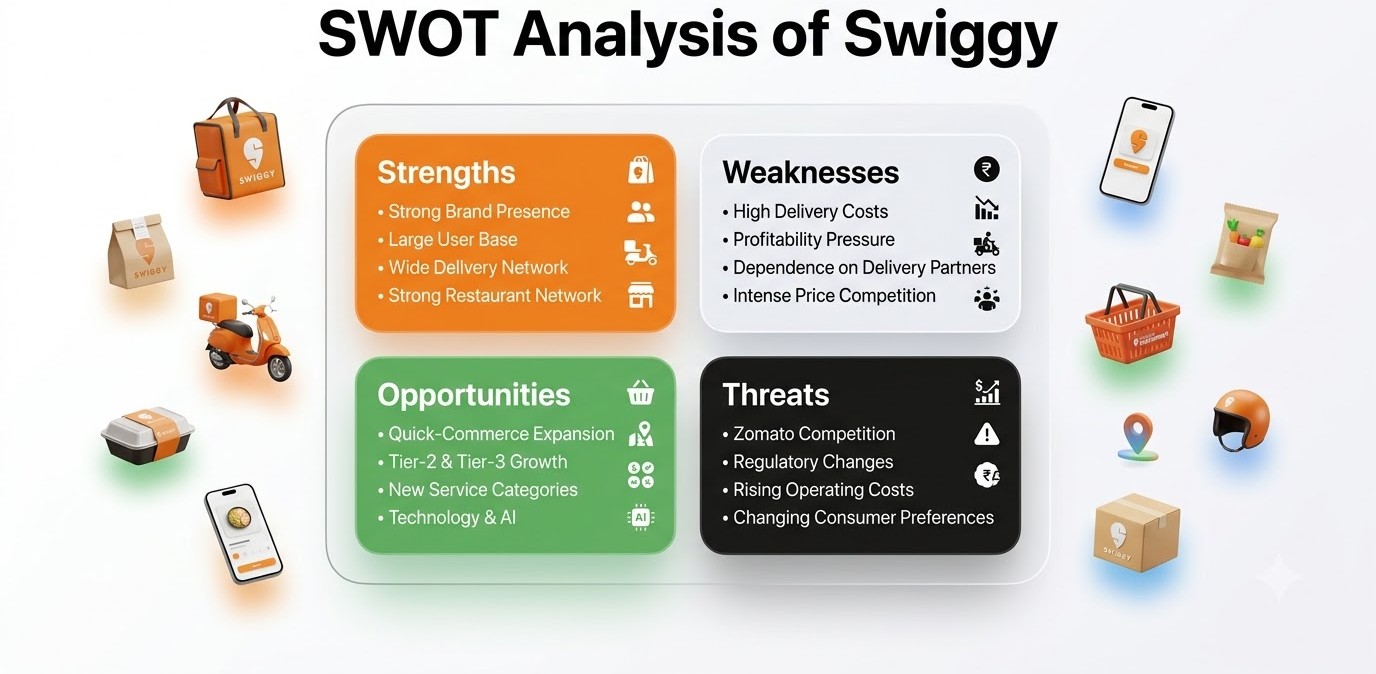
Swiggy’s SWOT analysis provides a clear overview of the company’s current position in India’s highly competitive food delivery and quick-commerce market. It highlights the key strengths that support Swiggy’s growth, the weaknesses that can affect profitability, the opportunities available in emerging markets and services, and the threats posed by competitors, changing customer preferences, and regulatory challenges.
Strengths
Swiggy didn’t become one of India’s most recognized consumer brands by accident. It built a genuinely strong operational core, and that core is what let it survive multiple waves of competition — from Foodpanda shutting down in India, to Uber Eats selling its India business to Zomato, to newer players like Zepto pushing into adjacent categories. Below are the five strengths that matter most when you’re doing a proper SWOT Analysis of Swiggy, and each one deserves more than a one-line mention because these are the actual pillars keeping the company competitive.
1. Fast Delivery
Look, in food delivery, speed isn’t a nice-to-have. It’s the entire product. Nobody orders biryani at 9 PM hoping it shows up cold at 10:15. Swiggy figured this out early and built its entire logistics network around minimizing the time between “order placed” and “food at your door.” The company uses a mix of algorithmic dispatch, dynamic batching of orders, and a large fleet of delivery partners spread across dense urban zones so that no restaurant is ever too far from an available rider.
This isn’t just about having more riders on the road, either. Swiggy’s backend systems predict order volume by neighborhood and time of day, so delivery partners are pre-positioned near high-demand restaurant clusters before the dinner rush even hits. That kind of forecasting is genuinely hard to pull off at scale, and it’s a big part of why Swiggy consistently ranks well on delivery time compared to rivals. Instamart, the grocery arm, pushed this even further with 10–15 minute delivery promises in select cities, chasing the same instant-gratification itch that Zepto and Blinkit built their whole business around. Honestly, that shift into quick commerce shows Swiggy knows speed is the moat, not the shiny app or the discount coupons.
There’s a deeper operational story here too. Route optimization software constantly recalculates the fastest path for a rider carrying multiple orders, accounting for traffic patterns, one-way streets, and even which apartment complexes have slow elevators. Restaurants get nudged by the app on how long their food prep is taking compared to peers, which quietly pressures kitchens to speed up too. None of that shows up in a marketing campaign, but it’s the actual machinery behind why your food arrives fast, and it’s a strength competitors have struggled to fully replicate even after years of trying.
Zoom out and you realize speed compounds into something bigger than convenience. When delivery is reliably fast, customers order more often, restaurants get more repeat business, and the whole ecosystem grows because nobody’s sitting there wondering if the app is going to flake on them tonight. That trust, built order after order, is honestly the real payoff of all that backend engineering, and it’s why Swiggy keeps investing in speed even in categories where it’s already ahead of most competitors.
2. Neat User Interface
Open the Swiggy app and you’ll notice it doesn’t overwhelm you. That’s deliberate. A lot of Indian apps in this space try to cram every feature onto the home screen — ads, banners, five different tabs — and end up confusing. Swiggy went the other way. The interface leads with what you actually want: restaurants near you, your recent orders, and a search bar that actually understands typos and regional dish names.
The checkout flow is short. Payment options are baked in — UPI, cards, wallets, cash on delivery in select areas — so there’s no fumbling around at the last step, which is exactly where a lot of apps lose customers. Swiggy also uses personalization well; if you’ve ordered dosas three times this month, don’t be surprised if dosa places start showing up higher in your feed. That’s not flashy design, that’s just paying attention to what keeps people from abandoning their cart, and it’s a real strength that doesn’t get enough credit in most breakdowns of the company.
There’s also the small stuff that adds up over time. Order tracking shows a rider’s exact location on a live map instead of a vague “on the way” message. Reordering a past meal takes two taps. The app remembers your saved addresses, your usual tip amount, your go-to payment method. None of this is groundbreaking individually, but stacked together it removes so much friction that switching to a clunkier competitor app genuinely feels annoying, and that friction — or lack of it — is exactly what keeps people opening Swiggy out of habit rather than comparing every single time.
3. Trained Employees
People underestimate how much of Swiggy’s reputation rides on its delivery partners, not its app. A rider who’s rude, who can’t find your address, or who mishandles a food bag full of curry is going to tank your opinion of the whole platform — no matter how slick the UI is. Swiggy has invested heavily in onboarding and training programs for its delivery fleet, covering everything from safe riding practices to basic customer interaction etiquette to how to properly carry food so it doesn’t spill or tip over on a bike.
Restaurant partners also get support from Swiggy’s account management teams, who help with things like menu photography, pricing strategy on the platform, and understanding order analytics. This might sound like a small thing, but a well-trained partner ecosystem — both riders and restaurant staff — is one of the reasons Swiggy has managed to maintain decent service quality even as it scaled into hundreds of cities. Untrained gig workers at that scale would be a recipe for disaster, and Swiggy clearly understood that early on.
Beyond basic etiquette, Swiggy runs safety modules covering helmet use, road rules, and what to do in case of an accident, plus insurance coverage options for delivery partners. Customer support teams get trained on de-escalating complaints quickly rather than making a frustrated customer wait through a scripted process. That investment in people, not just technology, is honestly one of the most overlooked parts of Swiggy’s operation, and it’s the difference between a platform that just connects people and one that actually delivers a consistent experience millions of times a day.
4. Wide Selection
Swiggy isn’t just a food app anymore, and that’s kind of the point. Beyond restaurant delivery, it runs Instamart for groceries, Swiggy Genie for package pickup and delivery, and it experiments constantly with new categories — from meat and seafood delivery to pet supplies in select markets. On the restaurant side alone, Swiggy lists everything from tiny local dhabas to major national chains, street food stalls to fine dining, so almost nobody opens the app and comes up empty.
This breadth matters because it turns Swiggy from a single-purpose app into a habit. Once you’re ordering groceries, medicine, and dinner all from the same platform, switching to a competitor becomes a bigger decision than just “which app has a better discount today.” That’s the whole logic behind Swiggy One, the subscription program bundling free delivery across these different verticals — it’s designed to lock in loyalty by making the ecosystem sticky, not just the food delivery piece.
Selection also isn’t just about category breadth, it’s about depth within categories too. Instamart alone stocks thousands of SKUs across groceries, personal care, and household items, closer to a mini supermarket than a convenience store. On the food side, cuisine variety spans regional Indian food from every state, plus international options like Thai, Korean, and Mexican in bigger cities. That kind of range means Swiggy can serve a college student ordering a ₹99 meal and a family ordering a ₹2,000 catering-style spread for a get-together, all through the same app, and that flexibility is a genuine strength most single-category competitors simply can’t match.
5. Neat Packing
This one sounds minor until your dal makes it to your door without leaking all over the bag. Swiggy has pushed restaurant partners toward better packaging standards — leak-proof containers, sealed lids, proper labeling — because a soggy paratha or a spilled curry is an instant one-star review, and those reviews hurt the restaurant and the platform both. Swiggy’s partner guidelines actually include packaging recommendations, and for select cuisines known for spillage risk, like gravies and soups, the platform nudges restaurants toward specific container types.
It’s a small operational detail, but it compounds. Multiply thousands of daily orders across a city, and packaging quality becomes a genuine differentiator in customer satisfaction. Competitors have had their own packaging complaints go viral on social media, so Swiggy’s relatively consistent standard here isn’t nothing — it’s a quiet strength that keeps churn lower than it would otherwise be.
Swiggy has also pushed sustainability angles into this — encouraging restaurants to move toward biodegradable packaging materials and cutting down on excess plastic cutlery unless a customer specifically requests it. That’s partly good PR, sure, but it also genuinely reduces cost for restaurants who no longer have to include cutlery in every single order by default, and it nudges the whole ecosystem toward slightly more responsible packaging choices without forcing anyone’s hand. Small thing, but it adds up across the sheer volume Swiggy processes daily.
Weaknesses
No company this size is without cracks, and Swiggy has a few that show up again and again in customer complaints, restaurant partner feedback, and financial results. A fair SWOT Analysis of Swiggy has to sit with these honestly instead of glossing over them, because pretending a company this large has no real weaknesses would just be dishonest.
1. Targets Zonal Restaurants
Swiggy’s expansion strategy has often leaned toward onboarding restaurants that are already popular or well-located within a zone, rather than aggressively going after smaller, newer, or off-the-beaten-path eateries in every corner of a city. That approach makes sense from a logistics standpoint — it’s easier to serve dense clusters of already-successful restaurants — but it means coverage can feel patchy once you move outside the core zones of a city.
If you live in a newer residential layout on the outskirts of a metro, or in a smaller town where restaurant density is lower, your Swiggy options can look thin compared to what someone in a central business district sees. This zonal concentration also creates a dependency risk: if a handful of high-performing restaurants in a zone leave the platform or switch to exclusivity deals with a competitor, that zone’s order volume can take a real hit. It’s a strategic tradeoff — efficiency now versus breadth later — and it’s one that shows up as a genuine weakness whenever Swiggy tries to push deeper into tier-2 and tier-3 India, where the restaurant density needed for the same model just isn’t always there yet.
This matters even more now that Swiggy is trying to grow beyond its metro strongholds. Smaller towns often have fewer organized restaurant chains and more standalone family-run places that aren’t used to managing an online storefront, digital menus, or order-volume spikes. Onboarding those restaurants takes more hand-holding, slower rollout, and honestly, more patience than Swiggy’s zonal-focused playbook was originally built for. Until that gap closes, expansion into less dense markets will keep moving slower than leadership probably wants.
2. Increase in Brand Name
This sounds like a strength, and honestly, in most ways it is. But there’s a flip side that’s worth being honest about: as Swiggy’s brand recognition grew, so did the scrutiny. Every viral complaint about a delivery partner, every price hike on delivery fees, every outage during a big cricket match or festival night gets amplified because everyone knows the Swiggy name. A smaller, less recognized competitor can have the exact same problem and it barely makes a ripple. Swiggy doesn’t get that luxury anymore.
There’s also a cost side to this. Building and maintaining that level of brand recognition isn’t cheap — marketing spend, sponsorships, influencer campaigns, and constant app-store visibility all add up, and Swiggy has had to keep spending aggressively just to stay top-of-mind against Zomato’s equally loud marketing machine. When your brand becomes a household name, expectations rise with it, and any slip gets magnified in a way that smaller players simply don’t have to deal with. That tension between visibility and vulnerability is a real weakness, not just a footnote.
Social media makes this worse, not better. A single bad screenshot of a rude chat with customer support, or a photo of a squashed cake that arrived for someone’s birthday, can spread across Twitter and Instagram within hours and rack up thousands of shares before Swiggy’s support team even sees it. That kind of reputational exposure is the price of being a household name, and it means Swiggy has to run its customer service operation almost flawlessly, all the time, just to avoid becoming the next viral complaint thread. That’s an exhausting bar to clear consistently.
3. Delivery Charges
Ask almost any regular Swiggy user what annoys them, and delivery charges will come up fast. Between the base delivery fee, platform fee, surge pricing during rain or peak hours, and small-cart fees for low-value orders, the final bill on a ₹150 meal can creep uncomfortably close to ₹200 once everything’s added in. Customers notice this, and plenty of them complain about it loudly on social media and review platforms.
The tricky part is that Swiggy genuinely needs these fees — delivery partner payouts, fuel costs, and the sheer logistics of running a same-day delivery network are expensive, and the company has been under pressure from investors to actually turn a profit rather than burn cash indefinitely chasing growth. So the fees aren’t arbitrary. But that doesn’t change the customer experience, and price-sensitive Indian consumers — a huge chunk of the market — will absolutely switch to a competitor’s app if it means saving twenty or thirty rupees on a routine order. This fee sensitivity is one of the clearest weaknesses limiting Swiggy’s pricing power, especially against local delivery apps or direct restaurant ordering that skip the middleman markup entirely.
It gets more complicated during monsoon season or festival nights, when surge pricing kicks in and delivery fees can jump noticeably higher than usual. Customers understand the logic — more demand, fewer available riders, higher cost to fulfil orders quickly — but understanding it doesn’t stop the frustration when a routine order suddenly costs forty extra rupees just because it started raining. That inconsistency in what people end up paying, order to order, is a weakness that keeps showing up in customer feedback no matter how many times Swiggy tweaks its fee structure.
Opportunities
Now for the fun part. Despite the weaknesses above, Swiggy is sitting on some genuinely large opportunities, and how it plays these next few years will decide whether it stays the number-two or number-one player in Indian food delivery, or whether it gets squeezed by faster-moving quick-commerce rivals.
1. Innovator of this Idea
Swiggy was one of the first movers in organized, app-based food delivery in India, arriving in the market before it was obvious that this business model would work at scale. That first-mover advantage still carries weight. Being early meant Swiggy could build direct relationships with restaurant owners before competitors showed up with better commission terms, and it meant Swiggy got to shape customer habits — the assumption that food delivery should be fast, trackable, and available almost everywhere — before anyone else defined what “normal” looked like.
That legacy as an innovator gives Swiggy a credibility advantage when it launches new things. When Swiggy tries a new category, like Instamart or Swiggy Genie, customers are more willing to give it a shot because they already trust the brand from years of food delivery experience. That trust is an asset competitors without the same track record have to build from zero, and it’s genuinely one of Swiggy’s more underrated long-term opportunities — using its history as the category creator to keep launching and validating new services faster than rivals can catch up.
This kind of trust also shows up in how restaurants react when Swiggy pitches something new. A restaurant owner who’s worked with Swiggy for eight years and seen steady payouts is far more likely to say yes to a new pilot program — say, a dark kitchen partnership or a new advertising product — than they would be with an unfamiliar startup knocking on their door for the first time. That accumulated goodwill, built over a decade of actually delivering on promises, is hard to quantify but it’s real, and it keeps opening doors for Swiggy that newer entrants simply don’t have access to yet.
2. Growing Marketplace
India’s internet user base keeps growing, smartphone penetration keeps climbing, and disposable incomes in tier-2 and tier-3 cities keep rising year over year. That’s a massive tailwind for any consumer internet business, and food delivery is no exception. More young professionals moving to cities for work, more dual-income households with less time to cook, more college students ordering in — all of that adds up to a market that’s still expanding, not shrinking.
Swiggy doesn’t need to invent new demand so much as it needs to keep capturing a growing pie. Cities that had almost no organized food delivery five years ago now have Swiggy riders on the road daily. As internet infrastructure improves in smaller towns and UPI adoption keeps climbing, the addressable market for Swiggy keeps widening. That’s a real structural opportunity, not a one-time bump, and it gives Swiggy room to grow its order volume even without stealing much share from Zomato — there’s simply more market to go around as India’s middle class expands.
Add to that the cultural shift happening in parallel. Ordering food online used to feel like an occasional treat for a lot of Indian households; now, for a growing segment of urban and semi-urban consumers, it’s just a normal Tuesday-night option, no different from cooking at home. That normalization of the habit, spreading further into smaller towns every year, is exactly the kind of long-term demand curve that makes this opportunity worth taking seriously rather than treating it as background noise.
3. Increase in Market Share
Swiggy has consistently traded the top spot in Indian food delivery with Zomato, and the gap between them shifts depending on the quarter and the metric you’re looking at — gross order value, active users, or restaurant partner count. That competitive tightness actually cuts both ways: it means there’s real room for Swiggy to pull ahead if it executes better on customer retention, delivery costs, or new-market entry.
Instamart’s expansion into quick commerce is a big lever here. Quick commerce as a category — Blinkit, Zepto, Instamart all fighting over the same 10-minute delivery promise — is growing faster than traditional food delivery in percentage terms, and Swiggy has a real shot at grabbing meaningful share in that fight if it keeps investing in dark store density and delivery fleet efficiency. Every additional dark store, every new city launch, every loyalty program tweak is a small lever toward increasing overall market share, and Swiggy’s leadership has been fairly aggressive about pulling those levers rather than sitting back and defending its existing position.
Winning share in this market isn’t just about spending more on ads, either. It’s about small execution details — cutting a few minutes off average delivery time, reducing order cancellations, making refunds smoother when something goes wrong. Customers notice these things even if they can’t articulate why they prefer one app over another, and Swiggy’s ability to keep sweating these small details at scale is exactly what separates gaining share from just holding steady.
4. More Service
Diversification is where a lot of Swiggy’s future growth story lives. The company has already shown it’s willing to experiment — Swiggy Genie for errands, Instamart for groceries, Swiggy Dineout for restaurant reservations and discounts, and pharmacy delivery pilots in select cities. Each new service category is a chance to capture more of a customer’s daily spending without having to acquire a brand-new user from scratch.
There’s also room to expand into things like event ticketing, subscription bundles that go beyond just delivery, and deeper integration with restaurant point-of-sale systems to help small eateries manage their entire operation, not just their delivery orders. Every new vertical Swiggy adds increases the average revenue per user and makes the overall platform harder to leave, because switching away from Swiggy stops being about food and starts being about giving up an entire ecosystem of convenience. That’s a genuinely exciting opportunity if Swiggy can execute without spreading itself too thin, which, to be fair, is always the risk with this kind of aggressive diversification.
There’s also a B2B angle worth mentioning. Restaurants increasingly need help with things beyond just delivery — inventory tracking, demand forecasting, even helping them figure out which dishes to push during a slow afternoon. If Swiggy builds out more tools like this for its restaurant partners, it stops being just a delivery middleman and starts becoming genuinely embedded in how these businesses operate day to day, which is a much stickier and more defensible position than simply being an order-routing app.
Threats
Every opportunity above comes with a mirror-image threat, and a proper SWOT Analysis of Swiggy needs to take these seriously instead of treating them as background noise. These are the pressures that could genuinely knock Swiggy off course if not managed well.
1. Fewer Customers
It sounds counterintuitive given the growth story above, but customer attrition is a real risk, especially in a market this price-sensitive. When a competitor runs a bigger discount campaign, or when delivery fees creep up one time too many, customers don’t hesitate — they just switch apps for a week, a month, or permanently. Loyalty in food delivery is thinner than most brands would like to admit, because the switching cost is basically zero. It’s just downloading a different app.
Economic downturns make this worse. When household budgets tighten, ordering in is one of the first discretionary expenses people cut, choosing to cook at home instead. Swiggy has to keep working to retain customers through loyalty programs like Swiggy One, but the underlying threat doesn’t go away — in a market with this many alternatives and this little brand loyalty, customer counts can soften faster than leadership would like, especially if a rival times a major promotional push well.
It’s also worth noting that customer habits shift generationally. Younger users who grew up with instant delivery expectations are quicker to compare prices across three apps before ordering than older users who just default to whichever app they downloaded first. That price-comparison behavior, increasingly normal among Gen Z consumers, means Swiggy can’t just rely on being first or being familiar anymore — it has to keep actively earning the order every single time, which is a very different, much harder game than the early days of the category.
2. Increasing Competitors
Zomato remains Swiggy’s biggest and most direct rival, and the two have been trading blows for years on pricing, restaurant exclusivity deals, and new feature launches. But it’s not just Zomato anymore. Zepto and Blinkit have carved out serious ground in quick commerce, and that category increasingly overlaps with what Instamart is trying to do. Regional and hyperlocal delivery startups keep popping up in specific cities, undercutting on commission fees to restaurants and delivery charges to customers.
This crowded field puts constant pressure on Swiggy’s margins. Every competitor forces a response — match this discount, launch a similar feature, adjust that commission rate — and each response costs money or shrinks profitability. The Indian food and grocery delivery space has become one of the most fiercely contested consumer internet battlegrounds in the country, and staying ahead means Swiggy can basically never stop innovating or spending on customer acquisition, which is an exhausting, expensive threat that isn’t going away anytime soon.
There’s also the restaurant side of this competition, which doesn’t get talked about as much. Restaurants increasingly negotiate lower commission rates by threatening to go exclusive with a rival platform, or by pushing customers toward direct-ordering websites and WhatsApp-based ordering to skip platform fees altogether. That kind of disintermediation, where restaurants try to route around delivery apps entirely for repeat customers, is a slow-building threat that chips away at Swiggy’s order volume from a completely different direction than app-to-app competition.
3. Increase in Health-Conscious People
Here’s a shift that doesn’t get talked about enough in food-delivery SWOT breakdowns: more urban Indians are actively rethinking how often they eat restaurant food. Rising awareness around processed ingredients, excess oil, and portion sizes in commercially prepared meals has pushed a growing segment of health-conscious consumers toward home cooking, meal-prep services, or diet-focused delivery options instead of regular restaurant orders.
This isn’t a fringe trend anymore. Fitness culture, wellness influencers, and a broader cultural shift toward mindful eating have real reach among the same urban, tech-savvy, disposable-income demographic that forms Swiggy’s core user base. If this keeps growing, it could slowly chip away at order frequency among exactly the customers Swiggy relies on most. Swiggy has responded with healthier filter options and partnerships with diet-focused kitchens, but the underlying threat is structural — it’s a values shift in how people think about eating out, not just a passing fad, and that makes it harder to counter with a simple discount code.
There’s a real business response Swiggy could lean into harder here, though — partnering more deeply with cloud kitchens focused on macro-tracked meals, or building better nutrition-label visibility directly into restaurant listings. Some of that already exists in pockets, but it’s not yet a core part of the discovery experience the way cuisine filters or price filters are. Until that changes, this remains a threat Swiggy is managing at the edges rather than addressing head-on.
Conclusion
Put it all together and you get a company that’s genuinely strong operationally — fast delivery, a clean app, trained people, wide selection, careful packaging — but one that’s also navigating real weaknesses around restaurant coverage, brand-driven scrutiny, and customer pushback on fees. The opportunities in front of Swiggy are substantial: a growing Indian market, a first-mover legacy it can keep leveraging, room to grow market share, and a real shot at building out new service categories that deepen customer loyalty. But the threats are just as real. Competitors aren’t slowing down, customer loyalty is thin in a market this price-sensitive, and a health-conscious shift among core urban customers could quietly reshape order patterns over the next several years.
This is what makes doing a SWOT Analysis of Swiggy genuinely useful rather than a box-ticking exercise — it forces you to hold the good and the bad in the same frame. Swiggy isn’t a story of pure triumph or pure struggle. It’s a company constantly adjusting, launching new bets like Instamart and Genie, tightening its delivery network, and fighting for every inch of market share against rivals who are just as motivated. Whether it comes out ahead of Zomato and the quick-commerce challengers over the next few years depends less on any single strength or weakness, and more on how well Swiggy keeps adapting as India’s food and grocery delivery market keeps evolving under its feet.
At the end of the day, this is a company built on thin margins, brutal competition, and a customer base that’s happy to switch apps for a twenty-rupee discount. Staying on top in that environment isn’t about one big breakthrough. It’s about getting a hundred small things right, again and again, faster than everyone else chasing the same customers.
Frequently Asked Questions
1. What is a SWOT Analysis of Swiggy actually used for?
It’s a framework for understanding Swiggy’s internal strengths and weaknesses alongside external opportunities and threats. Businesses, students, and analysts use it to get a structured, honest picture of where the company stands competitively, rather than just relying on surface-level news headlines about funding rounds or new features.
2. Is Swiggy profitable?
Swiggy has historically operated at a loss while prioritizing growth, though its food delivery business has shown improving unit economics over recent years. Instamart, the quick commerce arm, has been a bigger drag on overall profitability because of the heavy investment needed in dark stores and delivery infrastructure. Since financial performance changes quarter to quarter, it’s worth checking Swiggy’s latest investor filings for current numbers.
3. Who are Swiggy’s biggest competitors?
Zomato is the most direct competitor in food delivery. In quick commerce, Blinkit and Zepto compete hard with Instamart. Regional and hyperlocal delivery startups also compete in specific cities, especially where commission rates or delivery fees become a sticking point for restaurants and customers.
4. When did Swiggy go public?
Swiggy listed on the NSE and BSE in November 2024, marking a major milestone after years of being backed primarily by private investors like SoftBank, Prosus, and Accel.
5. What is Swiggy Instamart?
Instamart is Swiggy’s grocery and quick-commerce vertical, offering delivery of groceries and household essentials, often within 10 to 20 minutes in dense urban areas. It competes directly with Blinkit and Zepto in this fast-growing category.
6. Why does Swiggy charge a platform fee?
The platform fee helps Swiggy cover operational costs beyond just the delivery itself, including technology infrastructure, customer support, and payment processing. It’s a small flat fee added on top of delivery charges, and it’s become a common practice across most food delivery apps in India, not just Swiggy.
7. What is Swiggy One?
Swiggy One is the company’s subscription program that bundles benefits like free delivery, no platform fees, and other perks across Swiggy’s food delivery, Instamart, and Dineout services. It’s designed to increase customer loyalty by making the whole Swiggy ecosystem cheaper to use regularly.
8. How does Swiggy make money from restaurants?
Swiggy primarily earns through commission fees charged to restaurant partners on each order, along with advertising fees for restaurants that want better visibility in search results or featured placements within the app.
9. Does Swiggy operate outside India?
No, Swiggy’s operations are focused entirely on the Indian market. Unlike some competitors that have explored international expansion, Swiggy has stayed concentrated on deepening its presence across Indian cities and towns rather than expanding overseas.
10. What is Swiggy Genie? Swiggy Genie is a pickup-and-delivery service that lets users send packages, documents, or items from one location to another within a city, using Swiggy’s existing delivery partner network. It extends the platform beyond just food and groceries into general local errands.
11. How does Swiggy compare to Zomato in market share?
Swiggy and Zomato have historically been close competitors, with market share shifting between them depending on the specific metric and time period. Both companies compete aggressively on pricing, restaurant partnerships, and new feature rollouts, and neither has established a dominant, unshakeable lead over the other.
12. What are the biggest risks facing Swiggy’s business model?
Rising competition from quick-commerce players, thin customer loyalty in a price-sensitive market, and the ongoing pressure to balance growth spending with profitability are among the biggest risks. Shifts in consumer behavior, like increased health consciousness, also pose a longer-term structural challenge.
13. How does Swiggy select which restaurants to onboard? Swiggy tends to prioritize restaurants in dense, high-demand zones where delivery logistics are simpler and order volume is naturally higher. This helps efficiency but can leave gaps in restaurant selection for users living in less dense or newer parts of a city.
14. What is Swiggy Dineout?
Swiggy Dineout is a service focused on restaurant reservations and dine-in discounts, letting users book tables and access deals at partner restaurants, separate from the delivery side of the business.
15. How does weather affect Swiggy delivery charges?
During heavy rain or extreme weather, Swiggy often applies surge pricing on delivery fees to account for reduced rider availability and increased demand. This can make orders noticeably more expensive during monsoon season compared to a clear, ordinary day.