


Myntra sells clothes. That’s the simple version. The real version is that Myntra built one of the most profitable playbooks in Indian ecommerce by figuring out something most fashion retailers never crack: how to make a phone screen feel like a wardrobe. Walk into any Tier 1 city in India and ask a twenty-something where they bought their last kurta or sneakers, and there’s a decent chance the answer is Myntra. That’s not an accident. It’s the result of a decade of decisions around brand partnerships, logistics, and app design that most competitors are still trying to copy.

This SWOT analysis of Myntra breaks down exactly where the company stands right now, not in some generic “market leader” sense, but in specific, concrete terms. What’s actually working. What’s quietly costing them money. Where the next five years of growth could come from. And who’s circling, waiting for a slip-up. If you’re a business owner trying to understand what made Myntra dominant, a marketer studying fashion ecommerce, an MBA student writing a case study, or an investor sizing up the Flipkart-Walmart ecosystem, this guide gives you the full picture without the fluff.
What makes this analysis different from the dozen other Myntra breakdowns floating around is depth. Anyone can say “Myntra has strong brand recognition.” That tells you nothing. What matters is why that recognition exists, what it costs to maintain, and whether it’s durable against Amazon Fashion throwing money at the problem or Meesho undercutting on price. Every section here digs into that layer.
What You Will Learn in This Guide
- How Myntra actually makes money, beyond just “selling clothes online”
- The specific strengths that give Myntra a real edge over Amazon Fashion, Ajio, and Nykaa Fashion
- The weaknesses that show up in return rates, discount dependency, and margin pressure
- Where the biggest opportunities sit for the next phase of growth, including Tier 2 and Tier 3 expansion
- The threats that could genuinely dent Myntra’s market position over the next few years
- A full competitive comparison against its four biggest rivals
- The marketing playbook behind campaigns like the End of Reason Sale
- Answers to the questions people actually search about Myntra’s business
What is SWOT Analysis?
A SWOT analysis is a framework businesses use to map out their internal strengths and weaknesses alongside external opportunities and threats. It sounds academic, but it’s really just an organized way of answering four questions: what are we good at, where are we vulnerable, what’s changing in our favor, and what could hurt us. Businesses that skip this exercise tend to react to problems instead of seeing them coming.
Components of SWOT
Strengths and weaknesses are internal. They’re things a company controls directly, like its logistics network, its brand equity, or its pricing strategy. Opportunities and threats are external. They come from the market, the competition, government policy, or shifts in what customers want. The useful part of SWOT isn’t just listing these four categories. It’s connecting them, using strengths to grab opportunities and using awareness of weaknesses to defend against threats before they become real problems.
Why Businesses Use SWOT Analysis
Companies use SWOT because it forces honesty. It’s easy for a leadership team to talk endlessly about growth plans and market share while ignoring the fact that customer acquisition costs have tripled in three years. A proper SWOT puts weaknesses on the same page as strengths, so nobody gets to pretend the company has no soft spots. For a company like Myntra, operating in a brutal price-war category like Indian fashion ecommerce, that kind of honesty matters more than most.
Benefits of SWOT Analysis for Ecommerce Companies
Ecommerce moves fast. Trends shift in a season, competitors launch price wars overnight, and customer acquisition costs can swing wildly based on ad platform changes. A SWOT analysis gives ecommerce leadership a snapshot they can revisit quarterly, comparing what’s changed and what hasn’t. For a company like Myntra sitting inside the Flipkart-Walmart structure, it also helps clarify which advantages come from the parent company and which ones Myntra has actually built on its own.
Company Overview of Myntra
History of Myntra
Myntra started in 2007, and it didn’t begin as a fashion company at all. The original idea was personalization, specifically letting customers order customized merchandise like mugs, t-shirts, and gifts printed with names or photos. That business made some noise but never scaled the way the founders wanted. Around 2010 and 2011, the team pivoted hard into fashion ecommerce, betting that Indian consumers were ready to buy clothes online even though most retail at the time assumed people needed to touch fabric before buying it.
That bet paid off. By shifting the entire model toward apparel, footwear, and accessories, Myntra positioned itself early in a category that exploded over the next decade. The founding team, led by Mukesh Bansal, understood something that a lot of ecommerce players missed: fashion needed a different kind of platform than electronics or books, one built around discovery, styling, and trust in sizing.
Company Profile
Myntra is headquartered in Bengaluru, which puts it in the same tech ecosystem as most of India’s major startups. It operates as a subsidiary under Flipkart, which itself sits under the Walmart umbrella following Walmart’s majority acquisition of Flipkart in 2018. The company runs as an online fashion and lifestyle retailer, covering apparel, footwear, beauty, and accessories across thousands of brands. Nandita Sinha has led the company as CEO, steering it through the post-pandemic shift in how Indians shop for clothes.
Evolution of Myntra
The early years were about proving that fashion ecommerce could work in India at all. Once that was established, Flipkart acquired Myntra in 2014, a deal that gave Myntra access to serious capital and logistics infrastructure it couldn’t have built alone at the time. That acquisition also folded Myntra into what eventually became the Walmart ecosystem when Walmart took its stake in Flipkart four years later.
Today, Myntra isn’t just an app for buying t-shirts. It runs its own fashion week events, has built out a genuine beauty vertical to compete with Nykaa, and has pushed hard into private labels that now generate serious revenue on their own. The company has moved from “online fashion store” to something closer to a fashion media and commerce ecosystem, blending content, influencer partnerships, and shopping into one experience.
Mission and Vision
Myntra’s stated mission centers on democratizing fashion for India, making style and self-expression accessible regardless of city size or income bracket. Whether that’s fully true is debatable given the brand’s premium skew in certain categories, but the intent behind the mission does show up in real moves like expanding into Tier 2 and Tier 3 cities and running aggressive sale events that pull in price-sensitive shoppers who’d never buy at full price.
Core Values
The company leans heavily on personalization, technology, and customer trust as its stated values. In practice, that translates to constant investment in its recommendation engine, an obsession with reducing return friction, and marketing that positions Myntra as the platform that “gets” Indian fashion sensibilities better than global players like Amazon ever will.
Myntra at a Glance
| Attribute | Detail |
|---|---|
| Founded | 2007 |
| Headquarters | Bengaluru, Karnataka, India |
| Parent Company | Flipkart (majority owned by Walmart) |
| Industry | Fashion and Lifestyle Ecommerce |
| Business Model | Online Marketplace + Private Labels |
| Website | myntra.com |
| App Downloads | Tens of millions across Android and iOS |
| Estimated Revenue | Runs into thousands of crores annually |
| Number of Employees | Several thousand across tech, operations, and logistics |
| Number of Brands | Thousands, spanning Indian and international labels |
| Product Categories | Apparel, footwear, beauty, accessories, home and lifestyle |
| Customers Served | Tens of millions of registered users |
| Active Users | Millions of monthly active shoppers |
Myntra Business Model Explained
How Myntra Makes Money
Myntra’s revenue doesn’t come from one single source, and that’s actually one of the smarter parts of how the business is built. Product sales through both first-party inventory and third-party sellers form the base. On top of that sits marketplace commission, where Myntra takes a cut of every sale made by the brands and sellers listed on its platform, without ever holding that inventory itself.
Brand partnerships bring in a different kind of revenue. Fashion labels pay for premium placement, featured spots during sale events, and co-branded campaigns, which functions a lot like paid media inside the app itself. Advertising revenue works similarly. Sellers bid for visibility in search results and category pages, the same way brands pay for shelf space in a physical store, except it’s all measured and optimized in real time.
Myntra Insider, the platform’s loyalty and subscription layer, adds a recurring revenue stream while also increasing how often subscribers shop. The beauty segment has grown into a real profit center on its own, competing directly with Nykaa on categories like skincare and makeup. Premium fashion and luxury fashion verticals target higher-spending customers with better margins per transaction. Private labels like Roadster and HRX skip the commission structure entirely since Myntra owns the full margin. And seasonal sales, while they look like discount-driven revenue dips on paper, actually drive enormous volume and customer acquisition that pays off across the rest of the year.
Myntra Business Model Canvas
Customer Segments: Myntra targets urban and increasingly semi-urban Indian consumers aged roughly 18 to 40, split across budget-conscious shoppers chasing sale events and premium buyers looking for designer or international labels.
Value Proposition: A single app offering thousands of brands, AI-driven personalization, reliable delivery, and an easy returns process, all wrapped in a shopping experience built specifically around how Indians browse and buy fashion.
Customer Relationships: Built through personalized recommendations, the Myntra Insider loyalty program, customer support during returns and exchanges, and constant re-engagement through app notifications and email marketing.
Channels: Primarily the mobile app, which drives the overwhelming majority of transactions, supported by the website and occasional offline pop-up events tied to sale campaigns.
Key Activities: Curating brand partnerships, running the recommendation engine, managing logistics and reverse logistics, and executing large-scale marketing campaigns like the End of Reason Sale.
Key Resources: The Myntra brand itself, its technology stack, its warehousing and delivery network, and its relationships with thousands of fashion brands.
Key Partners: Fashion brands and designers, Flipkart’s logistics arm, payment gateway providers, and third-party sellers who list on the marketplace.
Cost Structure: Warehousing and logistics, marketing and customer acquisition, technology development, and the cost of processing returns, which is a bigger line item in fashion ecommerce than in almost any other retail category.
Revenue Streams: Product sales, marketplace commission, advertising, brand partnership fees, and subscription revenue from Myntra Insider.
Market Position of Myntra
Indian Fashion Ecommerce Market
India’s fashion ecommerce market has grown into one of the most competitive retail battlegrounds in the country, with players ranging from horizontal giants like Amazon to fashion-first platforms like Myntra and Ajio. Myntra has held a leadership position in this space for years, largely because it built its entire platform around fashion rather than bolting a fashion category onto a general marketplace, which is exactly what Amazon did.
Market Share
Myntra consistently ranks among the top two or three fashion ecommerce platforms in India by transaction volume, trading position with Ajio depending on the sale season and category. Its share is strongest in mid-range and premium apparel, where brand partnerships and curation matter more than pure price competition, which is where value players like Meesho tend to dominate instead.
Customer Base
The platform’s customer base skews urban, young, and mobile-first, with a strong concentration in metro cities but growing traction in Tier 2 cities like Indore, Lucknow, and Coimbatore. This customer base has shown high repeat purchase behavior, particularly among Myntra Insider members who get early access to sales and free returns.
Mobile App Performance
Myntra’s app consistently ranks near the top of shopping app charts on both Android and iOS during sale periods, a signal that its mobile-first strategy actually works rather than just being a talking point in investor decks. App-driven sales make up the vast majority of Myntra’s total transaction volume, far outpacing desktop or mobile web.
Brand Recognition
Ask most urban Indian consumers to name an online fashion platform and Myntra is usually the first or second name that comes up, alongside Amazon. That kind of top-of-mind recognition took years of consistent marketing and reliable service to build, and it’s genuinely hard for newer entrants to replicate quickly.
Industry Rankings
Within Indian ecommerce broadly, Myntra sits comfortably in the top tier of platforms by both revenue and app engagement, and within the fashion-specific vertical, it typically ranks first or second depending on the metric and time period being measured.
SWOT Analysis of Myntra
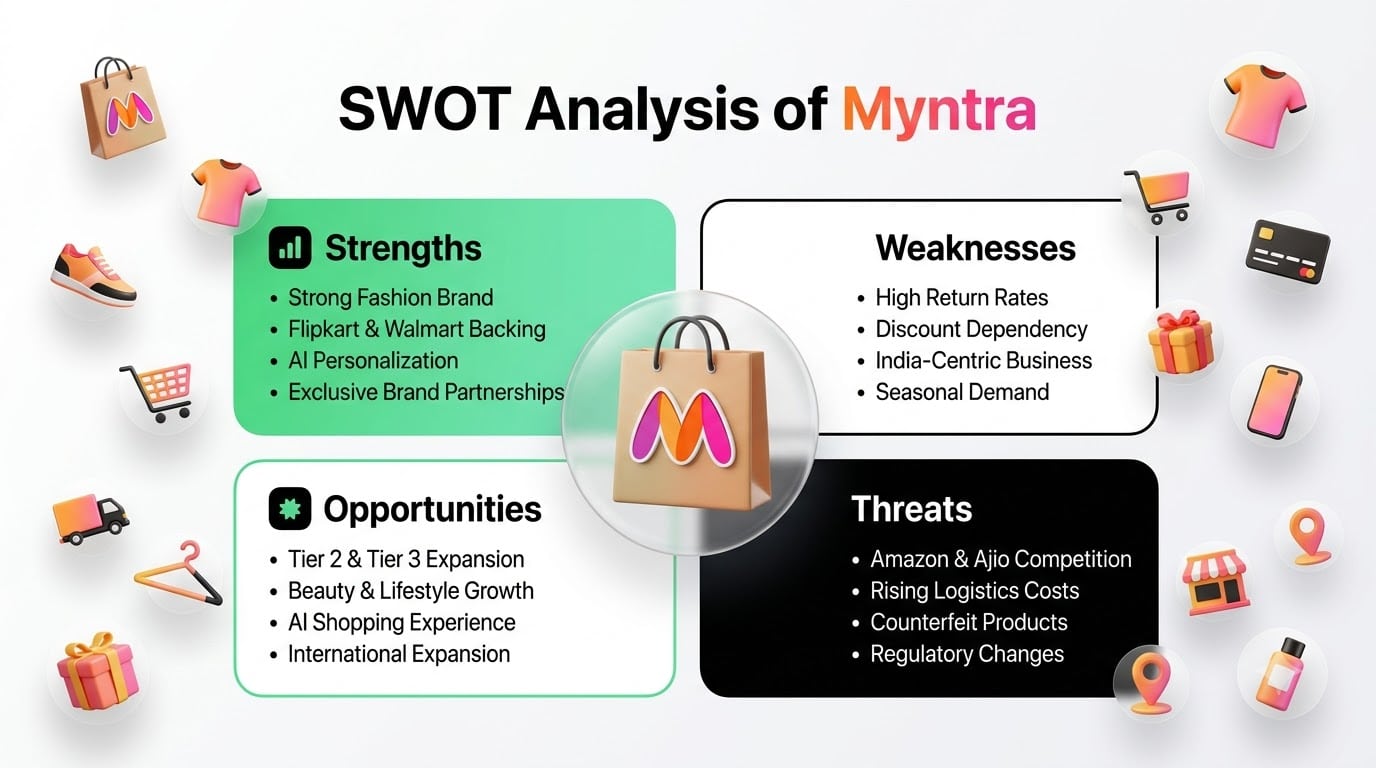
This is the core of the analysis, and it’s worth slowing down here. A lot of Myntra breakdowns list generic points like “strong brand” or “high competition” without explaining the mechanics behind them. Below, every strength, weakness, opportunity, and threat gets broken down with the reasoning behind it, not just the label.
Strengths of Myntra
Strong Brand Recognition
Myntra didn’t become a household name overnight. It took roughly a decade of consistent presence, aggressive sale marketing, and reliability during the early, riskier years of Indian ecommerce when trust was the biggest barrier to online shopping. Customers who had good experiences during the early End of Reason Sale events became repeat buyers, and word of mouth did the rest. That kind of organic trust is nearly impossible for a competitor to buy quickly, even with a massive ad budget.
Years of market leadership compound this advantage. Every season Myntra stays at the top of the category, it becomes the default choice for new online shoppers, since people tend to gravitate toward the platform their friends and family already trust. Customer perception research consistently shows Myntra scoring high on trust and fashion relevance, two things that are genuinely hard to fake in a review-driven ecommerce environment.
Extensive Fashion Catalog
Myntra’s catalog spans apparel, footwear, beauty, accessories, and lifestyle products, and the breadth here isn’t just about having more SKUs than competitors. It’s about covering enough categories that a customer never needs to leave the app for a fashion-adjacent purchase. Someone buying a wedding outfit can find the outfit, the footwear, the accessories, and even skincare products for the event, all in one checkout flow.
That breadth also protects Myntra from category-specific slowdowns. If apparel sales dip during a slow season, beauty or footwear can pick up the slack. Competitors with narrower catalogs, especially newer D2C fashion apps, don’t have that same cushioning effect when one category underperforms.
Exclusive Brand Partnerships
Myntra has built relationships with premium and global brands that either launch exclusively on the platform or give it first access to new collections before other Indian ecommerce sites. This matters because exclusivity drives urgency. When a designer collaboration or a global brand’s India debut happens only on Myntra, fashion-conscious shoppers have no choice but to shop there if they want it.
Designer collections and limited launches also do something subtler: they position Myntra as a fashion authority rather than just a discount retailer. That’s a distinction Amazon Fashion has struggled to build, since Amazon’s brand identity is built around convenience and price rather than curation and taste.
Strong Parent Company Support
Being owned by Flipkart, and by extension backed by Walmart’s capital, gives Myntra resources that standalone fashion ecommerce startups simply don’t have. Flipkart’s logistics network, built over more than a decade of operating across India’s toughest delivery terrain, gets extended to Myntra’s operations, cutting delivery times and costs that would otherwise take years to build independently.
Technology sharing works the same way. Flipkart’s investments in supply chain software, fraud detection, and payment infrastructure benefit Myntra without Myntra needing to build all of it from scratch. And when Myntra needs capital for expansion or a big marketing push, it has access to a parent company with far deeper pockets than most standalone competitors, which matters enormously in a market where customer acquisition costs keep climbing.
AI-Powered Personalization
Myntra’s recommendation engine has become genuinely central to how the platform operates, not just a nice-to-have feature. The personalized homepage shows different products to different users based on browsing history, past purchases, and even the time of year, which is a big part of why session times on the app run higher than on more generic ecommerce platforms.
Search optimization plays into this too. When someone searches “office wear for women,” the AI doesn’t just match keywords, it factors in past style preferences and price sensitivity to rank results. AI styling suggestions go a step further, recommending complete outfits rather than single items, which nudges up average order value in a way that manual curation never could at this scale.
Strong Mobile App Ecosystem
The app itself is where Myntra wins or loses most of its business, and the user experience reflects that priority. Smooth navigation, fast load times even on average Indian network speeds, and a wishlist feature that actually drives repeat visits all contribute to why the app retains users better than most competitors.
Smart search handles typos, regional language variations, and even visual search in some cases, letting users find products without needing exact product names. Easy checkout, with saved addresses and one-tap payment options, reduces the cart abandonment that plagues so much of ecommerce, particularly on mobile where typing is more friction-heavy than on desktop.
Efficient Logistics Network
Fast delivery has become table stakes in Indian ecommerce, and Myntra’s logistics network, boosted by Flipkart’s infrastructure, delivers on that expectation across most major and mid-tier cities. Reverse logistics, meaning the process of picking up returns and exchanges, gets less attention in most SWOT breakdowns but it’s arguably more important in fashion ecommerce than in any other category, since return rates run so much higher for clothing.
The returns and exchange process Myntra has built, including doorstep pickup and quick refund processing, directly affects whether a first-time buyer becomes a repeat customer. A smooth return experience turns a “this didn’t fit” moment into a positive brand interaction instead of a lost customer.
Private Label Portfolio
Roadster, HRX, DressBerry, Anouk, and Mast & Harbour aren’t just extra brands sitting in the catalog. They’re some of the highest-margin products Myntra sells, since there’s no third-party commission split and Myntra controls the entire supply chain from design to delivery. Roadster in particular has grown into a genuinely recognizable fashion brand in its own right, competing with established labels rather than just filling catalog gaps.
The profitability angle here matters a lot. Third-party brand sales come with commission caps and price competition from other platforms selling the same labels. Private labels don’t have that problem, since Myntra is the only place to buy them, giving the company full pricing control and significantly better margins per unit sold.
Strong Marketing Campaigns
The End of Reason Sale has become one of the most anticipated ecommerce events in India, generating massive spikes in both traffic and sales during its run. The Big Fashion Festival works similarly, timed around wedding and festive seasons when Indian consumers are already primed to spend on clothing and accessories.
Celebrity campaigns and influencer marketing extend this reach beyond the app itself, putting Myntra in front of audiences on Instagram and YouTube who might not otherwise open a shopping app. This isn’t just brand awareness spending either. These campaigns consistently convert into measurable spikes in app downloads and first-time purchases during and immediately after they run.
Loyal Customer Base
Myntra Insider gives frequent shoppers real, tangible benefits like early sale access and free returns, which creates a genuine reason to stick with the platform rather than price-comparing across apps every single time. Repeat purchase rates among Insider members run noticeably higher than among non-members, which tells you the loyalty program is doing more than just sitting on a features list.
Customer retention here isn’t just about discounts either. It’s built on the accumulated trust from consistent delivery times, easy returns, and a catalog that keeps expanding with brands people actually want. That combination is hard to replicate quickly, which is exactly why competitors keep struggling to peel away Myntra’s most loyal shoppers.
Weaknesses of Myntra
Heavy Dependence on Indian Market
Nearly all of Myntra’s revenue comes from within India, which means the company’s fortunes are tightly tied to Indian consumer spending patterns, monsoon-affected rural income cycles, and domestic economic conditions. Any prolonged slowdown in Indian consumer spending hits Myntra far harder than it would a globally diversified retailer, since there’s no international revenue to soften the blow.
Intense Discount Dependency
A huge share of Myntra’s highest-volume sales periods run on steep discounts, and that habit has trained a significant chunk of the customer base to wait for sale events rather than buy at full price. This creates real margin pressure, since the company essentially has to keep offering deeper and deeper discounts to maintain the same excitement and conversion rates each season, eating into profitability even as revenue looks strong on paper.
Limited International Presence
Unlike Amazon, which operates fashion ecommerce across dozens of countries, Myntra’s operations remain almost entirely focused on India. That’s a missed growth lever, especially since Indian fashion and diaspora demand exists in markets like the UAE, the US, and the UK, where Myntra currently has little to no direct presence compared to how aggressively it could be expanding.
High Return Rates
Fashion sizing challenges are a structural problem for every online clothing retailer, but they hit Myntra particularly hard given its catalog size and the number of brands with inconsistent sizing standards. A customer ordering the same size “medium” from two different brands can get two very differently fitting garments, which drives returns that have nothing to do with product quality and everything to do with sizing inconsistency across the catalog.
Reverse logistics costs from this problem aren’t small either. Every returned item needs to be picked up, quality-checked, restocked or written off, and in many cases the shipping cost alone eats into whatever margin existed on that sale in the first place.
Premium Pricing Compared to Some Competitors
On certain categories, Myntra’s pricing runs higher than value-focused competitors like Meesho, which built its entire business around ultra-low prices sourced directly from manufacturers. This premium positioning works fine for brand-conscious shoppers but pushes away a large segment of price-sensitive consumers, particularly in smaller towns where disposable income is lower and price sensitivity runs higher.
Dependence on Third-Party Brands
A significant chunk of Myntra’s catalog and revenue still comes from third-party brands rather than owned inventory or private labels. That dependence means Myntra doesn’t fully control pricing, availability, or even product quality on a large portion of what it sells, and if a major brand decides to pull out or list exclusively elsewhere, Myntra loses that revenue and catalog depth overnight.
Seasonal Revenue Fluctuations
Fashion ecommerce runs on predictable but sharp seasonal cycles tied to festivals, weddings, and end-of-season sales. Between these peak windows, transaction volume drops noticeably, creating uneven cash flow and making year-round demand forecasting genuinely difficult for both inventory planning and logistics staffing.
Counterfeit Product Concerns
Even with quality controls in place, marketplace models like Myntra’s occasionally run into counterfeit or misrepresented products slipping through from third-party sellers. Every incident like this, even if rare, does real damage to consumer trust and gives competitors an opening to position themselves as more reliable or better vetted.
Increasing Customer Acquisition Costs
Digital advertising costs across platforms like Meta and Google have climbed steadily for years, and fashion ecommerce is one of the most competitive, expensive categories to advertise in given how many players are bidding for the same customer attention. Myntra now spends significantly more to acquire each new customer than it did five years ago, which puts direct pressure on overall profitability even as revenue continues growing.
Limited Offline Presence
Myntra remains almost entirely a digital-first company, with minimal physical retail footprint compared to competitors like Tata CLiQ Fashion, which benefits from Tata’s existing offline retail network. This limits Myntra’s ability to reach customers who still prefer trying clothes on in person before buying, a segment that remains sizable outside the biggest metro cities.
Opportunities for Myntra
Growth of Indian Ecommerce
India’s overall ecommerce market continues expanding as internet penetration deepens and digital payment adoption grows, particularly through UPI. Every percentage point of growth in the broader ecommerce category represents more potential customers entering the fashion ecommerce funnel for the first time, and Myntra’s existing brand recognition puts it in a strong position to capture a healthy share of that new demand without needing to build awareness from scratch.
Expansion into Tier 2 and Tier 3 Cities
Cities like Jaipur, Bhopal, and Nagpur represent a massive, still-underpenetrated customer base for fashion ecommerce. These markets have growing disposable income and increasing smartphone and internet access, but they’ve historically been underserved by fashion retail, both online and offline. Myntra expanding delivery speed, local language support, and price-tiered product ranges specifically for these cities could unlock a genuinely large new customer segment.
AI-Based Shopping Experiences
Virtual try-on technology, where customers can see how a garment might look on them before buying, addresses the sizing and fit problem directly at its source rather than just managing it through easier returns. An AI stylist feature, offering personalized outfit suggestions based on body type, occasion, and past preferences, could meaningfully differentiate Myntra from competitors still relying on basic recommendation algorithms.
Sustainable Fashion
Eco-friendly collections and green packaging initiatives tap into a growing, increasingly vocal segment of Indian consumers, particularly younger shoppers, who factor sustainability into their purchase decisions. Circular fashion models, like resale or rental options for occasion wear, represent a genuinely new revenue category that few competitors have built out at scale in India yet.
International Expansion
Indian diaspora communities in markets like the US, UK, Canada, and the Gulf countries represent an underserved customer base with genuine demand for Indian fashion brands and ethnic wear that’s hard to find through local retailers in those countries. A focused international shipping or dedicated regional platform strategy could open meaningful new revenue without requiring Myntra to build entirely new supply chains from scratch.
Omnichannel Retail
Blending online and offline experiences through pop-up stores, brand experience centers, or try-before-you-buy kiosks in malls could help Myntra capture customers who remain hesitant about fully online fashion shopping. This approach also gives Myntra a physical touchpoint for its private labels, letting shoppers experience Roadster or HRX quality firsthand before committing to online purchases going forward.
Social Commerce
Instagram and YouTube have become genuine discovery engines for fashion trends among Indian consumers, and integrating shoppable content directly into Myntra’s marketing, or even building native social features into the app itself, could shorten the path from trend discovery to purchase significantly. Competitors that move faster here risk capturing the trend-driven, impulse-purchase segment of the market first.
Live Commerce
Live-streamed shopping events, where influencers or brand representatives showcase products in real time while viewers can purchase instantly, has already shown strong traction in markets like China and is gaining ground in India. Myntra running regular live commerce sessions during sale events could drive higher engagement and conversion than static product listings ever could on their own.
Luxury Fashion Market Growth
India’s luxury fashion segment continues expanding as disposable incomes rise among urban professionals and younger high-earners. Myntra has already made moves into premium and luxury categories, but there’s clear room to deepen partnerships with international luxury labels looking for a trusted, established entry point into the Indian ecommerce market rather than building standalone operations from zero.
Beauty & Personal Care Expansion
Myntra’s beauty vertical has grown steadily, but the category still trails Nykaa in overall market share and brand depth. Deepening exclusive partnerships with beauty brands, expanding into wellness and personal care adjacent categories, and investing further in beauty-specific content and tutorials could help Myntra close that gap meaningfully over the next few years.
Private Label Growth
Given how much better private labels perform on margin compared to third-party brand sales, expanding this portfolio into new categories like activewear, home goods, or accessories represents one of the clearest paths to improving overall profitability without needing to acquire a single new customer, just deepening what existing customers already buy.
Quick Commerce Integration
Quick commerce has reshaped grocery and essentials delivery in India, and fashion has started seeing early experiments in this direction for smaller, urgent purchase categories like accessories or last-minute gifting. Myntra building out a limited quick delivery option for high-demand items in metro cities could capture impulse purchases that currently go to competitors offering faster, if narrower, delivery options.
AR & VR Shopping Experiences
Augmented reality features that let customers visualize how footwear or accessories look in real time through their phone camera could reduce return rates while also making the shopping experience genuinely more engaging than scrolling through static product photos. This technology has matured enough in recent years that implementation costs have come down significantly compared to just a few years ago.
Gen Z and Millennials
Changing shopping behavior among younger Indian consumers, who value personalization, sustainability, and social proof over traditional brand loyalty, plays directly into strengths Myntra has already been building. This demographic shift means the platforms that adapt fastest to trend cycles and authentic influencer partnerships stand to capture disproportionate market share as older shopping habits fade out over the coming years.
Threats Facing Myntra
Amazon Fashion
Amazon Fashion brings competitive pressure that’s hard to overstate, given Amazon’s willingness to run fashion at thin or even negative margins to build overall platform loyalty across categories. Amazon’s logistics network, built over years of investment across every product category, gives it delivery speed advantages that Myntra has to work hard to match, and Amazon’s Prime membership creates a stickiness factor that pulls fashion purchases toward the platform simply because customers are already there for other shopping.
Ajio
Ajio, backed by Reliance’s massive retail and capital resources, runs aggressive pricing that directly challenges Myntra’s positioning, particularly during overlapping sale seasons. Ajio has also secured its own set of brand exclusives, meaning certain labels or collections are only available there, creating direct competition for the same premium and fashion-conscious customer segment Myntra has traditionally owned.
Nykaa Fashion
Nykaa Fashion has carved out real strength in the luxury segment, leveraging Nykaa’s existing beauty customer base and trust to cross-sell fashion products effectively. This overlap threatens Myntra specifically in categories where Nykaa has built strong authority, particularly high-end beauty-adjacent fashion and accessories where Nykaa’s brand credibility runs deep.
Tata CLiQ Fashion
Tata CLiQ Fashion benefits from the Tata Group’s existing offline retail infrastructure and decades of consumer trust in the Tata name, giving it a hybrid online-offline advantage that pure digital players like Myntra can’t easily replicate. This matters especially for premium and luxury fashion customers who want the reassurance of a trusted physical retail brand backing their online purchases.
Meesho
Meesho’s value-conscious consumer base represents a genuine threat to Myntra’s Tier 2 and Tier 3 expansion plans, since Meesho built its entire model around ultra-low prices sourced directly from manufacturers with minimal markup. Any customer Myntra is trying to win in smaller cities is a customer Meesho is already fighting hard to keep through sheer price competition that Myntra’s premium positioning struggles to match.
Emerging D2C Brands
Direct-to-consumer fashion brands building their own standalone apps and websites bypass Myntra’s marketplace entirely, keeping full margin and customer data for themselves rather than sharing it through commission structures. As more fashion brands realize they can build loyal customer bases without a marketplace intermediary, Myntra risks losing exclusive access to some of the most exciting, fast-growing labels in the category.
Government Regulations
FDI rules governing how much foreign ownership is allowed in Indian ecommerce marketplaces directly affect how companies like Flipkart and Myntra can structure their inventory and seller relationships. Data privacy regulations add compliance costs and operational complexity, while broader consumer protection laws around returns, refunds, and advertising claims require constant legal and operational adjustment that smaller competitors sometimes navigate more nimbly.
Cybersecurity Risks
Handling millions of customer transactions, payment details, and personal data makes Myntra a genuine target for cyberattacks and data breaches. A significant security incident wouldn’t just cost money in remediation, it would seriously damage the trust that took years to build, and trust is arguably Myntra’s single most valuable asset in a crowded market.
Rising Logistics Costs
Fuel price volatility, rising labor costs, and increasing last-mile delivery complexity as Myntra pushes into smaller towns all add up to higher operational costs that squeeze margins even as revenue grows. These costs don’t scale down easily either, since customers now expect fast, reliable delivery regardless of how remote their location is.
Inflation
Changing consumer spending patterns during periods of higher inflation tend to hit discretionary categories like fashion first, since clothing and accessories are far easier for households to cut back on than essentials. Any sustained inflationary period in India puts direct pressure on Myntra’s transaction volumes, particularly outside the steep-discount sale windows that already train customers to wait for deals.
Fake Products
Brand reputation risk from counterfeit items slipping through third-party sellers remains an ongoing threat, even with Myntra’s verification processes in place. A single viral incident involving a customer receiving a fake product can spread fast on social media, and rebuilding trust after that kind of story takes far longer than it took to lose it.
Supply Chain Disruptions
Global supply chain issues, whether from raw material shortages, shipping delays, or manufacturing disruptions in key production hubs, can affect product availability and pricing across Myntra’s catalog, particularly for international brands and private labels that rely on overseas manufacturing partners for certain product lines.
Changing Fashion Trends
Fashion trends move fast, and misreading demand, whether in inventory planning for private labels or in which brands to prioritize for partnerships, can lead to unsold stock and markdown pressure. This is a permanent operational risk in fashion retail that no amount of AI forecasting fully eliminates, since trends can shift based on unpredictable cultural moments.
Economic Slowdown
A broader economic slowdown in India, whether from global factors or domestic policy shifts, reduces discretionary spending across the board, and fashion is typically among the first categories consumers cut back on. Given Myntra’s heavy dependence on the Indian market covered earlier in the weaknesses section, this threat compounds with that existing vulnerability rather than acting as an isolated risk.
SWOT Matrix of Myntra
| Strengths | Weaknesses |
|---|---|
| Strong brand equity built over more than a decade | High return rates driven by inconsistent sizing |
| AI-powered personalization across search and recommendations | Heavy discount dependency eating into margins |
| Strong logistics network backed by Flipkart infrastructure | Limited international presence compared to Amazon |
| Parent company backing from Flipkart and Walmart | Seasonal demand creating uneven cash flow |
| Opportunities | Threats |
| Tier 2 and Tier 3 city expansion | Amazon Fashion’s aggressive category investment |
| Growth of social and live commerce | Ajio’s Reliance-backed pricing pressure |
| Sustainable and circular fashion models | Meesho winning value-conscious shoppers |
| Luxury fashion market growth | Regulatory changes around FDI and data privacy |
Competitive Analysis of Myntra
Myntra vs Amazon Fashion
Pricing on Amazon Fashion tends to run more aggressive across broad, non-branded categories, since Amazon can subsidize fashion losses with profits from electronics and other high-margin categories. Myntra’s product range skews more curated and fashion-forward, while Amazon’s catalog is genuinely massive but less specifically tailored to fashion discovery. Delivery speed is roughly comparable in metro cities given both companies’ strong logistics investments, though Amazon’s Prime ecosystem gives it an edge in customer stickiness across categories beyond just fashion.
Customer experience differs meaningfully too. Myntra’s app is built fashion-first, with styling content, outfit suggestions, and a browsing experience designed around discovery rather than search-and-buy efficiency, which is Amazon’s core strength. On returns, both platforms offer reasonably smooth processes, but Myntra’s fashion-specific size and fit guidance tends to reduce return-triggering mistakes more effectively than Amazon’s more generic product pages.
Myntra vs Ajio
Ajio competes most directly with Myntra on both pricing and brand exclusives, backed by Reliance’s deep retail expertise and capital. The two platforms often run overlapping sale events, forcing customers to genuinely compare deals across both apps rather than defaulting to one. Ajio has built a reputation for trendy, younger-skewing private labels, putting direct pressure on Myntra’s own private label strategy in that same demographic.
Myntra vs Nykaa Fashion
Nykaa Fashion leans heavily on its existing beauty customer trust to drive fashion cross-sells, particularly in premium and luxury categories. Myntra’s broader catalog and longer market presence in pure fashion give it an edge in overall category breadth, but Nykaa’s focused positioning in beauty-adjacent fashion creates real competition in specific high-value segments where Nykaa’s credibility runs deeper.
Myntra vs Tata CLiQ Fashion
Tata CLiQ Fashion’s biggest advantage is trust transferred from the broader Tata Group name, plus access to offline retail touchpoints that Myntra lacks entirely. Myntra counters with a significantly larger active user base and a more mature technology stack for personalization, but Tata CLiQ’s hybrid approach appeals strongly to customers who want a physical safety net behind their online fashion purchases.
Competitive Advantage Summary Table
| Platform | Core Advantage | Main Weakness vs Myntra |
|---|---|---|
| Amazon Fashion | Prime ecosystem and logistics scale | Less fashion-focused curation |
| Ajio | Reliance backing and pricing power | Newer to premium brand trust |
| Nykaa Fashion | Beauty-first customer trust | Narrower fashion catalog |
| Tata CLiQ Fashion | Offline retail integration | Smaller digital user base |
| Meesho | Ultra-low pricing | Weak premium brand presence |
Marketing Strategy Behind Myntra’s Success
Digital marketing forms the backbone of how Myntra reaches new customers, spanning performance ads on Meta and Google alongside consistent presence across YouTube and Instagram. Influencer marketing has become a core channel too, with fashion creators showcasing hauls and styling videos that function as organic advertising while feeling authentic to younger audiences who tune out traditional ads.
Celebrity endorsements give Myntra reach beyond digitally native audiences, tapping into mainstream awareness during major campaigns like the End of Reason Sale. Performance marketing runs constantly in the background, optimizing ad spend across platforms based on real-time conversion data rather than fixed seasonal budgets alone.
Social media strategy leans into trend-driven content, styling tips, and behind-the-scenes brand content that keeps the audience engaged even outside active sale periods. The mobile-first approach shapes every part of this strategy too, since nearly all campaigns are designed assuming the customer will discover and convert entirely within the app rather than on desktop.
Personalization extends into marketing itself, with email and push notification campaigns tailored to individual browsing and purchase history rather than blanket promotions. Loyalty programs, particularly Myntra Insider, get promoted heavily as a retention tool, since acquiring a new customer costs significantly more than keeping an existing one engaged.
Festive campaigns tied to Diwali, wedding season, and regional festivals drive some of the platform’s highest-volume periods, timed deliberately around when Indian consumers are already planning to spend on clothing and gifting. CRM strategy ties all of this together, segmenting customers based on purchase behavior and lifecycle stage to send the right message at the right moment rather than treating the entire customer base as one undifferentiated group.
Challenges Myntra Must Overcome
Rising competition from Amazon, Ajio, Meesho, and a growing wave of D2C brands means Myntra can’t coast on brand recognition alone anymore. Customer retention remains a constant battle too, since deal-seeking behavior trained by years of discount-heavy marketing makes loyalty harder to maintain than it looks on paper.
Profitability pressure keeps building as customer acquisition costs climb and discount dependency eats into margins season after season. Sustainability has become a genuine reputational issue too, with fast fashion criticism growing louder among younger, more environmentally conscious consumers who increasingly question the waste generated by constant new collection drops.
Fake sellers slipping through marketplace verification processes remain an ongoing operational headache, requiring constant investment in fraud detection and seller vetting. Increasing CAC compounds with rising logistics costs, particularly as expansion into Tier 2 and Tier 3 cities adds delivery complexity without guaranteed matching revenue in the short term.
AI competition is intensifying too, as rivals invest in their own recommendation engines and virtual try-on technology, narrowing the technological gap that once gave Myntra a clearer edge. And fast fashion criticism isn’t going away, meaning Myntra will need real, visible sustainability commitments rather than surface-level marketing to stay ahead of a genuinely shifting consumer mindset.
Future Outlook of Myntra
AI-driven commerce will likely define much of Myntra’s next phase, with deeper investment in recommendation accuracy, virtual try-on, and predictive inventory management shaping how the platform operates behind the scenes. Hyper-personalization goes beyond just product recommendations too, extending into personalized pricing, personalized marketing timing, and even personalized app layouts based on individual shopping patterns.
Sustainable fashion will keep growing from a nice-to-have marketing angle into a genuine business requirement as younger consumers increasingly factor environmental impact into purchase decisions. International expansion remains a real possibility, particularly targeting Indian diaspora markets where demand already exists but supply access remains limited.
Premium fashion and live shopping formats both represent near-term growth areas, tapping into rising disposable incomes and the growing popularity of real-time, influencer-led shopping experiences. The creator economy will likely play a bigger role in Myntra’s marketing and even product development, with creators potentially collaborating directly on capsule collections rather than just promoting existing inventory.
Virtual shopping experiences through AR and VR technology will keep maturing, addressing the sizing and fit problem that remains one of fashion ecommerce’s biggest unsolved challenges. Unified commerce, blending online, offline, and social shopping into one seamless customer journey, represents the broader direction the entire industry is heading, and Myntra’s resources through the Flipkart-Walmart ecosystem put it in a strong position to invest in that shift ahead of smaller competitors.
Conclusion
Myntra didn’t become India’s leading fashion ecommerce platform by accident. It built that position through years of consistent brand investment, a catalog that genuinely understands fashion discovery, and the kind of logistics and technology backing that only comes from being part of the Flipkart-Walmart ecosystem. Those strengths are real, and they show up in the numbers, the app store rankings, and the customer loyalty that competitors keep trying and failing to fully replicate.
But the weaknesses matter just as much as the strengths, maybe more. Discount dependency, high return rates, and rising customer acquisition costs aren’t small operational footnotes. They’re the exact pressure points that determine whether Myntra keeps growing profitably or just keeps growing revenue while margins quietly erode. The opportunities sitting in Tier 2 and Tier 3 expansion, AI-driven personalization, and sustainable fashion are genuinely large, but capturing them requires real investment, not just marketing language borrowed from a strategy deck.
The threats from Amazon Fashion, Ajio, Meesho, and a growing wave of D2C brands aren’t going anywhere either. Each one is fighting for a different slice of the same customer base Myntra has spent over a decade building. For business owners, marketers, and students studying this case, the real lesson isn’t that Myntra is winning or losing. It’s that market leadership in ecommerce is never permanent, and the companies that stay on top are the ones that keep addressing their weaknesses with the same energy they put into promoting their strengths. If you’re building a strategy of your own, start there: be honest about what’s actually working, and be even more honest about what isn’t.
Frequently Asked Questions
What is the SWOT analysis of Myntra?
The SWOT analysis of Myntra breaks down the company’s internal strengths like brand recognition and AI personalization, internal weaknesses like discount dependency and high return rates, external opportunities like Tier 2 and Tier 3 city expansion, and external threats like competition from Amazon Fashion and Ajio. It gives a full picture of where Myntra stands competitively in India’s fashion ecommerce market.
What are Myntra’s biggest strengths?
Myntra’s biggest strengths include strong brand recognition built over more than a decade, an extensive fashion catalog spanning apparel to beauty, exclusive brand partnerships, backing from Flipkart and Walmart, and a highly personalized AI-driven shopping experience that keeps customers engaged and returning.
What are Myntra’s weaknesses?
Myntra’s main weaknesses include heavy dependence on the Indian market, discount-driven customer behavior that pressures margins, high return rates caused by inconsistent brand sizing, rising customer acquisition costs, and a limited offline retail presence compared to competitors like Tata CLiQ Fashion.
Who are Myntra’s major competitors?
Myntra’s major competitors include Amazon Fashion, Ajio, Nykaa Fashion, Tata CLiQ Fashion, and Meesho. Each competes on a different angle, from Amazon’s logistics scale to Meesho’s ultra-low pricing to Nykaa’s beauty-first brand trust.
Is Myntra profitable?
Myntra’s profitability has fluctuated over the years, with heavy discount-driven sale events boosting revenue but pressuring margins. Private label growth and the beauty segment have helped improve overall profitability, since these categories carry better margins than third-party brand sales through the marketplace.
What opportunities does Myntra have in India?
Myntra’s biggest opportunities in India include expanding into Tier 2 and Tier 3 cities, growing its private label and beauty segments, investing further in AI-based shopping experiences like virtual try-on, and building out sustainable fashion offerings to match shifting consumer values among younger shoppers.
What are the biggest threats to Myntra?
The biggest threats to Myntra include aggressive competition from Amazon Fashion and Ajio, Meesho’s dominance among value-conscious shoppers, rising logistics and customer acquisition costs, and regulatory changes around FDI rules and data privacy that could affect how the marketplace operates.
How does Myntra make money?
Myntra makes money through product sales, marketplace commission from third-party sellers, brand partnership and advertising fees, subscription revenue from Myntra Insider, and high-margin private label sales through brands like Roadster and HRX that it owns and controls entirely.
Who owns Myntra?
Myntra is owned by Flipkart, which itself is majority owned by Walmart following Walmart’s 2018 acquisition of a controlling stake in Flipkart. This ownership structure gives Myntra access to significant capital, logistics infrastructure, and technology resources.
What is Myntra’s competitive advantage?
Myntra’s competitive advantage comes from combining strong brand trust, a fashion-first curated catalog, AI-driven personalization, and the logistics and capital backing of the Flipkart-Walmart ecosystem, a combination that’s genuinely difficult for standalone competitors to replicate all at once.
What is Myntra Insider?
Myntra Insider is Myntra’s loyalty and membership program, offering benefits like early access to sales, free returns, and personalized recommendations to frequent shoppers. It’s designed to increase purchase frequency and reduce the price-comparison behavior that discount-trained customers often exhibit.
How does AI improve Myntra’s shopping experience?
AI improves Myntra’s shopping experience through personalized homepages, smarter search results that account for past preferences, AI-generated outfit suggestions, and predictive recommendations that surface products a customer is statistically more likely to buy based on their browsing and purchase history.
Why do customers prefer Myntra over competitors?
Customers often prefer Myntra because of its fashion-specific curation, reliable delivery and returns process, strong brand partnerships offering exclusive collections, and a shopping experience built specifically around fashion discovery rather than a generic ecommerce interface adapted for clothing.
What role does Flipkart play in Myntra’s growth?
Flipkart provides Myntra with logistics infrastructure, technology resources, and capital access that would take years to build independently. This backing has allowed Myntra to scale delivery speed, invest heavily in personalization technology, and compete against well-funded rivals like Amazon Fashion.
What is the future of Myntra in India’s ecommerce market?
Myntra’s future in India’s ecommerce market likely involves deeper AI-driven personalization, expansion into Tier 2 and Tier 3 cities, growth in sustainable fashion offerings, and continued private label expansion, all aimed at improving margins while defending its market position against aggressive, well-funded competitors.