



Type “cheap wireless earbuds” into Amazon’s search bar and within about half a second you’re looking at forty thousand results, sorted by relevance, price, ratings, and Prime eligibility, with a “customers also bought” carousel already loading underneath. That entire experience- the price you see, the delivery date promised, the ad slotted in at position four, the review count nudging you toward one listing over another- is the Marketing Mix of Amazon playing out in real time, whether you notice it or not. Most people think of marketing as ads and slogans. Amazon barely runs traditional ads in the way Coca-Cola or Nike does. Instead it builds the entire buying experience, product selection, pricing, delivery speed, and discovery, into one machine, and that machine is basically the most studied marketing mix in modern business school curricula for a reason.

Here’s what makes Amazon genuinely different from a textbook case study: most companies pick one or two of the classic 4Ps to compete hard on and treat the rest as table stakes. A luxury brand competes on product and leaves price high on purpose. A discount retailer competes on price and keeps product basic. Amazon refuses to pick a lane. It competes on product selection with over 350 million items available, it competes on price with algorithmic repricing that changes millions of prices per day, it competes on place with a logistics network that gets packages to your door same day in over 2,300 cities, and it competes on promotion through a search and advertising engine that quietly generates tens of billions of dollars a year. That’s not one strategy executed well. That’s four strategies executed simultaneously at a scale nobody else has matched, and it’s exactly why so many business students, marketers, and sellers spend so much time picking apart how it actually works.
So this piece walks through the whole thing properly, starting with who Amazon actually is today, moving through target market, then digging deep into product, place, price, and promotion one at a time, the way the classic marketing mix framework was built to be studied. No fluff, no vague “Amazon does everything well” hand-waving. Just specific tactics, specific numbers, and an honest look at what actually works and where the strategy gets stretched thin. By the end you’ll understand why sellers obsess over Amazon SEO, why Prime Day generates more sales in 48 hours than most retailers see in a quarter, and why understanding this marketing mix matters whether you’re studying it academically or trying to sell something on the platform yourself.
What You Will Learn in This Guide
- A quick overview of Amazon as a company and why its scale changes how marketing strategy actually works here
- Who Amazon’s target market really is, and why “everyone” is a more accurate answer than it sounds
- A full breakdown of the classic 4Ps framework applied specifically to Amazon’s business model
- How Amazon’s product strategy uses selection, private labels, and reviews to outcompete narrower retailers
- Every major channel inside Amazon’s place and distribution strategy, from the website to physical stores to drone delivery
- The six core pricing strategies Amazon actually runs simultaneously across its catalog
- A detailed promotion strategy section covering SEO, advertising, social proof, and public relations
- Nine practical tactics anyone can use to build a genuinely profitable Amazon marketing strategy
- A look at some of Amazon’s most talked-about digital marketing campaigns
- Over ten frequently asked questions covering the details people actually search for
About Amazon
Amazon started as an online bookstore in 1994, run out of Jeff Bezos’s garage in Bellevue, Washington, and it’s genuinely wild how far that’s come. By 2025 the company posted $716.9 billion in net sales for the full year, and Q2 2026 alone crossed $200 billion in a single quarter for the first time in company history, up 20% from the year before. That’s not incremental growth, that’s a company still expanding at a rate most retailers would kill for despite already being one of the largest companies on the planet by market cap.
What makes Amazon relevant to a marketing mix discussion specifically is how much of that growth comes from marketing decisions baked directly into the product experience rather than external advertising campaigns. Third-party sellers now account for roughly 61% of paid units sold on the platform, which means Amazon’s marketing job partly involves convincing sellers to list with them and partly involves convincing shoppers to buy once they’re there. Add in Amazon Web Services generating a huge chunk of company profit, Prime Video competing in streaming, and Alexa sitting in tens of millions of homes, and you get a company where the marketing mix has to work across retail, cloud computing, entertainment, and hardware all at once, which is a genuinely unusual problem for any single marketing strategy to solve.
Amazon’s leadership under CEO Andy Jassy has kept pushing this multi-business approach further rather than pulling back to focus on any single line. Same-day and next-day delivery items topped 13 billion globally in a recent year, and the company keeps expanding drone delivery into new metro areas, both of which are technically logistics investments but function just as much as marketing investments, because delivery speed itself has become one of Amazon’s most persuasive selling points. That’s worth sitting with for a second: a huge chunk of what actually convinces someone to buy on Amazon rather than somewhere else isn’t a clever headline or a catchy jingle, it’s the concrete promise that the thing they want will show up at their door tomorrow, sometimes today, without needing to leave the couch.
Target Market: Amazon Marketing Mix
Here’s a question worth sitting with for a second: who exactly is Amazon’s target customer? The honest answer is almost everyone, and that’s not a lazy cop-out, it’s a deliberate strategic choice. Amazon segments its target market less by demographics like age or income and more by behavior and need state. There’s the price-sensitive shopper comparing options before checkout, the convenience shopper who just wants something delivered fast without thinking too hard, the Prime loyalist who’s basically outsourced their entire shopping habit to Amazon, and the small business buyer sourcing supplies through Amazon Business. Each of these groups gets a slightly different experience even though they’re all shopping the same platform.
Geographically, Amazon’s target market spans well beyond the United States, with meaningful operations across Europe, India, Japan, Brazil, and a growing footprint in the Middle East. But the US remains the core, and within the US, Prime membership alone tells the story: somewhere between 220 and 250 million people worldwide pay for Prime, with roughly 175 to 200 million of those in the US, meaning a huge majority of American households already have a direct financial relationship with Amazon before they even start shopping. That’s why Amazon’s marketing mix doesn’t need to work hard convincing people Amazon exists, it needs to work hard keeping people inside an ecosystem they’ve already joined, which is a fundamentally different marketing problem than the one most companies are solving.
There’s also a business-to-business layer to Amazon’s target market that doesn’t get nearly enough attention in most breakdowns. Amazon Business now serves millions of business customers buying office supplies, equipment, and bulk inventory, essentially running a parallel B2B marketplace on top of the consumer one, with bulk pricing, tax-exempt purchasing options, and approval workflows built specifically for procurement teams rather than individual shoppers. So then, when people talk about Amazon’s target market as “everyone,” it’s genuinely more accurate than it sounds, because Amazon has built distinct experiences for individual consumers, Prime loyalists, price-sensitive comparison shoppers, and corporate buyers, all running simultaneously on the same underlying platform rather than forcing every customer type through one generic experience.
Amazon Marketing Strategy & Marketing Mix (4Ps)
The classic marketing mix framework breaks any strategy down into four core levers: Product, Place, Price, and Promotion, often called the 4Ps. Most companies lean harder on one or two of these and let the others sit at “good enough.” Amazon’s whole competitive advantage comes from refusing to do that. It treats all four as equally important battlegrounds, and it’s built entire technology systems, algorithmic pricing engines, fulfillment center robotics, recommendation algorithms, and advertising auctions, specifically to compete on each one simultaneously rather than picking a favorite.
That’s why studying Amazon through the 4Ps lens is genuinely more useful than studying most companies this way. A lot of businesses have a thin, obvious answer for at least one or two of the Ps, “we compete on quality” or “we compete on price,” and that’s basically the whole story. Amazon doesn’t give you that easy answer anywhere. Product strategy involves selection breadth plus quality control plus private labels. Place involves a website, an app, physical stores, and a logistics network built almost like a parallel postal service. Price involves at least six distinct pricing tactics running at once across different product categories. Promotion involves organic search, paid advertising, social proof, and public relations all pulling in the same direction. So then, the rest of this piece breaks each one down properly, because a surface-level “Amazon does all four Ps well” answer doesn’t actually teach you anything useful.
There’s a reason business schools keep coming back to Amazon specifically rather than picking a simpler example. Most 4Ps case studies use a company where three of the four Ps are basically fixed, a car manufacturer’s place strategy is dealerships, full stop, and the interesting analysis happens entirely in product and promotion. Amazon refuses to hold anything fixed. Its place strategy alone spans five genuinely distinct channels, each with its own logic, and its pricing strategy runs six different tactics depending on category and competitive pressure. That complexity is exactly what makes it worth the deep dive rather than the usual two-paragraph summary most marketing mix breakdowns settle for.
Amazon Product Strategy: Marketing Mix of Amazon
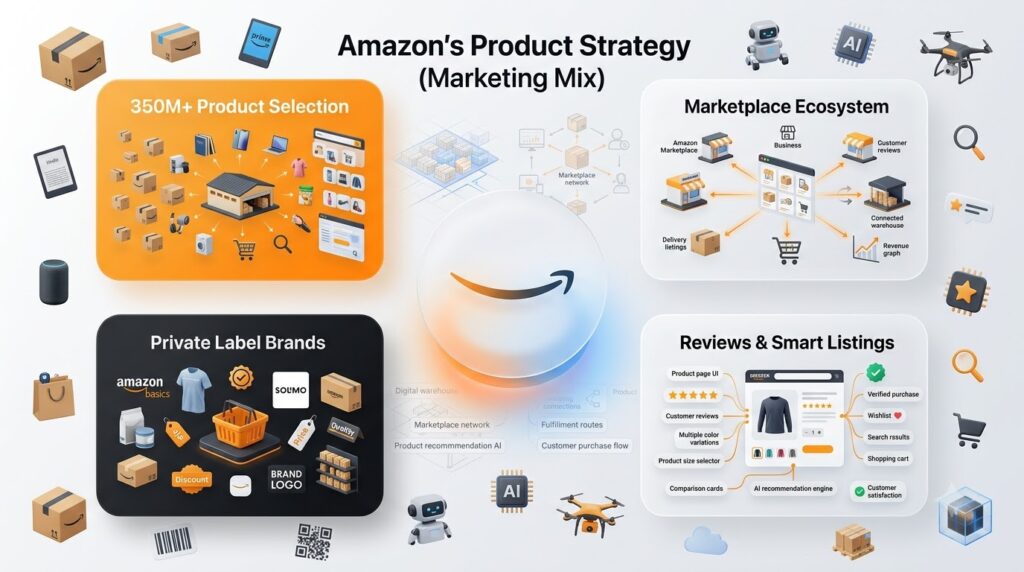
Amazon’s product strategy starts from a genuinely simple premise that took discipline to execute at scale: never let a customer leave because you didn’t have what they needed. That’s why the catalog spans more than 350 million individual items across virtually every category imaginable, books, electronics, groceries, furniture, industrial supplies, you name it. Getting there wasn’t really about Amazon manufacturing everything itself, it was about opening the marketplace to third-party sellers early and aggressively, which let selection grow exponentially without Amazon carrying all the inventory risk itself.
On top of that raw selection, Amazon layered private label brands like Amazon Basics, Amazon Essentials, and Solimo, competing directly against the same third-party sellers using the platform, which is honestly a controversial move that’s drawn real criticism and regulatory scrutiny over the years. But it works from a pure product strategy standpoint, because it lets Amazon fill gaps in categories where third-party selection is thin or where customers want a reliably cheap, no-frills option without wading through dozens of near-identical listings. Combine that with a review system that’s become the de facto trust signal for online shopping generally, star ratings and written reviews showing up before price on most product pages, and you get a product strategy built as much around helping customers choose confidently as around the products themselves.
Amazon also uses product bundling and variation listings as part of this same strategy, letting a single product page host multiple sizes, colors, or configurations rather than fragmenting the catalog into dozens of near-duplicate listings that would each need to build their own review history and search ranking separately. That consolidation matters more than it sounds like it should, because a product page with five hundred reviews spread across all its color variants looks far more trustworthy to a new shopper than five separate listings with a hundred reviews each. It’s a subtle structural choice, but it’s exactly the kind of decision that compounds across millions of products to make the entire catalog feel more credible than the sum of its individual parts would suggest.
Product in the Amazon Marketing Strategy
Digging a layer deeper, product strategy inside the broader marketing mix isn’t just about what Amazon sells, it’s about how products get organized, presented, and differentiated once they’re on the platform. Amazon uses detailed product categorization, structured attributes like size, color, and material, and algorithmically generated recommendations to make an overwhelming catalog feel navigable rather than chaotic. That structure is genuinely underrated as a marketing tool, because a customer who can’t find what they’re looking for quickly just leaves, no matter how big the underlying catalog actually is.
Amazon also treats product quality control as part of the marketing strategy rather than a separate operational concern, because counterfeit products or poor seller performance directly damages the trust that keeps customers buying without hesitation. Programs like Brand Registry help legitimate brands protect their listings from counterfeiters, and Amazon’s return policy, arguably one of the most generous in retail, removes the risk customers would otherwise feel buying from a seller they’ve never heard of. That’s why product strategy and trust-building are basically inseparable in Amazon’s approach, a broad catalog only works as a marketing advantage if customers actually trust what they’re buying once they click purchase.
Place in the Amazon Marketing Strategies

Place, in traditional marketing terms, just means how a product gets from the company to the customer. For most retailers that’s a handful of store locations or a single website. For Amazon, place became the single biggest differentiator in the entire marketing mix, because Amazon didn’t just build a place to buy things, it built an entirely new logistics infrastructure that changed what customers expect delivery speed to look like industry-wide. That infrastructure is honestly the least glamorous part of Amazon’s strategy and probably the most important one.
Look at what actually happens behind a single Prime order: warehouse robotics predict inventory placement before an order is even placed, route optimization software plans delivery truck paths in real time, and a mix of Amazon’s own delivery fleet, third-party carriers, and increasingly drones handles the last mile. That system is why same-day and next-day delivery became a realistic baseline expectation for hundreds of millions of shoppers instead of a rare premium perk reserved for a handful of categories. Competitors have spent years and billions trying to catch up to this specific piece of the marketing mix, and most still haven’t matched it at the same scale or reliability.
It’s worth pointing out that place, as a marketing lever, usually gets treated as the boring logistical cousin of the flashier Ps like promotion and product. Amazon flipped that assumption entirely. Delivery speed became a headline selling point in its own right, showing up front and center on product pages, in Prime membership marketing, and in customer expectations that now shape how the entire retail industry thinks about fulfillment. That’s a genuinely rare example of a company turning what most businesses treat as pure operational overhead into one of its most persuasive marketing assets, and it’s exactly why place deserves just as much attention in this breakdown as the more traditionally “marketing-flavored” Ps like promotion and pricing.
Place and Distribution Strategy of Amazon Marketing Mix
Breaking the place strategy down further, Amazon actually runs distribution through several genuinely distinct channels, each targeting a slightly different customer need or moment. It’s not just “the website” doing all the work, it’s a coordinated system of touchpoints designed to make sure customers can reach Amazon however and wherever they prefer to shop, whether that’s browsing from a couch, picking something up on the way home, or having groceries show up at the door within the hour.
Website
The Amazon website remains the core of the entire distribution strategy, and it’s been engineered relentlessly around reducing friction between “I want this” and “I bought this.” One-click ordering, saved payment methods, personalized recommendations pulling from browsing and purchase history, and a search function that’s honestly become as central to online shopping as Google is to general web search. Every element on that page, from the “Add to Cart” button placement to the delivery date estimate shown before checkout, has been tested and optimized over literally decades of iteration, which is why the experience feels so seamless most people don’t even notice how much engineering went into it.
Beyond the shopping mechanics themselves, the website also functions as a data collection engine that feeds back into every other part of the marketing mix. Every search, every scroll, every abandoned cart teaches Amazon’s algorithms something about what that specific customer wants, which then shapes future recommendations, ad targeting, and even inventory decisions at a category level. That feedback loop is part of why the website doesn’t just distribute products, it continuously gets smarter about which products to show which customers, turning a simple online storefront into something closer to a constantly learning demand-prediction system.
Physical Stores
Amazon’s physical footprint is small compared to Walmart’s roughly 10,500 locations, but it’s not nothing either. Whole Foods gave Amazon a genuine grocery presence with over 500 stores, and Amazon has experimented with Amazon Fresh grocery stores and cashierless Amazon Go convenience locations using “Just Walk Out” technology that tracks what you pick up and charges your account automatically. These physical locations serve a different purpose than pure distribution, they’re also a way to gather real-world shopping data and test technology, like computer vision checkout, that eventually gets deployed elsewhere across the business.
Transportation Services
Amazon built its own transportation and logistics arm, including Amazon Air with a fleet of cargo planes, Amazon Flex allowing gig workers to deliver packages using their own vehicles, and a growing network of Amazon-branded delivery vans that have become a familiar sight on residential streets everywhere. That’s a genuinely enormous investment, building a parallel shipping and logistics company essentially from scratch, but it gives Amazon control over delivery speed and reliability instead of depending entirely on UPS, FedEx, or the postal service the way most retailers still do.
Convenience Store
Beyond Whole Foods and Amazon Fresh, Amazon has pushed into smaller-format convenience retail through Amazon Go stores, positioned in urban areas and office districts where people want to grab something quickly without waiting in line. These stores are less about massive revenue and more about proving out checkout-free technology and building brand presence in dense urban environments where a full-size grocery store wouldn’t make sense, complementing the broader distribution strategy by covering a use case the website and app simply can’t serve, the impulse, immediate-need purchase happening on foot.
Mobile Apps
The Amazon shopping app has become one of the most-used retail apps in the world, and it’s not just a smaller version of the website, it’s optimized specifically for mobile behavior, quick reordering, barcode scanning to compare prices while standing in a physical store, voice search through Alexa integration, and push notifications for deals and order updates. A huge share of Amazon’s traffic now comes through mobile rather than desktop, and the app experience has been built to match that shift, with features like Amazon Photos and Prime Video streaming baked directly into the same app people use for shopping, keeping the entire ecosystem accessible from one place on the device people carry everywhere.
Pricing Strategies in Amazon Marketing Mix
Pricing at Amazon isn’t a single strategy, it’s a coordinated system running multiple pricing tactics simultaneously depending on the product category, competitive landscape, and customer behavior. Amazon reportedly changes prices on millions of items multiple times a day using automated repricing algorithms that track competitor pricing, demand signals, and inventory levels in real time. That’s a genuinely different approach than the fixed-price model most retailers still use, where prices get set and stay mostly static until the next seasonal sale rolls around.
This dynamic pricing approach means two people shopping for the exact same item at slightly different times might see slightly different prices, which sounds almost unfair when you say it out loud, but it’s honestly just an extension of how airlines and hotels have priced for decades, applied to retail at a scale nobody else has managed. The goal isn’t to squeeze every last cent out of every customer, it’s to stay competitively priced constantly without needing a human to manually adjust millions of listings, which would be logistically impossible at Amazon’s catalog size anyway.
Third-party sellers get pulled into this system too, whether they want to be or not. Amazon’s Buy Box, the featured “Add to Cart” button that most shoppers click without ever scrolling down to compare other sellers offering the same product, gets awarded algorithmically based heavily on price alongside shipping speed and seller performance history. That’s why professional sellers on Amazon often run their own repricing software just to stay competitive for Buy Box placement, effectively participating in the same dynamic pricing race Amazon itself runs, just one level down. The result is a marketplace where prices genuinely stay competitive almost by mechanical necessity, not because any single company is deliberately keeping prices low out of goodwill.
Price in the Marketing Mix of Amazon
Zooming into the actual tactics running underneath that broader dynamic pricing system, Amazon uses at least six distinct pricing strategies depending on the product, category, and competitive situation. None of these run in isolation, they overlap and combine depending on what a specific product needs at any given moment, which is exactly why Amazon’s pricing feels so responsive compared to a retailer running one static pricing policy across the board.
Cost Plus Pricing Strategies
For a lot of private-label and first-party inventory, Amazon starts with a straightforward cost-plus approach, calculating the cost of goods, shipping, warehousing, and fulfillment, then adding a margin on top. This is the most basic pricing model in retail, and Amazon still leans on it for baseline pricing before layering competitive and dynamic adjustments on top. It gives Amazon a pricing floor that protects margin even after algorithmic repricing kicks in to match or beat competitor prices elsewhere.
Competitive Pricing Strategy
Amazon actively tracks competitor pricing across the web, not just other online retailers but physical stores too, and adjusts its own prices to stay competitive without necessarily being the absolute cheapest option every single time. This is where that automated repricing engine does most of its heavy lifting, scanning for price changes elsewhere and nudging Amazon’s own listings to stay within a competitive range, which keeps the platform’s reputation for good deals intact even on items where Amazon isn’t technically the lowest price available anywhere.
Promotional Pricing Strategy
Lightning Deals, Prime Day, Black Friday, Cyber Monday, and countless smaller time-limited promotions all fall under promotional pricing, temporary price cuts designed to drive urgency and volume rather than represent Amazon’s everyday pricing. Prime Day alone generated $24.1 billion in sales in 2025 over a 48-hour window, which tells you just how effective time-boxed promotional pricing can be at concentrating demand into a specific period that Amazon can plan inventory and logistics around in advance.
Psychological Pricing Strategy
Ending prices in .99 or .97 instead of round numbers, showing a crossed-out “was” price next to the current price, and displaying percentage-off badges are all classic psychological pricing tricks Amazon uses constantly across the catalog. These tactics aren’t unique to Amazon, retailers have used them for decades, but Amazon applies them at a scale and with a data-driven precision, testing which framing actually converts better for which categories, that most retailers simply can’t match.
Value-Based Pricing Strategies
For certain products, particularly Amazon’s own devices like Kindle, Echo, and Fire TV, pricing gets set closer to cost or even below cost in some cases, because the real value Amazon captures isn’t the device sale itself, it’s the ongoing content purchases, subscription revenue, and ecosystem lock-in that device enables afterward. That’s value-based pricing applied strategically, pricing the entry point low because the lifetime value of a customer inside the ecosystem is worth far more than the margin on any single hardware sale.
Differential Pricing Strategy
Amazon also prices differently across regions and customer segments, adjusting for local purchasing power, shipping costs, and competitive intensity in different countries. A product priced one way in the US might carry a different price point in India or Brazil, not arbitrarily, but calibrated to what that specific market can actually bear while still moving volume. This differential approach lets Amazon stay competitive globally without forcing a single rigid price structure onto markets with wildly different economic conditions.
Promotion: Amazon Marketing Mix
Promotion is where Amazon looks least like a traditional advertiser and most like its own advertising platform. Amazon barely runs the kind of splashy TV commercial campaigns companies like Nike or Coca-Cola are known for. Instead, promotion at Amazon happens mostly inside the platform itself, sponsored product listings, search ranking algorithms, personalized email campaigns, and a genuinely massive advertising business that pulled in $19.8 billion in a single quarter in 2026, up 26% year over year. That’s not a side hustle anymore, that’s one of the most profitable advertising platforms on the entire internet, built almost entirely on top of purchase intent data Amazon already had from running the marketplace itself.
That’s why promotion and product discovery are basically the same thing on Amazon in a way they aren’t on most platforms. When a seller pays for a sponsored listing, they’re not interrupting someone’s day the way a TV ad does, they’re showing up at the exact moment someone is already searching for something in that category. That intent-driven ad model is a big part of why Amazon’s advertising business grows so fast even without the flashy brand campaigns other companies rely on, the ads themselves are woven directly into the shopping experience rather than sitting alongside it.
Email marketing plays a quieter but genuinely effective role here too. Personalized recommendation emails, abandoned cart reminders, and restock notifications for previously purchased items all count as promotion, even though they don’t feel like traditional advertising at all. These messages work because they’re timed around actual behavior rather than a generic broadcast schedule, someone gets a reminder about a product they already looked at, not a random pitch for something they’ve shown zero interest in. That kind of behaviorally triggered promotion converts at rates traditional batch-and-blast email campaigns can only dream about, and Amazon has had over two decades of purchase data to keep refining exactly when and how those messages land.
How to Create a Profitable Amazon Marketing Strategy for 2023
Whether you’re studying Amazon’s own marketing mix or trying to build a strategy to sell successfully on the platform yourself, the tactics that actually move the needle come down to a specific set of moves rather than vague advice about “building your brand.” Here’s what genuinely works, broken down piece by piece, because generic advice doesn’t help anyone actually rank higher or sell more.
Traditional Marketing Strategy
Even in a platform as digitally native as Amazon, traditional marketing principles still apply underneath the surface. That means understanding your target customer clearly, positioning your product against real competitors rather than assuming uniqueness, and pricing based on actual market research rather than guessing. Sellers who skip this foundational work and jump straight into tactics like advertising or SEO tend to burn budget without a clear sense of who they’re actually trying to reach or why that customer should choose their listing over the next one down the page.
This matters more than sellers often expect, because Amazon’s algorithm rewards products that convert well, and conversion rate is almost impossible to fix through tactics alone if the underlying positioning is off. A product priced wrong for its category, or aimed at a customer who isn’t actually searching Amazon for that solution, will keep underperforming no matter how much gets spent on advertising or how polished the listing copy becomes. Getting the fundamentals right first isn’t glamorous work, but it’s the difference between a listing that ranks itself upward through organic sales momentum and one that needs constant paid traffic just to stay visible.
Expand your Amazon Social Media Marketing Strategy
Driving traffic to an Amazon listing from outside the platform, through Instagram, TikTok, YouTube, or Facebook, has become one of the most effective ways to boost a product’s visibility inside Amazon’s own algorithm. Amazon’s ranking system rewards listings that generate external traffic and conversions, partly because it signals genuine demand rather than just internal search visibility. That’s why a lot of successful sellers now run coordinated campaigns where social content drives people directly to an Amazon product page rather than a separate website, letting Amazon’s trusted checkout experience close the sale.
TikTok in particular has become a genuine driver of Amazon sales in recent years, with product discovery happening through short-form video content and then completing on Amazon rather than through a separate e-commerce checkout flow. Amazon has leaned into this trend directly by launching features that let creators link products straight from their videos, recognizing that a huge share of Gen Z shopping behavior now starts with a video, not a search bar. Sellers who ignore this channel entirely are increasingly leaving real, measurable traffic on the table.
Sales Promotion
Running Lightning Deals, coupons, and limited-time discounts inside Amazon’s own promotional tools genuinely works to boost visibility and conversion, because these promotions get featured in Amazon’s deals sections and search results in ways regular listings don’t. Sellers who use these tools strategically, timing them around demand spikes or new product launches, tend to see meaningful bumps in both sales velocity and, over time, organic ranking, since Amazon’s algorithm factors in recent sales performance heavily.
Public Relations
Getting products featured in press coverage, YouTube reviews, or influencer content builds a kind of third-party credibility that paid advertising simply can’t replicate. A product mentioned in a “best gifts under $50” roundup or reviewed by a trusted YouTube channel carries social proof that translates directly into higher conversion rates once someone clicks through to the Amazon listing itself. This is slower and harder to control than paid advertising, but the trust it builds tends to stick around longer than a single ad campaign ever could.
Promoting User-Generated Content
Encouraging customers to post photos, videos, and honest reviews of products they’ve actually purchased builds exactly the kind of authentic social proof that modern shoppers trust more than polished brand messaging. Amazon’s own platform supports this directly through customer photo uploads on product pages and the Amazon Vine program, which gets trusted reviewers early access to new products in exchange for honest feedback, helping new listings build a credible review base faster than waiting for organic reviews to trickle in naturally.
Highlight Best Reviews
Not all reviews carry equal weight, and smart sellers actively work to surface their strongest, most detailed reviews rather than leaving review order entirely up to Amazon’s default sorting. Responding professionally to negative reviews, encouraging satisfied customers to leave detailed feedback, and using Amazon’s review highlighting features all help make sure the reviews a potential buyer sees first are the ones that actually build confidence rather than plant doubt right before checkout.
Add “customers also bought” suggestions
This feature, showing related and complementary products, drives a genuinely significant share of Amazon’s overall sales by capturing purchase intent someone didn’t even know they had until they saw the suggestion. Sellers can influence their placement in these carousels by using Amazon’s bundling tools and by understanding which products naturally get purchased together, then optimizing listings and even packaging to encourage that cross-sell behavior organically rather than fighting the algorithm.
Deploy an Amazon SEO (Search Engine Optimization) strategy
Amazon’s search algorithm, often called A9 or A10 depending on the version, weighs keyword relevance in titles and bullet points, conversion rate, review quality, and sales velocity when deciding what shows up first for any given search term. That’s why genuinely effective Amazon SEO looks less like stuffing keywords everywhere and more like writing genuinely clear, benefit-focused listings that convert well, because conversion rate feeds directly back into ranking, creating a feedback loop where good listings keep climbing and weak ones keep sinking.
Amazon Advertising
Sponsored Products, Sponsored Brands, and Sponsored Display ads let sellers pay to appear higher in search results and on competitor product pages, and given that Amazon’s advertising business now generates tens of billions annually, this has become close to essential for any seller trying to break through in a competitive category. The sellers who succeed here treat advertising as an ongoing optimization process, testing keywords, adjusting bids, and tracking actual return on ad spend rather than just setting a campaign and walking away.
Amazon Digital Marketing Strategy – Notable Digital Marketing Campaigns
Amazon doesn’t run traditional brand advertising often, but when it does, the campaigns tend to land because they’re built around genuine cultural moments rather than generic product pitches. Prime Day itself has essentially become a marketing campaign in its own right, an artificially created shopping holiday that now rivals Black Friday in scale, built entirely around exclusivity for Prime members and generating $24.1 billion in sales during a single 48-hour window in 2025. That’s marketing as event creation rather than simple advertising, and it’s honestly one of the more impressive pieces of demand generation in modern retail history.
Amazon’s holiday season commercials, particularly ones featuring Alexa integrated into heartfelt family moments, have also become genuinely memorable, leaning on emotional storytelling rather than product specs. And the company’s sponsorship of Thursday Night Football through Prime Video represents a different kind of digital marketing altogether, using live sports as appointment viewing to drive both subscription retention and broader brand visibility during one of the most valuable advertising windows in American media. Each of these campaigns reinforces the same underlying strategy: build genuine reasons for people to engage regularly rather than relying purely on interruption-based advertising to capture attention.
Beyond the marquee campaigns, Amazon has also gotten genuinely good at smaller-scale digital storytelling around specific launches, product teaser content ahead of new device releases, behind-the-scenes footage from fulfillment centers meant to humanize the delivery process, and creator partnerships that blend Amazon products naturally into everyday content rather than obvious sponsored posts. None of these individually generate headline-grabbing numbers the way Prime Day does, but together they keep the brand present in everyday digital culture in a way that pure product advertising rarely manages, which matters more over the long run than any single viral moment ever could.
Conclusion
Pull back far enough and the whole point of the Marketing Mix of Amazon becomes pretty clear: this isn’t a company that picked one competitive advantage and rode it for three decades, it’s a company that decided to compete hard on product, place, price, and promotion all at once and then built the technology infrastructure to actually pull that off at a scale nobody else has matched. The product strategy gives customers a catalog broad enough that they rarely need to look elsewhere. The place and distribution strategy turned fast, reliable delivery into a baseline expectation the entire retail industry now has to compete against. The pricing strategy runs six distinct tactics simultaneously through algorithms most competitors still can’t replicate. And the promotion strategy turned the shopping experience itself into an advertising platform generating tens of billions of dollars a year, almost entirely without the splashy brand campaigns other companies rely on.
That’s why studying this marketing mix matters beyond pure academic interest. Sellers who understand how these pieces fit together, SEO feeding ranking, ranking feeding conversion, conversion feeding advertising performance, can genuinely build profitable businesses on top of Amazon’s platform rather than fighting against a system they don’t understand. And marketers studying Amazon from the outside get a genuinely rare look at what happens when a company refuses to accept that you can only compete on one or two of the classic 4Ps at a time. Amazon proved you can compete on all four simultaneously, and honestly, that’s probably the single biggest lesson worth taking away from this entire breakdown.
None of this means the model is bulletproof, and it’s worth saying that plainly. Every piece of this marketing mix depends on scale, the pricing algorithms only work because there’s enough data to train them on, the logistics network only pays for itself because volume is high enough to justify the investment, and the advertising business only generates real revenue because search intent is concentrated on the platform in the first place. That’s exactly why competitors have struggled to copy individual pieces of Amazon’s strategy in isolation, a fast-shipping promise without the underlying logistics scale just becomes an expensive promise nobody can keep reliably. Understanding the Marketing Mix of Amazon really means understanding how tightly product, place, price, and promotion reinforce each other here, because pulled apart individually, none of these tactics would work nearly as well as they do woven together the way Amazon has spent three decades building them.
Frequently Asked Questions
1. What is the Marketing Mix of Amazon actually referring to?
The Marketing Mix of Amazon refers to how the company applies the classic 4Ps framework, Product, Place, Price, and Promotion, to its retail, cloud, and entertainment businesses. It’s used by marketers, students, and sellers to understand exactly how Amazon competes across selection, pricing, distribution, and advertising simultaneously rather than relying on just one competitive advantage.
2. Why doesn’t Amazon run more traditional advertising like TV commercials?
Amazon does run some traditional advertising, particularly around holidays and major sports sponsorships like Thursday Night Football, but most of its promotional strategy happens directly inside the platform through search ranking, sponsored listings, and personalized recommendations. That approach works because it captures people at the exact moment they’re already searching to buy something, which tends to convert far better than interruption-based advertising.
3. How many pricing strategies does Amazon actually use?
At least six run simultaneously across different categories: cost-plus pricing, competitive pricing, promotional pricing, psychological pricing, value-based pricing, and differential pricing by region. These aren’t run in isolation, they overlap depending on the specific product and competitive situation, which is why Amazon’s pricing feels so much more responsive than a retailer running one static pricing policy.
4. What is Amazon’s target market within its overall marketing mix?
Amazon’s target market is genuinely broad, segmented more by shopping behavior than traditional demographics like age or income. That includes price-sensitive comparison shoppers, convenience-driven Prime members, and small business buyers using Amazon Business, all served through slightly different experiences on the same underlying platform.
5. How does Amazon’s product strategy handle such a massive catalog?
Through a combination of third-party seller onboarding, which lets selection grow without Amazon carrying all the inventory risk, structured categorization and search, and a trust layer built around reviews, ratings, and a generous return policy. Private label brands like Amazon Basics fill gaps where third-party selection is thin, rounding out the catalog strategically rather than randomly.
6. What role do physical stores play in Amazon’s distribution strategy?
A smaller but meaningful one. Whole Foods gives Amazon a genuine grocery footprint with over 500 locations, and experimental formats like Amazon Go and Amazon Fresh let the company test technology like cashierless checkout while capturing impulse and immediate-need purchases the website and app simply can’t serve as effectively.
7. How much does Amazon’s advertising business actually generate?
Amazon’s advertising segment pulled in $19.8 billion in a single quarter in 2026, up 26% year over year, making it one of the most profitable advertising platforms on the internet. It runs almost entirely on purchase intent data gathered from the marketplace itself, which is part of why it converts so much better than traditional display advertising elsewhere online.
8. Why does Amazon price some of its own devices so low?
Devices like Kindle, Echo, and Fire TV get priced close to cost, sometimes even below cost, because Amazon’s real value capture happens after the sale, through content purchases, subscription revenue, and deeper ecosystem engagement. That’s value-based pricing applied deliberately, treating the hardware as an entry point rather than a standalone profit center.
9. What is Amazon SEO and why does it matter for sellers?
Amazon SEO refers to optimizing product listings, titles, bullet points, images, and backend keywords, to rank higher in Amazon’s own search algorithm, often called A9 or A10. Because conversion rate directly feeds back into ranking, genuinely effective Amazon SEO focuses on writing clear, benefit-driven listings that convert well rather than simply stuffing keywords everywhere.
10. How big was Prime Day in terms of actual sales?
Prime Day generated $24.1 billion in sales in 2025 over a 48-hour window, making it one of the largest concentrated shopping events in retail history. It works as both a promotional pricing tactic and a broader marketing campaign, creating an artificial shopping holiday built entirely around Prime membership exclusivity.
11. How does Amazon use transportation services within its marketing mix?
Amazon built its own logistics arm, including Amazon Air cargo planes, Amazon Flex gig delivery drivers, and a growing branded delivery van fleet, giving it direct control over delivery speed rather than depending entirely on third-party carriers like UPS or FedEx. That control lets Amazon guarantee delivery windows that become a genuine marketing differentiator, since fast, reliable shipping is now baked directly into customer expectations of the brand itself.
12. What makes Amazon Prime such a central part of the overall marketing strategy?
Prime bundles free fast shipping, video and music streaming, and other perks into one membership that somewhere between 220 and 250 million people worldwide now pay for. That membership fee creates a powerful psychological pull toward shopping on Amazon specifically, since members have already paid for the shipping benefit and want to use it, which drives both purchase frequency and average order value higher than non-member behavior.
13. How does the Buy Box affect Amazon’s overall pricing strategy?
The Buy Box is the featured purchase button most shoppers click without scrolling to compare alternative sellers, and Amazon awards it algorithmically based on price, shipping speed, and seller performance combined. This effectively pulls third-party sellers into the same competitive pricing race Amazon runs on its own listings, which is part of why prices across the platform stay competitive even in categories where Amazon itself isn’t the seller.
14. Does social media traffic actually help a listing rank better on Amazon?
Yes, genuinely. Amazon’s search algorithm rewards listings that convert well regardless of where the traffic originates, and external traffic from platforms like TikTok or Instagram that converts into sales signals real demand in a way that can boost organic ranking over time. That’s why more sellers now treat social content as a direct funnel into their Amazon listings rather than a separate marketing channel entirely.