



Amazon just posted a quarter where net income tripled to $62.6 billion, revenue crossed $200 billion for the first time ever in a single quarter, and AWS grew 37%, its fastest pace in eighteen quarters. And yet, in that same earnings report, free cash flow actually swung negative, dropping to a $7.6 billion outflow over the trailing twelve months, because Amazon is spending so aggressively on AI infrastructure that it raised its 2026 capital spending forecast to roughly $220 billion. So which story do you believe? The one where Amazon is printing money at a scale almost no company in history has managed, or the one where it’s burning cash faster than ever and betting the entire company on AI infrastructure paying off years down the road?

Honestly, both stories are true at the same time, and that tension is exactly why a real SWOT Analysis of Amazon matters right now instead of five years ago when the story was simpler. This isn’t the Amazon of 2015, when it was mostly a retailer with a side hustle in cloud computing that nobody had quite figured out yet. AWS alone now runs at a $169 billion annualized revenue run rate, which Andy Jassy pointed out would rank it 24th on the Fortune 500 list as a standalone company. Meanwhile the actual retail business, the one most people still associate with the Amazon name, runs on margins so thin that a bad quarter in shipping costs or labor expenses can wipe out profit almost entirely. Layer on top of that a $2.5 billion FTC settlement over deceptive Prime enrollment practices, a separate antitrust case still working its way through the courts, and Walmart quietly closing the gap in e-commerce, and you’ve got a company that looks unstoppable on the surface while carrying real structural risk underneath.
So this piece walks through all of it, company overview first, then a full breakdown of strengths, weaknesses, opportunities, and threats using the actual structure that shows up in most credible strategic breakdowns of this company. No fluff, no vague “Amazon is big and powerful” filler. Just specific numbers, specific business lines, and an honest read on where the cracks are starting to show even as the top-line numbers keep climbing. By the end you’ll understand why Wall Street cheers Amazon’s earnings calls one quarter and grills executives about cash burn the next, because both reactions are grounded in something real.
What You Will Learn in This Guide
- A clear company overview covering where Amazon actually stands financially heading into the back half of 2026
- Four detailed strengths explaining why Amazon’s cost structure, ecosystem, brand, and logistics network are so hard to compete with
- Four weaknesses that show exactly where Amazon is exposed, from thin retail margins to a surprisingly weak patent portfolio
- Four real opportunities across grocery, voice assistants, streaming, and the Internet of Things that Amazon is still chasing
- Four threats that could genuinely slow Amazon down, from Walmart’s comeback to currency swings to data privacy risk
- A full breakdown of how each point ties back into the bigger SWOT Analysis of Amazon picture
- Over ten frequently asked questions covering the details people actually want answered
- A bottom-line conclusion that pulls the whole analysis together into something you can actually use
Company Overview
Amazon in 2026 is really three companies stitched together under one name, and understanding that split is the whole key to reading this SWOT Analysis of Amazon correctly. There’s the original retail marketplace business, the one that sells everything from paper towels to laptops and increasingly relies on third-party sellers rather than Amazon’s own inventory. There’s Amazon Web Services, the cloud computing arm that now generates the overwhelming majority of the company’s actual profit. And there’s a fast-growing advertising business, which pulled in $19.8 billion in the second quarter of 2026 alone, up 26% year over year, quietly becoming one of the most profitable ad platforms on the internet by riding on top of all that shopping traffic.
The numbers from Q2 2026 tell the story pretty clearly. Total net sales hit $200.6 billion, up 20% from $167.7 billion a year earlier. Operating income jumped 43% to $27.5 billion. AWS alone brought in $42.2 billion in revenue, growing 37% year over year, its fastest growth rate in eighteen quarters, with an operating margin of 39.4% that dwarfs anything the retail side produces. North America segment sales rose 16% to $116.2 billion, while international sales climbed 15% to $42.2 billion. Net income reached $62.6 billion for the quarter, though a huge chunk of that, roughly $53.4 billion, came from a non-operating gain tied to Amazon’s investment stake in Anthropic, not from selling more packages or renting more server capacity. That’s worth separating out clearly, because it means the headline profit number looks far more dramatic than the underlying operating business alone would suggest, even though the operating business itself genuinely had a strong quarter too.
Founded by Jeff Bezos in 1994 and now led by CEO Andy Jassy, Amazon has grown from an online bookstore into one of the largest companies on earth by market capitalization, with operations spanning e-commerce, cloud infrastructure, streaming media, smart home devices, logistics, healthcare, and increasingly artificial intelligence infrastructure through its stake in Anthropic and its own custom chip lines, Trainium and Graviton. That breadth is exactly why any honest SWOT Analysis of Amazon has to look past the headline revenue figure and dig into how differently each of these business lines actually performs.
Amazon’s headline guidance for the third quarter of 2026 called for net sales between $197 billion and $202 billion, representing growth of somewhere between 9% and 12% year over year, alongside operating income guided between $22.5 billion and $26.5 billion. That’s a slower growth rate than the 20% posted in Q2, which is worth flagging, because it suggests management itself expects growth to moderate somewhat even as investment keeps climbing. Meanwhile Amazon’s own commentary on the earnings call pointed to demand strong enough that AWS capacity for 2027 is already largely reserved, with some capacity already spoken for as far out as 2028. That’s an unusually confident forward statement, and it tells you Amazon genuinely believes the AI infrastructure buildout isn’t a speculative bet so much as a race to keep up with contracted demand that’s already locked in.
Amazon SWOT Analysis
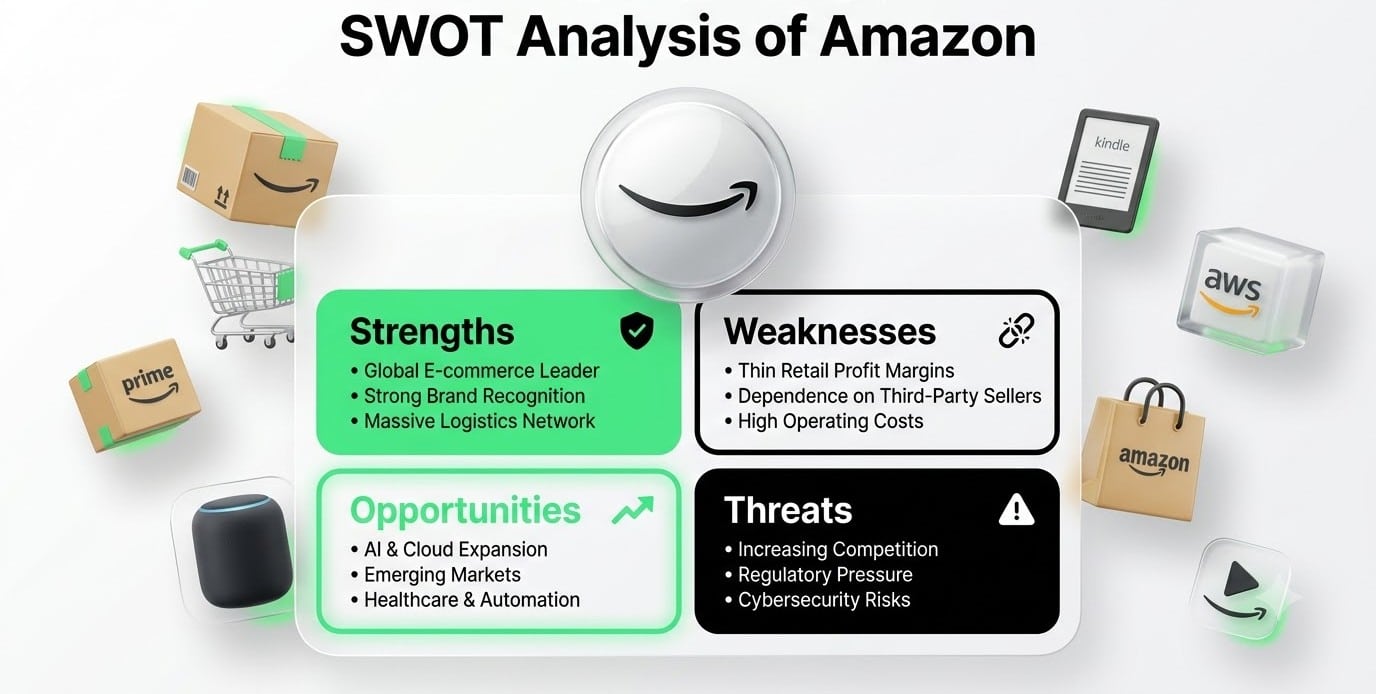
Amazon SWOT Analysis is a strategic framework used to evaluate Amazon’s internal capabilities and external market environment. It helps businesses, investors, marketers, and students understand what makes Amazon one of the world’s largest technology and e-commerce companies, where it faces challenges, what future growth opportunities exist, and what external risks could affect its business.
The SWOT framework is divided into four key components:
Strengths
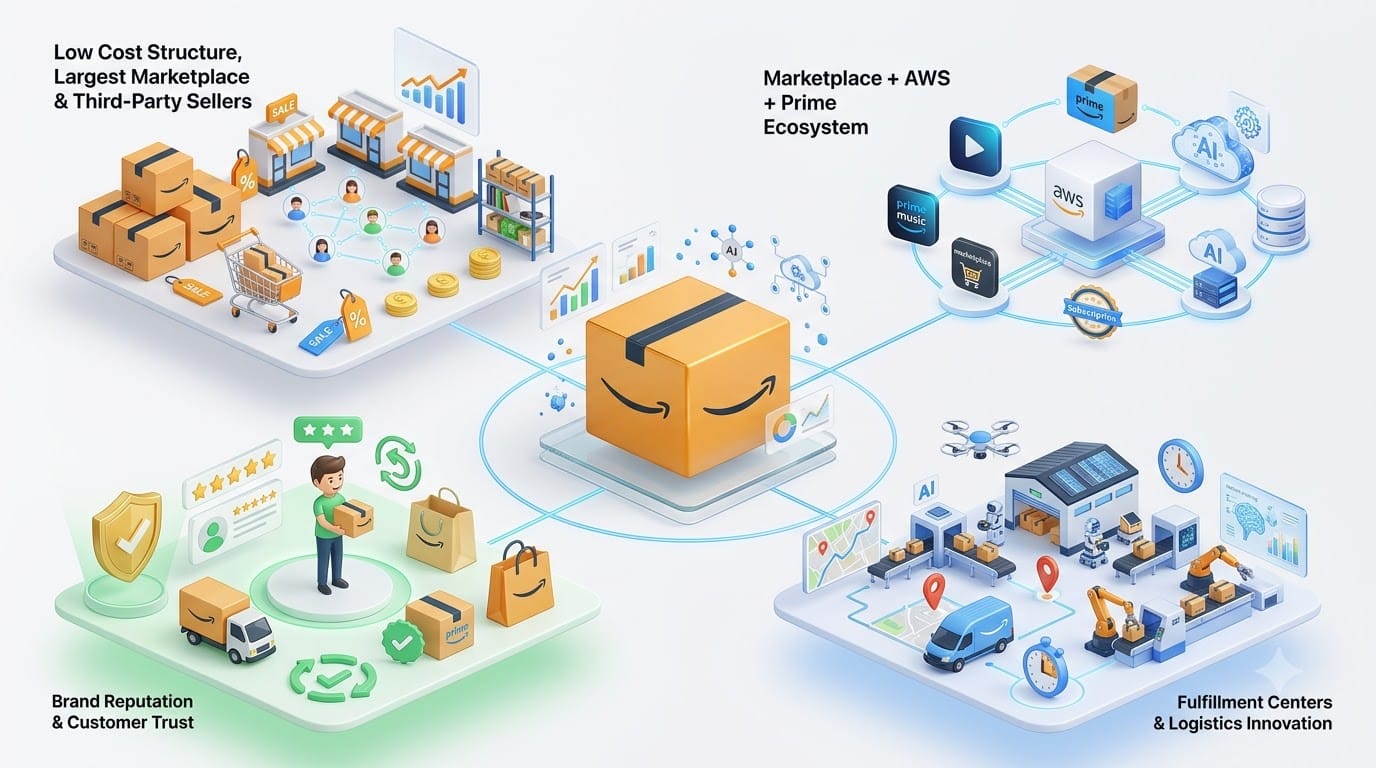
1. Low cost structure, the largest merchandise selection and a huge number of third party sellers
Amazon’s retail business runs on a genuinely brutal cost discipline that most competitors simply can’t match, and that discipline is baked into the company’s DNA going back to its earliest years as a scrappy online bookstore obsessed with keeping overhead low. Combine that cost structure with the largest product selection of any online retailer on the planet, millions of items spanning every category imaginable, and you get a shopping experience where customers rarely need to look anywhere else first. That “search Amazon first” habit is worth more to the business than almost any single feature or promotion could be.
Third-party sellers make this whole machine work at a scale Amazon could never achieve alone. Well over half of everything sold on Amazon comes from independent sellers using the platform’s infrastructure, warehousing, and customer base to reach shoppers they’d never reach on their own. That’s why Amazon’s selection keeps expanding without Amazon itself having to source, warehouse, or risk capital on every single product. Look at what actually happens here: sellers take on inventory risk, Amazon takes a cut of every transaction plus fees for fulfillment services, and the customer gets a nearly bottomless catalog. That’s a genuinely efficient system, and it’s a big reason competitors built purely on first-party inventory, like traditional department stores trying to go digital, never managed to catch up.
There’s also a pricing dynamic worth calling out here that people don’t always connect back to cost structure. Because Amazon runs so lean on overhead relative to its transaction volume, it can afford to compete aggressively on price across an enormous number of categories at once, rather than picking a handful of loss-leader items to draw people in the way a traditional retailer might. That breadth of competitive pricing, spread across millions of items rather than concentrated in a few, is part of why shoppers develop the habit of checking Amazon first even when they’re not entirely sure Amazon will actually have the lowest price on any given item. The selection and the cost structure reinforce each other, and that combination is genuinely difficult for a narrower competitor to replicate without matching both pieces at once.
2. Synergies between Marketplace, Amazon Web Services, Prime and subscription services
Here’s the thing people underestimate about Amazon: it’s not really separate businesses bolted together, it’s one flywheel where each piece makes the others stronger. Prime membership gets people hooked on fast, reliable shipping, which makes them shop the marketplace more often, which generates more third-party seller fees and advertising revenue, which funds more investment in fulfillment infrastructure, which makes Prime even faster. AWS, meanwhile, was originally built to handle Amazon’s own internal infrastructure needs before Amazon realized it could rent that same infrastructure out to the rest of the internet, and now it funds a huge share of the company’s total operating profit.
That’s why Amazon’s business model is so hard to replicate piece by piece. A pure-play retailer can’t build a cloud business overnight, and a pure-play cloud provider can’t build a logistics network overnight either. Prime Video, Prime Music, and other subscription perks bundled into Prime membership deepen the relationship even further, giving customers more reasons to renew every year instead of shopping around. So then, when Amazon reports a strong quarter, it’s rarely just one business line carrying the weight. It’s the whole flywheel spinning together, and that interconnection is genuinely difficult for any single competitor to copy without building the same breadth Amazon spent three decades assembling.
3. Unmatched brand reputation in the retail sector
Ask almost anyone where they’d check first for a product, any product, and the honest answer for a huge share of consumers is still Amazon. That kind of default-choice status doesn’t happen by accident, it comes from years of consistently fast delivery, easy returns, and a search experience that, whatever its flaws, usually gets you to what you’re looking for quickly. Amazon’s brand isn’t glamorous the way Apple’s is, nobody lines up outside a store for a new Amazon product launch, but it’s arguably even more valuable in a different way: it’s the brand people trust by default for convenience and reliability rather than aspiration.
That trust shows up in hard numbers too. Prime membership retention rates stay remarkably high year over year, and customer satisfaction scores for delivery speed and return policies consistently rank near the top of the retail industry. Yeah, there have been bumps, counterfeit product complaints, marketplace quality control issues, the FTC settlement over Prime cancellation practices. But none of that has meaningfully dented the base habit of reaching for Amazon first when someone needs something delivered fast. That kind of ingrained consumer behavior is an asset competitors spend billions trying to build and rarely manage to replicate at the same scale.
Part of why that trust has proven so durable is the return policy, which honestly might be underrated as a brand asset. Amazon made returns painless at a time when most retailers, online or off, treated them as an adversarial hassle designed to discourage people from bothering. That single decision, made years ago, quietly removed one of the biggest sources of friction and anxiety in online shopping generally, not just on Amazon specifically, and competitors have spent years trying to match that same level of convenience without fully closing the gap. Trust built on removing friction tends to compound over time in a way flashy marketing campaigns simply can’t replicate.
4. Innovative fulfillment centers and distribution software reducing order fulfillment times and costs
Amazon’s fulfillment network is genuinely one of the most sophisticated logistics operations ever built by a private company, full stop. Warehouse robotics handle a huge share of the physical movement inside fulfillment centers now, machine learning models predict what inventory needs to be where before customers even place an order, and route optimization software keeps delivery trucks moving efficiently even during peak shopping periods like the holiday season. That’s not marketing spin, it’s the reason same-day and next-day delivery became a realistic expectation for hundreds of millions of customers instead of a rare premium perk.
This investment keeps paying off in ways that show up directly in the numbers. Amazon’s grocery and everyday essentials business has been expanding same-day delivery to more than 2,300 cities, with perishable customer growth up roughly 50% since the start of 2026 alone. That kind of expansion only works because the underlying fulfillment and distribution technology can actually support it reliably at scale. Competitors without decades of accumulated logistics data and warehouse automation simply can’t match that delivery speed without spending years and billions of dollars catching up, and even then there’s no guarantee they’d get the software layer right the way Amazon has.
Weaknesses
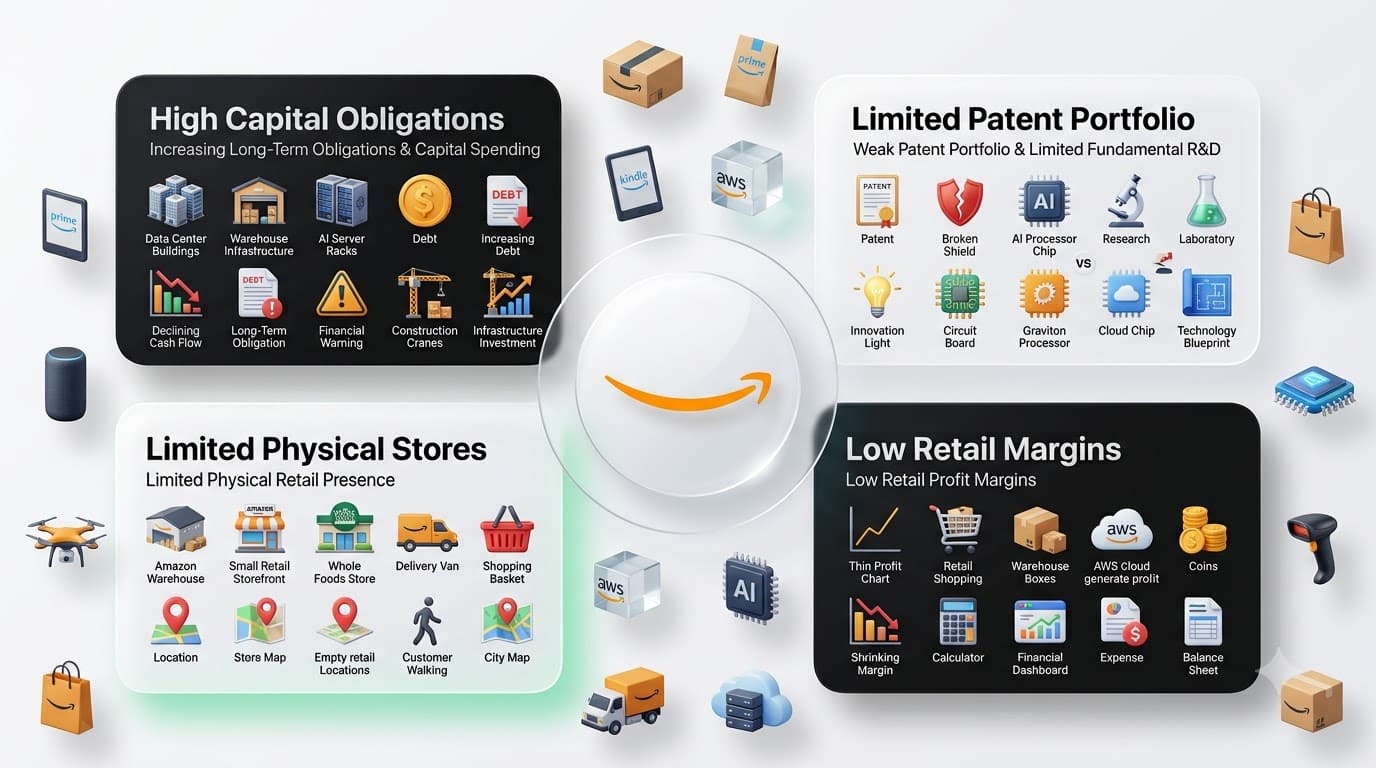
1. Increasing long-term obligations-to-assets ratio
Amazon’s capital spending has genuinely gotten enormous, and it’s climbing fast. The company raised its 2026 cash capital expenditure forecast to roughly $220 billion, up from an earlier estimate of about $200 billion, driven largely by AI infrastructure investment and rising memory costs. Property and equipment purchases on a trailing twelve-month basis reached $169 billion, up 64% year over year. That’s an eye-watering amount of money going out the door, and a lot of it is financed through long-term leases and debt obligations tied to data centers, warehouses, and equipment that will take years to pay off.
That’s why free cash flow actually swung negative, to a $7.6 billion outflow on a trailing twelve-month basis, down from an $18.2 billion inflow the year before. Nope, that’s not a crisis by itself, Amazon has the balance sheet to absorb it and the growth story arguably justifies the spending. But a rising ratio of long-term obligations against total assets means Amazon is taking on more financial commitment relative to what it actually owns outright, and if AI infrastructure demand ever cools off faster than expected, or if the capacity Amazon is building doesn’t get filled at the rate it’s betting on, that debt load becomes a much bigger problem than it looks like during a boom quarter like this one.
There’s a real historical parallel worth thinking about here too. Telecom companies in the late 1990s took on similarly enormous debt loads building out fiber optic infrastructure ahead of demand that eventually did materialize, but not before a wave of bankruptcies hit companies that had overbuilt relative to the timeline. Amazon isn’t in that same position today, its underlying businesses are far more profitable and diversified than a speculative fiber startup ever was, but the basic dynamic of borrowing heavily against future demand that hasn’t fully arrived yet is the same one investors should keep an eye on. If AWS utilization keeps climbing the way management expects, this spending looks brilliant in hindsight. If it doesn’t, the obligations don’t go away just because the growth assumptions were wrong.
2. Poor R&D capabilities leading to a weak patent portfolio
This one surprises people, because Amazon spends enormous amounts of money on technology and infrastructure, but a huge share of that spending goes toward operational efficiency, warehouse robotics, delivery software, cloud infrastructure, rather than the kind of fundamental research that generates a deep, defensible patent portfolio the way companies like Apple, IBM, or Google have built over decades. Amazon’s patent filings tend to cluster around logistics and e-commerce mechanics rather than breakthrough core technology, which leaves it more exposed to competitors catching up on the technical side than its size would suggest.
That matters because patents aren’t just legal paperwork, they’re a genuine competitive moat in industries where technology differentiation actually drives customer choice. In cloud computing specifically, AWS competes against Microsoft Azure and Google Cloud, both of which come from companies with far deeper histories of fundamental computer science research and correspondingly stronger patent positions. Amazon has been trying to close this gap through its custom chip lines, Trainium and Graviton, and through its investment in Anthropic, but honestly, building a genuinely strong research and patent moat from a standing start takes years, and Amazon is playing catch-up here in a way it usually doesn’t have to in other parts of its business.
That said, Amazon’s custom silicon push has shown real signs of progress recently. Graviton, its in-house server chip line, is now used by 98% of the top 1,000 EC2 customers, and revenue commitments tied to Graviton have nearly tripled quarter over quarter, with the newest generation growing roughly twice as fast as its predecessor did at the same stage. That’s genuine technical traction, not just marketing language, and it suggests Amazon can build a real competitive edge in specific, narrow technical domains even without the broader research portfolio a company like Google or Microsoft has accumulated. The gap is real, but it’s not unbridgeable, and Amazon seems to be closing it selectively rather than trying to compete everywhere at once.
3. Comparably few physical locations, limiting Amazon’s expansion potential
Despite owning Whole Foods and experimenting with Amazon Fresh and Amazon Go stores, Amazon’s physical retail footprint remains tiny compared to Walmart’s roughly 10,500 stores worldwide or even regional grocery chains that have decades of neighborhood presence built up. That matters more than people assume, because a huge share of retail spending, especially groceries and everyday essentials, still happens in person, and Amazon simply doesn’t have the physical density to capture that spending the way a company with thousands of storefronts does.
This limitation shows up clearly in the grocery category specifically, where Amazon has struggled for years to translate its e-commerce dominance into a comparable physical presence. Whole Foods gave Amazon a foothold, but it’s a premium, relatively small chain compared to what Walmart or Kroger operate. That’s why so much of Amazon’s grocery growth strategy leans on same-day delivery from existing warehouses rather than expanding physical stores, which works for convenience but doesn’t capture the impulse purchases and browsing behavior that drive so much in-store spending. Building out a genuinely competitive physical footprint would require billions in real estate investment that Amazon has so far chosen to direct toward warehouses and data centers instead.
There’s also a services gap that comes with having so few physical locations. Things like in-person returns, try-before-you-buy experiences, or simply browsing a store for inspiration rather than searching for something specific are all experiences physical retail still does better than even the most polished e-commerce interface. Amazon has tried to address parts of this through partnerships that let customers return items at Kohl’s or UPS locations, which is a clever workaround, but it’s still not the same as owning enough physical square footage to offer those experiences directly under its own roof the way Walmart or Target can.
4. Very low margins on retail business
Here’s the uncomfortable truth sitting underneath all those impressive top-line revenue numbers: Amazon’s core retail business runs on razor-thin margins, and it always has. North America segment operating margin came in at just 7.9% in the most recent quarter, and international segment margin was even thinner at 4.1%. Compare that to AWS, which posted a 39.4% operating margin in the same period, and you start to understand why investors and analysts talk about Amazon almost like two completely different companies wearing one name tag.
That’s why AWS, despite supplying only about 21% of total company revenue, generated over 60% of Amazon’s operating income in the most recent quarter. The retail business is essentially a massive, low-margin operation that exists partly to drive customer engagement, data, and advertising revenue, with the real profit engine sitting somewhere else entirely. If AWS growth ever slows meaningfully, or if competition from Azure and Google Cloud starts eating into that segment’s pricing power, Amazon doesn’t have nearly as much cushion from the retail side to fall back on, because that side of the business was never built to be a strong standalone profit generator in the first place.
Worth noting too, retail margins haven’t always been this thin by accident, Amazon has historically chosen to reinvest aggressively rather than let margins expand, prioritizing lower prices and faster shipping over near-term profitability on the retail side specifically. That’s a deliberate strategic choice that’s worked well for building market share over the years, but it does mean the retail business has less room to absorb a genuine cost shock, whether that’s rising fuel prices, labor cost increases, or tariff-driven increases in the cost of goods sold, without either raising prices or watching margins go negative entirely. A business running at 4% to 8% operating margin simply has far less margin for error than one running closer to 40%.
Opportunities
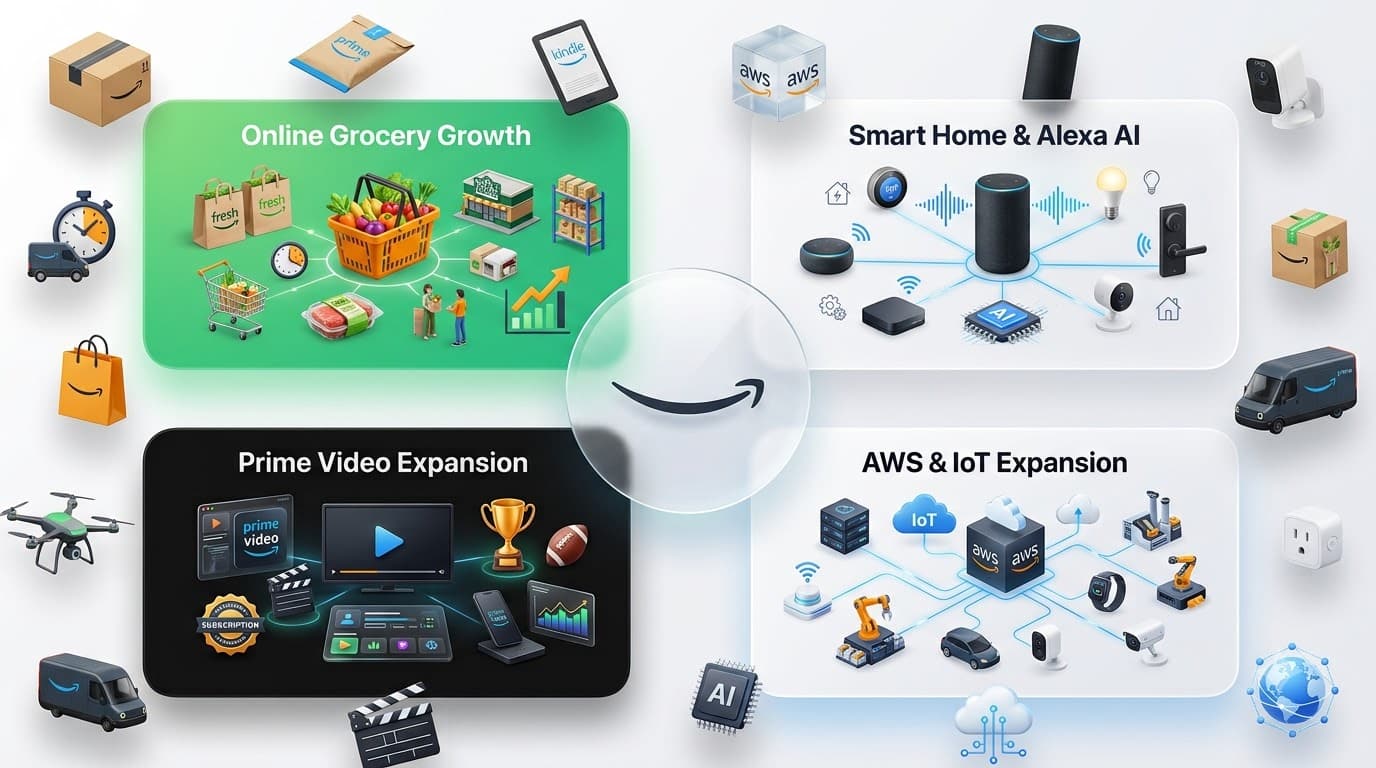
1. Online grocery sales will reach US$59.5 billion by 2023
Grocery has long been considered one of the last major retail categories where e-commerce hadn’t fully broken through, and Amazon has been pushing hard to change that. Industry projections pointed to online grocery sales reaching roughly $59.5 billion, and Amazon has clearly been positioning itself to capture as much of that shift as possible, expanding same-day perishable delivery to more than 2,300 cities and reporting perishable customer growth up around 50% since the start of 2026. That’s a real signal that the grocery push is gaining traction rather than stalling out the way some earlier grocery delivery experiments did.
The opportunity here isn’t just about selling more milk and eggs online, it’s about grocery being the single most frequent purchase category most households make, which means winning grocery loyalty tends to pull the rest of a customer’s shopping habits along with it. If Amazon can keep improving delivery speed and reliability for perishables specifically, which is technically harder than shipping a book or a phone case, it strengthens the entire Prime ecosystem by giving people a reason to open the app multiple times a week instead of just during occasional big purchases. That’s a genuinely large, still-growing opportunity that Amazon hasn’t fully captured yet.
The bigger prize sitting behind grocery specifically is frequency. Someone might buy electronics or clothing a handful of times a year, but groceries happen weekly, sometimes multiple times a week, for nearly every household on earth. Capturing even a modest share of that recurring spending creates a far stickier customer relationship than any single big-ticket purchase ever could, because it turns Amazon from an occasional destination into a genuine habit woven into someone’s weekly routine. That’s exactly the kind of behavioral shift Amazon has been chasing with Whole Foods, Amazon Fresh, and now the expanded same-day perishable rollout, and it’s still very much a work in progress rather than a finished win.
2. Increasing demand for voice-controlled virtual assistants in home devices
Amazon’s Alexa ecosystem, built around the Echo line of smart speakers, gave it an early and genuinely dominant position in voice-controlled home devices, and demand for these products has kept climbing as smart home technology becomes more mainstream rather than niche. Every Echo device sold isn’t just a hardware sale, it’s a foothold inside someone’s home that can drive additional purchases, smart home device sales, and daily engagement with the broader Amazon ecosystem in a way a website visit alone never could.
That’s the real opportunity here: voice assistants aren’t really a standalone product category, they’re an entry point into controlling lighting, security cameras, thermostats, and eventually a much wider range of connected devices throughout a household. Amazon has real work to do modernizing Alexa with genuine generative AI capabilities to keep pace with what OpenAI, Google, and others are building, and that catch-up race is genuinely competitive right now. But the installed base Amazon already has, tens of millions of Echo devices already sitting in homes, gives it a real distribution advantage if it can successfully upgrade the underlying AI without needing to convince people to buy new hardware all over again.
Amazon has already started leaning into its Anthropic relationship here too, integrating more capable foundation models into its own products rather than relying purely on internally built AI to carry the entire Alexa upgrade. That’s a smart hedge, honestly. Instead of betting everything on homegrown AI research catching up fast enough, Amazon gets to combine its massive existing hardware distribution with genuinely competitive third-party AI capability, which shortens the timeline to a meaningfully upgraded Alexa experience compared to building every layer from scratch internally.
3. Growing market for subscription-based video on demand services
Prime Video has become a genuine competitor in the streaming wars, not just a throw-in perk bundled with fast shipping anymore. The subscription video on demand market keeps growing globally as more households cut cable entirely and shift spending toward streaming platforms, and Amazon has been investing heavily in original content, live sports rights including NFL Thursday Night Football, and international licensing to keep Prime Video competitive against Netflix, Disney+, and the rest of the crowded streaming field.
The opportunity for Amazon specifically is a little different than it is for a pure streaming company like Netflix, because Prime Video doesn’t need to stand entirely on its own economics the way a standalone subscription service does. It’s bundled into Prime membership, which means its real job is keeping people subscribed to Prime overall rather than turning a profit purely on content licensing costs versus subscription revenue. That gives Amazon more flexibility to invest in content that strengthens the broader ecosystem, even if any single show or sports package wouldn’t independently justify its cost the way it would need to for a standalone streaming competitor.
Live sports specifically has turned out to be a smarter bet than a lot of people expected when Amazon first grabbed Thursday Night Football rights. Sports content drives appointment viewing in a way scripted shows rarely manage anymore, and appointment viewing is exactly what keeps a subscription service relevant week to week instead of becoming something people forget they’re paying for. As traditional cable sports packages keep shrinking and more rights deals move toward streaming exclusively, Amazon has positioned Prime Video to capture a growing share of an audience that used to be locked into traditional broadcast and cable deals almost entirely.
4. The Internet of Things (IoT) market is expected to grow significantly over the next decade
Connected devices, everything from smart thermostats to security cameras to wearables to industrial sensors, represent one of the largest growth markets in technology over the next several years, and Amazon sits at an unusually strong intersection point to capture a meaningful share of that growth. AWS already provides the cloud infrastructure backbone that a huge share of IoT devices, made by companies far beyond Amazon itself, actually run on behind the scenes. That’s a quieter, less visible opportunity than Alexa devices sitting on a kitchen counter, but it’s arguably a bigger one financially.
So then, the real opportunity spans two layers at once: Amazon’s own consumer IoT devices, like Ring cameras and smart plugs, continue building out its Alexa-connected ecosystem, while AWS IoT Core and related cloud services quietly power countless third-party devices and industrial applications that never carry the Amazon name at all. As more of the physical world gets connected to the internet over the next decade, Amazon is positioned to profit from that shift both as a device maker and as the infrastructure layer underneath a huge share of the broader industry, which is a genuinely rare dual position to be in.
Threats
1. Wal-Mart’s efforts to establish itself as a leading online retailer
Walmart has stopped being the retailer Amazon could safely ignore online. Walmart’s e-commerce business has been growing at a serious pace, backed by a physical store network Amazon simply doesn’t have, which lets Walmart offer things like same-day pickup and delivery from thousands of local stores rather than relying purely on centralized warehouses. That combination of physical footprint plus improving digital experience is exactly the kind of hybrid advantage that’s genuinely hard for Amazon to counter without spending billions building out its own physical presence, something it’s shown limited appetite for so far.
Look at what actually happens in categories like grocery specifically, where Walmart’s massive existing store network gives it a natural advantage for same-day fulfillment that Amazon has to build from scratch through warehouses instead. Walmart has also been investing heavily in its own advertising business, directly competing with Amazon’s fastest-growing profit center outside of AWS. That’s why Walmart isn’t just a threat in the categories it’s always dominated, it’s increasingly a threat across the exact areas Amazon has been counting on for its next phase of growth, and that overlap is only going to intensify as both companies keep investing in the same battlegrounds.
There’s also a pricing perception battle happening here that’s easy to overlook. For decades, Walmart owned the “everyday low price” reputation and Amazon owned the “endless selection with fast shipping” reputation, and the two brands mostly stayed in their lanes. That’s changed. Amazon has pushed harder into price competitiveness, and Walmart has pushed harder into selection and delivery speed, which means the two companies are now competing head-on for the exact same value proposition in a way that didn’t used to be true. Whoever wins that overlapping middle ground, price plus speed plus selection all at once, is going to set the terms for retail competition for the next decade, and right now that fight is genuinely closer than it’s been in years.
2. Risk of data breaches
Amazon holds an enormous amount of sensitive customer data, payment information, addresses, purchase histories, browsing behavior, and increasingly voice recordings and smart home camera footage through Alexa and Ring devices. That makes it an extremely attractive target for hackers, and the scale of Amazon’s operations means any breach wouldn’t just be embarrassing, it would potentially expose data belonging to hundreds of millions of people at once. The company has already faced real regulatory consequences tied to data handling, including a $2.25 million FTC penalty in mid-2026 for violating the Fair Credit Reporting Act by refusing to provide transaction records to identity theft victims within required timeframes.
That’s a smaller, more procedural example, but it points at a bigger structural risk: as Amazon expands deeper into smart home devices, healthcare data through its pharmacy and clinic businesses, and financial services, the amount of genuinely sensitive information flowing through its systems keeps growing, and so does the potential damage from any serious breach. Regulators worldwide have been getting more aggressive about data privacy enforcement generally, and a company holding this much personal information across this many product categories is going to keep facing scrutiny, fines, and reputational risk any time something goes wrong, whether that’s a hack, a policy violation, or simple mishandling of customer requests.
3. Amazon could potentially be sued for infringing intellectual property rights
Given how many product categories Amazon operates in, from its own private-label products to Alexa’s voice recognition technology to its logistics and warehouse automation systems, the surface area for potential patent and intellectual property disputes is genuinely large. Amazon has faced patent infringement claims before across multiple business lines, and given the weaker overall patent portfolio discussed earlier in the weaknesses section, Amazon arguably has less defensive leverage in these disputes than a company with a deeper research and patent history might have.
This threat compounds with Amazon’s private-label strategy specifically, where the company has faced accusations from third-party sellers and outside companies alleging that Amazon copied product designs or used marketplace data to develop competing in-house products. Whether or not any individual claim holds up in court, the pattern of accusations has created real reputational and legal risk, and a company operating at Amazon’s scale across this many product categories is always going to be a target for intellectual property litigation, some legitimate and some opportunistic, simply because the potential payout from a successful claim against a company this large is so much bigger than it would be against a smaller competitor.
This risk isn’t purely theoretical either, it shows up in real dollar terms when disputes get resolved. Settlements and licensing arrangements tied to patent disputes can run into the hundreds of millions of dollars depending on the technology involved, and voice recognition, machine learning, and logistics automation are all areas where the underlying technology moves fast enough that clear ownership boundaries aren’t always obvious until a court sorts it out. Given how central these technologies are to Amazon’s actual competitive advantage, any meaningful adverse ruling wouldn’t just cost money, it could force real changes to how core parts of the business actually operate.
4. The rising U.S. dollar exchange rate could negatively affect the company’s revenue and profits
Amazon generates a meaningful chunk of its revenue internationally, with the international segment pulling in $42.2 billion in the most recent quarter alone. When the US dollar strengthens against foreign currencies, revenue earned abroad translates back into fewer dollars once it hits Amazon’s consolidated financial statements, even if the underlying local sales performance hasn’t actually changed at all. That’s a purely financial headwind that has nothing to do with how well Amazon’s international operations are actually running, but it shows up directly in reported results anyway.
Currency volatility also affects competitiveness in international markets more directly, because a stronger dollar can make goods sourced or priced relative to dollar costs more expensive for international customers, potentially denting demand in price-sensitive markets. Given how unpredictable currency movements have been amid ongoing trade tension and shifting interest rate policy, this remains a threat Amazon can’t fully control or hedge away, and it’s exactly the kind of macro risk that can quietly erode a quarter’s results even when every operational metric inside the business looks genuinely strong.
Amazon does use financial hedging instruments to soften some of this exposure, but hedging only smooths out volatility over shorter time horizons, it doesn’t eliminate the underlying risk over the long run. If the dollar stays elevated for an extended stretch, hedges eventually roll off and get repriced at less favorable rates, meaning sustained currency strength eventually flows through to reported results no matter how well the hedging program is managed in any given quarter. That’s simply the nature of operating a business this large across dozens of currencies simultaneously, and it’s a risk every major multinational company shares, not something unique to Amazon, but the sheer scale of Amazon’s international operations means the dollar amounts involved are larger than most companies ever have to think about.
Conclusion
So where does this leave Amazon heading into the rest of 2026? The strengths here are genuinely substantial: a cost structure and third-party seller network competitors can’t easily replicate, a flywheel effect connecting Marketplace, AWS, Prime, and advertising into something bigger than the sum of its parts, brand trust that makes Amazon the default first stop for online shopping, and a logistics network so sophisticated it’s reshaped what customers expect from delivery speed industry-wide. Those aren’t small advantages, they’re the kind of structural moats that took three decades to build and can’t be copied overnight by any single competitor, no matter how much money that competitor is willing to spend trying.
But the weaknesses are just as real and shouldn’t get waved away just because the headline revenue numbers keep climbing. Retail margins remain thin enough that the entire business essentially runs on AWS profitability propping up a much lower-margin core operation. The patent portfolio gap leaves Amazon more exposed on intellectual property than its size would suggest. And that rising long-term obligations-to-assets ratio, driven by the $220 billion AI infrastructure bet, means Amazon is taking on real financial risk that only makes sense if that infrastructure demand actually materializes the way management is projecting. That’s why a genuine SWOT Analysis of Amazon has to hold the impressive growth story and the underlying structural risk in the same frame rather than picking one narrative and running with it. This is a company betting enormous sums on AI infrastructure and grocery expansion paying off, while regulators circle from multiple directions and Walmart closes the gap in exactly the categories Amazon needs for its next growth chapter. Whether that bet pays off the way Andy Jassy and his team are projecting will probably become clear well before the end of this decade, and the next few quarters of AWS utilization data and grocery growth numbers should tell us a lot about which direction this is actually heading.
There’s one more thread worth pulling on before wrapping up, and it’s the question of how much longer Amazon can keep running two fundamentally different businesses under one roof without one eventually pulling focus away from the other. Retail demands constant attention to thin margins, delivery logistics, and price competition against Walmart on one side and countless discount marketplaces on the other. AWS demands enormous, sustained capital investment in a race against Microsoft and Google that shows no signs of slowing down. Both businesses are genuinely strong today, but they pull Amazon’s leadership attention and capital in different directions, and the company that manages to balance both without shortchanging either one is the company that keeps winning both fights at once. So far, Amazon has managed that balancing act better than almost anyone expected a decade ago. Whether it can keep doing so as the AI infrastructure race gets more expensive and the retail competition gets more crowded is honestly the single biggest question hanging over this entire SWOT Analysis of Amazon, and it’s not one that gets answered by a single earnings report, no matter how strong that report looks on the surface.
Frequently Asked Questions
1. What is a SWOT Analysis of Amazon actually used for?
A SWOT Analysis of Amazon breaks the company down into strengths, weaknesses, opportunities, and threats so you can evaluate its competitive position clearly instead of just reacting to whatever headline earnings number came out that quarter. It’s used by investors, students, and business analysts who want to understand not just how big Amazon is, but where the business is genuinely exposed underneath the impressive top-line growth.
2. Why does AWS matter so much more to Amazon’s profitability than the retail business?
Because AWS runs at a 39.4% operating margin while North America retail runs at just 7.9% and international retail at only 4.1%. Even though AWS supplies only about 21% of total company revenue, it generated over 60% of Amazon’s operating income in the most recent quarter. That’s why any slowdown in cloud growth would hit Amazon’s actual profitability far harder than a slowdown in retail sales would.
3. Is Amazon’s retail business actually profitable on its own?
It’s profitable, but just barely, and it’s nowhere near as profitable as AWS. North America and international retail segments together carry thin single-digit operating margins, which means the retail business mostly functions as a scale and engagement driver, feeding advertising revenue and Prime subscriptions, rather than being a strong standalone profit center the way AWS is.
4. How much is Amazon spending on AI infrastructure right now?
Amazon raised its 2026 cash capital expenditure forecast to roughly $220 billion, up from an earlier estimate near $200 billion, driven largely by AI infrastructure buildout and rising memory costs. That spending pushed free cash flow negative on a trailing twelve-month basis, turning what was an $18.2 billion inflow the year before into a $7.6 billion outflow, which shows just how aggressively Amazon is betting on AI demand continuing to grow.
5. What was the Amazon Prime FTC settlement about?
The FTC sued Amazon alleging it enrolled tens of millions of customers into Prime subscriptions without clear consent and made cancellation intentionally difficult. Amazon settled for $2.5 billion total, including $1.5 billion in customer refunds and a $1 billion civil penalty, while denying any wrongdoing as part of the settlement terms.
6. Is Walmart really catching up to Amazon in e-commerce?
Walmart isn’t overtaking Amazon in overall online sales, but it’s closing the gap meaningfully in specific categories, especially grocery, by leveraging its roughly 10,500 physical stores worldwide for same-day pickup and delivery that Amazon can’t easily match through warehouses alone. Walmart has also been building out its own advertising business to compete directly with one of Amazon’s fastest-growing profit centers.
7. Why does Amazon have a weaker patent portfolio than companies like Apple or Google?
Amazon’s R&D spending has historically focused more on operational efficiency, things like warehouse robotics and delivery logistics software, rather than fundamental research that tends to generate deep, defensible patents. That leaves Amazon comparatively exposed on the intellectual property front, particularly in cloud computing where it competes against Microsoft and Google, both of which come from much longer histories of core computer science research.
8. How exposed is Amazon to currency exchange rate swings?
Fairly exposed, given that international segment sales reached $42.2 billion in the most recent quarter alone. When the US dollar strengthens against foreign currencies, revenue earned internationally translates into fewer dollars once consolidated into Amazon’s financial statements, even when the underlying local business performance hasn’t actually changed, making this a persistent risk that’s largely outside Amazon’s direct control.
9. What role does Amazon’s investment in Anthropic play in its financial results?
A surprisingly large one recently. Amazon’s Q2 2026 net income of $62.6 billion included roughly $53.4 billion in non-operating income, primarily from an upward revaluation of its stake in Anthropic. That means a huge share of the headline profit number came from an investment gain rather than from operating the actual retail or cloud businesses, which is worth separating out when evaluating how the core business is genuinely performing.
10. Does Amazon have a real opportunity in online grocery?
Yes, and it’s actively pursuing it. Amazon has expanded same-day perishable delivery to more than 2,300 cities and reported perishable customer growth up roughly 50% since the start of 2026, suggesting real traction in a category that’s historically been one of the hardest for e-commerce to crack given how time-sensitive and locally dependent grocery shopping tends to be.
11. What are the biggest legal and regulatory threats Amazon is currently facing?
Beyond the Prime settlement, Amazon faces a separate FTC antitrust lawsuit filed in 2023 alleging illegal monopoly tactics, a possible additional FTC suit over claims it misled advertisers, and ongoing scrutiny from state attorneys general. Combined with the $2.25 million penalty for violating the Fair Credit Reporting Act, this pattern of regulatory action suggests Amazon will keep facing legal and compliance pressure across multiple fronts simultaneously rather than dealing with isolated one-off cases.
12. Should investors be concerned about Amazon’s negative free cash flow?
That depends on time horizon and risk tolerance, and this isn’t investment advice, just an observation about what the numbers show. The negative free cash flow is a direct result of aggressive, deliberate AI infrastructure investment rather than a sign of a struggling core business, and management has said demand is strong enough that 2027 capacity is already largely reserved. Whether that spending pays off as expected will likely become clearer over the next few reporting periods as AI infrastructure utilization data becomes available.
13. How does Amazon’s advertising business fit into the overall SWOT picture?
Advertising has quietly become one of Amazon’s most profitable segments, pulling in $19.8 billion in the second quarter of 2026 alone, up 26% year over year. It runs on top of existing shopping traffic, meaning Amazon doesn’t need to build separate audience reach the way a standalone ad platform would, which gives it unusually strong margins for a business built almost entirely on data Amazon already collects through normal marketplace activity.
14. What happens to Amazon if AWS growth slows down significantly?
Given that AWS generated over 60% of operating income from just 21% of revenue in the most recent quarter, a meaningful slowdown there would hit Amazon’s overall profitability far harder than a similar slowdown in retail would. The retail business simply doesn’t have the margin structure to compensate for a weaker cloud segment, which is exactly why Wall Street watches AWS growth rates so closely every single quarter rather than focusing purely on total company revenue.