


Apple just closed its strongest June quarter ever. $109.4 billion in revenue, up 16% from a year earlier, iPhone sales up 22%, and net income jumping to nearly $30 billion. Read that again. This is a company that turns 50 this year, sells a phone that costs more than most people’s monthly rent, and still somehow keeps growing at a pace that startups would kill for. And yet, if you sat in on Apple’s earnings call in July 2026, you’d have heard analysts hammering Tim Cook about Services revenue missing estimates, about Siri still not shipping the AI features it promised back in 2024, about China being a rollercoaster instead of a straight line up. So which is it? Is Apple crushing it or is Apple stumbling into its next decade a step behind?
Honestly, it’s both. That’s what makes a SWOT Analysis of Apple genuinely interesting right now instead of just another corporate case study you skim for a business school assignment. This isn’t 2015 Apple, coasting on iPhone momentum with no real competition in sight. This is a company mid-transition. Tim Cook is stepping down as CEO on September 1, 2026, handing the keys to John Ternus, the hardware engineering chief. That alone should tell you something is shifting. Apple spent $11.7 billion on R&D last quarter alone, up 32% year over year, because it knows it got outpaced on generative AI and it’s throwing money at the problem. Meanwhile regulators in Brussels, Washington, and Seoul are all taking turns picking apart the App Store business model that generates a huge chunk of Apple’s profit margin.
So this piece digs into all of it. Not the sanitized, everything-is-fine version you get from a press release, and not the doom-and-gloom “Apple is dying” hot take either. Just an honest look at where Apple is strong, where it’s exposed, where the real opportunities sit, and what could actually knock it off its perch. We’ll go company snapshot first, then straight into strengths, weaknesses, opportunities, and threats, each broken down point by point with real numbers and real context, not vague generalities. By the end you’ll have a clear picture of why Apple’s stock has held up despite every headline about it “falling behind,” and why that confidence might not be permanent.
What You Will Learn in This Guide
- A quick profile of Apple as it stands in 2026, including leadership, size, and current financial position
- A snapshot table covering the core strengths, weaknesses, opportunities, and threats at a glance
- Six detailed strengths that explain why Apple keeps winning even when critics say it shouldn’t
- Five weaknesses that show exactly where the cracks are forming, from AI delays to iPhone dependence
- Five real opportunities Apple could still capture, from India to health tech to spatial computing
- Five threats that could genuinely dent Apple’s growth over the next few years, not just headline noise
- A bottom-line takeaway that ties the whole SWOT Analysis of Apple together
- Over ten frequently asked questions that cover the details people actually search for
Apple Company Profile
Apple is headquartered in Cupertino, California, and as of fiscal 2026 it remains the most valuable public company on the planet by market capitalization, trading in a range that’s kept it neck and neck with Microsoft and Nvidia depending on the week. The company makes its money across five reporting segments: iPhone, Mac, iPad, Wearables/Home/Accessories, and Services. iPhone is still the engine room, pulling in $54.25 billion in the June 2026 quarter alone, a 22% jump from the year before. Services, which includes the App Store, iCloud, Apple Music, Apple TV+, AppleCare, and its licensing deal with Google, brought in $30.7 billion that same quarter, and it’s the segment investors watch most closely because it carries fatter margins than hardware.
Geographically, Apple’s biggest market is the Americas at $45.8 billion for the quarter, followed by Europe at $29.4 billion, which grew a striking 22.4% year over year. Greater China came in at $18.8 billion, up 22% from the prior year but actually below what Wall Street analysts were expecting, which tells you something about how twitchy the market still is about China. Apple’s leadership picture is also changing in a way that hasn’t happened in over a decade. Tim Cook, who took over from Steve Jobs in 2011, is stepping down as CEO on September 1, 2026, with John Ternus, previously Apple’s senior vice president of hardware engineering, taking the reins. That’s not a small detail buried in a footnote. It’s a genuine changing of the guard at a company that has spent fourteen years being run by the same steady hand.
Beyond the headline numbers, Apple’s product lineup as of 2026 spans well past the phone people usually associate the brand with. There’s the Mac lineup running entirely on Apple silicon now, the iPad family that still dominates the tablet category despite years of Android and Windows tablets trying to chip away at it, Apple Watch, AirPods, and a growing Home category that includes HomePod and various smart home accessories. Then there’s Vision Pro, the company’s first genuinely new product category in almost a decade, still in its early, expensive, first-generation phase. Add on top of all that the software layer, iOS, iPadOS, macOS, watchOS, tvOS, and visionOS, all developed in-house and tightly integrated with the hardware they run on, and you start to understand why Apple’s competitive position is so hard for any single rival to replicate. Nobody else controls quite this much of the stack from silicon to screen to software to storefront.
Apple SWOT Analysis at a Glance
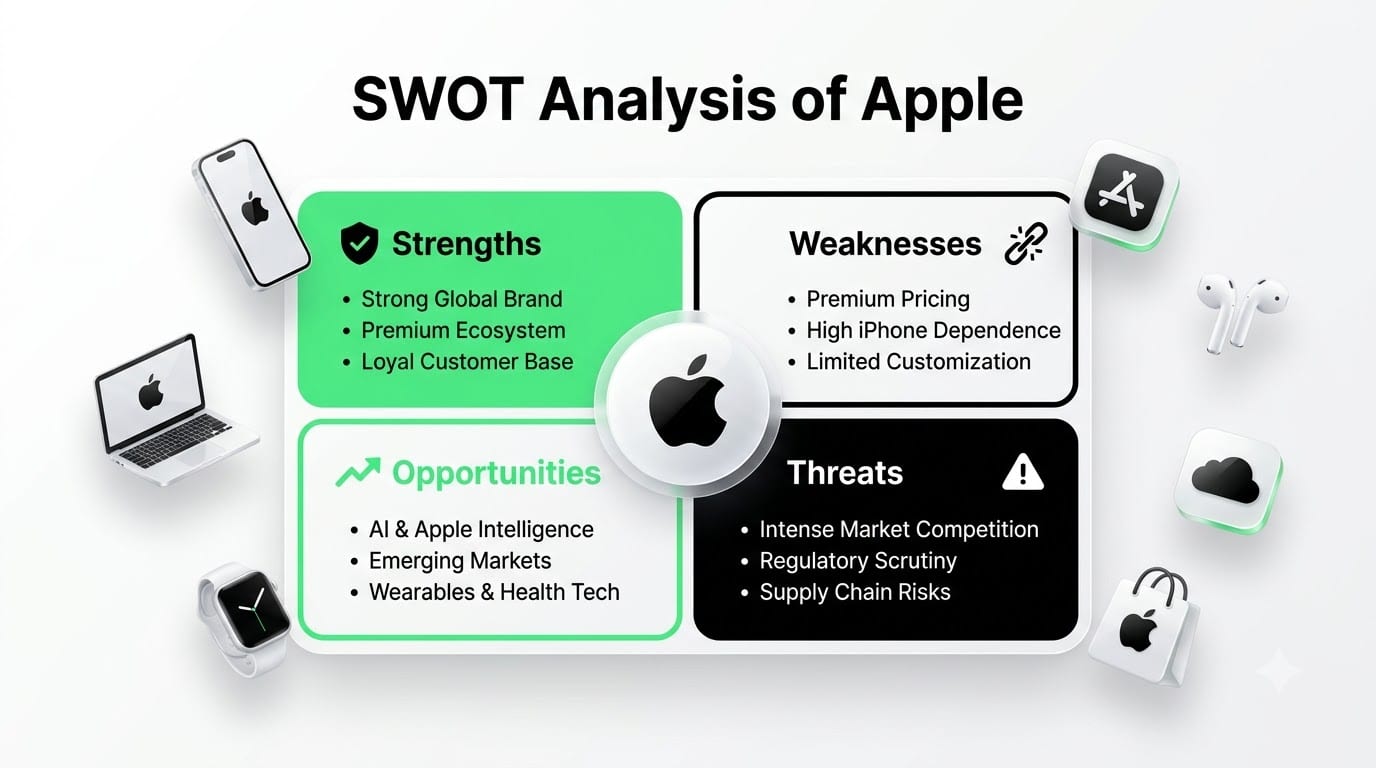
Before we go deep into each point, here’s the fast version. If you only have five minutes, this section gets you most of the way there, though the detail further down is where the real substance is.
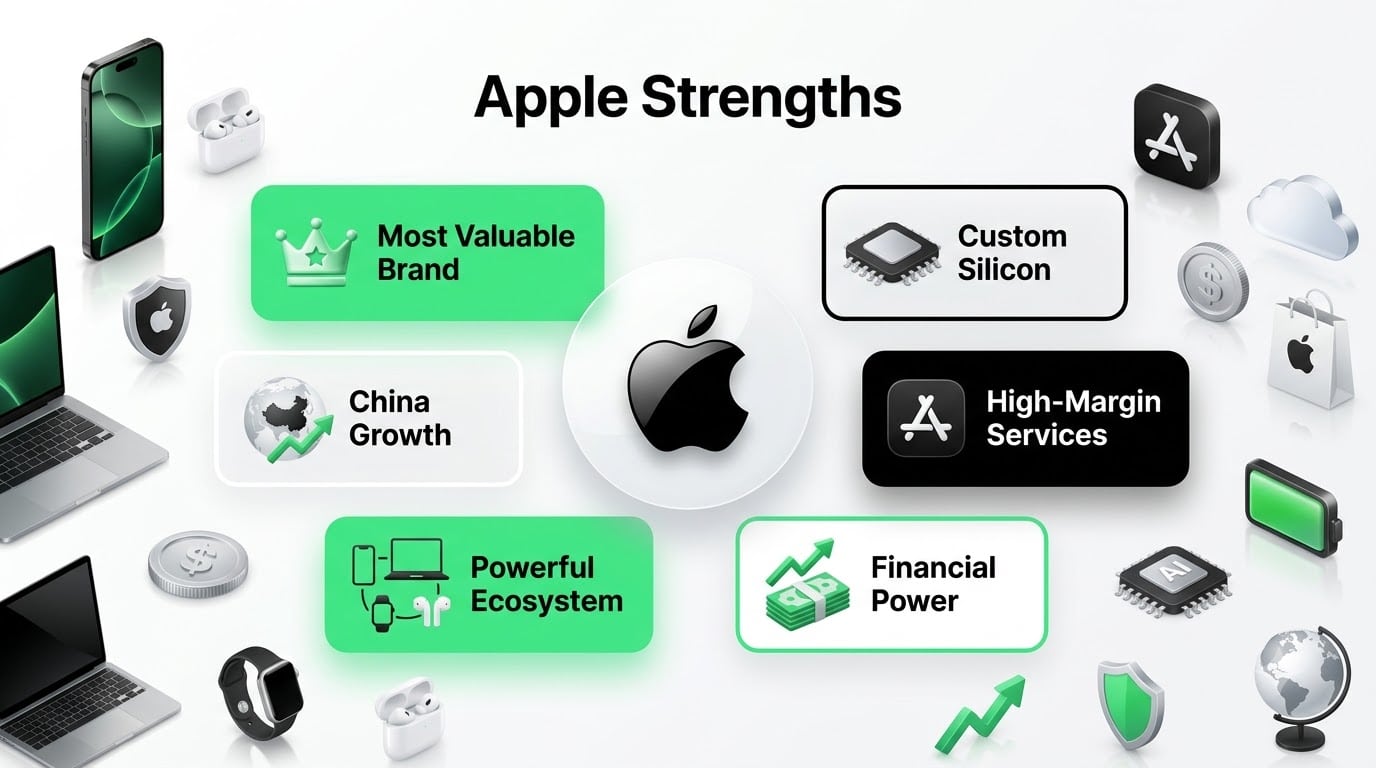
Apple’s strengths center on brand power that no competitor can match, custom silicon that gives it a genuine performance and efficiency edge, a Services business that keeps compounding, a balance sheet stacked with cash, an ecosystem that locks users in through convenience rather than contracts, and a China performance in 2026 that surprised almost everyone who had written the market off. The weaknesses are just as real: Apple still depends far too heavily on iPhone for its revenue, it got caught flat-footed on generative AI and is still playing catch-up with Siri, its premium pricing strategy leaves an entire price-sensitive customer base to competitors, its supply chain is still dangerously concentrated in China, and its software quality has taken visible hits in recent years.
On the opportunity side, Apple has a real shot at actually delivering on AI if it executes well, India represents a genuinely massive untapped growth market, health and medical devices could become a whole new product category, subscriptions and financial services still have room to run, and spatial computing might finally find its moment. The threats are equally serious: regulators in the EU, US, and elsewhere are actively dismantling parts of Apple’s walled garden, the ecosystem itself is being pried open by legal mandate, Huawei has clawed back serious ground in China, foldables and new form factors are reshaping what a premium phone even looks like, and tariffs plus currency swings remain a persistent drag on margins.
Apple Strengths
1. The most valuable brand on earth
Apple’s brand isn’t just recognizable, it’s aspirational in a way almost no other consumer tech company has managed to replicate. People don’t just buy an iPhone, they buy into an identity, and that’s worth more than any single feature Apple could ship. This brand equity lets Apple charge premium prices without the sticker shock that would sink any other company, and it’s why an iPhone with a three-year-old chip still outsells flagship Android phones that spec out higher on paper. Brand loyalty at Apple isn’t marketing spin either, it shows up in the numbers, with upgrade cycles, trade-in rates, and customer retention all sitting well above industry norms.
Look at what actually happens when Apple launches a new product. There’s no need for aggressive discounting, no need for the kind of desperate marketing blitz you see from smartphone makers trying to move units in a saturated market. People line up outside Apple Stores. Scalpers flip pre-order slots. That’s not something you can buy with an ad budget, it’s decades of consistent product experience compounding into something closer to cultural gravity. Nope, other brands haven’t managed to replicate it, not Samsung with its far larger marketing spend, not Google despite owning the operating system three-quarters of the world’s phones run on.
There’s also a resale value angle that rarely gets enough credit in these discussions. A three-year-old iPhone still holds meaningful resale value on the secondhand market, often more than a comparable Android flagship half its age. That resale strength isn’t an accident, it’s a direct product of how much people trust the brand to keep working reliably and how much cultural cachet even an older iPhone still carries. It also quietly supports Apple’s premium pricing at the point of purchase, because buyers factor in that strong resale value when deciding whether the higher upfront cost is worth it, which most of the time, for a large chunk of Apple’s customer base, it clearly is.
2. Custom silicon nobody else has
Apple’s decision to design its own chips, starting with the A-series for iPhone and then the M-series for Mac, turned out to be one of the smartest long-term bets in the company’s history. Building silicon in-house means Apple isn’t at the mercy of Qualcomm or Intel roadmaps, and it means the chip, the operating system, and the software are all designed together instead of bolted on after the fact. That’s why an M-series MacBook gets battery life that Windows laptops running comparable specs simply can’t match, and why iPhones run smoother years after Android competitors with similar or better on-paper specs start chugging.
This isn’t a small technical footnote either. Chip design is brutally expensive and famously difficult to get right, and Apple has now shipped over a decade of consistently competitive silicon while competitors like Samsung have gone back and forth between their own Exynos chips and licensed Qualcomm designs because they couldn’t hit the same bar. The Mac business, which pulled in $10.35 billion in the June 2026 quarter alone, essentially got rebuilt from the ground up on custom silicon and it shows in both performance reviews and sales numbers. That’s a strength competitors can’t just copy by throwing money at the problem, it takes years of chip design talent Apple has been quietly stockpiling since it bought PA Semi back in 2008.
3. A Services business printing money
Here’s the thing people miss about Apple: it’s not just a hardware company anymore, not really. Services generated $30.7 billion in the June 2026 quarter and $91.7 billion over the first nine months of fiscal 2026, up over 14% from the year before. That includes the App Store’s cut of every transaction, Apple Music and TV+ subscriptions, iCloud storage fees, AppleCare warranties, and the massive licensing payment Google makes to stay the default search engine on Safari. Services carries significantly higher margins than hardware, which is exactly why Wall Street watches this number so closely every quarter.
So then, why does this matter for a SWOT Analysis of Apple specifically? Because it means Apple isn’t purely a hardware bet anymore. Even in a year where iPhone sales flatten out, Services keeps compounding because it rides on top of an installed base of well over two billion active devices. That’s recurring, high-margin revenue sitting on top of a hardware business that’s already massive. The only wrinkle, and we’ll get to this later, is that Services actually missed analyst expectations in the most recent quarter, coming in at $30.7 billion against expectations closer to $31.3 billion. That’s still growth, just not quite the growth investors had priced in.
4. Financial firepower most companies can only dream of
Apple generated approximately $117 billion in operating cash flow during just the first nine months of fiscal 2026, up from $81.8 billion in the same period a year earlier. Read that number again. That’s not revenue, that’s cash actually flowing into the business after expenses. Companies with that kind of cash generation can do things smaller competitors simply cannot: buy back billions in stock every quarter, fund massive R&D increases without touching debt, absorb regulatory fines that would cripple smaller firms, and still have money left over to make strategic acquisitions when the right target comes along.
This financial strength is honestly underrated in most SWOT breakdowns because it doesn’t feel as exciting as a new product launch, but it’s arguably Apple’s deepest moat. When Apple got hit with a €500 million fine from the EU over Digital Markets Act violations, that’s basically a rounding error against its cash position. When R&D spending jumped 32% year over year to $11.7 billion in a single quarter because Apple needed to catch up on AI, it barely dented the balance sheet. Most companies would need to take on debt or slow other investments to absorb that kind of spending increase. Apple just wrote the check.
5. An ecosystem that is genuinely hard to leave
Once you own an iPhone, a MacBook, an Apple Watch, and a set of AirPods, switching to another platform starts to feel like giving up a limb. Messages, FaceTime, Handoff, Universal Control, AirDrop, the shared photo library, Find My, the way your Apple Watch unlocks your Mac automatically. None of these features are individually revolutionary, but stacked together they create a level of convenience that competitors genuinely struggle to replicate because they don’t control both the hardware and software across every category the way Apple does.
That’s why Apple’s ecosystem lock-in works differently than a subscription or a contract. Nobody is forcing you to stay. You just don’t want to leave, because leaving means losing a dozen small conveniences you’ve stopped noticing because they’ve become invisible parts of your daily routine. This is also why Apple’s upgrade cycle stays healthy even when a new iPhone doesn’t have a headline feature worth writing home about. You’re not just buying a phone, you’re maintaining a system, and that system gets more valuable to you the longer you stay inside it.
6. Record performance in China when most expected decline
For years, the narrative around Apple in China was pure decline: Huawei clawing back share, local nationalism pushing consumers toward domestic brands, economic softness hitting discretionary spending. And then Apple went and posted a June quarter record in Greater China anyway. Revenue hit $18.8 billion for the quarter, up 22% year over year, and for the first nine months of fiscal 2026, Greater China revenue climbed roughly 30% to $64.8 billion. Tim Cook specifically credited iPhone for the June quarter record in the region, and said Mac had its best quarter in company history there too.
Yeah, it’s true that this figure came in below what analysts had modeled, which spooked the stock a bit after earnings. But step back from the quarter-to-quarter noise for a second. A company that was supposedly losing China to homegrown competitors just posted its best quarterly performance there in company history. That’s not a fluke, that’s evidence Apple’s premium positioning still resonates with Chinese consumers even as domestic brands like Huawei and Xiaomi fight hard for the same wallet. Whatever concerns exist about China long-term, and there are real ones we’ll cover in the threats section, this quarter alone should put to rest the idea that Apple has already lost the region.
Apple Weaknesses
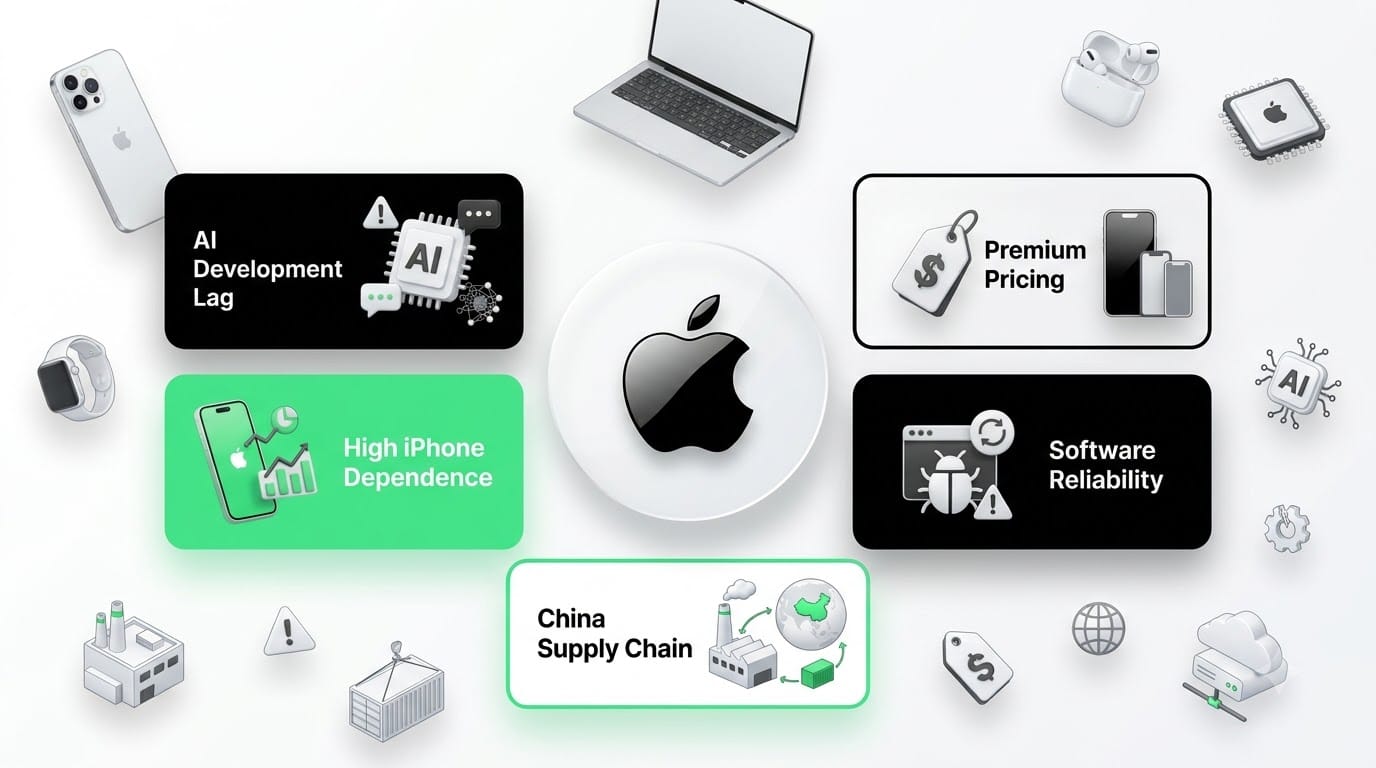
1. Still leaning too hard on the iPhone
Here’s an uncomfortable truth: iPhone alone brought in $54.25 billion of Apple’s $109.4 billion in quarterly revenue. That’s basically half the company riding on a single product line. Yes, Services is growing, and yes, Mac had a great quarter too, but when your single biggest product accounts for roughly half of total revenue, any hiccup in that line, whether it’s a weak upgrade cycle, a manufacturing delay, or a competitor releasing something genuinely compelling, hits the entire company’s numbers immediately and visibly.
This concentration risk isn’t new, people have been pointing it out for over a decade, but it hasn’t actually gone away. Compare this to a company like Microsoft or Amazon, where revenue is spread across cloud infrastructure, enterprise software, advertising, and retail in a way that cushions any single segment’s bad quarter. Apple doesn’t have that same diversification, not really. Services helps, sure, but Services revenue itself is largely downstream of how many iPhones are in people’s pockets generating App Store transactions and iCloud subscriptions in the first place. If iPhone demand ever genuinely stalls for a multi-year stretch, there’s no other product line big enough to absorb that hit.
2. It fell badly behind on generative AI
This one stings because it’s so visible. Apple announced its AI-powered Siri overhaul back at WWDC 2024, complete with promises of deep personal context awareness and cross-app actions. That was supposed to ship with iOS 18.4. Instead, Apple pushed the launch back, then pushed it back again, and as of mid-2026 those features still hadn’t fully shipped in a public build. Along the way, Apple ousted its Siri chief John Giannandrea, replaced him with Mike Rockwell, and reportedly sent close to 200 engineers to an AI coding bootcamp because the existing team’s skills weren’t cutting it. That’s not a company executing confidently, that’s a company scrambling.
Meanwhile, competitors moved fast. OpenAI’s ChatGPT became a household name, Google folded Gemini into everything from Search to Android to Workspace, and Apple was left bolting on a ChatGPT integration as a stopgap while its own homegrown personalized Siri stayed vaporware for over two years. Craig Federighi and Greg Joswiak have both publicly acknowledged the issues, which is at least honest, but honesty doesn’t undo the reputational damage. Apple even faced multiple class-action lawsuits from customers who bought iPhone 16 models specifically because of AI features that were advertised but never delivered on schedule. That’s about as bad as a self-inflicted wound gets for a company this size, and it’s the single biggest weakness in this entire SWOT Analysis of Apple.
What makes this sting even more is that Apple used to be the company that waited, watched everyone else stumble first, and then shipped a more polished version later. That’s basically the entire iPhone, iPad, and Apple Watch playbook. With generative AI, that pattern flipped. Apple announced first, at WWDC 2024, with a splashy keynote and a wave of press coverage, and then failed to actually deliver on the announced timeline, which is the opposite of its usual approach. Reports also emerged of internal architecture problems serious enough that Apple had to essentially restart development on a more capable version, internally referred to as V2, after the original approach proved too limited to deliver what had been promised. That’s a costly do-over on a feature the entire industry was watching closely, and it’s part of why confidence in Apple’s AI timeline has been so shaky ever since.
3. Premium pricing leaves the low end wide open
Apple has never really competed on price, and that’s been a deliberate, mostly successful strategy for years. But it comes with a real cost: it hands the entire budget and mid-range smartphone market to competitors almost by default. In markets like India, Southeast Asia, and much of Africa and Latin America, a huge share of first-time smartphone buyers simply cannot afford even Apple’s cheapest iPhone, let alone a flagship model. That’s billions of potential future customers who grow up on Android, build years of app purchases, photo libraries, and habits inside a different ecosystem, and by the time they can afford a premium phone, they may not see a reason to switch.
Apple has tried to address this with the iPhone SE line and by keeping older iPhone models in its lineup at reduced prices, but honestly, these are half-measures compared to the sheer breadth of budget and mid-range options Android manufacturers like Xiaomi, Oppo, and Samsung offer. This isn’t a fatal weakness by any means, Apple’s margins on premium devices are simply too good to abandon that strategy, but it does mean Apple is voluntarily sitting out of a massive and growing chunk of the global smartphone market, one that will only get bigger as more of the world’s population comes online for the first time.
4. The supply chain still runs through China
Despite years of talk about diversification, Apple’s manufacturing base remains heavily concentrated in China, primarily through partners like Foxconn. That’s a genuine strategic vulnerability, not a theoretical one. Geopolitical tension between the US and China has already led to real financial consequences, including tariff exposure that Apple has had to actively manage, and the company disclosed a roughly 2% gross margin boost in its most recent quarter specifically from tariff refunds, which tells you tariffs have been eating into margins in a way significant enough to actually move the needle.
Apple has made real moves to diversify, shifting more iPhone assembly to India and expanding operations in Vietnam, but let’s be honest about the scale here. China’s manufacturing infrastructure, skilled labor pool, and component supply chains took decades to build up, and you don’t replicate that in a few years no matter how much money you throw at the problem. If US-China trade relations sour further, or if China decided to make life difficult for Apple as leverage in some broader dispute, the company would face real production disruption that no amount of cash reserves could instantly fix. This is a slow-moving risk, but it’s one that isn’t going away anytime soon.
5. Software polish is not what it used to be
There was a time when “it just works” was basically Apple’s unofficial slogan, and it earned that reputation through genuinely reliable, well-tested software. That reputation has taken real hits recently. iOS updates have shipped with bugs that needed multiple follow-up patches. Features get announced with big fanfare at WWDC and then quietly slip or ship half-finished, the Siri saga being the most glaring example but far from the only one. Longtime Apple users, the kind who used to defend the company reflexively, have started openly complaining online about declining software quality.
Part of this comes down to sheer complexity: Apple now maintains iOS, iPadOS, macOS, watchOS, tvOS, and visionOS simultaneously, each with its own quirks and integration requirements, and that’s a much harder engineering problem than it was a decade ago when the lineup was smaller. But complexity is an explanation, not an excuse, and it doesn’t change how it feels to the customer when a promised feature doesn’t show up on time or a routine update introduces new bugs. If Apple wants to keep charging premium prices, it has to keep delivering premium reliability, and that promise has gotten shakier in recent years than longtime fans are comfortable admitting.
Apple Opportunities
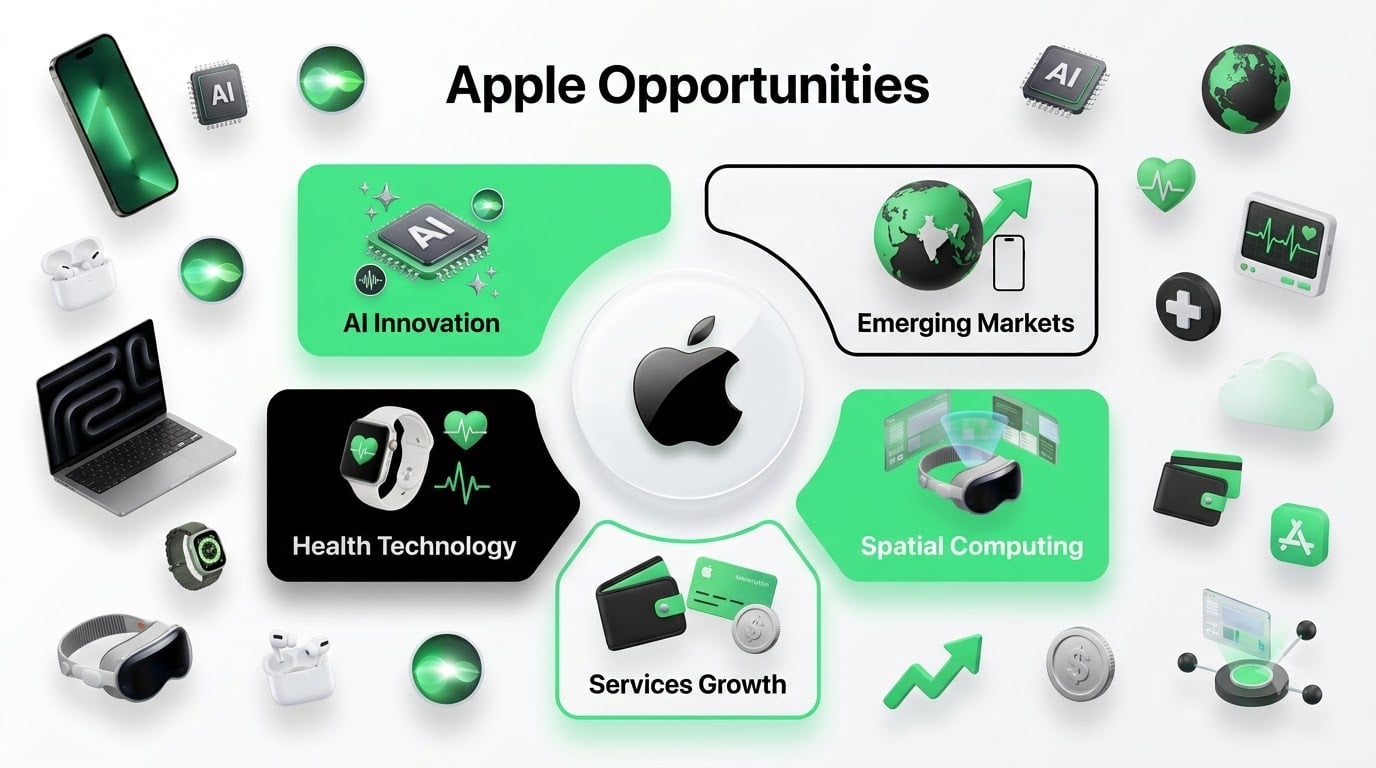
1. Actually delivering on AI
Yes, Apple fell behind. But here’s the flip side: if Apple can actually ship the personalized Siri overhaul it’s been promising since 2024, and do it well, the opportunity is enormous. Apple has something almost none of its AI competitors have: direct hardware and software integration across two billion active devices, plus a privacy-first reputation that genuinely resonates with a huge slice of consumers who are increasingly wary of how much personal data cloud-based AI assistants are hoovering up. If Apple can pair genuinely useful on-device AI with its existing trust advantage, that’s a differentiator competitors can’t easily copy.
The internal target as of mid-2026 is a spring 2026 rollout tied to an iOS 26.4-style update, built on a reworked architecture Apple internally calls V2 after the original approach proved too limited. If this actually ships reliably, and reliability is the key word given the track record, Apple has a real shot at reframing the entire “Apple is behind on AI” narrative almost overnight. That’s a big opportunity sitting right there, mostly because expectations have been beaten down so far by repeated delays that even a solid, on-time launch would feel like a win relative to where sentiment currently sits.
There’s also a quieter AI opportunity that doesn’t get as much attention as Siri: on-device processing for everyday tasks like photo organization, writing suggestions, and notification summaries, all running locally instead of shipping your data off to a cloud server somewhere. Apple has already started building this into its Apple Intelligence branding, and it plays directly into the privacy positioning the company has spent years establishing. If Apple leans into “AI that doesn’t need to see your data to be useful” as a genuine differentiator rather than just a marketing line, that’s a pitch neither OpenAI nor Google can make with quite the same credibility, given how central cloud processing is to both of their current AI business models.
2. India and other emerging markets
India isn’t a future opportunity for Apple anymore, it’s already happening, but there’s a lot more room to run. Apple has been rapidly scaling iPhone manufacturing in India, both to diversify away from China and to serve the Indian market directly with lower import costs. India has the second-largest smartphone user base on the planet and a fast-growing middle class that’s increasingly able to afford premium devices, which is exactly Apple’s sweet spot. Apple has also been opening its own retail stores in India, a market it had underserved for years through third-party resellers.
Beyond India, there’s real opportunity across Southeast Asia, parts of Latin America, and Africa, where smartphone penetration keeps climbing and premium segments are growing even in markets that are broadly price-sensitive. This is a slow burn rather than an overnight windfall, these markets take years of retail investment, local partnerships, and pricing strategy to properly develop. But the trajectory is clearly upward, and any company that can crack meaningful premium market share in India specifically is looking at hundreds of millions of future customers who are just now entering their prime smartphone-buying years.
3. Health and medical devices
Apple Watch already tracks heart rate, blood oxygen, sleep, and has FDA clearance for ECG and irregular rhythm notifications. That’s not a gimmick anymore, that’s genuinely useful medical-adjacent technology sitting on millions of wrists. The opportunity here is to push further: blood pressure monitoring, better sleep apnea detection, more sophisticated glucose tracking, and eventually deeper integration with actual healthcare providers and insurance systems. Health is one of the few categories where Apple’s brand trust, hardware quality, and privacy positioning all line up perfectly with what customers actually want.
This matters strategically too, because health tech opens up an entirely new sales motion beyond the usual consumer upgrade cycle. Imagine insurance companies subsidizing Apple Watches for policyholders who hit activity targets, or healthcare systems integrating Apple Health data directly into patient records. That’s recurring relevance beyond just “do you want the newest chip.” Apple has been circling this opportunity for years without fully committing to it, but the pieces, the hardware, the sensors, the trust, and the existing installed base, are all already in place. It just needs Apple to push harder and faster than it has so far.
4. More subscriptions, more financial services
Services already generates over $90 billion in the first nine months of fiscal 2026 alone, and there’s still room to grow this further. Apple has been quietly building out financial products, from Apple Card to Apple Pay Later to savings accounts through partner banks, and each of these adds another layer of recurring revenue and deeper customer lock-in. Bundling products like Apple One, which combines Music, TV+, Arcade, and iCloud into a single subscription, is another lever Apple can keep pulling to push average revenue per user higher without needing anyone to buy a new device.
The bigger opportunity here is turning Apple from a device company that happens to sell some subscriptions into something closer to a genuine platform business where recurring revenue becomes an even larger share of the pie. That’s a much more valuable, more predictable business model than one that lives and dies by hardware upgrade cycles. Apple’s Services segment already carries far better margins than hardware, so every dollar shifted from a one-time device sale to a recurring subscription is a dollar that’s worth more to the bottom line over time.
5. Spatial computing as the next category
Vision Pro launched with a lot of hype and, so far, modest sales relative to Apple’s usual standards. But “so far” is doing a lot of work in that sentence. Apple has a long history of entering categories with an expensive first-generation product that doesn’t sell in massive volume, then iterating down in price and up in polish until it becomes a mainstream hit. That’s basically the entire story of the original iPhone, the Apple Watch, and AirPods. Spatial computing could follow the same arc if Apple keeps investing and eventually ships a genuinely more affordable version.
The opportunity isn’t really about VR gaming or watching movies on a headset, that’s a fairly niche use case. It’s about spatial computing becoming a genuine productivity and communication tool, something that replaces multiple monitors, enables new kinds of remote collaboration, or becomes the next major computing platform the way the smartphone did before it. That’s a huge if, and it depends entirely on Apple actually executing a serious price and weight reduction over the next few product generations. But if any company has the balance sheet and patience to make that multi-year bet, it’s Apple.
Apple Threats
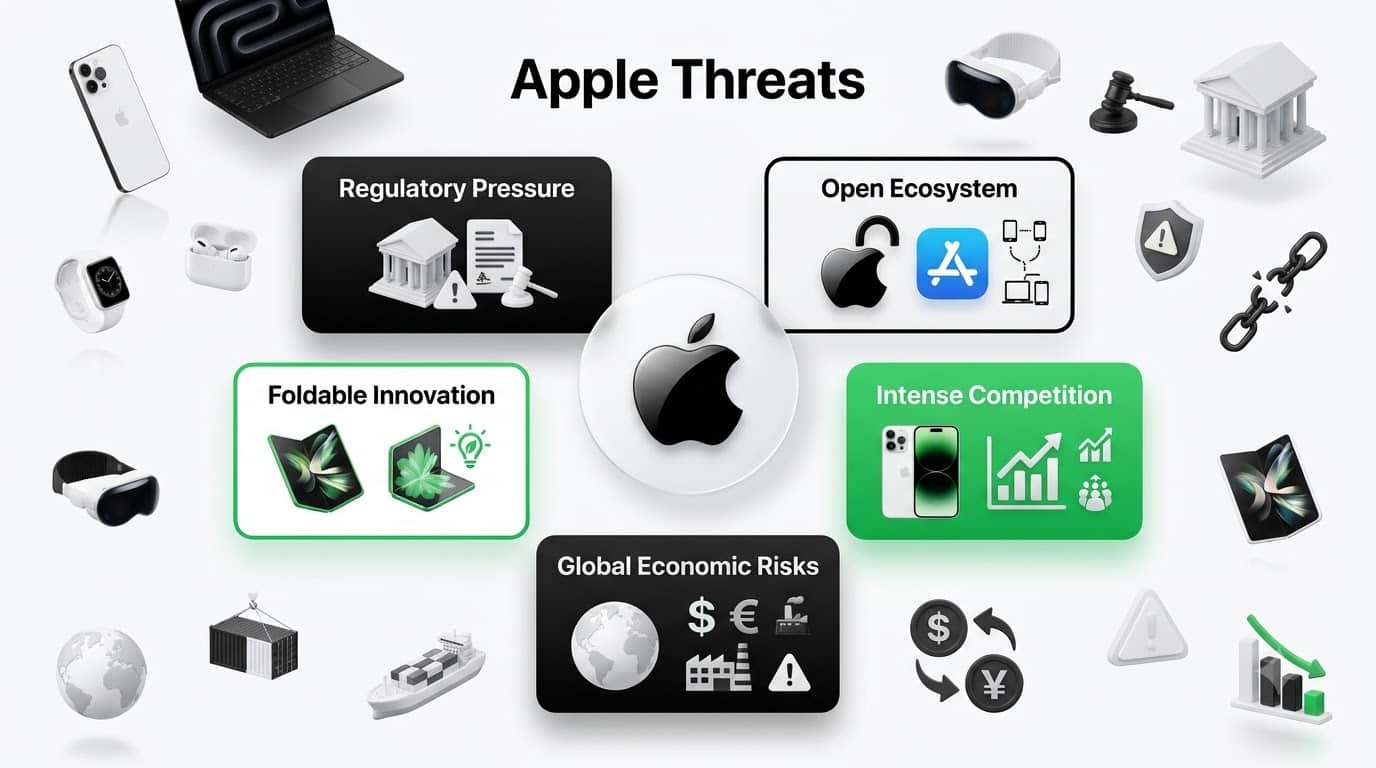
1. Regulators are circling
This is probably the most underrated threat in the entire SWOT Analysis of Apple conversation, because it doesn’t show up as dramatically in a single quarter’s earnings the way a bad iPhone launch would, but it chips away at the business model over years. The EU has already fined Apple €500 million under the Digital Markets Act for restricting how developers can steer users to alternative payment options, and issued a cease-and-desist order forcing Apple to remove those restrictions. Apple challenged its “gatekeeper” designation under the DMA and lost that fight in the EU’s General Court in July 2026, meaning it has no path around continued compliance requirements.
And this isn’t just a European problem. Regulators in the US, South Korea, and elsewhere have been pushing similar App Store reforms, and each new ruling chips away at the roughly 15 to 30% commission Apple takes on App Store transactions, which is a genuinely significant chunk of that high-margin Services revenue we talked about earlier. Every regulatory win for developers, whether it’s allowing third-party payment options or forcing sideloading, is a direct hit to a revenue stream that Wall Street has been counting on to keep growing steadily. This threat isn’t going away, if anything it’s accelerating as more governments follow the EU’s lead.
There’s also a case pending in the US around App Store steering rules stemming from Apple’s long-running fight with Epic Games, plus separate antitrust scrutiny from the US Department of Justice examining whether Apple’s ecosystem control amounts to illegal monopoly behavior. None of these cases exist in isolation. Regulators watch each other closely, and a ruling against Apple in one jurisdiction tends to embolden similar action elsewhere. So even if Apple manages to contain the damage in any single case, the cumulative effect across multiple regions and multiple years is what actually matters, and that cumulative pressure has been building steadily rather than easing off.
2. The ecosystem is being pried open
Remember that ecosystem lock-in we praised as a strength? Regulators are actively working to dismantle exactly that. The DMA is forcing Apple to allow sideloading, alternative app stores, and third-party browser engines on iOS within the EU. South Korea has passed similar legislation. Even in the US, ongoing legal pressure has pushed Apple to loosen some restrictions around app distribution and in-app payments. Each of these changes individually seems small, but stacked together they represent a genuine erosion of the closed system that made Apple’s ecosystem so sticky in the first place.
That’s why this threat pairs so directly with the regulatory one above; they’re really two sides of the same coin. If users in major markets can increasingly get Apple hardware while running third-party app stores, alternative payment systems, and non-Safari browser engines by default, some of that stickiness starts to fray. It won’t happen overnight, most users won’t bother switching away from default Apple services even when given the option, force of habit is powerful. But over a long enough timeline, an ecosystem that used to be fully closed and is now legally required to be at least partially open is a meaningfully different business than the one Apple built its dominance on.
3. Huawei is back
For a few years it looked like US sanctions had permanently crippled Huawei’s smartphone business, cutting it off from critical chip supplies and Google services. Then Huawei found workarounds, built its own chip supply chain through SMIC, and came roaring back into the Chinese premium smartphone market with genuinely competitive devices and a strong wave of domestic nationalism behind it. That’s a real threat specifically in Greater China, Apple’s third-largest market and one where national pride increasingly plays into purchasing decisions in a way it simply doesn’t in the US or Europe.
Yeah, Apple just posted a China quarterly record, so it’s not like Huawei has already won this fight. But the competitive pressure is real and ongoing, and it forces Apple to keep innovating and pricing carefully in a market where it can’t rely purely on brand prestige the way it might elsewhere. If Huawei keeps closing the technical gap while riding a wave of domestic preference that Apple simply cannot replicate as a foreign brand, China could shift from being a growth engine back into being a genuine headwind, and that swing could happen faster than people expect given how quickly sentiment moves in that market.
4. Foldables and new form factors
The smartphone form factor has been essentially static since the first iPhone, a rectangular glass slab, for the better part of two decades. Samsung and Chinese manufacturers have spent years iterating on foldable designs, and while early foldables had real durability and price issues, the category has matured significantly. Apple has reportedly been working on its own foldable iPhone, with leaks pointing to a September 2026 launch, but showing up years after Samsung’s Galaxy Fold line means Apple is playing catch-up in a form factor category for the first time in the smartphone era, rather than defining it.
That matters because Apple’s whole competitive advantage has traditionally come from either inventing a category or entering late with a dramatically more polished version of an existing product. If Apple’s foldable launches without a genuinely compelling reason to choose it over a mature Samsung foldable that’s already had multiple generations to work out the kinks, that’s a rare instance of Apple entering a fight from behind rather than from a position of category-defining strength. It’s not fatal, Apple has pulled off late entries successfully before, but it’s a real test of whether that playbook still works in a form factor this technically difficult to nail.
5. Tariffs, currency, and the global economy
Apple doesn’t operate in a vacuum, and broader macroeconomic pressure shows up directly in its numbers. The company disclosed a roughly 2% gross margin boost in its most recent quarter specifically from tariff refunds, which by itself tells you tariffs have been a meaningful drag that Apple has had to actively manage and disclose to investors. Currency swings matter too. A stronger dollar makes Apple products more expensive in foreign markets when priced in local currency, which can dent international sales even when underlying demand hasn’t actually changed.
None of this is unique to Apple, every global company selling into dozens of currencies and navigating shifting trade policy deals with similar pressure. But given how much of Apple’s revenue comes from outside the US, and given how concentrated its manufacturing still is in regions directly affected by US trade policy, Apple is more exposed to these macro swings than a company with a more domestically focused supply chain and customer base. Tariff policy in particular remains genuinely unpredictable, and a sudden escalation in US-China trade tension could hit Apple’s margins hard with very little warning, since supply chain shifts of the scale Apple would need take years, not months, to execute.
Conclusion
So where does all this leave us? Apple in 2026 is a company that’s simultaneously stronger than ever on paper and more exposed than it’s been in years to forces outside its direct control. The strengths are real and substantial: unmatched brand power, custom silicon nobody else can match, a Services business that keeps compounding, a cash position that lets it absorb almost any shock, an ecosystem that’s genuinely hard to leave, and a China performance that just embarrassed the doubters. Those aren’t small advantages, they’re the kind of structural moats most companies would trade almost anything to have.
But the weaknesses aren’t cosmetic either. Falling behind on generative AI is a real, self-inflicted wound that’s cost Apple credibility and led to actual lawsuits. Leaning on iPhone for roughly half of revenue is a concentration risk that hasn’t gone away just because people have stopped talking about it. And the threats section isn’t filled with speculative, far-off risks, it’s filled with things actively happening right now: courts ruling against Apple’s regulatory appeals, ecosystems being forced open by law, and a resurgent Huawei fighting for the exact market Apple just celebrated a record quarter in. That’s why a genuine SWOT Analysis of Apple has to hold both truths at once instead of picking a side. This is a company with an enormous amount going for it, led by a new CEO taking over at a genuinely pivotal moment, standing at the edge of either reclaiming its innovation edge or slowly ceding ground while the balance sheet cushions the fall. Which way it goes depends almost entirely on whether Apple can actually ship the AI features it’s been promising since 2024, and whether it can navigate a regulatory environment that’s clearly done giving it the benefit of the doubt.
Zoom out far enough and the pattern becomes pretty clear. Every strength Apple has built over the past two decades, the brand, the silicon, the Services engine, the ecosystem, the cash pile, the China resilience, exists because Apple controlled its own destiny across hardware, software, and retail all at once. Every threat currently bearing down on the company, the regulatory rulings, the forced ecosystem openness, Huawei’s comeback, the tariff exposure, chips away at exactly that same control. So the real story of Apple in 2026 isn’t really about AI or China or foldables individually. It’s about whether a company built on tight, closed control of its own stack can keep growing in a world that’s actively legislating and competing that control away, piece by piece, year after year. John Ternus inherits that exact question the moment he takes over in September, and how he answers it will probably matter more to Apple’s next decade than any single product launch on the current roadmap.
Frequently Asked Questions
1. What is a SWOT Analysis of Apple actually used for?
A SWOT Analysis of Apple is a framework used to break the company down into four categories, strengths, weaknesses, opportunities, and threats, so you can evaluate its competitive position clearly instead of relying on scattered headlines. Investors, students, and business analysts use it to understand not just what Apple is doing well, but where it’s genuinely exposed, which is far more useful than just reading quarterly earnings summaries in isolation.
2. Is Apple’s biggest weakness really its AI strategy?
For most analysts watching the company in 2026, yes. Apple’s promised personalized Siri overhaul was announced back at WWDC 2024, delayed multiple times, and still hadn’t fully shipped in public builds well into 2026, even triggering class-action lawsuits from customers who felt misled. Combined with fierce competition from ChatGPT and Google’s Gemini, this delay has been the single most visible crack in Apple’s usual execution record.
3. How much revenue does Apple make from the iPhone alone?
iPhone generated $54.25 billion in the June 2026 quarter, roughly half of Apple’s total $109.4 billion in quarterly revenue. That concentration is exactly why analysts keep flagging iPhone dependence as a structural weakness, even though the iPhone business itself remains genuinely strong and grew 22% year over year in that same quarter.
4. Is Apple actually losing market share in China to Huawei?
Not based on the most recent numbers. Apple posted a June quarter record in Greater China in 2026, with revenue climbing 22% year over year to $18.8 billion, and Tim Cook specifically credited strong iPhone and Mac demand there. That said, Huawei has genuinely recovered ground with domestic chip supply and nationalist sentiment favoring local brands, so the competitive threat is real even if the most recent quarter went Apple’s way.
5. Why is Apple’s Services business so important to its overall strategy?
Services carries significantly higher profit margins than hardware and generates recurring revenue from an installed base of over two billion active devices. It pulled in $91.7 billion over the first nine months of fiscal 2026, up over 14% from the prior year, making it Apple’s fastest-growing major segment and a key reason investors don’t view Apple purely as a hardware company anymore.
6. What does the EU’s Digital Markets Act actually mean for Apple?
The DMA designates Apple as a “gatekeeper” and forces it to allow things like third-party app stores, sideloading, and alternative payment systems on iOS within the EU. Apple was already fined €500 million for restricting how developers could direct users to cheaper payment options outside the App Store, and it lost its legal challenge against the gatekeeper designation itself in July 2026, meaning continued compliance is essentially mandatory going forward.
7. Who is taking over as Apple’s CEO and when?
John Ternus, previously Apple’s senior vice president of hardware engineering, is set to become CEO on September 1, 2026, succeeding Tim Cook, who has led the company since 2011. This is a genuinely significant leadership transition given how long Cook has been at the helm, and it’s happening right as Apple navigates its biggest AI catch-up effort and its toughest regulatory environment in years.
8. Does Apple actually manufacture products outside of China now?
Yes, increasingly so. Apple has significantly scaled up iPhone assembly in India and expanded operations in Vietnam as part of a broader supply chain diversification push. That said, the bulk of Apple’s manufacturing infrastructure, especially for component sourcing and specialized assembly, still runs through China, and fully replicating that infrastructure elsewhere will take years, not months.
9. Is Apple Vision Pro considered a success or a failure?
It’s genuinely somewhere in between, and it’s too early to call it either definitively. Sales so far have been modest relative to Apple’s usual product standards, largely due to the high price and limited practical use cases at launch. But Apple has a long track record of entering new categories with an expensive first-generation device and iterating toward mainstream adoption over several years, so Vision Pro’s ultimate success will likely depend on future generations rather than the current one.
10. How exposed is Apple to tariffs and trade policy right now?
More exposed than it would like to admit publicly. Apple disclosed a roughly 2% gross margin boost in its most recent quarter specifically tied to tariff refunds, which confirms tariffs have had a real, measurable impact on the business that Apple has had to actively manage. Given how much of Apple’s manufacturing still runs through China and how much of its revenue comes from international markets, ongoing US-China trade tension remains a genuine and somewhat unpredictable risk factor.
11. What is Apple’s biggest opportunity for growth over the next few years?
Most analysts would point to two things working together: actually delivering a reliable, genuinely useful AI-powered Siri, and continuing to scale in India as smartphone penetration and middle-class incomes both keep climbing there. Neither is guaranteed, execution risk is real on both fronts, but together they represent the clearest path to reigniting the kind of growth story that made Apple exciting to watch in the first place.
12. Should investors be worried about Apple based on this SWOT Analysis?
That depends entirely on time horizon and risk tolerance, and this isn’t investment advice, just an observation about what the analysis shows. Apple’s near-term fundamentals remain genuinely strong, with record revenue and cash flow numbers backing that up. The real questions are longer-term ones: can Apple close the AI gap, can it absorb sustained regulatory pressure on its most profitable business line, and can new leadership under John Ternus maintain the execution discipline that got Apple here in the first place.
13. How does Apple’s custom silicon actually give it an advantage over competitors?
Because Apple designs its own chips instead of licensing them from a third party, it can tune the hardware and software together in a way competitors relying on off-the-shelf processors simply can’t match. This shows up in real, measurable ways, like MacBooks getting dramatically longer battery life than comparable Windows laptops, and iPhones staying smooth for years longer than Android phones running similar specs. It’s a technical advantage that took over a decade of investment to build and can’t be replicated quickly, which is exactly why it remains one of Apple’s most durable strengths.
14. What role does Apple’s Vision Pro play in the company’s long-term strategy?
Vision Pro represents Apple’s bet on spatial computing eventually becoming a mainstream computing category the way smartphones did before it. Current sales are modest and the price remains high, but Apple has a track record of using first-generation products to establish a category and then iterating toward affordability and mass adoption over several product cycles. Whether Vision Pro follows that same path depends heavily on how aggressively Apple can bring down cost and weight in future versions, something that hasn’t happened yet but remains the clear long-term plan.

An avid blogger, dedicated to boosting brand presence, optimizing SEO, and delivering results in digital marketing. With a keen eye for trends, he’s committed to driving engagement and ROI in the ever-evolving digital landscape. Let’s connect and explore digital possibilities together.