


Look, five years ago if someone told you that you’d order toothpaste, a phone charger, and a kilo of onions on the same app and have it land on your doorstep before your chai got cold, you’d have laughed. Now it’s just Tuesday. That’s what quick commerce has done to Indian shopping habits, and Flipkart Quick Commerce Expansion is one of the biggest stories in that shift right now.
For years, Flipkart was the company that taught India how to shop online. Big Billion Days, next-day delivery, cash on delivery when nobody trusted online payments. It built its name on getting things right, not necessarily getting things fast. Then Blinkit showed up, followed by Zepto and Swiggy Instamart, and suddenly “fast” wasn’t a nice-to-have anymore. It became the whole game. Customers stopped asking “is it available online” and started asking “how soon can it get here.” That single shift in expectation forced Flipkart’s hand.
So Flipkart launched Flipkart Minutes in August 2024, and honestly, it came in later than most of its rivals. Blinkit had already built a name for itself. Zepto had already proven that 10-minute delivery wasn’t a gimmick, it was a business people would pay for repeatedly. Swiggy Instamart had the advantage of an existing delivery fleet from food orders. Flipkart had to catch up, and catch up fast, backed by Walmart’s money and a two-decade-old supply chain that most quick commerce startups simply don’t have.
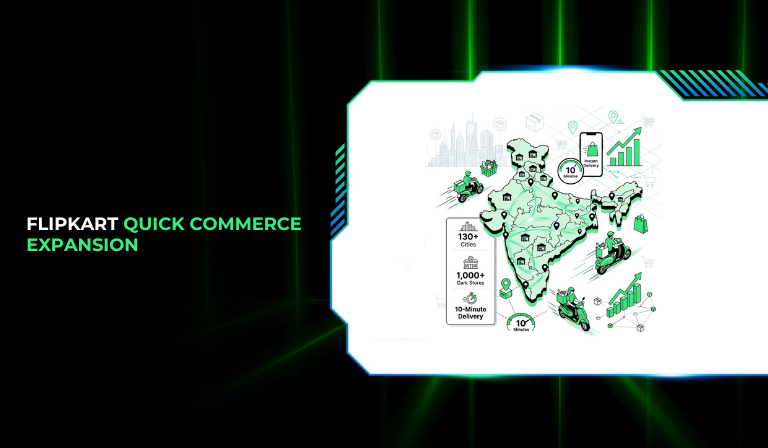
What’s happened since then isn’t a slow, cautious rollout. It’s aggressive. Dark stores went from a handful to over a thousand micro-fulfilment centres in under two years, spread across more than 130 cities and thousands of pincodes. Orders have grown several times over year on year. And a big chunk of that growth isn’t even coming from Delhi or Mumbai, it’s coming from places like Patna, Guwahati, Bokaro, and Siliguri, cities that quick commerce mostly ignored until recently. That’s the part of this story that doesn’t get talked about enough.
This piece walks through the whole picture. Why Flipkart entered quick commerce when it did, how Flipkart Minutes actually works behind the scenes, the dark store network, the logistics, the money side of it, how it stacks up against Blinkit and Zepto, the problems it’s running into, and where this whole thing is likely headed. If you’re a business owner trying to understand the space, a marketer studying the competition, an investor sizing up the opportunity, or just someone curious why your delivery app suddenly promises “10 mins” on everything, this should cover it.
What You Will Learn in This Guide
- Why Flipkart entered quick commerce and what pushed Walmart to back it so heavily
- How Flipkart Minutes actually works, from the app screen to your doorstep
- The business model behind quick commerce and where the real money comes from
- How Flipkart’s dark store network is built and why store density matters so much
- The logistics and technology stack running underneath the 10-minute promise
- A full comparison of Flipkart Minutes against Blinkit, Zepto, Instamart, and BigBasket Now
- The genuine challenges Flipkart faces, including profitability and rider availability
- Where the quick commerce industry in India is headed over the next few years
- Answers to the most common questions people ask about Flipkart Minutes
What is Quick Commerce?
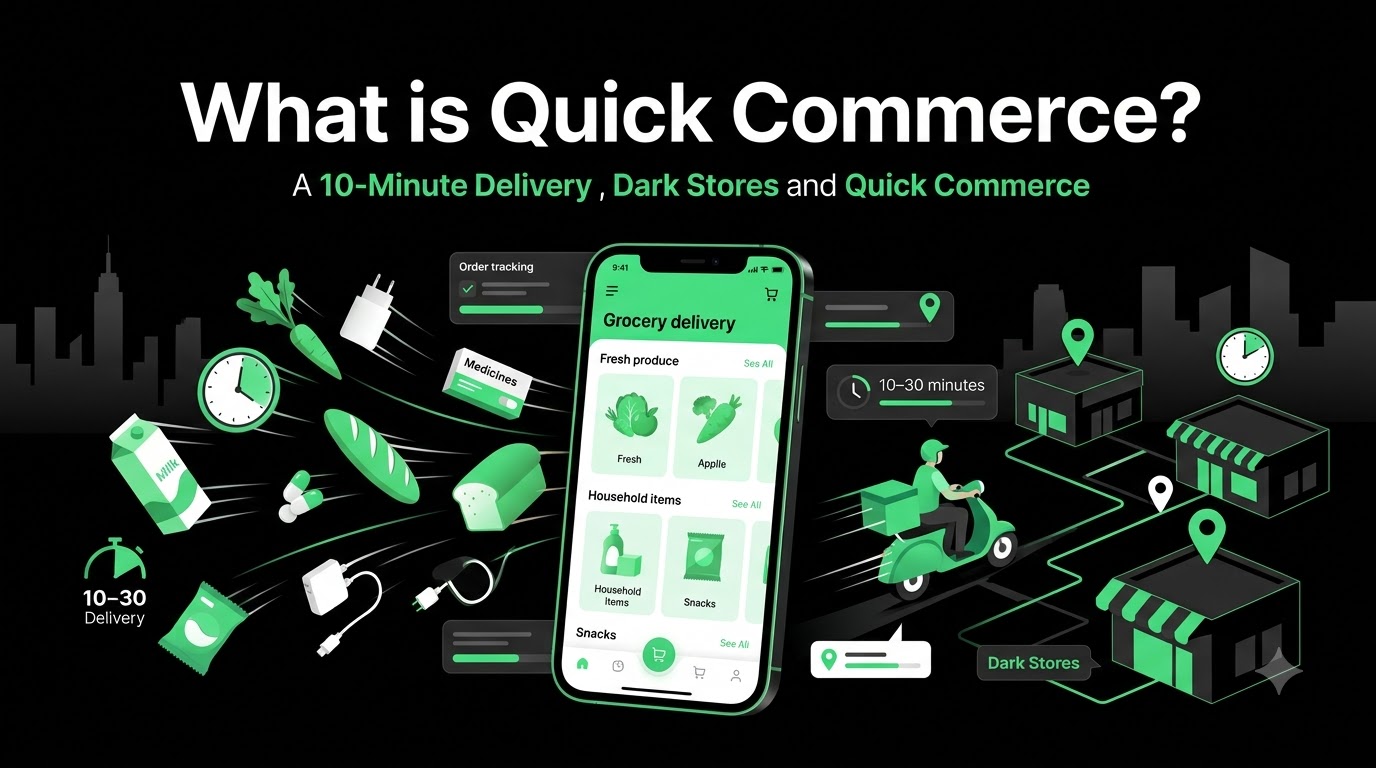
Quick commerce, or q-commerce if you want to sound like you’ve been in a boardroom, means delivering products to customers within minutes instead of days. Not next-day. Not same-day. Minutes. Usually somewhere between 10 and 30 minutes, depending on the platform, your location, and honestly, a bit of luck with traffic. It runs on small, local warehouses called dark stores instead of massive regional fulfilment centres, which is the whole trick that makes the speed possible.
The Evolution From Traditional Delivery to 10-Minute Delivery
Think about how delivery timelines have collapsed over the last decade. Traditional e-commerce used to run on 2 to 7 day windows, and people accepted that because there was no alternative. Then same-day delivery showed up and felt revolutionary. Next-day delivery became the new normal after that. And now we’re at 10-minute delivery, which honestly still feels a bit unbelievable when you actually stop and think about it. Each jump happened because someone proved the previous standard could be beaten, and once one player did it, everyone else had to follow or lose customers.
Why Consumers Actually Prefer Quick Commerce
It’s not complicated. People are busy, cities are chaotic, and nobody wants to plan grocery shopping three days in advance anymore. Convenience is the biggest driver, plain and simple. You realize mid-cooking that you’re out of onions, you order them, they arrive before the dal is even done. Emergency purchases matter too, a sudden headache at 11 PM, a phone charger that just died, a kid’s school project due tomorrow morning. Urban lifestyles with smaller households, both partners working, and higher smartphone penetration have all pushed this demand higher. This isn’t a fad. It’s a genuine shift in how urban India buys everyday stuff.
Growth of India’s Quick Commerce Industry
The Indian quick commerce market has grown from being a niche experiment into a genuinely massive battleground in under five years. Multiple players now operate thousands of dark stores between them, and the sector has attracted serious money from some of the biggest names in retail, including Walmart, Amazon, Reliance, and a stack of private equity investors lining up for a piece of it. What used to be dismissed as “burning cash for convenience” is now treated as one of the most important battles in Indian retail, because whoever wins grocery and daily essentials wins a huge chunk of repeat, high-frequency spending.
Flipkart’s Entry into Quick Commerce
Why Flipkart Entered the Market
Here’s the thing that probably kept Flipkart’s leadership up at night. Grocery and daily essentials are the categories people buy the most often. Not once a year like a phone, not once a season like clothes, but multiple times a week. Whoever owns that habit owns the app people open first. Flipkart watched Blinkit, Zepto, and Instamart eat into exactly that kind of high-frequency spending, and it knew that if it stayed out of the race, it would lose relevance in the one category that keeps users coming back constantly. Rising competition combined with genuinely changing consumer behaviour, people simply expected faster delivery across the board, forced Flipkart’s hand.
Launch of Flipkart Minutes
Flipkart Minutes launched in August 2024, built specifically to compete in this fast-delivery race. The initial rollout was cautious by quick commerce standards, starting in select metro pockets before expanding. But the pace since then has been anything but cautious. The company crossed a thousand micro-fulfilment centres across more than 130 cities in under two years, which for a business this capital heavy is a genuinely fast build-out. The key objective from day one was clear: don’t just compete on price and catalogue like the old Flipkart app did, compete on speed too, because that’s what the market now demands.
Walmart’s Influence on the Strategy
Walmart’s backing matters more here than people give it credit for. This isn’t a startup burning venture capital and hoping to raise another round before the money runs out. Walmart has deep pockets and a long-term view on retail dominance in India, and it’s clearly willing to fund Flipkart’s quick commerce push for years if that’s what it takes to win share. That patience is a real advantage against startups under constant pressure from investors demanding profitability on a tighter timeline. Flipkart also gets to reuse a chunk of its existing grocery and supply chain infrastructure built over two decades, which brings down the cost of opening each new dark store compared to a pure-play rival building everything from scratch.
Flipkart Minutes Explained
What is Flipkart Minutes?
Flipkart Minutes is Flipkart’s dedicated quick commerce service, currently running as a tab inside the main Flipkart app, though the company has been working toward spinning it out into its own standalone app, similar to what Swiggy did with Instamart. It promises deliveries in as little as 10 minutes on select items, with realistic delivery windows more commonly falling between 10 and 30 minutes depending on your location, order size, and how close the nearest dark store actually is to you.
How It Works: The Customer Journey
The flow is simple on the surface but there’s a lot happening behind it. You open the app, browse or search for what you need, and add it to cart, same as regular Flipkart. At checkout, the system checks your delivery address against the nearest dark store’s inventory and delivery radius. If it’s in range and in stock, you get a Minutes delivery slot instead of the usual multi-day one. Once you place the order, the nearest dark store picks the item, packs it, and hands it to a rider waiting nearby, who then delivers it straight to your door. The entire chain, from order placement to doorstep, is designed to move in a matter of minutes, not hours.
Delivery Promise: 10, 15, and 30 Minutes
The 10-minute promise gets all the marketing attention, but it genuinely only applies under ideal conditions. Small item, dark store practically around the corner, no traffic snarl outside your building. Realistically, a lot of orders land closer to the 15 to 20 minute mark, and larger orders or slightly farther addresses can stretch to 30 minutes. That’s not a failure of the system, it’s just physics and traffic doing what they do. Customers who understand this tend to be far less frustrated than those expecting a stopwatch-perfect 10 minutes on every single order, every single time.
Flipkart Quick Commerce Business Model
Revenue Sources Behind Flipkart Minutes
Product margins are the obvious first source, Flipkart buys stock at wholesale rates and sells at retail, pocketing the difference just like any grocery business. But that alone doesn’t come close to covering the cost of instant delivery. Advertising revenue from brands wanting premium shelf placement inside the app matters a lot here, similar to how Blinkit and Zepto monetize sponsored listings. Brand promotions and paid placements on the home screen add another layer. Subscription models, where customers pay a flat fee for free or discounted quick deliveries, are becoming a bigger piece of the puzzle too. And delivery charges on smaller basket sizes help cover at least part of the last-mile cost.
Cost Structure Nobody Talks About Enough
This is where quick commerce gets genuinely expensive, and it’s worth being honest about it. Warehousing costs money, every dark store is real estate, real rent, real electricity bills. The delivery fleet, riders, their incentives, fuel or EV charging, insurance, all of it adds up fast when you’re promising 10-minute windows across hundreds of locations. Technology built to power real-time inventory, route optimization, and demand forecasting isn’t cheap either. And customer acquisition costs in quick commerce are brutal, because every platform is throwing discounts and cashback at new users to win them over from a rival app that’s doing the exact same thing.
Unit Economics: The Numbers That Actually Decide Who Wins
Average order value matters enormously in this business because a 10-minute delivery on a single ten-rupee item basically guarantees a loss. Basket size, how much a customer buys per order, is one of the biggest levers platforms pull to fix their economics, which is exactly why apps nudge you toward “add more items to save on delivery fee.” Repeat customers are the real prize here, because acquiring a new user is expensive but a loyal repeat buyer who orders three or four times a week eventually makes the whole dark store profitable. Profitability challenges remain real across the entire industry, not just for Flipkart, and nobody has fully cracked it yet, though the densest urban dark stores are getting closer.
Flipkart Dark Store Strategy
What Are Dark Stores?
A dark store is basically a small warehouse that isn’t open to walk-in customers. No shopping aisles, no billing counter for you to stand at, just shelves stocked and organized purely for fast picking and packing by staff who know exactly where every item sits. It looks nothing like a regular retail store from the inside, more like a mini logistics hub optimized entirely for speed.
Why Dark Stores Matter So Much to the Whole Model
Speed is the obvious reason, having stock physically close to the customer is the only real way to hit a 10 to 20 minute delivery window, there’s no clever algorithm that beats plain geography. Inventory accuracy matters just as much, because a dark store with messy stock data ends up cancelling orders, which kills customer trust fast. Delivery radius is the third piece, each dark store typically serves only a small radius around itself, usually just a couple of kilometres, which is exactly why Flipkart needs so many of them rather than a few giant ones.
How Flipkart Actually Uses Its Dark Store Network
Flipkart picks store locations based on population density, existing demand signals, and how well an area is already served by its logistics network. Inventory planning at each store leans heavily on local buying patterns, a dark store in a family-heavy residential area stocks differently than one near a college campus or office park. Demand forecasting tools help predict what a specific pincode is likely to order on a given day, so shelves get restocked before they run empty rather than after.
The Technology Sitting Behind Dark Store Operations
AI and machine learning models are doing a lot of the heavy lifting here, from predicting demand spikes to flagging which items are about to run out. Real-time stock updates sync constantly between the store’s inventory and the app, so you’re not shown an item as available when it actually sold out two minutes ago. This is honestly the unglamorous, invisible part of quick commerce, but it’s arguably more important than the flashy 10-minute badge on the app.
Flipkart Logistics Network
Last-Mile Delivery and Why It’s the Hardest Part
Everyone talks about the first and middle parts of a supply chain, procurement, warehousing, all that. But last-mile delivery, the final stretch from the dark store to your actual door, is where quick commerce lives or dies. It’s the most expensive, most unpredictable part of the whole chain, and it’s the part customers judge you on most harshly.
Hyperlocal Delivery and the Rider Network
Flipkart’s rider network operates on a hyperlocal basis, meaning riders are attached to specific zones around specific dark stores rather than roaming citywide. This keeps delivery distances short and predictable. Managing a rider ecosystem at this scale, with incentive structures, shift patterns, and peak-hour surge handling, is genuinely one of the toughest operational puzzles in this entire business.
Warehouse Integration and Route Optimization
The dark stores don’t operate in isolation, they’re tied into a bigger warehouse network that restocks them regularly, often overnight or during low-demand hours to avoid disrupting daytime deliveries. Route optimization software calculates the fastest path for each rider in real time, factoring in traffic, one-way streets, and even which building entrance is quickest to reach. AI-based delivery planning increasingly decides which rider gets which order based on their current location, not just who’s next in a queue, squeezing out every possible minute.
Product Categories Available on Flipkart Minutes
Flipkart Minutes covers a genuinely wide catalogue for something built around speed. Groceries sit at the core, obviously, alongside fresh fruits and vegetables that need quick turnover to stay actually fresh. Dairy products, milk, curd, paneer, move fast through these stores because of shelf life. Beverages and snacks are some of the highest-frequency purchase categories, the classic “ran out mid-evening” order. Personal care items, soaps, shampoos, oral care, round out the daily essentials list. In select cities, medicines are available too, which matters a lot for genuine emergencies. Home essentials, cleaning supplies, kitchen basics, sit alongside a growing range of electronics accessories like chargers and cables, plus stationery and even pet supplies. The breadth here is deliberate, Flipkart wants Minutes to be the app you open for literally anything you need in the next half hour, not just groceries.
Flipkart Expansion Across Indian Cities
From Metro Launch to Nationwide Push
Flipkart Minutes started, like most quick commerce services, in India’s biggest metros where demand density made the economics work fastest. From there it pushed into other major cities, and then, notably, into tier-2 markets much faster than a lot of people expected. Cities like Lucknow have turned into some of the platform’s best-performing markets, even without full city coverage yet. That’s a strong signal that demand for fast delivery isn’t a metro-only phenomenon anymore.
Tier-2 and Tier-3 Cities Are Where the Real Growth Story Is
This is genuinely the most interesting part of Flipkart’s expansion story. Growth in smaller cities, places like Patna, Guwahati, Bokaro, Darbhanga, Jorhat, Ongole, Purnia, and Tenali, has massively outpaced growth in the big metros over the past year. That’s not a small trend, it’s tens of times the growth rate compared to established markets. Nearly a quarter to a third of Flipkart’s quick commerce orders now come from smaller towns, which tells you the next phase of this industry isn’t about winning Bangalore or Mumbai harder, it’s about being the first credible player in a city that’s never had 10-minute delivery before.
Selection Criteria for New Cities
Population density obviously matters, you need enough people close together to justify a dark store’s delivery radius. Existing demand signals, sometimes drawn from regular Flipkart order history in that pincode, help predict whether quick commerce will actually get adopted there. Infrastructure, roads, internet connectivity, availability of riders, plays a real role too. And purchasing power determines whether the local market can sustain the kind of basket sizes that make a dark store financially viable long term.
Technology Powering Flipkart Quick Commerce
Artificial Intelligence and Machine Learning at the Core
None of this works at scale without serious tech underneath it. Inventory forecasting models predict what each dark store needs to stock, and when, based on historical patterns, local events, weather, even day of the week. Real-time order allocation systems decide which dark store and which rider handles an incoming order within seconds of it being placed, factoring in current stock, distance, and rider availability all at once.
Delivery Route Optimization and Demand Prediction
Route optimization isn’t a one-time calculation, it’s constantly recalculating as traffic conditions shift through the day. Demand prediction models help Flipkart figure out where to add new dark stores next, and which existing ones need more stock ahead of predictable spikes, like a cricket match evening or a festival weekend when snack and beverage orders shoot up fast.
Data Analytics and Automation
Every order feeds back into the system, refining future predictions. Automation shows up in picking workflows too, some dark stores use guided picking systems that tell staff exactly which shelf and bin to grab an item from, cutting down the seconds spent searching, because in a 10-minute delivery promise, seconds genuinely add up.
Flipkart vs Competitors
Flipkart vs Blinkit
Blinkit remains the market leader by dark store count and, by most accounts, still leads on raw delivery speed and order density in the cities where both operate. Blinkit’s product range and pricing are aggressive, and it has a longer track record of operating at true 10-minute speed consistently. Flipkart’s edge is its existing brand trust from years of regular e-commerce, plus deeper pockets from Walmart, but on pure execution speed in dense urban pockets, Blinkit still has the upper hand for now.
Flipkart vs Zepto
Zepto built its entire identity around the 10-minute promise from day one, and it shows in how tightly its dark store network is optimized for speed over breadth. Flipkart, by comparison, is playing a broader game, wider city coverage, wider product catalogue, betting on scale rather than just raw speed. Zepto is reportedly eyeing a public listing to raise fresh capital, which tells you how seriously it’s preparing to fight this out long term rather than get acquired or fade out.
Flipkart vs Swiggy Instamart
Instamart had a natural head start because Swiggy already had a massive food delivery rider network it could repurpose for groceries. That gave it operational muscle from day one that Flipkart had to build from scratch. Instamart has also already spun off into its own standalone app, a move Flipkart is reportedly working toward as well. Both are racing hard on dark store count, sitting roughly in the same range as each other by mid-2026.
Flipkart vs BigBasket Now
BigBasket, now under Tata’s ownership, brings deep grocery expertise from years of running an online grocery business before quick commerce even existed. BigBasket Now is its answer to the 10-minute race, leaning on that grocery-specific know-how. Flipkart’s advantage over BigBasket is sheer catalogue breadth beyond groceries and a much larger existing user base already inside its main app.
Comparison Table
| Feature | Flipkart Minutes | Blinkit | Zepto | Instamart | BigBasket Now |
|---|---|---|---|---|---|
| Launch Year | 2024 | Earlier mover | Early mover, speed-first | Backed by Swiggy’s fleet | Backed by BigBasket’s grocery base |
| Core Strength | Scale, catalogue breadth, Walmart backing | Store density, execution speed | Speed-first design | Existing delivery fleet | Grocery expertise |
| City Coverage | 130+ cities, expanding to smaller towns fast | Widest network, sector leader | Strong metro and expanding footprint | Expanding aggressively | Focused, grocery-led footprint |
| Product Range | Groceries plus electronics accessories, stationery, pet supplies | Broad, grocery to electronics | Groceries plus lifestyle categories | Groceries plus food-adjacent items | Primarily grocery and household |
| Standalone App | In progress | Yes | Yes | Yes | Yes |
Marketing Strategy Behind Flipkart Quick Commerce
Customer Acquisition Through Discounts and Cashback
Like every player in this space, Flipkart leans hard on discounts and cashback to pull in first-time users, because the honest truth is nobody switches delivery apps without an incentive when the existing one already works fine for them. Membership benefits tied to Flipkart’s broader ecosystem, things like combined perks across regular Flipkart shopping and Minutes, give it a card to play that pure quick commerce startups don’t have.
Digital Marketing and App-Level Engagement
SEO and app store optimization help Flipkart Minutes show up when people search for fast delivery options. Push notifications nudge users the moment they’re near a store with a flash deal or when an item in their regular basket is running low on stock, a subtle but effective retention trick. Email marketing plays a smaller role given how mobile-first this category is, but it still matters for re-engaging lapsed users. Influencer marketing and performance marketing campaigns on social platforms are where a lot of the acquisition budget actually goes, since that’s where the target audience, urban, smartphone-heavy, time-starved, spends most of its scrolling time.
Benefits of Flipkart Quick Commerce Expansion
For Customers
Faster delivery is the obvious headline benefit, but convenience runs deeper than just speed, it’s about not having to plan ahead for small, everyday needs anymore. Better product availability across a wide catalogue means fewer trips to physical stores for last-minute needs. Competitive pricing, backed by Flipkart’s scale and existing supplier relationships, keeps costs reasonable compared to some smaller quick commerce players still figuring out their sourcing.
For Sellers and Brands
Higher sales volume comes naturally from being present on a high-traffic platform with an existing, massive user base. More visibility through sponsored placements helps brands, especially smaller or newer ones, get discovered by shoppers who’d never have found them otherwise. Faster inventory movement through quick commerce channels also means sellers aren’t sitting on stock for weeks, which helps cash flow.
For Flipkart Itself
Higher engagement is the real prize here, quick commerce gives people a reason to open the Flipkart app multiple times a week instead of just during festival sales. Customer retention improves when people build a habit around an app for daily essentials, because that habit tends to spill over into other purchases too. Increased purchase frequency across the whole Flipkart ecosystem is ultimately the strategic bet behind this entire expansion.
Challenges Facing Flipkart Quick Commerce
Intense Competition Isn’t Slowing Down
Blinkit, Zepto, Instamart, Amazon Now, JioMart, all of them are pouring serious money into this exact same race at the exact same time. That kind of crowded field means no single player gets to relax, ever, and every advantage Flipkart builds gets matched or countered within months by a rival.
High Delivery Costs Eat Into Everything
Running a fleet of riders capable of hitting 10 to 20 minute windows across hundreds of dark stores is expensive, full stop. There’s no clever workaround for the basic economics of paying humans and vehicles to move fast, constantly, across dense urban traffic.
Profitability Remains Genuinely Elusive
Across the entire quick commerce industry, not just at Flipkart, true profitability is still rare and mostly limited to the densest, highest-order-volume dark stores in the biggest cities. Smaller city stores, despite their exciting growth numbers, often take longer to break even simply because order volumes per store are naturally lower.
Inventory Management at This Scale Is Brutally Hard
Keeping thousands of SKUs accurately stocked across a thousand-plus dark stores, each with different local demand patterns, is an operational nightmare even with strong AI forecasting tools. Get it wrong and you either cancel orders, which frustrates customers, or you overstock, which eats into margins through wastage, especially with perishables.
Rider Availability Is a Constant Pressure Point
Every quick commerce platform competes for the same limited pool of delivery riders in any given city, and rider shortages during peak hours, festivals, or bad weather can quietly break the 10-minute promise even when everything else is working fine.
Customer Expectations Keep Climbing
Once you’ve promised 10 minutes and delivered it a few times, customers stop being impressed and start expecting it every single time. Any slip, a 25-minute delivery instead of 10, gets remembered far more than the dozens of times it worked perfectly.
Regulatory Issues and Price Wars
Local regulations around dark store zoning, labour laws for gig riders, and food safety compliance for grocery items add friction that pure e-commerce never had to deal with. And the price wars between platforms, constant discounting to win users from each other, keep margins thin across the entire sector, not just for Flipkart.
Sustainability and Environmental Impact
Packaging Waste Is a Real Problem
Every quick commerce order tends to generate more packaging per rupee spent than a bulk weekly grocery trip would, simply because orders are smaller and more frequent. That adds up to a genuinely significant amount of plastic and cardboard waste across the industry, and it’s an issue quick commerce platforms, Flipkart included, are only beginning to seriously address.
Electric Vehicles and Route Optimization Helping Reduce Emissions
A growing share of delivery fleets across the industry is shifting toward electric two-wheelers, partly for cost savings on fuel over time and partly for genuine emissions reduction. Smarter route optimization also cuts down on unnecessary distance travelled per delivery, which helps on both the cost and environmental side at once.
Green Warehouses and Carbon Emissions
Some newer dark stores are being built with better energy efficiency in mind, from lighting to refrigeration for perishables. It’s still early days for this across the industry broadly, sustainability tends to take a back seat to growth and speed in a race this competitive, but it’s becoming a more visible talking point as the sector matures and faces more public scrutiny.
Financial Performance and Investment Outlook
Revenue Opportunities Beyond Just Product Sales
Beyond straightforward product margins, advertising and brand placement revenue inside the Minutes app is becoming an increasingly important income stream, mirroring how Blinkit and Zepto monetize their platforms. Subscription-style membership programs offering free or discounted delivery are another growing lever that platforms are leaning on to both boost loyalty and generate predictable recurring revenue.
Operating Costs Remain the Biggest Drag
Warehousing, delivery fleet costs, and technology investment together make up the bulk of ongoing operating expenses, and none of them shrink easily as the network scales, they mostly just scale alongside it. This is exactly why unit economics per dark store matter so much more than headline revenue numbers in this business.
Walmart’s Investment Commitment
Walmart’s backing gives Flipkart a genuine runway advantage over startup rivals under constant investor pressure to show profitability fast. That patience lets Flipkart prioritize market share and store density now, betting that profitability follows once density and repeat usage both mature in a given city.
Future Profitability and the Investor Perspective
Investors watching this space are largely focused on unit economics at the dark store level rather than overall company revenue, because that’s the real signal of whether the business model actually works long term. The consensus view right now is that the biggest metro dark stores are inching toward profitability, while smaller city stores, despite explosive growth, will likely take longer to get there.
Future of Flipkart Quick Commerce
AI-Driven Commerce Getting Even Smarter
Expect forecasting and personalization to keep improving, with the app increasingly predicting what you’re about to run out of before you even open it, nudging you with a timely reminder rather than waiting for you to search.
Drone Deliveries and Autonomous Logistics
Still mostly experimental in India right now, but drone delivery and autonomous ground vehicles are genuinely being tested by various players globally, and it wouldn’t be surprising to see limited pilots show up in Indian quick commerce over the next few years as regulations catch up.
Smart Warehouses and Expansion Into Smaller Cities
The trend toward automation inside dark stores, guided picking, better inventory sensors, will likely deepen. And based on current momentum, expansion into tier-2 and tier-3 cities isn’t slowing down, it’s arguably becoming the primary growth engine for the whole industry going forward.
Omni-Channel Retail and Personalized Shopping
Flipkart’s broader advantage is tying Minutes into its existing e-commerce ecosystem, letting customers move seamlessly between a 10-minute grocery order and a regular next-day electronics purchase within the same app and same account. That kind of omni-channel stitching is something pure quick commerce players without a broader retail arm simply can’t replicate as easily.
Expert Insights and Industry Trends
Consumer behaviour has genuinely shifted from planned shopping to on-demand shopping, and that shift looks permanent rather than a passing trend. The future of instant commerce is increasingly tied to how well platforms can predict demand before it happens, rather than just reacting to orders as they come in. Retail digitization broadly is accelerating because of this pressure, pushing even traditional retailers to think about hyperlocal fulfilment. Hyperlocal commerce has evolved from a niche experiment into a mainstream expectation, especially among younger, Gen Z shoppers who now treat 10-minute delivery as a default option rather than a novelty. And AI’s role across the entire quick commerce chain, forecasting, routing, personalization, keeps deepening, to the point where it’s genuinely hard to imagine this industry functioning at its current scale without it.
Real-World Case Studies
Case Study 1: Flipkart Minutes Launch Strategy
Flipkart didn’t try to launch everywhere at once. It started with a focused rollout in select metro pockets, leaning heavily on its existing supply chain assets to keep initial dark store costs lower than a pure-play startup would face. That measured start, followed by a rapid scale-up once the model proved itself, let Flipkart avoid some of the early operational chaos that hit faster-moving rivals.
Case Study 2: Expansion Into New Cities
The move into tier-2 and tier-3 cities like Lucknow, Patna, and Guwahati stands out as one of the smarter bets in this whole story. These markets had almost no exposure to quick commerce before, and Flipkart’s growth numbers there have massively outpaced growth in already-saturated metros. It’s a classic case of finding an underserved market rather than fighting harder for a crowded one.
Case Study 3: Competitive Response to Blinkit and Zepto
Rather than trying to out-speed Blinkit or Zepto on pure 10-minute execution in metros where they already dominate, Flipkart has leaned into breadth, wider catalogue, wider city coverage, and its existing brand trust from years of regular e-commerce. It’s a different playbook, betting on scale and ecosystem rather than pure speed alone.
Frequently Asked Questions
What is Flipkart Minutes?
Flipkart Minutes is Flipkart’s quick commerce service that promises delivery of groceries and daily essentials within 10 to 30 minutes, currently available as a tab within the main Flipkart app.
How fast is Flipkart quick commerce delivery actually?
The headline promise is 10 minutes, but realistically most orders land somewhere between 10 and 30 minutes depending on your distance from the nearest dark store, order size, and local traffic conditions.
Which cities have Flipkart Minutes?
Flipkart Minutes is available in over 130 cities as of mid-2026, spanning major metros as well as a rapidly growing list of tier-2 and tier-3 cities like Lucknow, Patna, and Guwahati.
How does Flipkart quick commerce work behind the scenes?
Orders placed within a dark store’s delivery radius get routed to the nearest store, picked and packed by staff there, and handed to a nearby rider who delivers it directly, all coordinated through real-time inventory and route optimization systems.
Is Flipkart Minutes profitable right now?
Not broadly, no. Like most of the quick commerce industry, only the densest, highest-volume dark stores in major metros are approaching profitability, while the network as a whole is still in an investment-heavy growth phase backed by Walmart.
What products are available on Flipkart Minutes?
Groceries, fresh produce, dairy, beverages, snacks, personal care, home essentials, select medicines, electronics accessories, stationery, and pet supplies, depending on the city and store.
Does Flipkart own its dark stores?
Flipkart operates a network of micro-fulfilment centres, commonly called dark stores, which it has been rapidly expanding, crossing the thousand-store mark in under two years since launch.
How is Flipkart competing with Blinkit?
Flipkart is competing on catalogue breadth, city coverage, and its existing customer base and brand trust, while Blinkit still leads on raw execution speed and dark store density in the cities where both operate.
Is Flipkart expanding into tier-2 cities?
Yes, aggressively. Growth in smaller cities has significantly outpaced growth in established metros, and much of Flipkart’s future expansion strategy is centred on these underserved markets.
What is Walmart’s role in Flipkart’s quick commerce push?
Walmart is Flipkart’s majority owner and is effectively funding this expansion, giving Flipkart the financial runway to prioritize growth and market share over immediate profitability, unlike many startup rivals under tighter investor pressure.
How are deliveries completed so quickly?
Through a combination of dense dark store networks placed close to customers, real-time inventory syncing, AI-driven order allocation, and route-optimized rider assignment that all work together within seconds of an order being placed.
Does Flipkart charge delivery fees on Minutes orders?
Delivery charges typically apply on smaller basket sizes, similar to most quick commerce platforms, though this can vary by city, order value, and any active membership benefits a customer has.
How does Flipkart manage inventory across so many stores?
Through AI-driven demand forecasting and real-time stock tracking systems that predict what each individual dark store needs based on local buying patterns, helping avoid both stockouts and overstocking.
Is Flipkart Minutes available 24/7?
Availability varies by city and store, with most operating during standard daytime and evening hours, though coverage windows have been expanding as the network matures in denser markets.
What is the future of Flipkart quick commerce?
Continued expansion into smaller cities, deeper AI-driven personalization, a likely standalone app launch, and gradual movement toward profitability as store density and repeat customer habits mature across the network.