


Order some food on a Friday night and there’s a good chance you’re doing it through Zomato. That’s not an exaggeration, it’s just how food delivery works in most Indian cities now. But here’s the thing nobody talks about enough: Zomato isn’t just a food delivery app anymore. It’s turned into this weird, sprawling company that does groceries through Blinkit, live events through District, and even runs a B2B supply business called Hyperpure. The brand that started as a simple restaurant listing site in 2008 is now sitting under a parent company called Eternal Limited, and it’s playing in categories that have nothing to do with a plate of biryani.
So when someone asks for a SWOT analysis of Zomato in 2026, you can’t just talk about delivery boys and restaurant tie-ups anymore. You have to look at a company that’s fighting Swiggy in food, fighting Zepto and Instamart in quick commerce, fighting BookMyShow in events, and doing all of this while trying to keep its investors happy about profitability. That’s a lot of fronts to fight on. And honestly, that’s what makes this SWOT analysis of Zomato interesting to write, because the company’s strengths and its weaknesses are often the exact same thing looked at from a different angle.
This isn’t going to be some dry corporate breakdown with generic bullet points that could apply to any tech company. We’re going deep into what actually makes Zomato tick, where it’s genuinely strong, where it’s exposed, where the next big opportunity is sitting, and what could actually knock it off its perch. There’s history here too, the discounting wars of the early 2010s, the pandemic that nearly killed the whole industry and then supercharged it in the same breath, the IPO that made headlines for all the right and wrong reasons, and the quiet pivot into quick commerce that changed the entire trajectory of the company. Grab a coffee, this is a long one, but if you’re a student, a marketer, an investor, or just someone curious about how this company actually works, you’ll walk away knowing more than most people who talk about Zomato on LinkedIn.
What’s genuinely different about looking at Zomato in 2026 compared to five years ago is that it’s stopped being a single-bet company. Back when it was purely a food delivery business, you could argue about it in fairly simple terms, is delivery profitable, is Swiggy winning or losing, will discounting ever stop. Now every one of those questions has three or four sub-questions attached to it because the company runs multiple businesses under one roof, each with its own competitors, its own cost structure, and its own path to profitability or failure. That complexity is exactly why a proper SWOT analysis of Zomato needs more than a quick skim, you actually need to sit with each piece of the business separately before you can say anything useful about the company as a whole.
SWOT analysis of Zomato
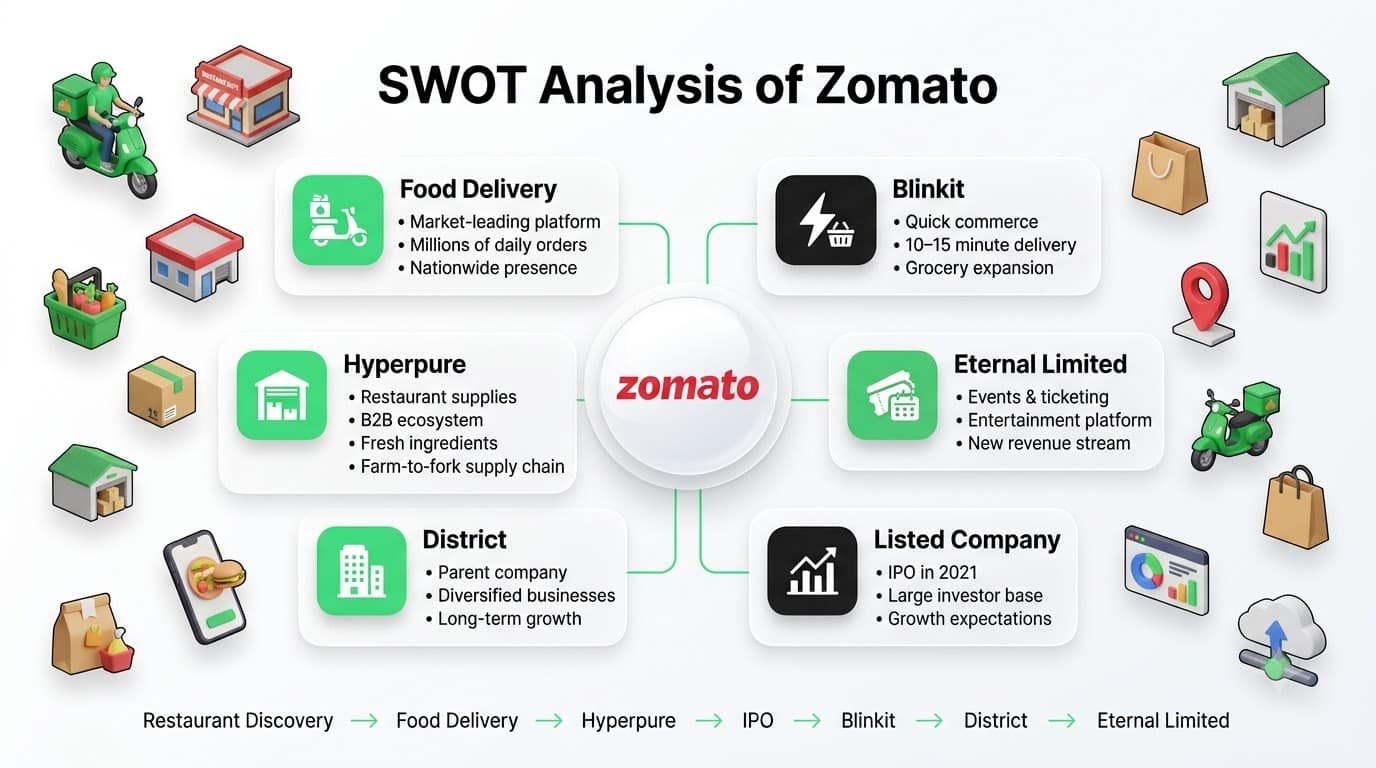
Before jumping into strengths and weaknesses, let’s get some context straight, because a SWOT analysis of Zomato only makes sense once you understand what the company actually looks like today. Zomato started as a restaurant discovery platform in Delhi. Two guys, Deepinder Goyal and Pankaj Chaddah, built it because they were tired of asking around for menu cards at their office. From that small idea, it grew into food delivery, then into cloud kitchens, then into grocery delivery through the Blinkit acquisition in 2022, and now into live events and ticketing through District. Along the way it also picked up Hyperpure, a business that supplies raw ingredients to restaurants, which nobody outside the industry really talks about but which quietly makes solid money.
The company went public in July 2021, and that IPO was a big deal because it was one of the first major new-age internet companies from India to list on the stock exchange. Investors weren’t entirely sure how to value a company that was burning cash to grow, but a few years later Zomato actually turned profitable, which surprised a lot of skeptics who assumed food delivery companies in India would just keep bleeding money forever. Then in 2024, the parent entity rebranded itself as Eternal Limited, keeping Zomato as the food delivery brand name while the group structure changed. That’s a detail people miss, and it matters because when you’re doing a SWOT analysis of Zomato you’re really analyzing a group of businesses, not just an app that brings you dinner.
What makes this analysis worth reading closely is that Zomato sits at an odd intersection. It’s old enough to have institutional memory about what worked and what flopped in Indian food delivery, but young enough as a diversified group to still be figuring out whether Blinkit, District, and Hyperpure will each become real standalone winners or just expensive experiments. That tension shows up everywhere in this SWOT, strengths that are also weaknesses, opportunities that carry real threats attached to them, and a management team that seems to genuinely enjoy making bold, sometimes confusing bets rather than playing it safe.
It also helps to remember how young this entire industry still is in India. Ten years ago, ordering food on an app was a novelty mostly limited to a handful of neighborhoods in a few big cities, and grocery delivery in fifteen minutes would have sounded like science fiction to most people. The fact that Zomato has managed to stay relevant, keep growing, and eventually turn a profit through that entire wild period of experimentation, failed competitors, and shifting consumer habits says something about how the leadership team has approached the business. They’ve made expensive mistakes along the way too, the pulled international markets being the clearest example, but they’ve generally been quick to admit when something isn’t working and redirect resources somewhere else rather than stubbornly doubling down on a losing bet for years.
What You Will Learn in This Guide
- How Zomato’s brand power and city-level dominance translate into real competitive advantages
- Why thin delivery margins and gig worker issues remain a persistent weakness
- Where the real opportunities sit, from tier 2 and tier 3 cities to quick commerce expansion
- What threats could actually hurt Zomato’s business model over the next few years
- How Blinkit, District, and Hyperpure fit into the bigger SWOT picture
- Why restaurant partners keep complaining about commissions and what that means long term
- How regulatory changes around gig work could reshape the company’s cost structure
- Answers to the most common questions people ask about Zomato’s business and strategy
Each of these points gets its own full breakdown later in the article, so if you’re skimming right now, don’t worry, we’re not leaving anything half explained. This guide walks through every angle with real numbers, real business logic, and zero fluff.
Zomato Strengths
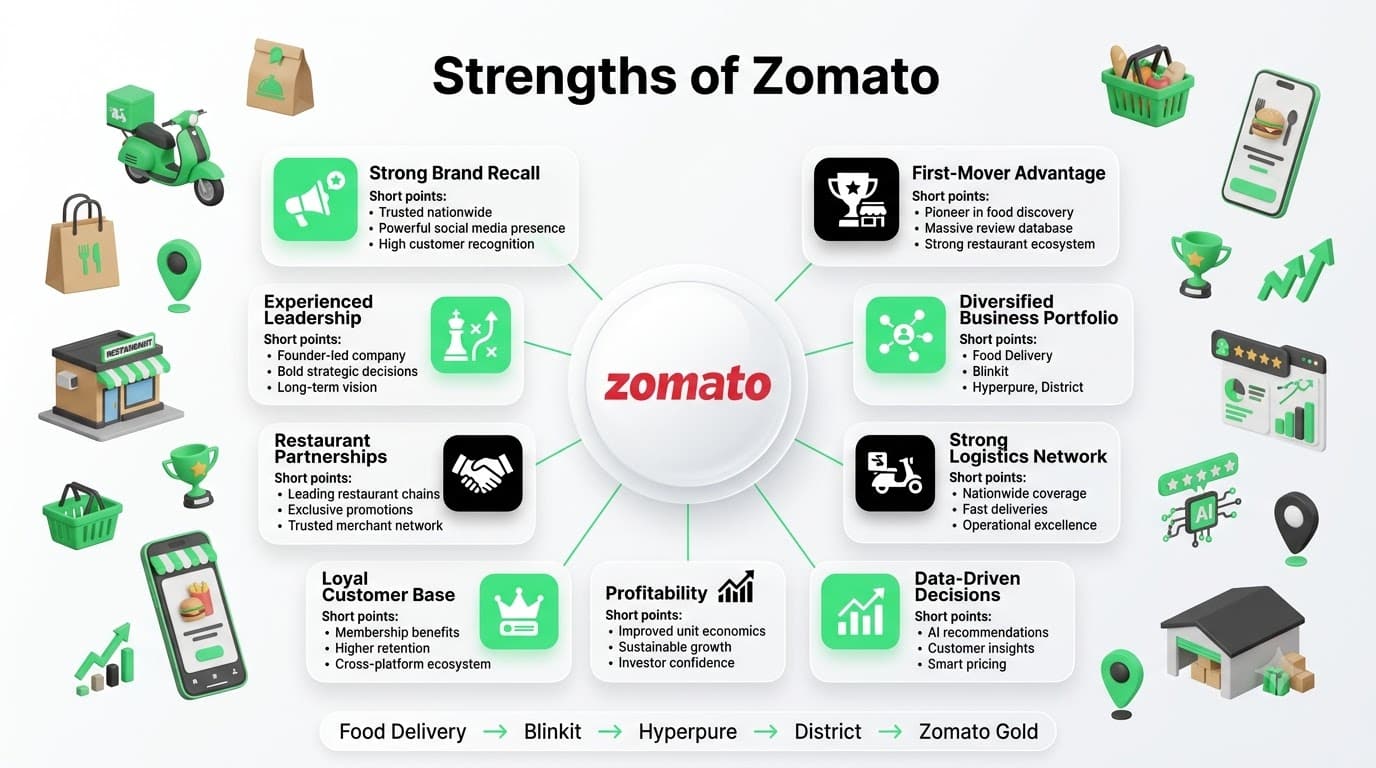
Let’s start with what Zomato actually does well, because there’s a lot here, and some of it isn’t obvious unless you’ve watched the company operate for years. A strength in a SWOT framework isn’t just “the app works fine.” It’s something that gives the company a real edge that competitors struggle to copy. Zomato has built a handful of those, and they compound on each other in ways that make the whole business harder to attack than it looks from the outside.
Strong Brand Recall Across India
Ask anyone in a metro city to name a food delivery app and Zomato is probably the first or second word out of their mouth. That kind of brand recall doesn’t happen by accident, it happens through years of consistent advertising, witty social media posts, and a product that actually delivers what it promises most of the time. Zomato’s Twitter and Instagram game has genuinely been one of the smarter brand-building tools in Indian tech, with copywriting that feels human instead of corporate, and that builds a kind of goodwill that’s hard to buy with ad spend alone.
That brand equity carries real commercial weight too. When Zomato launches a new feature, a new city, or even a new business line like District, it doesn’t need to explain what Zomato is first. Users already trust the name, which cuts down customer acquisition cost significantly compared to a brand new startup trying to earn that same trust from scratch in a crowded market.
Massive First Mover Advantage in Food Discovery
Zomato didn’t invent food delivery, but it was one of the earliest platforms in India to combine restaurant discovery with reviews and ratings, long before delivery became the main business. That early presence meant it had years to build restaurant relationships, collect user reviews, and become the default place people check before eating out. By the time delivery became the bigger revenue driver, Zomato already had the trust and the data to make that transition look easy, even though building that kind of database from scratch today would take a new entrant years.
This head start also means Zomato holds one of the largest restaurant review databases in the country, spanning cuisines, price points, and cities most competitors haven’t even mapped properly. That database still quietly powers a huge chunk of daily decision making for users who aren’t even ordering delivery, just checking where to eat out that evening.
Diversified Business Portfolio
This is where Zomato has genuinely changed its risk profile. Food delivery alone is a low-margin, high-competition business. But Zomato isn’t just food delivery anymore. Blinkit handles grocery and quick commerce, District handles live events and dining reservations, and Hyperpure supplies restaurants with ingredients and kitchen equipment. When one segment slows down, the others can pick up slack, and that diversification is something Swiggy has tried to copy with Instamart but hasn’t matched at the same scale, especially in the grocery quick commerce race where Blinkit has genuinely pulled ahead.
This kind of portfolio also gives investors more reasons to stay patient. A weak quarter in food delivery doesn’t necessarily tank the whole stock story anymore if Blinkit posts strong growth numbers in the same period, and that kind of internal hedge is something a single-business competitor simply doesn’t have.
Strong Logistics and Delivery Network
Zomato has spent over a decade building a delivery fleet that covers hundreds of Indian cities, from massive metros down to smaller towns most other apps haven’t bothered entering yet. That network isn’t just riders on bikes, it’s route optimization, hyperlocal warehousing for Blinkit’s dark stores, and a level of operational experience that’s genuinely hard to replicate quickly. A new competitor can raise money and hire riders, sure, but matching a decade of operational learning about which routes work, which cities are profitable, and how to handle festival-season order spikes takes actual time.
This logistics backbone is also shared across businesses in smart ways. Delivery infrastructure originally built for food orders now supports Blinkit’s grocery drops and even some of Hyperpure’s restaurant supply runs, which spreads fixed costs across multiple revenue lines instead of building three separate delivery networks from zero.
Data-Driven Decision Making
Every order placed on Zomato generates data, what people eat, when they eat, how much they spend, which restaurants they favor, which areas have demand gaps. Zomato uses this to recommend restaurants, optimize delivery times, and even help restaurant partners figure out what dishes to push. This isn’t some abstract “big data” claim either, it directly feeds into things like Zomato Gold recommendations and dynamic delivery fee pricing, giving the company a pricing and personalization edge that a brand-new entrant simply doesn’t have access to on day one.
That same data also helps Zomato decide where to open new Blinkit dark stores or which neighborhoods are ready for a District rollout, turning years of food ordering data into a genuine roadmap for expanding entirely different business lines, which is a pretty clever use of an existing asset most companies would let sit idle.
Profitability Turnaround
For years, critics said Zomato would never make money, that food delivery in India was a race to the bottom with thin margins and heavy discounting. Then the company actually posted consolidated profits, driven by better unit economics in food delivery and Blinkit scaling toward profitability too. That turnaround matters a lot for a SWOT analysis of Zomato because it changes the company’s negotiating position with investors, restaurants, and even regulators. A profitable company can afford to play a longer game than one that’s constantly worried about runway.
It also changes how the company is perceived by talent and by potential acquisition targets. Profitable companies find it easier to hire senior leadership, negotiate better terms in acquisitions, and generally operate from a position of strength rather than constantly justifying their existence to skeptical analysts on every earnings call.
Loyal User Base Through Zomato Gold and Cross-Platform Bundling
Zomato’s loyalty program, now bundled across food delivery, Blinkit, and District in various forms, keeps users inside the ecosystem instead of hopping between apps for every single purchase. Once someone is paying for a membership that gives them benefits across three different services, the switching cost to a competitor that only offers one of those services goes up noticeably, even if that competitor’s individual app experience is slightly better on any single dimension.
Strong Relationships With Restaurant Chains and Large Brands
Beyond individual restaurants, Zomato has built long-standing relationships with national and regional restaurant chains, the kind of partners who bring consistent order volume and reliable quality across cities. These relationships give Zomato negotiating leverage on things like exclusive launch tie-ups, co-branded promotions, and priority placement deals that smaller competitors trying to build a restaurant network from scratch simply can’t offer on day one. Big chains also tend to stick with the platform that already has the most users, which reinforces Zomato’s position every time a new large brand decides which delivery partner to prioritize.
Experienced Leadership With a Track Record of Bold Bets
Deepinder Goyal has been at the helm since the company’s earliest days, and while founder-led companies can go either way, in Zomato’s case that continuity has generally translated into decisive strategic moves, the Blinkit acquisition, the District launch, the willingness to pull out of unprofitable international markets, rather than the slow, committee-driven decision making that tends to plague larger, more bureaucratic organizations. That kind of leadership stability also matters to investors and employees alike, since it signals the company isn’t going to suddenly lurch in a different strategic direction every time a new executive rotates through.
Zomato Weaknesses
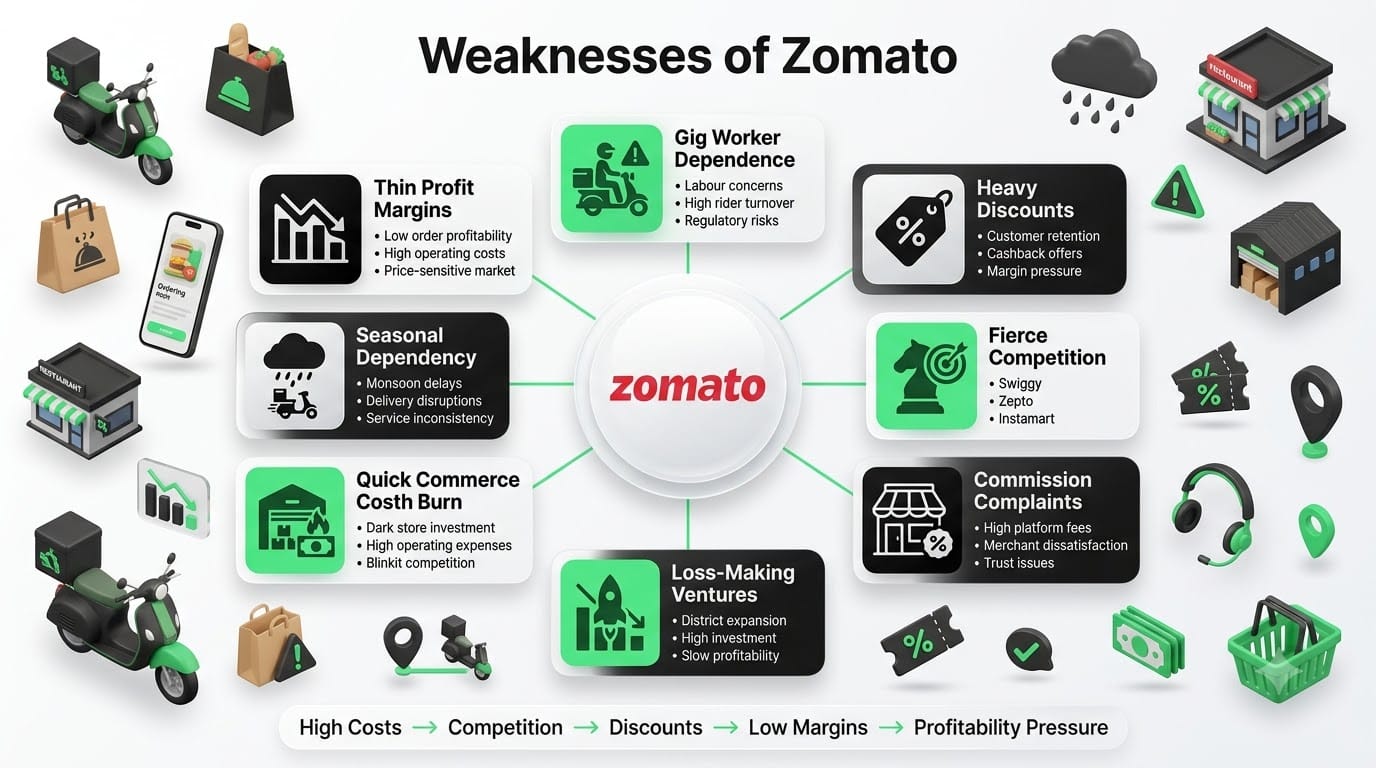
Now for the uncomfortable part. No company is perfect, and Zomato has real weaknesses that show up in its financials, its public perception, and its day-to-day operations. Some of these are structural problems with the food delivery business model itself, and some are specific to how Zomato runs things. Either way, ignoring them would make this a useless SWOT analysis of Zomato, so let’s be honest about where the cracks are.
Thin Margins in Core Food Delivery
Food delivery, even at scale, doesn’t make a lot of money per order. Between delivery partner payouts, discounts to keep customers ordering, and the cost of running the platform, the actual profit per food order is razor thin. Zomato has improved this over the years through better logistics and reduced discounting, but the core business still isn’t a high-margin machine like software or advertising. That means growth has to come from volume and adjacent businesses rather than just raising prices, because Indian consumers are famously price sensitive and will switch apps over a ten rupee difference.
Even small operational hiccups, a rider shortage during monsoon season, a spike in fuel prices, or a sudden surge in orders during a cricket match, can eat directly into that thin margin in ways that a higher-margin business would barely notice.
Dependence on Gig Workers and Labor Issues
Zomato’s entire delivery network runs on gig workers who aren’t classified as full employees, which keeps costs lower but has led to repeated criticism, protests, and even strikes over pay cuts and working conditions in different cities. This isn’t a small PR problem either, it’s a structural risk. If labor regulations in India tighten around gig work, which has been a live policy conversation for years now, Zomato’s entire delivery cost structure could shift overnight, and that’s the kind of risk that doesn’t show up clearly in a quarterly earnings call but sits there quietly in the background.
Rider attrition is also a real operational headache. Training new delivery partners, onboarding them into the app, and getting them familiar with local routes takes time and money, and high turnover in this workforce means Zomato is constantly running that onboarding cycle rather than benefiting from a stable, experienced fleet.
Heavy Reliance on Discounts to Retain Customers
Indian consumers have been trained, partly by Zomato itself, to expect discounts, free delivery, and cashback on almost every order. Pulling back on these offers often leads to a noticeable dip in order volume, which puts the company in an awkward spot. It needs discounts to keep users engaged, but discounts eat into the very margins it’s trying to protect. This tension between growth and profitability is a genuine weakness that doesn’t have an easy fix, and it’s one reason quarterly results can swing based on how aggressive the discounting was that quarter.
This discount dependency also makes forecasting harder for the company itself. Internal teams have to constantly model how much a promotional push will cost against how much order volume it’ll actually generate, and getting that calculation wrong in either direction shows up directly in the bottom line.
Intense Competition Eating Into Market Share
Swiggy isn’t going anywhere, and in the quick commerce space, Zepto has grown aggressively and taken meaningful share from Blinkit in certain cities. This constant competitive pressure means Zomato can’t just coast on brand strength, it has to keep spending on marketing, keep investing in dark stores, and keep matching competitor pricing, which again puts pressure on margins. A weakness in a SWOT framework is something that limits the company’s options, and having to constantly react to competitor moves instead of setting the pace is exactly that kind of limitation.
This competitive intensity has also made customer loyalty shallower across the whole industry. Users increasingly compare prices across two or three apps before placing an order, which erodes the pricing power any single platform, including Zomato, can actually exercise.
Restaurant Partner Complaints Over Commission Rates
Restaurant owners, especially smaller and independent ones, have complained for years about the commission Zomato charges, sometimes as high as 20 to 30 percent of order value. For a restaurant with thin margins itself, that commission can be the difference between profit and loss on delivery orders. Some restaurants have started pushing customers toward their own websites or WhatsApp ordering to avoid these fees entirely, and while that hasn’t dented Zomato’s overall order volume dramatically, it’s a slow erosion of trust with the very partners the platform depends on.
There have even been organized protests by restaurant associations in some cities demanding lower commission rates and more transparency in how Zomato ranks restaurants within the app, which suggests this isn’t just background noise but a recurring point of friction that shows up in the news cycle regularly.
Losses in Newer Business Segments
While food delivery and Blinkit have shown improving profitability, other bets like District, the events and going-out platform, are still in early stages and burning cash as they try to build scale against established players like BookMyShow and Paytm Insider. Investing in new segments is normal and even necessary, but until these newer bets prove themselves, they represent a drag on overall profitability and a genuine question mark for anyone evaluating the company’s near-term financial health.
Customer Service Complaints and App Reliability Issues
Anyone who’s used delivery apps regularly has run into at least one bad experience, an order that arrived cold, a refund that took days to process, or a support chat that felt like talking to a wall. Zomato has improved its customer service over the years with better in-app resolution tools, but at the scale it operates, even a small percentage of bad experiences translates into a large absolute number of frustrated users, and those stories spread fast on social media, sometimes doing more brand damage than the actual failure rate would suggest.
Cash Burn in the Quick Commerce Race
Even though Blinkit is a genuine growth story, winning the quick commerce race has required, and continues to require, heavy spending on dark stores, inventory, discounts, and delivery infrastructure just to keep pace with Zepto and Instamart. That spending puts real pressure on group-level profitability, and if the category ever cools off or if one of the well-funded rivals decides to fight even harder on price, Zomato could find itself needing to burn cash again just to defend the ground it’s already won, which is a genuinely uncomfortable position for a company that worked so hard to reach profitability in the first place.
Seasonal and Weather-Related Demand Swings
Monsoon season in most Indian cities is a genuine headache for delivery operations, riders slow down for safety reasons, roads flood, orders spike because nobody wants to step outside, and delivery times stretch out in ways that frustrate customers no matter how good the underlying technology is. This kind of seasonal volatility isn’t something Zomato can engineer its way out of completely, and it shows up every year as a predictable dip in service quality metrics and customer satisfaction scores during the wettest months, which is a weakness baked into operating a physical delivery business in a country with such extreme weather swings.
Zomato Opportunities
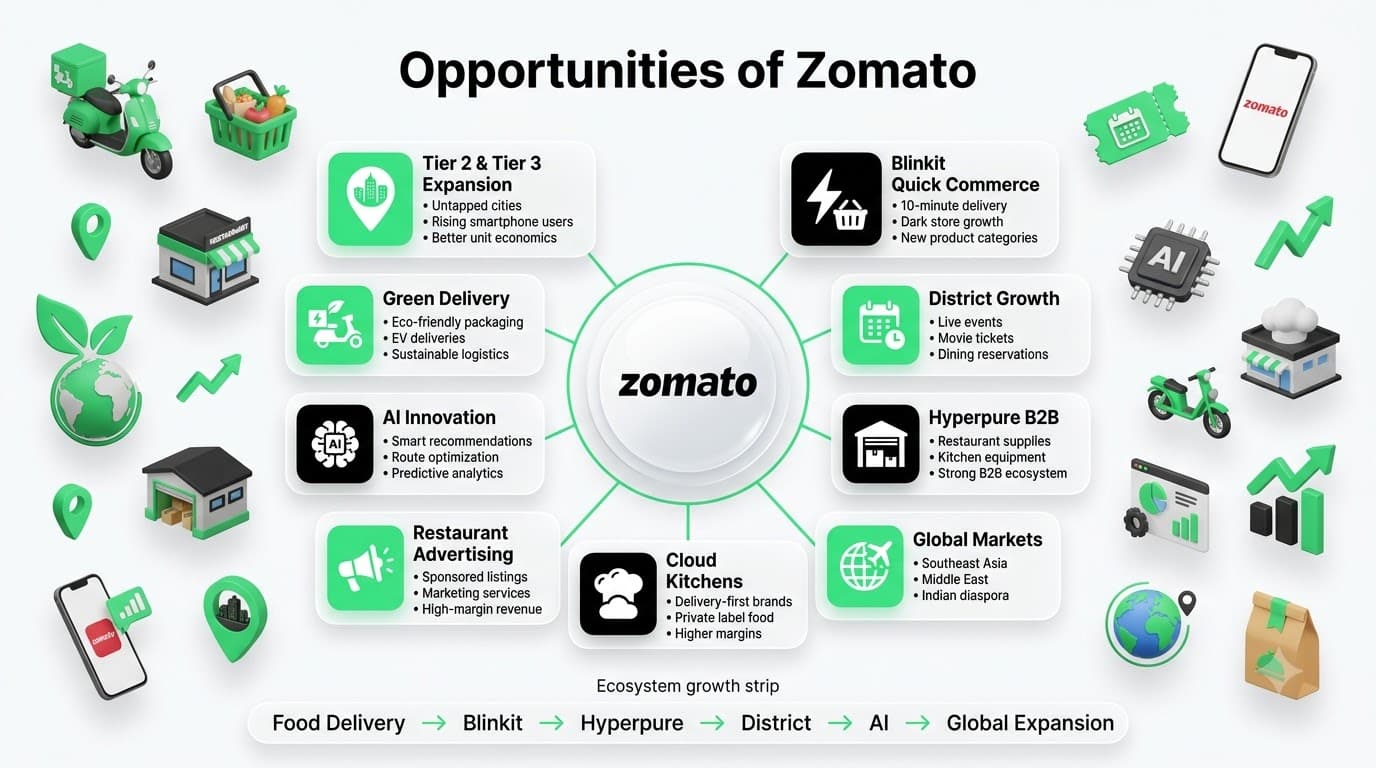
Here’s where things get genuinely exciting, because Zomato has more room to grow than most people realize. India’s internet economy is still young in a lot of ways, and there are entire categories and geographies where Zomato hasn’t even scratched the surface yet. Let’s go through the biggest ones.
Expansion Into Tier 2 and Tier 3 Cities
The metros are getting saturated, everyone in Mumbai, Delhi, and Bangalore who wants to order food online is probably already doing it. But smaller cities like Indore, Coimbatore, Jaipur, and dozens of others still have huge untapped demand, growing incomes, and increasing smartphone penetration. Zomato has been pushing into these markets, but there’s still a lot of runway left, and whoever wins these cities first tends to keep the loyalty of users who don’t switch apps as easily as jaded metro users do.
These smaller cities also tend to have lower delivery costs per order because of shorter distances and less traffic congestion, which means the unit economics of expanding here can actually look better than they do in an overcrowded metro, something that isn’t always obvious until you actually run the numbers city by city.
Growth of Quick Commerce Through Blinkit
Quick commerce, delivering groceries and daily essentials in ten to fifteen minutes, has exploded in India, and Blinkit is right in the middle of that fight. This category still has years of growth ahead as more cities get dark stores and as consumer habits shift away from weekly grocery trips toward on-demand ordering. If Blinkit keeps scaling its dark store network smartly and keeps unit economics under control, this could end up being the single biggest growth driver for the entire Zomato group, potentially even bigger than food delivery itself in a few years.
There’s also room to expand what Blinkit actually sells beyond groceries, electronics accessories, beauty products, and even pharmacy items are already showing up in quick commerce catalogs across the industry, and every new category added is another reason for a user to open the app more often instead of just during a grocery emergency.
Building Out District as an Events and Going-Out Platform
District is Zomato’s answer to the massive Indian market for movie tickets, live events, concerts, and restaurant reservations, a space currently dominated by BookMyShow. India’s live events and entertainment spending has been climbing fast, especially post-pandemic, with concerts by international artists selling out in minutes and local events scaling up too. If District can carve out even a meaningful slice of this market by bundling it with Zomato’s existing user base, that’s a whole new revenue stream that doesn’t depend on food delivery economics at all.
The real advantage District has is distribution. It doesn’t need to build an audience from scratch, it can cross-promote directly to millions of existing Zomato and Blinkit users, which is a shortcut most standalone ticketing startups would kill for.
Growing Hyperpure Into a Bigger B2B Play
Hyperpure supplies fresh ingredients, packaging, and kitchen equipment to restaurants, and it’s honestly one of the most underrated parts of the Zomato ecosystem. Every restaurant needs a reliable ingredient supply chain, and Hyperpure can use Zomato’s existing restaurant relationships to sell into this market without having to build trust from scratch. As this business scales, it could become a steady, high-volume revenue stream that’s less exposed to consumer discounting behavior than the food delivery side of things.
There’s also an interesting long-term angle here where Hyperpure’s data on ingredient demand and pricing trends could feed back into Zomato’s own restaurant recommendations and menu insights, creating a loop where two seemingly separate businesses actually make each other smarter over time.
International Expansion Possibilities
Zomato actually pulled back from several international markets a few years ago to focus on India, which was the right call at the time given how much cash those markets were burning. But as the Indian business matures and throws off more consistent profit, there’s room to selectively re-enter international markets, especially in regions with large Indian diaspora populations or similar food delivery dynamics to India, like parts of Southeast Asia or the Middle East, where the operational playbook could transfer more easily than starting from zero.
A smarter international strategy this time around would likely mean picking two or three focused markets and going deep rather than the scattershot approach of spreading thin across a dozen countries, which is what burned cash so badly the first time around.
Rise of Cloud Kitchens and Private Label Food Brands
Cloud kitchens, restaurants that exist only for delivery with no dine-in space, are cheaper to set up and easier to scale than traditional restaurants. Zomato has the data to identify exactly what kind of food is in demand in which neighborhoods, which makes it uniquely positioned to either partner with cloud kitchen operators or even experiment with its own private label food brands in underserved cuisine categories, something that could open up an entirely new margin structure compared to just taking commission on other people’s restaurants.
Advertising and Restaurant Marketing Services
Beyond delivery commissions, Zomato has a growing opportunity in selling advertising space and promotional placement to restaurants wanting more visibility within the app, similar to how e-commerce platforms monetize sponsored product listings. This kind of ad revenue tends to carry much higher margins than delivery itself, and as more restaurants compete for limited screen space during peak ordering hours, this could become a meaningfully larger slice of overall revenue over the next few years.
Deeper Use of AI for Personalization and Operations
Every part of Zomato’s business, from suggesting what to order to figuring out the fastest delivery route to predicting how many riders a city will need during a festival weekend, can get sharper with better AI models. This isn’t just a buzzword opportunity either, small improvements in things like delivery time prediction or restaurant recommendation accuracy compound across hundreds of millions of orders, and even a modest percentage improvement in efficiency at that scale translates into real money saved and real customer satisfaction gained. Companies that get serious about this early tend to build a lead that’s hard for slower-moving competitors to close later.
Sustainable Packaging and Green Delivery Initiatives
Consumers, especially younger urban ones, are increasingly vocal about packaging waste from food delivery, and there’s a real opportunity for Zomato to lead on sustainable packaging standards, electric delivery vehicles, and carbon-conscious logistics in a way that actually differentiates the brand rather than just being a marketing checkbox. Early movers on genuine sustainability initiatives in this space tend to earn disproportionate goodwill from exactly the kind of younger, higher-spending urban customers that food delivery and quick commerce businesses most want to retain long term.
Zomato Threats
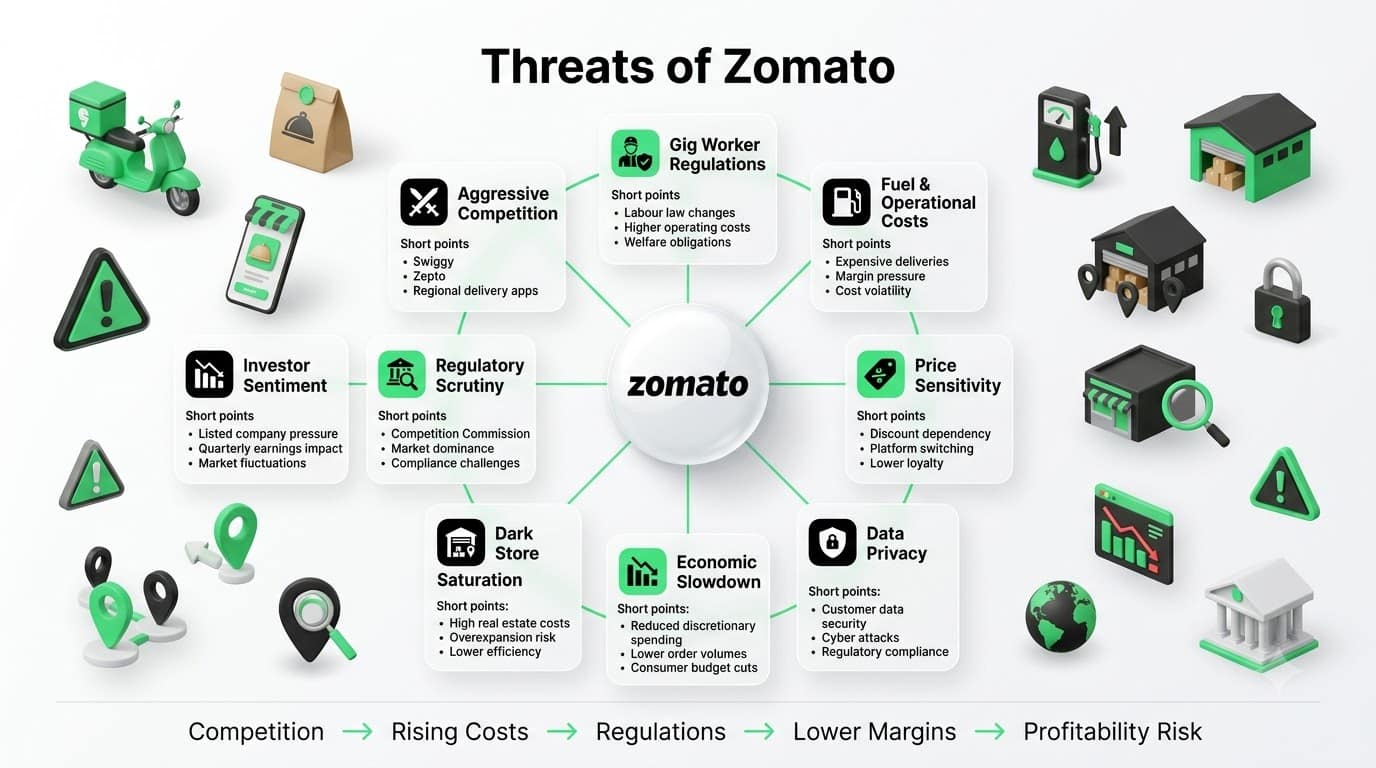
No SWOT analysis of Zomato would be complete without looking honestly at what could actually hurt this business. Some of these threats are competitive, some are regulatory, and some are just structural risks baked into the industry itself.
Aggressive Competition From Swiggy and Zepto
Swiggy remains Zomato’s closest rival in food delivery, and the two have been locked in a pricing and feature war for years that shows no sign of slowing down. Meanwhile Zepto has grown at a genuinely startling pace in quick commerce, forcing Blinkit to keep spending aggressively just to defend its position. This kind of sustained competitive pressure from well-funded rivals means Zomato can never really relax, and any slip in service quality or pricing gives users an easy reason to switch, because switching costs in this industry are basically zero.
New entrants and regional players also keep popping up in specific cities or categories, and while none of them individually threaten Zomato’s national dominance, collectively they chip away at margins by forcing localized price wars that spread across the broader market.
Regulatory Risk Around Gig Worker Classification
Governments in India and around the world have been debating how gig workers should be classified, whether they deserve benefits like minimum wage guarantees, insurance, or paid leave typically reserved for full-time employees. If Indian regulations shift significantly in this direction, Zomato’s delivery cost structure, which relies heavily on the flexibility and lower cost of gig work, could take a real hit, and that’s a threat that’s largely outside the company’s control.
Several Indian states have already introduced or discussed gig worker welfare boards and social security contributions from platform companies, and even incremental versions of these policies add real, recurring costs that weren’t part of the original delivery cost model these companies were built around.
Rising Fuel and Operational Costs
Delivery runs on two wheelers and fuel prices in India can be volatile, tied to global crude oil prices and government tax policy. Every spike in fuel costs either eats into Zomato’s margins or has to be passed on to delivery partners or customers, both of which create friction. This is one of those threats that doesn’t grab headlines but quietly affects the bottom line every single quarter, especially given how thin food delivery margins already are.
Consumer Price Sensitivity and Platform Fatigue
Indian consumers have shown time and again that they’ll switch apps for even small savings, and there’s a growing sense of platform fatigue where people juggle multiple apps just to catch whichever one has the best deal that day. If this behavior becomes more entrenched, it forces Zomato into a permanent discounting cycle just to retain order volume, which directly threatens the profitability gains the company has worked hard to build over the past few years.
Data Privacy and Cybersecurity Concerns
Zomato holds a massive amount of personal data, addresses, payment details, ordering habits, for hundreds of millions of users. Any major data breach or privacy scandal wouldn’t just be a PR headache, it could trigger regulatory penalties under India’s data protection laws and cause real user trust issues that take years to rebuild. As data protection regulation in India matures and enforcement gets stricter, this threat only grows larger, not smaller.
Economic Slowdowns Affecting Discretionary Spending
Food delivery and online grocery ordering are still, for a lot of Indian households, discretionary spending rather than essential spending, especially compared to cooking at home or shopping at a local kirana store. In any broader economic slowdown, these categories tend to get cut first as households tighten budgets, which makes Zomato’s revenue somewhat exposed to macroeconomic conditions outside its own control, something investors watch closely every time inflation numbers or GDP growth figures come out.
Dark Store Saturation and Real Estate Costs in Quick Commerce
As Blinkit and its competitors race to open more dark stores in every neighborhood, the cost of leasing commercial real estate in dense urban areas keeps climbing. At some point, adding more dark stores in an already saturated area stops improving delivery speed meaningfully and just adds fixed cost, which means the quick commerce race, while a huge opportunity, also carries a real risk of overexpansion if growth targets push the pace faster than the economics can support.
Potential Regulatory Scrutiny Over Market Dominance
As Zomato and its handful of major rivals consolidate more and more of India’s food delivery and quick commerce spending between them, there’s a growing chance that competition regulators start paying closer attention to pricing practices, restaurant listing algorithms, and how dominant platforms treat smaller sellers on their marketplace. Other large tech platforms globally have faced exactly this kind of scrutiny once they got big enough, and there’s no reason to assume Indian regulators won’t eventually take a harder look at how much control a small number of delivery and commerce apps have over both consumer prices and restaurant or seller livelihoods.
Currency and Investor Sentiment Risk Tied to a Listed Stock
Being a publicly listed company cuts both ways. It gave Zomato access to public markets and the credibility that comes with an IPO, but it also means the stock price reacts to broader market sentiment, global tech selloffs, and quarterly earnings expectations that don’t always reflect the actual underlying health of the business. A single disappointing quarter, even one caused by something as ordinary as higher marketing spend during a competitive push, can trigger a sharp stock reaction that then affects the company’s ability to raise capital cheaply or make acquisitions using stock as currency, which is a threat that didn’t really exist back when Zomato was still a private company answering only to venture investors.
Conclusion
Putting this whole SWOT analysis of Zomato together, what you see is a company that’s genuinely matured from a scrappy food discovery app into a diversified consumer internet business with real profitability and real strategic options. The strengths, brand power, logistics network, data advantage, and diversification, are legitimate and hard for competitors to copy overnight. But the weaknesses are just as real, thin margins, gig worker dependency, and heavy reliance on discounting aren’t going away just because the company posted a good quarter.
The opportunities in front of Zomato, especially in quick commerce and smaller cities, are big enough to genuinely reshape the company’s revenue mix over the next few years. And the threats, from Swiggy and Zepto’s aggression to regulatory risk around gig work, aren’t hypothetical, they’re playing out in the news cycle regularly. That’s really what makes Zomato worth studying closely if you’re into business strategy, it’s not a simple story with an obvious ending, it’s a company juggling multiple bets at once and mostly pulling it off so far, though nothing here is guaranteed to stay that way forever.
If you zoom out even further, Zomato’s real test over the next few years isn’t going to be whether food delivery stays profitable, that piece of the puzzle looks reasonably settled at this point. It’s going to be whether Blinkit can keep winning against Zepto without burning cash forever, whether District actually becomes a real business instead of a permanent experiment, and whether the company can keep all these moving pieces coordinated without losing focus on any single one. Companies that try to do too many things at once often end up doing none of them particularly well, and that’s the risk sitting quietly underneath every strength listed at the top of this article. Whether Zomato avoids that trap or falls into it is honestly one of the more interesting business stories to watch in Indian tech over the next few years, and anyone tracking the space would do well to keep revisiting this SWOT analysis of Zomato as new numbers come in each quarter.
Frequently Asked Questions
What is the biggest strength of Zomato as of 2026?
Zomato’s biggest strength is honestly its diversified portfolio combined with brand recall. It’s not just a food delivery app anymore, it’s a group of businesses spanning food, grocery through Blinkit, events through District, and B2B supply through Hyperpure, all riding on a brand that most Indians instantly recognize and trust. That combination of trust and diversification gives it options competitors without a similar portfolio simply don’t have.
Is Zomato profitable in 2026?
Yes, Zomato, under its parent Eternal Limited, has moved into consistent profitability in recent years, driven by improved unit economics in food delivery and Blinkit scaling toward profitability. That said, newer segments like District are still in an investment phase and not yet contributing positively to overall profits, so overall group profitability depends heavily on how the mature segments perform each quarter.
What is Zomato’s biggest weakness?
The thin margins in the core food delivery business remain the biggest structural weakness. Between delivery costs, discounting to retain price-sensitive customers, and competitive pressure, the food delivery segment alone doesn’t generate huge profit per order, which is exactly why the company has pushed hard into other business lines with potentially better margin profiles.
How does Blinkit fit into Zomato’s SWOT analysis?
Blinkit is arguably Zomato’s biggest opportunity right now. Quick commerce in India is growing fast, and Blinkit has built a strong position in that race, though it faces intense competition from Zepto. It’s listed as both a strength, given its scale and execution, and an opportunity, given how much room the category still has to grow across smaller cities and new product categories.
Why do restaurants complain about Zomato’s commission rates?
Restaurants, especially smaller independent ones, often pay commissions in the range of 20 to 30 percent per order, which eats significantly into their margins. For a restaurant already operating on thin profits, that commission can be the difference between breaking even and losing money on delivery orders, which is why some restaurants push customers toward direct ordering channels or organize public protests demanding lower rates.
What is District and how does it relate to Zomato?
District is Zomato’s platform for live events, movie tickets, concerts, and restaurant reservations, essentially competing with BookMyShow in the going-out and entertainment space. It’s part of the company’s strategy to diversify beyond food delivery and tap into India’s growing spending on entertainment and experiences, using Zomato’s existing user base as a built-in audience.
Is Zomato facing threats from gig worker regulations?
Yes, this is a genuine and ongoing threat. Gig worker classification and rights have been debated in Indian policy circles for years, and any significant regulatory shift toward treating delivery partners as employees rather than independent contractors could raise Zomato’s operational costs considerably, especially given how central gig labor is to the entire delivery model.
How does Zomato compete with Swiggy?
Zomato and Swiggy compete on nearly every front, delivery speed, restaurant tie-ups, discounts, loyalty programs like Zomato Gold versus Swiggy One, and now quick commerce through Blinkit versus Instamart. It’s a constant back-and-forth where neither company can afford to fall behind on pricing or service quality for too long without losing market share to the other.
What role does Hyperpure play in Zomato’s business?
Hyperpure supplies restaurants with fresh ingredients, packaging materials, and kitchen equipment, essentially acting as a B2B supply chain business. It leverages Zomato’s existing relationships with restaurant partners and has quietly become a steady, growing revenue stream that’s less dependent on consumer discounting than the food delivery side of the business.
Can Zomato expand internationally again?
It’s possible, though Zomato pulled back from several international markets a few years ago to focus resources on India. As the domestic business matures and generates more consistent profit, a more selective, better-planned international push isn’t out of the question, particularly in markets with similar delivery dynamics to India rather than a broad scattershot expansion.
What are the main opportunities for Zomato’s growth going forward?
The biggest opportunities include deeper expansion into tier 2 and tier 3 Indian cities, continued growth of Blinkit in the quick commerce space, scaling District into a real competitor to BookMyShow, growing Hyperpure into a larger B2B ingredient supply business, and building out higher-margin advertising revenue from restaurant partners wanting more visibility.
How does economic slowdown affect Zomato’s business?
Food delivery and online grocery are still discretionary spending for many Indian households compared to cooking at home or shopping locally. During economic slowdowns, households often cut back on these categories first, which means Zomato’s revenue can be sensitive to broader macroeconomic conditions like inflation and consumer spending confidence.
Why is quick commerce considered risky as well as an opportunity for Zomato?
Quick commerce is growing fast, but the dark store model that powers it requires significant real estate and inventory investment in every neighborhood a company wants to serve. As competition pushes companies to open more stores faster, there’s a real risk of overexpansion where fixed costs rise faster than the delivery speed benefits actually justify, which is why this category sits in both the opportunities and threats sections of this analysis.
Does Zomato’s brand strength actually translate into pricing power?
Not as much as you’d expect. Even with strong brand recall, Indian consumers remain highly price sensitive and will switch to whichever app has the better deal on a given day. Zomato’s brand helps with trust and initial download decisions, but it doesn’t fully insulate the company from having to compete aggressively on price and discounts.
How has the rebrand to Eternal Limited changed how people should read Zomato’s SWOT?
The rebrand mostly changed the corporate wrapper rather than the day-to-day product experience, Zomato is still the name on the food delivery app people use. But for anyone doing a proper SWOT analysis of Zomato, it’s a reminder that you’re evaluating a holding structure with multiple business lines, food delivery, Blinkit, District, and Hyperpure, each of which deserves its own mini analysis rather than being lumped together as one undifferentiated business.
Is Zomato vulnerable to a new competitor entering the market from scratch?
It’s unlikely a brand new company could challenge Zomato’s core food delivery business without an enormous amount of funding, given how much capital and time it takes to build restaurant relationships, a delivery fleet, and user trust at scale. The more realistic threat comes from well-funded adjacent players, like a quick commerce company expanding into food delivery, rather than a completely new startup trying to build everything from zero.
What should investors watch most closely in Zomato’s SWOT going forward?
The clearest signal to watch is how Blinkit’s unit economics evolve as competition with Zepto continues, since that business is increasingly central to the group’s growth story. Alongside that, keeping an eye on whether District can meaningfully narrow its losses over the next few reporting periods will tell you a lot about whether management’s diversification bets are actually paying off or just adding complexity without adding value.