



Look, if you’ve been running ads for more than a month, you already know the feeling. You launch a campaign, you’re excited, the creative looks great, the copy is punchy, and then… nothing. Or worse, it works for three days and then the numbers crash. You’re sitting there refreshing the dashboard wondering what went wrong, and honestly, most of the time the answer isn’t your product or your budget. It’s that you never actually tested the ad properly before scaling it.

That’s the thing nobody tells you when you start running paid campaigns. Everyone talks about targeting, budgets, bidding strategies, all that stuff. But the real difference between an account that burns cash and one that prints money usually comes down to one boring, unsexy habit: running a proper ad test before you commit real money to anything.
I’ve seen accounts spend $50,000 a month without ever running a single structured test. They just guess, launch, and hope. And then I’ve seen scrappy accounts with $2,000 a month budgets outperform them because every single dollar was backed by data from an actual ad test. That gap isn’t talent. It’s process.
This guide is going to walk you through every type of ad test that matters right now, why each one exists, when to use it, and how to actually read the results without lying to yourself (which, by the way, is way easier to do than people admit). We’re not going to talk in vague theory here. We’re going to get into the actual mechanics of split testing, creative testing, audience testing, placement testing, and more, because each of these solves a completely different problem, and using the wrong one at the wrong time wastes money faster than almost anything else in advertising.
What You Will Learn in This Guide
- What an ad test actually is and why most people confuse it with just “trying stuff”
- The ten major types of ad test used by performance marketers today
- How sample size and testing duration change your results completely
- A comparison table breaking down when to use each ad test
- The most common mistakes people make when running an ad test
- Tools that actually help you run a cleaner ad test
- How to read your results without fooling yourself into a false win
- Ten plus frequently asked questions about ad testing, answered honestly
What Is an Ad Test and Why Most Marketers Get It Wrong

An ad test, at its core, is just a controlled way of comparing two or more versions of something in your advertising to see which one performs better against a specific goal. That sounds simple, and it is simple in theory. The problem is that most people running ads don’t actually run a test. They run a vibe check. They launch two ads, glance at the results after a day, pick whichever one has more clicks, and call it a day. That’s not an ad test. That’s guessing with extra steps.
A real ad test needs a few things to actually mean something. You need a clear hypothesis before you even launch anything. You need a single variable that’s changing between versions, not five things at once. You need enough traffic or spend to reach statistical relevance, and you need a defined time window so you’re not just stopping the test the moment you see a number you like. Skip any one of these and your test results are basically noise dressed up as insight.
Here’s what gets me. Marketers will spend hours debating whether to use a blue button or a green button, but they won’t spend ten minutes writing down what success actually looks like before the test starts. That’s backwards. The whole point of an ad test is to remove opinion from the equation. If you already know what you want the answer to be, you’re not testing anything, you’re confirming a bias.
And honestly, the platforms don’t help either. Facebook and Google will happily tell you “ad A is outperforming ad B” after twelve hours and forty clicks, and people take that as gospel. Forty clicks isn’t a sample size, it’s a coin flip. So the first mental shift you need before running any kind of ad test is patience. Testing takes longer than you want it to, and it costs more than you want it to. But skipping it costs way more in the long run.
Types of Ad Test Every Marketer Should Know
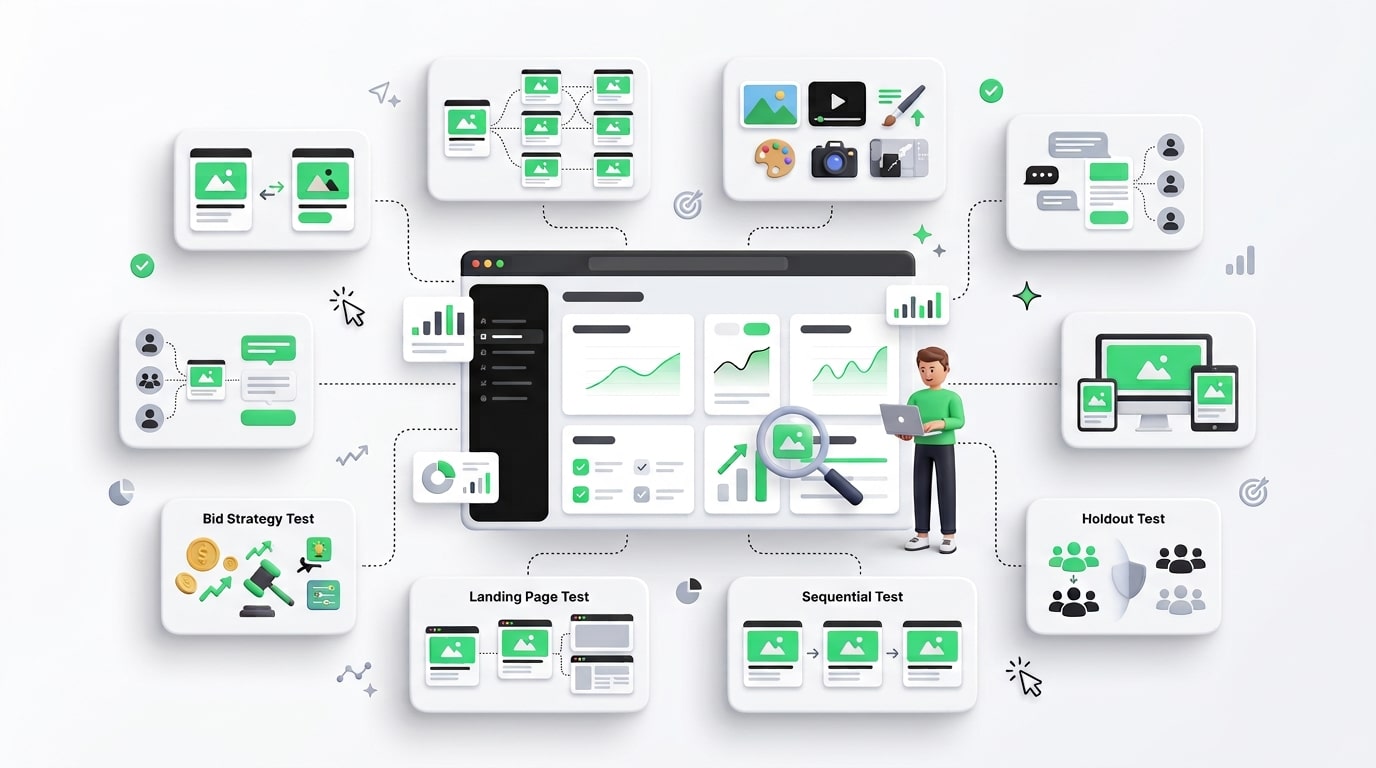
There isn’t just one kind of ad test. That’s actually the biggest misconception out there. People hear “ad testing” and think it only means split testing two headlines against each other. Nope. There are at least ten distinct categories, each built to isolate a different variable in your campaign. Let’s go through them one by one, because knowing which type of ad test to run at which stage of your campaign is honestly half the battle.
Split Ad Test (A/B Testing)
This is the classic. A split ad test, also called an A/B test, takes one single element and changes it while keeping everything else identical. Maybe it’s the headline. Maybe it’s the image. Maybe it’s the call to action button text. You run version A against version B with the same budget, same audience, same placement, and you let the data decide which one wins.
The reason this is still the most common form of ad test after all these years is because it’s clean. When you isolate one variable, you know exactly why one version beat the other. If you change the headline and the image and the audience all at once, and version B wins, you have no idea which of those three changes actually caused the lift. Was it the headline? The image? Pure luck? You genuinely can’t say. That’s why disciplined marketers keep coming back to the split ad test even when fancier options exist. It’s slow, but it’s honest.
A good split ad test needs a decent chunk of budget behind each variant, usually enough to generate at least a few hundred conversions per side if you want real statistical confidence, though for smaller businesses even fifty to a hundred conversions per variant can start showing a directional trend. The key is resisting the urge to call a winner after twenty clicks.
Multivariate Ad Test
Now this one gets more complicated, and honestly, most small to mid-size advertisers shouldn’t even bother with it unless they have serious traffic volume. A multivariate ad test changes multiple elements at once, headline, image, and CTA, for example, and tests every possible combination against each other simultaneously.
So if you have two headlines, two images, and two CTAs, that’s actually eight different combinations being tested at once. The advantage here is that you learn how elements interact with each other. Maybe headline A works great with image 1 but terribly with image 2. A simple split ad test would never reveal that interaction. A multivariate ad test would.
The catch, and it’s a big one, is that you need massive traffic to make this statistically valid. Each of those eight combinations needs enough volume on its own to reach significance. If you’re running a $3,000 a month budget, running a multivariate ad test is basically setting money on fire because you’ll never get enough data per variant to draw real conclusions. This type of ad test really only makes sense for accounts spending well into six figures monthly, or for platforms with huge organic reach.
Creative Ad Test
A creative ad test focuses purely on the visual or video element of the ad, keeping copy, targeting, and placement constant. This is where you test different image styles, video lengths, thumbnail choices, color schemes, or even entirely different creative concepts, like user generated content versus polished studio photography.
Creative fatigue is real, and it happens faster than people expect, sometimes within a week or two on smaller audiences. That’s why a creative ad test isn’t a one time thing you do at campaign launch. It needs to be ongoing. The brands that stay profitable long term are constantly cycling new creative into their tests because what worked in March is dead by May.
What’s interesting about a creative ad test is that the winning creative isn’t always the “prettiest” one. I’ve watched rough, almost ugly UGC style videos crush polished, expensive productions because they felt more native to the platform. That’s exactly why you test instead of assume. Your personal taste in creative direction means nothing if the data says otherwise.
Copy Ad Test
While a creative ad test looks at visuals, a copy ad test isolates the written words, headlines, primary text, descriptions, and CTAs. This might be testing “Save 20% Today” against “Limited Time: 20% Off,” or testing a question-based headline against a statement-based one.
Copy testing tends to get overlooked because visuals feel like the “important” part of the ad, but honestly copy can swing conversion rates just as hard, sometimes harder. A single word change, like swapping “buy now” for “shop now,” has moved conversion rates by double digit percentages in real campaigns I’ve watched play out. That’s wild when you think about how small that change actually is.
The trick with a copy ad test is making sure you’re only changing the copy and nothing else. If you change the headline and also swap the image at the same time, you’ve muddied your results and you’re back to guessing.
Audience Ad Test
An audience ad test compares how the exact same ad performs across different audience segments. Same creative, same copy, same budget allocation logic, different targeting. This could mean testing lookalike audiences against interest based audiences, or testing a broad audience against a narrow one, or comparing age brackets against each other.
This type of ad test matters enormously because even the best ad in the world will flop in front of the wrong audience. I’ve seen identical creative get a 0.8% conversion rate with one audience and a 4.2% conversion rate with another. Same ad. Completely different outcome. That’s not a creative problem, that’s an audience problem, and only an audience ad test reveals it.
A lot of advertisers skip this step because targeting feels like a “set it and forget it” decision made once at campaign setup. That’s a mistake. Audiences shift, interests change, and what worked for cold traffic six months ago might be completely saturated now.
Placement Ad Test
A placement ad test examines how the same ad performs across different platform placements, Instagram feed versus Instagram Stories, Facebook feed versus Facebook Marketplace, YouTube in-stream versus YouTube Shorts, that sort of thing. The same ad can perform completely differently depending on where it shows up, mostly because user intent and behavior differ wildly by placement.
Someone scrolling Stories is in a totally different headspace than someone browsing a feed slowly. A placement ad test helps you figure out where your specific creative and offer resonates best, instead of just letting the algorithm’s automatic placement do all the thinking for you (which, to be fair, is often fine, but not always).
I’ll be honest, a lot of advertisers just trust automatic placements blindly because manually testing placements takes more setup work. But if you’ve got a healthy budget, running a dedicated placement ad test at least once per quarter can reveal some surprisingly cheap, underused placements that your competitors are ignoring.
Bid Strategy Ad Test
This one’s less about the creative and more about the mechanics behind how your ad gets shown. A bid strategy ad test compares different bidding approaches, cost cap versus bid cap, lowest cost versus target cost, manual bidding versus automated bidding, to see which delivers your goal most efficiently.
This type of ad test is often ignored because it feels technical and boring compared to creative testing. But bidding strategy alone can swing your cost per acquisition by 30% or more in some accounts. If you’ve optimized every other element of your campaign and results still feel inconsistent, the bidding strategy might genuinely be the missing piece.
Landing Page Ad Test
Here’s one people forget belongs in the ad testing conversation at all: a landing page ad test. The ad itself might be flawless, driving clicks and engagement, but if the landing page doesn’t match the promise or loads slowly or has a confusing checkout flow, all that ad spend goes to waste anyway.
A landing page ad test pairs the same ad creative with different landing page versions to see which converts better once the click happens. Maybe it’s a long form sales page versus a short simple one. Maybe it’s different headline matching, where the landing page headline mirrors the ad’s exact promise word for word versus a more general headline.
This is honestly one of the most underrated types of ad test because marketers tend to separate “ad performance” from “landing page performance” like they’re two different disciplines. They’re not. They’re one continuous user journey, and testing them together, or at least in sequence, gives you a much clearer picture of where users are actually dropping off.
Sequential Ad Test
A sequential ad test looks at how a series of ads perform when shown to the same audience over time, in a specific order, rather than testing isolated single ads. This is common in retargeting funnels, where someone might see an awareness ad first, then a consideration ad, then a direct offer ad.
The question a sequential ad test answers isn’t “which single ad wins” but “which sequence and timing of ads leads to the best overall outcome.” Maybe showing a testimonial ad before a discount ad converts better than showing the discount ad first. You’d never know that from a standard split ad test because it’s testing the interaction across multiple touchpoints, not a single moment.
Holdout Ad Test
A holdout ad test is a bit different from the others because it’s less about comparing creative variations and more about proving whether your ads are working at all. In a holdout test, you take a portion of your audience and deliberately exclude them from seeing any ads, then compare their behavior against the group that did see ads.
This matters more than people think, especially for brand campaigns where attribution gets murky. If people would have converted anyway without seeing your ad, that’s incremental waste. A holdout ad test reveals your true incremental lift, meaning the actual value your ads are adding on top of organic behavior. Big brands run these constantly. Smaller advertisers rarely do, mostly because it requires giving up potential conversions on purpose, which feels counterintuitive, but the insight is worth it.
How to Run an Ad Test Without Wasting Your Budget
Knowing the types of ad test is one thing. Actually running one without torching your budget is a different skill entirely. This is where a lot of people trip up, not because they don’t understand the concept, but because they rush the execution.
Setting Clear Goals Before Your Ad Test
Before you even open the ads manager, you need to know what “winning” looks like. Is it lowest cost per click? Highest conversion rate? Best return on ad spend? These aren’t interchangeable. An ad can have a low cost per click and still be a disaster for conversions, and I’ve seen that exact scenario tank an account’s profitability while everyone celebrated the “great CTR.”
Write your hypothesis down before launching the ad test. Something like, “We believe a video creative will outperform a static image because our audience engages more with motion content on this platform.” That single sentence keeps you honest later when you’re tempted to move the goalposts because the result wasn’t what you expected.
Choosing the Right Sample Size for Your Ad Test
This is the part everyone skips, and it’s the part that ruins the most tests. If you’re testing conversion rate, you generally want each variant to reach somewhere around 100 conversions minimum before drawing conclusions, though the exact number depends on your baseline conversion rate and how big a difference you’re trying to detect. Smaller differences need bigger samples to detect reliably.
Calling an ad test after three conversions on each side isn’t data, it’s superstition. I get that budgets are tight and everyone wants answers fast, but a test that ends too early just gives you a confident wrong answer instead of an honest “we don’t know yet.”
Picking a Testing Duration That Actually Works
Most platforms recommend running an ad test for at least seven days, and there’s real logic behind that. It captures a full weekly cycle, weekday behavior versus weekend behavior, which can differ wildly depending on your industry. B2B campaigns often perform completely differently on Saturday than on Tuesday, for example. Cutting a test short at day three might just be catching a weird dip or spike that has nothing to do with the actual ad quality.
That said, longer isn’t always better either. Creative fatigue sets in, and if you run a test for a full month, your later data might be affected by audience saturation rather than actual creative performance. Seven to fourteen days tends to be the sweet spot for most standard ad test setups, though high-volume accounts can sometimes get valid signals faster.
Types of Ad Test Compared
| Type of Ad Test | What It Tests | Best For | Typical Duration | Traffic Needed |
|---|---|---|---|---|
| Split Ad Test | One variable at a time | Most campaigns, all budget sizes | 7-14 days | Low to medium |
| Multivariate Ad Test | Multiple variables and combinations | High-traffic, established accounts | 14-30 days | Very high |
| Creative Ad Test | Images, videos, visual style | Ongoing creative refresh | 7-10 days | Medium |
| Copy Ad Test | Headlines, body text, CTAs | Conversion rate optimization | 7-14 days | Low to medium |
| Audience Ad Test | Targeting segments | Scaling and finding new pockets | 7-14 days | Medium |
| Placement Ad Test | Where the ad appears | Efficiency and cost reduction | 10-14 days | Medium |
| Bid Strategy Ad Test | Bidding mechanics | Cost per acquisition control | 14-21 days | Medium to high |
| Landing Page Ad Test | Post-click experience | Full funnel conversion | 14-21 days | Medium |
| Sequential Ad Test | Order and timing of ad exposure | Retargeting and nurture funnels | 21-30 days | Medium to high |
| Holdout Ad Test | True incremental impact | Brand and large-scale campaigns | 30+ days | High |
Tools That Make Ad Test Easier
You don’t need expensive software to run a solid ad test, most platforms have this built in already. Meta’s Ads Manager has a dedicated A/B test feature that automatically splits your audience to avoid overlap, which matters because without it, both ad sets might compete against each other in the same auction and mess up your results entirely. Google Ads has similar functionality through Campaign Experiments, letting you run a controlled percentage split against your existing campaign.
Beyond the native platform tools, some advertisers use dedicated landing page testing tools to run their landing page ad test separately from the ad platform itself, since these give more granular control over page-level variables like load speed and form fields. For creative testing specifically, some teams use dedicated creative analytics dashboards that pull performance data across platforms into one view, making it easier to spot patterns across dozens of creative variants instead of checking each ad individually.
Honestly though, the tool matters way less than the discipline. I’ve seen people run brilliant ad test programs with nothing but a spreadsheet and the native platform reporting, and I’ve seen people with expensive third-party tools still make bad calls because they didn’t understand statistical significance. The software helps, but it doesn’t replace actually knowing what you’re looking at.
How to Read Ad Test Results Without Fooling Yourself
This might be the most important section in this whole guide, because running the test is only half the job. Reading the results honestly is the other half, and it’s where confirmation bias sneaks in hard.
First thing, check for statistical significance, not just which number is bigger. A conversion rate of 3.2% versus 2.9% might look like a win, but if the sample size is small, that gap could easily be random noise. Most ad platforms will show a confidence level next to test results now. If it’s below 90%, treat the result as inconclusive rather than a decision point.
Second, watch out for what’s sometimes called the “winner’s curse” in testing circles. Sometimes a variant wins the test but the margin was tiny and driven by a handful of outlier days. Look at day by day performance, not just the aggregate number, to see if the win was consistent or just a couple of lucky days propping up the average.
Third, and this one’s honestly the hardest, be willing to accept a result you don’t like. If your favorite creative concept loses to something you personally think looks worse, that’s exactly the moment to trust the ad test over your gut. Your audience’s behavior is the data. Your opinion isn’t data, no matter how experienced you are.
Fourth, look beyond the primary metric. A copy ad test might show version B has a higher click through rate, but if you check downstream and version B actually converts worse on the landing page, then chasing that click through win would be a mistake. Always trace the metric all the way to the outcome that actually matters for your business, usually revenue or profit, not just engagement signals along the way.
Conclusion
Running a proper ad test isn’t glamorous. Nobody’s writing case studies about the seven days they patiently waited for statistical significance instead of jumping to conclusions. But that patience, that discipline to isolate one variable, wait for real data, and trust the numbers over your gut, is honestly the entire difference between advertisers who scale profitably and advertisers who burn budget chasing whatever felt right that week.
Pick one type of ad test from this guide that you’re currently skipping. Maybe it’s audience testing, maybe it’s landing page testing, whatever it is, start there. You don’t need to run all ten types simultaneously. Just start testing something with actual structure behind it, and build the habit from there.
Frequently Asked Questions
What is the difference between an ad test and A/B testing?
An ad test is the broader category, it covers any structured comparison within your advertising, whether that’s creative, copy, audience, placement, or bidding. A/B testing, or split testing, is just one specific type of ad test where you compare exactly two versions with a single changed variable. So A/B testing is a form of ad test, but not every ad test is A/B testing.
How long should an ad test run before I make a decision?
Most standard tests need at least seven to fourteen days to account for weekly behavior patterns. Some platforms will show early trends within a couple days, but calling a winner that fast usually leads to wrong conclusions because the sample size hasn’t caught up yet.
How much budget do I need to run a proper ad test?
There’s no single number, but a rough guideline is having enough spend to generate at least fifty to a hundred conversions per variant before drawing conclusions. Lower conversion volume businesses can use clicks or engagement as an interim signal, but final decisions should rest on the metric closest to actual revenue.
Can I run multiple types of ad test at the same time?
You can, but it gets messy fast if they overlap on the same audience. Running a creative ad test and an audience ad test simultaneously on separate ad sets is fine, but if they’re pulling from the same audience pool, you risk cross-contamination where one test’s traffic affects the other’s results.
What’s the biggest mistake beginners make with ad testing?
Changing too many variables at once. Someone will test a completely new headline, new image, and new CTA all in one version against the original, then have no idea which change actually caused the shift in performance. Isolate one variable per ad test whenever possible.
Does a winning ad test result last forever?
No, and this trips people up constantly. Creative and messaging that wins today can fatigue or become irrelevant within weeks, especially on visually saturated platforms. Treat ad testing as an ongoing habit, not a one-time event you complete and forget about.
Should small businesses bother with multivariate ad test setups?
Generally, no. Multivariate testing needs significant traffic volume to produce reliable data across all the combinations being tested. Small businesses are usually better served running sequential, simple split ad test comparisons instead, one variable at a time, until traffic volume grows.
What metrics matter most in an ad test?
It depends on your campaign goal, but generally you want to prioritize metrics closest to actual business outcomes, conversion rate, cost per acquisition, return on ad spend, over vanity metrics like impressions or even click through rate alone, since those don’t guarantee downstream value.
Can seasonality mess up my ad test results?
Absolutely. Running a test during a holiday sale period or right before a major seasonal shift can skew results in ways that don’t reflect normal performance. Try to run tests during stable periods, or at minimum, be aware of seasonal context when interpreting results.
Is a holdout ad test really necessary for small advertisers?
Not usually, it’s more valuable for larger brand campaigns trying to measure incremental lift versus organic behavior. Smaller advertisers with direct response goals typically get more value from split, creative, and copy ad test setups since attribution is generally clearer at smaller scale.
How do I know if my ad test result is statistically significant?
Most ad platforms display a confidence percentage next to test results now, generally you want this above 90 to 95% before trusting the outcome. If the platform doesn’t show this natively, there are free statistical significance calculators online where you can plug in your conversion numbers from each variant.
What should I do if my ad test comes back inconclusive?
Extend the test if budget allows, or accept that the two variants perform similarly and move on to testing a different variable entirely. Forcing a conclusion out of inconclusive data just leads to false confidence in a decision that isn’t actually backed by anything solid.

An avid blogger, dedicated to boosting brand presence, optimizing SEO, and delivering results in digital marketing. With a keen eye for trends, he’s committed to driving engagement and ROI in the ever-evolving digital landscape. Let’s connect and explore digital possibilities together.