


Here’s the thing nobody tells you when you start running marketing campaigns: spending money is easy. Proving it worked is the hard part. You can dump $50,000 into a campaign, watch the traffic numbers climb, feel good about the vanity metrics, and still have zero clue whether any of it actually moved the needle on revenue.

That gap — between “stuff is happening” and “stuff is making money” — is where most marketing teams get stuck. A CMO asks a simple question in a board meeting: “What did we get for that spend?” And suddenly the room goes quiet because nobody built the tracking to answer it.
This happens constantly. A SaaS company runs a six-month content push, publishes 40 blog posts, sees organic traffic double. Great, right? Except when someone finally asks how many of those visitors turned into paying customers, the answer is… nobody actually knows. The analytics were tracking pageviews, not pipeline. Two different things entirely.
Marketing ROI tools exist to close that gap. Not to make dashboards prettier — to actually connect the dots between what you spent, what you did, and what came back in revenue. That’s it. That’s the whole point.
The tricky part is picking the right ones. There are dozens of platforms out there claiming to solve “ROI tracking,” and half of them are just analytics tools wearing a fancier label. So this guide walks through eight tools that genuinely help with measuring and improving marketing ROI, what each one actually does well, where it falls short, and who should bother using it.
What You Will Learn in This Guide
- Why most marketing teams struggle to measure ROI accurately, even with tracking “in place”
- Eight specific tools, what they’re built for, and their real limitations (not the marketing-page version)
- How free tools like Google Analytics compare to paid platforms built specifically for revenue attribution
- Which tools work for content-driven strategies versus paid acquisition versus product-led growth
- A practical framework for choosing tools based on team size, budget, and what you’re actually trying to measure
- Why combining two or three tools usually beats trying to find one that “does everything”
Why Marketing ROI Tools Matter More Than Ever
Budgets got tighter over the last few years. That’s not news to anyone running a marketing department. What changed is how much scrutiny every dollar gets before a CFO signs off on it. “We think it’s working” doesn’t fly anymore. You need numbers.
And look, tracking clicks and impressions was never the problem. Every platform under the sun gives you that for free. The problem is connecting those clicks to actual dollars. A LinkedIn ad might generate 200 clicks at $4 each. Did those clicks turn into 3 deals worth $45,000 total, or did they turn into zero deals and a wasted $800? Without the right tooling, you genuinely cannot tell the difference.
That’s why marketing ROI tools have become less of a “nice to have” and more of a baseline requirement. Not because they’re trendy. Because the alternative is flying blind with a budget that someone else is going to ask hard questions about eventually.
1. Google Analytics
Start here because, honestly, almost everyone already has it installed and most people are barely using half of what it can do.
Google Analytics (specifically GA4 at this point, since Universal Analytics got sunset) tracks how people move through a website — where they came from, what pages they viewed, whether they converted on a goal you’ve set up. For e-commerce sites, it tracks actual transaction data: order values, product performance, checkout drop-off.
The ROI angle comes from setting up conversion events properly. That’s the part people skip. Somebody installs GA4, sees traffic numbers going up, and calls it a day. But traffic isn’t revenue. Without configured conversion events — a form submission, a purchase, a demo request — GA4 is just a fancy visitor counter.
Set it up right, though, and you get channel-level attribution. You can see that organic search drove 340 conversions last quarter while paid social drove 12. That’s the kind of number that changes a budget conversation.
Pricing: Free for the standard version. GA360 (the enterprise tier) runs into six figures annually and is really only worth it for massive traffic volumes with sampling issues.
Best for: Basically everyone, as a starting point. There’s no excuse not to have this running.
The catch: GA4’s interface confused a lot of longtime Universal Analytics users when the switch happened. The reporting logic is different, event-based instead of session-based, and it takes some getting used to. Also, without solid technical setup — proper event tracking, cross-domain configuration, e-commerce tracking wired correctly — the data quality suffers. Garbage in, garbage out applies hard here.
2. Cyfe
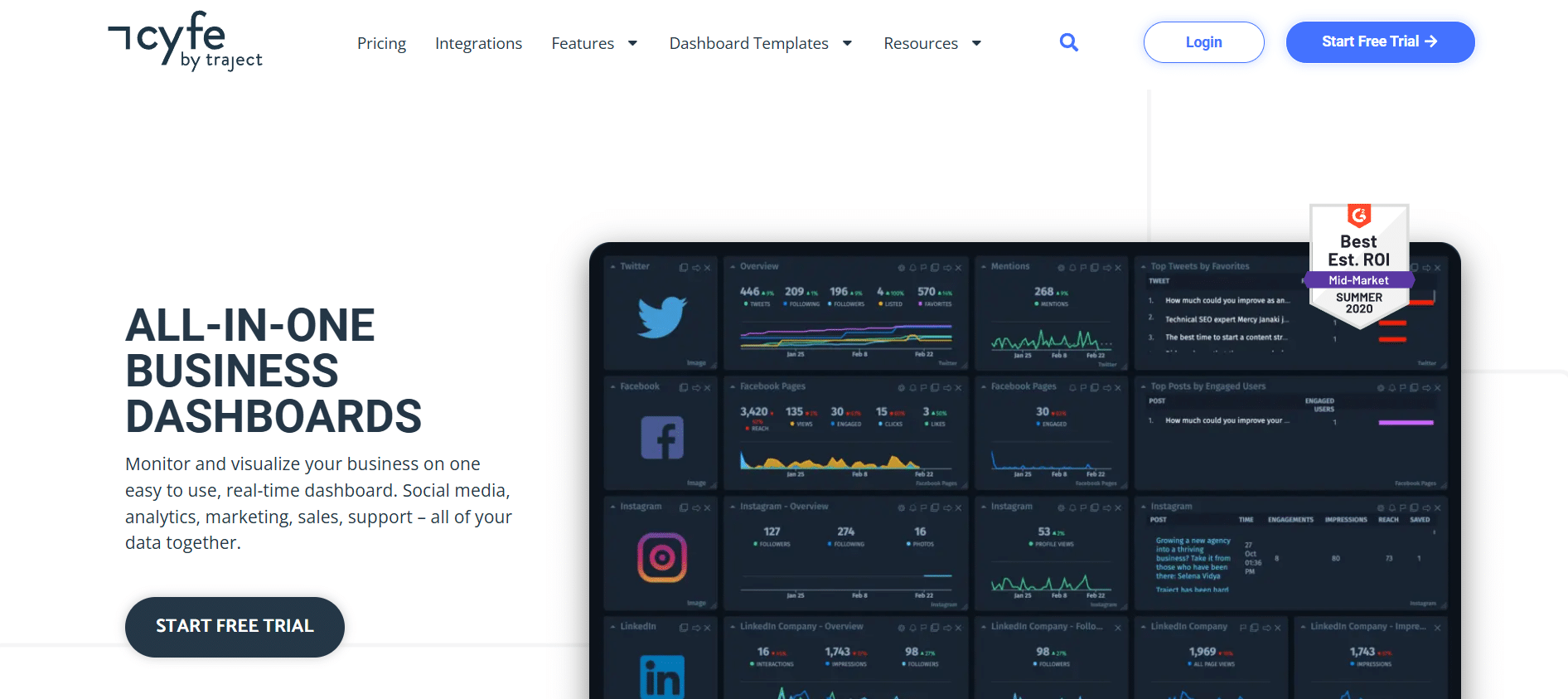
Cyfe solves a different problem: too many dashboards, not enough time to check all of them.
If your team pulls data from Google Analytics, Facebook Ads, Google Ads, a CRM, and maybe an email platform, that’s five different logins just to get a Monday morning snapshot. Cyfe pulls all of that into one dashboard. Custom widgets, real-time updates, the works.
For ROI tracking specifically, the value is in seeing spend and performance side by side without jumping between ten browser tabs. You set up a widget pulling ad spend from Google Ads next to a widget pulling conversion data from GA4, and suddenly the cost-per-acquisition math is sitting right there in front of you instead of buried in a spreadsheet someone updates once a week.
Pricing: Plans start around $19/month for individual use, scaling up for business and enterprise tiers with more data sources and users.
Best for: Teams juggling multiple platforms who need a centralized view without building custom reporting infrastructure.
The catch: Cyfe aggregates data — it doesn’t add analytical depth. It’s a visualization layer sitting on top of other tools, not a replacement for them. If the underlying data in your CRM or ad platform is messy, Cyfe just displays messy data in a nicer layout.
3. Revenue Attribution Platforms
This category deserves its own mention because it’s where a lot of B2B marketing teams are heading, and for good reason.
Standard analytics tools stop at the lead. Someone fills out a form, GA4 logs a conversion, done. But a lead isn’t revenue. A lead might sit in a sales pipeline for four months before closing — or never close at all. Revenue attribution platforms track the entire journey from first touch to closed deal, tying specific marketing activities to actual dollar amounts in the CRM.
This is a meaningfully different way of measuring ROI. Instead of “we generated 150 leads from this campaign,” it’s “we generated 150 leads from this campaign, 12 of them became opportunities, 4 closed, and those 4 deals total $180,000.” That’s a number a CFO actually cares about.
These platforms usually include predictive scoring too — flagging which leads are most likely to close based on behavior patterns from past deals. That helps sales prioritize instead of treating every lead the same.
Best for: Mid-size to large B2B companies with a sales cycle long enough that direct attribution matters, and a CRM disciplined enough to feed clean data back into the system.
The catch: These platforms need real setup investment. Sales and marketing data have to be integrated properly, deal stages need to be consistent, and the CRM needs to be reasonably clean already. Bolt one of these onto a messy CRM and the attribution reports will be just as messy. Also, pricing tends to scale with company size and contact volume, so it’s rarely the cheapest option on this list.
4. Kissmetrics
Kissmetrics zooms in on individual customer behavior rather than aggregate traffic patterns, and that distinction matters a lot for subscription businesses.
Where GA4 tells you “this page got 5,000 views,” Kissmetrics tells you “this specific user viewed the pricing page three times over two weeks before signing up for the annual plan.” It tracks people, not just sessions. That means cohort analysis, funnel breakdowns by user segment, and lifetime value calculations that actually mean something.
For SaaS companies especially, this matters because a “conversion” isn’t the end of the story. Someone signing up for a free trial is worth very different amounts depending on whether they churn after 30 days or stick around for three years. Kissmetrics is built to track that whole arc, which is exactly what ROI measurement for subscription businesses actually needs.
Pricing: Custom, typically starting in the low hundreds per month depending on user volume, scaling up from there.
Best for: SaaS and subscription businesses that care about lifetime value, not just initial conversion.
The catch: It’s a narrower tool than GA4. Great at behavioral and cohort analysis, less useful if you need broad-spectrum web analytics or e-commerce transaction tracking. Most teams run it alongside GA4, not instead of it.
5. BuzzSumo
Content marketing ROI is notoriously hard to measure directly, and BuzzSumo doesn’t pretend to solve that entirely. What it does well is inform the strategy that eventually drives ROI.
It shows what content is performing well across a topic or industry — which headlines get shared, which formats get engagement, who’s talking about a given subject. That’s useful before you write anything, because it tells you where the actual demand is instead of guessing.
There’s also a competitive angle. Type in a competitor’s domain and see their top-performing content by shares and backlinks. That’s not indirect fluff — that’s actionable intelligence about what topics are actually resonating in a space, which directly affects whether the content you produce next gets traction or gets ignored.
Pricing: Plans start around $199/month for the Content Creation tier, going up from there for larger teams and more historical data access.
Best for: Content teams and agencies that need to prioritize topics based on real engagement data instead of internal guesswork.
The catch: BuzzSumo measures engagement, not revenue. Shares and backlinks are proxies, not dollars. A piece of content can get shared 5,000 times and generate zero pipeline. Pair it with actual conversion tracking downstream, or the “ROI” story stays incomplete.
6. Hotjar
Analytics tools tell you what happened. Hotjar tells you why.
Heatmaps show where people click, scroll, and hover on a page. Session recordings let you literally watch someone navigate your site — where they hesitate, where they abandon a form, where they rage-click because something isn’t working. Surveys and feedback widgets add the qualitative layer on top of that.
Here’s why this connects to ROI directly: a checkout page with a 60% abandonment rate isn’t a traffic problem, it’s a UX problem. GA4 will tell you the abandonment happened. Hotjar shows you that everyone’s getting stuck on a confusing shipping cost field halfway down the page. Fix that field, abandonment drops, revenue goes up — without spending a single additional dollar on acquisition.
That’s the real value here. ROI isn’t only about tracking spend against results. Sometimes the biggest ROI wins come from fixing what’s broken in the existing funnel.
Pricing: Free tier available with limited sessions. Paid plans start around $39/month and scale with traffic volume.
Best for: Any team running significant traffic to conversion pages — checkout flows, signup forms, landing pages — that needs to understand friction points.
The catch: It’s qualitative. Heatmaps and recordings show patterns, but someone still has to watch the sessions and interpret them. It’s not going to spit out a revenue number on its own. Pair it with quantitative data, or it’s just interesting to look at without driving decisions.
7. SEMrush
SEMrush is one of those platforms that started as an SEO tool and quietly became a full competitive intelligence suite.
For Marketing ROI Tools conversations, SEMrush earns its spot because it connects organic and paid performance to actual competitive positioning. Keyword tracking shows what you rank for and where you’re losing ground. Site audits flag technical issues dragging down organic visibility. The advertising research module shows what competitors are bidding on and roughly what they’re spending.
That competitive layer is what separates SEMrush from a basic keyword tool. Knowing that a competitor just started bidding heavily on your branded terms is the kind of insight that changes a paid search budget conversation immediately.
Pricing: Plans start around $139.95/month for the Pro tier, scaling up to $499.95/month or custom enterprise pricing for larger teams needing more data and users.
Best for: Teams running both SEO and paid search who need competitive visibility, not just their own performance numbers.
The catch: The learning curve is real. SEMrush has so many modules that new users often use maybe 20% of what they’re paying for. It’s worth the investment, but only if someone on the team actually has time to dig into the reporting regularly. Otherwise it’s an expensive subscription generating reports nobody reads.
8. Ahrefs
Ahrefs and SEMrush get compared constantly, and for good reason — they overlap a lot. But Ahrefs has a reputation for having the strongest backlink index in the industry, and that matters if link building is part of the strategy.
Site Explorer breaks down a domain’s full backlink profile, organic keywords, and top pages. Keywords Explorer does deep keyword research with difficulty scoring and click data. Content Gap analysis shows what keywords competitors rank for that you don’t — which is genuinely one of the more useful features for finding content opportunities with real revenue potential behind them, not just traffic potential.
The ROI connection here is straightforward: organic search traffic is one of the cheapest acquisition channels there is, once it’s ranking. No cost-per-click, no ongoing ad spend. Ahrefs helps identify and track the keywords worth chasing to build that channel out.
Pricing: Starts at $129/month for the Lite plan, up to $999/month for Enterprise, based on data limits and team size.
Best for: SEO-focused teams, especially those prioritizing link building and content gap strategy.
Ahrefs vs. SEMrush: If forced to pick one, it comes down to priorities. Ahrefs generally wins on backlink data depth. SEMrush wins on the broader competitive and advertising intelligence side. Plenty of serious SEO teams run both, honestly, because the overlap isn’t 100% and each catches things the other misses.
Finding the Right Marketing ROI Tools for Your Business
No single tool on this list does everything. Anyone selling you on a one-tool-fits-all solution is oversimplifying.
Here’s a rough way to think about it based on what you’re actually trying to measure:
Small business, limited budget: Start with Google Analytics (free) and Hotjar’s free tier. That combination covers basic conversion tracking and user behavior without spending anything. Add SEMrush or Ahrefs once there’s budget for serious keyword and competitive research.
B2B with a long sales cycle: Revenue attribution platforms become worth the investment here, because leads-to-revenue tracking is the whole ballgame. Pair that with GA4 for top-of-funnel visibility.
SaaS / subscription business: Kissmetrics or a similar behavioral analytics tool matters more than pure traffic tools, because lifetime value and churn are the real ROI drivers, not just signups.
Content-heavy strategy: BuzzSumo for research and prioritization, SEMrush or Ahrefs for keyword targeting and performance tracking, GA4 to close the loop on what’s actually converting.
High-traffic e-commerce: GA4’s e-commerce tracking is non-negotiable here. Layer Hotjar on top to fix conversion friction, and Cyfe if the team needs a consolidated dashboard across ad platforms.
The real mistake teams make isn’t picking the wrong tool. It’s trying to run everything through one platform and forcing it to do jobs it wasn’t built for. A stack of two or three tools that each do one thing well beats one tool trying to do everything and doing all of it mediocre.
Set the tracking up right first. That matters more than which specific tool gets picked. A poorly configured expensive platform tells you less than a properly configured free one.
Conclusion
At the end of the day, marketing ROI tools aren’t about collecting more data. Most teams already have too much of that sitting in dashboards nobody checks. The real point is connecting the dots — spend to activity, activity to behavior, behavior to actual revenue sitting in a bank account somewhere.
Start small if you have to. Google Analytics and a free Hotjar account will tell you more about what’s actually happening on your site than most people bother to find out. Add revenue attribution once the sales cycle gets complicated enough to need it. Layer in SEO tools once organic search becomes a real channel worth defending.
The teams that get this right aren’t the ones with the fanciest tool stack. They’re the ones who picked two or three tools, set them up properly, and actually looked at the numbers every week instead of once a quarter when someone in finance starts asking questions. That habit matters more than any platform on this list.
Pick what fits your business right now. Not what looks impressive in a sales pitch.
Frequently Asked Questions
What are marketing ROI tools, exactly?
They’re platforms that help track, measure, and analyze the return generated from marketing spend and activity. That ranges from basic web analytics (like Google Analytics) to full revenue attribution platforms that connect marketing touchpoints directly to closed deals in a CRM.
Is Google Analytics enough to measure marketing ROI?
For a lot of small businesses, it’s a solid starting point — but only if conversion events and e-commerce tracking are set up correctly. On its own, GA4 shows traffic and on-site behavior. It won’t connect marketing activity to long-term customer value or complex B2B sales cycles without additional tools layered on top.
How do you calculate marketing ROI?
The basic formula is (Revenue Generated from Marketing − Marketing Cost) ÷ Marketing Cost, expressed as a percentage. The hard part isn’t the math — it’s accurately attributing revenue to the right campaigns and channels in the first place, which is exactly what these tools are built to help with.
What’s the difference between a marketing ROI tool and a regular analytics tool?
Regular analytics tools track behavior — traffic, clicks, pageviews. ROI-focused tools go a step further and tie that behavior to actual financial outcomes, whether that’s e-commerce revenue, closed deals in a CRM, or customer lifetime value.
Do small businesses need paid ROI tracking tools?
Not necessarily to start. Google Analytics and Hotjar’s free tier cover the basics without any spend. Paid tools become worth it once there’s enough budget and complexity — multiple channels, longer sales cycles, or a content strategy that needs competitive research to prioritize effectively.
How many marketing ROI tools should a team actually use?
Usually two to four, covering different layers: one for web analytics, one for behavioral or attribution tracking, and one for SEO or content research if that’s part of the strategy. Beyond four or five tools, the overhead of maintaining and cross-referencing data usually outweighs the added insight.