


Every marketing conversation eventually gets to this point. The budget meeting where someone has to decide whether to put money into content and SEO or into social media. The founder who’s been told by one person that TikTok is where all their customers are and by another person that organic search is the only channel that compounds over time. The marketing manager who’s doing both badly because the budget isn’t big enough to do both well, but nobody will make a call on which one to prioritize.
This is a real problem. Not a theoretical one. And the reason it keeps coming up is that both channels have genuine believers who can point to genuine results, and both channels have also burned a lot of people who put serious money in and got very little back. So the debate stays alive, and teams stay stuck in the middle, doing half-measures on both sides and wondering why neither is working.
Here’s the thing though. The question isn’t really “which one is better.” That’s the wrong frame. The right question is: which one is better for this specific business, at this specific stage, with this specific audience and budget? And to answer that properly, you have to actually understand what each channel does, how it works, where it fails, and what kind of business it’s built for.
So let’s actually go through it. Not at a surface level where every section ends with “it depends on your goals,” but at a real level where you can come away with a clear sense of what belongs in your strategy and why.
SEO vs Social Media: Understanding What Each Channel Actually Does
Before comparing them, it’s worth being clear about what each one is actually doing when it works.
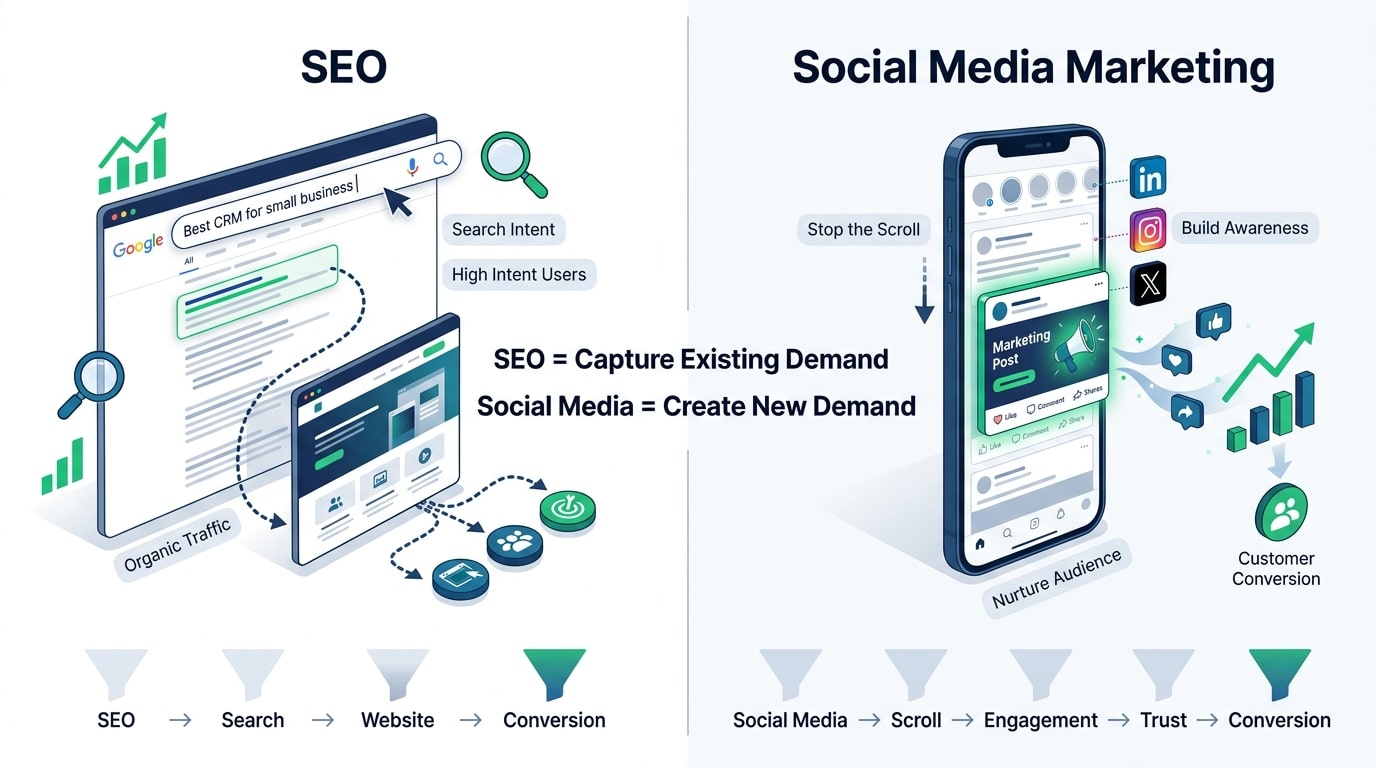
SEO, search engine optimization, is the process of getting your content to appear in search results when people type in queries related to what you do. The fundamental mechanic is intent matching. Someone has a question or a problem. They go to Google. If your content answers that question better than everyone else’s, you show up. They click. They read. Some of them convert.
The beauty of that mechanic is that you’re reaching people at the exact moment they’re looking for what you offer. There’s no interruption. No convincing someone they have a problem they didn’t know they had. The demand already exists. SEO just connects you to it.
Social media is different at a mechanical level. On Instagram, TikTok, LinkedIn, X, people aren’t searching for solutions. They’re scrolling. They’re consuming content passively. So social media is an interruption channel, even when it doesn’t feel like one. You’re showing up in someone’s feed while they’re looking at their friend’s holiday photos or watching a video about something completely unrelated to your product. The job of social media content is to stop the scroll, build awareness, create a relationship with an audience over time, and eventually convert some of that audience into customers.
Those are genuinely different jobs. And mixing them up is where a lot of the confusion comes from.
How SEO Builds Traffic Over Time and Why That Matters
SEO is slow. Anyone who tells you otherwise is either selling something or talking about a very specific edge case. The typical timeline for a new site to start seeing meaningful organic traffic from an SEO investment is six to twelve months. For a site in a competitive niche, sometimes longer.
That’s a hard sell in a world where performance marketing can show results in 48 hours. So a lot of companies deprioritize SEO, especially early stage, because the payoff feels too distant. And then two years later they’re still paying rising CPCs on Google Ads while a competitor who started SEO earlier is sitting on page one for every high-intent keyword in the space and getting thousands of free clicks a month.
That’s the compounding effect of SEO and it’s real. A blog post that took eight hours to write and two months to rank can drive traffic for three years. The paid ad that cost $2,000 stopped delivering the moment you stopped funding it. Over a long enough time horizon, the economics of SEO are almost always better than paid channels for the same traffic volume.
Ahrefs is a good example of a company that built its entire growth engine on SEO and content. They have a domain authority that took years to build and a content library that covers essentially every keyword their ICP searches. Their organic traffic is enormous. And the cost to acquire that traffic now, relative to what it would cost them to buy equivalent clicks through paid search, is almost incomprehensibly better. But they started early, invested consistently, and didn’t give up during the months when nothing seemed to be happening.
The other thing SEO does that social media doesn’t is capture bottom-of-funnel intent. When someone searches “best CRM for small business” or “HubSpot vs Salesforce,” they are ready to make a decision. They’re not browsing. They’re shopping. If you’re showing up for those queries, you’re in front of buyers, not just audiences. That distinction matters enormously for conversion rates.
Where SEO Falls Short and What It Can’t Do
Nope, SEO is not the answer to everything. There are real situations where it either doesn’t work or takes too long to matter.
New products or categories are a genuine problem for SEO. If nobody is searching for what you sell yet, there’s no search volume to capture. If you’re a company that invented a genuinely new category of software, SEO can’t help you with demand capture because the demand doesn’t exist in search yet. You have to create demand first, which is a social media and brand awareness job, and then SEO becomes useful once people start searching for what you’ve introduced to the market.
Highly visual products also have an SEO ceiling. A furniture brand, a fashion label, an interior design service. These categories live and die on imagery and aesthetics. The person choosing a sofa isn’t just Googling “grey sofa for living room” and buying the first result. They’re browsing Pinterest, scrolling Instagram, saving things that look good. SEO gets them to product pages, but the visual channels are where the desire is built.
And honestly, the algorithm is a risk. Google updates its ranking algorithms constantly, and periodically those updates are large enough to wipe out significant amounts of traffic for sites that were doing fine before. The March 2024 core update hit a lot of sites that had been ranking well for years. Some legitimate, well-run content sites lost 50% or more of their organic traffic overnight. That’s a real risk of being too dependent on any one channel, but SEO specifically has this problem because ranking is something Google controls and can change.
What Social Media Actually Does Well (And the Part Nobody Talks About)
Social media gets a lot of grief from performance marketers because it’s hard to directly attribute revenue to it. The path from “someone saw your Instagram reel” to “someone bought your product” is long and messy and full of touchpoints that are hard to track. So it often looks bad in last-click attribution models, which is mostly what companies use to measure marketing ROI.
That doesn’t mean it isn’t working. It means the measurement is wrong.
What social media does extremely well is build brand awareness and brand affinity at scale. It’s the channel where people learn that you exist. Where they form an opinion about what kind of company you are. Where they see enough touchpoints, over enough time, that when they do have the problem your product solves, your name is the first one that comes to mind.
Notion is a good case study here. Before Notion was huge, it built a massive following on Twitter and YouTube through a combination of genuine utility (templates, use cases) and community energy. People shared their Notion setups. Creators built tutorial content. The brand showed up everywhere in the productivity space. When people started looking for a note-taking or project management tool, Notion had top-of-mind awareness that no search ranking could have built as quickly.
Social media is also faster. If you publish a post today and it resonates, you can have thousands of views and engagement within hours. SEO doesn’t work on that timeline. For announcing something new, responding to a cultural moment, building buzz around a launch, social media is the only channel fast enough to matter.
And for certain audiences, social media is simply where they live. Gen Z uses TikTok as a search engine. That’s not a metaphor. They literally type queries into TikTok search and watch videos instead of reading articles. If that’s your audience, a content strategy that’s 100% SEO-focused is reaching them on a platform they’re using less and less for discovery.
SEO vs Social Media: Where the Money Goes and What You Get Back
Let’s talk about cost because that’s usually the real decision driver.
SEO costs are mostly in content creation and technical work. A decent SEO-focused blog post from a good writer costs somewhere between $300 and $800 depending on length and depth. Add keyword research tools (Ahrefs or Semrush runs $100 to $400 a month depending on the plan), maybe some link building outreach, and a technical SEO audit once or twice a year. For a small business doing this properly, you’re probably looking at $2,000 to $5,000 a month in total SEO investment.
The returns are delayed but they’re real. A blog post that ranks for a keyword with 2,000 monthly searches and generates a 3% CTR is getting 60 clicks a month. Forever. Or until the ranking drops. Over three years, that’s 2,160 visits from a post that cost $500 to produce. The math gets very favorable, very quickly, once rankings are established.
Social media costs depend heavily on whether you’re going organic or paid. Organic social media, posting content without paying to boost it, has near-zero distribution on most platforms now. Facebook organic reach for business pages is somewhere around 2% to 5% of followers. Instagram is similar. LinkedIn is better for organic reach but still limited unless posts get strong early engagement. So “free” organic social isn’t really free because you’re paying for the content creation and getting very limited reach.
Paid social is more predictable but more expensive and the moment you stop paying, the traffic stops. Facebook and Instagram ads for a B2B audience can run $15 to $50 per click depending on the targeting. LinkedIn is even more expensive, often $8 to $15 per click minimum, but the targeting options are unmatched for B2B. For ecommerce targeting consumer audiences, Meta ads can be extremely efficient when set up properly, sometimes driving $3 to $5 ROAS, but that efficiency has gotten harder to find since the iOS 14 changes wrecked attribution.
The Content Strategy Differences Nobody Explains Clearly Enough
Creating content for SEO and creating content for social media are genuinely different skills. Content that works on one channel often fails completely on the other. This trips up a lot of teams who think they can produce one piece of content and distribute it everywhere.
SEO content is built around a specific keyword or topic cluster. It needs to be comprehensive enough to fully address the search intent. It should be well-structured with headers that match the questions people are actually asking. It needs internal links to related content. And it needs to be long enough to cover the topic properly, which for competitive informational keywords is usually 1,500 words minimum, often more.
That same piece of content posted as a LinkedIn article would probably get very little engagement because LinkedIn’s algorithm rewards short, punchy content with strong hooks and conversation-starting opinions. A 2,000-word comprehensive guide on LinkedIn is not going to perform the same way it performs in Google search.
Social content needs a hook in the first line because platforms truncate text after two or three lines before a “read more” click. It needs to invite engagement, comments, shares, saves, because engagement signals drive algorithmic distribution. It needs to be posted consistently and frequently because social media algorithms reward accounts that post regularly. Three times a week on LinkedIn is a different content cadence than publishing one SEO post a month.
Video is the most obvious format difference. Video content is dominant on every social platform right now. Instagram Reels, TikTok, YouTube Shorts, LinkedIn video all have algorithmic advantages over static posts. But video content doesn’t help SEO directly, though YouTube videos rank in Google search, so YouTube is an interesting bridge between the two channels.
Which Businesses Should Prioritize SEO
There are certain business types where SEO is clearly the better primary investment.
B2B software companies. The buying process involves research. Decision makers Google comparison terms, feature lists, reviews, alternatives. A B2B SaaS company that ranks well for “best [category] software for [use case]” is catching buyers in active research mode. The conversion rates from that traffic are significantly higher than from social media audiences who stumbled across the company’s LinkedIn posts.
Service businesses with clear search intent. Lawyers, accountants, plumbers, consultants, dentists. When someone needs these services, they search Google. They might search “business tax accountant in Austin” or “family law attorney Chicago” or “emergency plumber near me.” Local SEO for these businesses is extremely high ROI because the search intent is commercial and local. Social media brand awareness for a plumber is largely wasted because the customer’s decision to hire a plumber is triggered by a specific need, not by scrolling through Instagram.
Content-driven businesses. Media sites, educational platforms, SaaS companies with educational blog strategies. If your business model depends on generating large volumes of organic traffic to content, SEO is the engine. Full stop.
Which Businesses Should Prioritize Social Media
Some businesses genuinely get more from social media than from SEO, at least in the early stages.
Consumer brands with strong visual products. Fashion, food, beauty, home goods, fitness. These categories are discovery-oriented. People find new brands while scrolling. The product needs to be seen to create desire. A sofa brand that has beautiful Instagram content and Pinterest presence is building desire in the right places. An SEO strategy for the same brand matters too, but it’s not the primary discovery channel for their audience.
Creators and personal brands. If the business is built around a person, social media is the primary channel. The relationship is the product. A coach, a consultant, a creator monetizing an audience. SEO can support this, but the audience relationship is built through consistent social presence, not through ranking for keywords.
Businesses launching into new categories. If there’s no search volume for what you do yet, you have to build awareness before you can capture it. Social media, PR, and paid advertising create the demand. SEO captures it once it exists.
Early-stage companies that need fast feedback. A founder testing a new product idea needs to know quickly whether anyone cares. Social media provides that feedback loop in days. SEO provides it in months. For validation and early traction, social wins on speed alone.
When You Should Be Doing Both and How to Not Spread Thin
Look, the honest answer for most established businesses is that both channels belong in the strategy. But the mistake is treating them with equal priority and equal budget when the company doesn’t have the resources to do both well.
Doing both badly is worse than doing one well. A company that’s producing mediocre SEO content and posting inconsistently on social is getting the worst of both channels. The SEO content isn’t comprehensive enough to rank. The social posts aren’t frequent or engaging enough to build an algorithm-favored presence. Both channels underperform and the team concludes that neither works for their business, which isn’t true. They just never committed properly to either.
The sequencing that tends to work for most companies: start with the channel that matches your business model and audience, go deep on it, build a system, measure it properly, and then add the second channel once the first is working. That’s not glamorous advice but it’s the advice that actually leads to results.
The channels do support each other, by the way. Good SEO content can be reformatted into social posts. Social media can amplify content and build the backlinks that help SEO. A company with both channels working has a content engine that feeds itself. But you have to get one working first or you’re just spinning plates.
The Attribution Problem and Why It Makes Social Look Bad
Here’s something worth saying plainly. Social media is systematically undervalued in most marketing attribution models because most companies use last-click or first-click attribution, which credits the touchpoint right before the conversion or the first touchpoint ever, and ignores everything in between.
So what actually happens is: someone sees a company’s LinkedIn post, gets curious, Googles the company name, finds the website through organic search, signs up for a newsletter, gets an email, clicks the email, and converts. Last-click attribution credits the email. First-click credits the Google search. LinkedIn gets zero credit. So in the report, social media shows no ROI and SEO and email look like the heroes.
That’s not accurate. The LinkedIn post started the whole chain. Without it, that customer might never have heard of the company.
Multi-touch attribution models are better but imperfect. The cleanest way to understand what social media is actually doing is to survey new customers and ask how they first heard about you. The answers often reveal that social media is a much bigger part of the acquisition story than the attribution tools show.
Conclusion
There isn’t a winner. That’s not a cop-out, it’s just true. But there is a right answer for your business specifically, and it comes from being honest about three things.
Where does your audience actually go when they have the problem you solve? If they Google it, invest in SEO. If they scroll for inspiration and discovery, invest in social. If both, figure out which one is higher volume and start there.
What stage is your business at? Early stage companies often need social for speed and feedback. Growth stage companies often need SEO for compounding traffic. Both can run in parallel once there’s enough team and budget to do both properly.
What can you actually sustain? A blog that gets published twice and then abandoned is worse than no blog at all. A social media account that posts twice a month is worse than not having one. Whatever channel you commit to, commit to it consistently enough to give it a real chance. That’s the only way to know if it works for you.
Pick the right channel, build it properly, measure it honestly, and add the second one when the first is producing. That’s the strategy. Everything else is just noise.
Frequently Asked Questions
Which is better for a brand new business with no budget?
Organic social media is probably the starting point because you can begin building an audience with zero budget beyond your time. But don’t neglect SEO fundamentals from day one, making sure your site is indexed, you have basic on-page optimization, and you’re targeting at least a handful of keywords you could realistically rank for. Building both from the start, even if social gets more attention initially, puts you in a better position six months later.
Can social media posts rank in Google search?
Sometimes. LinkedIn articles and posts sometimes appear in Google results. YouTube videos rank regularly in search. Pinterest pins show up in image search. But general Instagram, TikTok, and Facebook posts don’t typically rank in Google. The overlap between the two channels is real but limited.
How long does SEO take to show results?
For a site with some existing domain authority and decent technical health, you might see movement in three to six months for lower competition keywords. For a brand new domain targeting competitive terms, twelve months is more realistic. Anyone promising page one rankings in 30 days is selling something you don’t want to buy.
Is social media traffic lower quality than SEO traffic?
Generally, yes, in terms of conversion rate. Social media visitors are usually earlier in the buying journey. They’re discovering you, not shopping for you. SEO traffic, particularly from commercial or transactional intent keywords, converts at higher rates because those visitors are further along in their decision process. That doesn’t make social traffic worthless, it just means the conversion path is longer.
What about YouTube, is that SEO or social media?
Both, genuinely. YouTube is the second largest search engine in the world and YouTube videos rank in Google search results. But it also has social mechanics: subscribers, comments, shares, algorithmic recommendations. A YouTube strategy sits at the intersection of both channels, which is one reason it’s such a valuable channel for businesses that can produce good video content consistently.
Should ecommerce brands focus on SEO or social media?
Both matter but in different ways. Social media, particularly Meta and Pinterest, drives discovery and desire for physical products. SEO, particularly Google Shopping and category pages, captures purchase intent. The most effective ecommerce brands invest in both, using social to build awareness and desire and SEO to capture people who are actively looking to buy.
How do you measure social media ROI properly?
This is the hard one. Beyond direct conversions, measure brand search volume over time (if more people are Googling your brand name, social awareness is working), track new follower growth and engagement rates, use UTM parameters on every social link so you can see social-referred traffic in analytics, and survey new customers about how they found you. No single metric tells the whole story.

An avid blogger, dedicated to boosting brand presence, optimizing SEO, and delivering results in digital marketing. With a keen eye for trends, he’s committed to driving engagement and ROI in the ever-evolving digital landscape. Let’s connect and explore digital possibilities together.