


You have a photo and you need answers. Who is this person? Is this profile picture real or stolen from someone else’s Instagram? Is the person on this dating app actually who they say they are? These are not niche questions anymore. They come up in fraud investigations, background checks, journalist source verification, and everyday personal situations where a name attached to a face would change everything.

The AI face search tools that solve this problem are not all created equal. Some scan millions of web pages with genuine facial geometry matching. Others are glorified image search wrappers dressed up in technical language. Picking the wrong one wastes time and, depending on your use case, can give you a false sense of certainty that leads to a real mistake.
This article ranks the 7 best AI face search tools available in 2026, starting with what separates a tool worth using from one that only looks the part.
What Makes an AI Face Search Tool Actually Worth Using
Most roundups skip this part entirely and jump straight to the list. That is a problem, because without a clear evaluation framework, every tool looks roughly equivalent. They are not.
A face search tool earns its place based on five specific criteria. Understanding these before you pick a tool is the difference between finding who you are looking for and wasting an afternoon chasing false matches.
Facial matching accuracy and confidence scoring
The core question is how a tool actually identifies a face. Pixel-matching (comparing raw image data) is shallow and breaks down when lighting, angle, or image quality changes even slightly. Tools built on facial geometry mapping, where the algorithm measures the precise distances between specific facial landmarks like eye spacing, jawline contour, and cheekbone structure, hold up far better across different photos of the same person. Accuracy claims in marketing copy are not always reliable, so look specifically for whether a tool publishes confidence scores on its results. A result showing 99.8% confidence is useful. A result with no confidence indicator at all means you cannot tell whether you have a strong match or a weak guess.
Database scope
A face search tool is only as good as the index it searches. The relevant question is not just how large the database is, but what it covers. Social media platforms, news archives, professional networks like LinkedIn, and public image sources each serve different use cases. A tool that indexes Twitter and TikTok is useful for verifying dating profiles. A tool with deeper news and press archive coverage is more useful for journalism and OSINT work. Knowing what a tool indexes tells you whether it is the right fit for your specific task.
Speed and API access for scale
For individual one-off searches, speed matters but is rarely a deal-breaker. For teams running identity verification at volume, or developers building face search into an existing workflow, API access is non-negotiable. Tools without an API force manual effort at every step, which breaks down fast when you are processing dozens or hundreds of searches.
Privacy and legal compliance
This is where most reviews are silent. What happens to the photo you upload? Is it stored? Is it used to train the tool’s AI models? Is the tool compliant with GDPR for EU-based users, BIPA for Illinois residents, or CCPA for California users? These are not bureaucratic details. They determine whether using a tool in a professional or corporate context creates legal exposure. A tool that stores uploaded photos without disclosure is a liability, not a feature.
False positive rate
No vendor advertises this. Every tool claims high accuracy. What vendors rarely discuss is how often their tools return a match that looks convincing but is wrong. False positives are more dangerous than false negatives in most contexts, because a false negative means you did not find someone, while a false positive means you acted on incorrect information. The tools that handle this best are the ones that show tiered confidence levels on results, so you can see the difference between a near-certain match and a possible match, and decide accordingly.
Free Tools vs. Paid Platforms: Where the Capability Gap Actually Starts
Free tiers exist across most tools in this category and are worth using to test a platform before committing. The gap between free and paid is not just about search volume. It shows up in result depth, confidence scoring detail, batch processing access, and whether the tool flags low-confidence matches separately from high-confidence ones. For personal one-off use, a free tier is often enough. For professional or recurring use, the paid tier is where the tool actually performs at its stated capability.
The 7 Best AI Face Search Tools of 2026 (Ranked)
The following tools are ranked by overall capability across accuracy, database scope, privacy architecture, and practical usability. Each entry covers what the tool is, who it is built for, how it works technically, what the pricing structure looks like, and an honest assessment of where it performs and where it falls short.
1. AIFaceSearch.io
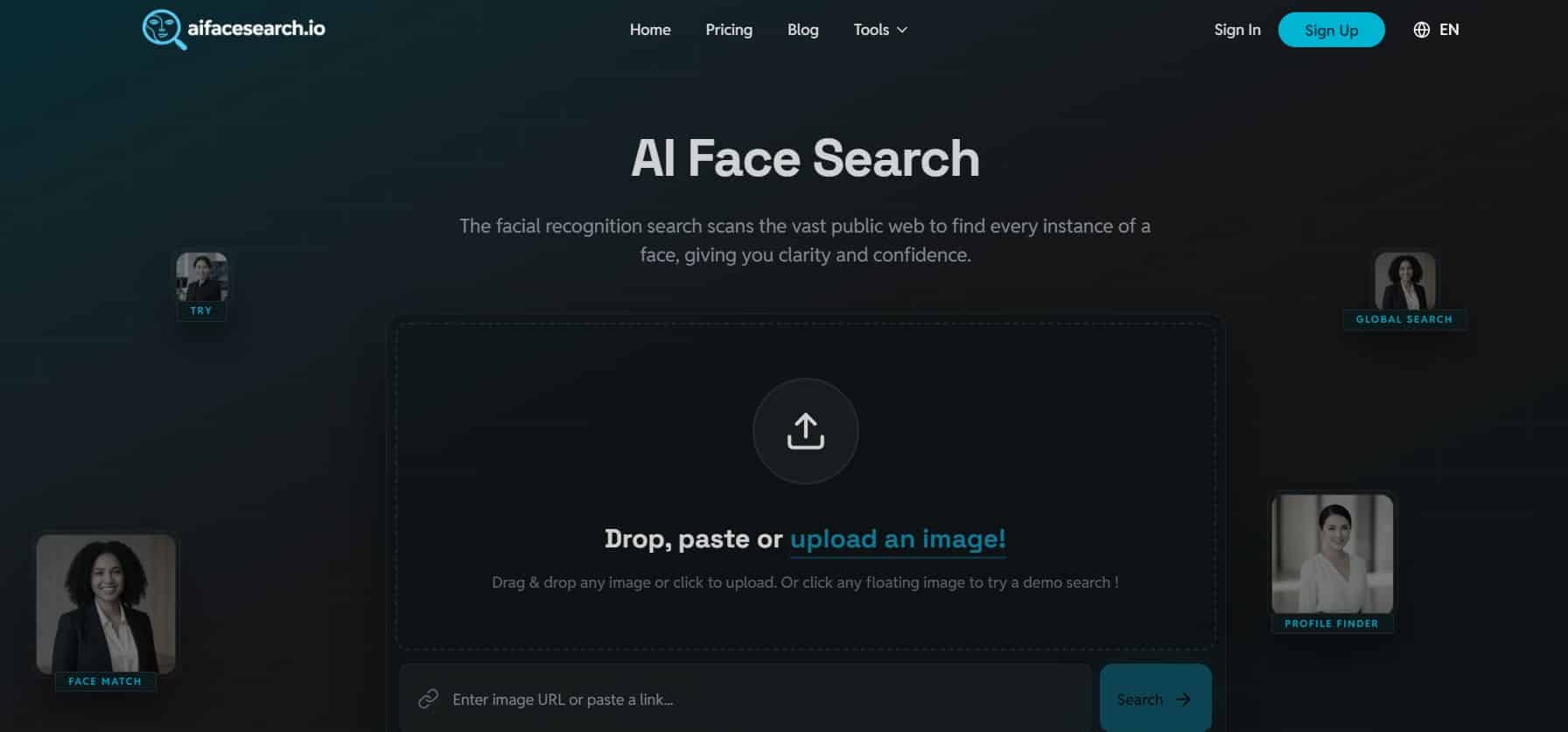
What it is: AIFaceSearch.io is an all-in-one AI face search platform built for individuals, investigators, and businesses who need to find where a face appears across the public web, verify a digital identity, or cross-reference a photo against social media and news sources.
Best for: Users who need a single platform covering the full face search workflow, from reverse face lookup to social profile discovery, without requiring technical setup or a developer team.
How it works: The platform uses deep learning models that map 68 unique facial geometry datapoints per face. Rather than comparing raw pixels, it measures the precise distance between eyes, the contour of the jawline, and the structure of the cheekbones. This biological approach to facial measurement means the tool holds up across different photos of the same person even when expression, lighting, or angle varies. Once the facial map is built, it scans a constantly updated index of the public web and returns matches ranked by confidence level.
Database coverage:
- Social media platforms including Twitter (X), TikTok, and LinkedIn
- News articles and press releases
- Professional networks and career-oriented platforms
- Public image sources across the web
Accuracy and speed: AIFaceSearch.io claims a 95% match accuracy rate with results returned in under 5 seconds. The platform has processed over 10 million searches and serves users across 40+ countries.
Standout features:
- Duplicate match filtering with confidence tiers: Results are categorized as Exact Match, High Confidence, or Possible Match, so you know exactly how much weight to give each result rather than treating all results the same
- Batch processing: Upload multiple images and run searches simultaneously, which is the feature that separates it from consumer-grade tools for anyone doing professional verification at scale
- Social profile lookup: Cross-reference a face against social media accounts directly, not just image sources
- Reverse image search: Find where a specific image appears online, separate from the face-specific search
- Celebrity lookalike: Identify which public figure a face most closely resembles, useful for content and media use cases
- Face swap and face shape detector: Additional tools built into the same platform for adjacent use cases
- No photo storage: Uploaded photos are encrypted during the search process and not added to a public database or used to train AI models without explicit, separate consent
- End-to-end encryption: All data transfers are encrypted
- Anonymous searches: Searches are not logged against the user’s identity
Pricing: A free plan is available for individual use. A Pro tier covers power users with higher search volume and full feature access. API access is available for enterprise and developer integration, making it viable for teams building face search into larger workflows.
Honest pros:
- The widest feature set of any tool in this category, covering reverse face search, social profile lookup, batch processing, and identity verification in one place
- Privacy-first architecture with no photo storage and end-to-end encryption, which is a meaningful differentiator for professional and corporate use
- Confidence-tiered results make it easier to triage matches rather than manually evaluating every result
- API access supports scale without manual overhead
- The free plan is a genuine way to test the tool before committing, not a stripped-down version designed to force an upgrade
Honest cons:
- The platform is newer relative to established players like PimEyes, meaning long-term track record data is less available
- The database covers the public web, so it will not surface matches from private accounts, closed networks, or databases that are not publicly indexed, which is true of every tool in this category but worth stating clearly
Verdict: AIFaceSearch.io is the strongest all-round option for 2026. It combines search depth, feature breadth, transparent confidence scoring, and a privacy-first architecture that most competitors in this space do not offer. Whether you are an individual checking a dating profile, an investigator running OSINT research, or a business verifying identity at scale, it covers the workflow without requiring you to switch between multiple tools.
2. PimEyes
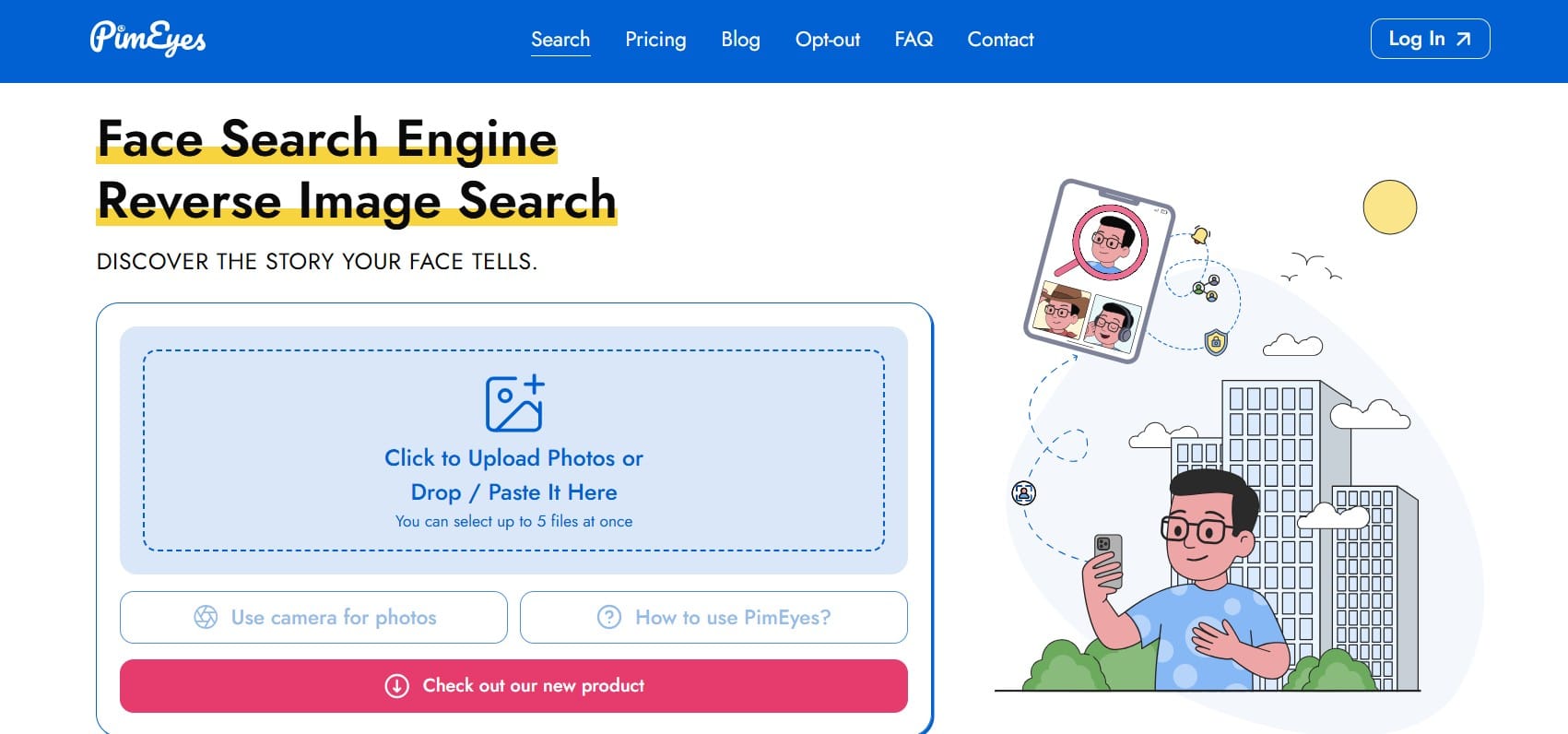
What it is: PimEyes is a consumer-facing reverse face search engine that scans web-indexed images to find where a specific face appears online. It was founded in 2017 and is one of the better-known names in this category for personal use.
Best for: Individuals who want to find where their own photos appear online, trace image sources, or verify whether a profile picture has been taken from elsewhere on the web.
How it works: PimEyes uses facial recognition to compare an uploaded photo against a database of publicly indexed images. It returns results showing where similar or matching faces appear, with source links so you can visit the original page. The tool focuses specifically on image indexing rather than social profile cross-referencing.
Database coverage: PimEyes indexes publicly available images from across the web. It does not claim to cover social media platforms directly, as many of those platforms restrict image indexing in their terms of service.
Accuracy: PimEyes uses facial similarity scoring rather than binary match/no-match results. Results are ranked by visual similarity, though the specific confidence threshold methodology is not publicly detailed.
Pricing:
- A free search tier exists but limits the number of results shown and does not include source links, which significantly reduces its usefulness for anything beyond basic testing
- The PimEyes Plus plan, priced at $29.99 per month as of its published pricing, includes full results with source links and a higher search volume
- Higher tiers add features like real-time monitoring and alerts when new images of a face appear online
Honest pros:
- One of the longer-established tools in the category with a track record dating to 2017
- Monitoring and alert features are useful for public figures, models, and photographers protecting their image
- Clean interface that does not require technical knowledge to use
Honest cons:
- The free tier is functionally limited; you cannot see source links without a paid subscription, which means the tool’s core value is gated immediately
- Coverage gaps on social media platforms limit its usefulness for dating profile verification or social media-specific investigation
- No API access on standard consumer plans, which limits its use for teams or developers
Verdict: PimEyes is a solid personal use tool, particularly for people monitoring their own image online. For professional or investigative use where social media coverage and API access matter, it falls short of the more capable platforms in this list.
3. Clearview AI
What it is: Clearview AI is an enterprise and law enforcement facial recognition platform with one of the largest biometric databases in the world. It was founded in 2017 and gained wide public attention following a 2020 New York Times investigation into its data collection practices.
Best for: Law enforcement agencies, government bodies, and enterprise security teams operating with legal authorization to use biometric identification tools.
How it works: Clearview AI scraped billions of public photos from social media platforms and news sources to build its database. When a user uploads a photo, the system searches that database for facial matches and returns source links. The scale of the database is what sets it apart from every other tool in this category.
Database coverage: Clearview AI’s database contains over 40 billion images, according to the company’s own published figures. This is significantly larger than any other commercially available face search database.
Accuracy: Clearview AI has been used in law enforcement investigations across the United States and multiple other countries. However, independent accuracy assessments, including one from the National Institute of Standards and Technology (NIST), which evaluates facial recognition algorithms, have shown that facial recognition tools in general can produce higher false positive rates on certain demographic groups, particularly darker-skinned individuals and women. Clearview AI’s specific performance on the NIST benchmark has varied by evaluation year.
Pricing: Clearview AI does not publish consumer pricing. Access is restricted to vetted law enforcement agencies, government bodies, and enterprise clients with approved contracts. It is not available to the general public.
Legal status: Clearview AI has faced significant legal action across multiple jurisdictions. In 2022, the UK’s Information Commissioner’s Office issued a fine of £7.5 million and ordered the company to delete data of UK residents. The French data protection authority (CNIL) issued a similar order in 2022. In the United States, Clearview AI settled a lawsuit brought under Illinois’ Biometric Information Privacy Act (BIPA) in 2022, agreeing to restrict sales to private companies in Illinois and to law enforcement nationwide. These legal actions are matters of public record and are directly relevant to understanding the compliance risk of this tool.
Honest pros:
- The largest facial image database available in any commercial tool
- Purpose-built for professional and law enforcement investigation
- Ongoing development specifically for enterprise identity verification workflows
Honest cons:
- Not accessible to the general public, individual researchers, or most private businesses
- Significant legal and regulatory exposure across the EU, UK, and parts of the US
- Independent accuracy concerns on certain demographic groups have been documented
Verdict: Clearview AI is the most powerful database in this category by volume. But access requires a law enforcement or enterprise contract, and the legal history across multiple jurisdictions is a serious factor any compliance team needs to evaluate before use. For most readers of this article, it is not an option they can access.
4. FaceCheck.ID
What it is: FaceCheck.ID is a face search tool built for OSINT (open-source intelligence) researchers and investigators who need to identify individuals from photos using social media and public web sources.
Best for: Journalists, private investigators, security researchers, and OSINT practitioners who need to trace a face to its online sources and build a picture of a person’s digital presence.
How it works: FaceCheck.ID runs uploaded photos against a database that includes social media profiles, news articles, and other publicly indexed sources. It returns matches with direct source links, allowing the researcher to verify each result manually. The tool is designed for investigation workflows rather than automated mass processing.
Database coverage: FaceCheck.ID indexes social media profiles, news and media sources, and public web pages. It is specifically oriented toward social media identity matching, which is where it performs best.
Accuracy: FaceCheck.ID provides match results with similarity scores. The tool is built for investigative use where results are reviewed manually, so the confidence scoring is a guide for where to look rather than a definitive verification. This is appropriate for OSINT work, where results always require human judgment and secondary source verification before any conclusion is drawn.
Pricing:
- Free searches are available but limited in the number of results returned
- Paid plans unlock full result depth and higher search volume
- Pricing is published on the FaceCheck.ID website and is positioned for individual researchers rather than enterprise teams
Honest pros:
- Specifically built for investigative and OSINT use cases, which means the interface and result format match what a researcher actually needs
- Social media coverage is a core strength, making it useful for verifying whether a profile picture is authentic
- Transparent about what the tool is for and who it is designed to serve
Honest cons:
- No API access for developer integration or team-scale processing
- The manual review workflow that suits investigators is a limitation for anyone who needs volume or automation
- Batch processing is not a feature, so searches must be run one at a time
Verdict: FaceCheck.ID is the right tool for individual investigators and OSINT researchers who are comfortable reviewing results manually and verifying findings through secondary sources. For teams or anyone who needs scale, it is not the right fit.
5. Amazon Rekognition
What it is: Amazon Rekognition is a cloud-based computer vision service from Amazon Web Services (AWS) that includes facial recognition as one of its core capabilities. It is an API-first product designed for developers and enterprises building identity verification, content moderation, or security applications.
Best for: Development teams and enterprise organizations that need to integrate facial recognition into an existing application or workflow, rather than use a standalone search tool.
How it works: Amazon Rekognition does not come with a pre-built face search interface. Developers use the AWS API to send images to the service, which returns facial analysis data including match confidence scores, facial attributes, and comparisons against a user-defined collection of reference faces. Building a usable face search application on top of Rekognition requires development work; it is infrastructure, not a finished product.
Database coverage: Amazon Rekognition does not search the public web. It works against a face collection that the developer or organization builds and manages. This is a fundamental difference from the other tools in this list: Rekognition is designed for closed-system identity verification (employees, registered users, known individuals) rather than open-web face discovery.
Accuracy: Amazon publishes accuracy and performance benchmarks for Rekognition, including face comparison accuracy metrics. Independent testing by NIST has evaluated Amazon’s facial recognition technology in its ongoing Face Recognition Vendor Testing (FRVT) program, which provides publicly available comparative performance data. In earlier NIST evaluations, Amazon’s submissions showed higher error rates on certain demographic groups, a finding that led Amazon to announce in 2020 a one-year moratorium on police use of the technology. Amazon has continued to update and resubmit its algorithms since.
Pricing: Amazon Rekognition uses a pay-per-use model billed through AWS. Pricing is based on the number of images processed and the specific API calls made. AWS publishes its pricing structure publicly. For low-volume use, it is inexpensive. For high-volume production use, costs scale with usage.
Honest pros:
- API-first design means it integrates into any existing system or application
- Scales to enterprise volume without manual overhead
- AWS infrastructure provides reliability, audit logging, and compliance certifications (SOC 2, ISO 27001, GDPR-ready configurations)
- Works well for closed-system identity verification where you control the face collection
Honest cons:
- Requires a developer to use; there is no interface for non-technical users
- Does not search the public web, which makes it unsuitable for reverse face search or open-web identity discovery
- Historical accuracy concerns on certain demographic groups are documented in public NIST test results
Verdict: Amazon Rekognition is the right choice when you are building facial recognition into an application and need enterprise-grade infrastructure. It is the wrong choice if you want to upload a photo and find where a face appears online.
6. Luxand
What it is: Luxand is a facial recognition technology company that provides SDKs (software development kits), APIs, and cloud services for businesses that want to build biometric features directly into their own software applications.
Best for: Enterprise development teams building custom applications that require embedded facial recognition, such as access control systems, employee time tracking, or customer identity verification within a proprietary platform.
How it works: Luxand provides the FaceSDK product for desktop and mobile app integration, and a cloud API for web-based applications. Developers implement Luxand’s facial recognition engine within their own codebase, giving them control over how face data is collected, stored, and processed. The SDK handles face detection, recognition, liveness detection, and facial attribute analysis.
Database coverage: Like Amazon Rekognition, Luxand does not search the public web. It works against face collections that the implementing organization defines and manages. This makes it a closed-system tool by design.
Accuracy: Luxand publishes performance data for FaceSDK, citing a 99.5% recognition accuracy rate under controlled conditions. Real-world accuracy varies based on image quality, lighting, camera specifications, and the size of the face collection being searched.
Pricing: Luxand pricing is based on the specific product: FaceSDK is available under a commercial license, and cloud API pricing is usage-based. Pricing is published on Luxand’s website and varies by deployment scale and use case.
Honest pros:
- Built specifically for product integration, so the SDK is mature and well-documented for developers
- Liveness detection is included, which prevents spoofing using static photos
- Suitable for regulated industries where controlling your own face data infrastructure is a compliance requirement
Honest cons:
- Not useful for open-web face search or reverse image lookup
- Requires significant development resources to implement correctly
- Not accessible to non-technical users in any meaningful way
Verdict: Luxand is the right choice when you need to build facial recognition into a product you control. It is not a face search tool in the sense that the other tools in this list are; it is development infrastructure.
7. Social Catfish
What it is: Social Catfish is a consumer-facing identity verification and reverse search platform designed to help people verify online identities, uncover fake profiles, and protect themselves from romance scams and online fraud.
Best for: Individuals who want to verify whether someone they met online is who they claim to be, particularly in dating, social media, and online marketplace contexts.
How it works: Social Catfish combines reverse image search with social media lookup, name search, email search, and phone number search to build a picture of whether an online profile is authentic. The face search component works by comparing an uploaded photo against social media profiles and publicly indexed images to find whether the image appears elsewhere under a different identity.
Database coverage: Social Catfish indexes social media platforms, dating sites, and public web sources. Its strength is cross-referencing multiple data types (image, name, email, phone) rather than deep facial geometry matching alone.
Pricing:
- Social Catfish operates on a subscription model. A 3-day trial is available at a low entry price, after which a monthly subscription applies
- Full pricing and subscription terms are published on the Social Catfish website
Honest pros:
- Multi-data-type search (image, name, email, phone) in one platform is genuinely useful for consumer identity verification
- Designed for non-technical users with a straightforward interface
- Covers dating site-specific use cases that more technically oriented tools do not address
Honest cons:
- The subscription model and trial-to-monthly structure have drawn consumer complaints about clarity around billing; this is documented in Better Business Bureau reviews and is worth knowing before you enter payment details
- Facial matching accuracy is not as technically rigorous as purpose-built facial geometry tools like AIFaceSearch.io
- Results quality can vary; the platform works best when combined with other data points rather than used as a standalone face search tool
Verdict: Social Catfish is built for everyday consumers trying to verify an online identity quickly, without technical knowledge. It fills a real need for dating safety and fraud prevention. For investigative depth or professional use, the other tools in this list are more capable.
Reverse Face Search vs. Facial Recognition: Why the Distinction Matters
These two terms appear interchangeably in most articles. They describe different technical processes, and using a tool built for one when you need the other produces consistently poor results.
Reverse face search takes a photo as input and searches the public web or a specific database to find where that face appears. The question it answers is: “Where has this face shown up online?” The output is a list of web pages, social profiles, or image sources where a matching or similar face appears. PimEyes, FaceCheck.ID, and AIFaceSearch.io are reverse face search tools.
Facial recognition takes a photo as input and compares it against a known collection of reference faces to determine whether there is a match. The question it answers is: “Is this the same person as someone in my database?” The output is typically a match score against specific known identities, not a list of web pages. Amazon Rekognition and Luxand are facial recognition infrastructure tools. Clearview AI functions as a large-scale facial recognition system against its proprietary image database.
The practical consequence of this distinction:
- If you want to find where a stranger’s photo appears online, you need a reverse face search tool
- If you want to verify whether a person in a photo is the same person in your employee database, you need a facial recognition system
- If you use a recognition tool for open-web discovery, you get no results because the tool has no database of the public web to search against
- If you use a reverse search tool for real-time identity verification against known individuals, you get probabilistic web matches rather than the definitive identity confirmation the use case requires
When You Need Both: Identity Verification Workflows That Combine the Two
Some professional workflows require both steps in sequence. A background check process might first run a reverse face search to discover where a submitted photo appears online, then cross-reference those findings against a known identity database to confirm the match. In practice, few single tools cover both ends of this workflow fully. AIFaceSearch.io’s multi-platform scan and social profile lookup covers the discovery step thoroughly, and its confidence-tiered results support the secondary verification step without needing a completely separate system.
Legal and Privacy Risks You Need to Know Before Using These Tools
This section covers what most roundups leave out. The tools ranked above are capable. Several of them have also been at the center of significant legal action, regulatory fines, and ongoing compliance debates. Using any face search tool without understanding the legal context is a risk that falls on the user, not the vendor.
Biometric data laws by region
Three legal frameworks are directly relevant to face search tools:
- GDPR (EU): The General Data Protection Regulation classifies biometric data used for unique identification as a special category of personal data, subject to strict processing requirements. Using a face search tool to identify EU residents without a lawful basis, such as explicit consent or a documented legitimate interest, can constitute a GDPR violation. The fines issued to Clearview AI by UK and French regulators (detailed in the Clearview AI section above) were issued under GDPR-equivalent frameworks.
- BIPA (Illinois): The Biometric Information Privacy Act in Illinois is one of the strictest biometric privacy laws in the United States. It requires written consent before collecting biometric identifiers (which includes facial geometry data), prohibits selling biometric data, and gives individuals a private right of action to sue for violations. The Clearview AI BIPA settlement is a documented example of the law’s reach.
- CCPA (California): The California Consumer Privacy Act gives California residents rights over their personal information, including biometric data. Businesses collecting biometric data from California residents must disclose this in their privacy policy and must respond to data deletion requests.
Which tools are restricted or banned in certain jurisdictions
Clearview AI is the clearest example: its data collection practices led to legally binding orders to delete data in the UK and France, and voluntary restrictions on sales to private companies in Illinois. Any organization considering Clearview AI access should involve legal counsel in the evaluation before proceeding.
Data retention: what platforms store and for how long
This is the most practically important question for professional users. AIFaceSearch.io publishes that uploaded photos are not stored and are encrypted during the search process. PimEyes similarly states that it does not retain uploaded images after the search is complete. Social Catfish stores search data as part of its subscription service model. Amazon Rekognition and Luxand data retention policies depend entirely on how the implementing organization configures its AWS environment or SDK deployment. Before using any tool professionally, read the privacy policy for specific data retention commitments, not just high-level assurances.
Consent requirements when searching third-party faces
Uploading a photo of someone else and searching their face raises consent questions in multiple jurisdictions. The general rule: searching for publicly available images of a public figure for journalistic or research purposes sits in a different legal category than searching for a private individual’s face without their knowledge for personal reasons. The former has established precedent for legitimate use. The latter is where personal, professional, and legal risk converges.
OSINT legal gray zones: what crosses from research into surveillance
Open-source intelligence research using publicly available information is legal in most jurisdictions. The line shifts when face search data is combined with location data, when searches are conducted on individuals without public profiles, or when findings are used to track, harass, or intimidate a person. Legal definitions vary by country and are still evolving, particularly as AI face search tools become more accessible. If your use case involves investigating a private individual rather than verifying your own image or researching a public figure, consult a legal professional in your jurisdiction before proceeding.
Corporate and HR Use: What Your Legal Team Needs to Sign Off On First
Using AI face search tools in an HR or employment context is a specific category of risk. Running a candidate’s photo through a face search tool during a hiring process, without their knowledge or consent, creates exposure under employment discrimination laws (if protected characteristics become discoverable through the search), BIPA (if the candidate is an Illinois resident), and GDPR (if the candidate is an EU resident). Any organization that wants to incorporate face search into HR workflows should document the legal basis for doing so, obtain explicit consent from candidates, and have legal counsel review the process before it goes live.
How to Choose the Right AI Face Search Tool for Your Use Case
The right tool is determined by your specific task, not by which platform has the most features or the biggest marketing budget. Here is a direct breakdown by use case type.
Investigators and OSINT researchers
Your priority is database depth, transparent confidence scoring, and the ability to export or follow up on results efficiently. You need to know not just that a face appeared somewhere, but where specifically, and how confident the match is so you can decide where to focus follow-up research.
- AIFaceSearch.io covers multi-platform social media discovery, confidence-tiered results, and batch processing for running multiple subjects
- FaceCheck.ID is purpose-built for investigative social media matching and works well for single-subject manual review
Enterprise security and HR teams
Your priorities are API access, compliance certifications, audit logging, and data handling commitments you can document for your legal team. You are building face search into a system or workflow, not running one-off searches manually.
- Amazon Rekognition provides AWS-grade infrastructure with documented compliance certifications and audit logging
- Luxand is the right choice if you need to embed facial recognition into a proprietary application your organization controls
- AIFaceSearch.io’s API tier covers teams that need web-scale face discovery rather than closed-system verification
Individual and consumer users
Your priorities are ease of use, transparent pricing, and confidence that your uploaded photo is not being stored or sold. You are likely checking one photo, not running volume searches.
- AIFaceSearch.io’s free plan covers a genuine search without technical setup and with a published no-storage policy
- PimEyes is well-suited for monitoring your own image across the web
- Social Catfish is the most accessible option for dating safety and catfish prevention, with multi-data-type cross-referencing that goes beyond face search alone
Red Flags to Watch For in Any Face Search Tool
Before committing to any platform, check for these specific warning signs:
- No accuracy disclosures: A tool that claims high accuracy but does not publish what that means in practice (under what conditions, against what benchmark, at what confidence threshold) is a claim you cannot evaluate
- Vague or missing privacy policy: A privacy policy that does not specifically address what happens to uploaded photos, how long data is retained, and whether it is used for model training is not a policy worth trusting
- No confidence scoring on results: A tool that returns matches without telling you how confident it is in each match is giving you information you cannot act on responsibly
- No API documentation: For any team or developer use case, the absence of public API documentation means the tool is not built for scale and will not integrate cleanly into a workflow
The Accuracy Problem: Why No AI Face Search Tool Gets It Right Every Time
The honest version of this category that vendors do not publish is this: every AI face search tool produces false positives, and the conditions that cause them are predictable. Knowing what breaks these tools makes you a better user of them, regardless of which platform you choose.
What facial matching confidence scores actually mean in practice
A 99.7% confidence score on a match does not mean there is a 99.7% chance the two photos are the same person. It means the algorithm found a very high geometric similarity between the two facial maps. Geometric similarity is not the same as identity. Identical twins will produce near-perfect confidence scores against each other. A photo of a face that shares similar bone structure to another person from a different angle can produce a high score against a low-quality reference image. Confidence scores are a measure of algorithmic agreement between two facial maps, not a legal or factual confirmation of identity. Treating them as the latter is where misidentifications happen.
The four factors that degrade every tool
These are not edge cases. They are common real-world conditions that affect accuracy on every platform in this list:
- Lighting: Facial geometry measurements become less accurate when one side of the face is significantly lighter or darker than the other, or when overall illumination is poor. Outdoor photos, photos taken from below a ceiling light, and heavily filtered social media images all introduce lighting variation that degrades match accuracy
- Angle: Front-facing photos produce the most accurate results. A 30-degree turn to either side reduces the number of measurable facial geometry datapoints. Profile shots and strong upward or downward angles reduce it further. Most tools state this requirement clearly; most users upload whatever photo they have anyway
- Aging: Facial geometry changes measurably over time. The distance between facial landmarks shifts with age, weight changes, and medical conditions. A photo taken 10 or 15 years apart from a reference image will produce lower confidence scores even for the same person
- Image resolution: Low-resolution images reduce the number of precise measurements the algorithm can take. A 100×100 pixel face crop contains far less geometric information than a high-resolution portrait, and results degrade accordingly
Deepfakes and AI-generated faces: how 2026 tools handle synthetic imagery
This is the hardest current problem in the face search category. AI-generated faces from tools like Stable Diffusion, Midjourney, and commercial deepfake software can produce photorealistic images of faces that do not belong to real people, or that convincingly place a real person’s face in a fabricated context. When someone submits a deepfake for face search, the results are unpredictable: the tool may match the underlying real person (if the deepfake was generated from their photos), return no match (if the face is fully synthetic), or return false matches (if the generated face resembles a real person in the database by coincidence).
AIFaceSearch.io includes deepfake detection as a stated use case, positioning the tool as a way to trace the origin of faces used in synthetic media. The practical approach: if a face search on a suspicious image returns no match but the image looks highly polished and professional, that combination is itself a signal worth investigating. Deepfake detection is an active area of AI research and no tool currently available offers guaranteed detection.
Why false positives are a bigger operational risk than vendors admit
A false negative means you searched for a face and did not find it. That is an inconvenient miss. A false positive means you searched for a face and got a confident-looking result pointing to the wrong person. The consequences of acting on a false positive are orders of magnitude more serious: misidentified individuals in investigations, wrongful accusations, incorrect HR decisions, and in law enforcement contexts, misidentified suspects.
The tools that handle this most responsibly are the ones that show tiered confidence levels (Exact, High, Possible) and include enough metadata on each result (source, image date, context) for the user to evaluate the match manually before acting on it. AIFaceSearch.io’s duplicate match filtering with tiered confidence categories is the current standard for this kind of result transparency. Using any face search tool responsibly means treating high-confidence results as a strong lead that warrants verification, not a confirmed fact.
Conclusion
Picking the right AI face search tool comes down to one question: what are you actually trying to do?
If you want to search the open web for where a face appears, verify a social media profile, or run identity checks without technical setup, AIFaceSearch.io covers the full workflow better than any single tool currently available. Its combination of 68-point facial geometry matching, confidence-tiered results, no-storage privacy policy, and multi-feature platform (from social lookup to batch processing) removes the need to cobble together multiple tools for what should be a single task.
If you are building facial recognition into an enterprise system you control, Amazon Rekognition and Luxand are the right infrastructure choices. If you are an investigator doing social media-specific OSINT research manually, FaceCheck.ID is purpose-built for that workflow. If you are protecting your own image or monitoring your personal digital presence, PimEyes is worth a look.
What none of these tools are is infallible. Every platform in this list produces false positives under real-world conditions. The four factors that break accuracy (lighting, angle, aging, image resolution) affect every tool regardless of what its marketing copy says. Use confidence scores as leads, verify results against secondary sources, and understand the legal context for your specific use case before you act on any match.
Start with your use case from the decision framework above. Identify the two tools that fit it. Test the free tier. See which one returns results you can actually work with before committing to a paid plan.
Frequently Asked Questions
1. What is an AI face search tool and how does it work?
An AI face search tool is a platform that takes a photo as input, maps the facial geometry in that image using machine learning, and then searches a database or index of images to find where a matching or similar face appears. Unlike standard image search, which compares pixels, AI face search tools measure specific facial landmarks (eye spacing, jawline contour, cheekbone structure) to identify the same face across different photos taken at different angles, lighting conditions, and points in time. The result is a list of sources where that face appears, ranked by how closely the facial geometry matches the input photo.
2. Is it legal to search for someone’s face online without their consent?
The legality depends on jurisdiction, purpose, and the specific tool used. Searching for publicly available images of a public figure for journalistic or research purposes is generally legal in most countries. Searching for a private individual’s face without their consent raises questions under GDPR in the EU (where biometric data is classified as sensitive personal data requiring a lawful basis for processing), under BIPA in Illinois (which requires written consent before collecting facial geometry data), and under CCPA in California. Using face search data to stalk, harass, or intimidate any individual is illegal in all these jurisdictions and most others. If your use case involves a private individual, consult a legal professional in your jurisdiction before proceeding.
3. What is the most accurate AI face search tool in 2026?
Accuracy depends heavily on input image quality, angle, lighting, and the specific use case. Among publicly available tools, AIFaceSearch.io claims a 95% match accuracy rate across its published database of 10 million+ searches. Clearview AI has the largest database by volume (40 billion images) and is used by law enforcement, but is not publicly accessible. No tool is universally most accurate across all conditions; the tool that returns the most accurate results for your specific use case is the one whose database best covers the sources where the face you are searching is likely to appear.
4. Can AI face search tools find someone from a social media photo?
Yes, with qualifications. Tools like AIFaceSearch.io and FaceCheck.ID index social media platforms including Twitter (X), TikTok, and LinkedIn as part of their search databases. The limitation is that private or restricted social media accounts (accounts visible only to followers or connections) are not publicly indexed and therefore not searchable by any of these tools. Face search tools can only find faces that appear in publicly accessible content.
5. What is the difference between reverse face search and facial recognition?
Reverse face search takes a photo and searches the public web or an image database to find where that face appears across multiple sources, returning web pages and image links. Facial recognition takes a photo and compares it against a defined collection of known faces to determine whether there is an identity match, returning a confidence score against specific individuals in that collection. Reverse face search is a discovery tool for open-web use. Facial recognition is a verification tool for closed-system use. Amazon Rekognition and Luxand are facial recognition infrastructure. AIFaceSearch.io, PimEyes, and FaceCheck.ID are reverse face search tools.
6. Are there any free AI face search tools that actually work?
Yes. AIFaceSearch.io, PimEyes, FaceCheck.ID, and Social Catfish all offer free tiers. The practical caveat: free tiers typically limit the number of results shown, the level of confidence detail provided, or the number of searches allowed per day. AIFaceSearch.io’s free plan provides genuine search results without requiring a paid subscription to see whether a match exists. For recurring professional use, a paid tier is where the tools perform at their full stated capability.
7. How do AI face search tools handle deepfakes or AI-generated images?
This is an active problem without a fully solved answer. AI-generated faces from tools like Stable Diffusion or commercial deepfake software can produce photorealistic images that either do not belong to real people or convincingly place a real person’s face in a fabricated context. When a deepfake is submitted for face search, results vary: the tool may match the underlying real person if the deepfake was generated from their photos, return no match if the face is fully synthetic, or return false matches if the generated face resembles a real person in the database by coincidence. AIFaceSearch.io positions deepfake detection as a use case for its platform. Practically, a high-quality image that returns no face search result is itself a signal worth investigating. Deepfake detection is an active area of AI research, and no tool currently offers guaranteed detection.