


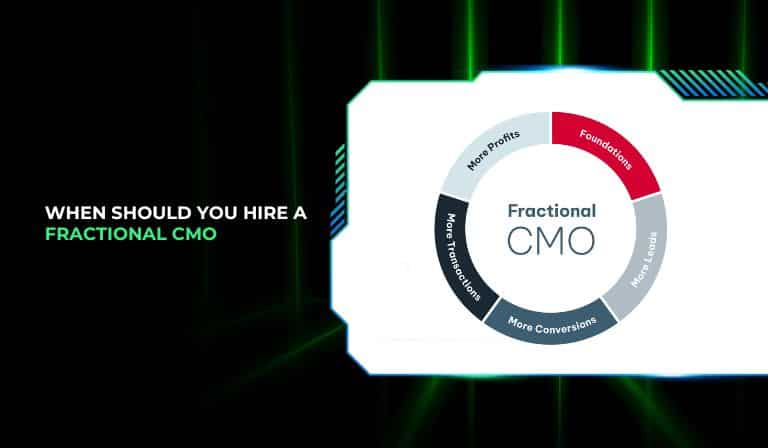
If you are running a growing business and marketing feels like a constant guessing game, you have probably wondered whether bringing in senior marketing leadership would finally fix things. The fractional CMO model has become one of the most talked-about solutions for founders and CEOs who need real strategic horsepower without the cost or commitment of a full-time executive hire. But the real question is not what a fractional CMO does or how much they cost. The real question is whether right now is the right time for your business to bring one in.

This article gives you a straight answer. Below are seven clear signs that tell you exactly when to hire a fractional CMO, along with honest guidance on when it is not the right move and what to look for once you decide to go ahead.
What Is a Fractional CMO?
A fractional CMO is a senior marketing executive who works with your company on a part-time or contract basis, typically a few days per week or a set number of hours per month. They carry the same strategic weight as a full-time Chief Marketing Officer but without the six-figure base salary, equity package, and long onboarding timeline that comes with a permanent hire.
They are not a consultant who hands you a deck and disappears. They are not an agency that manages your ad spend in isolation. A fractional CMO sits inside your leadership team, shapes your go-to-market strategy, manages or mentors your marketing team, aligns marketing with sales, and takes accountability for pipeline and revenue outcomes. The engagement is designed to be high-impact from day one, because unlike a full-time hire, there is no honeymoon period built into the model.
When to Hire a Fractional CMO: 7 Signs Your Business Is Ready
Many businesses struggle with inconsistent marketing results, unclear strategies, and slow growth without realizing they need senior-level marketing leadership. A Fractional CMO can step in to create direction, improve performance, and align marketing efforts with business goals—without the expense of a full-time executive. In this blog, we’ll cover 7 clear signs that indicate your business is ready to hire a Fractional CMO and how the right marketing leadership can help you scale more effectively.
Sign 1 — You Have Product-Market Fit but No Marketing Strategy
One of the clearest signals that it is time to bring in fractional CMO leadership is when your product is working but your marketing is not. You are closing customers, getting referrals, and seeing genuine demand, but you cannot explain exactly where that demand comes from or how to reliably generate more of it. Growth feels opportunistic rather than engineered. Some months are great. Others are inexplicably flat. The team is busy, but nobody can point to a repeatable system that turns effort into pipeline.
This is the gap a fractional CMO is specifically built to close. Product-market fit tells you that the market wants what you sell. It does not tell you how to reach that market at scale, how to position your offer against competitors, which channels will generate the best return, or how to build a demand engine that compounds over time. Those answers require someone who has built marketing systems before, understands how to translate business goals into marketing strategy, and can move fast because they have solved this problem in other contexts.
If you are at the stage where you have real revenue but no documented strategy, no defined ideal customer profile, no channel playbook, and no clear attribution for where your best customers come from, that is not a marketing execution problem. That is a strategic leadership problem. A fractional CMO solves it.
Sign 2 — You Cannot Justify a Full-Time CMO Salary
The economics of hiring are one of the most practical reasons why companies ask themselves whether they should hire a fractional CMO. A full-time Chief Marketing Officer with the experience needed to actually move the needle at a growth-stage company costs between $200,000 and $350,000 per year in base salary alone. Add benefits, equity, bonuses, recruiting fees, and onboarding time, and you are looking at a fully-loaded cost that many companies simply cannot absorb, especially in the $2M to $15M revenue range where the need for senior marketing leadership is often the most acute.
The fractional model solves this directly. A fractional CMO engagement typically runs between $6,000 and $20,000 per month depending on scope, industry, and time commitment. That is a fraction of the annual cost, and because the engagement starts with a clear strategic brief and defined outcomes, the ramp time is compressed compared to a traditional executive hire who may spend their first 90 days learning the business before producing anything of value.
This is why the fractional model is particularly well-suited to companies that are post-seed or pre-Series B, professional services firms scaling past their founder-led sales phase, and established businesses in the $5M to $30M range that need strategic marketing leadership but are not yet at the scale where a full-time CMO role is fully justified. If your budget cannot sustain a full-time executive hire but your growth ambitions demand senior thinking, that gap is exactly where the fractional model delivers the most value.
Sign 3 — Your Marketing Team Is Executing Without Direction
This is one of the most common and most underdiagnosed situations that signals a need for fractional CMO leadership. You have a marketing team. Maybe it is two people. Maybe it is five or six. They are producing content, running campaigns, managing social media, sending emails, and keeping the website updated. The team is not lazy. They are not incompetent. But results are inconsistent, priorities shift constantly, and there is no clear line between what the team is doing and what the company is actually trying to achieve commercially.
The problem is not the people. The problem is that the team has execution capacity but no strategic direction. Nobody is deciding which channels to prioritize, what the messaging hierarchy should be, how marketing aligns with the sales cycle, or what success looks like beyond vanity metrics. In the absence of that leadership layer, good marketers default to staying busy rather than staying focused.
A fractional CMO steps into that leadership gap without requiring you to add headcount. They establish the strategy, set the priorities, define the metrics that matter, and give the team a framework to operate within. The existing team becomes significantly more effective almost immediately because they finally understand what they are working toward and why. This is one of the strongest arguments for why hire a fractional CMO over simply hiring another marketing specialist — more execution capacity without strategic direction rarely solves the underlying problem.
Sign 4 — You Have Had a Bad Experience With a Marketing Agency
Agency relationships that go wrong tend to follow a predictable pattern. You hire the agency based on a strong pitch and impressive case studies. They deliver a steady stream of activity — reports, campaigns, content, ads. Six months in, you have spent a significant budget and the pipeline has not moved in any meaningful way. When you ask hard questions about ROI, you get answers about impressions and engagement rates. Eventually, you part ways feeling burned, skeptical about marketing in general, and unsure what you actually needed in the first place.
The root cause of most failed agency relationships is not that agencies are bad at what they do. It is that agencies execute tactics, and someone on your side needs to be responsible for strategy. Without an internal strategic voice telling the agency what outcomes to pursue, which audiences to prioritize, and how marketing connects to sales and revenue, even a technically competent agency will optimize for the wrong things.
A fractional CMO fixes this by giving you that internal strategic leadership layer. They write the briefs, set the KPIs, hold the agency accountable to business outcomes rather than activity metrics, and integrate agency work into a coherent overall strategy. They act as your internal advocate and translator between what the business needs and what external partners deliver. If you have been burned by agencies and are trying to figure out who should hire a fractional CMO next time around, the answer is: any company that plans to use agencies but does not have a senior internal voice to manage them strategically.
Sign 5 — You Are Preparing for a Funding Round or Major Growth Phase
Investors do not just evaluate your product and your financials. They evaluate your go-to-market strategy. They want to understand how you acquire customers, what it costs you to do so, how that cost changes as you scale, what your retention looks like, and whether your marketing and sales motion is repeatable and defensible. If you cannot answer those questions clearly and confidently, it signals that your growth to date has been more accidental than systematic — and that is a risk flag for sophisticated investors.
A fractional CMO can build that narrative from the inside. They can document your customer acquisition strategy, clean up your funnel metrics, define your positioning in the competitive landscape, and present a credible growth roadmap that shows investors exactly how you plan to deploy their capital. They have often been in the room for these conversations before and understand what the questions will be before they are asked.
Beyond the investor narrative, major growth phases — new market entry, product launches, geographic expansion — require someone who can think strategically about how marketing needs to evolve for a larger, more complex commercial operation. A fractional CMO can parachute into that transition with speed and experience that a first-time marketing hire simply cannot match.
Sign 6 — Your Customer Acquisition Cost Is Rising and You Do Not Know Why
When your CAC starts climbing but your pipeline does not grow proportionally, something is wrong with the marketing system. Maybe you are spending more on paid channels that are becoming saturated. Maybe your conversion rates have dropped at some point in the funnel and nobody has caught it. Maybe you have been relying on a channel that worked early on but has plateaued. Whatever the cause, a rising CAC without a clear diagnosis is one of the most expensive problems a growing company can ignore.
This is a sign that you need someone who can look at the entire marketing system analytically, not just manage the channels within it. A fractional CMO will audit your attribution model, assess channel efficiency, identify where the funnel is leaking, and recommend strategic changes rather than tactical tweaks. They are not going to tell you to spend more on Google Ads. They are going to tell you why your current spend is not working and how to reallocate it against a strategy that is built around your actual unit economics.
This is a core part of why fractional CMO engagements deliver strong ROI when the timing is right. The ability to diagnose systemic marketing problems and correct them quickly — drawing on experience across multiple businesses and industries — is exactly the kind of thinking that a coordinator, a specialist, or an agency account manager is not positioned to provide.
Sign 7 — You Are Entering a New Market or Launching a New Product
Many companies assume that because they know how to market their existing product to their existing customers, they can apply the same approach to a new product or a new market. This assumption is responsible for a significant number of expensive and avoidable failures. Different markets have different buyer psychology, different competitive dynamics, different channel preferences, and different messaging requirements. What worked in one context does not automatically transfer to another.
Entering a new market or launching a new product requires building a go-to-market strategy from a clean slate. That means defining the ideal customer profile for the new offering, developing positioning that resonates with a potentially very different buyer, selecting the channels most likely to reach that buyer efficiently, and establishing metrics that tell you early whether the approach is working. This is precisely the kind of strategic build that a fractional CMO is designed to own.
Because fractional CMOs work across multiple engagements, they often bring direct experience in the market or vertical you are entering, which accelerates the learning curve significantly. Rather than spending six months figuring out that your initial approach to a new market is wrong, you benefit from someone who has already made those mistakes in other contexts and knows how to avoid them.
When a Fractional CMO Is Not the Right Choice
Being honest about when this model does not fit is just as important as identifying when it does. A fractional CMO is not the answer to every marketing challenge, and deploying one in the wrong situation wastes money and time.
If you have not yet achieved product-market fit, fractional CMO leadership is premature. Marketing strategy without a validated product is a very expensive way to accelerate in the wrong direction. The focus at that stage should be on customer discovery and product iteration, not demand generation and brand building.
If your total marketing budget is under $4,000 to $5,000 per month across everything including the CMO engagement itself, the math does not work. A qualified fractional CMO will cost a meaningful portion of that budget, leaving too little for the actual marketing activity they are supposed to be directing.
If what you actually need is someone to execute specific tasks — write content, manage your ads account, run your email campaigns — then a specialist or a small agency is a more efficient solution. A fractional CMO is a leadership role, not a production role. Hiring one when you only need execution is like hiring an architect when you need a painter.
Fractional CMO vs. Other Options: How to Know You Are Choosing Right
Choosing the right marketing leadership can significantly impact your business growth, budget, and long-term success. While some companies hire in-house marketing managers or agencies, others turn to a Fractional CMO for strategic guidance and flexibility. Each option comes with different advantages, costs, and responsibilities. In this blog, we’ll compare a Fractional CMO with other marketing solutions to help you understand which option best fits your business goals, growth stage, and marketing needs.
Fractional CMO vs. Full-Time CMO
The full-time CMO is the right choice when your marketing operation has reached the scale and complexity that demands constant senior attention. If you are post-Series B, managing a large marketing team, operating across multiple product lines or geographies, and marketing is a primary driver of your company valuation, a full-time CMO is justified. Below that threshold, the fractional model gives you equivalent strategic quality at a fraction of the cost and commitment.
Fractional CMO vs. Marketing Agency
Agencies are execution partners. They are best deployed when someone internally is responsible for defining the strategy they are executing against. A fractional CMO and an agency are not competing options — they are complementary ones. Many of the best fractional CMO engagements involve the CMO managing agency relationships on behalf of the company, holding those agencies accountable to business outcomes rather than activity metrics.
Fractional CMO vs. Marketing Consultant
Consultants typically deliver recommendations. They assess your situation, produce a strategic document or framework, and then exit. A fractional CMO delivers strategy and stays to implement it, iterate on it, and take accountability for the results. If you have the internal capability to execute a well-defined strategy and just need someone to define it, a consultant may be sufficient. If you need someone to lead the execution as well, a fractional CMO is the right model.
Fractional CMO vs. VP of Marketing Hire
A VP of Marketing is often a strong option for companies that have reached the scale where they need dedicated senior marketing leadership but want someone building institutional knowledge over time. The tradeoff is cost, hiring timeline, and ramp time. A fractional CMO can start delivering value within the first two weeks. A VP of Marketing hire can take three to six months to recruit, onboard, and bring up to speed. If speed matters — and it usually does — the fractional model wins in the short to medium term.
What to Look for When You Are Ready to Hire
Once you have identified that the timing is right, choosing the right person matters as much as the timing itself. Here is what to prioritize.
Relevant industry experience. A fractional CMO who has worked extensively in B2B SaaS may not be the right fit for a consumer brand, and vice versa. Look for someone who has driven results in markets that are at least adjacent to yours, because the learning curve for a new industry eats into the speed advantage that makes the fractional model valuable.
A documented track record of pipeline impact. Avoid anyone who leads with brand metrics, awareness campaigns, and thought leadership as primary outcomes. The question to ask is direct: can you show me specific examples where your work contributed to measurable pipeline growth or revenue outcomes? If the answer is vague, keep looking.
Experience building and managing teams. A fractional CMO who has only ever been an individual contributor or an agency strategist may struggle with the leadership dimension of the role. You want someone who has hired, developed, and led marketing teams before, because part of their value is making your existing team better.
Strategic and tactical range. The best fractional CMOs can think at the board level about positioning and growth strategy and also roll up their sleeves to work directly in your CRM, your analytics platform, or your content calendar when needed. Pure strategists who cannot get into the work are a liability in a resource-constrained environment.
Cultural fit with your leadership team. This is underweighted in most hiring decisions and then regretted constantly once the person is in seat. A fractional CMO will be in your leadership meetings, pushing back on assumptions, challenging priorities, and advocating for the customer. If the communication style, values, or working style does not mesh with how your leadership team operates, the strategic value will be severely diluted.
How a Typical Engagement Unfolds
Understanding the structure of a fractional CMO engagement helps you evaluate whether the investment is likely to pay off within a timeframe that makes sense for your business.
Month 1 is typically focused on discovery and strategy. The fractional CMO audits your current marketing performance, interviews key stakeholders, maps the competitive landscape, and delivers a strategic framework with clear priorities and 90-day goals. This phase is about establishing the foundation before touching execution.
Months 2 and 3 are about building the foundation. Messaging and positioning get refined, the ICP is documented and validated, channel priorities are set, and the marketing team gets aligned around a shared strategy and set of metrics. Agency or vendor relationships are reviewed and restructured if necessary.
Months 4 through 6 shift toward pipeline acceleration. Campaigns are running against a clear strategy, the funnel is being measured and optimized, and early results are visible. The fractional CMO is spending more time coaching the team and less time building from scratch.
Months 7 through 12 are about scale and transition planning. If the company is ready to hire a full-time CMO or VP of Marketing, the fractional CMO helps define that role and supports the transition. If the fractional relationship continues, the focus shifts to scaling what is working and building toward the next stage of growth.
Frequently Asked Questions
How much does a fractional CMO cost?
Fractional CMO engagements typically range from $6,000 to $20,000 per month, depending on the scope of work, the seniority and track record of the individual, and the number of hours committed per week. Some engagements are structured as project-based work with a fixed fee. The cost is substantially lower than a full-time CMO hire when you factor in salary, benefits, equity, and recruiting costs.
How many hours per week does a fractional CMO typically work?
Most fractional CMO arrangements run between 10 and 20 hours per week, though this varies by engagement. Some companies bring in a fractional CMO for a defined number of days per month rather than tracking hours. The structure should be determined by what the role actually requires, not by an arbitrary time commitment.
How long does a fractional CMO engagement typically last?
Most engagements run between six months and two years. Shorter engagements focused on a specific deliverable — a product launch, a funding round, a market entry — can be scoped to three to six months. Longer ongoing engagements are common when the company wants sustained strategic leadership while building toward a full-time hire or scaling the team.
Can a fractional CMO transition into a full-time role?
Yes, and this is a common outcome when the relationship works well. The fractional engagement serves as an extended working interview where both sides develop a clear understanding of fit, expectations, and results before committing to a full-time arrangement. Many companies find this a lower-risk path to a full-time CMO hire than a traditional recruiting process.
Is a fractional CMO worth it for a company our size?
Whether a fractional CMO is worth it depends on your stage, your budget, and the specific problem you are trying to solve. If you have product-market fit, at least $5,000 to $6,000 per month allocated to marketing leadership, a team that needs direction, and a growth goal that requires strategic thinking rather than more execution, then yes — the ROI is typically strong. If you are pre-revenue or only need tactical execution, other options are likely a better fit.
Conclusion
The fractional CMO model is not a trend and it is not a shortcut. It is a genuinely efficient way for growth-stage companies to access the kind of senior marketing leadership that used to be available only to well-funded enterprises with large headcount budgets. But the model only delivers its full value when the timing is right and the fit is genuine.
The seven signs outlined above give you a clear framework for making that call. If you have product-market fit without a marketing strategy, a team executing without direction, a rising CAC you cannot explain, a funding round on the horizon, or a new market entry that demands strategic clarity, those are the moments when fractional CMO leadership creates disproportionate value. If you are pre-product-market fit, operating on a very tight budget, or only need execution rather than leadership, you are better served by other options.
The question of when to hire a fractional CMO ultimately comes down to one thing: do you have a strategic marketing leadership gap that is limiting your growth? If the answer is yes, the fractional model is almost certainly worth a serious conversation.

An avid blogger, dedicated to boosting brand presence, optimizing SEO, and delivering results in digital marketing. With a keen eye for trends, he’s committed to driving engagement and ROI in the ever-evolving digital landscape. Let’s connect and explore digital possibilities together.