


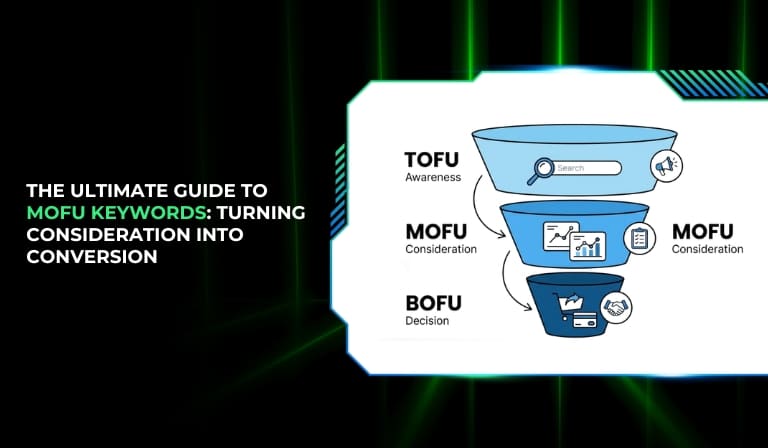
MOFU (Middle of Funnel) keywords are used when a user is no longer just exploring a topic but is actively thinking about solutions. At this stage, people already understand their problem and are now comparing options, tools, or services to solve it.

In a typical marketing funnel, there are three stages:
- TOFU (Top of Funnel): Awareness stage
- MOFU (Middle of Funnel): Consideration stage
- BOFU (Bottom of Funnel): Decision stage
MOFU sits in the middle and plays a very important role. It connects curiosity (TOFU) with action (BOFU). Without strong MOFU content, users may visit your website but leave without converting because they didn’t get enough information to make a decision.
In 2026, user behavior has changed significantly. People don’t trust simple informational content anymore. They want detailed comparisons, reviews, and proof before they choose anything. That is why MOFU keywords are now one of the most powerful parts of SEO.
What Is a MOFU Keyword?
A MOFU keyword is a search term that shows the user is evaluating options. These users are not beginners—they already know what they need, but they are deciding which option is best.
For example:
- “Best SEO tools for beginners”
- “Shopify vs WooCommerce”
- “Affordable email marketing platforms”
These keywords clearly show that the user is thinking about choosing a product or service.
MOFU keywords are different from basic informational keywords. A user searching “what is email marketing” is still learning (TOFU). But a user searching “best email marketing tools” is comparing solutions (MOFU).
This difference is very important because MOFU users are much closer to taking action. They are more likely to sign up, request a demo, or make a purchase.
Why MOFU Keywords Matter More Than Ever in 2026
In 2026, the importance of MOFU keywords has increased due to changes in search behavior and technology.
- Search engines now provide instant answers, reducing the need for basic informational content
- AI tools help users quickly understand concepts, so they move faster to the comparison stage
- Users rely more on reviews, comparisons, and recommendations before making decisions
Because of this shift, TOFU content alone is not enough. You may get traffic, but that traffic will not convert unless you guide users further.
MOFU keywords help solve this problem by targeting users who already have intent.
- They bring higher-quality leads because users are already interested
- They increase conversions because users are closer to buying
- They build trust by providing detailed and helpful information
Another important factor is competition. Many businesses focus heavily on TOFU content to increase traffic. However, fewer businesses invest properly in MOFU content. This creates an opportunity to stand out and capture users at the decision-making stage.
Understanding Search Intent Behind MOFU Keywords
To use MOFU keywords effectively, you must understand the intent behind them. Not all MOFU searches are the same. Users may be looking for different types of information based on their needs.
Commercial Investigation Intent
This is one of the most common types of MOFU intent. Users are actively comparing options before making a decision.
They search for things like:
- “Best CRM software”
- “Top project management tools”
These users expect:
- Lists of options
- Feature comparisons
- Pricing details
- Honest recommendations
If your content does not provide these, users will leave and choose another source.
Problem-Solution Intent
Here, users are trying to solve a specific problem. They already know what they are facing and want a solution.
Examples include:
- “How to reduce cart abandonment”
- “Tools to improve website speed”
These users expect:
- Clear explanations of the problem
- Practical solutions
- Recommended tools or strategies
This type of intent is very powerful because it directly connects problems with solutions.
Comparison Intent
These users are comparing specific products or services.
Examples:
- “Ahrefs vs Semrush”
- “Notion vs Trello”
They want:
- Side-by-side comparisons
- Pros and cons
- Use cases
- Final verdict
This type of content often leads directly to conversions because users are very close to making a decision.
Feature-Based Intent
Some users are searching for specific features or requirements.
Examples:
- “CRM with automation features”
- “Affordable SEO tools for small business”
They expect:
- Filtered recommendations
- Focus on specific needs
- Clear explanation of features
This type of intent requires highly targeted content.
Types of MOFU Keywords (With Examples)
MOFU keywords can be grouped into different categories based on how users search and what they are looking for.
Comparison Keywords
These keywords involve direct comparisons between two or more options.
Examples:
- “Ahrefs vs Semrush”
- “Mailchimp vs ConvertKit”
These are high-intent keywords because users are already choosing between options. Content for these keywords should include:
- Detailed comparisons
- Feature breakdowns
- Pros and cons
- Final recommendations
Best-of Keywords
These keywords focus on lists of top tools or services.
Examples:
- “Best CRM for startups”
- “Top SEO tools in 2026”
Users expect:
- Ranked lists
- Clear criteria
- Detailed descriptions
This type of content works well because it simplifies decision-making.
Alternatives Keywords
Users search for alternatives when they are not satisfied with a current option.
Examples:
- “Alternatives to HubSpot”
- “Mailchimp alternatives”
These keywords have strong conversion potential because users are already looking to switch. Content should focus on:
- Better options
- Feature comparisons
- Pricing differences
Use-case Keywords
These keywords are based on specific situations or audiences.
Examples:
- “Email marketing for small business”
- “CRM for real estate agents”
Content should be highly targeted and relevant to that use case. Generic content will not perform well here.
Pain-Point Keywords
These keywords focus on solving specific problems.
Examples:
- “How to reduce cart abandonment”
- “Improve website conversion rate”
These are powerful because they connect directly to user needs. Content should:
- Clearly explain the problem
- Provide actionable solutions
- Recommend tools or strategies
MOFU vs TOFU vs BOFU Keywords
To fully understand MOFU keywords, it is important to compare them with TOFU and BOFU keywords. Each stage of the funnel serves a different purpose and targets users with different intent.
TOFU (Top of Funnel) keywords focus on awareness. These are used by people who are just starting to learn about a topic. They are not ready to buy and are simply looking for information.
MOFU (Middle of Funnel) keywords focus on consideration. These users already understand their problem and are now comparing different solutions.
BOFU (Bottom of Funnel) keywords focus on decision-making. These users are ready to take action, such as buying a product or signing up for a service.
Here are the key differences:
- Intent
- TOFU: Learning and awareness
- MOFU: Evaluation and comparison
- BOFU: Purchase or conversion
- Content Type
- TOFU: Blog posts, guides, educational content
- MOFU: Comparison articles, listicles, reviews
- BOFU: Landing pages, product pages, demos
- Conversion Potential
- TOFU: Low
- MOFU: Medium to high
- BOFU: Very high
One of the biggest mistakes businesses make is focusing only on TOFU content to increase traffic. While traffic is important, it does not guarantee conversions. Without MOFU content, users do not get enough information to move forward in their journey.
How to Find MOFU Keywords (Step-by-Step)
Finding MOFU keywords requires a structured approach. You need to identify keywords that show clear intent and match the consideration stage.
Use Keyword Research Tools
Keyword research tools are the starting point for finding MOFU keywords.
- Look for keywords that include terms like “best,” “vs,” “review,” and “alternatives”
- Focus on keywords with commercial intent rather than purely informational ones
- Analyze search volume and keyword difficulty to find opportunities
These tools help you identify what users are actively searching for.
Analyze Competitor Content
Competitor analysis is a powerful way to discover proven MOFU keywords.
- Identify pages that rank for comparison or list-based keywords
- Study how competitors structure their content
- Look at which topics are driving traffic and engagement
This helps you understand what works and where you can improve.
Use Google SERP Features
Search engine result pages provide valuable insights into user intent.
- Check the “People Also Ask” section for common questions
- Look at related searches at the bottom of the page
- Analyze featured snippets and top-ranking content
These insights come directly from real user behavior.
Leverage Customer Questions
Your customers are one of the best sources of keyword ideas.
- Analyze questions from sales calls
- Review support tickets and FAQs
- Look at product reviews and feedback
These sources reveal real problems and concerns that users have, which can be turned into MOFU content.
Use AI & Search Trends
AI tools and trend analysis can help you stay ahead.
- Use AI to generate keyword ideas based on your niche
- Identify trending topics and emerging search patterns
- Adapt your content strategy based on changing behavior
This ensures your content remains relevant and competitive.
How to Create High-Converting MOFU Content
Creating MOFU content is not just about providing information. It is about helping users make decisions.
Match Search Intent Perfectly
Your content must directly match what the user is looking for.
- If the keyword is “best tools,” provide a list of tools
- If it is a comparison, provide a detailed comparison
Avoid adding unnecessary information that does not help the user decide.
Use Structured Content Formats
Structured content makes it easier for users to understand and compare options.
- Use tables for comparisons
- Add clear headings and sections
- Highlight key points
This improves both readability and user experience.
Add Trust Signals
Trust is very important in the consideration stage.
- Include reviews and testimonials
- Use real data and examples
- Show case studies if possible
These elements help users feel confident in their decision.
Include Clear CTAs
MOFU content should guide users toward the next step.
- Use soft CTAs like “Learn more,” “Try for free,” or “Explore features”
- Place CTAs naturally within the content
Avoid being too aggressive, as users are still evaluating options.
Optimize for Readability & UX
A good user experience increases engagement and conversions.
- Use simple and clear language
- Keep paragraphs short
- Make content easy to scan
If users find your content difficult to read, they will leave quickly.
Best Content Formats for MOFU Keywords
Choosing the right content format is essential for MOFU success. Different formats work better for different types of keywords.
Comparison Articles
Comparison articles directly compare two or more products or services.
- Provide side-by-side comparisons
- Highlight differences clearly
- Include pros and cons
These articles are highly effective because they match strong user intent.
Listicles (Top/Best Tools)
Listicles present a list of the best options available.
- Rank tools based on specific criteria
- Provide detailed descriptions for each option
- Include use cases and pricing
This format helps users quickly explore multiple options.
Product Alternatives Pages
These pages focus on alternatives to a specific product.
- Target users who are looking to switch
- Highlight better features or pricing
- Compare multiple alternatives
This type of content has high conversion potential.
Case Studies & Use Cases
Case studies show real-world results.
- Explain how a product or service solved a problem
- Include measurable results
- Provide context and details
This builds trust and credibility.
In-depth Buying Guides
Buying guides help users make informed decisions.
- Explain what to look for in a product
- Compare different options
- Provide recommendations
These guides are especially useful for complex products or services.
MOFU Content Optimization Best Practices
Creating MOFU content is not enough. To get real results, you need to optimize it properly so that it ranks well and converts users effectively.
Internal Linking Strategy
Internal linking helps guide users through the funnel and improves SEO performance.
- Link TOFU content (guides, blogs) to relevant MOFU pages
- Connect MOFU pages to BOFU pages (product or service pages)
- Use clear and relevant anchor text
This creates a smooth journey for users and helps search engines understand your site structure.
On-Page SEO Optimization
On-page SEO ensures your content is properly optimized for search engines.
- Use your primary keyword in the title, headings, and meta description
- Keep the content relevant and focused on intent
- Avoid keyword stuffing and keep it natural
Proper optimization increases visibility and improves rankings.
Use Schema Markup
Schema markup helps search engines understand your content better and can improve how it appears in search results.
- Use FAQ schema for common questions
- Use review schema for product-related content
- Use comparison-related structured data where possible
This can increase click-through rates by making your listing more attractive.
Add Visual Elements
Visual elements improve user experience and make content easier to understand.
- Use comparison tables to simplify information
- Add charts or visuals where needed
- Highlight key differences clearly
Good visuals help users make faster decisions and stay longer on the page.
How to Measure MOFU Keyword Success
Measuring performance is important to understand what is working and what needs improvement.
Engagement Metrics
Engagement shows how users interact with your content.
- Time on page indicates how long users stay
- Scroll depth shows how much content they consume
- Bounce rate indicates whether users leave quickly
High engagement usually means your content matches user intent.
Conversion Metrics
MOFU content should contribute to conversions, even if it is not the final step.
- Track assisted conversions
- Measure lead generation (sign-ups, downloads)
- Analyze user journeys
These metrics help you understand how MOFU content supports the buying process.
SEO Metrics
SEO metrics help you track visibility and performance in search engines.
- Monitor keyword rankings
- Track organic traffic growth
- Identify which pages are performing best
Consistent monitoring helps you improve your strategy.
Revenue Impact
Ultimately, MOFU content should contribute to business growth.
- Track its impact on your sales pipeline (for B2B)
- Measure changes in average order value (for B2C)
- Analyze how it influences purchase decisions
This connects your SEO efforts directly to revenue.
MOFU Keywords in Your SEO Funnel Strategy
MOFU keywords are the bridge between awareness and conversion. Without them, your funnel remains incomplete.
A strong funnel works like this:
- TOFU content attracts users and builds awareness
- MOFU content educates and helps users compare options
- BOFU content drives final action
To make this effective:
- Create content for each stage of the funnel
- Link them together strategically
- Guide users step-by-step toward conversion
This approach ensures that traffic does not go to waste.
Conclusion
MOFU keywords are one of the most important parts of modern SEO. They help you connect with users who are actively considering their options and are close to making a decision. By understanding intent, creating structured content, and optimizing effectively, you can turn traffic into real conversions.
In 2026, success is not just about ranking on search engines. It is about guiding users through their journey and helping them make informed decisions. MOFU content allows you to build trust, provide value, and drive meaningful business results.
FAQs
What is the difference between MOFU and BOFU keywords?
MOFU keywords focus on comparison and evaluation, while BOFU keywords focus on final decisions and actions like purchasing or signing up.
Are MOFU keywords good for beginners?
Yes, they are very effective because they target users with clear intent and can lead to faster conversions compared to informational keywords.
How long does it take to see results?
The time depends on competition and content quality, but MOFU content often shows faster conversion results because it targets users closer to the decision stage.
What tools are best for MOFU keyword research?
Common tools include Ahrefs, Semrush, and Google Keyword Planner, which help identify keywords with strong commercial intent.