


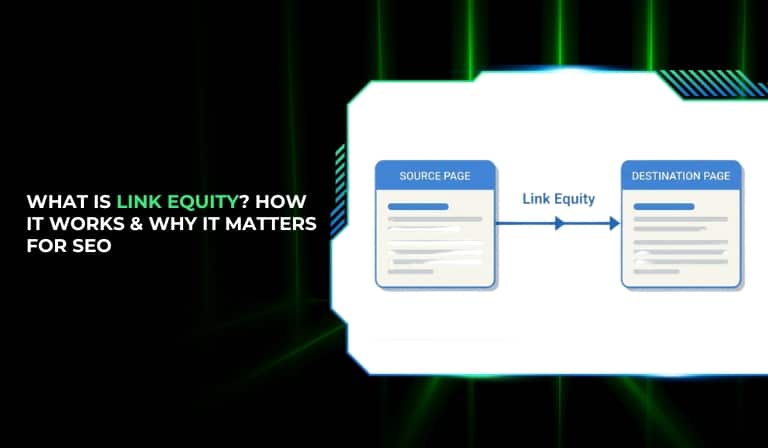
Link equity, often called “link juice,” is one of the most important concepts in SEO because it explains how value flows across the web. Every time one webpage links to another, it passes a portion of its authority, trust, and ranking potential.

Search engines like Google use links as signals to understand which pages are important. If many strong and relevant pages link to a particular page, search engines assume that page is valuable and rank it higher.
Even in today’s AI-driven search environment—where features like AI Overviews and zero-click results are becoming common—link equity still plays a major role. AI systems also rely on trusted, authoritative sources, and links remain one of the strongest ways to identify those sources.
What is Link Equity?
Link equity refers to the value or authority passed from one webpage to another through hyperlinks. It is not a visible metric but a conceptual way to understand how search engines evaluate links.
Think of link equity like a recommendation system. When a strong page links to another page, it is essentially “vouching” for it. The more high-quality recommendations a page receives, the stronger it becomes in search rankings.
- Link equity flows through hyperlinks between pages
- It helps search engines determine importance and trust
- Both internal links and external backlinks contribute
- Higher-quality links pass more value than low-quality ones
There are two main types of link equity:
- Internal link equity: Passed between pages on your own website
- External link equity: Passed from other websites (backlinks)
Both are important, but backlinks are often more powerful because they act as third-party validation.
Why Link Equity Is Important for SEO
Link equity directly influences how well your pages perform in search results. Without it, even well-written content may struggle to rank.
Search engines rely on link signals to evaluate content quality, relevance, and authority. This makes link equity a critical ranking factor.
- Helps pages rank higher in search results
- Improves indexing speed for new content
- Distributes authority across important pages
- Supports topical authority and content clusters
- Strengthens trust signals used in ranking systems
For example, if your homepage has strong backlinks but your blog pages have none, internal linking can pass equity from the homepage to those blog pages. This improves their chances of ranking.
In simple terms, link equity ensures that your website’s strength is shared across all important pages instead of being concentrated in just one area.
How Link Equity Works (Step-by-Step Explanation)
Link equity does not pass randomly. It follows a structured process influenced by multiple factors. Understanding this flow helps you control how authority moves across your site.
1. Source Page Authority
The strength of the linking page plays a major role in how much equity is passed.
- Pages with strong backlinks pass more equity
- High-authority domains provide stronger signals
- Low-quality or spammy pages pass little to no value
For example, a link from a well-established website will carry far more weight than a link from a new or low-quality site.
2. Link Placement Matters
Not all links on a page are treated equally. Their position affects how much value they pass.
- Links within the main content carry the most weight
- Links placed higher on the page are often more valuable
- Footer and sidebar links usually pass less equity
Search engines prioritize links that appear naturally within content because they are more likely to be relevant and intentional.
3. Anchor Text Relevance
Anchor text is the clickable text of a link, and it helps search engines understand what the linked page is about.
- Relevant anchor text improves contextual understanding
- Natural phrasing works better than keyword stuffing
- Over-optimized anchors can look manipulative
For example, a link with descriptive text provides clearer signals than a generic “click here” link.
4. Number of Outgoing Links
Link equity is divided among all the links on a page. This means more links can reduce the value passed to each one.
- Fewer links = more equity per link
- Too many links dilute authority
- Balance is important for effective distribution
This does not mean you should avoid linking, but you should link strategically.
5. Crawlability & Indexability
Search engines must be able to access and index a page for link equity to pass through it.
- Links on non-indexed pages may not pass value
- Blocked pages (via robots.txt or noindex) limit flow
- Proper technical SEO ensures smooth equity transfer
If a page cannot be crawled, it cannot pass link equity effectively.
6. Internal vs External Links
Both types of links play different but complementary roles.
- Internal links distribute authority within your website
- External links bring new authority from other domains
- A strong SEO strategy uses both effectively
Internal linking helps you control where equity flows, while external backlinks bring new equity into your site.
Key Factors That Influence Link Equity
Link equity is not passed equally across all links. Several factors determine how much value is transferred from one page to another. Understanding these factors helps you build stronger SEO strategies instead of relying on random linking.
Domain Authority & Trust
The overall authority and trust level of a website play a major role in link equity.
- Links from well-established, trusted websites pass stronger equity
- Domains with a history of high-quality content are more valuable
- Spammy or low-trust sites pass very little value
Search engines evaluate trust signals such as content quality, backlink profile, and domain history before assigning weight to links.
Page-Level Authority
Not all pages on a website are equally powerful. Link equity is passed at the page level, not just the domain level.
- Pages with strong backlinks pass more equity
- High-performing pages (like top-ranking blogs) are valuable sources
- Newly created or low-traffic pages pass less value
This is why getting a link from a popular page is more beneficial than from a weak or hidden page.
Relevance of Linking Page
Relevance is one of the most important factors in modern SEO.
- Links from related topics pass stronger signals
- Contextually aligned pages improve understanding
- Irrelevant links are less effective
For example, a link from a digital marketing blog to an SEO article is far more valuable than a link from an unrelated niche.
Contextual vs Non-Contextual Links
Where and how a link appears affects its strength.
- Contextual links inside content carry the most value
- Links surrounded by relevant text are stronger
- Sidebar, footer, or navigation links pass less equity
Search engines prioritize links that appear naturally within meaningful content because they reflect genuine recommendations.
Follow vs Nofollow Links
Link attributes influence whether equity is passed.
- Follow links pass link equity directly
- Nofollow links signal search engines to limit direct transfer
- However, nofollow links can still provide indirect SEO value
Even though nofollow links may not pass full equity, they can still drive traffic, visibility, and brand signals.
Unique Referring Domains
The number of unique websites linking to you matters more than the number of total links.
- Links from different domains increase authority
- Multiple links from the same domain have diminishing value
- Diversity strengthens your backlink profile
Search engines view links from multiple sources as stronger validation than repeated links from one source.
Link Freshness (Live vs Broken Links)
The status of links affects equity flow.
- Active (live) links continue passing value
- Broken links stop the flow completely
- Regular updates help maintain equity
Keeping your links updated ensures that your SEO strength remains intact over time.
Types of Links and Their Impact on Link Equity
Different types of links behave differently when it comes to passing link equity. Understanding these differences helps you use them more effectively.
DoFollow Links
These are the default type of links and are the most important for SEO.
- Pass link equity directly
- Contribute to rankings
- Help build authority
Most SEO strategies focus on acquiring high-quality dofollow backlinks.
NoFollow, Sponsored & UGC Links
These links include attributes that signal search engines about their nature.
- Nofollow links may not pass full equity
- Sponsored links indicate paid placements
- UGC (User Generated Content) links come from comments or forums
While these links may not directly boost rankings, they still play a role in traffic and brand visibility.
Internal Links
Internal links connect pages within your website and are essential for controlling link equity flow.
- Help distribute authority across pages
- Improve navigation and user experience
- Support indexing of new pages
A strong internal linking strategy ensures that your most important pages receive the most equity.
External Links
External links (backlinks) come from other websites and bring new equity into your site.
- Act as trust signals
- Increase domain credibility
- Help improve rankings
The quality of external links matters far more than the quantity.
Backlinks vs Outbound Links
Understanding the difference helps clarify link equity flow.
- Backlinks are incoming links from other websites
- Outbound links are links from your site to others
Backlinks increase your site’s authority, while outbound links distribute your site’s equity.
How Link Equity Flows Through a Website
Link equity flows through your website based on how your pages are connected. A well-structured site ensures that authority is distributed efficiently.
- The homepage usually has the highest authority
- Equity flows from top-level pages to deeper pages
- Internal linking controls how this flow happens
If your structure is weak, equity may not reach important pages, which can limit their ability to rank.
Hub-and-Spoke (Topic Cluster) Model
This model organizes content around a central topic and is widely used in modern SEO.
- A pillar page covers a broad topic
- Supporting pages (spokes) cover subtopics
- All pages link to each other strategically
This structure helps concentrate and distribute link equity effectively while building topical authority.
Silo Structure
Siloing groups related content into categories, improving clarity and relevance.
- Each silo focuses on one topic
- Internal links stay within the same category
- Strengthens subject relevance
This approach helps search engines better understand your website’s structure and expertise.
Flat vs Deep Site Architecture
The depth of your site structure affects how easily link equity flows.
- Flat structure: Pages are closer to the homepage and receive more equity
- Deep structure: Pages are buried and receive less equity
- Balanced structure ensures proper distribution
A good structure ensures that no important page is too far from your main authority sources.
How Redirects, Canonicals & Tags Affect Link Equity
Technical SEO elements play a critical role in how link equity is preserved, transferred, or lost. If implemented incorrectly, they can waste valuable authority.
301 vs 302 Redirects
Redirects are used when a page URL changes, but not all redirects behave the same.
- 301 redirects (permanent) pass most of the link equity to the new page
- 302 redirects (temporary) may not pass full equity consistently
- Using the wrong redirect type can lead to loss of authority
For long-term changes, 301 redirects are the preferred option because they consolidate ranking signals.
Canonical Tags
Canonical tags help search engines understand which version of a page should be treated as the main one.
- Prevent duplicate content issues
- Consolidate link equity from similar pages
- Ensure the correct page gets ranking signals
Without proper canonicalization, link equity can get split across multiple versions of the same content.
Meta Robots & Nofollow
Meta tags control how search engines crawl and index pages.
- Noindex pages are excluded from search results and may not pass equity
- Nofollow links limit the transfer of link equity
- Incorrect usage can block important pages from receiving authority
Using these tags strategically helps maintain control over how equity flows.
How to Build and Improve Link Equity (Actionable Strategies)
Building link equity requires a combination of content, backlinks, and internal optimization. This is where most SEO gains happen.
Create High-Quality, Link-Worthy Content
Content is the foundation of link equity.
- Unique insights attract natural backlinks
- Helpful content earns trust and authority
- Evergreen content continues to gain links over time
Build Backlinks from Authority Sites
External links are one of the strongest signals in SEO.
- Focus on relevant and trusted websites
- Avoid low-quality or spammy links
- Prioritize quality over quantity
Use Smart Internal Linking
Internal links allow you to control how equity flows.
- Link from high-authority pages to important pages
- Use relevant and natural anchor text
- Maintain a clear structure
Fix Broken Links Regularly
Regular audits help maintain your site’s strength.
- Identify and fix broken links
- Replace outdated URLs
- Ensure continuous equity flow
Use Topic Clusters & Pillar Pages
Structured content improves authority distribution.
- Pillar pages act as central hubs
- Supporting content links back to the main topic
- Strengthens topical relevance
Optimize Anchor Text Naturally
Anchor text should feel natural and informative.
- Avoid keyword stuffing
- Use variations and context
- Improve readability and relevance
Update Old Content to Retain Equity
Older content can lose value over time if not maintained.
- Refresh outdated information
- Add new insights and links
- Maintain rankings and authority
Link Equity in the Age of AI Search (SGE & Zero-Click Results)
Search is evolving, but link equity is still important—just in a slightly different way.
Impact of AI Overviews on Organic Clicks
AI-generated summaries reduce the need for users to click on websites.
- Fewer clicks for informational queries
- Higher competition for visibility
- Ranking alone is no longer enough
Importance of Authority & Trust Signals
AI systems prioritize reliable and authoritative sources.
- Strong link profiles increase trust
- High-quality backlinks improve credibility
- Authority becomes more important than ever
Entity-Based SEO & Knowledge Graph
Search engines now focus on understanding entities (topics, brands, people).
- Links help define relationships between entities
- Improve recognition in knowledge systems
- Strengthen topical authority
Featured Snippets & Passage Ranking
Search engines can rank specific sections of content.
- Well-linked pages improve section-level authority
- Internal links support better visibility
- Structured content performs better
Why Links Still Matter for AI Training Signals
Links continue to act as validation signals.
- Help confirm content accuracy
- Indicate trust and authority
- Support AI understanding of reliable sources
Link Equity vs PageRank: What’s the Difference?
Link equity and PageRank are closely related but not identical concepts.
- PageRank is a specific algorithm used to evaluate links
- Link equity is a broader concept describing value flow
- Both rely on link relationships to determine importance
Even though PageRank is no longer publicly visible, its core principles still influence how search engines treat links.
Can You Measure Link Equity?
Link equity cannot be measured directly because search engines do not share exact data. However, SEO tools provide useful estimates.
- Ahrefs uses URL Rating (UR)
- Moz uses Page Authority (PA)
- SEMrush uses Authority Score
These metrics help compare pages and track improvements, but they are only approximations.
Conclusion
Link equity remains a foundational element of SEO, even in a rapidly evolving search landscape. It helps search engines understand which pages are valuable, how content is connected, and where authority should be assigned. By combining high-quality backlinks, strong internal linking, and proper technical optimization, you can build a system where authority flows efficiently across your website.
A successful SEO strategy is not just about gaining links—it is about managing and directing link equity in a way that supports long-term growth, visibility, and trust.