


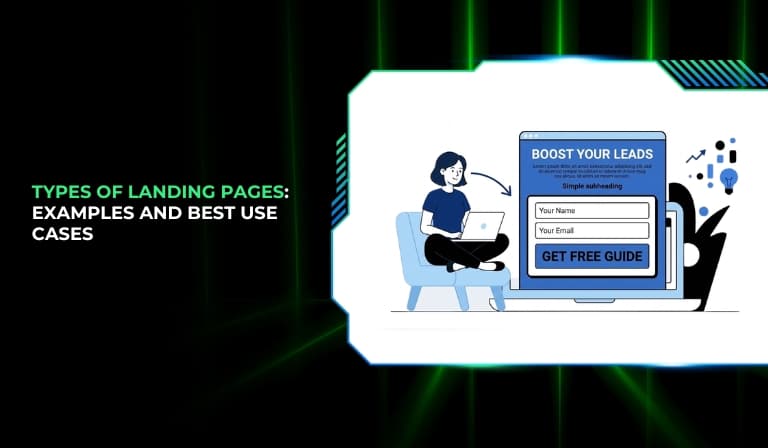
Landing pages are one of the most important tools in digital marketing. Unlike general website pages, landing pages are designed with a specific goal in mind. They guide visitors toward completing a particular action, such as signing up for a newsletter, downloading a guide, registering for a webinar, or making a purchase. Because of this focused purpose, landing pages often achieve higher conversion rates than regular web pages.

Businesses use landing pages in many types of marketing campaigns, including paid advertising, email marketing, and social media promotions. Each campaign may require a different type of landing page depending on the marketing objective and the stage of the customer journey. Choosing the right landing page structure can significantly improve engagement and conversions.
In this guide, you will learn what landing pages are, why they are important, and the most common types used in digital marketing. The article also explains when each landing page should be used and how businesses can select the right one for their marketing goals.
What Is a Landing Page?
A landing page is a standalone web page created for a specific marketing campaign. It is typically where visitors arrive after clicking on a link from advertisements, emails, search engine results, or social media posts. The primary purpose of a landing page is to encourage visitors to take a specific action.
Unlike traditional website pages that may contain multiple navigation options, landing pages focus on a single goal. This focused design helps reduce distractions and increases the likelihood that users will complete the intended action.
Common goals of landing pages include collecting contact information, promoting a product or service, or guiding visitors to the next step in a marketing funnel.
Key characteristics of landing pages include:
- A clear and compelling headline that communicates the offer
- A strong value proposition explaining the benefit to the visitor
- A call-to-action (CTA) that tells users what action to take
- Supporting visuals or content that reinforce the message
- Minimal distractions to keep the focus on the main goal
Landing Page vs Website Homepage
Although landing pages and homepages may look similar at first glance, they serve very different purposes in digital marketing. Understanding the difference between them helps businesses design better marketing campaigns.
A homepage is the main entry point of a website. It introduces visitors to the brand and provides access to different sections of the website. It usually contains multiple links, navigation menus, and information about various services or products.
Landing pages, on the other hand, are designed for a specific campaign or offer. They focus on guiding users toward completing a single action. Because of this focus, they often remove unnecessary navigation elements that could distract visitors.
Key differences between landing pages and homepages include:
- Purpose
- Homepage: Provides an overview of the entire website
- Landing page: Focuses on a specific marketing goal
- Navigation
- Homepage: Includes multiple navigation links
- Landing page: Often removes navigation to reduce distractions
- Content Structure
- Homepage: Covers many topics and services
- Landing page: Focuses on one product, service, or offer
- Conversion Focus
- Homepage: Informational and exploratory
- Landing page: Conversion-oriented
Why Different Types of Landing Pages Matter
Not all landing pages serve the same purpose. Different marketing objectives require different types of landing pages. For example, a business trying to collect leads will use a different page structure compared to a business trying to sell a product directly.
Using the correct type of landing page improves marketing results because it aligns with the user’s intent and the stage of the customer journey. When the design and message match the visitor’s expectations, users are more likely to engage and convert.
The importance of using the right landing page type includes:
- Better alignment with campaign goals
- Higher conversion rates
- Improved user experience
- More effective marketing funnels
- Easier measurement of campaign performance
Common Types of Landing Pages
Landing pages can be categorized based on their marketing objective and the action they encourage users to take. Below are some of the most common types used by businesses.
Lead Generation Landing Pages
Lead generation landing pages are designed to collect contact information from visitors. These pages typically include a form that asks for details such as name, email address, or phone number. Businesses use this information to follow up with potential customers through email campaigns or sales outreach.
Lead generation pages usually offer something valuable in exchange for the visitor’s information. This offer is often called a lead magnet.
Common examples of lead magnets include:
- Free eBooks or guides
- Industry reports or whitepapers
- Newsletter subscriptions
- Webinar registrations
These pages are widely used in both B2B and B2C marketing because they help businesses build a list of potential customers.
Click-Through Landing Pages
Click-through landing pages are designed to guide visitors to another page where the final conversion happens. Instead of collecting information directly, these pages provide detailed information about a product or service and encourage users to click a button that takes them to the next step.
This type of landing page is commonly used in sales funnels where customers need more information before making a purchase.
Typical characteristics of click-through landing pages include:
- Detailed explanation of product benefits
- Visual demonstrations or screenshots
- Customer testimonials
- A strong call-to-action that leads to the purchase page
Sales Landing Pages (Long-Form Landing Pages)
Sales landing pages are created to persuade visitors to purchase a product or service directly. These pages are often long-form because they provide detailed information about the offer.
Long-form sales pages use persuasive content to build trust and convince visitors that the product or service solves their problem. They typically include multiple sections explaining benefits, features, and customer success stories.
Common elements of sales landing pages include:
- Detailed product descriptions
- Customer testimonials and reviews
- Case studies or success stories
- Product demonstrations or videos
- Multiple call-to-action buttons
These pages are frequently used for online courses, digital products, and software subscriptions.
Squeeze Pages
Squeeze pages are a simplified version of lead generation landing pages. Their primary goal is to capture email addresses from visitors with minimal distractions.
Unlike more detailed pages, squeeze pages focus only on one message and one action. They usually contain very little text and a simple form.
Key features of squeeze pages include:
- Short and clear headline
- Brief explanation of the offer
- Simple email capture form
- Strong call-to-action button
Because of their simplicity, squeeze pages are commonly used in email marketing campaigns and lead generation strategies.
Splash Pages
Splash pages are temporary pages that appear before users reach the main website. They are often used to display announcements or promotions.
Unlike other landing pages, splash pages usually provide limited information and require users to take a simple action before continuing.
Common uses of splash pages include:
- Announcing special promotions
- Age verification for restricted content
- Language selection for international websites
Although splash pages can be useful in certain situations, they should be used carefully because they may interrupt the user experience.
Product Landing Pages
Product landing pages focus on promoting a specific product. These pages highlight the product’s features, benefits, and unique selling points.
Product landing pages often include high-quality visuals and detailed descriptions to help users understand how the product works and why it is valuable.
Typical elements of product landing pages include:
- Product images or videos
- Feature explanations
- Benefits and value propositions
- Pricing information
- Customer reviews or testimonials
These pages are commonly used in e-commerce marketing campaigns.
Webinar Registration Landing Pages
Webinar landing pages are designed to encourage users to register for an online event or presentation. These pages provide information about the topic, the speakers, and the benefits of attending.
The main goal is to convince visitors that the webinar will provide valuable insights or knowledge.
Typical elements of webinar landing pages include:
- Webinar title and topic description
- Speaker profiles and credentials
- Event date and time
- Registration form
Webinar landing pages are widely used in educational marketing and software product demonstrations.
Event Landing Pages
Event landing pages promote physical or virtual events such as conferences, workshops, or product launches. These pages provide detailed information about the event and encourage users to register or purchase tickets.
Common components of event landing pages include:
- Event overview and objectives
- Schedule or agenda
- Speaker or presenter information
- Ticket pricing or registration forms
These pages help businesses attract attendees and manage event registrations effectively.
Coming Soon Landing Pages
Coming soon landing pages are used before launching a new product, website, or service. Their purpose is to generate anticipation and collect early interest from potential users.
Instead of providing full details, these pages offer a preview of what is coming and encourage visitors to sign up for updates.
Common features include:
- A brief description of the upcoming launch
- Countdown timers
- Email sign-up forms for updates
- Early access registration
These pages help businesses build excitement before a launch.
Thank You Landing Pages
Thank you landing pages appear after a user completes a desired action, such as filling out a form or making a purchase. These pages confirm that the action was successful and often provide next steps.
Thank you pages can also encourage further engagement with the brand.
Common uses of thank you pages include:
- Confirming form submissions
- Providing download links for resources
- Suggesting related products or services
- Encouraging users to share the offer on social media
Landing Pages Across the Marketing Funnel
Top of Funnel (TOFU)
Top-of-funnel landing pages focus on attracting new visitors and generating awareness. At this stage, users may not be ready to buy but are interested in learning more about a topic or solution.
Common TOFU landing pages include:
- Lead generation pages offering free resources
- Squeeze pages collecting email subscribers
- Educational webinar registration pages
These pages aim to build relationships with potential customers.
Middle of Funnel (MOFU)
Middle-of-funnel landing pages focus on educating and nurturing potential customers who already know about the brand.
Examples include:
- Product information pages
- Webinar or demo registration pages
- Case study or report download pages
These pages help users evaluate whether a product or service meets their needs.
Bottom of Funnel (BOFU)
Bottom-of-funnel landing pages target users who are ready to make a purchase or complete a conversion.
Typical BOFU pages include:
- Sales landing pages
- Product landing pages with pricing information
- Limited-time offer pages
These pages focus on converting interested users into customers.
SEO Landing Pages vs PPC Landing Pages
Landing pages can also differ based on how visitors reach them. Two common types are SEO landing pages and PPC landing pages.
SEO landing pages are optimized for organic search traffic. They target specific keywords and provide detailed information that helps them rank in search engine results. These pages often include educational content and helpful resources.
PPC landing pages are designed specifically for paid advertising campaigns. They are usually shorter and more focused because they match the message of the advertisement that brought the visitor to the page.
Key differences include:
- Traffic Source
- SEO pages receive traffic from search engines
- PPC pages receive traffic from paid ads
- Content Depth
- SEO pages often contain more detailed content
- PPC pages focus on quick conversions
- Keyword Strategy
- SEO pages target organic search keywords
- PPC pages match ad campaign keywords
How to Choose the Right Landing Page Type
Selecting the correct landing page type depends on several factors. Businesses need to consider their marketing objective, audience, and the stage of the customer journey.
Important factors to consider include:
- The main goal of the campaign
- The target audience and their needs
- The traffic source bringing visitors to the page
- The stage of the marketing funnel
When these factors align with the landing page design, campaigns are more likely to achieve higher conversion rates.
Best Practices for Creating High-Converting Landing Pages
Creating effective landing pages requires careful planning and optimization. A well-designed page should clearly communicate the offer and make it easy for users to take action.
Best practices include:
- Writing clear and compelling headlines
- Using a single, focused call-to-action
- Adding visual elements that support the message
- Including social proof such as testimonials or reviews
- Keeping forms simple and easy to complete
- Ensuring the page loads quickly
- Optimizing the page for mobile devices
- Testing different versions through A/B testing
Conclusion
Landing pages play a critical role in digital marketing because they focus on guiding visitors toward a specific action. Unlike regular website pages, landing pages are designed with a single goal, making them highly effective for marketing campaigns.
There are many different types of landing pages, including lead generation pages, sales pages, product pages, and webinar registration pages. Each type serves a different purpose depending on the marketing objective and the stage of the customer journey. Understanding when to use each landing page helps businesses design more effective campaigns.
By choosing the right landing page type and following proven optimization practices, businesses can improve conversions, generate more leads, and create more successful marketing campaigns.
FAQs
What is the main purpose of a landing page?
The main purpose of a landing page is to encourage visitors to complete a specific action. This action can include signing up for a newsletter, downloading a guide, registering for an event, or purchasing a product. Landing pages are designed with a single goal, which helps reduce distractions and improves conversion rates compared to general website pages.
How is a landing page different from a homepage?
A landing page focuses on one specific objective and usually removes unnecessary navigation links to guide visitors toward a single action. A homepage, on the other hand, introduces visitors to the entire website and provides access to multiple pages, products, or services. Because of this focused structure, landing pages are often more effective for marketing campaigns.
What are the most common types of landing pages?
Some of the most common types of landing pages include:
- Lead generation landing pages
- Click-through landing pages
- Sales landing pages
- Squeeze pages
- Product landing pages
- Webinar registration pages
- Event landing pages
- Coming soon pages
- Thank you pages
Each type is designed for a specific marketing goal.
When should businesses use a lead generation landing page?
Businesses should use a lead generation landing page when they want to collect contact information from potential customers. These pages are commonly used for offering resources such as eBooks, whitepapers, or webinar registrations in exchange for user details like email addresses.
What is a squeeze page?
A squeeze page is a type of landing page designed specifically to collect email addresses from visitors. It usually contains minimal content, a short explanation of the offer, and a simple sign-up form. The goal is to encourage visitors to subscribe quickly without distractions.
What is the difference between a click-through landing page and a sales landing page?
A click-through landing page provides information about a product or service and encourages visitors to click a button that leads to the final purchase page. A sales landing page, however, aims to convince visitors to complete the purchase directly on that page using detailed information, testimonials, and persuasive content.
What are SEO landing pages?
SEO landing pages are optimized to attract organic traffic from search engines. They target specific keywords and often provide detailed information that helps them rank in search results. These pages are typically part of a content marketing strategy.
What are PPC landing pages?
PPC landing pages are designed for paid advertising campaigns. These pages match the message of the advertisement and focus on encouraging visitors to complete a conversion quickly, such as signing up or making a purchase.
What makes a landing page effective?
An effective landing page usually includes several key elements:
- A clear and compelling headline
- A strong value proposition
- A single call-to-action
- Supporting visuals or content
- Social proof such as testimonials or reviews
- A simple and easy-to-complete form
These elements help guide visitors toward completing the desired action.
How can businesses improve landing page conversion rates?
Businesses can improve landing page conversion rates by focusing on clear messaging, strong calls-to-action, and user-friendly design. Other effective strategies include simplifying forms, improving page loading speed, optimizing the page for mobile devices, and testing different page versions through A/B testing.