


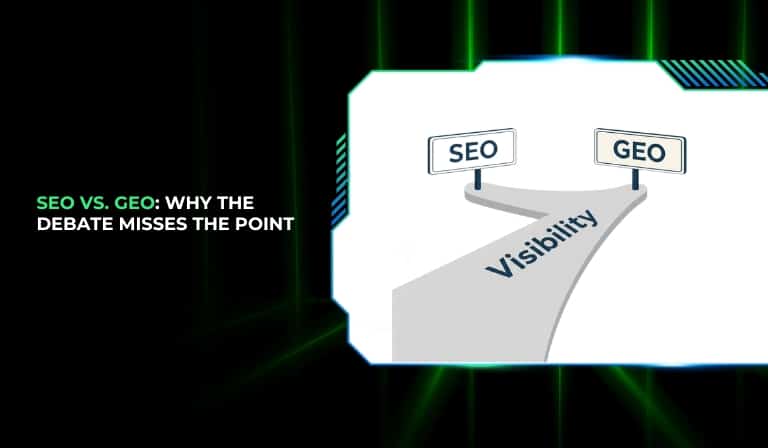
The debate around SEO versus GEO has gained attention because discovery itself has changed. As AI systems, social platforms, and alternative interfaces influence how people find information, marketers naturally try to name and separate new practices. SEO represents optimization for traditional search engines, while GEO is often described as optimization for generative AI systems. The problem begins when these two ideas are treated as opposing strategies.

Framing the discussion as SEO versus GEO assumes that discovery happens in isolated environments. In reality, modern discovery is interconnected. Search engines, AI assistants, social platforms, and content aggregators draw from overlapping data sources and reinforce each other. A brand does not exist separately in “SEO space” and “GEO space.” It exists as a set of signals that different systems interpret in different ways.
The debate distracts teams because it shifts attention away from outcomes and toward labels. Instead of asking whether a brand is visible and understood, teams ask whether they should optimize for one system or another. This leads to fragmented strategies, duplicated efforts, and confusion about success metrics. The real challenge is not choosing a side, but understanding how visibility works across all discovery systems and how to measure it consistently.
The Fragmentation of Visibility
Visibility Fragmentation Anxiety
Visibility fragmentation anxiety describes the unease many teams feel as traditional indicators of success become less reliable. Rankings may remain stable, content may still be indexed, and impressions may still appear, yet traffic and engagement patterns change. AI-generated answers reduce clicks, social platforms surface content independently of search, and users often get what they need without visiting a website.
This anxiety is not caused by a lack of visibility, but by a lack of clarity. When teams cannot clearly see where and how their brand appears, they assume visibility has been lost. This perception leads to reactive behavior rather than strategic thinking.
- Concern that declining clicks mean declining relevance
- Pressure to immediately adapt to every new discovery surface
- Misinterpretation of visibility loss when it is actually visibility redistribution
Alternative Information Discovery Paths
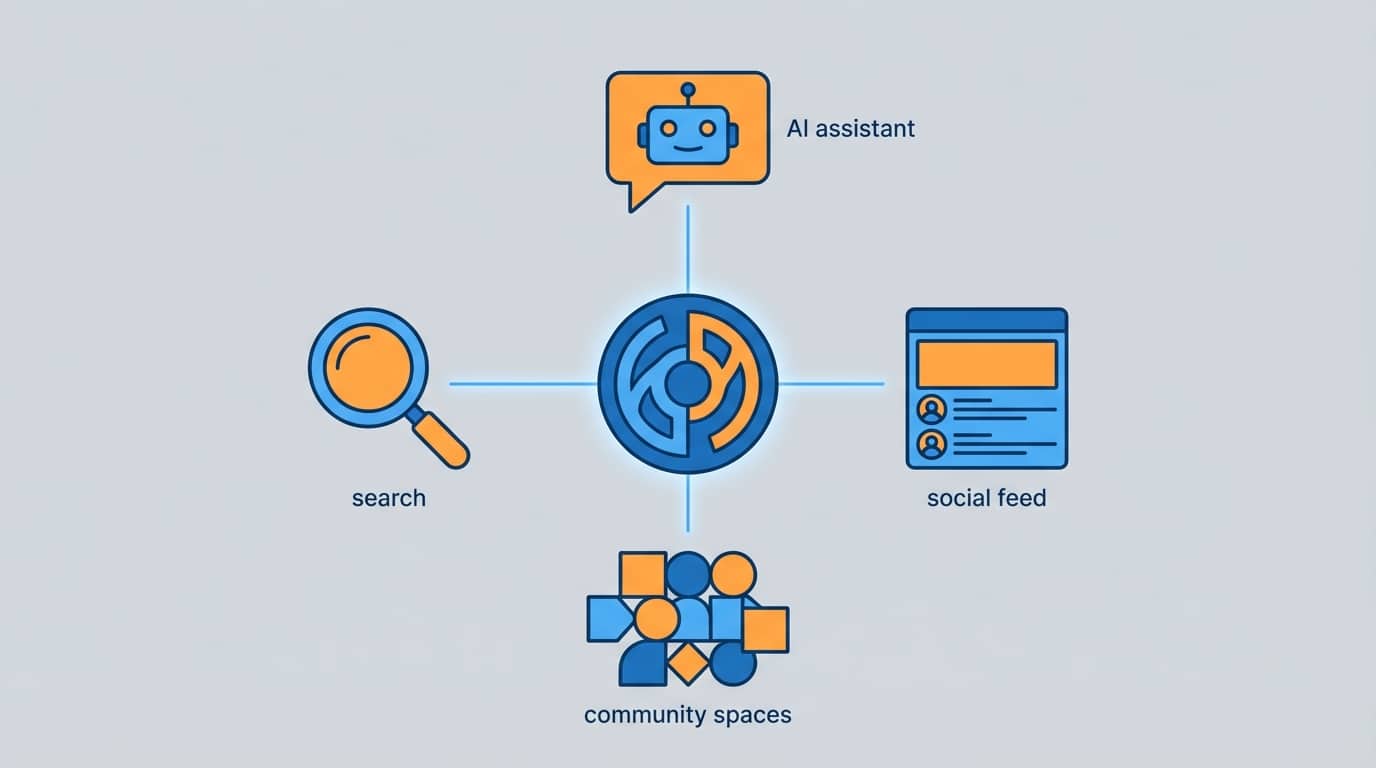
Discovery no longer follows a linear path from query to result to website. Users move between platforms seamlessly. A question might be answered by an AI assistant, reinforced by a social post, and validated through a community discussion before a brand website is ever visited.
These alternative paths are not replacements for search. They are parallel systems that draw from similar content ecosystems. Search engines still crawl, index, and rank content, but that content is now reused, summarized, and contextualized elsewhere.
- AI systems summarize information from indexed content
- Social platforms surface content based on relevance and engagement
- Communities and discussions shape perception before direct interaction
Cross-Surface Visibility
Cross-surface visibility refers to a brand’s presence across multiple discovery environments rather than dominance in a single one. Visibility today is not about ranking first in one place, but about appearing consistently wherever users seek understanding.
A brand that appears in search results, AI-generated answers, and social discussions reinforces its legitimacy. Each appearance strengthens the others. Visibility becomes cumulative rather than competitive.
- Multiple touchpoints reinforce recognition
- Consistency across platforms builds trust
- Visibility compounds over time rather than resetting per channel
How Discovery and Visibility Have Changed
Entities Over Keywords
Traditional SEO focused heavily on keywords because early search systems relied on text matching. Modern systems, including Google, focus on entities. An entity represents a real-world concept with attributes and relationships. This shift allows systems to understand meaning rather than just matching words.
When a system understands an entity, it can connect related information across contexts. A brand that is clearly defined as an entity benefits from this understanding across search and generative systems.
- Entities clarify meaning beyond phrasing
- Relationships between entities create stronger context
- Clear entity signals improve consistency across platforms
Context Over Queries
User behavior has shifted from precise keyword searches to conversational and exploratory interactions. Systems now interpret context using language patterns, prior interactions, and topical relationships. This means content must explain concepts fully rather than optimizing for narrow queries.
Contextual understanding allows systems to answer broader questions and connect information across sources. Content that lacks depth or clarity struggles in this environment because it cannot support contextual inference.
- Context enables broader relevance
- Systems infer intent beyond literal words
- Comprehensive explanations improve discoverability
Answers Over Listings
Many users now receive direct answers instead of lists of links. Generative systems synthesize information into responses that address the user’s intent immediately. This changes the role of content from destination to source.
Even when users do not click, content can still influence understanding. Visibility is no longer defined solely by visits, but by inclusion in answers and summaries.
- Influence exists without direct traffic
- Attribution may be indirect or absent
- Being referenced still builds authority
Search Appearance vs. Systemic Visibility
Search appearance is a momentary state. Systemic visibility is an ongoing condition. A page might rank temporarily, but systemic visibility depends on repeated presence across contexts and systems.
Systemic visibility reflects how well a brand is understood, remembered, and trusted by discovery systems. It is built through consistent signals rather than isolated wins.
- Rankings fluctuate, visibility compounds
- Repetition strengthens recognition
- Consistency signals reliability
The AI Visibility Measurement Gap
Measurement systems have not evolved at the same pace as discovery systems. Traditional SEO tools track rankings, impressions, clicks, and conversions. Generative systems, including platforms like ChatGPT, often provide limited visibility into how content is used or referenced.
This creates a gap between presence and proof. Brands may influence answers without seeing corresponding metrics. As a result, teams struggle to justify investment and align stakeholders.
- Lack of standardized AI visibility metrics
- Limited insight into citations and references
- Fragmented data across tools
The Case for Unified Visibility Measurement
Unified visibility measurement treats discoverability as a single outcome across systems. Instead of separating SEO and GEO metrics, this approach evaluates how often and how effectively a brand appears wherever users seek information.
This model aligns teams around shared goals. SEO, content, and brand functions contribute to the same visibility outcomes, reducing duplication and conflict.
- Visibility measured across systems, not channels
- Emphasis on presence, frequency, and relevance
- Alignment across marketing and content teams
Tools to Track Visibility in AIs
Emerging tools attempt to track AI mentions, citations, and references. While these tools are still developing, they highlight the need for broader measurement frameworks that combine qualitative and quantitative insights.
- Monitoring AI-generated mentions
- Identifying recurring contexts
- Combining data with human analysis
How SEO vs. GEO Thinking Hurts Teams
When teams treat SEO and GEO as separate disciplines, strategy becomes fragmented. Different teams pursue different metrics, leading to inefficiencies and internal friction.
This separation often increases cost without improving visibility. Teams spend more time optimizing systems than understanding outcomes.
- Conflicting goals and KPIs
- Duplicated content and efforts
- Reduced strategic clarity
Do I Need to Hire a GEO Expert?
The idea that GEO requires entirely new expertise is often overstated. Most organizations already possess the skills needed to adapt. The challenge lies in mindset, not capability.
Teams need to understand how visibility works across systems, not adopt isolated practices.
- Existing skills remain relevant
- Learning systems matters more than labels
- Strategy should guide execution
Conclusion
The SEO versus GEO debate simplifies a complex reality into a false choice. Discovery today is distributed, interconnected, and system-driven. Visibility depends on how clearly a brand is understood and how consistently it appears across environments.
SEO and GEO are not opposing strategies. They are expressions of the same underlying goal: being discoverable and understandable wherever users seek answers. Brands that focus on visibility as a system will adapt naturally as discovery continues to evolve.

Passionate about blogging and focused on elevating brand visibility through strategic SEO and digital marketing. Always tuned in to the latest trends, I’m dedicated to maximizing engagement and delivering measurable ROI in the dynamic world of digital marketing. Let’s connect and unlock new opportunities together!