


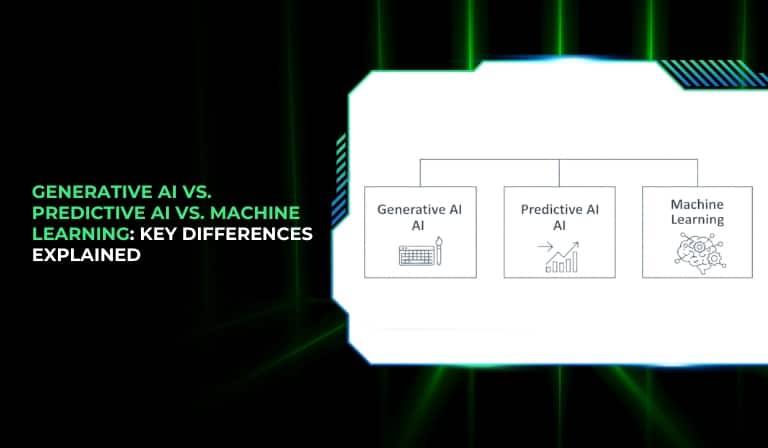
Artificial Intelligence (AI) is transforming how businesses operate, make decisions, and serve customers. However, terms like Generative AI, Predictive AI, and Machine Learning are often used interchangeably, which creates confusion. While they are related, they serve very different purposes.

This blog clearly explains what each of these technologies means, how they work, how they differ, and when to use each one. By the end, you’ll have a clear understanding of their roles, strengths, and limitations.
Understanding the Basics of Artificial Intelligence
Artificial Intelligence refers to computer systems designed to perform tasks that normally require human intelligence. These tasks include learning from data, recognizing patterns, making decisions, and generating content.
Within AI, there are different approaches designed to solve different problems. Machine Learning is a foundational technique. Predictive AI uses Machine Learning to forecast outcomes. Generative AI focuses on creating new content rather than predicting results. Together, these technologies form the core of modern AI systems.
What Is Machine Learning?
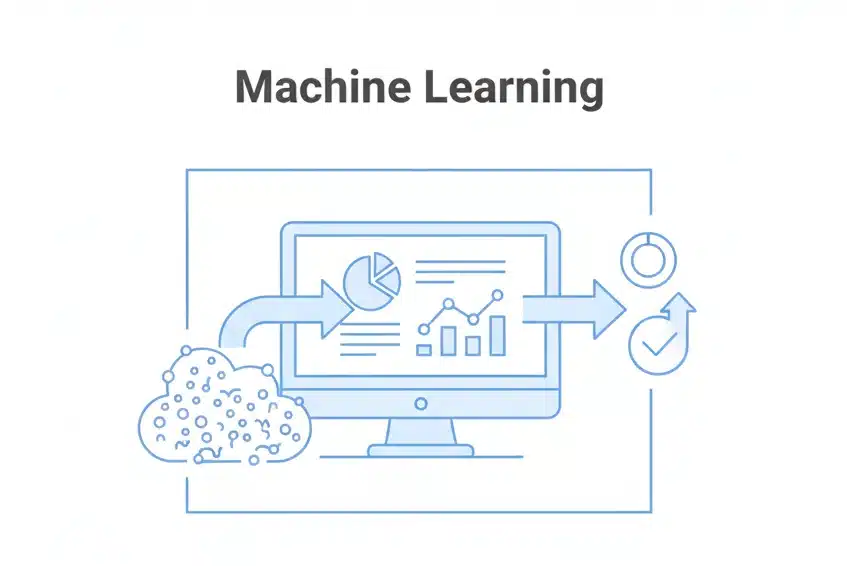
Machine Learning is a method of teaching computers to learn from data without being explicitly programmed for every task. Instead of following fixed rules, Machine Learning systems identify patterns in data and improve their performance over time.
Machine Learning works by analyzing large datasets, learning relationships within the data, and applying that learning to new situations. It acts as the foundation for many advanced AI applications.
Types of Machine Learning
- Supervised learning, where models learn from labeled data
- Unsupervised learning, where models identify patterns in unlabeled data
- Reinforcement learning, where models learn through trial and error
Common Machine Learning applications
- Fraud detection
- Image and speech recognition
- Recommendation systems
- Spam filtering
What Is Predictive AI?
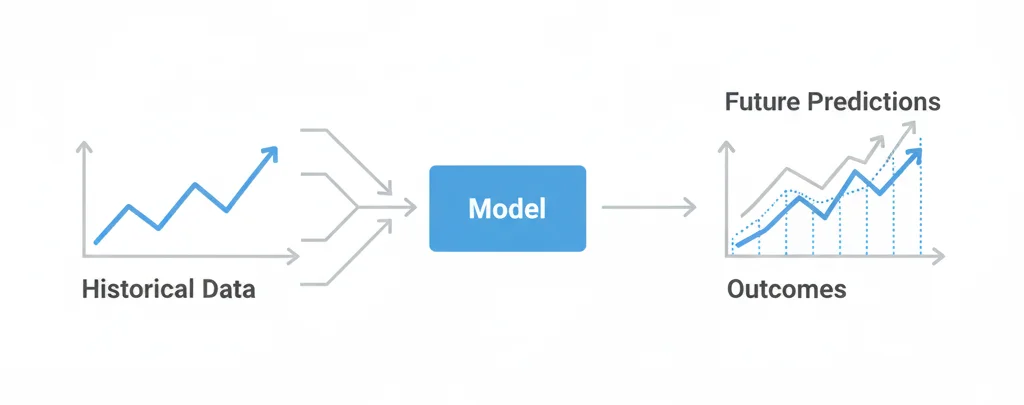
Predictive AI focuses on using historical data to forecast future outcomes. It answers questions like what is likely to happen next, when it might happen, or how probable an event is.
Predictive AI relies heavily on Machine Learning models to analyze trends, patterns, and correlations in past data. Its primary goal is accuracy and reliability in forecasting.
Key characteristics of Predictive AI
- Uses structured historical data
- Produces probabilities or forecasts
- Supports decision-making rather than automation
Common Predictive AI use cases
- Sales forecasting
- Customer churn prediction
- Demand planning
- Risk assessment
What Is Generative AI?
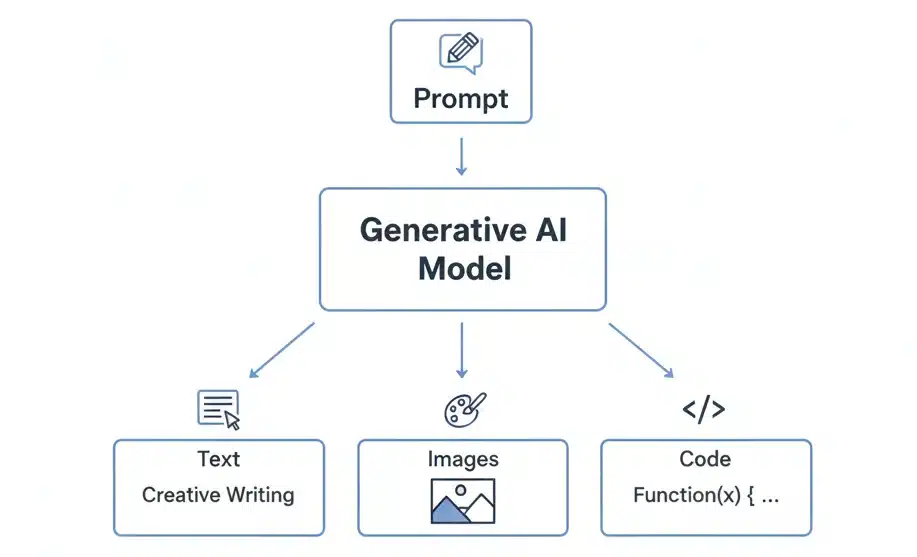
Generative AI is designed to create new content rather than predict outcomes. This content can include text, images, audio, video, or code. Instead of asking what will happen, Generative AI answers what can be created.
Generative AI systems learn patterns from massive datasets and use those patterns to generate original outputs that resemble human-created content.
Core characteristics of Generative AI
- Produces new and original outputs
- Works with unstructured data like text and images
- Focuses on creativity and automation
Popular Generative AI applications
- Content creation
- Image generation
- Code assistance
- Chat-based systems
How Each AI Type Works
How Machine Learning Works
Machine Learning follows a structured process that focuses on learning from data and improving accuracy.
- Data is collected and prepared
- Algorithms are trained on the data
- Models are tested and refined
- Patterns are applied to new data
How Predictive AI Works
Predictive AI builds on Machine Learning by focusing on forecasting future outcomes.
- Historical data is analyzed
- Patterns and trends are identified
- Models generate probability-based predictions
- Results support strategic decisions
How Generative AI Works
Generative AI learns how content is structured and then creates new outputs based on that learning.
- Large datasets are used for training
- Models learn relationships and context
- New content is generated based on prompts
- Outputs improve with additional training
Key Differences Between Generative AI, Predictive AI, and Machine Learning
While these technologies are connected, their goals and outputs differ significantly.
- Purpose: creation, prediction, or pattern recognition
- Type of input data used
- Type of output produced
- Learning and training approach
- Creativity versus accuracy
- Level of explainability
Generative AI vs. Predictive AI
Generative AI and Predictive AI serve very different business needs. One focuses on creation, while the other focuses on forecasting.
- Generative AI produces new content
- Predictive AI forecasts future outcomes
- Generative AI emphasizes creativity
- Predictive AI emphasizes accuracy and reliability
Predictive AI vs. Machine Learning
Predictive AI is a specialized application of Machine Learning. While Machine Learning is a broad technique, Predictive AI is focused specifically on forecasting.
- Machine Learning provides the foundation
- Predictive AI applies ML to prediction problems
- Machine Learning supports many use cases
- Predictive AI supports decision-making
Generative AI vs. Machine Learning
Generative AI and Machine Learning differ mainly in their outputs and goals.
- Generative AI creates content
- Machine Learning identifies patterns
- Generative AI handles unstructured data
- Machine Learning works with structured and unstructured data
Comparison Table: Generative AI vs. Predictive AI vs. Machine Learning
| Criteria | Generative AI | Predictive AI | Machine Learning |
| Primary Purpose | Creates new and original content | Predicts future outcomes based on past data | Learns patterns from data to make decisions |
| Main Focus | Creativity and content generation | Forecasting and probability estimation | Pattern recognition and learning |
| Type of Output | Text, images, audio, video, code | Predictions, scores, probabilities | Classifications, predictions, recommendations |
| Data Type Used | Mostly unstructured data | Mostly structured historical data | Structured and unstructured data |
| Core Technique | Deep learning and generative models | Machine Learning–based predictive models | Algorithms that learn from data |
| Creativity Level | High | Low | Low to moderate |
| Accuracy Requirement | Flexible, context-based | Very high and measurable | High, depending on use case |
| Explainability | Often limited | Moderate to high | Varies by model |
| Human Involvement | Prompting, review, validation | Model tuning and result interpretation | Training, monitoring, and optimization |
| Typical Business Use Cases | Content creation, design, coding | Forecasting, risk analysis, planning | Fraud detection, recommendations, automation |
| Dependency Relationship | Uses Machine Learning techniques | Built on Machine Learning | Foundational AI approach |
| Best Used When | You need ideas or content | You need future insights | You need data-driven decisions |
Advantages and Limitations of Each AI Type
Advantages of Generative AI
Generative AI offers strong creative and automation benefits.
- Enables rapid content creation
- Supports brainstorming and ideation
- Automates repetitive creative tasks
Limitations of Generative AI
Despite its power, Generative AI has important limitations.
- Can generate inaccurate or misleading content
- Depends heavily on training data quality
- Raises ethical and security concerns
Advantages of Predictive AI
Predictive AI excels at forecasting and planning.
- Improves decision-making
- Helps anticipate future trends
- Reduces uncertainty in planning
Limitations of Predictive AI
Predictive AI is not perfect and has clear constraints.
- Relies on historical data
- Cannot guarantee exact outcomes
- Requires large datasets
Advantages of Machine Learning
Machine Learning is versatile and widely applicable.
- Works across industries
- Adapts to new data
- Powers many AI systems
Limitations of Machine Learning
Machine Learning also presents challenges.
- Requires clean, high-quality data
- Can be complex to implement
- Needs ongoing monitoring
Can Generative AI Be Used for Prediction?
Generative AI can support predictive tasks by generating scenarios or simulations, but it is not designed for precise forecasting.
- Generative AI focuses on possibilities
- Predictive AI focuses on probabilities
- Predictive AI remains better for forecasts
Business Use Cases: Which AI Is Best for You?
Choosing the right AI depends on the problem you want to solve.
- Generative AI for content and creativity
- Predictive AI for forecasting and planning
- Machine Learning for pattern recognition and automation
How to Choose the Right AI Approach
Selecting the right AI solution requires careful evaluation.
- Define your business goals
- Understand your data availability
- Assess technical expertise
- Consider budget and scalability
Career Opportunities in Generative AI, Predictive AI, and Machine Learning
Each AI field offers strong career potential.
- Generative AI roles focus on content and automation
- Predictive AI roles focus on analytics and forecasting
- Machine Learning roles focus on model development and optimization
Conclusion
Generative AI, Predictive AI, and Machine Learning are closely related but serve different purposes. Machine Learning provides the foundation, Predictive AI focuses on forecasting outcomes, and Generative AI specializes in content creation. Understanding these differences helps businesses and professionals choose the right technology for their needs and build more effective AI strategies.
Frequently Asked Questions (FAQs)
1. What is the main difference between Generative AI, Predictive AI, and Machine Learning?
The main difference lies in their purpose. Machine Learning focuses on learning patterns from data, Predictive AI uses those patterns to forecast future outcomes, and Generative AI creates new content such as text, images, or code.
2. Is Generative AI a type of Machine Learning?
Yes, Generative AI uses Machine Learning techniques, especially deep learning models, to learn patterns from large datasets and generate new outputs. It is built on top of Machine Learning rather than replacing it.
3. Can Predictive AI work without Machine Learning?
In modern systems, Predictive AI typically relies on Machine Learning models to analyze historical data and make forecasts. Machine Learning provides the learning capability that Predictive AI depends on.
4. Which is better for businesses: Generative AI or Predictive AI?
Neither is universally better. Generative AI is best for content creation and automation, while Predictive AI is better for forecasting, planning, and decision-making. The right choice depends on the business goal.
5. Does Generative AI predict future outcomes?
Generative AI does not focus on precise forecasting. It generates content or possible scenarios, while Predictive AI is specifically designed to estimate future outcomes using historical data.
6. Why is Predictive AI considered more accurate than Generative AI?
Predictive AI is designed to optimize accuracy and reliability in forecasts. Generative AI prioritizes creativity and flexibility, which can sometimes result in less precise outputs.
7. What type of data does each AI model use?
Machine Learning can use both structured and unstructured data. Predictive AI mainly relies on structured historical data, while Generative AI commonly works with unstructured data like text, images, and audio.
8. Can a single system use Generative AI, Predictive AI, and Machine Learning together?
Yes, many modern AI systems combine all three. Machine Learning forms the foundation, Predictive AI supports forecasting, and Generative AI enhances content creation and automation.

Passionate about blogging and focused on elevating brand visibility through strategic SEO and digital marketing. Always tuned in to the latest trends, I’m dedicated to maximizing engagement and delivering measurable ROI in the dynamic world of digital marketing. Let’s connect and unlock new opportunities together!