

Traditional marketing funnels are built to move users from awareness to conversion, but once a user converts, the process often ends. This approach limits long-term growth because it constantly depends on new spending to acquire new users. As competition increases and acquisition costs rise, businesses need a more sustainable way to grow.
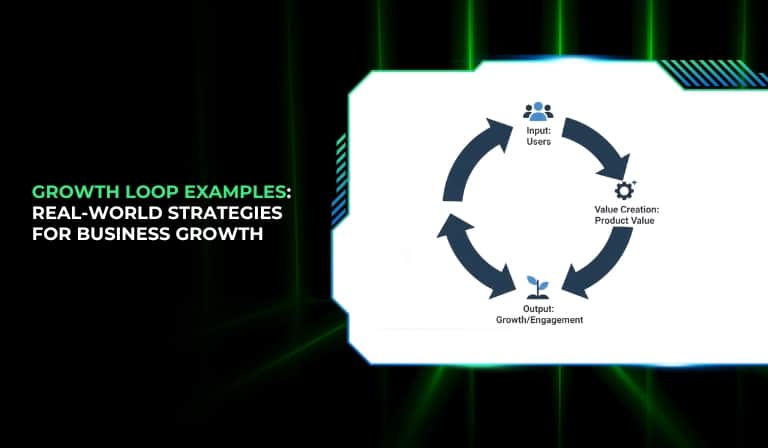
This is where growth loops come in. Growth loops are designed to create continuous and compounding growth by turning outputs—such as users, content, or data—back into inputs that fuel further growth. Instead of stopping at conversion, growth loops keep the system moving.
In this blog, you’ll learn what growth loops are, how they differ from funnels, why they matter for business growth, and six real-world growth loop examples that show how successful companies use them in practice.
What Is a Growth Loop?
A growth loop is a system where a user action creates value that feeds back into the product or marketing engine, driving future growth without restarting the process from scratch. Unlike one-time campaigns, growth loops are ongoing by design.
At a basic level, growth loops work because every completed cycle strengthens the next one. Each time the loop runs, it improves reach, engagement, or retention, leading to compounding results over time.
A growth loop typically consists of:
- An input that starts the loop, such as a user action or piece of content
- A value-creating step that benefits both the user and the business
- An output that naturally brings in more users, engagement, or data
Growth Loops vs Traditional Funnels
Traditional funnels are linear. They move users step-by-step until a conversion happens, after which the funnel effectively ends. Growth loops, on the other hand, are circular and self-reinforcing.
The key difference is what happens after conversion. Funnels stop, while loops continue to generate momentum.
Key differences include:
- Funnels focus on short-term acquisition, while loops focus on long-term compounding growth
- Funnels rely heavily on paid channels, while loops reduce dependency on continuous spending
- Funnels optimize individual steps, while loops optimize the entire system
Why Growth Loops Matter for Business Growth
Growth loops matter because they align growth with real user value. When users gain value from the product, they naturally contribute to growth through referrals, content creation, data generation, or invitations.
For businesses, growth loops lead to more resilient growth models. Instead of chasing constant acquisition, teams can focus on improving the loop’s efficiency and speed.
Growth loops are important because they:
- Create sustainable growth that compounds over time
- Reduce customer acquisition costs in the long run
- Improve retention by tying growth to product value
- Align marketing, product, and user behavior around a single system
Types of Growth Loops (Foundation for Examples)
Growth loops come in different forms depending on the business model and user behavior. While the structure remains the same, the trigger and output vary across loop types.
Common types of growth loops include:
- Referral growth loops that rely on users inviting others
- User-generated content (UGC) loops driven by content creation
- Viral growth loops powered by built-in sharing and distribution
- Product usage loops where usage exposes new users to the product
- Marketplace loops that balance supply and demand
- Community-led growth loops driven by shared knowledge and collaboration
These loop types form the foundation for the real-world examples discussed next.
6 Real-World Growth Loop Examples
1. Referral Growth Loop – Dropbox
Referral loops work when users are rewarded for inviting others, creating a natural incentive to share the product. The value exchange must benefit both the inviter and the new user.
In Dropbox’s case, additional storage space directly increased product value, making referrals useful rather than promotional.
How the Loop Works
- A user signs up and starts using the product
- The user invites others to gain extra storage
- New users join and experience the same incentive
- Increased usage leads to more invitations
2. User-Generated Content Loop – Instagram
User-generated content loops depend on users creating content that attracts new users. The content itself becomes the distribution channel.
As more users create posts, the platform becomes more valuable, encouraging even more participation and discovery.
How the Loop Works
- Users create and publish content
- Content is shared and discovered by others
- New users join the platform
- More users create more content
3. Viral Growth Loop – TikTok
Viral loops are built directly into the product experience. Content is designed to be easily shareable and discoverable, often with algorithmic distribution.
TikTok’s growth loop is powered by rapid content consumption and personalized recommendations that expose users to creators instantly.
How the Loop Works
- Users upload short-form videos
- The algorithm distributes content widely
- New users engage and create content
- Increased content improves discovery
4. Product Usage Loop – Zoom
Product usage loops occur when using the product naturally introduces it to new users. Invitations are not marketing actions but necessary steps to use the product.
Zoom meetings expose non-users to the platform, turning product usage into acquisition.
How the Loop Works
- A user hosts a meeting
- Participants receive meeting invitations
- New users experience the product
- More users host meetings
5. Marketplace Growth Loop – Airbnb
Marketplace loops rely on balancing supply and demand. More supply attracts more demand, and increased demand encourages more supply.
Reviews and trust mechanisms strengthen the loop by reducing friction for both sides.
How the Loop Works
- Hosts list properties
- Guests book stays
- Reviews build trust
- More hosts and guests join
6. Community-Led Growth Loop – Notion
Community-led loops grow through shared resources, templates, and workflows. Users help onboard other users by sharing how they use the product.
This reduces onboarding friction and increases adoption through peer validation.
How the Loop Works
- Users create and share templates
- Community content attracts new users
- New users adopt and customize workflows
- More resources are shared
How to Choose the Right Growth Loop for Your Business
Not every growth loop works for every business. The right loop depends on how users receive value and how growth naturally fits into their behavior.
To choose the right growth loop:
- Align the loop with your core product value
- Consider whether your model is B2B or B2C
- Decide if growth is product-led or marketing-led
The most effective loops feel like a natural extension of the product, not an added marketing tactic.
How to Build Your Own Growth Loop
Building a growth loop starts with understanding the moment when users experience the most value. That moment should trigger the loop.
A practical framework includes:
- Identifying the core value moment
- Defining what starts the loop and what it produces
- Reducing friction at each step
- Reinforcing actions through visibility or incentives
Key Metrics to Track Growth Loop Performance
Growth loops must be measured as systems, not isolated actions. Tracking the right metrics helps identify where the loop slows down.
Important metrics include:
- Loop cycle time
- Input-to-output conversion rate
- Retention and engagement levels
- Signs of compounding growth over time
Common Mistakes Businesses Make with Growth Loops
Many businesses fail with growth loops because they treat them like short-term campaigns rather than long-term systems.
Common mistakes include:
- Over-focusing on acquisition and ignoring retention
- Adding complexity instead of removing friction
- Building loops without clear user value
- Failing to measure loop efficiency
Conclusion
Growth loops offer a sustainable alternative to traditional funnels by turning user value into continuous growth. Instead of restarting the process after every conversion, growth loops build momentum with every cycle.
By studying real-world growth loop examples and applying the right loop to your business model, you can create systems that grow stronger over time. The key is to start simple, focus on user value, and continuously optimize how the loop operates.
Frequently Asked Questions (FAQs)
1. What is a growth loop in simple terms?
A growth loop is a system where a user action creates value that brings in more users or engagement, which then repeats the cycle. Instead of ending after conversion, the process continues and strengthens over time.
2. How are growth loops different from marketing funnels?
Marketing funnels are linear and stop once a user converts. Growth loops are circular and continue after conversion by using outputs (users, content, data) as inputs for future growth.
3. Are growth loops only for startups?
No. Growth loops can be used by startups, mid-sized companies, and large enterprises. Any business that can connect user value with acquisition, retention, or engagement can build a growth loop.
4. Can a business have more than one growth loop?
Yes. Many businesses operate multiple growth loops at the same time, such as a referral loop combined with a content or product usage loop. However, each loop should be optimized individually.
5. Which growth loop is best for B2B businesses?
B2B businesses often benefit from:
- Product usage loops (invitations, collaboration)
- Community-led growth loops
- Referral loops within teams or organizations
The best loop depends on how users interact with the product.
6. Do growth loops reduce customer acquisition costs?
Over time, yes. Because growth loops reuse existing value and user actions to drive growth, they reduce reliance on constant paid acquisition once the loop is working efficiently.
7. How long does it take for a growth loop to show results?
Growth loops usually take longer than campaigns to show results, but their impact compounds over time. Early progress may be slow, but long-term returns are more sustainable.
8. What is the most important metric for a growth loop?
There is no single metric, but key indicators include:
- Loop cycle time
- Input-to-output conversion rate
- Retention and engagement levels
These metrics show whether the loop is strengthening or slowing down.